Quotulatiousness

August 4, 2019

A sure-fire way to reduce monarchist sentiments – Royal celebrity slacktivism

Filed under: Britain, Cancon, Media — Tags: , , , , , — Nicholas @ 03:00

Chris Selley offers some friendly advice to His Royal Highness the Duke of Sussex:

Prince Harry and Meghan Markle visit Titanic Belfast in March 2018.
Photo from the Northern Ireland Office via Wikimedia Commons.

Despite what some scandalized British headlines have suggested, Prince Harry, Duke of Sussex, has not claimed to be helping to save the world from climate change by only planning to get his 37-year-old wife pregnant one more time. “Two, maximum!” he tells primatologist Jane Goodall in an interview-cum-rambling discussion in the current edition of British Vogue, which was guest-edited by Meghan, Duchess of Sussex. It was in the context of some store-bought Harry musings about the perils facing planet Earth and its future inhabitants — “this place is borrowed,” etc. — but it was presented more as a half-joke than as an earnest plan to help out the biosphere.

Good thing, too, because not long after those headlines landed we learned Harry was off to Sicily for a massive Google-sponsored climate change celebrity gabfest. Needless to say, he didn’t row there. Italian media reported more than 100 private jets and several superyachts had delivered the actors, singers, supermodels and tech magnates. All reportedly had to sign non-disclosure agreements about what went on, which is a brilliant new innovation in climate-change slacktivism: “Our climate change discussions were not only important enough to justify heroic eruptions of carbon dioxide, but so important that we can’t tell you anything about them.”

Some think it’s petty to criticize climate activists for their own emissions. I was recently taken to task by myriad correspondents, many of whom were not Liberal partisans, for suggesting that a family long weekend surfing on Vancouver Island was a strange look for a prime minister trying to sell Canadians on a carbon tax with the very future of the planet, he argues, hanging in the balance. Honestly it baffles me. Is the idea that celebrity advocacy for decarbonized lifestyles will inspire so many other people to adopt them that we should forgive the celebrities’ own excesses? If people actually take their environmental cues from the likes of Leonardo DiCaprio, Harry Styles, Naomi Campbell and Orlando Bloom — all were reportedly in Sicily — then surely they would be far more inspired if the celebrities actually made half a personal effort.

But there will always be films, and they will always need actors, and there will always be pop music, and it will always need singers, and fame being what it is, a lot of the actors and singers will always end up being insufferable flakes. The monarchy Harry’s dad and brother are front of the line to lead isn’t nearly so immutable. No other Western royal family has managed to maintain such a conspicuously opulent lifestyle while maintaining head-of-state status and widespread affection not just on its home soil — where class remains a dominant social divider — but in many very different realms all over the world.

Whatever you think of the Royals, it’s quite an accomplishment. And a significant part of the recipe has been eschewing intellectualism and the unfortunate flights of fancy that can come with it. Prince Charles will be Britain’s (and Canada’s) first university-graduate monarch. In contrast, by some accounts, 10-year-old Elizabeth Windsor was home-schooled to the tune of just seven-and-a-half hours a week. As Ben Pimlott explains in his landmark biography of her, the goal was first and foremost to prevent her emerging as a “blue stocking” — i.e., as a female intellectual.


July 31, 2019

Federal NDP and Greens duel on climate platforms

Filed under: Cancon, Economics, Environment, Politics — Tags: , , , , — Nicholas @ 03:00

Colby Cosh looks at the two most environmentally conscious federal parties’ climate change stances as we head into the next general election:

Federal NDP leader Jagmeet Singh taking part in a Pride Parade in June 2017 (during the leadership campaign).
Photo via Wikimedia.

So why are our most radical, eco-aware parties so easily distracted on this front? Jagmeet Singh’s New Democrats talk tough on climate change in their “Power to Change” plan. It is maximum urgency right out of the gate in the preamble. “People across Canada are worried about the future.” True enough! They usually are! “Flooding and forest fires are threatening our homes.” Well, speak for yourself, but OK. “Polluted air and water are hitting communities hard.” Wait, polluted water…? Wasn’t this supposed to be a climate change thing? “And rising temperatures are threatening our farming and forestry industries.” Oh, good, back on track! “It’s clear there’s no time to waste.”

There is a whole load of radical measures in the NDP program, but they cannot resist this tendency to drag in grace notes of economic nationalism and other subjects at best vaguely related. They promise to “make it easier to own a zero-emission vehicle” in Canada, which might help with the Big Problem, but in mid-sentence they remember that they’re in hock to organized labour and add “and make sure those cars are made in Canada.” This means that if the price of a Tesla comes down to $500 tomorrow, you’ll still have to buy the carbon-neutral modern equivalent of a Bricklin, assuming someone can be found to try building one. Shouldn’t we be willing to buy zero-emission vehicles from Zanzibar or Antarctica if that’s the most efficient way, or the only way, to upgrade the fleet?

The document also smuggles in a promise to eliminate single-use plastic products, which take carbon from the bowels of Mother Earth and… restore it thither in landfills, with the evil molecules usefully imprisoned in polymer chains. We’ll be replacing all that plastic, presumably, with metal cutlery (from mines) and cloth bags (from forests) that have to be washed in hot water if you happen to be particular. There is no hint that this is an incongruous or irrelevant part of a climate-change plan.

So, perhaps a bit of mixed messaging there, as the NDP have to trim their sails in odd ways to keep some of their constituencies in line. How about the Green Party then?

Green Party of Canada leader Elizabeth May with Green candidate Christ Tindal in 2008.
Photo by Shaun Merritt via Wikimedia Commons.

The Green list of climate-change policies is much more radical and earnest in appearance; Elizabeth May’s political liquidators intend to abolish internal-combustion vehicles by 2040 (such dates are no longer sci-fi, oldies) and retrofit every single building in the country for carbon neutrality by 2030.

But what, as the University of Alberta energy economist Andrew Leach asked in a CBC editorial on Monday, is this about “ending all imports of foreign oil”? This autarkic flake out flies in the face of the Greens’ entire approach; some of the oil we produce here is (please imagine me whispering this part) somewhat carbon-intensive relative to the stuff Eastern Canada takes from elsewhere in the world. Moreover, increasing use of domestic oil even in the short term implies a pretty major program of, uh, pipeline-building.

Not to mention the new refineries. The Green Climate Change War Cabinet (a real thing they want) would permit “investment in upgraders to turn Canadian solid bitumen into gas, diesel, propane and other products for the Canadian market, providing jobs in Alberta.” By 2050, they envision shifting “all Canadian bitumen from fuel to feedstock for the petrochemical industry.” This adds up to an awful lot of subsidized high-tech construction — executed at the same time as a total retrofit of the national housing stock! — that has nothing much to do with reducing emissions per se. Although it sounds as though the Greens are, if nothing else, definitely much bigger fans of plastic than the New Democrats.

July 25, 2019

QotD: Ice ages as evolutionary drivers

Filed under: Environment, History, Pacific, Quotations, Science — Tags: , — Nicholas @ 01:00

The widths of the Pacific continued unaltered for millions of years. Temperatures scarcely dropped there in the Ice Ages. Generation after generation of Pacific birds were able to evolve in an almost completely stable world. Birds which somehow or other had arrived on remote islands branched into different species. In the Atlantic, there was hardly time to do that between the Ice Ages […] in the Atlantic endemics — species confined to particular places — only rarely evolved.

What you see when the puffins arrive in the spring is a product of this history. The Atlantic, for the past 2.74 million years has been a place of coming and going, unsettled at the deepest of levels, a system always ready to flip from relatively beneficent to deeply unaccommodating. Life does not have the time here to develop the mass of differentiated variety it has within the security of the Pacific.

[…]

The result is that now in the North Atlantic there is relatively little local variation. Species have evolved to cope with the variability and have wide ranges across the latitudes. The Pacific is a mosaic of local land-based varieties; the Atlantic the exclusive realm of the ocean travellers, birds which have distance embedded in their way of being.

Adam Nicholson, The Seabird’s Cry: The Lives and Loves of Puffins, Gannets and Other Ocean Voyagers, 2017.

June 28, 2019

What does £1 trillion buy you?

Not much, apparently:

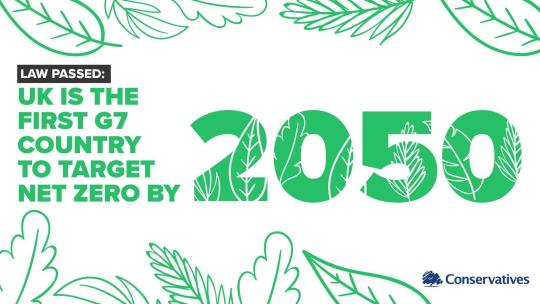
Tory MPs have been told by CCHQ to share this graphic boasting about their new commitment to make the UK carbon-neutral by 2050. No other major country has committed to the pledge although Theresa May is planning a desperate attempt at the G20 to talk other leaders into it. The fact that developed countries going ‘net zero’ simply means they’ll outsource all their emissions to the developing world instead seems to be completely lost on her…

The pledge will cost the UK at least £1 trillion, much of which will be borne by individuals and businesses rather than the exchequer, we don’t know the true cost as May hasn’t even done a proper Treasury analysis. Eco-fanatics love to talk about the burden this generation is placing on children and grandchildren. For a fleeting PR stunt Tory MPs are being told to boast about piling on mountains of economic harm for future generations by a leader who won’t be in office to deal with the consequences…

This is exactly the sort of virtue signalling that Justin Trudeau indulges in … I imagine he’s quite miffed that Theresa May got there first.

May 27, 2019

QotD: The Green death cult

In keeping with all millenarian movements, the extinction-obsessed green cult reserves its priestly fury for ordinary people. Even when it is putting pressure on the government, it is really asking it to punish us. It wants tighter controls on car-driving, restrictions on flying, green taxes on meat. That these things would severely hit the pockets of ordinary people – but not the deep pockets of Emma Thompson and the double-barrelled eco-snobs who run Extinction Rebellion – is immaterial to the angry bourgeoisie. So convinced are they of their own goodness, and of our wickedness, that they think it is utterly acceptable for officialdom to make our lives harder in order to strongarm us into being more “green”. People complaining about Extinction Rebellion disrupting people’s lives in London over the past few days are missing the point – the entire point of the green movement is to disrupt ordinary people’s lives, and even to immiserate them. All in the jumped-up name of “saving the planet”.

And now the green cult has pushed Ms [Greta] Thunberg into the position of its global leader, its child-like saviour, the messiah of their miserabilist political creed. What they have done to Ms Thunberg is unforgivable. They have pumped her – and millions of other children – with the politics of fear. They have convinced the next generation that the planet is on the cusp of doom. They have injected dread into the youth. “I want you to panic”, said Ms Thunberg at Davos, and the billionaires and celebs and marauding NGOs that were in attendance all lapped it up. Because adult society loves nothing more than having its own fear and confusions obediently parroted back to it by teenagers. They celebrate Thunberg because she tells them how horrible they are: it is an entirely S&M relationship, speaking to the deep self-loathing of the 21st-century elites.

Brendan O’Neill, “The cult of Greta Thunberg: This young woman sounds increasingly like a millenarian weirdo”, Spiked, 2019-04-22.

May 22, 2019

Climate change, no, climate crisis, no, climate catastrophe, no, we mean climate APOCALYPSE!!!

Filed under: Cancon, Economics, Environment, Politics — Tags: , , , — Nicholas @ 03:00

The official marching orders for journalists now insist that the language to use around what was formerly “global warming” or “climate change” will now be described in starker, more frightening terms. Canada’s Liberal Party, under Justin Trudeau, has been virtue signalling for pretty much its entire term in office on the climate issue and with a fall election coming into view, the rhetoric will become more extreme and shrill. Jay Currie discusses climate change and the Canadian election:

I suspect this divide between people who think “doing something” about climate change (no matter how futile) and people who do not accept the urgency of dealing with something they really don’t believe in will inform politics in the West for the next few years. Most particularly, it will inform the next Canadian federal election.

The Liberal Party of Canada has been going all in on its “tax on carbon pollution” (a fine bit of wordsmithing managing to attach “carbon” to “pollution”). Led by the remarkably scolding Catherine McKenna, the Libs seem to think that purporting to “do something” about climate change is a vote winner. So McKenna tours the country speaking to uncritical school children and assorted environmentalists about how important having a “carbon tax” is. The Liberals tax will save the planet, ensure sea level rise stops (easy because sea level is not actually rising), save the Arctic ice cap (already saving itself, thank you), keep polar bears from extinction (also easy because virtually all polar bear populations are growing) and reduce or eliminate climate change “caused” weather events. Plus, Canada will honour its Paris Accord commitments (we won’t) and serve as a beacon to lesser nations like China and India in their efforts to combat climate change (as if).

The Liberals think that the fact that a carbon dioxide tax in Canada will have a rounding error effect on worldwide emissions and no detectable effect on world temperature does not matter politically. What matters politically is that the Liberals believe that there is a large constituency out there which urgently wants to “do something”.

The NDP is fully on board and, of course, the Greens have been banging the climate change drum forever. Andrew Scheer’s Conservatives seem to be on the fence. Like the Coalition in Australia, the Conservatives endorse the “climate change is a problem” line and very few are willing to challenge the underlying science or economics for fear of being branded uncool “climate change deniers”. But the Conservatives seem to be, prudently in my view, dragging their feet on “doing something” about CO2.

Political virtue signalling on the climate file is the easy part. All that is really required is the abandonment of any sort of scientific judgement (easy when you are told that all the scientists agree that climate change is real and primarily human caused) and policy skepticism (we don’t need a cost benefit analysis, this is an emergency!). The hard part occurs when you try to “do something”. Because doing something means that people are going to see their expenses rise without actually seeing (in any tangible way) any actual benefit. In fact, as Ontario’s wonderfully disastrous adventure in wind energy demonstrated, tax dollars can be wasted and consumer prices increased all without making any difference at all to the climate.

April 25, 2019

QotD: “Science”

Filed under: Environment, Politics, Quotations, USA — Tags: , — Nicholas @ 01:00

Ah, science. If you’re even loosely engaged in the wild and dark art that is politics these days, you know by now that “science,” as a word, has taken on an almost mystical meaning. “Science,” in many of its modern incantations, now serves as a form of code, as vague and fuzzy as a Wiccan chant. For a growing number of political activists, the meaning is simple: Science, you see, is a lively mix of standard progressive hobbyhorses, tossed wild-eyed and cranky into one cantankerous bag.

Heather Wilhelm, “The Left’s New Cure-All: ‘Science’”, National Review, 2017-04-12.

April 2, 2019

The not-so-ancient extinction of Madagascar’s megafauna

Filed under: Africa, Environment, History, Science — Tags: , , , , — Nicholas @ 03:00

At The Conversation, Nick Scroxton, Laurie Godfrey, and Stephen Burns discuss their new theory on the megafauna extinction in Madagascar just over a thousand years ago:

Giant 10-foot-tall elephant birds, with eggs eight times larger than an ostrich’s. Sloth lemurs bigger than a panda, weighing in at 350 pounds. A puma-like predator called the giant fosa.

They sound like characters in a child’s fantasy book, but along with dozens of other species, they once really roamed the landscape of Madagascar. Then, after millions of years of evolution in the middle of the Indian Ocean, the populations crashed in just a couple of centuries.

Scientists know that over the past 40,000 years, most of Earth’s megafauna – that is, animals human-size or larger – have gone extinct. Woolly mammoths, sabre tooth tigers and countless others no longer roam the planet.

What’s remarkable about the megafaunal crash in Madagascar is that it occurred not tens of thousands of years ago but just over 1,000 years ago, between A.D. 700 and 1000. And while some small populations survived a while longer, the damage was done in a relatively short amount of time. Why?

Over the last three years, new investigations into climate and land use patterns, human genetic diversity on the island and the dating of hundreds of fossils have fundamentally changed scientists’ understanding of the human and natural history of Madagascar. As two paleoclimatologists and a paleontologist, we brought together this research with new evidence of megafaunal butchery. In doing so we’ve created a new theory of how, why and when these Malagasy megafauna went extinct.

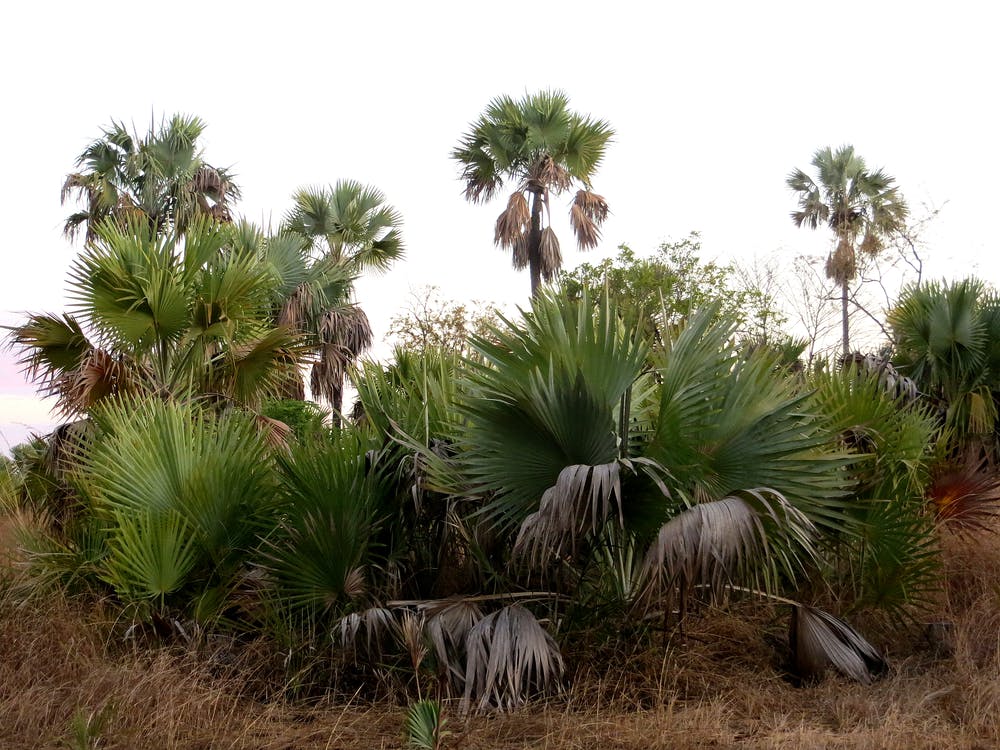
Many of the forests that originally existed on Madagascar are now replaced by more open, human-modified landscapes, like this palm savanna at Anjohibe.
Laurie Godfrey, CC BY-ND

February 23, 2019

How a statistical error became the key argument in the “everyone must turn vegan” movement

Filed under: Economics, Environment, Food, Health, Politics, USA — Tags: , , , — Nicholas @ 05:00

At The Conversation, Frank M. Mitloehner explains how a flawed statistic — comparing numbers derived from non-parallel bases — evolved into one of the most widely quoted arguments for governments forcing people to give up meat in their diet:

As the scale and impacts of climate change become increasingly alarming, meat is a popular target for action. Advocates urge the public to eat less meat to save the environment. Some activists have called for taxing meat to reduce consumption of it.

A key claim underlying these arguments holds that globally, meat production generates more greenhouse gases than the entire transportation sector. However, this claim is demonstrably wrong, as I will show. And its persistence has led to false assumptions about the linkage between meat and climate change.

[…]

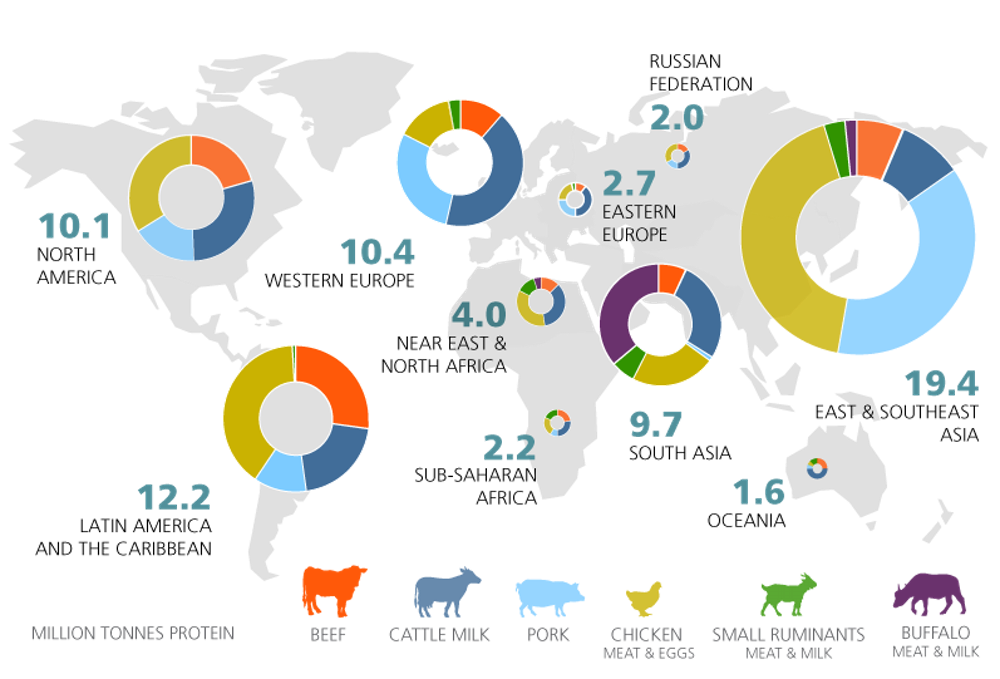
Global livestock production by region (milk and eggs expressed in protein terms).
Source: United Nations Food and Agriculture Organization.

Setting the record straight on meat and greenhouse gases
A healthy portion of meat’s bad rap centers on the assertion that livestock is the largest source of greenhouse gases worldwide. For example, a 2009 analysis published by the Washington, D.C.-based Worldwatch Institute asserted that 51 percent of global GHG emissions come from rearing and processing livestock.

According to the U.S. Environmental Protection Agency, the largest sources of U.S. GHG emissions in 2016 were electricity production (28 percent of total emissions), transportation (28 percent) and industry (22 percent). All of agriculture accounted for a total of 9 percent. All of animal agriculture contributes less than half of this amount, representing 3.9 percent of total U.S. greenhouse gas emissions. That’s very different from claiming livestock represents as much or more than transportation.

Why the misconception? In 2006 the United Nations Food and Agriculture Organization published a study titled “Livestock’s Long Shadow,” which received widespread international attention. It stated that livestock produced a staggering 18 percent of the world’s greenhouse gas emissions. The agency drew a startling conclusion: Livestock was doing more to harm the climate than all modes of transportation combined.

This latter claim was wrong, and has since been corrected by Henning Steinfeld, the report’s senior author. The problem was that FAO analysts used a comprehensive life-cycle assessment to study the climate impact of livestock, but a different method when they analyzed transportation.

For livestock, they considered every factor associated with producing meat. This included emissions from fertilizer production, converting land from forests to pastures, growing feed, and direct emissions from animals (belching and manure) from birth to death.

However, when they looked at transportation’s carbon footprint, they ignored impacts on the climate from manufacturing vehicle materials and parts, assembling vehicles and maintaining roads, bridges and airports. Instead, they only considered the exhaust emitted by finished cars, trucks, trains and planes. As a result, the FAO’s comparison of greenhouse gas emissions from livestock to those from transportation was greatly distorted.

No matter which “global crisis” they cry up, their answer is always “more government”

Filed under: Environment, Government, Media, Politics — Tags: , , , — Nicholas @ 03:00

Alex Noble on the remarkable consistency of the proffered solution to any and all “global” problems:

Climatechangers are really just watermelons – green on the outside but red on the inside. You’ll notice that none of their ideas about how to prevent climate change involve anything other than bigger government.

For them, climate change is just a pretext – an irrefutable argument (“if you disagree that we need to save the planet you must want people to die!”) that enables them to demand more taxes and more power for them and their friends so they can set the world to rights.

And out here in the real world, they have their army of useful innocents – voters fearful of tackling the real world on their own without help from a cosseting State, all too ready to swallow any argument for bigger government.

Climate change largely consists of menacing them with stories about rising water and melting ice and starving polar bears, so they will allow our civil rights to be ridden over to keep us all safe. They demand it, in fact.

As H.L Mencken said, “The whole aim of practical politics is to keep the populace alarmed (and hence clamorous to be led to safety) by menacing it with an endless series of hobgoblins, all of them imaginary”

February 9, 2019

QotD: The global utility of a national carbon tax

Filed under: Economics, Environment, Government, Quotations — Tags: , , , — Nicholas @ 01:00

James Griffin [of] Texas A&M’s Bush School of Government […] is a carbon-tax advocate who begins by acknowledging what everyone knows but hardly anyone says: that, absent subsidies and mandates, renewables and so-called green energy could not begin to compete with oil and coal, and the market would be entirely dominated by fossil fuels.

The carbon tax is one of those policy ideas that is largely sound in theory but runs up hard upon the shoals of reality. I am not convinced that a national carbon tax would change U.S. consumer behavior to such an extent that it would have positive effects on what is after all a global phenomenon, nor am I convinced that the U.S. government would use the revenue from a carbon tax to invest in real climate-change mitigation. That makes the carbon tax a very expensive way of demonstrating good intentions, which does not seem to me like a very fruitful way to work. And compared to more direct programs, such as clearing the way for the development of new, modern, nuclear-power facilities, a carbon tax is even less attractive.

Kevin D. Williamson, “The Case for a Carbon Tax”, National Review, 2017-03-08.

February 6, 2019

The “Green New Deal” of Alexandria Ocasio-Cortez won’t work

Filed under: Economics, Environment, Politics, USA — Tags: , , — Nicholas @ 03:00

Tim Worstall predicts — well in advance of hearing any details of Alexandria Ocasio-Cortez’s Green New Deal — that it won’t work:

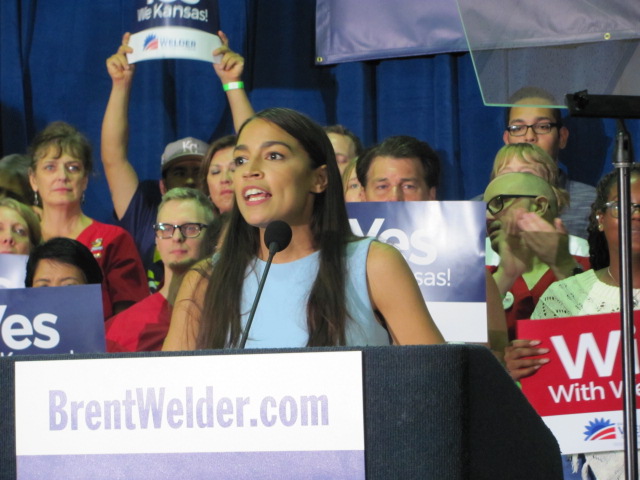
Alexandria Ocasio-Cortez speaking at the Reardon Convention Center in Kansas City, on 20 July 2018.
Photo by Mark Dillman via Wikimedia Commons.

Alexandria Ocasio-Cortez is to reveal the details of her Green New Deal in the next few days – the one thing we absolutely know about this being that it won’t work. This isn’t a commentary upon climate change nor the desirability of doing something about it. This is just a simple statement of fact about the universe we inhabit. As with the climate the economy is a complex, even chaotic, thing. Plans to substantially reform it therefore don’t work, no matter how egghead the planners nor pure in motive the instigators.

All of this being why the very reports which tell us we should do something about climate change – say, the Stern Review – tell us that we shouldn’t try to have those detailed plans for what we’ll do and how we’ll do it. Instead we’ve got to use the only management technique we’ve got for something this complex, markets and prices. Which is why near every economist who has even thought about the problem advocates either cap and trade or a carbon tax.

This is, of course, just a rerun of Friedrich Hayek’s point in his Nobel Lecture, “The Pretence of Knowledge”. That universe out there is a complicated place. There’s just no manner that the planner can gain enough information about it, in anything like real time, to be able to plan it. We’ve thus got to use other methods to bend that reality to our will. We can jam a crowbar into prices with a carbon tax for example, but we can’t start planning who should be taking how many car journeys in what sort of vehicles powered in what manner.

So, the Green New Deal from Alexandria Ocasio-Cortex, it fails at this first and basic hurdle. She’s using the wrong method to try to solve the agreed upon problem. Central planning just doesn’t work.

[…]

The reason we want cheap solutions to climate change is that this justifies producing more of a solution. Again, the justification of doing something about climate change is that it will be expensive. So, we should spend up to the amount of the damage to prevent it. Say it will cost $100, then we’re willing to spend up to $99.99 to stop it. This makes us one cent better off. We’re not willing to spend $200 to stop those $100 damages, that would make us poorer.

And more – we should spend that $99.99 as efficiently as we can because that means we’ll stop more climate change for our dollars. That also makes us richer.

Don’t forget, we’ve all already agreed that we’re going to have some climate change. Our arguments are over how much and how much are we willing to do to stop how much of it?

January 12, 2019

The role of tyche in the fall of the Roman empire

Filed under: Environment, Europe, History — Tags: , , — Nicholas @ 03:00

Williamson Murray posted this review at The Strategy Bridge back in August, but I don’t recall seeing it linked anywhere. He emphasizes the role of tyche both in the small events and the greater flow of history (tyche is a Greek word meaning luck, chance, or random events that change the course of human activity). In his review, he makes it clear that he feels earlier historians have failed to emphasize just how much tyche impacted the Roman world:

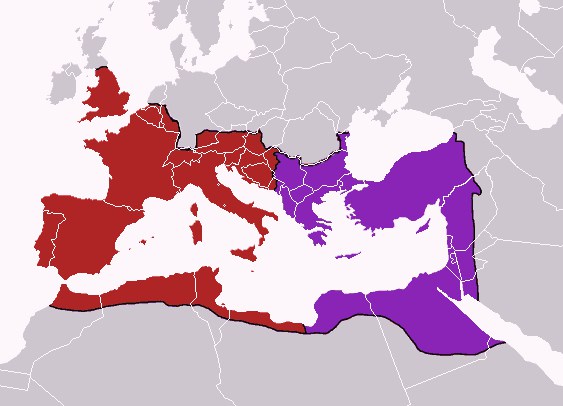
The approximate extent of the Roman empire circa 395AD, when the empire was formally divided into eastern and western zones with joint emperors in Rome and Constantinople.

In The Fate of Rome: Climate, Disease & the End of an Empire, Kyle Harper has presented us with a case study, namely the collapse of the Roman world in the period between the third and sixth centuries CE. Here tyche, in the largest sense, created a perfect storm of disastrous natural events and happenings that brought about the complete collapse of the Western Roman Empire in the fifth century CE, and eventually the ability of the Eastern Roman Empire to control much of the Mediterranean world after the seventh century. These natural events created conditions the Roman world was incapable of understanding, but which nevertheless brought about the collapse of one of the greatest, longest lasting empires in history. What Professor Harper’s book underlines is that the military difficulties that Rome’s generals and soldiers experienced in the period from the third century on were only the surface manifestations of far deeper systemic changes that could not be predicted, but which in combination created a perfect storm. Thus, fate, or more accurately tyche, undermined the best efforts to prevent what turned out to be a disastrous collapse.

The slide to catastrophe began after a period of unparalleled prosperity that had seen the population of Rome grow from approximately 60 million under Emperor Augustus in 33 BC to 75 million in 165 AD. The historian Edward Gibbon would describe the period in the following terms: “If a man were called to fix a period in the history of the world, during which the condition of the human race was most happy and prosperous, he would without hesitation, name” that period. Significantly, archeological and scientific evidence indicates the period from 200 BCE through the mid-point of the second century CE was extraordinarily favorable in terms of its climate for agriculture and the development of an extensive and expansive civilization in the Mediterranean and Western Europe. Combined with the favorable weather was a period of general peace under the empire that, for the most part, removed the generally disastrous role played by war throughout history. Except for one short period of civil wars between the claimants to Nero’s throne (70-71 CE, the year of the three emperors) and the two Jewish rebellions (66-71 CE and 135 CE), Rome fought its wars on the frontiers: the Rhine, the Danube, and Syria.

All that changed in the midst of the rule of the emperor Marcus Aurelius. The traditional narrative suggests that in 165 CE Roman soldiers returning from the campaign against the Parthians in Mesopotamia brought a plague. In fact, the pathogen most probably came through the Red Sea, brought by traders. In the great urban centers of the empire, all closely linked, it found an ideal environment. Given the extent of trade among these urban centers, the smallpox pathogens spread rapidly from urban center to urban center. As Professor Harper points out, “[i]n one sense, the Antonine Plague was a creature of chance, the final unpredictable outcome of countless millennia of evolutionary experimentation. At the same time, the empire — its global connections and fast-moving networks of communications — had created the ecological conditions for the outbreak of history’s first pandemic.” We have no way of knowing how many died, but it was substantial, on the order most probably of what was to occur in the Black Death of the fourteenth century.

Had the Antonine Plague been the only major problem besetting the Romans, the empire would likely have weathered the initial storm without catastrophic results. It was, however, not the only major factor that would affect the long-term health of the empire, based as it was on the slight surpluses that subsistence agriculture produced. Almost concurrently with the Antonine Plague, the weather patterns across the Mediterranean and Europe, reaching into central Asia, began a slow, steady shift that resulted in an average drop in temperature and rainfall. That decline would continue through to the mid-fifth century, which was to see the beginning of an even colder period, what climatologists are now calling the “Late Antique Little Ice Age” — one that was even less favorable to agriculture.

November 18, 2018

New research shows 536AD to have been the true annus horribilis

Filed under: Asia, Environment, Europe, History, Middle East — Tags: , , , , , — Nicholas @ 05:00

There have been bad years in human history. There have been worse days in human history. But according to a recent study summarized in Science magazine, the worst year in recorded history was 536AD:

Ask medieval historian Michael McCormick what year was the worst to be alive, and he’s got an answer: “536.” Not 1349, when the Black Death wiped out half of Europe. Not 1918, when the flu killed 50 million to 100 million people, mostly young adults. But 536. In Europe, “It was the beginning of one of the worst periods to be alive, if not the worst year,” says McCormick, a historian and archaeologist who chairs the Harvard University Initiative for the Science of the Human Past.

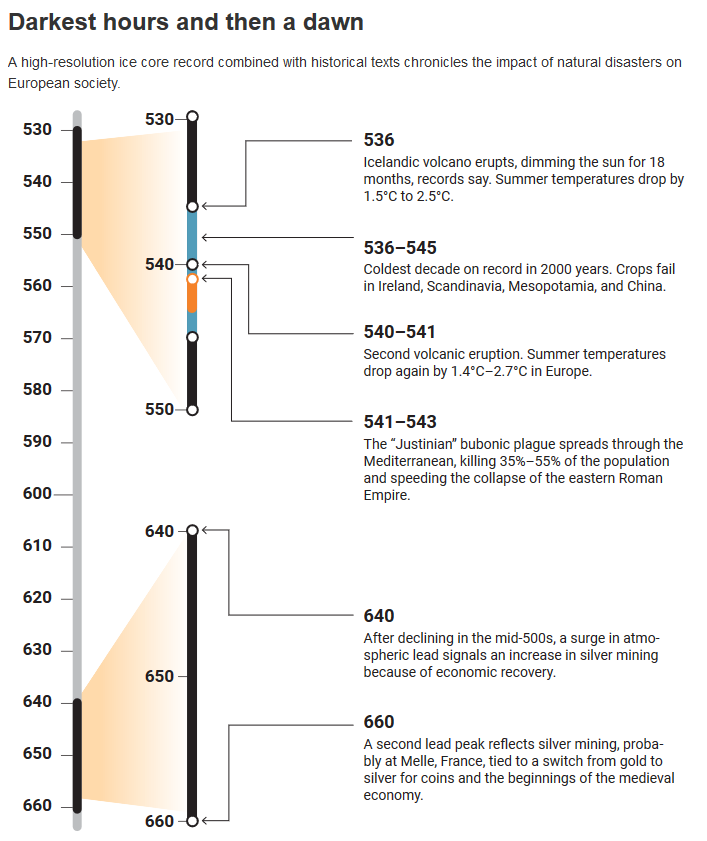
A mysterious fog plunged Europe, the Middle East, and parts of Asia into darkness, day and night — for 18 months. “For the sun gave forth its light without brightness, like the moon, during the whole year,” wrote Byzantine historian Procopius. Temperatures in the summer of 536 fell 1.5°C to 2.5°C, initiating the coldest decade in the past 2300 years. Snow fell that summer in China; crops failed; people starved. The Irish chronicles record “a failure of bread from the years 536–539.” Then, in 541, bubonic plague struck the Roman port of Pelusium, in Egypt. What came to be called the Plague of Justinian spread rapidly, wiping out one-third to one-half of the population of the eastern Roman Empire and hastening its collapse, McCormick says.

Historians have long known that the middle of the sixth century was a dark hour in what used to be called the Dark Ages, but the source of the mysterious clouds has long been a puzzle. Now, an ultraprecise analysis of ice from a Swiss glacier by a team led by McCormick and glaciologist Paul Mayewski at the Climate Change Institute of The University of Maine (UM) in Orono has fingered a culprit. At a workshop at Harvard this week, the team reported that a cataclysmic volcanic eruption in Iceland spewed ash across the Northern Hemisphere early in 536. Two other massive eruptions followed, in 540 and 547. The repeated blows, followed by plague, plunged Europe into economic stagnation that lasted until 640, when another signal in the ice — a spike in airborne lead — marks a resurgence of silver mining, as the team reports in Antiquity this week.

H/T to Blazing Cat Fur for the link.

October 26, 2018

Economist Jack Mintz dis-claims credit for the Liberals’ carbon tax scheme

Filed under: Economics, Environment, Government — Tags: , , , , — Nicholas @ 05:00

Everybody likes to be recognized for their work, but Jack Mintz wants to delineate where his original plan and the actual carbon tax scheme implemented by the federal government diverge:

I continue to maintain, as I have all these years, that the best way to implement carbon taxes is to use the revenues to reduce harmful corporate and personal taxes (I’ve since added land-transfer taxes to the original list). This includes removing anti-competitive levies while also providing support for low-income households to cope with higher electricity, heating and transportation costs.

However, what was unveiled Tuesday by the federal Liberal government in its carbon-pricing plan fails to achieve what I would have argued to be an ideal carbon policy. What is being advertised as a climate plan for provinces that fail to follow Ottawa’s carbon-tax directives — currently New Brunswick, Ontario, Manitoba and Saskatchewan, but they’ll likely be joined by others — instead comes across as a grand redistribution scheme administered by an expanding government bureaucracy.

While the federal carbon tax is almost uniform (electricity is not yet included), it provides special exemptions for certain sectors such as farmers, fishers, aviation, power producers in the North and greenhouse operators, although not the ones growing recreational cannabis.

But the departure from uniformity is marginal and not nearly as concerning as the Trudeau government’s continuing commitment to existing and even new regulations and subsidies to promote “clean energy,” each with their implicit carbon price. While economists repeatedly argue for a carbon tax precisely because it means we can forgo these high-cost interventions, somehow that has all been lost. While plenty of the economists behind the carbon-tax lobby were cheering Prime Minister Justin Trudeau’s new plan yesterday, I somehow missed their demands that we now must eliminate clean fuel and renewable electricity standards, subsidies for electric vehicles and ethanol — all of which have carbon costs well in excess of the $50-a-tonne carbon tax planned for 2022.

Another failure of the federal plan is to pass on carbon taxes in the form of Justin Bucks — or, to use the more laborious official name for these tax rebates: Climate Action Incentive Payments. So, rather than include carbon taxation as part of a comprehensive tax reform to make the tax system simpler, less distorting and fair, these Justin Bucks will be paid to households, small businesses, municipalities, universities, colleges, hospitals, non-profit and Indigenous populations.

A fatal flaw in federal pricing plan is a major shift in taxes from individuals to businesses. The average per household rebate — $1,161 in Saskatchewan in 2022 for example — is more than the cost per household of $946 (not including GST or HST on any energy bills). Even though the document states that business taxes are fully shifted forward to households, something is amiss here. How can household rebates average more than costs?

« Newer PostsOlder Posts »

Powered by WordPress