
Quotulatiousness

August 19, 2019

The Peterloo Massacre

Filed under: Britain, History, Liberty, Military, Politics — Tags: , , , — Nicholas @ 05:00

In Spiked on Friday, Brendan O’Neill marked the 200th anniversary of a brutal suppression of thousands of protestors demanding the right to vote in Britain:
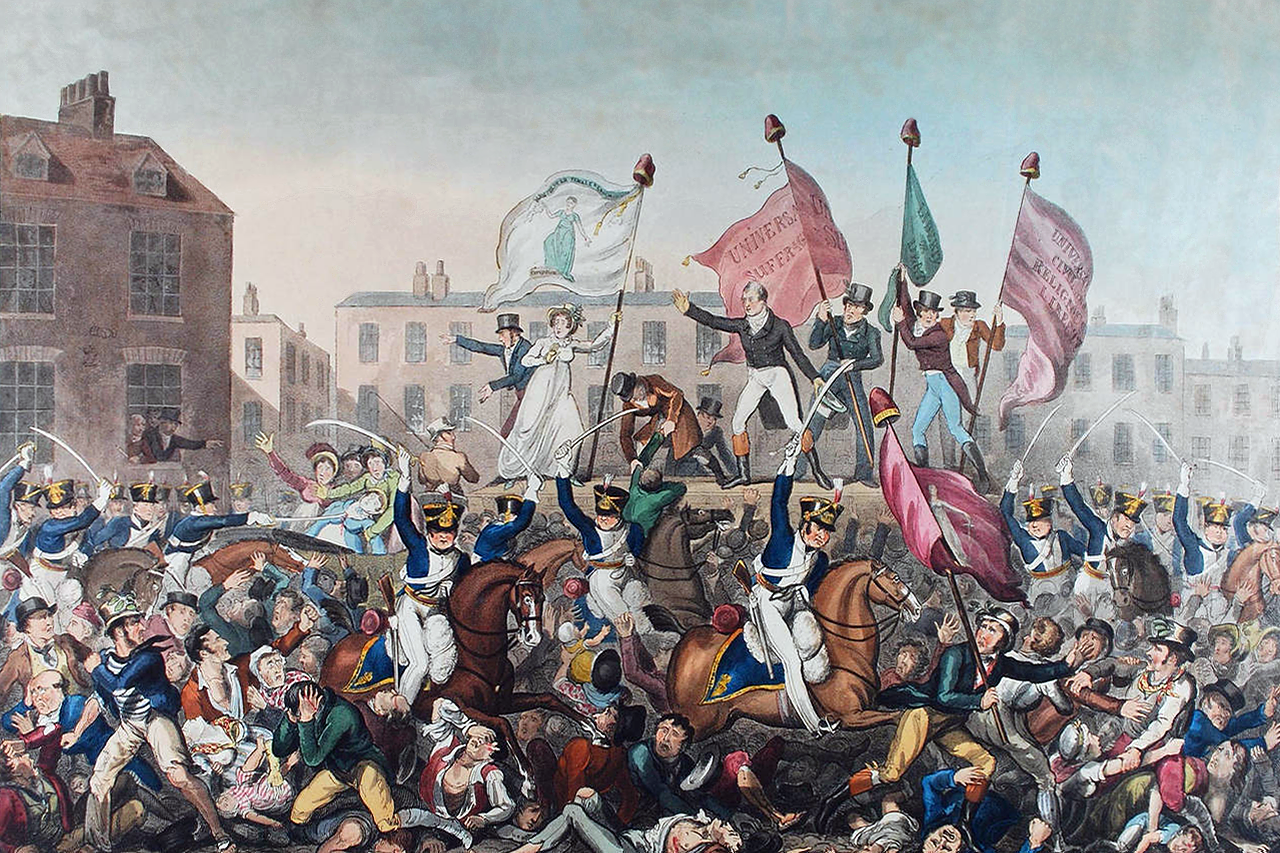
The Peterloo Massacre by Richard Carlile (1790-1843)
To Henry Hunt, Esq., as chairman of the meeting assembled in St. Peter’s Field, Manchester, sixteenth day of August, 1819, and to the female Reformers of Manchester and the adjacent towns who were exposed to and suffered from the wanton and fiendish attack made on them by that brutal armed force, the Manchester and Cheshire Yeomanry Cavalry, this plate is dedicated by their fellow labourer, Richard Carlile: a coloured engraving that depicts the Peterloo Massacre (military suppression of a demonstration in Manchester, England by cavalry charge on August 16, 1819 with loss of life) in Manchester, England.

All the poles from which banners are flying have Phrygian caps or liberty caps on top. Not all the details strictly accord with contemporary descriptions; the banner the woman is holding should read: Female Reformers of Roynton — “Let us die like men and not be sold like slaves”.
Manchester Library Services via Wikimedia Commons.

Today is the 200th anniversary of the Peterloo Massacre, when working people in Manchester were attacked and murdered by cavalry forces for daring to demand the right to vote. And what is our political class doing on this anniversary of such an important event in British political history? They are plotting, tirelessly, to overthrow something that millions of working-class people, and others, voted for: Brexit. They are doing what the Peterloo butchers did, only by political means and court cases rather than with bayonets and sabres. Our current political rulers may not physically attack the masses for having the temerity to use their democratic voices — not yet, anyway — but they view us with the exact same seething, elitist contempt as those who did attack the masses in St Peter’s Field on 16 August 1819.

Around 60,000 men, women and children gathered in St Peter’s Field in Manchester 200 years ago to demand parliamentary representation. They wanted that most basic and essential democratic right: the right to vote. The teeming industrial city of Manchester had no elected MPs in parliament. The old “rotten boroughs” system meant that often sparsely populated rural areas sent MPs to the Commons, involving much patronage and sometimes even the buying of votes by wealthy aspiring politicians, while newly industrialised cities full of the growing urban working classes had little to no political representation. Against a background of post-Napoleonic Wars economic depression and a fast-spreading radical desire for meaningful democratic change, the tens of thousands of marchers arrived in St Peter’s Field with a clear demand: let us vote, let us speak.

What happened next is well known. They were attacked by cavalry forces. Troops on horseback wielded sabres against the democratic crowd. They slashed and stabbed, killing 18 people. Around 500 were injured. The slaughter was given the name “Peterloo” as an ironic comparison to the Battle of Waterloo that took place four years earlier, in 1815. The bourgeoisie’s assault on the working-class democrats of Manchester had a deep impact on the radical psyche. New movements emerged in subsequent years, including the Chartists, the working-class movement for democratic representation. But it would be decades before the right to vote had been established across society. In 1867 some working-class men got the right to vote. In 1918, all men and some women got the right to vote. In 1928, finally all women got the vote. The General Election of 1929, 110 years after the march to St Peter’s Field, was the first election in which all adults had the right to vote.

The 200th anniversary of this bloody assault on working-class democrats ought to be a major occasion. It should be a reminder of the incredible, heroic sacrifices earlier generations made to secure people’s right to express themselves, to vote, and to see their votes be enacted. And yet while some in the political and media class will today pay lip service to the heroes of St Peter’s Field and express regret about the massacre of 18 of them, most of the elites will be too busy to do anything of the kind. Busy doing what? Trying to override and crush the votes of 17.4million people, which includes millions of working-class people and eight million women. It is a genuinely alarming and revealing moment: the 200th anniversary of the Peterloo Massacre arrives and the political set is engaged in an effective coup against the people; in a war against “No Deal Brexit” (which really just means a war against Brexit); in a concerted effort to force the ignorant public, as they see us, to vote for a second time and to give the “right” answer on this occasion.


May 21, 2019

Armoured Vehicles of the Invasion of France 1940, by The Chieftain – WW2 Special

Filed under: Britain, France, Germany, History, Military, Technology, WW2 — Tags: , , — Nicholas @ 06:00

World War Two
Published on 20 May 2019

The Chieftain takes you on an extensive walkthrough of the armoured vehicles used by both sides during the German invasion of France in 1940.

The Chieftain’s channel: https://www.youtube.com/user/TheChief…

April 22, 2019

Siege of Vienna – Charge of the Winged Hussars – Extra History – #3

Filed under: Europe, History, Military, Religion — Tags: , , , , , , — Nicholas @ 04:00

Extra Credits
Published on 20 Apr 2019

Leopold knew it was time to get the Holy Roman Empire involved if he wanted to keep Vienna, but it wouldn’t be as simple as asking for a favor. Charles of Lorraine and Sobieski of Poland would be the ones to lead the charge on the battlefield against the Janissaries.

Join us on Patreon! http://bit.ly/EHPatreon

October 20, 2018

Cavalry was a stupid idea

Filed under: History, Military, Technology — Tags: , — Nicholas @ 04:00

Lindybeige
Published on 28 Aug 2016

The Great Courses Plus free trial: http://ow.ly/fA12302OFSt

Riding a horse into battle is not a technique easy to adopt. The first man to suggest it may have been laughed at.

Support me on Patreon: https://www.patreon.com/Lindybeige

A long ramble by me. Possibly I should have done one video about Celtic/Roman four-pommelled saddles, and a separate one about how cavalry took a long time to develop.

I wasn’t quite at my peak while making this one. I came back from abroad with a virus, and had spent the previous day coughing.

Lindybeige: a channel of archaeology, ancient and medieval warfare, rants, swing dance, travelogues, evolution, and whatever else occurs to me to make.

▼ Follow me…

Twitter: https://twitter.com/Lindybeige I may have some drivel to contribute to the Twittersphere, plus you get notice of uploads.

website: www.LloydianAspects.co.uk

July 5, 2018

Tales of Cromwell tanks

Filed under: Books, Britain, History, Military, Technology, WW2 — Tags: , , , — Nicholas @ 02:00

Lindybeige
Published on 6 Apr 2016

War memoirs are filled with amazing anecdotes. Here I relate two, and ramble a bit about British WW2 tank units.
Support me on Patreon: https://www.patreon.com/Lindybeige

I am likely to return to this topic – anecdotes from war memoirs. It is a rich vein of stories. These come from Troop Leader by Bill Bellamy, which describes the author’s time commanding a trio of fast Cromwell tanks in World War Two, when fighting the Germans in Holland.

Lindybeige: a channel of archaeology, ancient and medieval warfare, rants, swing dance, travelogues, evolution, and whatever else occurs to me to make.

May 24, 2018

Medieval tank – The 13th Century Knight I IT’S HISTORY

Filed under: Europe, History, Military, Weapons — Tags: , , — Nicholas @ 04:00

IT’S HISTORY
Published on 23 May 2018

This time we will take you back to middle ages. It’s 13th century – what did medieval armor look like?

May 8, 2018

Charge of the Light Brigade | Animated History

Filed under: Britain, France, History, Military, Russia — Tags: , , — Nicholas @ 02:00

The Armchair Historian
Published on 28 Dec 2017

The Charge of the Light Brigade, Animated History

March 11, 2018

Savage Division – Displaced People – Sexual Relations I OUT OF THE TRENCHES

Filed under: Europe, France, History, Military, Russia, WW1 — Tags: , , , — Nicholas @ 04:00

The Great War
Published on 10 Mar 2018

Chair of Wisdom time!

February 15, 2018

The rise of the bourgeoisie

Filed under: Economics, Europe, History — Tags: , , — Nicholas @ 03:00

Ed West on the beginning of the end of military aristocracy in Europe and the rise of the merchant class:

The medieval system began with the Franks, whose mastery of cavalry made them the most powerful tribe in the former western empire. Later, the Normans used horses in far larger numbers and developed the cavalry charge, used to lethal effect at the Battle of Hastings. Cavalry underpinned the European social order because only those with a reasonable amount of land could afford the destrier warhorse, which cost 30 times as much as a regular farm animal and could carry up to 300lbs in weight, including 50lbs of iron armor — itself very costly.

The sons of the aristocracy were mostly schooled in warfare from a young age and despised learning and trade, which were viewed as dishonorable, leading to an excess of landless younger sons whose only skill was fighting, many of whom found their way to wars, or caused them, or made a living at absurdly dangerous tournaments. Cavalry developed certain rules — chivalry, which primarily concerned the treatment of aristocratic prisoners — as well as an idealization of the aristocratic warrior through the stories of Arthur, Lancelot, and Roland that singers recited at the courts of dukes and counts.

This order was first shaken in 1302 when France’s cavalry confidently marched north to suppress a revolt by the Flemish. Flanders is not naturally rich in resources — Vlaanderen means flooded — but its people had turned swamps into sheep pastures and towns, building a cloth industry that made it the wealthiest part of Europe, its GDP per capita 20 percent greater than France and 25 percent better than England. The wealth of Flanders’ merchants was such that when Queen Joan of France visited, she afterward wrote in horror that: “I thought I would be the only queen there, but I find myself surrounded by 600 other queens.”

The Flemish were traders, not knights, which is why the French were sure of victory. And yet, with enough money to pay for a large, well-drilled infantry, they were able, for the first time, to destroy the cavalry at the Battle of the Golden Spurs. It was the beginning of the end. No longer could the aristocracy simply push around the bourgeoisie, and as the latter grew in strength, it undermined the violence-obsessed culture of the nobility.

[…]

The aristocratic class that wished for glory in battle was in retreat, and yet, despite this, won the narrative. While in exile in Burgundy, King Edward had met a London merchant by the name of William Caxton who in his spare time transcribed books for aristocratic women. Exhausted at the toll of work, he learned through business contacts of a new technology in Germany, called movable type; when Caxton brought a printing press back home one of the most successful books he published was Thomas Malory’s The Death of Arthur.

It became the influential work in celebrating the Heroic Narrative of the Middle Ages, but the aristocratic ideals it harked back to were mostly a sham and ultimately rested on the rusty sword (and Malory was a convicted rapist). No account of any trader or banker could ever compete with these knights’ tales, of course, and yet you could argue that they were the real heroes who shaped our world.

November 14, 2017

The Last Hussar – August von Mackensen I WHO DID WHAT IN WW1?

Filed under: Europe, Germany, History, Military, WW1 — Tags: , , , — Nicholas @ 04:00

The Great War
Published on 13 Nov 2017

August von Mackensen was one of the most prolific generals of World War 1. He served with distinction on the Eastern theatres. The Gorlice-Tarnow Offensive, the conquest of Serbia and Romania were all possible thanks to him. He was raised with the belief in Prussian glory and held onto this belief even after the war ended.

November 12, 2017

The Mad Baron – Roman von Ungern-Sternberg I WHO DID WHAT IN WWI?

Filed under: Asia, History, Military, Russia, WW1 — Tags: , , , — Nicholas @ 06:00

The Great War
Published on 11 Nov 2017

Check out Feature History’s video about the Polish-Soviet War: https://www.youtube.com/watch?v=UJ3jQQ00pX0

Roman von Ungern-Sternberg was certainly one of the most interesting characters of the First World War. He was a military buddhist, loyal to the Tsar and enjoyed acts of foolish heroism and cruel violence in equal measure. From his Estonian beginnings to his Russian military service, and eventually running his own autocratic regime whilst the Bolsheviks and Whites engaged in Civil War, let’s take a look at the man behind the legends; the Bloody Baron.

May 21, 2017

Tank Chats #9 Whippet – Medium A

Filed under: Britain, History, Military, WW1 — Tags: , — Nicholas @ 02:00

Published on 31 Aug 2015

The ninth in a series of short films about some of the vehicles in our collection presented by The Tank Museum’s historian David Fletcher MBE.

While the heavy tanks were designed for direct attacks against enemy trenches the Tank Corps also wanted a lighter, faster tank to work with the cavalry over open country. Designed by Sir William Tritton and built by Fosters of Lincoln the Medium A, or Whippet, was the only such tank to see service with the Tank Corps, starting in 1918.

May 2, 2017

Reinventing Cavalry in WW1 – Bulgarian General Ivan Kolev I WHO DID WHAT IN WW1?

Filed under: Europe, History, Military, WW1 — Tags: , , , — Nicholas @ 04:00

Published on 1 May 2017

Cavalry was seen as leftover from the past in the dawn of modern warfare during World War 1. But Bulgarian General Ivan Kolev was one of the few who still saw a place for them on the modern battlefield. He reinvented the cavalry role and used them together with early motorised infantry – with great success during the Romanian campaign. He died before the war was over but people like August von Mackensen or Heinz Guderian were still impressed with his legacy.

March 19, 2017

Crucified Soldier – RMS Olympic – Somme Cavalry I OUT OF THE TRENCHES

Filed under: Europe, History, Military, WW1 — Tags: , , , — Nicholas @ 04:00

Published on 18 Mar 2017

Chair of Wisdom Time! This week we talk about the propaganda story of the crucified soldier and the RMS Olympic.

November 8, 2016

Operational analysis: The Battle of the Pelennor Fields

Filed under: Books, Military — Tags: , , , , , — Nicholas @ 02:00

The Angry Staff Officer analyzes the Battle of the Pelennor Fields (called by some the Battle of Minas Tirith) in terms of the six warfighting functions:

… Which leads me to my problem statement for this impromptu mission analysis that I am forcing you into: how did the forces of Gondor wage unified land operations versus the forces of Sauron at the Battle of Minas Tirith? More specifically, how can a primarily infantry force defend against a numerically superior enemy that possesses significant air assets, fires superiority, and freedom of movement and maneuver?

Couched in these terms, the problem statement resembles the complex situation faced by our brigade combat teams in a potential peer-to-peer engagement.

The situation – for those who do not remember it – is as follows: the forces of Gondor have been driven back from their forward defensive strongpoints along the Anduin River in the population center of Osgiliath. The withdrawal had been conducted in an orderly manner until the rear guard covering the retreat came under air attack by the Nazgul, which used their air superiority to drive the defenders into a panic. Most significantly, this air sortie wounded the primary land component commander, Faramir, depriving the forces of Gondor of their most effective warfighter.

More than 30,000 orcs and men of the forces of Sauron then enveloped the battle positions around Minas Tirith and began a siege of the 4,000 or so defenders of the city, which was primarily an infantry force with little in the way of cavalry or artillery. Significantly, the defenders possessed virtually no anti-air defenses, allowing the Nazgul freedom of movement around the battlefield – a dangerous proposition as the Nazgul also wielded considerable psychological damage (not unlike the sound of Stuka dive bombers in World War II). The greatest asset for Gondor was the wizard Gandalf – a force multiplier by any definition of the term – who was serving as the principle mission command adviser to Denethor. The objective for Gondor was to maintain their battle positions and hold out until reinforcements could arrive. However, lines of communication were cut during the siege and Gondor could not be sure that cavalry reinforcements from neighboring Rohan could arrive in time to save the city. This uncertainty weighed heavily on the forces of Gondor.

As a good staff officer, I turn to Army Doctrinal Publication 3-0, Unified Land Operations to understand the problem through the six warfighting functions. And given that J.R.R. Tolkien himself was a British signal officer during World War I, it would be appropriate to start out with mission command.

I imagine the author was grinning when he got to this section:

Luckily for Gondor, Gandalf then assumed command of all land forces, despite his position as a primary staff advisor to Denethor.

Yeah, that’s right, a staff officer took over operations.

Gandalf immediately provided vision and direction to the city’s defenders at a critical moment, as the forces of Sauron were conducting a breaching operation on the gates of Minas Tirith utilizing a battering ram named Grond. Arriving at the enemy point of breach, Gandalf rallied the forces in the engagement area, organized the defense, and directly opposed the primary enemy air and land component commander, the Witch-king of Angmar. The Witch-king was Sauron’s chief captain and commander of the Nazgul. Under his supervision, Sauron’s forces breached the main perimeter to the city and the Witch-king moved through the point of penetration into the far side of the breach, where he was confronted by Gandalf. The two land component commanders were prevented from close combat by the arrival of the primary maneuver element: the forces of Rohan.

H/T to John Donovan for the link.

« Newer PostsOlder Posts »

Powered by WordPress
