Quotulatiousness

September 9, 2011

Opportunities for humour with your bank’s “secret questions”

Filed under: Humour, Technology — Tags: , , — Nicholas @ 09:15

If you do online banking, you’ve probably been asked to provide additional security checks beyond your userid and password. Some banks only allow you to select answers from pre-selected questions, but others get you to provide both the question and the answer. In a post from more than a year back, Bruce Schneier offers a few combinations that lighten the mood (and there are lots of funny — and weird — suggestions in the comment thread):

Q: Need any weed? Grass? Kind bud? Shrooms?
A: No thanks hippie, I’d just like to do some banking.

Q: What the hell is your fucking problem, sir?
A: This is completely inappropriate and I’d like to speak to your supervisor.

Q: I’ve been embezzling hundreds of thousands of dollars from my employer, and I don’t care who knows it.
A: It’s a good thing they’re recording this call, because I’m going to have to report you.

Q: Are you really who you say you are?
A: No, I am a Russian identity thief.

September 6, 2011

Switzerland devalues the franc

Filed under: Economics, Europe — Tags: , , — Nicholas @ 12:06

In what appears to be a successful attempt to devalue their currency, the Swiss have announced that they will peg the franc at €0.83, or SFr1.20 to the euro:

The Swiss National Bank in effect devalued the franc, pledging to buy “unlimited quantities” of foreign currencies to force down its value. The SNB warned that it would no longer allow one Swiss franc to be worth more than €0.83 — equivalent to SFr1.20 to the euro — having watched the two currencies move closer to parity as Switzerland became a “safe haven” from the ravages of the eurozone crisis.

The move stunned currency traders, and sent the Swiss franc tumbling against other currencies. Jeremy Cook, chief economist at currency brokers World First, said it was “intervention on a grand scale”, and the start of a “new battle in the currency wars”.

“That was the single largest foreign exchange move I have ever seen … The Swiss franc has lost close on 9% in the past 15 minutes. This dwarfs moves seen post-Lehman brothers, 7/7, and other major geo-political events in the past decade,” Cook said.

August 23, 2011

Markets hate uncertainty

Filed under: Economics, Government, History — Tags: , , , — Nicholas @ 13:34

I’ve often remarked that the economy won’t — can’t — recover as long as governments (the US government in particular) keep messing around with the rules of the game. Amity Shlaes explains why:

One product makes clear exactly how unusual this year’s slide has been, and offers a clue as to why 2011 broke the rules. It’s called the Congressional Effect Fund. Founded by Wall Streeter Eric Singer in 2008, the fund is premised on the idea that equity markets dislike a hostile Washington, tolerate a friendly Washington, but prefer an inactive Washington above all.

It follows that stock-market rallies would come most often when Congress is idled — in recess, at home, in the districts. From 1965 until early this summer, the Standard & Poor’s 500 Index, Singer’s proxy for stocks, rose 17 percent while Congress was out of session versus only 0.9 percent while Congress was working in Washington.

In one study, four scholars took a step back to look at a century of returns — from 1897, just after the Dow Jones Industrial Average was founded, to 1997 — and found that average daily returns when Congress was out of session were almost 13 times higher than when it was in. Their explanation: “Perhaps the market enjoys the temporary certainty exhibited by the absence of Congressional decisions.”

Singer is blunter. About Washington’s impact on the economy, he says simply: “Congress subtracts value.”

The regulators are still on the job, but the legislators appear to be the ones causing the greater degree of uncertainty — and thereby limiting market opportunities. Nice work, government.

July 24, 2011

Bank of Ireland “suffered a restructuring credit event”

Filed under: Economics, Europe — Tags: , , — Nicholas @ 10:46

I’m not fluent in banker . . . does this Reuters report really say that the Bank of Ireland is in default?

The ISDA said a restructuring credit event occurred after Bank of Ireland closed an offer to buy back about 2.6 billion euros of Tier 1 and Tier 2 subordinated debt at a discount of up to 90 percent earlier this month.

A credit event is financial industry jargon for default on payment, breach of bond covenants or other event that casts doubt on an issuer’s ability to service its debt.

If it does mean the bank is in default, how come it hasn’t received much attention in the media? (Aside from the focus being on Norway right now for other reasons, of course.)

H/T to Karl Denninger for the link.

July 12, 2011

Have the markets already “priced in” the risk of a US government default?

Filed under: Economics, Government, USA — Tags: , , , , — Nicholas @ 11:48

Along with everyone else, I’ve been watching the US government’s fiscal game of “chicken” with some alarm. What is puzzling is that the opposition in congress doesn’t seem to be all that scared by the risk of default:

The facts, in fact, are plain enough. In the unlikely event that the U.S. government would hit the real ceiling on August 2 as advertised, the federal government would still be on track to collect about $2.2 trillion in the fiscal year. That wouldn’t change. And net interest for the year would still be about $205 billion, or less than a tenth of incoming revenues. And in light of the consequences, there is no doubt that President Obama and his Treasury Secretary would ensure that the interest payments are made on time and in full.

Thus it should not be surprising, as Fox Business News senior correspondent Charlie Gasparino wrote in a New York Post piece some days ago that “just about every private-sector economist I speak to says that Treasury could simply use its ample cash on hand to pay off our creditors first—then begin to prioritize payments for the military and various social programs.”

This view appears to be shared in spades by the credit markets, which so far have reacted to the Obama-media scare tactics with a big yawn. When the markets fear real default, they respond by jacking up interest rates, as we’ve seen in Greece, Italy, Portugal, etc. It’s happening right now in those countries.

In sharp contrast, U.S. long-term rates are actually falling. The 10-year Treasury bond rate, which only a few days ago was around 3.15 percent, has dropped 20 basis points to 2.95 percent. Maybe the markets just aren’t paying attention. Or maybe they know Obama and Company are blowing smoke. Whether the debt ceiling is raised on time or not, markets are confident that the interest will be paid.

June 27, 2011

The Economist calls for Greek debt restructuring

Filed under: Economics, Europe, Government, Greece — Tags: , , , — Nicholas @ 10:23

A Greek default. It’s stopped being a possibility, moved into being a probability, and it’s starting to look inevitable:

There is an alternative, for which this newspaper has long argued: an orderly restructuring of Greece’s debts, halving their value to around 80% of GDP. It would hardly be a shock to the markets, which have long expected a default (an important difference from Lehman). The banks that still hold a big chunk of the bonds are in better shape to absorb losses today than they were last year. Even if Greece’s debts were cut in half, the net loss would still represent an absorbable proportion of most European banks’ capital.

An orderly restructuring would be risky. Doing it now would crystallise losses for banks and taxpayers across Europe. Nor would it, by itself, right Greece. The country’s economy is in deep recession and it is running a primary budget deficit (ie, before interest payments). Even if Greece restructures its debt and embraces the reforms demanded by the EU and IMF, it will need outside support for some years. That is bound to bring more fiscal-policy control from Brussels, turning the euro zone into a more politically integrated club. Even if that need not mean a superstate with its own finance ministry, the EU’s leaders have not started to explain the likely ramifications of all this to voters. But at least Greece and the markets would have a plan with a chance of working.

No matter what fictions they concoct this week, the euro zone’s leaders will sooner or later face a choice between three options: massive transfers to Greece that would infuriate other Europeans; a disorderly default that destabilises markets and threatens the European project; or an orderly debt restructuring. This last option would entail a long period of external support for Greece, greater political union and a debate about the institutions Europe would then need. But it is the best way out for Greece and the euro. That option will not be available for much longer. Europe’s leaders must grab it while they can.

June 25, 2011

Tim Harford analyzes the ECB’s real problem

Filed under: Economics, Europe, Humour — Tags: , — Nicholas @ 10:30

Tim Harford puts the head of the ECB (Essex Community Business association) on the couch:

“With all due respect, doctor, I don’t think it’s me who needs to see a shrink.”

“Don’t worry. A lot of people feel a bit awkward when they first lie on this couch. This is a safe, non-judgmental space.”

“I wish the Essex Community Business association was as relaxed.”

“But you’re the chairman of the ECB association. Tell me why you feel that way.”

“Look, I always felt that the ECB association was supposed to be an informal talking shop, a way for people with shared interests to make new friends and perhaps even launch joint projects. Everyone was really happy when Georgios, the new owner of the Plaka Taverna, wanted to join — the more the merrier.”

[. . .]

“So if I understand the situation, you’re lending money to Georgios that you know he can never pay back, and demanding that his staff make sacrifices they are transparently unwilling to make, in order to protect Mr Saville’s bank, in order to protect José, who in some unspecified way is connected to Georgios’s fate.”

“It does sound a bit strange when you put it like that. I think the theory is that if we don’t throw money and yell impractical and unwelcome management advice at a transparently bankrupt business, then maybe a perfectly viable business will be damaged. Especially since there won’t be any money left, because we’ll have given it all to Georgios, who will have given it all to his waiters. Does that make sense?”

June 22, 2011

What is a balance-sheet recession?

Filed under: Cancon, Economics, USA — Tags: , , — Nicholas @ 12:07

Stephen Gordon has some really nasty looking diagrams explaining just what a balance sheet recession looks like:

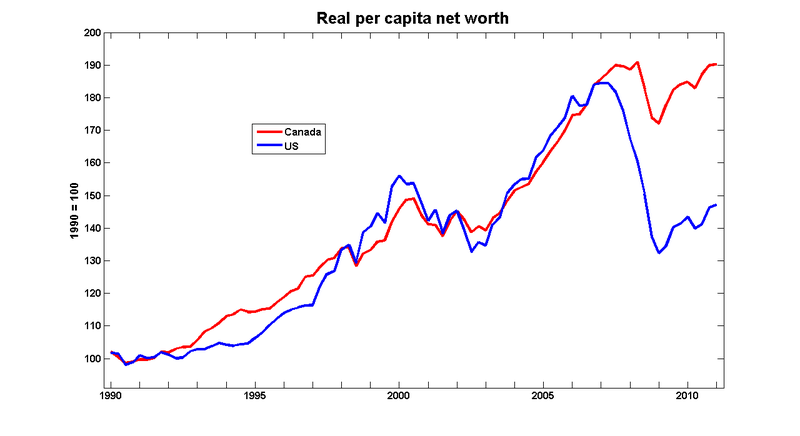
I had never heard the expression “balance-sheet recession” before this recent episode, and it’s time I got around to a comparison of the household balance sheets of the US and Canada. Of all my “Canada is not the US” posts, this is the one that makes me most grateful.

The quarterly data goes back to 1990, and it’s good to put the last few years in context. I’ve scaled all the series by price (the consumption spending deflator) and population. Here is the net worth series:

There’s been talk of a Japan-like ‘lost decade’ in the US; that seems optimistic. US real per capita net worth is back to what it was back in 1999.

More (and somewhat scarier) diagrams at the original post. It doesn’t even finish on a high note:

The US data go back to 1952, so I was able to check the last time the real, per capita value of US housing equity was at its current level. Even after looking at all of these graphs, the answer astonished me: 1978. Nineteen seventy-freaking-eight.

June 19, 2011

“It is clear they are running out of options”

Filed under: Britain, Economics, Europe, Greece — Tags: , — Nicholas @ 10:29

It looks as though the British banks are starting to get very nervous about Eurozone bank defaults:

Senior sources have revealed that leading banks, including Barclays and Standard Chartered, have radically reduced the amount of unsecured lending they are prepared to make available to eurozone banks, raising the prospect of a new credit crunch for the European banking system.

Standard Chartered is understood to have withdrawn tens of billions of pounds from the eurozone inter-bank lending market in recent months and cut its overall exposure by two-thirds in the past few weeks as it has become increasingly worried about the finances of other European banks.

Barclays has also cut its exposure in recent months as senior managers have become increasingly concerned about developments among banks with large exposures to the troubled European countries Greece, Ireland, Spain, Italy and Portugal.

H/T to Elizabeth for the link.

Cyber-espionage in theory and practice

Filed under: China, Government, Military, Technology, USA — Tags: , , , — Nicholas @ 09:50

An interesting article at Strategy Page discussing online espionage:

Firms with the most to lose, like financial institutions, guard their data most successfully. They do this the old-fashioned way, with layers and layers of security, implemented by the best (and most highly paid) people and pushed by senior managers who take the time to learn about what they are dealing with, and what it will take to stay on top of the problem.

It’s different in the defense business. If the Chinese steal data on some new weapon, there might be a problem years down the road, when the Chinese offer a cheaper alternative to an American weapon, for the export market. But even that problem has a silver lining, in that you can get away with insisting that those clever Chinese developed your technology independently. Meanwhile, everyone insists that there was no espionage, cyber or traditional, involved. As a further benefit, the American firm will get more money from a terrified government, in order to maintain the American technical edge. It’s the same general drill for military organizations. But for financial institutions, especially those that trade in fast moving currency, derivatives and bond markets, any information leaks can have immediate, and calamitous consequences. You must either protect your data, or die.

It’s not exactly a secret that China has been active in this area, but the extent of their official activity is hard to state. However, just as non-state actors take advantage of individuals who fail to use anti-virus software on their computers, ignorance and apathy are tools for state actors:

But the biggest problem, according to military Cyber War commanders, is the difficulty in making it clear to political leaders, and non-expert (in Internet matters) military commanders, what the cyber weapons are, and the ramifications of the attacks. Some types of attacks are accompanied by the risk of shutting down much, or all, of the Internet. Other types of operations can be traced back to the source. This could trigger a more conventional, even nuclear, response. Some attacks use worms (programs that, once unleashed, keep spreading by themselves.) You can program worms to shut down after a certain time (or when certain conditions are met). But these weapons are difficult, often impossible, to test “in the wild” (on the Internet). By comparison, nuclear weapons were a new, very high-tech, weapon in 1945. But nukes were easy to understand; it was a very powerful bomb. Cyber weapons are much less predictable, and that will make them more difficult for senior officials to order unleashed.

So the first order of business is to develop reliable techniques to quickly, and accurately, educate the senior decision makers about what they are about to unleash. This would begin with the simplest, and cheapest, weapons, which are botnets, used for DDOS attacks. In plain English, that means gaining (by purchase or otherwise) access to hundreds, or thousands, of home and business PCs that have had special software secretly installed. This allows whoever installed the software that turned these PCs into zombies, to do whatever they want with these machines. The most common thing done is to have those PCs, when hooked up to the Internet, to send as many emails, or other electronic messages, as it can, to a specified website. When this is done with lots of zombies (a botnet), the flood of messages becomes a DDOS (Distributed Denial of Service) attack that shuts the target down. This happens because so much junk is coming in from the botnet, that no one else can use the web site.

May 29, 2011

Are we facing a crash in the value of the US dollar?

Filed under: Economics, Politics, USA — Tags: , , , — Nicholas @ 11:25

Conrad Black certainly makes a strong case to expect it sooner, rather than later:

When Barack Obama took office, the official normal money supply of the United States was about $1.1-trillion. The $3-trillion in federal budget deficits that have been run up since then have largely, technically, escaped the money supply, though accretions have almost doubled the official total, an unheard of rate of growth (about 40% annualized) in a hard-currency country. About 70% of this debt has been paid by the issuance of bonds to the central bank of the United States, the Federal Reserve, a subsidiary of the United States government. Whatever the balance sheets say, this has produced the effect of a money-supply increase, which has brought pump-priming to a level of over-achievement not seen since Noah felt the compulsion to build an ark. And the annual trillion-dollar deluge is forecast to continue for a decade.

The world’s reserve currency, the fabled vehicle of the “faith and credit of the United States,” is now virtual money — a symbol for all the other massive problems afflicting the U.S. economy. The imported share of America’s oil consumption, for instance, has gone from 20% to 60%. Large suppliers like Iran and Venezuela have become hostile countries. Yet Americans remain neurotic about paying half the gas price of other oil-importing countries.

But he says that we shouldn’t look to Europe to save the day:

Meanwhile, the European Union is a water-logged vessel in a tempest, frantically bailing. In the six weeks since French finance minister Christine Lagarde last bravely proclaimed her personal fantasy that Greece would not default, the interest on Greek government notes has risen from 20% to 26%. Germany will not indefinitely remain so encumbered with guilt for the Third Reich that it will go on eating the costs of the false prospectus Goldman Sachs assisted Greece and others to file when they joined the Euro. The Germans have only tolerated it up to now because the strain Greece, Portugal, Ireland, Spain and eventually others put on the European banking system and the Euro,keep the Euro in fairly close downward mode with the U.S. dollar, which assists German exports. What a splendid irony that Germany, reviled as the rampaging hun in olden time, is now being entreated by genuflecting masses of its former ungrateful subjects to occupy and dominate them again, at least economically. (The Bundesbank’s uniforms are less stylish than those of the Wehrmacht.)

The EU is in hot contention with the United States as the Sick Man of the Great World Economic Powers, because less than 40% of Eurozone citizens work and over 60% are on benefits of some sort. But not to be discounted in this gripping Olympic contest for total fiscal immolation is geriatric, debt-ridden, stagnating Japan, a great but terribly beleaguered and demoralized country.

How’s that for your daily dose of DOOM? Pretty DOOM-ish, isn’t it?

May 20, 2011

Bank of Canada is not there to “guide” the markets

Filed under: Cancon, Economics, Media — Tags: , , , — Nicholas @ 13:22

Stephen Gordon points out that there appear to be some dangerous assumptions out in the market about whether and when the Bank of Canada will change interest rates:

The Bank of Canada is scheduled to make its next interest rate announcement on May 31, and my understanding is that the consensus of opinion among private sector analysts is that interest rates will remain unchanged, because there was no explicit warning of an increase in its April 12 decision.

This consensus of opinion may turn out to be well-founded — but not for that reason. Recent reports confirm what Bank officials have said several times: the Bank of Canada believes that it under no obligation to provide guidance about short-term interest rates. Governor Mark Carney has already noted that one of the contributing factors of the financial crisis was the private sector’s overconfidence in its ability to predict central banks’ behaviour.

This doesn’t automatically mean the Bank will raise interest rates at their next meeting, but it does mean that it could happen (despite the “lack of warning” in April).

April 29, 2011

Stephen Gordon: Layton needs to avoid disruptive monetary policies

Filed under: Cancon, Economics, Politics — Tags: , , , , — Nicholas @ 13:20

It’s almost as if nobody bothered to read what the NDP had in their platform until last week . . . and paying even less attention to what Jack Layton said on the campaign trail. They’re paying attention now:

In my recent post on the prospects of a possible NDP government, I came to the conclusion that not very much would change; their platform had none of the transformational elements that had been a feature of so many NDP campaigns in the past.

But if recent reports are correct, and if Jack Layton seriously thinks that it would be a good idea for a Prime Minister to instruct the Bank of Canada to keep interest rates low, then this benign assessment no longer holds. Such an intervention would be a serious mistake that would seriously endanger the recovery, and could generate another spiral of higher inflation and higher interest rates.

The first thing that would happen after such an order is that Governor Mark Carney would have no choice but to resign. This would be a serious shock to the financial system, and unless his successor could extract a promise that no further orders would be forthcoming, the Bank of Canada’s credibility would simply disappear.

You remember all those smug, self-congratulatory pieces about how well Canada had weathered the recession and how well positioned the country was to take advantage of economic growth? Perhaps this is the imp of the perverse coming back for a revision of all that hearty back-patting.

April 25, 2011

Grameen Bank cleared of “irregularities”, but Yunus will not be re-instated

Filed under: Asia, Economics, Law, Liberty — Tags: , , , , — Nicholas @ 11:06

The Bangladeshi government has completed their investigation into financial irregularities at microfinance specialist Grameen Bank, but the founder, Muhammad Yunus, will not be brought back:

Yunus, 70, was dismissed by a central bank order — upheld by the high court and supreme court — on the grounds that he had overstayed in his position and refused requests to quit.

Yunus, winner of the 2006 Nobel peace prize, set up Grameen, which means village in Bengali, and had been the bank’s managing director since 2000.

Lauded at home and abroad by politicians and financiers as the “banker to the poor”, he has been under attack by the government since late last year, after a Norwegian documentary alleged the bank was dodging taxes.

Yunus denied any wrongdoing and a Norwegian government investigation later also cleared him of any malpractice.

April 21, 2011

Why the headline inflation rate may not force the Bank of Canada to increase interest rates

Filed under: Cancon, Economics — Tags: , — Nicholas @ 08:00

Stephen Gordon explains why the spike of certain prices may not trigger interest rate hikes from the Bank of Canada:

The increase in the headline March CPI inflation rate is due to increases in a relatively small number of goods, and is best seen as a change in relative prices that will have only a transitory increase in the CPI. There are two ways that headline CPI can return to target. The first is that consumers adjust their spending patterns and substitute away from the goods whose prices have risen; the resulting fall in demand will bring prices back down. If this doesn’t happen, prices of other goods can fall — or at least rise more slowly — so that the rate of inflation of the broader index falls back to target.

The Bank of Canada is preoccupied with inflation, not fluctuations in relative prices, so the current increase in the CPI will only be a problem if firms and workers start using 3 per cent as a benchmark for increases in wages and the prices of other goods.

Even though the target is the headline CPI inflation rate, it is the Bank’s opinion that the core CPI inflation rate is a better predictor for future inflation. The components of core CPI are generally those whose prices are set infrequently and whose increases reflect expectations for future inflation as well as market conditions. If expected inflation starts to rise, it will be more visible in the core rate than in the headline number.

« Newer PostsOlder Posts »

Powered by WordPress