
The end of the reign of Augustus (in 14AD) is a convenient marker for a shift in Roman strategic aims away from expansion and towards a “frontier maintenance”. The usual term for both the Roman frontier and the system of fortifications and garrisons which defended it is the limes (pronounced “lim-ees”), although this wasn’t the only word the Romans applied to it. I want to leave aside for a moment the endless, complex conversation about the degree to which the Romans can actually be said to have strategic aims, though for what it is worth I am one of those who contends that they did. We’re mostly interested here in Roman behavior on the frontiers, rather than their intent anyway.
What absolutely does begin happening during the reign of Augustus and subsequently is that the Roman legions, which had spent the previous three centuries on the move outside of Italy, begin to settle down more permanently on Rome’s new frontiers, particularly along the Rhine/Danube frontier facing Central and Eastern Europe and the Syrian frontier facing the Parthian Empire. That in turn meant that Roman legions (and their supporting auxiliary cohorts) now settled into permanent forts.
The forts themselves, at least in the first two centuries, provide a fairly remarkably example of institutional inertia. While legionary forts of this early period typically replaced the earthwork-and-stakes wall (the agger and vallum) with stone walls and towers and the tents of the camp with permanent barracks, the basic form of the fort: its playing-card shape, encircling defensive ditches (now very often two or three ditches in sequence) remain. Of particular note, these early imperial legionary forts generally still feature towers which do not project outward from the wall, a stone version of the observation towers of the old Roman marching camp. Precisely because these fortifications are in stone they are often very archaeologically visible and so we have a fairly good sense of Roman forts in this period. In short then, put in permanent positions, Roman armies first constructed permanent versions of their temporary marching camps.
And that broadly seems to fit with how the Romans expected to fight their wars on these frontiers. The general superiority of Roman arms in pitched battle (the fancy term here is “escalation dominance” – that escalating to large scale warfare favored the heavier Roman armies) meant that the Romans typically planned to meet enemy armies in battle, not sit back to withstand sieges (this was less true on Rome’s eastern frontier since the Parthians were peer competitors who could rumble with the Romans on more-or-less even terms; it is striking that the major centers in the East like Jerusalem or Antioch did not get rid of their city walls, whereas by contrast the breakdown of Roman order in the third century AD and subsequently leads to a flurry of wall-building in the west where it is clear many cities had neglected their defensive walls for quite a long time). Consequently, the legionary forts are more bases than fortresses and so their fortifications are still designed to resist sudden raids, not large-scale sieges.
They were also now designed to support much larger fortification systems, which now gives us a chance to talk about a different kind of fortification network: border walls. The most famous of these Roman walls of course is Hadrian’s Wall, a mostly (but not entirely) stone wall which cuts across northern England, built starting in 122. Hadrian’s Wall is unusual in being substantially made out of stone, but it was of-a-piece with various Roman frontier fortification systems. Crucially, the purpose of this wall (and this is a trait it shares with China’s Great Wall) was never to actually prevent movement over the border or to block large-scale assaults. Taking Hadrian’s wall, it was generally manned by something around three legions (notionally; often at least one of the legions in Britain was deployed further south); even with auxiliary troops nowhere near enough to actually manage a thick defense along the entire wall. Instead, the wall’s purpose is slowing down hostile groups and channeling non-hostile groups (merchants, migrants, traders, travelers) towards controlled points of entry (valuable especially because import/export taxes were a key source of state revenue), while also allowing the soldiers on the wall good observation positions to see these moving groups. You can tell the defense here wasn’t prohibitive in part because the main legionary fortresses aren’t generally on the wall, but rather further south, often substantially further south, which makes a lot of sense if the plan is to have enemies slowed (but not stopped) by the wall, while news of their approach outraces them to those legionary forts so that the legions can form up and meet those incursions in an open battle after they have breached the wall itself. Remember: the Romans expect (and get) a very, very high success rate in open battles, so it makes sense to try to force that kind of confrontation.
This emphasis on controlling and channeling, rather than prohibiting, entry is even more visible in the Roman frontier defenses in North Africa and on the Rhine/Danube frontier. In North Africa, the frontier defense system was structured around watch-posts and the fossatum Africae, a network of ditches (fossa) separating the province of Africa (mostly modern day Tunisia) from non-Roman territory to its south. It isn’t a single ditch, but rather a system of at least four major segments (and possibly more), with watch-towers and smaller forts in a line-of-sight network (so they can communicate); the ditch itself varies in width and depth but typically not much more than 6m wide and 3m deep. Such an obstruction is obviously not an prohibitive defense but the difficulty of crossing is going to tend to channel travelers and raids to the intentional crossings or alternately slow them down as they have to navigate the trench (a real problem here where raiders are likely to be mounted and so need to get their horses and/or camels across).
On the Rhine and the Danube, the defense of the limes, the Roman frontier, included a border wall (earthwork and wood, rather than stone like Hadrian’s wall), similarly supported by legions stationed to the rear, with road networks positioned; once again, the focus is on observing threats, slowing them down and channeling them so that the legions can engage them in the field. This is a system based around observe-channel-respond, rather than an effort to block advances completely.
Bret Devereaux, “Collections: Fortification, Part II: Romans Playing Cards”, A Collection of Unmitigated Pedantry, 2021-11-12.
December 2, 2022
QotD: Rome’s legions settle down to permanent fortresses
June 10, 2022
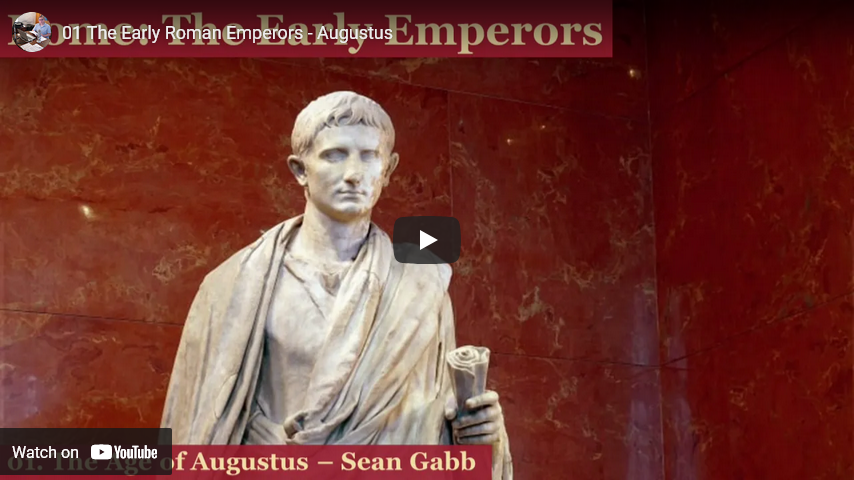
The Early Roman Emperors – Part 1: Augustus
seangabb
Published 26 Sep 2021The Roman Empire was the last and the greatest of the ancient empires. It is the origin from which springs the history of Western Europe and those nations that descend from the Western Roman Empire. It is the political entity within which the Christian faith was born, and the growth of the Church within the Empire, and its eventual establishment as the sole faith of the Empire, have left an indelible impression on all modern denominations. Its history, together with that of the ancient Greeks and the Jews, is our history. To understand how the Empire emerged from a great though finally dysfunctional republic, and how it was consolidated by its early rulers, is partly how we understand ourselves.
Here is a series of lectures given by Sean Gabb in late 2021, in which he discusses and tries to explain the achievement of the early Emperors. For reasons of politeness and data protection, all student contributions have been removed.
More by Sean Gabb on the Ancient World: https://www.classicstuition.co.uk/
Learn Latin or Greek or both with him: https://www.udemy.com/user/sean-gabb/
His historical novels (under the pen name “Richard Blake”): https://www.amazon.co.uk/Richard-Blak…
April 18, 2022
Republic to Empire: The Augustan Settlement
seangabb
Published 23 Mar 2021Here is the tenth lecture, which covers the Augustan Settlement and the ending of the Roman Republic. Discussion includes: the Constitutional Settlements, graphical representations of the old and new Roman Constitutions; opinions in Rome and the provinces of the new order; the legitimisation propaganda; the general success of the reign of Augustus.
(more…)
April 11, 2022
Republic to Empire: The Ides of March to Actium
seangabb
Published 13 Mar 2021In 120 BC, Rome was a republic with touches of democracy. A century later, it was a divine right military dictatorship. Between January and March 2021, Sean Gabb explored this transformation with his students. Here is one of his lectures. All student contributions have been removed.
(more…)
April 10, 2022
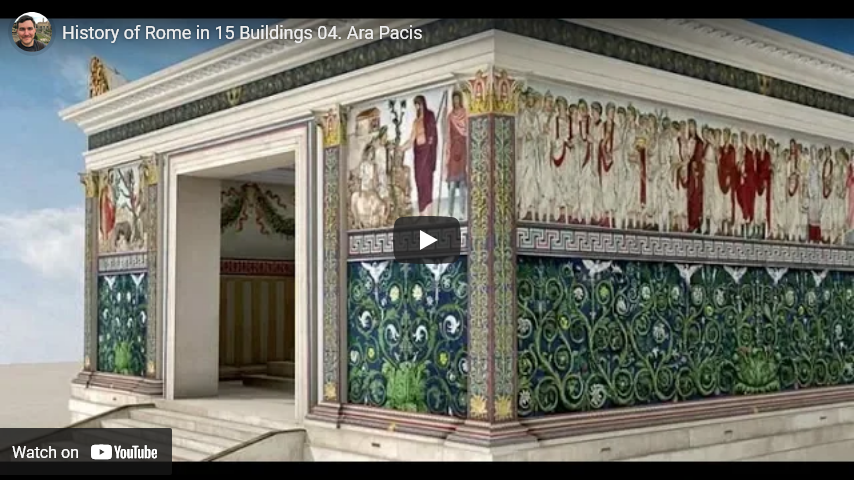
History of Rome in 15 Buildings 04. Ara Pacis
toldinstone
Published 27 Sep 2018Augustus dominates this fourth episode of our History of Rome, which uses the Ara Pacis Augustae (Altar of the Augustan Peace) to discuss the first emperor’s reign, reforms, and propaganda. I also threw in a gripping description of the Battle of Actium.
If you enjoyed this video, you might be interested in my book Naked Statues, Fat Gladiators, and War Elephants: Frequently Asked Questions about the Ancient Greeks and Romans. You can find a preview of the book here:
https://toldinstone.com/naked-statues…
If you’re so inclined, you can follow me elsewhere on the web:
https://www.reddit.com/r/AskHistorian…
https://www.instagram.com/toldinstone/To see the story and photo essay associated with this video, go to:
https://toldinstone.com/ara-pacis/Thanks for watching!
February 6, 2022
QotD: Marcus Tullius Cicero
Cicero was a key politician in the Late Republic, but it was his misfortune that his life was spent in an era where words meant less than weapons. He sided with Pompey against Caesar, but was granted clemency after Pompey’s defeat. He was not involved in Caesar’s assassination – he was still too much an outsider for some of the stuck-up Roman elitists who made up the conspiracy (though he correctly pointed out at the time that leaving Antony alive would be a fatal mistake). In the aftermath of the assassination, he identified (correctly) Antony as the key threat to the Republic and worked to discredit him politically in a devastating series of speeches named the Philippics (in honor of a similar set of speeches made by the Athenian Demosthenes against Philip II of Macedon, father of Alexander). Cicero’s political assault on Antony succeeded – his reputation was ruined and his popularity in Rome never recovered – but it cost Cicero his life when Antony, in league with Octavian, moved into the capital and had Cicero murdered. Cicero’s literary legacy survived him, however, in part because it was useful for Augustus’ own political ends (e.g. Plut. Cic. 49.5-6).
Cicero’s position as the most eloquent orator of the Latin language – and probably its best prose stylist – is largely uncontested. It was his speaking skills – honed in the courts – that made him so politically successful. He was also a prolific writer and a tremendous amount of his writings survive, including both legal and political speeches, private letters, handbooks on oratory, and a set of philosophical works. As anyone who has read Cicero can tell you, he also has a deserved reputation for pride and self-aggrandizement. While many of Cicero’s contemporaries and readers down to the modern era have been impressed by Cicero’s thinking and eloquence, I feel confident in asserting no one – alive or dead – will ever be more impressed by Cicero than Cicero was impressed by himself.
Bret Devereaux, “Collections: A Trip Through Cicero (Natural Law)”, A Collection of Unmitigated Pedantry, 2019-12-12.
March 20, 2021
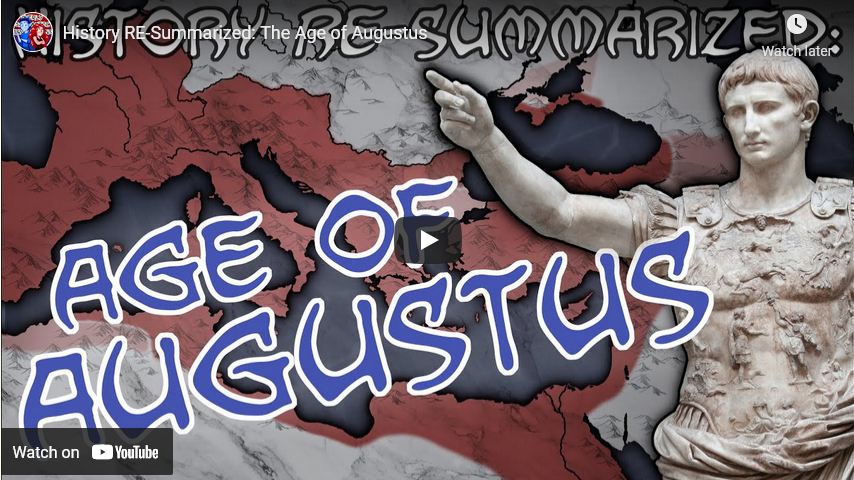
History RE-Summarized: The Age of Augustus
Overly Sarcastic Productions
Published 19 Mar 2021Many Romans had conquered the Republic, but nobody could keep it, until Augustus. In the half century after the assassination of Caesar, his adoptive son would fundamentally transform the Roman state: expanding it, reforming it, and bringing it under the control of one man. The Age of Augustus found Rome a Republic and left it an Empire.
This video is a Remastered, Definitive Edition of three previous videos from this channel — History Summarized: “Augustus Versus The Assassins”, “Augustus Versus Antony”, and “How Augustus Made An Empire”. This video combines them all into one narrative, fully upgrading all of the visuals and audio. If you want more Histories to be Re-Summarized, please comment and let me know!
SOURCES & Further Reading: The Age of Augustus by Werner Eck, Augustus and the Creation of the Roman Empire by Ronald Mellor, Cleopatra: A Life by Stacy Schiff, Virgil’s Aeneid, Polybius’ Histories, Livy’s Ab Urbe Condita, Plutarch’s Parallel Lives, SPQR by Mary Beard, Rome: A History in Seven Sackings by Matt Kneale, (and also my degree in Classical Studies).
SECTION TIME-CODES:
0:00 1 — Octavian V. the Assassins
07:40 2 — Octavian V. Antony
17:36 3 — Augustus as EmperorOur content is intended for teenage audiences and up.
PATREON: https://www.Patreon.com/OSP
PODCAST: https://overlysarcasticpodcast.transi…
DISCORD: https://discord.gg/osp
MERCH LINKS: http://rdbl.co/osp
OUR WEBSITE: https://www.OverlySarcasticProductions.com
Find us on Twitter https://www.Twitter.com/OSPYouTube
Find us on Reddit https://www.Reddit.com/r/OSP/
May 17, 2020
Cicero’s Finest Hour (44 to 43 B.C.E.)
Historia Civilis
Published 16 May 2020Patreon | http://patreon.com/HistoriaCivilis
Donate | http://www.paypal.com/cgi-bin/webscr?…
Merch | teespring.com/stores/historiacivilis
Twitter | http://twitter.com/HistoriaCivilis
Website | http://historiacivilis.comSources:
Cicero, “Letters to Atticus” | https://amzn.to/3b8EQby
Cicero, “The Philippics” | https://amzn.to/35EHcOe
Suetonius, “The Life of Julius Caesar” | https://amzn.to/2xJesHH
Plutarch, “The Life of Julius Caesar” | https://amzn.to/35DG6lZ
Plutarch, “The Life of Cicero” | https://amzn.to/2Laca7w
Plutarch, “The Life of Brutus” | https://amzn.to/2SLaWUC
Nicolaus of Damascus, “The Life of Augustus” | https://amzn.to/3dlQeCg
Appian, “The Civil Wars: Book 3” | https://amzn.to/2WbJXU4
Cassius Dio, “Roman History: Book 44” | https://amzn.to/35HC4ce
Cassius Dio, “Roman History: Book 45” | https://amzn.to/35HC4ce
Cassius Dio, “Roman History: Book 46” | https://amzn.to/2WDNIka
—
Barry Strauss, “The Death of Caesar: The Story of History’s Most Famous Assassination” | https://amzn.to/2WAUxTD
Tom Holland, “Dynasty: The Rise and Fall of the House of Caesar” | https://amzn.to/2zjG4n4
Adrian Goldsworthy, “Antony and Cleopatra” | https://amzn.to/2L8MQ1F
Anthony Everitt, “Cicero: The Life and Times of Rome’s Greatest Politician” | https://amzn.to/3bbrKKM
Tom Holland, “Rubicon” | https://amzn.to/3dombKn
Adrian Goldsworthy, “Augustus” | https://amzn.to/3fAInmD
Anthony Everitt, “Augustus: The Life of Rome’s First Emperor” | https://amzn.to/2Wf9CLH
Adrian Goldsworthy, “Caesar: Life of a Colossus” | https://amzn.to/3cfFQvUMusic:
“Moving Forward,” by Adi Goldstein
“Blonde,” by Nctrnm
“Heliograph,” by Chris Zabriskie
“The House Glows (With Almost No Help),” by Chris Zabriskie
“Hallon,” by Christian BjoerklundWe are a participant in the Amazon Services LLC Associates Program, an affiliate advertising program designed to provide a means for us to earn fees by linking to Amazon.com and affiliated sites.

January 2, 2020
Divine Caesar Augustus, Master of Propaganda – January 1, 2020 – TimeGhost of Christmas Past Day 9
TimeGhost History
143K subscribers
Dissent This
Julius Caesar was already associated with the Divine during his life. But two years after his death, he was officially declared so by the Senate of Rome. Very much to benefit of his cousin, Octavian.Join us on Patreon: https://www.patreon.com/TimeGhostHistory
Hosted by: Indy Neidell
Written by: Joram Appel
Directed and Produced by: Spartacus Olsson and Astrid Deinhard
Executive Producers: Bodo Rittenauer, Astrid Deinhard, Indy Neidell, Spartacus Olsson
Creative Producer: Joram Appel
Post-Production Director: Wieke Kapteijns
Research by: Joram Appel
Edited by: Karolina Dołęga
Sound design: Marek KamińskiSources:
Wellcome Library no. 42647i
Calendar by Lorena Salagre from the Noun ProjectMusic from Epidemic Sound Library:
“A Sleigh Ride Into Town” – Howard Harper-Barnes
“Ancient Saga” – Max Anson
“Thunder Storm 01” – Fredrik EkstromA TimeGhost chronological documentary produced by OnLion Entertainment GmbH.
From the comments:
TimeGhost History
1 week ago
Happy New Year! We have some amazing videos coming up in the new year, but not before we publish the final instalment of our TimeGhost of Christmas Past episode. This one is my personal favourite, as I’m a huge fan of the late Roman Republic and early Empire as a historical study object. So when we were dividing the Christmas episodes among the research team, I fought for this one to be on the list. I had a blast writing it (surprisingly, I don’t get to write about Caesar that often for the WW2 Channel) and I hope you all enjoy watching it.
Cheers,
Joram

December 11, 2014
QotD: Favourite expressions of the Emperor Augustus
“What about Apollo?” interrupted Vinicianus. “I never heard that Apollo was married. That seems to me a very lame argument.” The Consul called Vinicianus to order. It was clear that the word “lame” was intended offensively. But I was accustomed to insults and answered quietly: “I have always understood that the god Apollo remains a bachelor either because he is unable to choose between the Nine Muses, or because he cannot afford to offend eight of them by choosing the other as his bride. And he is immortally young, and so are they, and it is quite safe for him to postpone his choice indefinitely; for they are all in love with him, as the poet What’s-his-name says. But perhaps Augustus will naturally persuade him to do his duty by Olympus, by taking one of the Nine in honourable wedlock, and raising a large family — ‘as quick as boiled asparagus’.”
Vinicianus was silenced in the burst of laughter that followed, ‘quick as boiled asparagus’ was one of Augustus’s favourite expressions. He had several others: ‘As easily as a dog squats’ and ‘There are more ways than one of killing a cat’ and ‘You mind your own business, I’ll mind mine’ and ‘I’ll see that it gets done on the Greek Kalends’ (which, of course, means never) and ‘The knee is nearer than the shin’ (which means that one’s first concern is with matters that affect one personally). And if anyone tried to contradict him on a point of literary scholarship, he used to say: ‘A radish may know no Greek, but I do’. And whenever he was encouraging anyone to bear an unpleasant condition patiently he always used to say: ‘Let us content ourselves with this Cato’. From what I have told you about Cato, that virtuous man, you will easily understand what he meant. I now found myself often using these phrases of Augustus’s: I suppose that this was because I had consented to adopt his name and position. The handiest was the one he used when he was making a speech and had lost his way in a sentence — a thing that constantly happens to me, because I am inclined, when I make an extempore speech, and in historical writing too when I am not watching myself, to get involved in long, ambitious sentences — and now I am doing it again, you notice. However, the point is that Augustus, whenever he got into a tangle, used to cut the Gordian knot, like Alexander, saying ‘Words fail me, my Lords. Nothing that I might utter could possibly match the depth of my feelings in this matter.”
Robert Graves, Claudius the God, 1935.


