
Forgotten Weapons
Published on 24 Aug 2018Note: In the video I mistakenly describe this as a two-stamp NFA gun. It is actually deactivated, and thus does not require a tax stamp. Sorry for the mistake!
http://www.patreon.com/ForgottenWeapons
The Swedish Bofors company developed their 40mm antiaircraft gun in the 1930s, and it would go on to be one of the most successful weapon designs in modern history. Used by both sides in WWII and in all theaters, improved versions of the 40mm Bofors gun continue to serve in military front lines to this very day. In the US, they comprise part of the armament on the AC-130 Spectre gunships, for example.
This particular gun is a WW2 vintage piece, made in Sweden. Most of the examples used by the United States were made under license by Chrysler, the car company. Something like 60,000 were produced during the war, mostly for naval use. These guns would be a mainstay of American vessels’ air defense against Japanese Kamikaze attacks.
If you enjoy Forgotten Weapons, check out its sister channel, InRangeTV! http://www.youtube.com/InRangeTVShow
August 25, 2018
Swedish Antiaircraft Artillery: Bofors 40mm Automatic Gun M1
July 30, 2018
Forgotten History: World’s Biggest Black Powder Cannon – a 100-Ton Gun
Forgotten Weapons
Published on 10 Jul 2018http://www.patreon.com/ForgottenWeapons
The largest muzzleloading black powder cannons ever built were the Armstrong 100-ton guns which saw service with the Italian Navy and with British coastal fortifications on Malta and Gibraltar. They were purchased by the Italians first, to outfit a pair of new super battleships, each vessel having two turrets with two of these guns in each. To avoid being outclassed, the British ordered two guns for installation to protect the Grand Harbor of Malta and two more to protect Gibraltar. Today one survives at each location, and we are visiting the Rinella Battery in Malta, which was built to house one of the Maltese guns.
These guns had a maximum range of 8 miles, and was capable of piercing 15 inches of iron armor at 3 miles. It had a 17.7 inch (45cm) bore fired a 2000 pound (900 kg) shell with a 450 pound (200kg) charge of black powder. The gun itself weighed approximately 102 tons, and with its cradle and a shell the whole assembly came in at 150 tons.
Aside from the massive scale of the piece, the most interesting part of its design is actually the loading machinery. Because of the titanic size of the gun and ammunition, Armstrong designed a fascinating hydraulic reloading facility which makes up the body of the fortress in which the gun is set. A pair of steam engines drove a pair of hydraulic accumulators, which provided hydraulic pressure to move the gun on its carriage, to douse the barrel after firing, to hoist ammunition into position for loading and power a 60-foot (18m) ramrod to mechanically ram the charge and shell into place. Two mirror-image reloading galleries under the fortification operated in turn, giving the gun a sustained rate of fire of 1 round every 6 minutes – at least until its 120-round barrel life was exhausted.
I am grateful for the Malta Tourism Authority’s assistance in helping to make this visit and video possible, and would also like to give special thanks to Simon, our awesome reenactor guide!
If you enjoy Forgotten Weapons, check out its sister channel, InRangeTV! http://www.youtube.com/InRangeTVShow
July 22, 2018
Austro-Hungarian Artillery – Choctaw Code Talkers I OUT OF THE TRENCHES
The Great War
Published on 21 Jul 2018
June 3, 2018
Conrad von Hötzendorf – A Military Genius? I OUT OF THE TRENCHES
The Great War
Published on 2 Jun 2018Chair of Wisdom Time!
June 1, 2018
50 Miles To Paris – Third Battle Of The Aisne I THE GREAT WAR Week 201
The Great War
Published on 31 May 2018The German spring offensive has lost some traction over the past few weeks but the Allies are still under pressure. With Operations Blücher and York, the Germans are getting within 50 miles of Paris again, just as they did in 1914.
May 8, 2018
Charge of the Light Brigade | Animated History
The Armchair Historian
Published on 28 Dec 2017The Charge of the Light Brigade, Animated History
March 31, 2018
Firing the 30-pounder rifled Parrott cannon at Fort Pulaski, GA
Stagecoacher
Published on 21 Jun 2015June 13, 2015. I silenced portions of the video because of wind noise. The actual report was much louder than it sounds in the video. My digital camera could not capture a sound that loud. http://jimjanke.com
March 28, 2018
Backs To The Wall – All Eyes On Amiens I THE GREAT WAR Week 192
The Great War
Published on 27 Mar 2018The German Operation Michael continues this week and after some uncertainty, the Germans put their eyes on Amiens. The city is a vital communications and transport hub for the Entente and so Ferdinand Foch decides to mount a defence in front of the city.
March 23, 2018
Kaiserschlacht – German Spring Offensive 1918 I THE GREAT WAR Week 191
The Great War
Published on 22 Mar 2018It was all or nothing for the German Army under General Erich Ludendorff now: They unleashed the biggest offensive of the entire war on the Western Front trying to split the British and French Armies, drive the British off the continent and capture Paris.
March 16, 2018
The Imperial German Army’s final throw of the dice – Operation Michael, March 1918
Victor Davis Hanson summarizes the Central Powers’ brief moment of strength early in 1918:
One hundred years ago this month, all hell broke loose in France. On March 21, 1918, the German army on the Western Front unleashed a series of massive attacks on the exhausted British and French armies.
German General Erich Ludendorff thought he could win World War I with one final blow. He planned to punch holes between the French and British armies. Then he would drive through their trenches to the English Channel, isolating and destroying the British army.
The Germans thought they had no choice but to gamble.
The British naval blockade of Germany after three years had reduced Germany to near famine. More than 200,000 American reinforcement troops were arriving each month in France. (Nearly 2 million would land altogether.) American farms and factories were sending over huge shipments of food and munitions to the Allies.
Yet for a brief moment, the war had suddenly swung in Germany’s favor by March 1918. The German army had just knocked Russia and its new Bolshevik government out of the war. The victory on the Eastern Front freed up nearly 1 million German and Austrian soldiers, who were transferred west.
Germany had refined new rolling artillery barrages. Its dreaded “Stormtroopers” had mastered dispersed advances. The result was a brief window of advantage before the American juggernaut changed the war’s arithmetic.
The Spring Offensive almost worked. Within days, the British army had suffered some 50,000 casualties. Altogether, about a half-million French, British and American troops were killed or wounded during the entire offensive.
But within a month, the Germans were sputtering. They could get neither supplies nor reinforcements to the English Channel. Germany had greedily left 1 million soldiers behind in the east to occupy and annex huge sections of conquered Eastern Europe and western Russia.
The British and French had learned new ways of strategic retreat. By summer of 2018, the Germans were exhausted. In August, the Allies began their own (even bigger) offensive and finally crushed the retreating Germans, ending the war in November 1918.
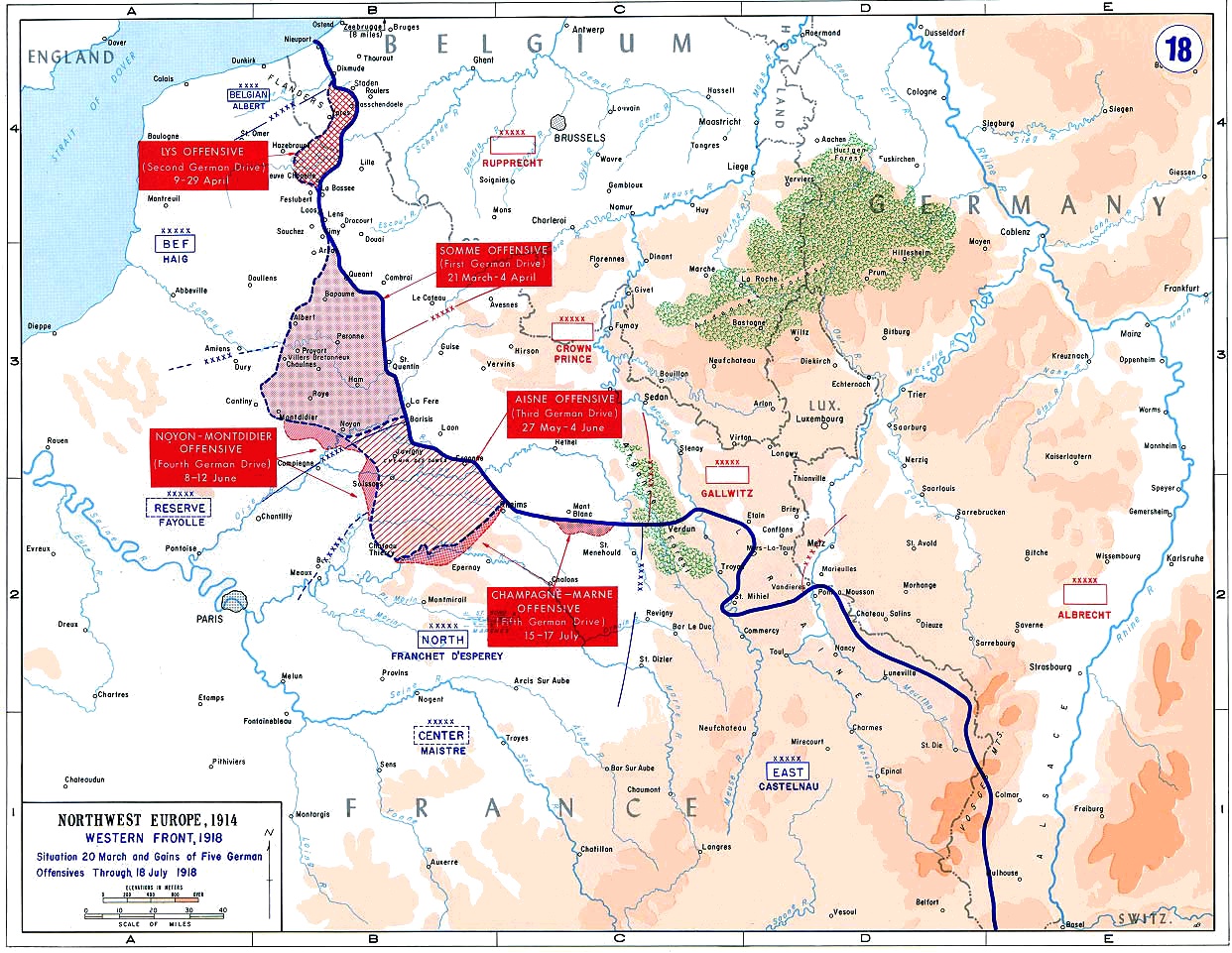
Click to see full-sized image.
For more information on Operation Michael, sometimes known as “The Kaiser’s Battle”, here’s the Wikipedia entry.
March 13, 2018
German Tactics For 1918 Spring Offensive I THE GREAT WAR Special
The Great War
Published on 12 Mar 2018The German Spring Offensive in 1918, the so called Kaiserschlacht or Operation Michael, was the biggest German offensive of World War 1 and Quartermaster-general Erich Ludendorff prepared his troops for this battle by incorporating everything the German Army had learned in this war until now. Hutier Infiltration Tactics, Georg Bruchmüller’s artillery targeting and more lessons from the Eastern Front mean the Entente was facing a different army than before.
March 7, 2018
Tank Chats #23 Hornsby Tractor | The Tank Museum
The Tank Museum
Published on 15 Jul 2016In the 23rd Tank Chat, David Fletcher takes a look at the Hornsby Tractor. The Hornsby Tractor was the first tracked vehicle in service with the British Army. They were designed to tow artillery.
The Museum’s example is still running and is the oldest vehicle in the collection.
http://tankmuseum.org/museum-online/vehicles/object-e1958-15
March 6, 2018
Cannon loading in the eighteenth century
Lindybeige
Published on 24 Sep 2015In Fort Rinella. Kalkara, Malta, every day, they put on a show of loading and firing cannons, and members of the public are invited (for a fee) to fire them off.
The cannon shown are eighteenth century barrels mounted on more modern carriages. The uniforms worn by the crew do not match those worn by eighteenth century artillerymen, but these same men were just minutes before performing a Victorian infantry drill, and are still dressed for that.
The loading process shown here is not complete, because it lacks the vital stage of ramming in the ball and wadding. The carriages each have a stopper behind them, securely fixed down into the ground, so that they do not recoil backwards dangerously, and since no heavy ball is being fired, there is not nearly so much recoil as there would be in a battle.
See also: http://www.fortrinella.com
Lindybeige: a channel of archaeology, ancient and medieval warfare, rants, swing dance, travelogues, evolution, and whatever else occurs to me to make.
February 23, 2018
Artillery Combat in World War 1
Military History Visualized
Published on 6 Jun 2016This video will focus on how the use of Artillery changed throughout the war and cover some of the many major innovations. Artillery tactics changed to a large degree from 1914 to 1918, whereas in 1914 the use of artillery in tactics and techniques had still a strong resemblance to the Napoleonic era, in 1918 the foundations of a modern artillery is clearly recognizable. Although the basic principles of indirect fire, massed fire, counter-battery fire, calibration and meteorological corrections and combined arms were known, they were usually not applied on the field in 1914, yet in 1918 these principles were used consistently and to a large degree by all sides.
Script and further information: http://militaryhistoryvisualized.com/artillery-combat-in-the-first-world-war/
January 9, 2018
German Anti-Tank Units – Herman Göring – Caltrops I OUT OF THE TRENCHES
The Great War
Published on 8 Jan 2018Ask your questions here: http://outofthetrenches.thegreatwar.tv


