Quotulatiousness

August 24, 2019

“82nd All The Way” – Alvin York – Sabaton History 029 [Official]

Filed under: History, Media, Military, USA, WW1 — Tags: , , — Nicholas @ 04:00

Sabaton History
Published on 22 Aug 2019

When the Americans joined the Great War in Europe, the 82nd “All American” division was the division that would engage in heavy fighting at St Mihiel. Among them was Alvin York, leading his battalion at the ferocious Battle of Hill 223.

Support Sabaton History on Patreon: https://www.patreon.com/sabatonhistory

Listen to The Great War (Where “82nd All the Way” is featured):
CD: http://nblast.de/SabatonTheGreatWar
Spotify: https://sabat.one/TheGreatWarSpotify
Apple Music: https://sabat.one/TheGreatWarAppleMusic
iTunes: https://sabat.one/TheGreatWarItunes
Amazon: https://sabat.one/TheGreatWarAmazon
Google Play: https://sabat.one/TheGreatWarGooglePlay

Watch the official music video for “82nd All the Way” right here: https://www.youtube.com/watch?v=0LS0Z…

Hosted by: Indy Neidell
Written by: Markus Linke and Indy Neidell
Directed by: Astrid Deinhard and Wieke Kapteijns
Produced by: Pär Sundström, Astrid Deinhard and Spartacus Olsson
Creative Producer: Joram Appel
Executive Producers: Pär Sundström, Joakim Broden, Tomas Sunmo, Indy Neidell, Astrid Deinhard, and Spartacus Olsson
Maps by: Eastory
Edited by: Iryna Dulka
Sound Editing by: Marek Kaminski

Eastory YouTube Channel: https://www.youtube.com/channel/UCEly…
Archive by: Reuters/Screenocean https://www.screenocean.com
Music by Sabaton.

Sources:
– IWM: Q 516, 23706
– National Library of Scotland: 3155
Saturday Evening Post scan and Alvin York portraits courtesy of the Tennessee State Library & Archives.
– National WWI Museum and Memorial
– Alvin York colorized by Chiel Zilverberg

An OnLion Entertainment GmbH and Raging Beaver Publishing AB co-Production.

© Raging Beaver Publishing AB, 2019 – all rights reserved.

From the comments:

Sabaton History
2 days ago
This video is about the 82nd Division who, together with Sergeant Alvin York stormed Hill 223 in September 1918. Just before that, the “Lost Battalion” made a stand against German forces in the same area. We have made an episode about the Sabaton Song “Lost Battalion” as well, which you can watch right here: https://youtu.be/pgNxijbDlJM

We love the reception of our weekly videos, and have some great stuff coming up over coming weeks. We want as many of our fans to see this, so make sure to share this channel with your friends, family, neighbours, colleagues, teachers and other loved ones. You’d be doing them and us a real favour! Cheers!

August 16, 2019

QotD: It’s not really accurate to call the French “cheese-eating surrender monkeys”

Filed under: Europe, France, Germany, History, Military, Quotations, WW2 — Tags: , , — Nicholas @ 01:00

It is a truth universally acknowledged that, en masse if not individually, E2 has a slight nagging tendency towards anti-French sentiment. For the Brits it’s sort of traditional/historic, dating back to the Hundred Years War and all that (in which the English gloriously won, as they will be sure to note, at Crecy and Agincourt; strangely, at the end of it all, the French owned all of France, including the bits that the English had owned previously) and quite a lot of subsequent ones, mainly fought in Belgium, while for the Americans it seems to be something to do with the fact that they needed French help to run a revolution properly, along with the proximity of uppity Quebeckers and the fact that the French are marginally less prepared than the rest of the world to roll over and be McDisneyfied™; not being one I can’t say definitively. But I digress.

When it comes to military history, this particular bias mostly comes out in references to three weeks in May 1940, and specifically one piece of particularly crap judgement by General Gamelin and one bypassed fortress line. The fact that that the allied participants — France, Britain, the Netherlands and Belgium — have spent most of the time since blaming each other and trying to work out who sold out whom has been allowed to mask the fact that this particular campaign was successful beyond all reasonable expectations for the Germans, and that when the French actually had troops in the right places, they were perfectly capable of fighting the advancing Panzers to a standstill at a tactical or operational level. Visitors to Paris may wish to note that the big — rather bigger than you think until you actually see it in the flesh — structure at one end of the Champs Elysées is called the Arc de Triomphe, and not the Arc de Defaite; it bears an admittedly tedious and tasteless, but indubitably long, list of battles at which the French did rather well. The fact that your school history lessons may have taught you rather more about Paul Revere or Clive of India than about Charles Martel is not relevant in the greater scheme of things.

Albert Herring, “Why neither the French nor the Italians are the worst military nation”, Everything2, 2002-01-07.

August 10, 2019

Sulla’s dictatorships

Filed under: Europe, Government, History, Politics, USA — Tags: , , , , , — Nicholas @ 03:00

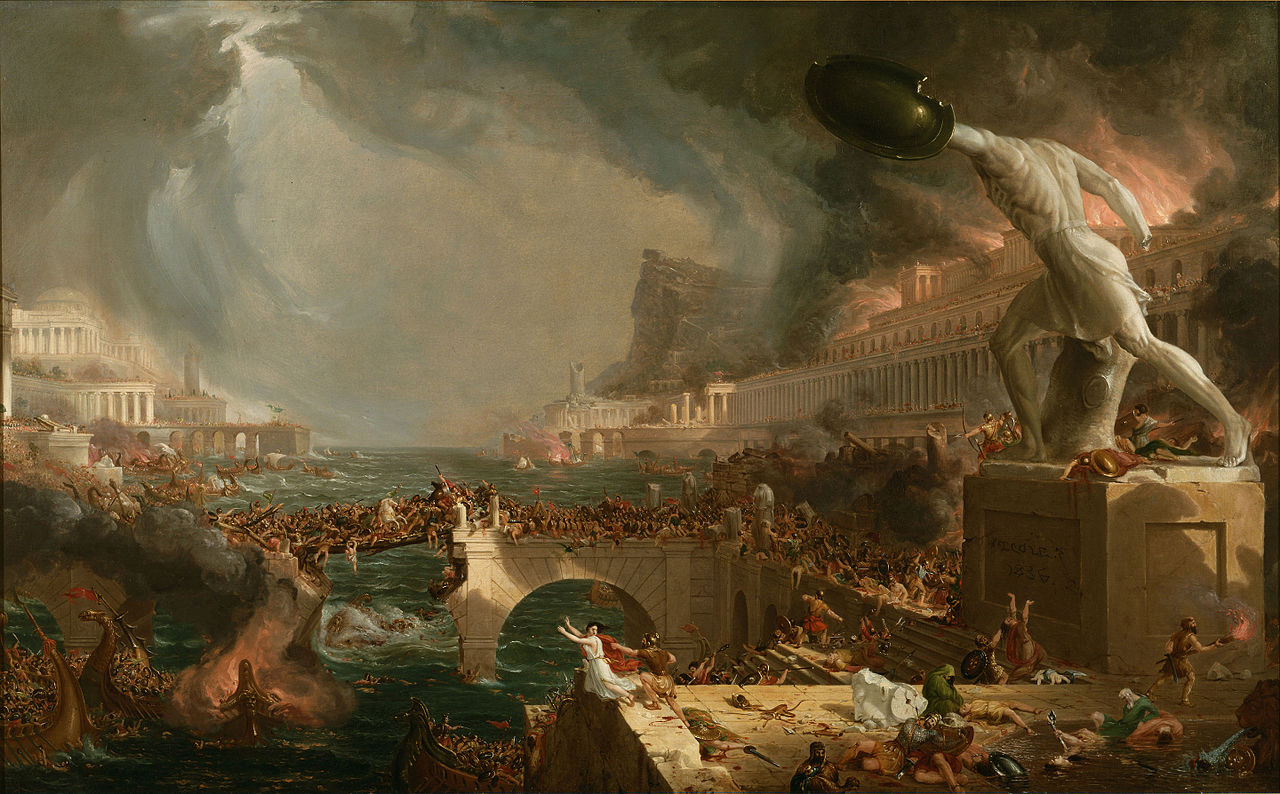
In New York magazine, Andrew Sullivan portrays the current state of the American Republic in light of the late history of the Roman Republic:

This 54 B.C. coin bears the portrait of the dictator Sulla. The moneyer was Q. Pompeius Rufus, the grandson of Sulla and his home would likely have had portraits of their famous ancestor. Thus, although posthumously struck, the portrait on these coins is probably an accurate representation.
Photo by CNG via Wikimedia Commons.

… zoom out a little more and one obvious and arguably apposite parallel exists: the Roman Republic, whose fate the Founding Fathers were extremely conscious of when they designed the U.S. Constitution. That tremendously successful republic began, like ours, by throwing off monarchy, and went on to last for the better part of 500 years. It practiced slavery as an integral and fast-growing part of its economy. It became embroiled in bitter and bloody civil wars, even as its territory kept expanding and its population took off. It won its own hot-and-cold war with its original nemesis, Carthage, bringing it into unexpected dominance over the entire Mediterranean as well as the whole Italian peninsula and Spain.

And the unprecedented wealth it acquired by essentially looting or taxing every city and territory it won and occupied soon created not just the first superpower but a superwealthy micro-elite — a one percent of its day — that used its money to control the political process and, over time, more to advance its own interests than the public good. As the republic grew and grew in size and population and wealth, these elites generated intense and increasing resentment and hatred from the lower orders, and two deeply hostile factions eventually emerged, largely on class lines, to be exploited by canny and charismatic opportunists. Well, you get the point.

After the overthrow of the monarchy, the new Republic went from strength to strength, struggling against and generally beating and absorbing other city states in the Italian peninsula, eventually rising to face the challenge of Carthage, the dominant power in the western Mediterranean. The eventual Roman victory over Carthage left Rome the superpower of its age, able to dominate and control even the remaining “great” powers of the eastern Mediterranean world. One of the costs of military dominance was an over-reliance on its citizen armies, which eventually changed the entire economy of the Republic, switching from largely small-holding farmers (who were subject to legionary service) to larger slave-worked farms that displaced the families of free citizens from their lands. The result was a constant inflow of impoverished rural citizens to the urban centres, especially Rome itself.

The newly enlarged urban poor found champions to push for reforms to aid them in their plight, the first of whom was Tiberius Gracchus (Extra Credits did a short video series on the Brothers Gracchi: Part I, Part II, Part III, Part IV, Part V, and an extra commentary video). The defeat and death of the Gracchi brothers by agents of the Patrician order led, as you might expect, to yet more polarization and further violent political struggle. This process was hastened by the conflict between Marius and his former protégé Sulla:

As the turn of the first century BCE approached and wars proliferated, with Roman control expanding west and east and south across the Mediterranean, the elites became ever wealthier and the cycle deepened. Precedents fell: A brilliant military leader, Marius, emerged from outside the elite as consul, and his war victories and populist appeal were potent enough for him to hold an unprecedented seven consulships in a row, earning him the title “the third founder of Rome.” Like the Gracchi, his personal brand grew even as republican norms of self-effacement and public service attenuated. In a telling portent of the celebrity politics ahead, for the first time, a Roman coin carried the portrait of a living politician and commander-in-chief: Marius and his son in a chariot.

A dashing military protégé (and rival) of Marius, Sulla, was the next logical step in weakening the system — a popular and highly successful commander whose personal hold on his soldiers appeared unbreakable. Tasked with bringing the lucrative East back under Rome’s control, he did so with gusto, prompting a somewhat nervous Senate to withdraw his command and give it to his aging (and jealous) mentor Marius. But Sulla, appalled by the snub, simply refused to follow his civilian orders, gathered his men, and called on them to march back to Rome to reverse the decision. His officers, shocked by the insubordination, deserted him. His troops didn’t, soon storming Rome, restoring Sulla’s highly profitable command, and forcing his enemies into exile. Sulla then presided over new elections of friendly consuls and went back into the field. But his absence from Rome — he needed to keep fighting to reward his men to keep them loyal — enabled a comeback of his enemies, including Marius, who retook the city in his absence and revoked Sulla’s revocations of command. Roman politics had suddenly become a deadly game of tit for tat.

When Sulla entered Rome a second time, he rounded up 6,000 of his enemies, slaughtered them en masse within earshot of the Senate itself, launched a reign of terror, and assumed the old emergency office of dictator, but with one critical difference: He removed the six-month expiration date — turning himself into an absolute ruler with no time limit. Stocking and massively expanding the Senate with his allies, he neutered the tribunes and reempowered the consuls. He was trying to use dictatorial power to reestablish the old order. And after three years, he retired, leaving what he thought was a republic restored.

Within a decade, though, the underlying patterns deepened, and nearly all of Sulla’s reforms collapsed. What lasted instead was his model of indefinite dictatorship, with the power to make or repeal any law. He had established a precedent that would soon swallow Rome whole.

August 4, 2019

QotD: The post-WW2 American army

Filed under: Asia, China, History, Military, Quotations, USA — Tags: , , , , — Nicholas @ 01:00

The men of the Inmun Gun and the CCF were peasant boys, tough, inured to hunger and hardship. One-third of them had been in battle and knew what battle meant. They had been indoctrinated in Communism, but no high percentage of them were fanatic. Most of them, after all, were conscripts, and unskilled.

They were not half so good soldiers as the bronzed men who followed Rommel in the desert, or the veterans who slashed down toward Bastogne.

They were well armed, but their weapons were no better than those of United States design, if as good.

But the American soldier of 1950, though the same breed of man, was not half so good as the battalions that had absorbed Rommel’s bloody lessons, or stood like steel in the Ardennes.

The weapons his nation had were not in his hands, and those that were were old and worn.

Since the end of World War II ground weapons had been developed, but none had been procured. There were plenty of the old arms around, and it has always been a Yankee habit to make do. The Army was told to make do.

In 1950 its vehicles in many cases would not run. Radiators were clogged, engines gone. When ordered to Korea, some units towed their transport down to the LST’s, because there was no other way to get it to the boat. Tires and tubes had a few miles left in them, and were kept — until they came apart on Korean roads.

In Japan, where the divisions were supposedly guarding our former enemies, most of the small arms had been reported combat unserviceable. Rifle barrels were worn smooth. Mortar mounts were broken, and there were no longer any spare barrels for machine guns.

Radios were short, and those that were available would not work.

Ammunition, except small arms, was “hava-no.”

These things had been reported. The Senate knew them; the people heard them. But usually the Army was told, “Next year.”

Even a rich society cannot afford nuclear bombs, supercarriers, foreign aid, five million new cars a year, long-range bombers, the highest standard of living in the world, and a million new rifles.

Admittedly, somewhere you have to cut and choose.

But guns are hardware, and man, not hardware, is the ultimate weapon. In 1950 there were not enough men, either — less than 600,000 to carry worldwide responsibilities, including recruiting; for service in the ranks has never been on the Metropolitan Life Insurance Company’s preferred list of occupations.

T.R. Fehrenbach, This Kind of War: A Study in Unpreparedness, 1963.

July 30, 2019

Units of Classical Antiquity: The Praetorian Guard (Roman Army)

Filed under: Europe, History, Military — Tags: , , — Nicholas @ 04:00

Invicta
Published on 18 Mar 2016

Who were the Praetorian Guard? Special Forces, dictatorial musclemen, or ceremonial relics? In this documentary episode we dive deep into the history of this feared unit of the Roman empire!

July 29, 2019

QotD: Put up your dukes!

Filed under: Britain, History, Military, Quotations — Tags: , , — Nicholas @ 01:00

Arthur Wellesley, 1st Duke of Wellington (1769–1852) by Thomas Lawrence, circa 1815-1816.
Wikimedia Commons.

The phrase “duke it out”, meaning “fight”, appears to derive ultimately from a nickname of one of the Great Captains, the Duke of Wellington (1769-1852).

It seems that the Duke had a rather prominent nose, so distinctive, in fact, that his troops often referred to him as “Old Nosey”. So the word “duke” soon became a synonym for “nose” in working class English slang, attested during Wellington’s own lifetime. That, in turn, led to the rise of the threat “bust your duke”, meaning “punch your nose”, and thus to “duke buster” as slang for “fist”, which was soon shortened to “duke”.

By further evolution, the phrase “put up your dukes” developed as an invitation to fight and “duke it out” became slang for “fight”.

While some etymologists apparently do not agree with this derivation, it’s worth noting that there is in London a mini-monument to the ducal proboscis, suggesting how notable it was.

Al Nofi, “Al Nofi’s CIC, Issue 472”, Strategy Page, 2019-06-01.

July 18, 2019

The Allied Occupation of Germany After The Treaty of Versailles I THE GREAT WAR July 1919

Filed under: Britain, France, Germany, History, Military, WW1 — Tags: , , , , , — Nicholas @ 04:00

The Great War
Published on 17 Jul 2019

When the Allied armies marched into German territory in late 1918 under the terms of the armistice, they were surprised to see a relatively untouched land. After the signing of the Treaty of Versailles, the Allied Occupation was made permanent and the troops settled in to stay in a country that did not want them there initially.

» SUPPORT THE CHANNEL
Patreon: https://www.patreon.com/thegreatwar
Merchandise: https://shop.spreadshirt.de/thegreatwar/

» SOURCES
Leonhard, Jörn. Der überforderte Frieden. Versailles und die Welt 1918-1923 (CH Beck, 2018)
Macmillan, Margaret. The Peacemakers: Six Months that Changed the World (London: John Murray, 2001).
Le Naour, Jean-Yves. La Honte noire (Hachette, 2004).
Schröder, Joachim, Watson, Alexander. “Occupation during and after the War (Germany)” in: 1914-1918-online. International Encyclopedia of the First World War https://encyclopedia.1914-1918-online…
Roos, Julia. “Schwarze Schmach” in: 1914-1918-online. International Encyclopedia of the First World War https://encyclopedia.1914-1918-online…
Godfroid, Anne. “Occupation after the War (Belgium and France)” in: 1914-1918-online. International Encyclopedia of the First World War https://encyclopedia.1914-1918-online…
Pawley, Margaret. The Watch on the Rhine: The Military Occupation of the Rhineland, 1918-1930 (I.B.Tauris, 2007).
Hart, Keith. “A Note on the Military Participation of Siam in WWI.” Journal of the Siam Society (ndp): 133–136.
Lauter, Anna-Monika. Sicherheit und Reparationen. Die französische Öffentlichkeit, der Rhein und die Ruhr (1919-1923) (Essen: Klartext, 2006).
Krugler, Gilles. “Allemagne decembre 1918. Les premières heures de l’occupation“. In Revue historique des armées 254 (2009): 76-81. https://journals.openedition.org/rha/…
Mignon, Nicolas. “Boche, ex-ennemie ou simplement femme? Le point de vue des responsables politiques et militaires sur la question des mariages entre militaires belges et femmes allemandes pendant les occupations de la Rhénanie et de la Ruhr (1918-1929).” In Revue belge de Philologie et d’Histoire (2013) 91-4 : 1259-1283.

»CREDITS

Presented by: Jesse Alexander
Written by: Jesse Alexander
Director: Toni Steller & Florian Wittig
Director of Photography: Toni Steller
Sound: Toni Steller
Editing: Toni Steller
Mixing, Mastering & Sound Design: http://above-zero.com
Motion Design: Christian Graef – GRAEFX
Maps: Daniel Kogosov (https://www.patreon.com/Zalezsky)
Research by: Jesse Alexander
Fact checking: Florian Wittig

Channel Design: Alexander Clark
Original Logo: David van Stephold

A Mediakraft Networks Original Channel

Contains licensed material by getty images
All rights reserved – Real Time History GmbH 2019

July 11, 2019

Unofficial High Speed Tour of Borden Base Military Museum

Filed under: Cancon, History, Military, WW2 — Tags: , , , , , — Nicholas @ 02:00

The_Chieftain
Published on 8 Jun 2019

Canadian Forces Base Borden is located about an hour’s drive North of Toronto. The base is open access, so anyone can go to the museum.

In addition to the vehicles at the museum, there are others scattered as monuments around the base. I encountered a T-72 and T-55 on my way out the gate.

June 11, 2019

TAB Episode 48: QF 6pdr Anti-Tank Gun

Filed under: Britain, History, Military, Weapons, WW2 — Tags: , , — Nicholas @ 02:00

The Armourer’s Bench
Published on Apr 28, 2019

The 6pdr AT Gun was introduced in 1942, joining the lighter 2pdr, the new gun was more capable of dealing with the increasing thickness of Axis armour. The 6pdr first saw action in North Africa and was used throughout the war in Europe and Asia. It also armed a series of British armoured cars, tanks, ships and even aircraft!

In this video Matt looks at the history, development and use of Britain’s second dedicated anti-tank gun.
Check out our accompanying blog on the 6pdr AT Gun over at: http://armourersbench.com/2019/04/28/the-6pdr-qf-anti-tank-gun/

If you enjoyed the video please consider supporting our work via Patreon, TAB is a viewer supported, non-monetised channel and any help is very much appreciated!
Check out our Patreon page here: https://www.patreon.com/thearmourersb…

Where to find TAB:
https://armourersbench.com
https://imgur.com/user/ArmourersBench
https://discord.gg/DAjRSBc

Don’t forget to like, share and subscribe and spread the word!

June 9, 2019

Making the legendary service Khukuri/Kukri of British Gurkhas – KHHI Nepal

Filed under: Asia, History, Technology, Weapons — Tags: , , , — Nicholas @ 02:00

KHHI Nepal
Published on 26 Mar 2018

See how a scrap of steel is converted into a piece of mastery craft by our men @ duty. All bear hands, hard labor, years of experience and great skill. Pls enjoy it!!

Is the original 2016-17 British Gurkhas Issue issued to the new recruits as their training, exercise, utility and even as a combat knife.

Product link :
https://www.thekhukurihouse.com/2016-17-british-standard-issue-bsi-2-kukri

#makingkhukuri #bsikukri #servicekukri #gurkhaknife

June 5, 2019

WWII Field Kitchen Overview

Filed under: Food, History, Military, USA, WW2 — Tags: , — Nicholas @ 02:00

Tri-State Living History Association
Published on 15 Dec 2018

The GI Field Kitchen during WWII was part of the Company HQ, designed to serve 150-180 men. They intended to serve 2 hot meals per day: Breakfast & Supper, with Dinner (Lunch) as a combat ration. They were equipped with stoves, water heaters and mermite cans to deliver the hot food to the troops.

While sound in theory, often times in reality the kitchens had to make do with less equipment and were forced to adapt to the situations in which they were forced to operate. Despite this, mess staff did their best to keep the fighting man’s body and morale fed.

Filmed at Rockford WWII Days 2018

Special thanks to Nick Yi Photography: https://www.nickyi.com/

Website: https://www.tslha.org/

Print Sources:

TM 10-405 (Apr 24, 1942) – The Army Cook

TM 10-406 (Nov 22, 1943) – Cooking Dehydrated Foods

TM 10-400 (Nov, 1944) – Stoves, Ranges, Ovens, and Cooking Outfits

TM 10-701 (Dec, 1945) – Range, Field M-1937

T/O 7-17 (Sept 1, 1942): http://www.hardscrabblefarm.com/ww2/

Footage Sources:

The Battle of San Pietro – John Huston (1945)

TF 10-1237 – Rations in the Combat Zone Part 1 – Fighting Food

TF 10-1215 – Rations in the Combat Zone Part 2 – Unit Messing

TF 10-2454 – Unit Messing in the Field

TF 10-1202 – Baking in the Field Part 1 – The M1942 Field Baking Unit

MISC 1282 – Quartermaster Activities in the European Theater

Picture Sources: 185th Field Artillery, 34th ID from the H. Smith collection: http://34thinfantry.com/photos.html

June 2, 2019

Brexit at Dunkirk – WW2 – 040 – June 1 1940

Filed under: Britain, France, Germany, History, Military, WW2 — Tags: , , , , — Nicholas @ 04:00

World War Two
Published on 1 Jun 2019

When the Germans Panzers move north from Calais, the British Expeditionary Force and France’s soldiers still fighting in Belgium and Northern France are trapped between a numerically superior German army. A big operation codenamed “Dynamo” is set up to evacuate as many as possible from Dunkirk.

Join us on Patreon: https://www.patreon.com/TimeGhostHistory
Or join The TimeGhost Army directly at: https://timeghost.tv

Follow WW2 day by day on Instagram @World_war_two_realtime https://www.instagram.com/world_war_t…
Join our Discord Server: https://discord.gg/D6D2aYN.
Between 2 Wars: https://www.youtube.com/playlist?list…
Source list: http://bit.ly/WW2sources

Written and Hosted by: Indy Neidell
Produced and Directed by: Spartacus Olsson and Astrid Deinhard
Executive Producers: Bodo Rittenauer, Astrid Deinhard, Indy Neidell, Spartacus Olsson
Creative Producer: Joram Appel
Post-Production Director: Wieke Kapteijns
Research by: Indy Neidell
Edited by: Daniel Weiss
Map animations: Eastory

Colorisations by Joram Appel, Spartacus Olsson and Norman Stewart.

Eastory’s channel: https://www.youtube.com/channel/UCEly…
Archive by Screenocean/Reuters https://www.screenocean.com.

Sources:

A TimeGhost chronological documentary produced by OnLion Entertainment GmbH.

From the comments:

World War Two
3 days ago (edited)
As many of you already know, people who support us on Patreon get three days early access to our content – which explains why some comments have been made before the video is published. We are very grateful to those who financially support us, because (as Indy mentions a lot) we really wouldn’t be able to do any of this without your support. This project is fully funded by our community and viewers. Right now, we are still very much working at the max of our capacity. That is partly because we take on new tasks whenever some time frees itself – we just can’t help making more and better content, but also because we still need more financial stability to hire more editors and researchers. Only then will we be able to deliver a steady flow of specials, Out of the Foxholes episodes and War Against Humanity videos at the quality that we would like them to be. You can support us on Patreon https://www.patreon.com/timeghosthistory or on our website http://www.timeghost.tv.

Thanks a lot!!

Cheers,
Joram

And, experimental image as fodder for social media link thumbnail:

May 20, 2019

The Evolution Of Knightly Armour – 1066 – 1485

Filed under: Europe, History, Military, Technology — Tags: , , , , — Nicholas @ 04:00

Metatron
Published on 16 May 2017

A video full of details which took over 30 hours in the making. I hope you like it and you find the info in it useful 😀

Armour (spelled armor in the US) is a protective covering that is used to prevent damage from being inflicted to an object, individual, or vehicle by weapons or projectiles, usually during combat, or from damage caused by a potentially dangerous environment or action. The word “armour” began to appear in the Middle Ages as a derivative of Old French. It is dated from 1297 as a “mail, defensive covering worn in combat”. The word originates from the Old French armure, itself derived from the Latin armatura meaning “arms and/or equipment”, with the root armare meaning “arms or gear”.

Armour has been used throughout recorded history. It has been made from a variety of materials, beginning with rudimentary leather protection and evolving through mail and metal plate into today’s modern composites.
Significant factors in the development of armour include the economic and technological necessities of its production. For instance, plate armour first appeared in Medieval Europe when water-powered trip hammers made the formation of plates faster and cheaper.

Well-known armour types in European history include the lorica hamata, lorica squamata, and lorica segmentata of the Roman legions, the mail hauberk of the early medieval age, and the full steel plate harness worn by later medieval and renaissance knights, and breast and back plates worn by heavy cavalry in several European countries until the first year of World War I (1914–15). The samurai warriors of feudal Japan utilised many types of armour for hundreds of years up to the 19th century.

Plate armour became cheaper than mail by the 15th century as it required less labour, labour that had become more expensive after the Black Death, though it did require larger furnaces to produce larger blooms. Mail continued to be used to protect those joints which could not be adequately protected by plate.
The small skull cap evolved into a bigger helmet, the bascinet. Several new forms of fully enclosed helmets were introduced in the late 14th century.

By about 1400 the full plate armour had been developed in armouries of Lombardy. Heavy cavalry dominated the battlefield for centuries in part because of their armour.

Probably the most recognised style of armour in the World became the plate armour associated with the knights of the European Late Middle Ages.

May 16, 2019

Boys Anti-Tank Rifle: Mk I and Mk I* Improvements

Filed under: Britain, Cancon, History, Military, Technology, Weapons — Tags: , , — Nicholas @ 02:00

Forgotten Weapons
Published on 11 Apr 2019

These rifles are lots #1087 and #1088 at Morphy’s April 2019 auction:
https://www.forgottenweapons.com/boys…

The Boys Anti-Tank Rifle was adopted by the British military in 1937, and remained in production until 1943 when it was replaced by the PIAT. During that time more than 114,000 were made, both in the UK and in Canada. Canadian engineers at the John Inglis company devised a number of improvements to the rifle in 1942, which were adopted as the Mk I* pattern that year. Today we are looking at these improvements with examples of each type side by side. They are a new style of muzzle brake, simplified rear sight, and improved bipod design.

http://www.patreon.com/ForgottenWeapons

Cool Forgotten Weapons merch! http://shop.bbtv.com/collections/forg…

Contact:
Forgotten Weapons
PO Box 87647
Tucson, AZ 85754

May 12, 2019

QotD: The British Army between the wars

Filed under: Britain, History, India, Military — Tags: , , , , — Nicholas @ 01:00

In the nineteenth century the British common soldier was usually a farm labourer or slum proletarian who had been driven into the army by brute starvation. He enlisted for a period of at least seven years – sometimes as much as twenty-one years – and he was inured to a barrack life of endless drilling, rigid and stupid discipline, and degrading physical punishments. It was virtually impossible for him to marry, and even after the extension of the franchise he lacked the right to vote. In Indian garrison towns he could kick the “niggers” with impunity, but at home he was hated or looked down upon by the ordinary population, except in wartime, when for brief periods he was discovered to be a hero. Obviously such a man had severed his links with his own class. He was essentially a mercenary, and his self-respect depended on his conception of himself not as a worker or a citizen but simply as a fighting animal.

Since the war the conditions of army life have improved and the conception of discipline has grown more intelligent, but the British army has retained its special characteristics – small size, voluntary enlistment, long service and emphasis on regimental loyalty. Every regiment has its own name (not merely a number, as in most armies), its history and relics, its special customs, traditions, etc., etc., thanks to which the whole army is honey-combed with snobberies which are almost unbelievable unless one has seen them at close quarters. Between the officers of a “smart” regiment and those of an ordinary infantry regiment, or still more a regiment of the Indian Army, there is a degree of jealousy almost amounting to a class difference. And there is no question that the long-term private soldier often identifies with his own regiment almost as closely as the officer does. The effect is to make the narrow “non-political” outlook of the mercenary come more easily to him. In addition, the fact that the British Army is rather heavily officered probably diminishes class friction and thus makes the lower ranks less accessible to “subversive” ideas.

But the thing which above all else forces a reactionary view-point on the common soldier is his service in overseas garrisons. An infantry regiment is usually quartered abroad for eighteen years consecutively, moving from place to place every four or five years, so that many soldiers serve their entire time in India, Africa, China, etc. They are only there to hold down a hostile population and the fact is brought home to them in unmistakeable ways. Relations with the “natives” are almost invariably bad, and the soldiers – not so much the officers as the men – are the obvious targets for anti-British feeling. Naturally they retaliate, and as a rule they develop an attitude towards the “niggers” which is far more brutal than that of the officials or business men. In Burma I was constantly struck by the fact that the common soldiers were the best-hated section of the white community, and, judged simply by their behaviour, they certainly deserved to be. Even as near home as Gibraltar they walk the streets with a swaggering air which is directed at the Spanish “natives.” And in practice some such attitude is absolutely necessary; you could not hold down a subject empire with troops infected by notions of class-solidarity. Most of the dirty work of the French empire, for instance, is done not by French conscripts but by illiterate Negroes and by the Foreign Legion, a corps of pure mercenaries.

To sum up: in spite of the technical advances which do not allow the professional officer to be quite such an idiot as he used to be, and in spite of the fact that the common soldier is now treated a little more like a human being, the British army remains essentially the same machine as it was fifty years ago.

George Orwell, “Democracy in the British Army”, Left, 1939-09.

« Newer PostsOlder Posts »

Powered by WordPress