No one gives a toss that Argentina is lying about its inflation rate. Well, except maybe the economists they’ve fined and ruined for calculating the real one. We’ve all put up with Cuba lying about everything for 60 years after all.
Except, except … Argentina has issued index linked bonds as part of the 2001/2 debt restructuring. The interest paid depends on what the inflation rate is. If the government deliberately undercounts inflation then they get away with rooking the holders of those bonds.
That’s what this is about. That’s why anyone cares. It’s not simply that they’re liars it’s that they’re thieves.
Tim Worstall, “I wish people would get it right about Argentina”, Tim Worstall, 2012-12-17
December 17, 2012
QotD: Argentina’s little white interest rate lie
October 25, 2012
Follow-up – Argentine flagship’s crew to fly home after three week delay
I originally found this story at the beginning of the month, and after all this time, the bulk of the Argentinian crew finally fly home. BBC News has the update:
Almost 300 sailors left on an Air France plane chartered by the Argentine government.
A skeleton crew is staying on board the three-masted Libertad to maintain it.
The tall ship was prevented from leaving Ghana after a local court ruled in favour of a US fund.
The fund, NML Capital, argued it was owed $370m (£231m) by Argentina’s government as a result of its debt default a decade ago.
[. . .]
An earlier plan for the sailors to fly back on an Argentine plane was scrapped because of fears that the aircraft might itself be impounded as part of the debt dispute.
On Tuesday, Argentine President Cristina Fernandez de Kirchner condemned the Libertad’s seizure and made it clear there would be no negotiations with creditors.
October 11, 2012
Venezuela’s man on a white horse
In sp!ked, Brendan O’Neill says that the western leftist affection for Venezuela’s Hugo Chavez illustrates its intellectual disarray:
For an insight into the collapsed standards, declining intellectual rigour and desperate opportunism of the modern Western left, look no further than its fawning over Hugo Chavez of Venezuela. In the past, much of the left — both the radical sections and even some of the stuffy Stalinist crowd — was highly critical of the Bonapartist antics of populist Latin American leaders. They critiqued the way these leaders mobilised the masses to give their narrow, bourgeois, largely state-orientated policies a gloss of legitimacy or the appearance of revolutionism. But now, so isolated is the Western left, so bereft is it of a domestic constituency or anything approaching a political plan, that it sees in Chavez’s twenty-first-century Bonapartism something ‘genuinely progressive’.
This week, Chavez won a fourth term as president of Venezuela. He did not repeat his landslide victory of 2006, instead winning a safe but not-especially-astounding 54 per cent of the vote (on a turnout of 81 per cent). His supporters among Western radicals immediately went into hyperbolic hyperdrive, talking about the ‘revolution’ that Chavez has led in Venezuela and commending him for ‘challenging imperial domination’. Chavez’s posturing against US influence in Latin America and his implementation of social-assistance programmes for the Venezuelan poor are variously described as ‘radical’, ‘progressive’ and part of his broader ‘profoundly revolutionary struggle’. He is compared to Simon Bolivar, the nineteenth-century political leader who liberated much of the Latin American continent from Spanish rule, or to Che Guevara, the more recent Argentine radical beloved of t-shirt sellers in hipster communities across the West.
Yet these accolades for Chavez tell us far more about the state of mind, and deep, existential needs, of the disarrayed left than they do about any revolution taking place in Venezuela. Because in truth, Chavez has far more in common with the populist style of the nationalist leadership pioneered in Latin America by Juan Peron, whom the left castigated for his exploitation of the masses, than he does with yesteryear’s revolutionaries. Juan Peron was an Argentine military leader who, after playing a role in the army’s 1943 seizing of power from the corrupt regime of Ramon Castillo, was elected president of Argentina in 1946, 1951 and briefly again in the 1970s. His rule — which came to be known as Peronism and was influential among populist left-wing leaders in Latin America — consisted of a combination of anti-Western actions, concessions to the working classes and the poor in the form of higher wages and trade union recognition, and populist demagogy. Through this process, Peron was able to build up an impressive mass base of support for his pursuit of nationalist capitalist development in Argentina.
October 7, 2012
Flagship of Argentinian Navy seized for unpaid government debt in Ghana
If I were you, I’d avoid investing in any Argentinian business (or businesses which have significant operations in Argentina), as the government is doing everything it can to prevent the flight of capital. Some of the debt holders are getting quite creative about finding ways to put pressure on Argentina to pay its debts:
If pirating didn’t work out, Capt. Jack Sparrow would perhaps have made a savvy hedge fund manager.
A New York hedge fund boss is being dubbed a real pirate of the Caribbean after seizing the flagship of the Argentinian navy in an attempt to settle some of the country’s huge debt.
Billionaire Paul Singer took control of the tall ship the A.R.A. Libertad with a court order in Ghana this week.
The triple-mast frigate, which stopped in the African country as it trained naval cadets, is valued at $10 million and is the ceremonial flagship of the Argentine fleet.
July 8, 2012
Argentina to force domestic banks to loan money at a loss
As the financial situation in Argentina gets more dire, the government is stepping in to make things even worse:
[President Cristina] Fernandez, a center-leftist, is embracing increasingly unorthodox economic policies as she seeks to sustain activity, which analysts say is vulnerable to insufficient credit.
“We’re going to tell the 20 principal banks… they have the obligation to lend for production and for investment,” Fernandez said in a televised speech.
“The central bank’s going to establish the conditions,” she said, adding that state-run banks should not have to shoulder the entire responsibility for business loans.
She said the loans would carry a maximum interest rate of the Badlar reference rate, which was 11.9pc per year for private banks in June, plus 400 basis points. The minimum loan period would be three years.
Officially, inflation in Argentina is running around 25%, so forcing banks to loan money out at half the rate of inflation seems like asking them to dig their own economic graves.
H/T to Tim Worstall for the link.
June 14, 2012
Thirty years after
A ceremony in Port Stanley today, marking the 30th anniversary of the end of occupation during the Falklands War between Britain and Argentina:
The anniversary of the liberation of the islands after 74 days of Argentine occupation was marked at a service of thanksgiving at Christ Church Cathedral in the Falklands capital.
Veterans of the 1982 war then led a military parade to the Liberation Monument for an act of remembrance.
The names of the 255 UK servicemen and three Falklands civilians who died in the war were recited at Liberation Monument. An estimated 650 Argentines were also killed during the conflict.
Wreaths were laid at the monument and the national anthem was played.
The BBC’s defence correspondent Caroline Wyatt, in Port Stanley, said it was a day of high emotion for veterans who had come back to see the battlefields where many of their friends and comrades laid down their lives.
For islanders, it was a vital ceremony to mark their liberation and to express the undying gratitude they felt for the servicemen and women who came 8,000 miles to help them.
In his statement, Mr Cameron said the anniversary was “an opportunity to remember all those who lost their lives in the conflict and to look forward to what the future holds for the Falklands”.
April 21, 2012
Argentina: Canada without the boring politics and grey politicians
Robert Fulford sees lots of similarities between Argentina and Canada, except the one difference that makes all the difference:
In some ways it’s much like Canada, a huge one-time colony with a talented population and endless natural resources — arable land, oil and gas and much else.
Except it is not like Canada. It doesn’t work. And the reason it doesn’t work is that it lacks a reliable, careful government, not subject to sudden bouts of hysteria. Argentina has few of the boring politicians who irritate people like Sid.
Public life in Argentina expresses itself through spasms of showmanship, braggadocio, paranoia and demagoguery. It’s the land of the eternal crisis, where a military coup is never unthinkable.
Argentina’s many economic failures, generation after generation, are self-created, politically induced. In all the world there’s no more obvious example of a nation that has squandered, through flawed governance, the riches provided by nature.
This week Cristina Fernández de Kirchner, President of Argentina, and the widow of the last president, announced she’s grabbing YPF, the country’s biggest energy company, taking it from Spain’s Repsol. Cristina, as she’s usually called in Argentina, thinks she can run YPF better than the Spanish. Of course the Spanish are furious and will sue as well as blacken Argentina’s name wherever possible. What Cristina has announced is a brazen, heedless act, with nothing to recommend it but high-handed nationalist fury.
Yet Cristina believes that when you encounter economic trouble, the best course is to strike out against something foreign. At the moment she’s also making anti-British noises, agitating to annex the Falklands Islands, which Argentina seized in 1982 and had to give back when it lost the war with the U.K. Somehow the Falklands (called the Malvinas in Argentina) are linked with the oil-company seizure as nationalist issues. A T-shirt has appeared on Cristina’s supporters: “The Malvinas are Argentine, so is YPF.”
April 17, 2012
Argentina’s latest economic lesson
Jan Boucek explains why Argentina is providing a helpful example to other countries on what not to do in economic policy:
This week, President Cristina Fernandez de Kirchner announced the seizure of Spanish oil company Repsol’s stake in Argentine oil company YPF to give the government 51% control. Spain is outraged and has recalled its ambassador. […]
Ms Fernandez justified her move on the grounds that YPF has failed to invest sufficiently to prevent Argentina from importing ever greater quantities of fuel. The fact that Argentine oil reserves have been dwindling means the sector needs greater and increasingly sophisticated investment to reach more complex structures, just like in the North Sea. Expropriation isn’t going to attract that kind of high-risk investment.
[. . .]
The YPF seizure continues Argentina’s cavalier attitude towards other people’s money shown back in 2008 when Ms Fernandez grabbed some $24 billion of private pension funds and used central bank reserves to meet debt payments. More recently, the country has been in a spat with the IMF over the quality of its statistics. Argentina claims inflation is running at somewhere between 5% and 11% but private independent estimates put the number at somewhere around 25%. The Economist is refusing to publish official Argentine inflation data.
Update: Well, regardless of the state of the economy, President Fernandez de Kirchner has a friend in the White House! President Obama has indicated his support for the Argentinian claim to … the ¿Maldives?
President Obama erred during a speech at the Summit of the Americas in Cartagena, Colombia, when attempting to call the disputed archipelago by its Spanish name.
Instead of saying Malvinas, however, Mr Obama referred to the islands as the Maldives, a group of 26 atolls off that lie off the South coast of India.
The Maldives were a British protectorate from 1887 to 1965 and the site of a UK airbase for nearly 20 years.
April 4, 2012
Argentine government accuses Britain of “militarizing” the Falklands
The latest bee in the Argentinian government’s bonnet is the deployment of HMS Dauntless on a “pre-planned” six-month tour of duty in the Falkland Islands:
HMS Dauntless, a Type 45 Destroyer, sailed from Portsmouth and was seen off by crowds of flag-waving well-wishers.
It will relieve HMS Montrose and carry out operations off the coast of west Africa and the wider South Atlantic, with planned port visits in both west and South Africa.
BBC defence correspondent Jonathan Beale said it was unlikely that there would be any visits to Argentina’s ports.
The Royal Navy said it was the first operational deployment for HMS Dauntless since it was commissioned in 2010.
In a sidebar, Jonathan Beale discusses the balance between provocation and bad planning:
Argentina has already accused Britain of behaving like a colonial power, by sending warships and royalty to the islands.
Though the MoD insists the timing is just “coincidence”, Argentina will view it as calculated. But it is probably more cock-up than conspiracy. The plans have been in the pipeline for some time. The Royal Navy always has a warship in the South Atlantic on a six-month rotation.
As discussed in a post back in 2010, the Type 45 class are very expensive ships with a not-yet-proven military value:
The Royal Navy’s new £1bn+ Type 45 destroyers, which have been in service for several years (the first is already on her second captain), have finally achieved a successful firing of their primary armament.
The Ministry of Defence (MoD) announced yesterday that HMS Dauntless, second of the class, has made the first firing from a Type 45 of the French-made Aster missiles with which the ships are armed. All previous trial shoots were carried out using a test barge at French facilities in the Mediterranean.
[. . .]
Our Type 45s will have no serious ability to strike targets ashore, and we will continue to have no capabilities against ballistic missiles. Most glaringly of all, the Type 45 will have no weapon other than its guns with which to fight enemy ships — Sea Viper has no surface-to-surface mode.
You might feel that preservation of British high-tech jobs in some way justifies such horrific overspending for such lamentable amounts of capability, but in fact the relatively few Brit workers concerned have now mostly been fired anyway.

April 2, 2012
30 years on, and the tension is rising again
On this day in 1982, Argentina attempted to take the Falkland Islands in a surprise attack. The ruling Junta had hoped to use the invasion to rally popular support. After the islands were retaken, the Junta fell and democracy eventually returned to Argentina. In recent months, a democratically elected Argentinian government has been pushing for Britain to “negotiate” the future of the islands.
A total of 255 British servicemen and about 650 Argentines died after the UK sent a task force following the Argentine invasion on 2 April 1982.
The anniversary comes amid renewed tension, as Argentina has reasserted its claim to the archipelago.
UK Prime Minister David Cameron said the day should be used to remember both the British and Argentine dead.
In a statement, Mr Cameron also said that he remained committed to upholding British sovereignty over the islands.
[. . .]
Argentina’s President Cristina Fernandez de Kirchner is expected to visit the southern port of Ushuaia on Monday to remember the Argentine servicemen who died.
President Fernandez is due to lead rallies to commemorate the Argentine dead and to light an eternal flame devoted to their memory.
[. . .]
Argentina has complained about what it calls British “militarisation” in the south Atlantic.
BBC World affairs editor John Simpson said while a new armed conflict remained unlikely, Argentina was now using diplomatic weapons to push its claim over the Falklands.
The defeat of the Argentine forces led directly to the collapse of the military dictatorship led by Gen Leopoldo Galtieri, who was later jailed in Buenos Aires for “incompetence” during the war.
The British prime minister at the time was Margaret Thatcher, but she is not expected to play a part in the commemoration of the 30th anniversary because of ill-health.
March 4, 2012
“Assuming this account is accurate, this was a war crime”
Heresy Corner on the story being serialized in the Daily Mail from Tony Banks:
Banks says that “we simply did not have the resources to take prisoners” and “they had started the war and they had not shown much respect for the white flag when they had shot my three mates who went forward to take the surrender at Goose Green.” Neither is an excuse recognised by the Geneva Convention.
To issue an order to take no prisoners is a fundamental violation of the principles of international law and thus a war crime. Section 40 of Additional Protocol I of the Geneva Conventions provides that soldiers who have clearly expressed an intention to surrender (for example by raising their arms or waving a white flag) are considered to be hors de combat and they must be given quarter (i.e. allowed to peacefully surrender). The officer who gave that order is not named but presumably Banks, along with other surviving members of his unit, knows who it was.
[. . .]
Assuming this account is accurate, this was a war crime. The fact that the Paras involved plainly knew that it was a war crime (hence the “brief argument”) exacerbates rather than mitigates their guilt. One soldier killed this boy in cold blood and the others covered up for him. That makes them all guilty, morally and legally. The fact that this took place thirty years ago is no reason why it cannot now be investigated and the perpetrators brought to trial. At the very least Banks should be taken in for questioning.
February 27, 2012
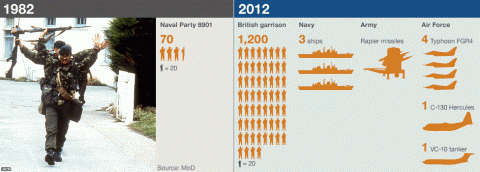
BBC: Could Britain still defend the Falkland Islands?
The BBC has a then-and-now summary of the military balance in the south Atlantic in 1982 and today:
1982: On the eve of the invasion, there were about 70 Royal Marines stationed on the islands — twice the usual number due to a changeover. They were, in theory, backed up by about 120 local reservists, although only a small proportion reported for duty. HMS Endurance, an Antarctic ice patrol vessel, was the only ship based in the South Atlantic at the time. And there were no fighter jets — none of the island’s airstrips were long enough. The only planes that could land before the war came from Argentina. Supplying the Falklands by sea from Britain took two weeks.
2012: The major difference is the construction of RAF Mount Pleasant, a modern air base housing four Eurofighter Typhoon strike fighters, a Hercules transport plane and VC-10 tanker plane. There are also Rapier missile batteries in several locations. The British garrison numbers 1,200, including 100 infantrymen, with 200 reservists in the Falkland Islands Defence Force. The Royal Navy has a patrol vessel, an auxiliary support ship, and frigate or state-of-the-art destroyer. It’s reported that a British nuclear-powered submarine is in the South Atlantic, but the Ministry of Defence will not discuss operational matters. “It’s quite a considerable deterrent force,” says Peter Felstead, editor of Jane’s Defence Weekly. Military experts believe the islands are now virtually impregnable. Any sign of Argentine invasion and the islands could be quickly reinforced by air.
Just as we established the last time this was up for discussion, Argentina doesn’t have the military forces for a stand-up fight, but if they can take the RAF base in a surprise attack by special forces, Britain probably can’t recapture the islands.
February 24, 2012
Argentina, like China, publishes unreliable economic statistics
The Economist has finally decided to stop using “official” economic statistics from Argentina:
Imagine a world without statistics. Governments would fumble in the dark, investors would waste money and electorates would struggle to hold their political leaders to account. This is why The Economist publishes more than 1,000 figures each week, on matters such as output, prices and jobs, from a host of countries. We cannot be sure that all these figures are trustworthy. Statistical offices vary in their technical sophistication and ability to resist political pressure. China’s numbers, for example, can be dodgy; Greece underreported its deficit, with disastrous consequences. But on the whole government statisticians arrive at their figures in good faith.
There is one glaring exception. Since 2007 Argentina’s government has published inflation figures that almost nobody believes. These show prices as having risen by between 5% and 11% a year. Independent economists, provincial statistical offices and surveys of inflation expectations have all put the rate at more than double the official number. The government has often granted unions pay rises of that order.
What seems to have started as a desire to avoid bad headlines in a country with a history of hyperinflation has led to the debasement of INDEC, once one of Latin America’s best statistical offices. Its premises are now plastered with posters supporting the president, Cristina Fernández de Kirchner. Independent-minded staff were replaced by self-described “Cristinistas”. In an extraordinary abuse of power by a democratic government, independent economists have been forced to stop publishing their own estimates of inflation by fines and threats of prosecution. Misreported prices have cheated holders of inflation-linked bonds out of billions of dollars.
February 17, 2012
Colby Cosh on the current drama around the Falkland Islands
The last time Colby Cosh discussed the Falkland Islands, we had a bit of a discussion on Twitter, with my pessimism about Britain’s strategic situation finally persuading him to say “You’ve convinced me to worry about this a little more than I would’ve” (summary in this post). He’s now posted a new article at Maclean’s, which I think accurately captures the situation in the south Atlantic:
Argentina, the world press tells us, intends to rename its top soccer league the “Cruiser General Belgrano First Division”, in honour of the Argentine ship sunk by the Royal Navy during the 1982 Falklands War. Far be it from any outsider to prescribe how a country honours its war dead, but honour is not what the move is about: it’s part of a continuing, exhausting barrage of Falklands agitprop from Argentina’s Kirchner government. Kirchner is scrambling to keep Argentine economic growth rolling, barracking businesses and workers in the classic caudillo manner as inflation outpaces the dubious official statistics. She has tried, with some success, to close off Southern Hemisphere ports to boats flying the maritime flag of the Falklands and to weld traditionally UK-friendly neighbours into a regional bloc against “colonialism”. Tensions are high and the Falkland Islanders are feeling besieged.
Britain is passing through a phase of relative strategic vulnerability when it comes to the Falklands. The islands are garrisoned much more strongly than they were in 1982 and the RAF has a proper airfield. But the UK has sold off its Harrier fleet, and its naval force-projection capacity is a little threadbare; public austerity has forced the Royal Navy to wait until 2016 for a new Nimitz-sized aircraft-carrier class to come into play. General Sir Michael Jackson, often considered the top UK commentator on military affairs (how many General Sirs are there?), recently summed up the situation by suggesting that the Falklands could be defended—but if Argentina captured them in a coup de main, as it did in ’82, its soldiers could probably not now be driven off. From a game-theoretic standpoint, the situation is a nightmare.
Update, 21 February: Brendan O’Neill explains that in the modern celebrity-fuelled world, the Penn really is mightier than the sword:
Easily the most extraordinary thing about Sean Penn’s recent comments on the Falkland Islands is the impact that they made. The tidal wave of furious commentary has tended to focus on Penn’s undoubted combination of daftness and arrogance, with enraged British hacks asking ‘where does Mr Madonna get off holding a press conference to pontificate about the serious affairs of the South Atlantic?’. That is indeed a good question. But a better and more pressing one is this: how on earth did the musings of one muppet make such a massive impact, intensifying the stand-off between Argentina and Britain, generating acres of newsprint, and even provoking a huge protest in the Falkland Islands themselves under the banner ‘Falk You, Sean’?
[. . .]
The Penn affair confirms the extraordinary and terrifying power of celebrity today. It shows that in our celeb-obsessed era, the famous and allegedly fabulous are no longer used simply to advertise booze or to titillate the readers of gossip columns — they have become actual tools of global politics. (In both senses of the word ‘tool’ — ‘a device used to carry out a particular function’ and ‘one who lacks the mental capacity to know he is being used’.) Indeed, Kirchner’s use of Penn in her war of words with Britain shows that she is a sussed and wily leader — she recognises that, today, a comment from a celeb is a far more effective political manoeuvre than readying a warship or making a stern speech at the United Nations. Her message is basically: ‘I’ll see your Prince William and raise you Sean Penn…’
February 11, 2012
Argentina accuses Britain of deploying nuclear weapons in Falkland Islands
Raising the rhetorical stake yet again, Argentina has taken their complaint to the United Nations:
Argentina has accused Britain of deploying nuclear weapons near the Falkland Islands and “militarising” the south Atlantic.
The Argentinian foreign minister, Héctor Timerman, lodged a formal protest at the United Nations on Friday and showed slides of British military bases in the region, saying they represented a threat to all south America.
He said Buenos Aires had intelligence that a Vanguard submarine was operating in the area. “Thus far the UK refuses to say whether it is true or not,” he told a press conference in New York. “Are there nuclear weapons or are there not? The information Argentina has is that there are these nuclear weapons.” Quoting John Lennon, he added: “Give peace a chance.”
Britain’s ambassador to the UN, Mark Lyall Grant, said London did not comment on the disposition of nuclear weapons or submarines but that it was “manifestly absurd” to say it was militarising the region. Britain’s defence posture remained unchanged, he said.
There was a report in the press that the Royal Navy had sent a nuclear powered submarine to the south Atlantic, but that it was conventionally armed. No nuclear power is in the habit of detailing where their nuclear weapons are deployed, so don’t expect Britain to break ranks with the others.
Also in the Guardian, Marina Hyde characterizes the decision to send a member of the royal family to the Falklands is the wrong kind of gesture:
The technical military term for the decision to deploy the second in line to the throne to the Falkland Islands is William-waving. If dispatching a fancy new warship to the archipelago on the eve of the 30th anniversary of the conflict with Argentina sends a message, then dispatching Prince William makes a hand gesture.
Of course, the Duke of Cambridge is not in the South Atlantic in his capacity as the male lead from the latest, successful instalment of the hit-and-miss Windsor Wedding franchise. His other day job is as an RAF search and rescue pilot, which is genuinely commendable — but need he really have been sent to the Falklands this week in a posting described by William Hague as “entirely routine”? If the foreign secretary truly wishes to claim that the deployment of Prince William is a business as perfunctory as deciding whether to serve tea or coffee at a meeting, then that is a matter for him. But many of us will find our disbelief simply impossible to suspend in this case, and will nurse a deep suspicion that such things are discussed at prime ministerial level.