Quotulatiousness

September 2, 2013

South Korea decides against the F-35 and the Eurofighter Typhoon

Filed under: Asia, Military, Technology — Tags: , , , — Nicholas @ 08:40

The South Korean government is in the same situation as the Canadian government: needing to purchase replacements for Cold War era combat aircraft and having a very limited budget to do so. After analyzing their specific needs, South Korea isn’t going to buy either the F-35 or the Eurofighter Typhoon:

On August 18th South Korea selected Boeing’s F-15SE Silent Eagle as the sole candidate for Phase III of its Fighter eXperimental Project (F-X) over Lockheed Martin’s F-35A and the Eurofighter Typhoon. The decision has drawn vociferous criticism from defense experts who fear the selection of F-15SE may not provide the South Korean military with the sufficient Required Operational Capabilities (ROCs) to counterbalance Japan and China’s acquisition of 5th generation stealth fighters.

In hindsight, Zachary Keck of The Diplomat believes that Republic of Korea’s (ROK) preference for the F-15SE over two other competitors was “unsurprising.” After all, Boeing won the previous two fighter competitions with its F-15-K jet. In 2002 and 2008, South Korea bought a total of 61 F-15K jets from Boeing. South Korea’s predilection for the F-15SE is understandable given its 85% platform compatibility with the existing F-15Ks.

However, the most convincing explanation seems to be the fear of “structural disarmament” of the ROK Air Force should it choose to buy yet another batch of expensive fighters to replace the aging F-4 Phantom and F-5 Tiger fighters. Simply stated, the more advanced the fighter jet, the more costly it is. The more expensive the jet, the fewer the South Korean military can purchase. The fewer stealth fighters purchased, the smaller the ROK Air Force.

Here is a mock-up of the F-15SE, courtesy of Wikipedia:

Mockup of the F-15SE Silent Eagle

Mockup of the F-15SE Silent Eagle

September 1, 2013

The military tablet – appearing now in combat zones around the world

Filed under: Military, Technology — Tags: , , , , — Nicholas @ 00:01

Strategy Page talks about the US Air Force use of Windows tablet computers for aircraft pilots and the wider adoption of tablets in the rest of the military:

Air forces all over the world are catching up when it comes to iPads. These devices were soon being adopted by officers and troops after they first appeared in 2010, without waiting for official permission. The iPad mini showed up in 2012. While using PDF files to replace maps and manuals was one of the first military uses, this was quickly followed by military-specific smart phone apps.

Early on combat pilots in Afghanistan, like many businesses, discovered how useful the iPad could be on board. U.S. Marine Corps helicopter pilots found the iPad a useful way to carry hundreds of military maps, rather than the hassle of using paper versions. Marine commanders quickly realized this “field expedient” (a military “hack” that adopts something for unofficial use while in the combat zone) worked, and made it official. That meant buying iPads for this and getting to work coming up with more uses. Meanwhile, support troops that have to handle a lot of data, quickly found ways to get it done on iPads. This was pretty simple for technical troops who rely on lots of manuals. They are often already available in PDF format, and can easily be put on an iPad. But the iPads are basically hand-held computers, and can do so much more. The troops quickly began making that happen themselves.

About the same time iPad appeared the U.S. Army decided to establish an app store (the Army Marketplace) for military smart phone users. This quickly included the iPad, which soldiers were instant big fans of. The army app store included an “App Wanted” section where users could post descriptions of an app they need. If a developer (in uniform, or an army approved civilian with access to the Army Marketplace) was interested, a discussion could be started on an attached message board. The army found that many needed apps were quickly created and made available at the Army Marketplace. Developers could charge for their apps, although the army is also would pay developers to create needed apps that have been described by military smart phone users. The other services quickly adopted a similar attitude towards app development and many of the U.S. Army apps have shown on smart phones outside the country.

August 28, 2013

Military deployments near Syria

Filed under: Middle East, Military, USA — Tags: , , , , — Nicholas @ 08:31

Zero Hedge passes on a bit of analysis from Stratfor:

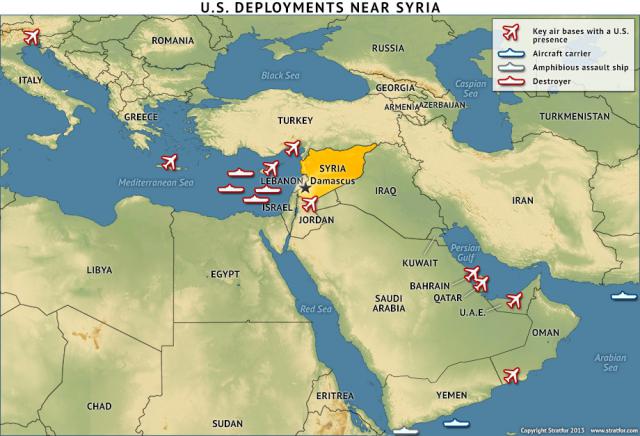
In the event of a punitive strike or a limited operation to reduce Syrian President Bashar al Assad’s chemical weapons delivery capability — for instance, by targeting key command and control facilities, main air bases and known artillery sites — the United States already has enough forces positioned to commence operations.

US deployments near Syria 20130828

Four Arleigh Burke-class destroyers — and probably a nuclear-powered cruise missile submarine — are already within Tomahawk cruise missile range of Syrian targets. In addition, the United States can call upon strategic bombers based in the continental United States as well as B-1 bombers from Al Udeid Air Base in Qatar. In such an operation, the United States would be able to carry out standoff attacks beyond the range of Syrian air defenses, while B-2 bombers could stealthily penetrate the Syrian air defense network to drop bunker-busting bombs with minimal risk.

Considering that al Assad’s forces have a number of ways to deliver chemical weapons, ranging from air power to basic tube and rocket artillery, an operation that seeks to degrade the regime’s ability to launch chemical weapons would necessarily be far wider in scope and scale. This means tactical aviation would have to play a key role in such a campaign, which in turn would entail the deployment of significant enabler aircraft such as aerial refueling tankers and intelligence, surveillance and reconnaissance assets.

In addition, as reported the other day, the French carrier Charles de Gaulle has been ordered to move east from Toulon and the British are reported to have a nuclear submarine in the region as well.

Update: The Iranian Farsnews site says the US military will be in for a serious defeat if they attack Syria.

Syria’s supersonic and anti-ship missiles as well as the Lebanese Hezbollah movement will inflict astonishing damage on any invading force, specially the US Navy’s giant warships, an expert said, adding that the missile capability is working as a deterrent to a US naval attack on Syria.

“The supersonic and long-range anti-ship Yakhont missiles of the Syrian army and the Lebanese Hezbollah (resistance movement) are serious deterrents to a US naval attack by its warships in the Mediterranean Sea,” Dr. Mostafa Zahra, a military analyst and strategic studies expert, told FNA on Monday.

He said that Syria’s Iskandar high-precision ballistic missiles and its anti-ship Scud missiles will also target the US warships in case of a US naval invasion of Syria, reminding that the American military vessels are not equipped with any weapons system to intercept or divert the Syrian anti-ship missiles.

Did you hear that, Great Satan? “Astonishing damage“. You’d better back off now, infidel.

July 12, 2013

Mapping the latest British defence “disgrace”

Filed under: Britain, Germany, Military — Tags: , , — Nicholas @ 14:06

Sir Humphrey on the mapping uproar:

Several UK newspapers reported this week the findings of the UK Parliaments Intelligence & Security Committee report that during OP ELLAMY, the UK had relied on Germany to provide mapping for the RAF to conduct its missions. This was apparently a disgraceful sign of a nation in decline and that we should all be jolly ashamed of ourselves.

The reality (as ever!) is a little different and one worth thinking about. Maps are something that we all take for granted in our daily lives, and they are an utterly indispensable part of modern military operations (even in the hands of a newly appointed young officer). We perhaps take for granted the information on them, without considering how it is obtained. In the UK the Ordnance Survey has over many hundreds of years done a phenomenal job of providing accurate information almost down to the last manhole cover about what lies where. At sea the Hydrographic Service has similarly spent many hundreds of years charting the oceans and waters of the planet — it is not an exaggeration to say that in some of the more remote parts of the globe, the only charts in use date back to the surveys done by Captain Cook or other explorers. As a national asset the Hydrographic Office in particular is absolutely priceless — very few nations run credible hydrographic programmes beyond the UK, US, Russia and China. The Royal Navy, with its extremely effective and very hard worked survey fleet has been able to become a global leader in providing accurate chart information to the world — indeed many countries are enormously reliant on the UK for providing charts for their warships.

But, to put a map or chart together is an enormously complicated piece of work which takes a lot of time and effort. No country on earth currently has the resources to provide a truly global and accurate mapping capability of all the nations and areas that it may need military mapping for. Its not just a case of putting down some generic top level mapping and hoping that’s enough — modern military operations require a lot of detail, and to be able to work effectively, mapping is needed at a very high level of detail. When it comes to targeting, knowing whether a particular target is located at grid reference 123456, or 12345678 can make a huge difference — precision weapons nowadays mean that the chances of hitting the intended spot are much higher than ever before. This means you can destroy a critical node or facility without necessarily doing much in the way of wider damage, which makes rebuilding efforts easier, and also reduces the risk of civilian casualties.

[. . .]

The irony is that amidst the anguish over using German maps, the article skims over the wider point that Defence Intelligence appears to be losing several hundred posts. It is not commonly realised that the DI is responsible for the provision of geographic information to the military, currently via the Defence Geographic Centre in Feltham (for more information see LINK HERE). This sort of service is crucial to help the MOD maintain an edge on operations — it isn’t just about having a good set of weapons, but the ability to know where you are, where you are going and how you can have the best possible military effect that matters. Ironically the papers that got the most irate about the news the UK was relying on the Germans were also the same papers that call the most loudly for ever more civil servants to be fired. The problem is that the people working at the DGC are exactly the sort of civil servants who are not pen pushers, who make a massive, near immeasurable difference to UK security, and who face considerable uncertainty in the future. We perhaps forget at our peril that just because someone doesn’t wear uniform, it doesn’t mean that they don’t play a major role in helping the defence of the UK.

May 4, 2013

Israeli air attack on missile shipment in Syria

Filed under: Middle East, Military — Tags: , , , — Nicholas @ 09:05

It’s almost anti-climactic to report that the Israeli defence ministry is confirming that an air strike was launched against Syria yesterday. The unexpected part of the news is that the attack was on a shipment of missiles, not a chemical weapons depot:

Israeli officials said the shipment was not of chemical arms, but of “game changing” weapons bound for the Lebanese militant group. The airstrike took place early on Friday, but did not say where it took place.

American officials earlier told the Associated Press of an airstrike. One report had suggested the strike was on a chemical weapons facility.

Benjamin Netanyahu, the Israeli prime minister, has repeatedly warned in recent weeks that Israel would be prepared to take military action if chemical weapons or other arms were to reach Hizbollah.

Lebanon’s army said pairs of Israeli airplanes entered Lebanese airspace on three occasions overnight between Thursday and Friday.

The move will raise tensions in the Middle East and comes amid mounting pressure over the alleged use of chemical weapons by president Bashar Assad’s regime.

April 18, 2013

PVFW heroically takes the fight back to disparaging military bloggers

Filed under: Humour, Military, USA — Tags: , , , , , — Nicholas @ 08:46

You’ve got to admire their willingness to continue their fight against reality:

The Phony Veterans of Foreign Wars, the nation’s leading military fakers’ organization — representing fake members from all service branches — has gone on the offensive in the fight against military bloggers.

PVFW fired back with a public relations offensive, speaking with reporters and establishing a password-protected blog on their website devoted to peer-reviewed development of members’ stories of their superhuman valor and heroism.

“Because of these milbloggers’ relentless assault on our First Amendment-protected right to lie about brief, unglamorous or nonexistent military service,” PVFW chairman Michael Spurwick told reporters, “several of our members have suffered irreparable damage to their reputations, and a few have even had their businesses and careers ruined, after being exposed as frauds. Something had to be done.”

Spurwick, a former Army sergeant, who was promoted to General before retiring as a Captain, has a long and impressive career of made-up military service.

“We lost a lot of good men out there,” Spurwick said. “I don’t really like to talk about it.”

Born in 1965, he’s a veteran of every U.S. military action since his birth, from the Vietnam War to the wars in Iraq and Afghanistan. Boasting unearned Special Forces and Ranger tabs, Spurwick served with both Delta Force and the Rangers during Operation Gothic Serpent in Mogadishu, Somalia. He’s participated in every combat parachute jump since 1967, when, at just fifteen months of age, he parachuted into North Vietnam with the 173rd Airborne during Operation Junction City — as well as a top-secret high altitude, high opening jump from the International Space Station during OEF VI and a LANO (low-altitude, no-opening) jump from a B-1 bomber during OIF V.

[Editor’s note: According to Spurwick’s DD214, obtained by The Duffel Blog through a FOIA request, he was discharged from the Army in 1986 during basic training at Fort Sill, Okla., as an E-2.]

I’m sure there is — or soon will be — an anti-bullying law of some stripe that will allow these brave imaginary heroes to launch legal counter-attacks against those who would deny them the ability to wear uniforms, medals, badges, and awards to which they have no actual right.

March 28, 2013

US responds to North Korean rhetoric with symbolic B-2 bombing exercise

Filed under: Asia, Military, USA — Tags: , , , — Nicholas @ 08:15

March 15, 2013

Is Lockheed’s C-130 Hercules the all-time champion in US pork barrel politics?

Filed under: Business, Military, Politics, USA — Tags: , , , , — Nicholas @ 00:02

Ian Geldard linked to this rather interesting history lesson on the Lockheed C-130 transport aircraft (the RCAF is also a user of this type of plane, along with a large number of other air forces):

USAF Lockheed Hercules C-130 at Yokota Air Base in Tokyo (Photo from Wikimedia)

USAF Lockheed Hercules C-130 at Yokota Air Base in Tokyo (Photo from Wikimedia)

Here’s where the story starts to get interesting. After 25 years, the Pentagon decided that it was well stocked with C-130s, so President Jimmy Carter’s administration stopped asking Congress for more of them.

Lockheed was in trouble. A few years earlier, the Air Force had started looking into replacing the Hercules with a new medium-sized transport plane that could handle really short runways, and Lockheed wasn’t selected as one of the finalists. Facing bankruptcy due to cost overruns and cancellations of programs, the company squeezed Uncle Sam for a bailout of around $1 billion in loan guarantees and other relief (which was unusual back then, as William Hartung points out his magisterial Prophets of War: Lockheed Martin and the Making of the Military-Industrial Complex).

[. . .]

So what did Lockheed do about the fate of the C-130? It bypassed the Pentagon and went straight to Congress. Using a procedure known as a congressional “add-on” — that is, an earmark — Lockheed was able to sell the military another fleet of C-130s that it didn’t want.

To be fair, the Air Force did request some C-130s. Thanks to Senator John McCain, the Government Accountability Office (GAO) did a study of how many more C-130s the Air Force requested between 1978 and 1998. The answer: Five.

How many did Congress add on? Two hundred and fifty-six.

[. . .]

The Air Force’s approach of passing unwanted Herks off to the Air Guard and Reserves worked out nicely for Lockheed. The company allied with Air Guard and reservist advocacy groups to lobby Congress further. In an era of base closures, heavily lobbied governors would use the arrival of new planes to argue for the continuing life of bases in their states. In turn, states and their congressional delegations would fight to get new planes or hang onto existing ones. It was a veritable Lockheed feedback loop. Washington Post reporter Walter Pincus quoted a Pentagon official as seeing C-130 politics as a twist on the old military-industrial complex: “a triangle of the Guard, Lockheed, and politicians.”

The result: the military was often prevented from retiring the oldest Herks, the ones that really needed to be put out to pasture. For example, as Pincus reported, the Joint Chiefs and the Air Force concluded in 1996 that they had 50 more C-130s than they needed, but Congress stymied efforts to retire any of them. One tactic used was to hold nominees hostage: a Kentucky senator repeatedly held up Air Force promotions until four Kentucky Air Guard C-130s were taken off the chopping block.

March 10, 2013

Lockheed Martin’s budgetary force-field

Filed under: Military, Politics, USA — Tags: , , , , — Nicholas @ 11:15

In the Washington Post, along with asking why “the Navy’s Army needs its own Air Force”, Rajiv Chandrasekaran explains why the F-35 is close to un-killable:

The Defense Department and Lockheed Martin, the giant contractor hired to design and build the plane, also known as the Joint Strike Fighter, have constructed what amounts to a budgetary force field around the nearly $400 billion program.

Although it is the costliest weapons system in U.S. history and the single most expensive item in the 2013 Pentagon budget, it will face only a glancing blow from the sequester this year. And as the White House and Congress contemplate future budgets, those pushing for additional cuts may find it difficult to trim more than a fraction of the Pentagon’s proposed fleet, even though the program is years behind schedule and 70 percent over its initial price tag.

The reasons for the F-35’s relative immunity are a stark illustration of why it is so difficult to cut the country’s defense spending. Lockheed Martin has spread the work across 45 states — critics call it “political engineering” — which in turn has generated broad bipartisan support on Capitol Hill. Any reduction in the planned U.S. purchase risks antagonizing the eight other nations that have committed to buying the aircraft by increasing their per-plane costs. And senior military leaders warn that the stealthy, technologically sophisticated F-35 is essential to confront Iran, China and other potential adversaries that may employ advanced anti-aircraft defenses.

The biggest barrier to cutting the F-35 program, however, is rooted in the way in which it was developed: The fighter jet is being mass-produced and placed in the hands of military aviators such as Walsh, who are not test pilots, while the aircraft remains a work in progress. Millions more lines of software code have to be written, vital parts need to be redesigned, and the plane has yet to complete 80 percent of its required flight tests. By the time all that is finished — in 2017, by the Pentagon’s estimates — it will be too late to pull the plug. The military will own 365 of them.

By then, “we’re already pregnant,” said Air Force Lt. Gen. Christopher Bogdan, who oversees F-35 development for the Pentagon.

March 7, 2013

US Department of Defence to change standards for awarding the Purple Heart

Filed under: Humour, Military, USA — Tags: , , , — Nicholas @ 10:35

A recognition of the importance of maintaining service members’ self-esteem in the face of harsh and unyielding forces beyond their control:

Purple Heart medalIn the wake of the newly unveiled Distinguished Warfare Medal, the Department of Defense intends to relax standards on the nation’s oldest military decoration — the Purple Heart. Under the expanded interpretation, the award will now be available to any disgruntled service member suffering from disillusionment and shattered expectations.

“Acute Rectal Inflammation, colloquially known as ‘butthurt,’ is a serious and grossly underrated epidemic plaguing our military,” Lieutenant Jimmy Chang, Doctor of Osteopathic Medicine, told The Duffel Blog. “Essentially, psychological or emotional trauma, stemming from either internal or external stimuli, manifests itself and eventually begets anal trauma. In severe cases, butt cells can become so hurt that they become malignant. In fact, butthurt is the leading cause of colon cancer among service members.”

February 27, 2013

Sequestration and the defence budget

Filed under: Military, Politics, USA — Tags: , , , — Nicholas @ 09:10

At the Cato At Liberty blog, Christopher Preble graphically refutes the notion that sequestration will automatically weaken the US military:

Click to see full-size infographic at the Cato Institute blog.

Click to see full-size infographic at Cato At Liberty.

Military spending will remain at roughly 2006 levels — $603 billion, higher than peak U.S. spending during the Cold War. Meanwhile, we live in a safer world. The Soviet Union has been dead for more than two decades; no other nation, or combination of nations, has emerged since that can pose a comparable threat. We should have a defense budget that reflects this reality.

To be clear, sequestration was no one’s first choice. But the alternative — ever-increasing military spending detached from a legitimate debate over strategy — is worse. We should have had such a debate, one over the roles and missions of the U.S. military, long before this day of reckoning. And politicians could have pursued serious proposals to prudently reduce military spending. Instead, they chose the easy way out, avoiding difficult decisions that would have allowed for smarter cuts.

Update: Nick Gillespie explains why you shouldn’t worry too much about the sequester:

Update, the second: Putting the actual numbers in perspective:

February 26, 2013

Defence industry lobbyists versus actual USAF needs

Filed under: Business, Government, Military, Technology, USA — Tags: , , , — Nicholas @ 10:35

Strategy Page talks about the ongoing drama of the Global Hawk UAV and the US Air Force’s attempt to get rid of the weapon:

The U.S. Air Force recently disbanded a Global Hawk UAV squadron. The reserve unit contained 200 personnel and operated an aircraft the air force is getting rid of. This is in spite of political opposition to the move (helped along by the manufacturers many lobbyists).

This all began last year when the U.S. Air Force cancelled all orders for the Block 30 Global Hawk because of reliability issues. This renewed Department of Defense threats to cancel the Global Hawk program entirely. In response Northrop Grumman (the RQ-4 manufacturer) lobbyists made sure that key members of Congress knew where Global Hawk components were being built and how many jobs that added up to. Elected politicians pay attention to that. This move delayed the RQ-4 Block 30 until there was enough political support to convince Congress to order the air force to accept the Block 30 RQ-4s and shut up.

The air force can take some comfort in the fact that Northrop Grumman fixed some of the problems (some of which the manufacturer said don’t exist or didn’t matter). The Block 30 was supposed to be good to go but the air force was not convinced and decided that Block 30 was just more broken promises. Congress was also tired of all the feuding and being caught between Northrup lobbyists and exasperated air force generals. The lobbyists, as is usually the case, eventually won. But the air force is not required to pay for operating the Global Hawks, thus the disbanding of the Global Hawk unit.

February 7, 2013

Japan scrambles fighters after two Russian aircraft intrude

Filed under: Asia, Japan, Military, Pacific, Russia, WW2 — Tags: , , — Nicholas @ 09:39

Japan’s military forces are getting quite a workout these days, with the standoff with China over the Senkaku Islands and now the Russians are getting aggressive about probing Japanese airspace:

Two Russian fighter jets have violated Japanese airspace, prompting Tokyo to scramble its own aircraft, reports say.

Japan lodged a protest after the planes were detected off the northern island of Hokkaido for just over a minute.

The incident happened after Japanese PM Shinzo Abe said he was seeking a solution to a territorial dispute with Russia over a Pacific island chain.

Russia’s military denied the incursion, saying the jets were making routine flights near the disputed islands.

Mr Abe was speaking on the anniversary of an 1855 treaty which Japan says supports its claims to the islands.

The four islands — which Russia calls the Southern Kurils and Japan calls the Northern Territories — are the subject of a 60-year-old dispute.

Because of the dispute, the two nations have not yet signed a peace treaty to end World War II.

January 18, 2013

Camouflage patterns and the patterns of inter-service rivalry

Filed under: Bureaucracy, Military, USA — Tags: , , , , , — Nicholas @ 00:01

In The Atlantic, D.B. Grady reminds us that some patterns are more deeply dyed than others:

Military combat uniforms have two purposes: to camouflage soldiers, and to hold together in rugged conditions. It stands to reason that there’s only one “best” pattern, and one best stitching and manufacture. It should follow that when such a uniform is developed, the entire military should transition to it.

MARPAT woodland patternIn 2002, the Marine Corps adopted a digital camouflage pattern called MARPAT. Rigorous field-testing proved that it was more effective than the splotched woodland pattern in use at the time, and the Combat Utility Uniform (of which it was a part) was a striking change for such a conservative institution.

UCP patternNot to be outdone, the Army drew up digital plans of its own, and in 2005 issued a redesigned combat uniform in a “universal camouflage pattern” (UCP). Three years after the Marines made the change, four years after the invasion of Afghanistan, and two years after the invasion of Iraq, you might think the Army would have been loaded with data on how best to camouflage soldiers in known combat zones. You would be wrong.

In fact, not only did the Army dismiss the requirements of the operating environments, but it also literally chose the poorest performing pattern of its field tests. The “universal” in UCP refers to jungle, desert, and urban environments. In designing a uniform for wear in every environment, it designed a uniform that was effective in none.

[. . .]

Such dysfunction is not unique to the Army. MARPAT was a success not only in function, but also in adding distinction to the Marines wearing it. Naturally the Air Force wanted in on that action, and set about to make its own mark on the camouflage world. It’s first choice? A Vietnam-era blue tiger-stripe pattern. (You know, to blend in with the trees on Pandora.)

After an outcry in the ranks, the leadership settled on a color scheme slightly more subdued. The new uniform did, however, have the benefit of being “winter weight” only, which was just perfect for service in Iraq.

January 13, 2013

The “successes” of the drone war can only be measured in body counts

Filed under: Africa, Asia, Military, USA — Tags: , , , , , , — Nicholas @ 12:48

In the Guardian, Simon Jenkins discusses the negative aspects of the drone war:

The greatest threat to world peace is not from nuclear weapons and their possible proliferation. It is from drones and their certain proliferation. Nuclear bombs are useless weapons, playthings for the powerful or those aspiring to power. Drones are now sweeping the global arms market. There are some 10,000 said to be in service, of which a thousand are armed and mostly American. Some reports say they have killed more non-combatant civilians than died in 9/11.

I have not read one independent study of the current drone wars in Afghanistan, Pakistan and the horn of Africa that suggests these weapons serve any strategic purpose. Their “success” is expressed solely in body count, the number of so-called “al-Qaida-linked commanders” killed. If body count were victory, the Germans would have won Stalingrad and the Americans Vietnam.

Neither the legality nor the ethics of drone attacks bear examination. Last year’s exhaustive report by lawyers from Stanford and New York universities concluded that they were in many cases illegal, killed civilians, and were militarily counter-productive. Among the deaths were an estimated 176 children. Such slaughter would have an infantry unit court-martialled. Air forces enjoy such prestige that civilian deaths are excused as a price worth paying for not jeopardising pilots’ lives.

[. . .]

Since the drone war began in earnest in 2008, there has been no decline in Taliban or al-Qaida performance attributable to it. Any let-up in recruitment is merely awaiting Nato’s departure. The Afghan president, Hamid Karzai, has called the attacks “in no way justifiable”. The Pakistan government, at whose territory they are increasingly directed, has withdrawn all permission.

The young Yemeni writer Ibrahim Mothana protested in the New York Times of the carnage drones are wreaking on the politics of his country, erasing “years of progress and trust-building with tribes”. Yemenis now face al-Qaida recruiters waving pictures of drone-butchered women and children in their faces. Notional membership of al-Qaida in Yemen is reported to have grown by three times since 2009.

« Newer PostsOlder Posts »

Powered by WordPress