
The Tank Museum
Published 3 April 2025Operation Market Garden failed because the tanks of XXX Corps did not reach the Paras in Arnhem in time. Many historians have argued that the British armoured column “let the side down”. But is this actually true?
We reckon there are six reasons why the operation was a total disaster. It was a poor plan from the get-go, relying on a rate of advance that would outmatch the German invasion of France in 1940. Bad weather prevented the deployment of badly-needed reinforcements, and the terrain Guards Armoured were expected to traverse – a single road with impassable conditions on either side – significantly hampered the efforts of the tank crews.
Poor intelligence also meant that the British column was not prepared for resistance from a retreating and desperate German Army. It was a combination of all these factors that caused Market Garden to unravel completely.
Despite the complications, many acts of valour were carried out by both the airborne and armoured divisions, including the legendary assault across the Waal by the US 82nd Airborne.
So, join us as we explore these six reasons why Operation Market Garden failed and decide for yourself whether XXX Corps could have done anymore.
00:00 | Introduction
02:23 | #1 – A Bad Plan
06:22 | #2 – Poor Intelligence
07:51 | #3 – Difficult Terrain
11:27 | #4 – Determined Resistance
13:45 | #5 – Bad Weather
14:38 | #6 – Loss of Surprise
19:45 | What Went Wrong?
(more…)
August 21, 2025
Six Reasons Operation Market Garden FAILED
August 11, 2025
Speed vs Armour: The Unexpected History of Fast Tanks
The Tank Museum
Published 21 Mar 2025Would you rather go to war in a tank that was quick but lightly armoured – or heavily armoured but slow?
The concept of fast tanks has existed since the First World War, but making a tank fast is easier said than done. You can increase the speed, but only by compromising the other two sides of The Iron Triangle.
Whilst a good power to weigh ratio is key to making a tank go fast, there are other factors that need to be considered. J Walter Christie pioneered the innovative helicoil spring suspension system – an invention that allowed tanks to cope with travelling at high speeds across country. Although not picked up by the US Army, the brilliance of Christie’s suspension was recognised by the Soviets and soon made an appearance on the BT-Series of tanks – and most effectively on the T-34.
Back in the UK, the newly mechanised cavalry was making use of some brand-new Cruiser tanks. Whilst these were fast vehicles, this was coming at the cost of effective protection. Some military thinkers advocated for the concept of “speed as armour” but results were mixed – with the Crusader and Cromwell both proving to be capable tanks.
After the war, the British Army finally moved on from “speed as armour” and settled on sacrificing a bit of speed for the sake of better protection. This was incorporated first into the concept of Universal Tanks and remains a fixture in the modern Main Battle Tank.
So, we’ll ask again. Would you rather go to war in a tank that was quick but lightly armoured – or heavily armoured but slow?
00:00 | Introduction
00:51 | What Makes it a Fast Tank?
02:39 | What is a Fast Tank For?
04:39 | Suspension of Disbelief
06:34 | Speedy Soviets
08:29 | Cruisers Replace Cavalry
11:20 | The Second Wave
13:19 | Cruising in Europe
19:08 | One Tank to Do It All
(more…)
August 10, 2025
QotD: The “generations” of warfare
Warfare is fundamentally about breaking the enemy’s will to fight. This can be done with violence, or without it – before the fight even starts, through raw intimidation. Working from this understanding, military theorists have divided the history of warfare into five generations.
First Generation Warfare, abbreviated 1GW, was war as it was waged from the dawn of civilization up through roughly the Civil War. This style of conflict involved massed line infantry, equipped with spears, pikes, swords, or line-of-sight ranged weapons such as longbows, crossbows, or muskets. The basic tactic was to draw up two large groups of armed men, bring them into close contact, and have them hack at one another until one side grew demoralized by the slaughter, at which point their line would break and the real slaughter could begin.
Industrial or Second Generation Warfare (2GW) brought rifled firearms, machine-guns, and indirect artillery. Men could now be killed at a great distance, without ever seeing the enemy. Camouflage, concealment, and cover became the keys to victory. Its heyday was roughly from the Civil War to the Great War.
Mechanized warfare or 3GW arrived with the internal combustion engine and powered flight. Tactics now depended on speed and manoeuvrability. It dawned with the Second World War and reached its apogee with the invasion of Iraq.
Mechanized warfare created an overwhelming advantage for large industrial states. Small states and non-state actors responded with 4GW, which can be thought of as televisual warfare – combat via propaganda. This is war as fought with cameras and media distribution networks. It is guerrilla warfare via weaponized morality: using the enemy’s own military actions against it by showing the consequences of war for one’s civilian population to the enemy civilian population. Bait the enemy into killing babies, then ask them how many more babies they’re willing to murder. Think Vietnam, Afghanistan, Iraq.
The response to 4GW is 5GW – warfare by psyop, utilizing misinformation and sentiment engineering. Its characteristic weapons platform is the social network. Where 4GW seeks to use the enemy’s own morality against it, 5GW seeks to change that morality, to transform the enemy’s inner nature, getting the enemy to attack themselves for you, to surrender with open arms and smiles on their faces … ideally, without the enemy even realizing that they’re under attack.
John Carter, “Political Conflict in the Age of Psychic Warfare”, Postcards From Barsoom, 2024-03-01.
August 4, 2025
Day Ten – German Victory in the Battle of France – Ten Days in Sedan
World War Two
Published 3 Aug 2025May 19, 1940. Ten days into Fall Gelb, Guderian’s panzers thunder toward the Channel, poised to slam a steel ring around nearly half a million Allied troops. In Paris, Paul Reynaud ousts Daladier and Gamelin, calling back Marshal Pétain and General Weygand as France’s last throw of the dice. The pocket is almost shut, yet the story is far from over. Is there time for one more twist? Keep watching as we follow the fight to its end and discuss the aftermath of this campaign.
(more…)
July 27, 2025
Day Nine – Hitler’s Halt Order and Tragedy at La Ferté – Ten Days in Sedan
World War Two
Published 26 Jul 2025May 18, 1940. Our coverage of the German blitzkrieg in France continues. Today, we take a break from the panzers for a spot of old-fashioned siege warfare. At Ouvrage La Ferté, a small garrison of French troops makes a doomed last stand against overwhelming German firepower. We follow their final hours, the decisions that sealed their fate, and what their sacrifice meant for the collapsing French front.
(more…)
July 20, 2025
Day Eight – Can Charles de Gaulle Save France? – Ten Days in Sedan
World War Two
Published 19 Jul 2025Ten Days in Sedan continues as our WW2 Blitzkrieg documentary follows the first serious counterblow against the German spearhead. Colonel Charles de Gaulle leads the 4th Armoured Division in an attack against the German flank. De Gaulle’s units are understrength and his assault is improvised but he catches Heinz Guderian by complete surprise. Is this just a fleeting gesture of defiance, or a new kind of French resistance?
(more…)
July 14, 2025
Day Seven – Ghost Division! – Ten Days in Sedan
World War Two
Published 13 Jul 2025May 16 1940: Our WW2 Blitzkrieg documentary, Ten Days in Sedan, continues as Winston Churchill arrives in Paris. The Prime Minister still has hope but he’s shocked to see the French burning documents and preparing to evacuate. Meanwhile French and German tanks slug it out in Stonne, Guderian reaches Montcornet, and Rommel leads his Ghost Division far behind French lines.
Chapters
00:00 Intro
00:58 Recap
01:38 Stonne
03:05 Panzers Drive West
07:02 New French Plan
12:23 Rundstedt’s Halt Order
16:06 Ghost Division
21:53 Churchill in Paris
(more…)
July 13, 2025
Tiger II: What was the point?
The folks at the Tank Museum at Bovington put together a video comparing the Tiger II to the earlier Tiger I and the typical allied tanks they faced on the battlefield. On the social media site formerly known as Twitter, historian Jonathan Ware posted a long thread about both the topics the Tank Museum’s video raised and where he feels they should have added more context:
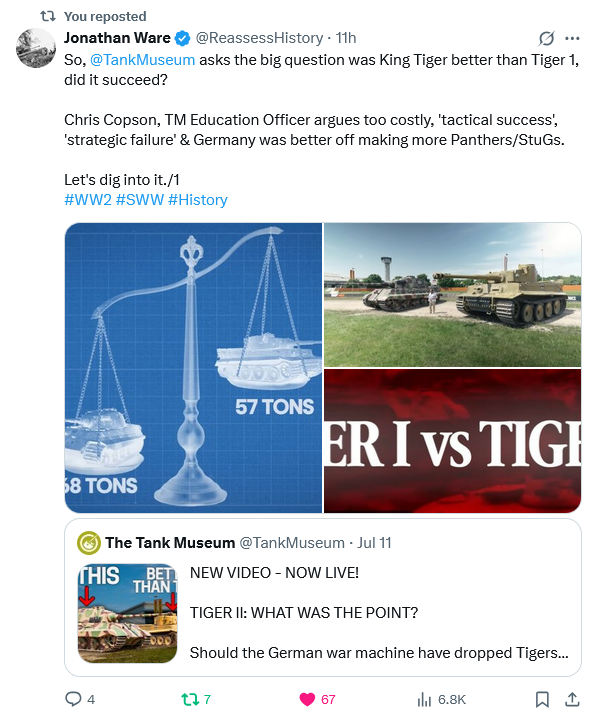
And here’s the Tank Museum’s video itself:
FEATURING FOOTAGE OF TIGER I AND TIGER II RUNNING TOGETHER AT TANKFEST 2025 – with thanks to Musée des Blindés and World of Tanks.
It’s absurdly large, heavy, expensive, and difficult to build. So, you have to ask; what is the point of Tiger II when you already have the biggest, toughest and meanest beast on the block – Tiger I.
Whilst the Tiger I has maintained a legendary status since its appearance on the battlefield, there were many aspects of this tank’s design that were pretty much dead ends. The turret couldn’t be resized to fit a more powerful gun. And adding extra weight in the form of armour would put a huge amount of strain on the internal mechanics. So, a new tank was needed to ensure the German’s could maintain their edge against Allied armour.
Enter the Tiger II, otherwise known as the King Tiger. Heavily armed, the Tiger II could take on any Allied tanks that it faced, with its KwK 43 able to penetrate the frontal armour of a Sherman at 1,800m. Its thick sloped armour was incredibly dependable, and no Allied tank commander would willingly engage a Tiger II in a head-to-head fight.
The Tiger II’s battlefield presence came at a significant cost. A single Tiger II could take up to 400,000 hours to build at a price of RM 321,500 – up to 100,000 more hours than a Tiger I, and over twice the cost of a Panther. A while the Allies were churning out tanks that were “good enough”, the Germans were committed to quality and ensuring their tanks would always have the edge against enemy armour.
The Tiger II has often been described as a tactical success for its battlefield prowess, but a strategic failure for being so resource-hungry, expensive and relatively low in number. Given their cost, it forces us to question whether the German war machine should have dropped Tigers altogether in favour producing tanks that were cheaper and easier to build
00:00 | Introduction
00:55 | Durchbruchswagen
06:15 | Tiger I vs Tiger II
12:52 | The Numbers Game
17:34 | Was Tiger II a Success?This video features archive footage courtesy of British Pathé.
In this film, Chris Copson breaks down the differences between two legendary tanks – the Tiger I and Tiger II. Whilst Tiger I was an impressive tank, certain areas of its design were an evolutionary dead-end. Its boxy turret couldn’t be enlarged to fit a bigger gun, and the hull couldn’t be up armoured without adding stress to the drive train. So, Tiger II ordered in 1943, including even thicker, sloped armour and a much more destructive gun. With mixed success on the battlefield, difficulties in maintaining its complex mechanics and reliance on dwindling supply lines, the Tiger II ended up being a tactic success, but a strategic failure.
Want to learn more about the Tiger I and Tiger II? Here are some of the sources we used to make this film:
Panzer Tracts No.23 – Panzer Production from 1933 to 1945 by Thomas Jentz and Hilary Doyle, 2011
Germany’s Tiger Tanks, DW to Tiger I: Design, Production and Modifications by Thomas Jentz and Hilary Doyle, 2000
Germany’s Tiger Tanks, VK45.02 to Tiger II: Design, Production and Modifications by Thomas Jentz and Hilary Doyle, 1997
Encyclopedia of German Tanks of World War Two, Revised Edition by Peter Chamberlain and Hilary Doyle, 1993
Tigerfibel. English translation by The Tank Museum, 2022
Panther and its Variants by Walter Spielberger, 1978
Armored Champion: The Top Tanks of World War II by Steven Zaloga, 2015
www.tankarchives.com
www.forum.axishistory.com
www.achtungpanzer.com
www.feldgrau.net
July 10, 2025
Was Matilda II the BEST Tank of WWII?
The Tank Museum
Published 21 Feb 2025Forget the Sherman, forget the Panther, forget the T-34 … Should Matilda II be considered the best tank of WWII?
Emerging from the request for a new and improved infantry tank, Matilda II debuted on the battlefield in France. The heroic actions of Matilda crews at Arras stopped Blitzkrieg in its tracks and allowed the British army to be evacuated from the beaches of Dunkirk.
The Matilda’s fighting peak was during the North Africa campaign, where the 2pdr gun was more than a match for any of the Italian armour it came up against. Despite some mechanical issues, the performance of Matilda II at this time would earn her the title “Queen of the Desert”. Once the Germans arrived in North Africa, Matilda started to become obsolete but remained useful as a testbed for experimental equipment that would eventually be used on D-Day.
Matilda II saw service in all theatres of the Second World War. Around 900 tanks were deployed by the Soviets in 1942, filling the gap as the Red Army increased its roster of T-34s. Matilda made great contributions to campaigns in the Pacific – its small and solid profile making it ideal for jungle bashing. The Australians made effective use of the Matilda, creating variants including a mortar launcher and a flamethrower.
Some say that if it wasn’t for Matilda II we would be speaking German right now. Watch this video to find out why …
00:00 | Introduction
00:36 | Heroics at Arras
03:29 | It Takes Two
06:00 | Matilda II – Inside and Out
13:03 | Queen of the Desert
18:14 | Soviet Service on The Eastern Front
19:49 | The Pacific – Welcome to the Jungle…
(more…)
July 6, 2025
Day Six – Breakout – Ten Days in Sedan
World War Two
Published 5 Jul 2025May 15 1940 — Ten Days in Sedan, continues as our WW2 Blitzkrieg documentary follows Germany’s drive through France. Today French 2nd Army chief Charles Huntziger faces a pivotal choice: try and contain the German bridgeheads at Sedan, where Heinz Guderian is trying desperately to breakout, or pivot south to shield the Maginot forts he still trusts. His choice may just decide the fate of France.
(more…)
June 30, 2025
Day Five – Massive Allied Air Attack – Ten Days in Sedan
World War Two
Published 28 Jun 2025May 14 1940. The blitzkrieg continues in today’s episode of Ten Days in Sedan. British and French bombers roar over Sedan, braving curtains of flak and German fighters in a bid to smash Guderian’s hastily built bridges across the Meuse. Further north, French infantry and tanks battle against the German crossings at Houx, Dinant, and Monthermé. German general Erwin Rommel has a narrow escape as the French nearly blow him and his tank to pieces!
(more…)
June 22, 2025
Day Four – The Meuse Must Hold! – Ten Days in Sedan
World War Two
Published 21 Jun 2025May 13, 1940: In today’s episode of our WW2 documentary, Ten Days in Sedan, the German Blitzkrieg reaches its climax. Guderian’s Panzers launch a daring river assault as the Luftwaffe pounds French lines into chaos. Away from Sedan itself, Rommel and Reinhardt strike further north, opening new fronts. France scrambles to counterattack, but the German bridgeheads are growing fast.
00:00 Intro
00:48 French Defences, German Air Assault
04:13 Guderian Crosses The Meuse
08:25 Hartlieb’s Houx Crossing
11:28 Rommel Crosses At Dinant
16:04 Einhardt Crosses At Monthermé
19:15 Summary & Conclusion
(more…)
June 17, 2025
The Crewless Tank Experiment | Project Crazy Horse
The Tank Museum
Published 31 Jan 2025This might just be one of the greatest missed opportunities in the history of tank development. Project Crazy Horse: a full-sized, crewless, remote-control tank – developed 35 years ago.
Being shot at is as unpleasant as it is dangerous. But in the 1980s, the Ministry of Defence needed to trial the cutting-edge TRIGAT missile system with a mobile target. The MOD approached the Royal Armament Research and Development Establishment (RARDE) with a unique challenge – design us a tank that can operate by remote control.
With a limited budget, the project team selected an old Mark I Chieftain as the test bed for their vehicle. Stripping out any unnecessary components and piecing together the needed parts from a range of tech, Crazy Horse was successfully trialed in 1988.
But despite the innovations of both the team and the technology, the project was shut down due to budget cuts and issues of unreliability. The team was reassigned, and Crazy Horse was sent to The Tank Museum. There is currently no such thing as an unmanned, remote controlled main battle tank. But 35 years ago, we came tantalisingly close.
00:00 | Introduction
00:39 | A Moving Target
03:00 | Less Than A Million Dollars?
04:40 | Previous Attempts
07:47 | Creating Crazy Horse
10:16 | A Stormer!
13:47 | Slow Death of Crazy Horse
18:23 | A Missed Opportunity?In this film Chris Copson and Paul Famojuro explore the extraordinary story of Project Crazy Horse. This unique Chieftain target tank was developed in the 1980s, by an enthusiastic team that used their expertise to create the biggest remote-controlled tank in the world. Sadly, despite several glimmers of a resurrection, Crazy Horse would never see its full potential. Both Crazy Horse and its Stormer control vehicle were saved from scrap, and are now on display at The Tank Museum, where visitors can discover more about this revolutionary design.
(more…)
QotD: What is a “tank”?
And we should stop to note that as with any question of definition, this one too is language-sensitive. The exact confines of a term vary from one language to another; kampfpanzer, for instance is not necessarily an exact synonym for “tank”.
In any event, the basic demands of early tanks were dictated by the realities of the Western Front: a tank needed to be able to resist small arms fire (particularly machine guns), deliver direct supporting fire itself, it needed to be able to move on the muddy, artillery-flattened ground and it needed to be able to cross a trench. This last requirement – the need to be able to both climb a parapet (usually c. 4ft) and then cross over an 8ft wide trench – was significant in the design of early tanks.
Those factors in turn dictated a lot of the design of early tanks. The armor demands of resisting small arms fire meant that the vehicle would be heavy (and indeed, as soon as tanks appeared amongst Allied troops, their German opponents began introducing more powerful bullets, like the K bullet and later the 13.2mm anti-tank round fired from the Mauser 1918 T-Gewehr). And here is the first advantage of tracks. The weight of a vehicle is distributed along all of the area of contact it has with the ground; with tires that area is limited to the bottom of the tire so the total area of ground contact is fairly low, which is fine for most vehicles.
But tanks are heavy. Really heavy. Even something like the Renault FT could mass around 7 tons and by later standards that would be classified as a tankette (a “mini-tank” as it were); by WWII, medium tanks often clocked in around 30 tons. If you put a vehicle like that on tires, you are going to create a LOT of pressure on those small points of contact. That might still be OK if you are just going to drive on roads and other firm surfaces which can take the pressure. But remember: tanks were designed for the Western Front, which looks like this.
Fortunately for the landship committee, this wasn’t a new problem: farming tractors were also heavy and also had to operate in churned up (in this case, plowed) soft soil; the heaviest of these vehicles had much the same problem and the solution was continuous tracks or “treads”. When kept properly tensioned – tune in, by the by, to Nicholas “The Chieftain” Moran’s YouTube for more than you ever want to know about track tension – the track distributes the weight of the tank across the entire section of the track touching the ground, which reduces the ground pressure at any given point, allowing a big heavy tank to roll over terrain where even a much lighter wheeled vehicle would get stuck.
This is one of those points where the functionality of a tank (what a tank does) has such a strong influence on design that the design implications of the functionality become part of the definition: a tank has to be heavily armored and has to be able to move off-road and as a result has to be tracked, not wheeled. One might be able to imagine some sort of exotic technology that might make it possible to do all of the things a tank does without tracks, but we don’t have that yet.
The other factor was fire. I’ve mentioned this before, but one of the significant background factors of WWI is that a lot of the belligerents misjudged the kind of artillery they’d need for a general European war. Not to get too deep into the weeds here, but most of the belligerents expected a relatively rapid war of maneuver and so thought that light, direct-fire artillery like the famed French ’75 (the Matériel de 75mm Mle 1897) would be the most useful. Those guns could be moved quickly and could deliver a lot of quick firepower on static or moving formations of enemy infantry in support of friendly infantry.
The problem is that in the conditions of trench warfare, those guns – as they were configured, at least – were far less useful. They were, first off, much shorter in range which meant they had to be brought dangerously far forward to do their direct fire role – often so far forward they could be engaged by enemy rifles and machine guns. This was compounded by the fact that direct fire at range was ineffective against trench works (which are dug down into the earth). But at the same time, the value of rapid firing (because these lighter guns could fire a lot faster than the heavy, indirect fire artillery) direct fire artillery remained high, if only you could get it to the fight.
This was also a problem a tank could solve: as a mobile, armored platform it could move a rapid-firing direct fire gun forward without immediately being knocked out by enemy small arms to support the infantry. There is, I should note, early complexity on this point, with both “male” (heavy direct fire cannon focused) and “female” (machine gun focused) tanks in WWI though in the end “hermaphrodite” designs with both capabilities (but much more focus on the main cannon) triumph, so that’s what we’ll focus on.
And that gets us the fundamental role structure for tanks: enough armor to resist enemy small arms (but with the understanding that some weapons will always be effective against the tank), enough mobility to cross the churned up battlefield and some direct fire capability to support the infantry crossing it at the same time.
Bret Devereaux, “Collections: When is a ‘Tank’ Not a Tank?”, A Collection of Unmitigated Pedantry, 2022-05-06.
June 15, 2025
Day Three – Guderian, Rommel, and The Race to Cross The Meuse – Ten Days in Sedan
World War Two
Published 14 Jun 2025May 12, 1940: Blitzkrieg, WW2’s new form of war, arrives in Sedan as Heinz Guderian’s Panzers capture the town and prepare to cross the river. Further north, Erwin Rommel drives toward the Meuse in the face of fierce French resistance. With the Luftwaffe dominating the skies and French reinforcements en route, the battle for Sedan is about to ignite.


