I’m All Right Jack is a film delicately poised between two very different cultural moments. The opening scene looks back to the war, the heyday of collective endeavour and national solidarity, but the song — both in content and style — seems to look forward to a new era of aggressive hedonism and unashamed self-interest.
At the time, though, what attracted most attention was Peter Sellers’s hilarious performance as the obstreperous trade unionist Fred Kite (“We do not and cannot accept the principle that incompetence justifies dismissal”), which delighted many cinemagoers and won him a BAFTA. Not surprisingly, it went down very badly with union leaders and left-wing reviewers, but the Boultings were unrepentant. In an article for the Daily Express, they explained their reasoning:
As individuals we believe in Britain because Britain has always stood for the individual.
Nowadays there seem to be two sacred cows — Big Business and Organized Labour. Both are deep in a conspiracy against the individual — to force us to accept certain things for what in fact they are not. Both are busy feathering their nests most of the time. And to hell with the rest of us…
AFter all, who is King in the Welfare State? That humourless, faceless monster — the official, the bureaucrat, the combine executive.
Certainly a great deal has changed since we used to be Angry Men before the war … But at the end of this huge revolution we are not so sure that the losses have not been as great as the gains.
For example, the tendency to think of people not as human beings but as part of a group, a bloc, a class.
The Boultings knew, of course, that this would annoy some poeple. But the great strength of the “average Briton”, they insisted, lay in “laughing at his leaders and institutions. We believe our films reflect the popular attitude and mood. Their success seems to prove our point.”
Since I’m All Right Jack is in black and white, it is easy to forget how bracingly modern it must have seemed, not just to the Queen and Harold Macmillan, but to the large audiences who flocked to see it in the autumn of 1959. It was released only ten years after Passport to Pimlico, but the difference in mood and tone can hardly be exaggerated. It is not just a question of colletivism versus individualism, but the social context that those two ideas reflected. The Ealing film was made against a background of austerity; the Boultings’ film is drenched in consumerism. In the early scenes of Passport to Pimlico, we find ourselves in a world of rationing and restrictions, bomb damage and dereliction. What kicks off the action, in fact, is the accidental detonation of an unexploded German bomb. But I’m All Right Jack is set in the late 1950s, a world awash with appliances and advertising, in which wartime austerity is merely a fading memory. The narrator tells us that at long last “industry, spurred by the march of science in all directions, was working at high pressure to supply those viatl needs for which the people had hungered for so long”. But when Ian Carmichael’s blundering hero gets a job in industrial management, he soon finds out what these “vital needs” are: Num-Yum chocolate bars and Detto washing powder, each with its own irritatingly catchy jingle.
Dominic Sandbrook, The Great British Dream Factory: The Strange History of our National Imagination, 2015.
October 16, 2018
QotD: I’m All Right Jack
October 5, 2018
When the marketing department took over tool sales
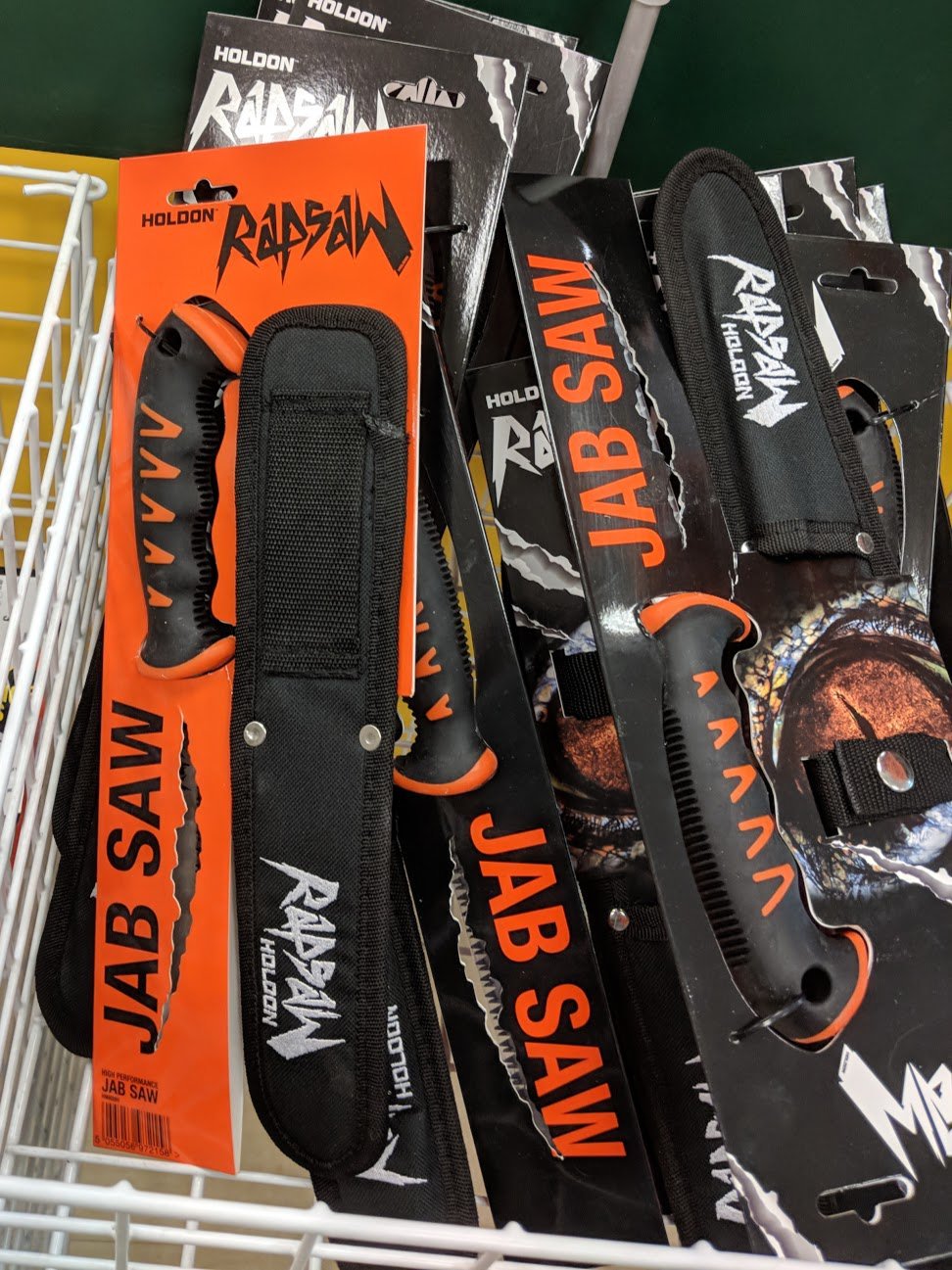
Paul Sellers was standing in line at one of his local big box store (in my part of North America, it’d be a Home Depot or Lowes), and he happened to glance at some of the packaging for otherwise pretty ordinary tools:
I’m never sure when it started, a point where you could no longer determine what something is by its name. A form of sensationalism was somehow loosed and we lost sincerity to titles declaring ‘not ordinary’ that hid what was, when all said and done, intrinsically quite the ordinary. All the handsaw makers followed suit latterly with model names like piranha, sabretooth and barracuda. Then they backed up claims with reference terms such as, “Using a handsaw impacts on all the muscles and joints in your arm. The ERGO™ handle is designed with users, tasks and environments in mind to make the job…” blah, blah, blah! The truth is that saw makers of the 18th century put far more effort into the development of ergonomic design of saw handles than any modern maker and all modern makers either copied what existed or dumbed down the designs to come up with the most basic one-size fits all design.
In reality of course nothing’s really changed except that the handles are pre moulded plastic and the teeth cannot be sharpened any more. I was in my local builders merchants waiting to pay and stood staring at the signage of the two nearest products facing me. Whereas these stab saws and jab saws convey a sense of brutalising aggression, it’s the marketer that suggests that this is what the buyer needs. Aggressive marketers think that that is indeed what the user wants, a kind of macho-man aggression to his work. The packaging has changed to use brighter hi-viz lines, letters and numbers with rip tares and wild hogs with tusks as the marketers way of connecting the would-be user to a sale of his products. Imagine, even a common degreasing agent remains the same as it was ten years ago is packed and wrapped with a punchy headline header, “Cleans like crazy!”, too, but why the wild ‘Mad Hog’ title replete with tusks? Reminds me of the Arkansas Razorback football team. What they don’t probably realise is that they would have sold as well without it. I guess they thought that they had that insider knowledge of what the trades people needed, right?
My suspicion is that there are really two distinct markets for tools and tool-related products like these. The first, and more stable market is the trades, where the demand is probably pretty steady and unlikely to shift much no matter what the marketers put on the packages. Tradespeople generally like to use known brands that they can depend on for consistent value at a given price point. These folks aren’t the target for all the marketing flash and bumf — they’ll keep buying the “Old Reliable™” brand until/unless they sell the brand to a cheaper manufacturer and the quality of the end product starts to slip. The target instead is … you. You, the non-regular user of “jab saws” or “stab saws” or even degreasing agents. You probably don’t have much recent experience with any of the current brands of tools, so you’re significantly more likely to be swayed by how the tools and materials are marketed. You’re the sucker who (they hope) will fall for the bright colours, eye-catching packaging, and mucho-macho descriptions.
And they wouldn’t keep doing it if it didn’t work.
May 27, 2018
April 15, 2018
March 30, 2018
March 22, 2018
QotD: “Sustainability”
Today on the radio I heard an ad for a DC-area supermarket chain that boasts that it now has on sale – as in, selling for a reduced price – “sustainably farmed fish.”
I really dislike the word “sustainable” (and all of its variations) as used today to signal holier-than-thou environmental ‘awareness.’ As Robert Solow said about this concept,
It is very hard to be against sustainability. In fact, the less you know about it, the better it sounds.
But advertising “sustainably farmed fish” – implying, as it does (rather bizarrely), that unsustainably farmed fish are common – is especially annoying. While the absence of property rights in oceans and other large bodies of water, and in uncaught fish, might well lead to overfishing (that is, to a genuinely unsustainable manner of acquiring fish for human consumption), the very essence of a fish farm implies property rights in the fish stocks. And where there are property rights there is sustainability. A fish farmer is no more likely to allow his stock of fish to be depleted than is the owner of Triple Crown winner American Pharaoh to allow his horse to be slaughtered for sport, or than are you to allow the cost of motor oil to prevent you from ever changing the oil in your car.
[…]
It’s depressing that those people who today are most likely to worry about resources being “unsustainable” – people who are most likely to prattle publicly about “sustainability” – are those people who also are most likely to disparage private property rights and to argue for government policies that weaken and attenuate such rights. Such people are those who are most likely to wish to further collectivize the provision not only of environmental amenities such as park space and animal conservation, but also of health care, of education, of housing, and of a host of other private goods and services. Such people also are those who are most likely to protest prices made higher by market forces, and to applaud rent-control and other government-imposed price ceilings on a variety of consumer goods and services.
In short, the people who today howl most frequently and loudly for “sustainability” are those who most frequently and loudly oppose the legal and economic institutions – private property and market-determined prices – that alone reliably promote genuine sustainability.
Don Boudreaux, “‘Sustainability’ is Fishy”, Café Hayek, 2016-07-26.
December 26, 2017
What makes a diamond priceless? – James May’s Q&A (Ep 7) – Head Squeeze
BBC Earth Lab
Published on 14 Feb 2013James May imparts his knowledge to let us know that diamonds aren’t that rare after all.
James May’s Q&A:
With his own unique spin, James May asks and answers the oddball questions we’ve all wondered about from ‘What Exactly Is One Second?’ to ‘Is Invisibility Possible?’
December 1, 2017
Censorship on the web
At City Journal, Aaron Renn explains why some of the concerns about censorship on the Internet are not so much wrong as misdirected:
The basic idea of net neutrality makes sense. When I get a phone, the phone company can’t decide whom I can call, or how good the call quality should be depending on who is on the other end of the line. Similarly, when I pay for my cable modem, I should be able to use the bandwidth I paid for to surf any website, not get a better or worse connection depending on whether my cable company cut some side deal to make Netflix perform better than Hulu.
The problem for net neutrality advocates is that the ISPs aren’t actually doing any of this; they really are providing an open Internet, as promised. The same is not true of the companies pushing net neutrality, however. As Pai suggests, the real threat to an open Internet doesn’t come from your cable company but from Google/YouTube, Twitter, Facebook, and others. All these firms have aggressively censored.
For example, Google recently kicked would-be Twitter competitor Gab out of its app store, not for anything Gab did but for what it refused to do — censor content. Twitter is famous for censoring, as Pai observes. “I love Twitter, and I use it all the time,” he said. “But let’s not kid ourselves; when it comes to an open Internet, Twitter is part of the problem. The company has a viewpoint and uses that viewpoint to discriminate.” (Twitter’s censors have not gotten around to removing the abuse, some of it racist, being hurled at Pai, including messages like “Die faggot die” and “Hey go fuck yourself you Taliban-looking fuck.”)
Google’s YouTube unit also censors, setting the channel for Prager University to restricted mode, which limits access; Prager U. is suing Google and YouTube. YouTube has also “demonetized” videos from independent content creators, making these videos ineligible for advertising, their main source of revenue. Much of the complaining about censorship has come from political conservatives, but they’re not the only victims. The problem is broad-based.
Yet sometimes Silicon Valley giants have adopted a see-no-evil approach to certain kinds of content. Facebook, for instance, has banned legitimate content but failed to stop Russian bots from going wild during last year’s presidential election, planting voluminous fake news stories. Advertisers recently started fleeing YouTube when reports surfaced that large numbers of child-exploitation videos were showing up on supposedly kid-friendly channels. One account, ToyFreaks, had 8 million subscribers — making it the 68th most-viewed YouTube channel — before the company shut it down. It’s not credible that YouTube didn’t know what was happening on a channel with millions of viewers. Other channels and videos featured content from pedophiles. More problems turned up within the last week. A search for “How do I …” on YouTube returned numerous auto-complete suggestions involving sex with children. Others have found a whole genre of “guess her age” videos, with preview images, printed in giant fonts, saying things like, “She’s only 9!” The videos may or may not have involved minors — I didn’t watch them—but at minimum, they trade on pedophilic language to generate views.
November 22, 2017
QotD: Anti-smoking fanaticism
Whenever I am in Paris I stay near Père-Lachaise, the greatest cemetery in the world, and I always take at least one walk in it. It is, like life and literature, inexhaustible; and after all, the paths not only of glory but of journalism, too, lead but to the grave.
On the way there this time I was passed by a road-sweeping vehicle with an excellent advertisement on its side. It showed a vast pyramid of cigarette ends, with the legend “350 tons of cigarette ends per year”: the sum of such annual sweepings in Paris. This must equate to an awful lot of death.
On the matter of smoking I suffer not so much from cognitive as from emotional dissonance. On the one hand I detest the filthy habit, and whenever I see the slogan SMOKING KILLS on a discarded packet on the ground, I think, “Yes, but not quickly enough.”
On the other hand, I detest the antismokers, the Savonarolas of public health. I want people to spite them by smoking, though not in my breathing space.
Theodore Dalrymple, “Of grave concern”, Taki’s Magazine, 2016-04-02.
October 23, 2017
Today I learned a new word: Pigmentocracy
In the Guardian, Afua Hirsch writes about the recent Nivea skin cream video to explain why the ad is so controversial:
“Now I have visibly fairer skin, making me feel younger,” declares the Nigerian actor Omowunmi Akinnifesi in an advert for a new face cream. The ad, for the global skincare brand Nivea, was only ever intended to reach a west African audience, but predictably – has Nivea heard of the internet? – it has been watched and shared millions of times around the world including in the UK, where most of us live in blissful ignorance of the fact that some of our most popular brands openly promote the idea in other markets that white is right.
Nivea says the ad was not intended to offend, but offence is not the point. The global market for skin lightening products, of which west Africa is a significant part, is worth $10bn (£7.6bn). Advertising has a long and unbroken history of promoting and normalising white beauty standards, and if Britain built its empire as a geopolitical and ideological project, the advertising industry commodified it. Soap brands such as Pears built a narrative that cast Africa as dark and its people as dirty, the solution to which – conveniently – was soap. Cleansing, lightening and civilising in one handy bar.
These days the marketing has become much more sophisticated. Ads speak of “toning” as code for whitening. Lancôme, which a few years ago got in trouble for using Emma Watson’s image to market its Blanc Expert line in Asia, emphasised that it does not lighten, but rather “evens skin tone, and provides a healthy-looking complexion … an essential part of Asian women’s beauty routines”.
[…]
Shadism, pigmentocracy – the idea of privilege accruing to lighter-skinned black people – and other hierarchies of beauty are a complex picture in which ads such as Nivea’s are only the obvious tip of an insidious iceberg. Celebrities with darker complexions, such as the Sudanese model Nyakim Gatwech – nicknamed Queen of the Dark – and actors such as Lupita Nyong’o, are so often discussed in the context of having achieved the seemingly impossible by being both dark and beautiful, that they become the exceptions that prove the rule.
It is often observed that light-skinned black women are more likely to become global superstars, the Beyoncé-Rihanna effect. They are, however, still black women and therefore not immune from the pressure to lighten – most recently by fans following a new Photoshopping trend of posting pictures of whitened versions of their faces and remarking upon the improvement.
In countries such as Ghana, the intended audience for the Nivea ad, and Nigeria – where an estimated 77% of women use skin-lightening products – the debate has so far, understandably, focused on health. The most toxic skin-lightening ingredients, still freely available, include ingredients such as hydroquinone, mercury and corticosteroid. It’s not unusual for these to be mixed with caustic agents ranging from automotive battery acid, washing power, toothpaste and cloth bleaching agents, with serious and irreversible health consequences.
September 8, 2017
Google’s unbridled market power and ability to quash critics and competitors
In Wired, Rowland Manthorpe reports on another case of Google roughing up someone for being critical of their current “be evil” business philosophy:
The latest allegation against Google? Jon von Tetzchner, creator of the web browser Opera, says the search giant deliberately undermined his new browser, Vivaldi.
In a blogpost titled, “My friends at Google: it is time to return to not being evil,” von Tetzchner accuses the US firm of blocking Vivaldi’s access to Google AdWords, the advertisements that run alongside search results, without warning or proper explanation.
According to Von Tetzchner, the problem started in late May. Speaking at the Oslo Freedom Forum, the Icelandic programmer criticised big tech companies’ attitude toward personal data, calling for a ban on location tracking on Facebook and Google. Two days later, he suddenly found Vivaldi’s Google AdWords campaigns had been suspended. “Was this just a coincidence?” he writes. “Or was it deliberate, a way of sending us a message?” He concludes: “Timing spoke volumes.”
Von Tetzchner got in touch with Google to try and resolve the issue. The result? What he calls “a clarification masqueraded in the form of vague terms and conditions.” The particular issue was the end-user license agreement (EULA), the legal contract between a software manufacturer and a user. Google wanted Vivaldi to add one to its website. So it did. But Google had further complaints.
According to emails shown to WIRED, Google wanted Vivaldi to add an EULA “within the frame of every download button”. The addition was small – a link below the button directing people to “terms” – but on the web, where every pixel matters, this was a potential competitive disadvantage. Most gallingly, Chrome, Google’s own web browser, didn’t display a EULA on its landing pages. Google also asked Vivaldi to add detailed information to help people uninstall it, with another link, also under the button.
June 3, 2017
Secondary boycotting
Ace describes the way political groups can exercise economic pressure on third parties to influence or even to eliminate media voices with which they disagree:
The tactic being objected to — and I didn’t make this clear yesterday — is the tactic created by the left called a “secondary boycott.”
None of you can “boycott” Rachel Maddow — you’re already not watching her, and you enjoy not watching her, and you recommend not watching her to all of your friends.
Well, leftists realized that about Rush Limbaugh — you can’t boycott that which you already don’t use — and so invented the tactic of telling advertisers: Stop advertising on his show or we will boycott you.
That’s the “secondary” part of the boycott: You’re not boycotting the primary target. Which is obviously your right. You’re now conducting political campaigns against businesses to make them stop advertising, and get the show taken off the air entirely.
This is why Cars Dot Com and USAA boycotted Hannity — because the losers of this movement decided to start pressuring the advertisers to stop advertising there.
This is what I mean by “constant political campaigns being run against people not actually running for any office.” These are actual political campaign style efforts — with websites, donor buttons, etc. — being run not just during campaign season, and not just against an office-seeker, but 24 hours a day, seven days a week, fifty two weeks a year, against just about anybody.
Note that the fringe actors who do this shit do so to raise money. They’re fringe, and they’re not going to be hired by actual political campaigns, for the most part.
But they have to make money, don’t they?
So they just decided to invent their own political campaign which is not time-limited as ordinary campaigns are, and just buckrake endlessly to get this or that person silenced.
And they’ve had some success.
Even where they don’t succeed outright, they make themselves permanent residents of your mind: Because they’ve taught you to fear them.
This is what I’m objecting to — I understand that there will be politics in politics, but I don’t want fundraising political campaigns constantly running against anyone the left doesn’t like making all of lives, every single day, every single hour, part of and endless and ugly War of All Against All just so some energetic obsessives can make a dime and feel powerful.
May 15, 2017
“The handgun industry uses the word ‘extreme’ like it’s on sale if bought by the dozen”
A post by Tamara Keel that may be of interest to my American friends, where getting legal permission to carry a handgun is still theoretically possible (unlike here in Soviet Canuckistan):
Extreme conditions! Extreme weather! The handgun industry uses the word “extreme” like it’s on sale if bought by the dozen. It gets used to tout the reliability of various handguns in advertising and in debates at gun store counters and internet forums: “The Blastomatic 2000 meets and exceeds MIL-STD-810G for blowing sand and dust…”
“We went down by the beaver pond and dunked my Sheepdog Sidearms Mk. III completely in the mud and it still fired a whole clip without jamming.”
“I read on a blog that the East Slobovian Army tested the Infidel Defense Crusader by freezing it in a block of ice and running it over with a tank!”
This is all well and good, but it has next to nothing to do with day-to-day concealed carry by the average American armed citizen. If someone were to come up with a relevant test to replicate the conditions faced by the typical concealed carry gun, it would probably involve gently bouncing the holstered gun up and down in a heated container full of pocket lint and dead skin cells for six months until all the lube evaporates or congeals — whichever comes first.
Neglect is probably the greatest enemy of the concealed self-defense handgun. In my experience, it’s a rare one that gets fired and lubricated very frequently. On one end of the spectrum are the people who might only own the one pistol and hardly ever get to the range with it, and on the other end are people who might have dedicated practice or training guns to spare their actual lifesaving tool the wear and tear.
April 27, 2017
Our Channel And The YouTube Adpocalypse I THE GREAT WAR
Published on 26 Apr 2017
Our Patreon: http://patreon.com/thegreatwar
Our Merch Store: https://shop.spreadshirt.net/thegreatwar/A good explanation how YouTube Ads work by CGP Grey: https://www.youtube.com/watch?v=KW0eUrUiyxo
In light of the news surrounding YouTube and their ad policy we got a lot of comments asking how and if all this affects our show and production. We want to make a few things clear and also underline how you can support us.
» HOW CAN I SUPPORT YOUR CHANNEL?
You can support us by sharing our videos with your friends and spreading the word about our work.You can also support us financially on Patreon: https://www.patreon.com/thegreatwarYou can also buy our merchandise in our online shop: http://shop.spreadshirt.de/thegreatwar/
Patreon is a platform for creators like us, that enables us to get monthly financial support from the community in exchange for cool perks.
April 13, 2017
United Airlines Honest Commercial [Jimmy Kimmel]
Published on Apr 11, 2017
“No one wanted to volunteer to get off the plane because the next flight wasn’t until 2 p.m. the next day, which is almost a full 24 hours later,” said Bridges, who added that the airline selected which flyers to eject “based on an internal algorithm that weighs in … who was the last to purchase.” Bridges said the unidentified passenger was told he had to leave, but the man refused to do so.
“He said he was a doctor, he had patients he had to see in the morning, he wasn’t going to get off the plane,” Bridges recounted, “and the gate agent was like, ‘You have to get off the plane. If you don’t get off, we’ll call in security.’ And he was like, ‘Fine, call security, I’m not getting off the plane.’”
Bridges said the man wasn’t being violent with security and police officers who responded, but did say he was “kind of [flailing] his arms and trying to keep them away from him and ultimately they had to use the force, as you can see in the video.”
The shocked passengers berated United employees who boarded the plane in the ejected flyers’ place.
Late Monday, United CEO Oscar Munoz issued a statement apologizing for having to “re-accommodate these customers.”
“Does that look like re-accommodation to you?” Carlson asked. “There’s no mention of the fact that this guy is bloody and unconscious. That’s re-accommodation, according to United Airlines.”
[http://www.foxnews.com/travel/2017/04/10/united-airlines-passenger-describes-moment-unconscious-man-was-dragged-off-plane.html]