Quotulatiousness

April 11, 2019

Ontario government unveils massive subway and light rail expansion for the GTA

Filed under: Cancon, Government, Railways — Tags: , , , , , — Nicholas @ 05:00

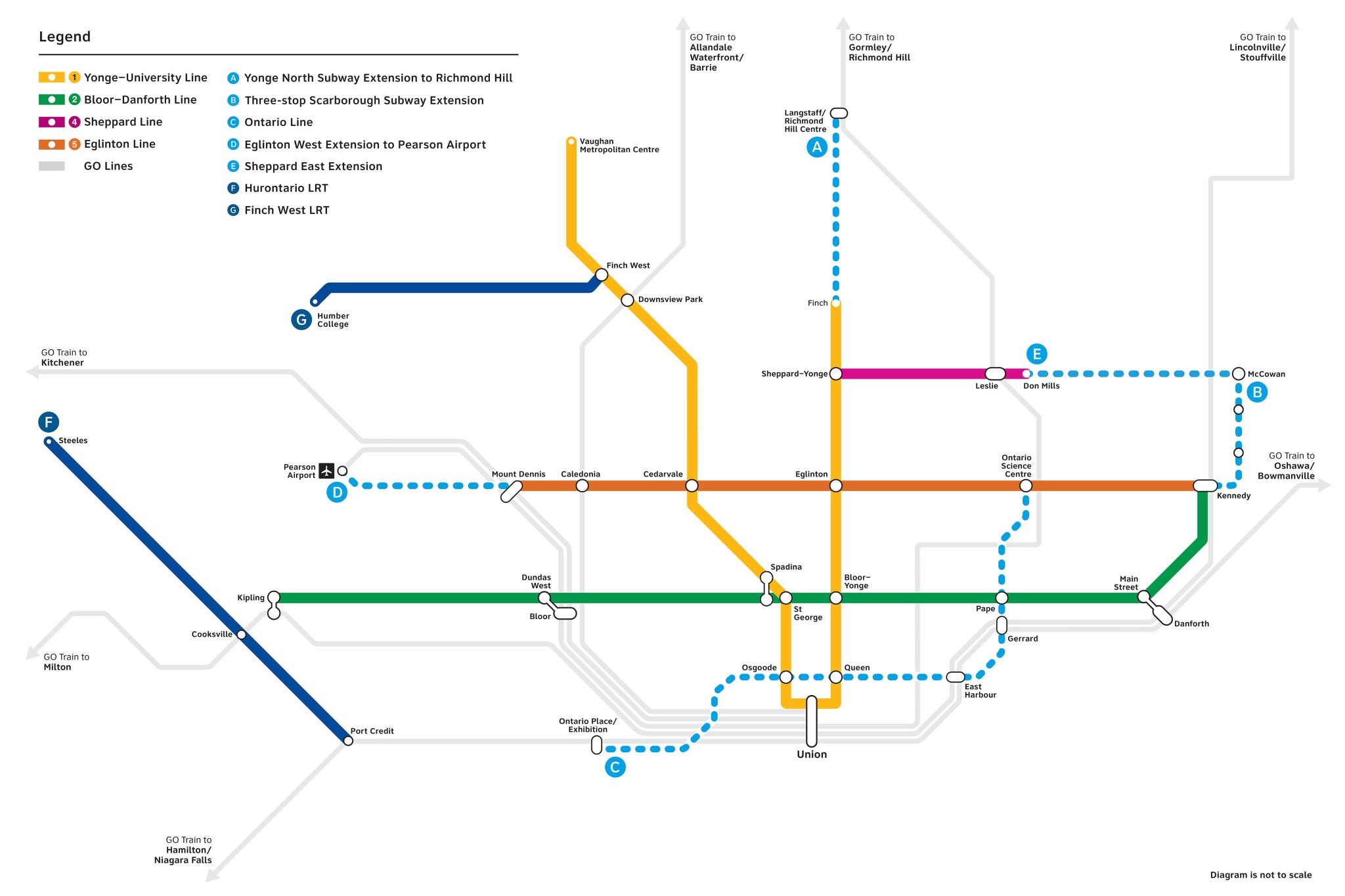
Doug Ford has always been a fan of subways, but now that he’s the Premier of Ontario, he’s getting to indulge his subway fetish in a vast expansion to heavy and light rail transit in and around Toronto:

Click map to embiggenate

The plans include:

  • An expanded downtown relief line, now to be called the Ontario line, running from Ontario Place on the lakeshore through downtown along Queen Street then crossing the Bloor-Danforth subway line at Pape station and running north to the Ontario Science Centre on the Eglinton Crosstown LRT line. This line is optimistically to be ready for opening by 2027.
  • The existing Sheppard Line will be extended east from Don Mills to McCowan, where it will intersect with the planned Scarborough subway extension (now to include three stops, not just the one originally announced, and to be completed by 2030).
  • The Yonge-University line will be extended north from current terminus at Finch to the Richmond Hill Centre with a hoped-for completion date soon after the Ontario line.
  • The Eglinton Crosstown line will be extended west to Pearson airport, with a target completion date of 2031.
  • New light rail lines will be created between Finch West on the Yonge-University subway to Humber College, and along Hurontario Street in Mississauga from Port Credit on the lakeshore to Steeles Avenue in Brampton.

To accomplish all of this will require financial contributions from the City of Toronto, York Region, and the federal government, as the province is only funding just over one third ($11.2 billion) of the estimated $28 billion price tag.

Of course, it’s a Doug Ford plan, so none of the usual suspects in Toronto are happy about any of it.

What happens if you block access to all of Google’s IP addresses?

Filed under: Business, Technology — Tags: , , — Nicholas @ 04:00

The answer is … not a lot, or at least not quickly. So many companies use Google’s services in the background that even if you can get a particular site to work for you, it’ll very likely be as slow as a mid-90’s dial-up connection. Stephen Green reports on someone’s live experiment with a Google-less internet:

Behind the scenes, [Gizmodo’s Kashmir] Hill’s specialty VPN blocked her devices from trying to ping Google’s servers more than 15,000 times — in just the first few hours. After a week, it had stopped more than 100,000 attempts to share data with Google. And to repeat, this is after Hill had stopped using any of Google’s apps or services. The company has its tendrils all throughout the internet.

As Hill describes the process in her report to Gizmodo:

    I migrate my browser bookmarks over to Firefox (made by Mozilla).

    I change the default search engine on Firefox and my iPhone from Google — a privilege for which Google reportedly pays Apple up to $9 billion per year — to privacy-respecting DuckDuckGo, a search engine that also makes money off ads but doesn’t keep track of users’ searches.

    I download Apple Maps and the Mapquest app to my phone…

    I switch to Apple’s calendar app.

    I create new email addresses on Protonmail and Riseup.net (for work and personal email, respectively) and direct people to them via autoreplies in Gmail.

Hill did literally everything an internet-connected human being can do to disconnect themselves from Google. But you don’t have to be a Google customer in order to have the company garner 100,000 little bits of data about you every single week. Or as Hill herself says, “Google, like Amazon, is woven deeply into the infrastructure of online services and other companies’ offerings, which is frustrating to all the connected devices in my house.”

The fact is, you aren’t Google’s customer: You and your data are Google’s product, served up on an electronic platter to advertisers and God-Only-Knows-Who-Else… even if, like me, you’ve boycotted all of the company’s little data-sniffing products.

As a libertarian, I have philosophical issues with the whole idea of antitrust. But when a company grows so big and so pervasive that you can’t avoid becoming its tool — even when going to the extreme lengths Hill went through — then I can draw only one conclusion, expressed in three words.

Break. Them. Up.

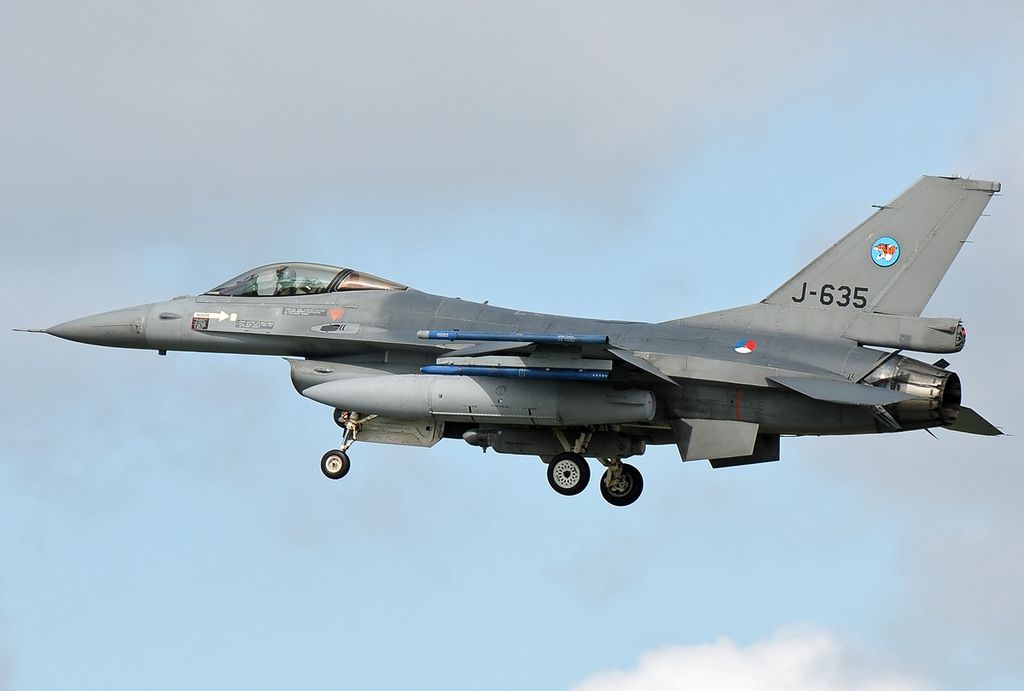
Dutch F-16 nearly shoots down … itself

Filed under: Europe, Military, Technology — Tags: , , — Nicholas @ 03:00

I didn’t think this was even remotely a possibility:

General Dynamics F-16AM Fighting Falcon
of the Netherlands Royal Air Force
Photo by Aldo Bidini via Wikimedia Commons.

The Netherlands’ Defense Safety Inspection Agency (Inspectie Veiligheid Defensie) is investigating an incident during a January military exercise in which a Dutch Air Force F-16 was damaged by live fire from a 20-millimeter cannon — its own 20-millimeter cannon. At least one round fired from the aircraft’s M61A1 Vulcan Gatling gun struck the aircraft as it fired at targets on the Dutch military’s Vliehors range on the island of Vlieland, according to a report from the Netherlands’ NOS news service.

Two F-16s were conducting firing exercises on January 21. It appears that the damaged aircraft actually caught up with the 20mm rounds it fired as it pulled out of its firing run. At least one of them struck the side of the F-16’s fuselage, and parts of a round were ingested by the aircraft’s engine. The F-16’s pilot managed to land the aircraft safely at Leeuwarden Air Base.

The incident reflects why guns on a high-performance jet are perhaps a less than ideal weapon. The Vulcan is capable of firing over 6,000 shots per minute, but its magazine carries only 511 rounds — just enough for five seconds of fury. The rounds have a muzzle velocity of 3,450 feet per second (1050 meters per second). That is speed boosted initially by the aircraft itself, but atmospheric drag slows the shells down eventually. And if a pilot accelerates and maneuvers in the wrong way after firing the cannon, the aircraft could be unexpectedly reunited with its recently departed rounds.

Modern History: A Funny Thing About Medieval Hoods

Filed under: History — Tags: , — Nicholas @ 02:00

Modern History TV
Published on 7 Mar 2019

A look at medieval hoods, how they’re used, how they’re worn and something you probably didn’t know about them.

Credits

Direction, Camera, Editing, Sound Kasumi
Presenter Jason Kingsley OBE

Music licensed from PremiumBeats

QotD: How to improve David Lynch’s Dune

Filed under: Books, Media, Quotations — Tags: , , — Nicholas @ 01:00

Dune (1982) is a Lawrence of Arabia pastiche with a mad bucket of half-baked science fiction tropes bolted onto it. It includes so much extraneous, confusing detail from the novel’s world, but when you think of all the things it omits you really get a good sense of why Lynch (or anyone?) could not form it in 2 or 3-hours.

I think there are two things that could be done to fix it. Firstly, remove all the speaking and turn the whole thing into a hallucinatory Lynchean nightmare, perhaps to be accompanied by Brian Eno’s mythic 45-minute album of Dune music. […]

Secondly, use Lynch’s movie as the basis for a full-length animated TV miniseries by rotoscoping it and bringing back the original actors for several hours or so of newly-animated scenes.

Rob Beschizza, “Sorry, David Lynch’s Dune sucks (or does it?)”, Boing Boing, 2017-04-21.

April 10, 2019

Canada and the Battle of the Atlantic, part 9 by Alex Funk

Filed under: Cancon, History, Military, WW2 — Tags: , , , , — Nicholas @ 05:00

Editor’s Note: This series was originally published by Alex Funk on the TimeGhostArmy forums (original URL – https://community.timeghost.tv/t/canada-and-the-battle-of-the-atlantic-part-4/1447/3).

Sources:

  • Far Distant Ships, Joseph Schull, ISBN 10 0773721606 (An official operational account published in 1950, somewhat sensationalist)
    [Schull’s book was published in part because the funding for the official history team had been cut and they did not feel that the RCN’s contribution to the Battle of the Atlantic should have no official recognition. It is very much an artifact of its era, and needs to be read that way. A more balanced (and weighty) history didn’t appear until the publication of No Higher Purpose and A Blue Water Navy in 2002, parts 1 and 2 of the Official Operational History of the RCN in WW2, covering 1939-1943 and 1943-1945, respectively.]
  • North Atlantic Run: the Royal Canadian Navy and the battle for the convoys, Marc Milner, ISBN 10 0802025447 (Written in an attempt to give a more strategic view of Canada’s contribution than Schull’s work, published 1985)
  • Reader’s Digest: The Canadians At War: Volumes 1 & 2 ISBN 10 0888501617 (A compilation of articles ranging from personal stories to overviews of Canadian involvement in a particular campaign. Contains excerpts from a number of more obscure Canadian books written after the war, published 1969)
  • All photos used exist in the Public Domain and are from the National Archives of Canada, unless otherwise noted in the caption.

I have inserted occasional comments in [square brackets] and links to other sources that do not appear in the original posts. A few minor edits have also been made for clarity.

Earlier parts of this series:

Part 9 — Early-to-mid 1941, the Rocky Isle in the Ocean

Marc Milner continues the story in North Atlantic Run:

The problem of providing end-to-end A/S escort in the North Atlantic was discussed by British and Canadian authorities during the winter. These talks were the first sure indication that RCN corvettes were likely to be used as ocean escorts (what the navy thought corvettes earmarked for the Eastern Atlantic were initially expected to do remains uncertain). In any event, the Anglo-Canadian discussions identified three factors crucial to the establishment of end-to-end A/S escort: the escorts must be available; they must have reached a reasonable state of individual and escort-group training, and the necessary bases must be available. In May 1941 none of these factors obtained in the Western Atlantic. An insufficient number of new corvettes were in commission, and most of these only recently. The development of facilities was now a top priority, but support facilities outside of Halifax were virtually non-existent, and the standard of training was to prove inadequate, to say the least.

The natural place from which to stage escort operations in the Northwest Atlantic was Newfoundland.

To briefly discuss Newfoundland’s role so far, when Canada declared war on September 10th, Newfoundland had already been at war for seven days. As a British dominion [under direct rule from London since 1934] ten years before joining Confederation, the mainland declaration of war received modest space on page four of the St. John’s Evening Telegram. They had participated in the first “hostile” act in North America: a German merchant vessel had been seized and thirty prisoners taken. The local YMCA was converted into a prison. Rationing and dim-outs took effect instantly. Private radio stations were silenced, mail and cables censored, aliens registered and controlled. Insurance premiums on waterfront property had gone up in less than a week from $1.00 to $5.00 for each $1000 of coverage.


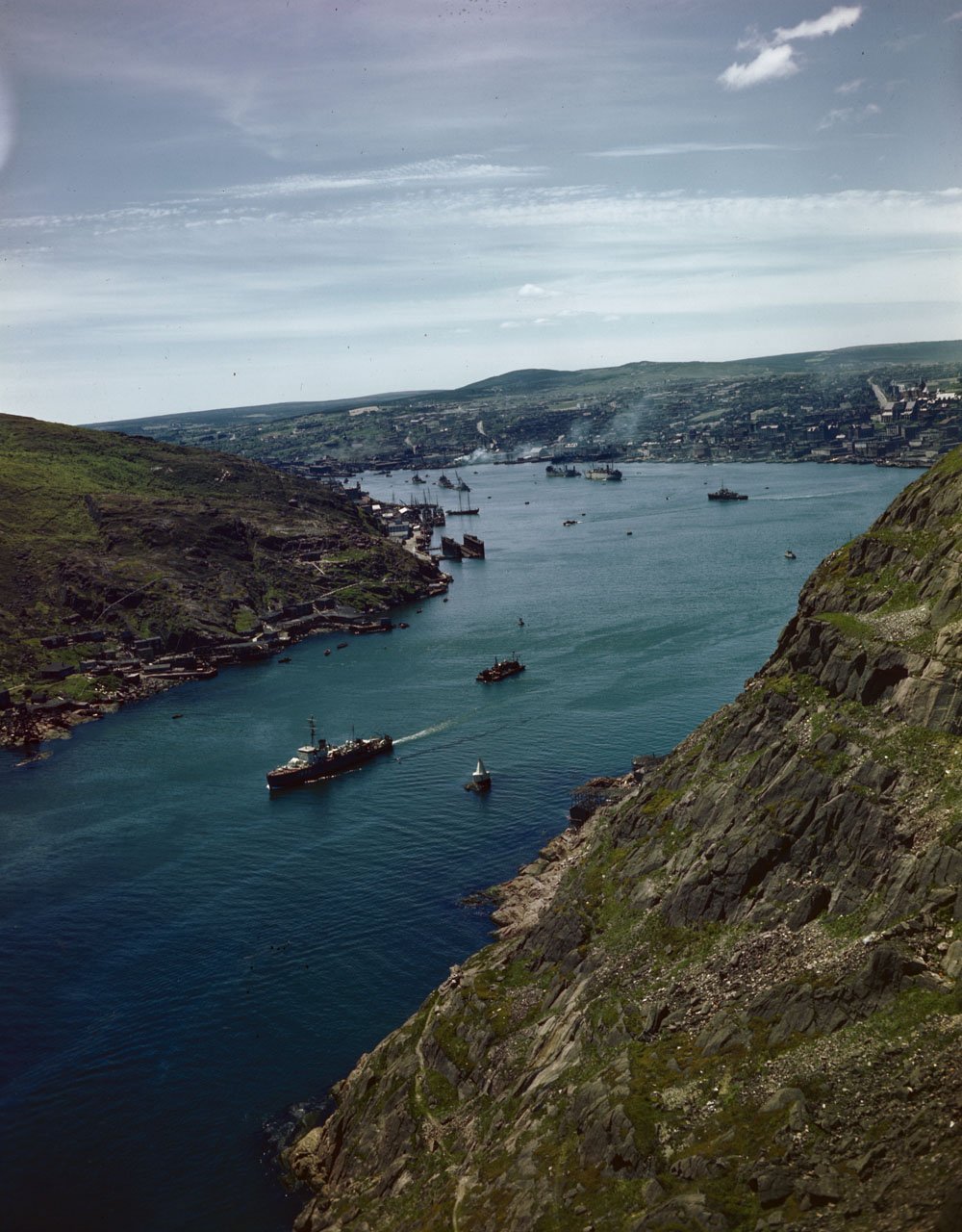
View of the entrance to St.John’s harbour and port facilities, Newfoundland, taken from Signal Hill, 1942. A minesweeper is leaving port.
Canada. Department of National Defence / Library and Archives Canada / ecopy

Milner continues:

Although not yet part of the Dominion of Canada, the island was integral to Canadian defence, and its protection was assumed, in consultation with the British, as a Dominion responsibility in 1939. By early 1941, however, the Canadian armed forces had made only a modest contribution to Newfoundland’s security, though more was planned under the terms of Plan Black. During 1940 the RCN had surveyed the coast for possible base sites and fleet anchorages and ordered a further ten corvettes for local defence. The navy had also seconded personnel to the Naval Officer in Charge, St John’s, Captain C.M.R. Schwerdt, RN, the only naval establishment on the island. Until the latter was turned over to the RCN in early May 1941, the Canadian navy had no permanent presence in Newfoundland. For a number of reasons, not all of them enemy inspired, this low level of activity was destined to change. The absorption of Schwerdt’s command into the RCN came as part of the integration of Newfoundland into the Canadian east-coast command system, and it mirrored similar army and air force arrangements. But Canada was also engaged in an embryonic war of influence with the U.S. over the old colony. The establishment of American bases on the island, as a result of the destroyers-for-bases deal with the British, was attended by an agreement granting the U.S. rights to defend its new bases by operations in adjacent territory. The agreement was concluded despite strong protests from Canada and in spite of the prior Canadian acceptance of responsibility for Newfoundland’s defence.

The anxiety Canada felt over her position in Newfoundland was exacerbated by joint Anglo-American planning of a combined strategy for the defeat of Germany should the U.S. enter the war. For several weeks in early 1941 senior American and British staffs met in Washington to discuss a co-ordinated Commonwealth and U.S. plan. Neither Canada nor any of the other Dominions was accorded official representation, although British delegates kept their Commonwealth allies informed of proceedings. The result of these meetings was an agreement, American-British Conference 1 (ABC 1), whereby the world was divided into two basic strategic zones. The Americans were to assume responsibility for most of the Pacific and for the Western Atlantic, with the exception of waters and territory assigned to Canada “as may be defined in United States-Canada joint agreements”.

The Canadians were not pleased with their treatment in the Anglo-American discussions, and the Chiefs of Staff feared that ABC 1 was intended to oust them from Newfoundland. The issue was somewhat problematical, since the implementation of ABC 1 was dependent upon U.S. entry into the war. However, the resolution of such issues, which had a direct bearing on Canada’s responsibilities as a sovereign state, did not accord with the national view of Canada as a full and independent partner in the war against Germany. Canada was already attempting to force recognition of that claim, at least with respect to North American defence, by the establishment of a Canadian Staff mission in Washington. While the battle to be heard and recognized went on, Canadian responsibilities under under the terms of ABC 1 were worked out by the Permanent Joint Board on Defence. These agreements, styled Joint Canadian-United States Basic Defense Plan No. 2 (Short Title ABC-22) and appended to ABC 1, acknowledged Canada responsibility for her own coastal waters (within the customary three mile limit) and for the commitment of five destroyers and fifteen corvettes to supplement USN forces in the Western Atlantic. Under the terms of ABC 22 the balance of Canadian naval forces was to be sent overseas.

[Editor’s Note: The actual wording of Annex 1 to ABC 22 isn’t quite as restrictive as far as available naval forces are concerned, and the inventory of USN and RCN forces is interesting in itself:]

ANNEX I-MILITARY FORCES

In view of the uncertainties which exist as to the stability of the strategic situations in various theatres, and as to the date on which the United States may enter the war, the strengths of forces listed below must be regarded as subject to change in the light of the strategic situation which may exist when the plan is placed in effect. The forces now estimated to be initially available for the operations required by this plan as of 15 July, 1941, are:

(A) ATLANTIC

    Ocean Escorts United States Atlantic Fleet
      6 Battleships
      5 8" Cruisers
     54 Destroyers
      4 Mine Sweepers (destroyer type)
     54 Patrol Planes

    North Atlantic Naval Coastal Force (U. S. N.)
      5 Eagle Boats
      3 Gunboats
      4 Patrol Yachts
     18 Patrol Planes

Page 1591

    Newfoundland Force (R. C. N.) (Allocated to operate with Ocean 
      Escorts, U. S. Atlantic Fleet)
      5 Destroyers
     15 Corvettes

    Atlantic Coast Command (R. C. N.)
      8 Destroyers
     28 Corvettes
      4 Mine Sweepers
      4 Magnetic Mine Sweepers
     11 Armed A/S Yachts

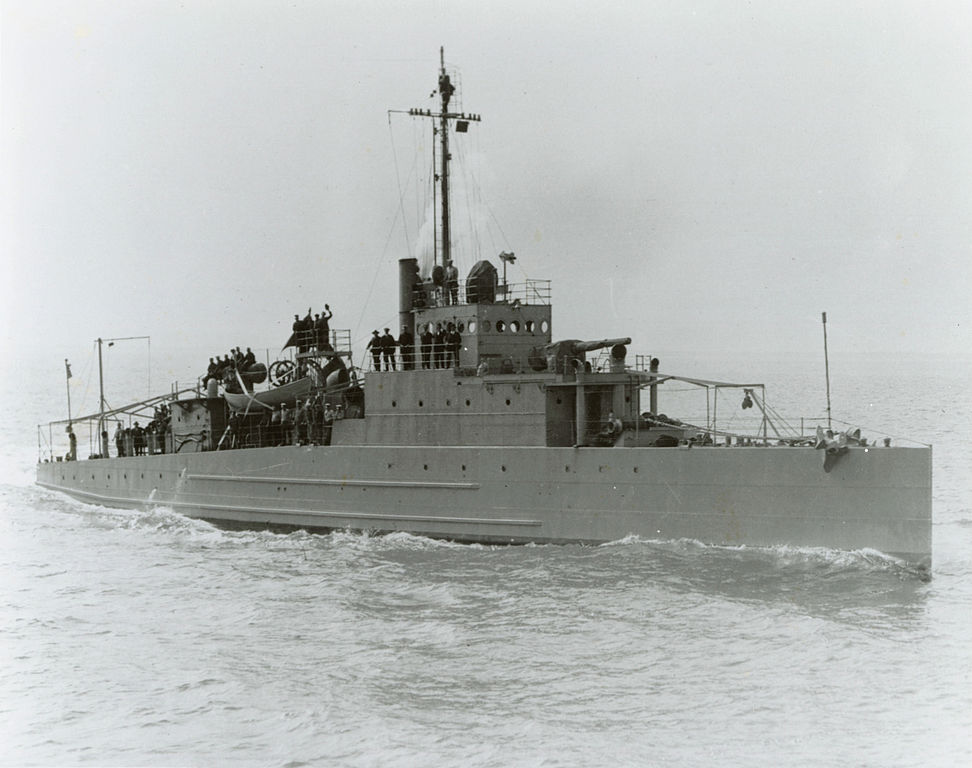
USS Eagle 2 (PE-2) on builder’s trials in 1918.
US Navy photo via Wikimedia Commons.

[Editor’s Note: I’d never heard of “Eagle Boats” before, so here’s what Wikipedia has to say about them: “The Eagle class patrol craft were a set of steel ships smaller than contemporary destroyers but having a greater operational radius than the wooden-hulled, 110-foot (34 m) submarine chasers developed in 1917. The submarine chasers’ range of about 900 miles (1,400 km) at a cruising speed of 10 knots (19 km/h) restricted their operations to off-shore anti-submarine work and denied them an open-ocean escort capability; their high consumption of gasoline and limited fuel storage were handicaps the Eagle class sought to remedy. […] The term “Eagle Boat” stemmed from a wartime Washington Post editorial which called for “…an eagle to scour the seas and pounce upon and destroy every German submarine.” However, the Eagle Boats never saw service in World War I. […] A number of the Eagle Boats were transferred to the United States Coast Guard in 1919, and the balance were sold in the 1930s and early 1940s. Eight Eagle boats saw service during World War II. One was stationed in Miami as a training vessel. After the war, seven were decommissioned, while one was sunk by a German submarine.”]

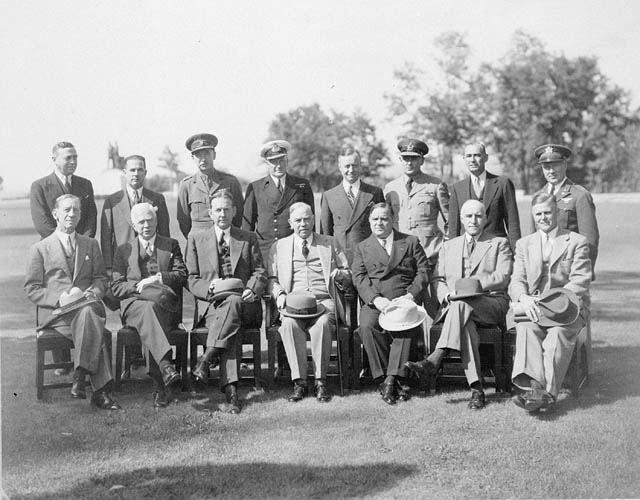
Members of the Permanent Joint Board on Defence, August 1940.
Library and Archives Canada / C-005767

Milner continues:

In the strictest sense, should the U.S. enter the war, Canada had lost the battle for Newfoundland. But though the Canadians had earlier been prepared to place their forces unreservedly under U.S. strategic direction in the worst-case scenario of Plan Black, they considered ABC 1 and ABC 22 offensive plans. The Canadians therefore clung firmly to their right to exercise command and control of Canadian forces in Canada and Newfoundland, even should ABC 1 come into force. Further, actual command of forces, despite a strong American sentiment to the contrary, was to remain with the respective nations. Co-ordination of the military effort in a given area was to be by “mutual co-operation”. Unified command of all forces under a single officer was allowed for upon agreement by the officers in the field or the Chiefs of Staff. The criteria for determining who was to command under such conditions were never clearly defined; however, the Canadians at least considered that the size of national contingent and the rank and seniority of its commanding officer were the governing elements. It was Canadian practice, therefore, throughout the joint American-Canadian occupation of Newfoundland to keep Canadian strength above that committed by the U.S. and to ensure that the senior Canadian present outranked his American counterpart. All of these considerations were foremost in the minds of the Canadian government and Staffs when Canada was asked by the British to base large escort forces at St John’s in the spring of 1941.

Thus, aside from the very real operational importance of the task, it was not surprising that the RCN responded enthusiastically to the Admiralty’s request of 20 May that the navy begin the escort of convoys from a base at St John’s. NSHQ responded by declaring that it was prepared to commit all of its new construction and its destroyer forces as well — virtually the entire navy. “We should be glad,” the Canadian reply read, “to undertake anti-submarine convoy escort in the Newfoundland focal area.” Naturally, command of the forces would rest with an RCN officer, and NSHQ suggested Commander E.R. Mainguy, RCN, an officer with experience in the Western Approaches who would be promoted to Captain for the task. However, the Canadians agreed that the Admiralty, through the Commander-in-Chief, Western Approaches (C-in-C, WA), would assume “direction of this force when necessary to coordinate its cooperation with those of the Iceland force.”

Commander E.R. Mainguy, Commanding Officer, HMCS Ottawa, off Botwood, Newfoundland in June, 1940. Botwood was being scouted as a potential seaplane base at the time, and would eventually become home to two RCAF Canso squadrons and a full Canadian Army detachment.
Canada. Dept. of National Defence / Library and Archives Canada / PA-104029

Whether Canadian enthusiasm for the Newfoundland Escort Force (NEF) stemmed from a belief that a permanent, military and politically acceptable role for the burgeoning corvette fleet had been found remains a mystery. What is patently clear, however, is that both the British and the Americans considered the NEF a stopgap measure. By the summer of 1941 it was becoming increasingly evident that the U.S. would get involved in the Atlantic battle under the guise of defending the neutrality of the Western Hemisphere. When that happened, the role of the RCN in the Western Atlantic would be governed by the accords of ABC 1.

Whatever the final outcome of NEF, the commitment of the corvette fleet to ocean escort work marked a radical departure from the intended use of such vessels.

Royal Canadian Navy Operations Room, St. John’s, Newfoundland, 24 September 1942.
Lt Gerald M. Moses / Canada. Dept. of National Defence / Library and Archives Canada / PA-180609

Zahhak the Demon King – Persian Myth #1 – Extra Mythology

Filed under: History, Middle East — Tags: , — Nicholas @ 04:00

Extra Credits
Published on 8 Apr 2019

Join the Patreon community! http://bit.ly/EMPatreon

Zahhak was not always a demon king — but, deceived by a young man named Iblis, he was motivated to slay his father to obtain world power. His pride would cause him to turn into a monstrous demon king, with serpents on his shoulders that fed on the Arabian people, for a thousand years… until Feraydun showed up…

Theodore Dalrymple on obesity

Filed under: Food, Health — Tags: , , , — Nicholas @ 03:00

His latest in the New English Review:

It hardly requires me to point out that obesity has become a greater threat to the health of the human population in most parts of the world than famine. There was a wonderful cartoon recently in the British magazine, The Oldie, which captured this perfectly. A mother is taking a plate of food away from her child, who is protesting. “Think of the obese millions!” she says to him. When I was young, of course, we were told to finish what was on our plate and to think of the starving millions. Being a precocious little brat, I used to ask how eating what I did not want would help them. Let us just say that the reply was seldom well-reasoned, either in form or content.

It has now become an almost unassailable orthodoxy, at least in medical journals, that obesity is an illness in and of itself: that is to say, it does not merely have medical consequences, but — even without those consequences — is a disease. To be fat is, ipso facto, to be ill, in the same sense as to have Parkinson’s disease is to be ill.

Nor, according to the modern orthodoxy, is obesity to be considered the natural consequence of bad or foolish individual choices, a lack of self-control. That would be to blame the victim. The fat person is in effect the vector of forces that play upon him or her, without any contribution on his or her part.

This is an idea of long gestation. Reading an old text on obesity, published in 1975, and edited by one of my medical mentors, I came across the following quote from a paper written in 1962:

    I wish to propose that obesity is an inherited disorder and due to a genetically determined defect in an enzyme: in other words that people who are fat are born fat, and nothing much can be done about it.

This is like saying that addicted people are born to be addicted, and until doctors discover a technical means of stopping their addiction, they might as well make no efforts on their own behalf. No doubt the people who adhere to this view – that obesity and addiction are illnesses simpliciter – think they are being generous but in fact they are forging psychological manacles. No doubt the fat woman in the bakery was at some level trying to prove to herself that obesity was a fatality and not under any possible individual control.

But is the theory in accord with the scene I have described above? In fact, the scene might lead us to a more nuanced or less categorical view of the problem of obesity (and, by extension, of other social problems) than we might at first adopt.

M37: The Ultimate Improved Browning 1919

Filed under: History, Military, Technology, USA, Weapons — Tags: , , , , , — Nicholas @ 02:00

Forgotten Weapons
Published on 8 Mar 2019

http://www.patreon.com/ForgottenWeapons

Cool Forgotten Weapons merch! http://shop.bbtv.com/collections/forg…

In November of 1950, the US Ordnance Department requested an improved version of the Browning 1919 air cooled machine gun for use in tanks. The new version was to be able to feed from either the left or right, a feature which was unimportant for an infantry gun but much more relevant when mounting guns into the tight spaces of an armored vehicle. An interim conversion of existing guns to the M1919A4E1 pattern came first, followed by manufacture of all-new guns by the Rock Island Arsenal and Saco-Lowell company from 1955 until 1957.

The design of the gun fell to Bob Hillberg at High Standard. He came up with a clever set of reversible plugs to change the bolt between left and right hand feed, as well as a captive recoil spring, manual safety, improved top cover and rear cover latches, and several other strengthened parts. He also incorporated a charging handle extension with integral manual hold open and a link ejection chute that could be mounted to either side of the gun. His T153 design was formally adopted as the M37, in caliber .30-06. A 7.62mm NATO version (the M37E1) followed as well. The M37 would serve into the late 1960s on the M48 and M60 tanks as well as several helicopters.

Contact:
Forgotten Weapons
PO Box 87647
Tucson, AZ 85754

QotD: UBI and the “end of work”

Filed under: Economics, Government, Quotations — Tags: , — Nicholas @ 01:00

I’m sort of skeptically agnostic about the end of work. Yes, this has been predicted before, and never arrived. On the other hand, history is full of stuff that was predicted and didn’t arrive, until suddenly it did. So maybe this time is really different.

And what do we do if it is? I don’t know. I don’t think UBI [Universal Basic Income] is the answer. We have a fair amount of data about what places look like where large numbers of people are subsidized not to work. The answer is “like nowhere you’d want to live”. The predicted flowering of artistic and community endeavor does not arrive; people are depressed, less social, and spend a great deal of time on activities like watching television.

To this, UBI advocates rejoinder “But what about trust fund babies and old-style aristocrats! Everyone admires their lives of leisure!” To which my answer is “Heck no, I don’t”. The lives of the idle rich are better upholstered than the out-of-work poor, but suffer the same absence of meaning and community. They are not a model to which anyone should aspire.

Megan McArdle, “Ask Me Anything”, Reddit, 2017-04-10.

April 9, 2019

Miscellaneous Myths: The Five Suns

Filed under: Americas, History — Tags: , , , — Nicholas @ 06:00

Overly Sarcastic Productions
Published on 5 Apr 2019

Everybody loves a good creation myth. The Aztecs loved it so much they did it five whole times! I’d call it “overkill”, but compared to all the other stuff the aztecs believed, four mythical extinction events is actually remarkably tame.

PATREON: https://www.patreon.com/user?u=4664797

Canada and the Battle of the Atlantic, part 8 by Alex Funk

Filed under: Cancon, History, Military, WW2 — Tags: , , , , — Nicholas @ 05:00

Editor’s Note: This series was originally published by Alex Funk on the TimeGhostArmy forums (original URL – https://community.timeghost.tv/t/canada-and-the-battle-of-the-atlantic-part-3/1442).

Sources:

  • Far Distant Ships, Joseph Schull, ISBN 10 0773721606 (An official operational account published in 1950, somewhat sensationalist)
    [Schull’s book was published in part because the funding for the official history team had been cut and they did not feel that the RCN’s contribution to the Battle of the Atlantic should have no official recognition. It is very much an artifact of its era, and needs to be read that way. A more balanced (and weighty) history didn’t appear until the publication of No Higher Purpose and A Blue Water Navy in 2002, parts 1 and 2 of the Official Operational History of the RCN in WW2, covering 1939-1943 and 1943-1945, respectively.]
  • North Atlantic Run: the Royal Canadian Navy and the battle for the convoys, Marc Milner, ISBN 10 0802025447 (Written in an attempt to give a more strategic view of Canada’s contribution than Schull’s work, published 1985)
  • Reader’s Digest: The Canadians At War: Volumes 1 & 2 ISBN 10 0888501617 (A compilation of articles ranging from personal stories to overviews of Canadian involvement in a particular campaign. Contains excerpts from a number of more obscure Canadian books written after the war, published 1969)
  • All photos used exist in the Public Domain and are from the National Archives of Canada, unless otherwise noted in the caption.

I have inserted occasional comments in [square brackets] and links to other sources that do not appear in the original posts. A few minor edits have also been made for clarity.

Earlier parts of this series:

Part 8 — Expansion problems: not enough men for not enough ships

Marc Milner discusses the RCN’s ongoing manning crisis afloat and ashore in North Atlantic Run:

… it was also necessary to find personnel to man new shore establishments. Indeed, by early 1941 the latter took precedence of the needs of the fleet. Although the navy remained committed to increasing the number of escort numbers assigned to its first operational priority, defence of the North Atlantic trade lanes, the gradual extension of the war underlined the paramount need for bases. “Our primary object from the Naval point of view,” a Canadian Chiefs of Staff “appreciation” of May 1941 observed, “must therefore be the extension of existing facilities and the provision of new ones to meet the ever-increasing demands of the British — and perhaps the United States — Naval forces.” The expansion fleet was then only one part of a much larger plan of support for North Atlantic naval operations. Moreover, actual planning for the commissioning and work-up of the new escorts took place as the fleet assumed new and more demanding tasks.

The concern of the Chiefs of Staff for facilities underlined the fact that even by the second winter of the war the navy’s growth was still held in check by enormous shortages. … The Director of Naval Personnel, Captain H.T.W. Grant, informed the council that the RCN needed three hundred RCNVR executive officers — none of whom had yet been enlisted — if the authorized commitments for the following May were to be met. This was no mean task in itself, but the Naval Council noted that the training establishments needed to prepare the men had to be built first. The final twist occurred when the minister advised that the navy must first make steps to acquire the necessary land!

As Nelles later explained in a personal letter to Admiral Sir Dudley Pound, the First Sea Lord, the RCN was indeed making bricks without straw. … The primary need was now quantity in all aspects of naval endeavour — manpower, ships, and bases.

With existing training establishments choked and new ones still in the planning stages, the provision of personnel for the expanding fleet posed a serious problem. Urgency was to Canadian planning in late 1940, when it became clear that Britain was involved in what Nelles described as “a Naval crisis equal [to] or greater than that which existed in 1917.”
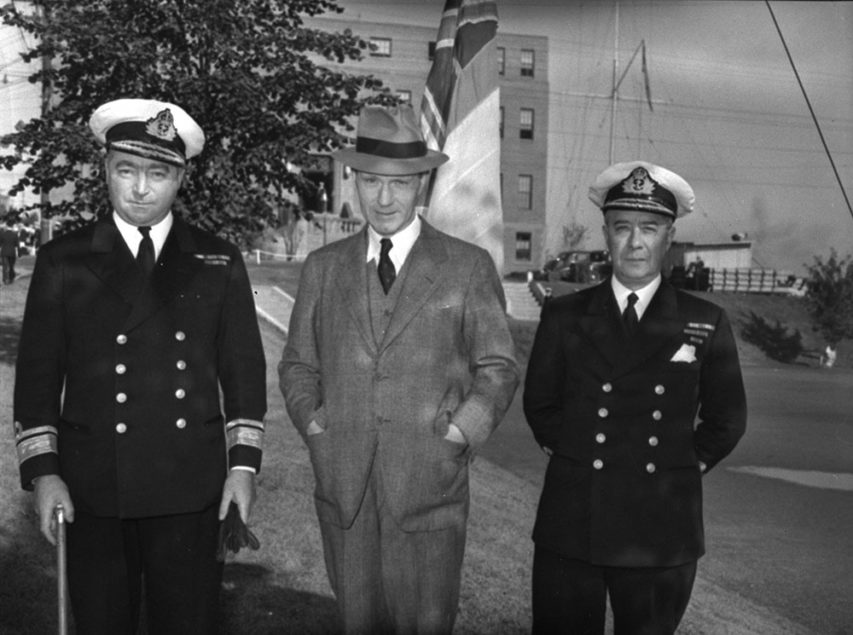
Hon. Angus L. Macdonald, Minister of National Defence for Naval Services, with senior RCN officers, Commodore H.E. Reid and Rear-Admiral P.W. Nelles, September 1940.
Canada. Dept. of National Defence / Library and Archives Canada / PA-104112

To help address the RCNVR officer shortage, a deal was agreed between the RCN and the RN by which RCNVR officers-in-training would travel to England and receive training at HMS King Alfred, the reservist training centre at Hove:

The great irony of the scheme was that it proved virtually impossible to draw on this body of highly trained Canadian naval officers later on, when the RCN was badly in need of qualified personnel. Certainly the King Alfred plan did nothing to resolve the shortage of qualified officers that crippled the fleet in 1941.

Another aspect of proper planning was work-up and operational training facilities for the fleet, particularly with respect to ASW.

Especially considering numerous British complaints of the low quality of Canadian ASW efforts on destroyers operating from UK bases. Canada had possessed no submarines since 1922 and had long since lost the ability to operate them. There was one submarine operating with the RN’s Third Battle Squadron out of Halifax: the Dutch O-15:

At the end of November, the Naval Staff formally requested that O-15 be made available for A/S training. For the moment, the Admiralty refused, although some exercises were conducted with her later in the year.

[Editor’s Note: The Dutch Submarines page on O-15 says “… the RCN was so desperate for ASW training in 1940 that when a Dutch submarine, which had avoided capture when Holland was invaded, fetched up in Halifax en route to England, the navy used it without permission and would not let it go when the Admiralty asked them to relinquish her …”]

Unable to obtain satisfaction from British sources, the RCN turned to the US, where preliminary investigations into acquiring an older USN submarine were made in early 1941. Commodore H.E. Reid, the naval attaché in Washington, raised the matter with the new Permanent Joint US-Canadian Board of Defense and then set about beating the bushes in more obscure parts of the American capital. By the end of January it was clear there were no submarines of any description would be forthcoming from American sources. The only gesture of assistance that the USN made was an offer to send a squadron of submarines (four boats) on a courtesy visit sometime in the summer. The RCN was advised to prepare itself to make maximum use of two to three weeks of free ASDIC training time. It was a generous offer, but it did not provide the RCN with a long-term solution to the pressing problem of providing ASDIC trainees with proper targets. Probably for this reason and because of the fear that acceptance would prejudice negotiations still underway regarding the future of O-15, the RCN politely declined the American offer. A few days later the Admiralty signalled its consent to the use of O-15 for A/S training.
View from HMCS ST Laurent of the submarine O-15 of the Royal Netherlands Navy during an anti-submarine training exercise off Pictou, Nova Scotia, Canada, 20 August 1941.
Canada. Dept. of National Defence / Library and Archives Canada / PA-105491

While extremely useful, one submarine was not sufficient for all training needs and the shortage would continue until 1943 when Italian and Free French submarines became available in the Western Atlantic to help train US-built British destroyer escorts commissioning from US ports.

… having secured the services of O-15, there was no reason not to return to the American offer of training time on US submarines. That the RCN saw fit to reject direct USN assistance was the first sign of what became a curious, closely guarded attitude on the part of the RCN towards the USN. Nor were training submarines the only answer to preparing escorts for battle with the U-boats. Had the RCN — and the RN, for that matter — been more attuned to developments in the war at sea and seen the U-boat pack for what it really was, a flotilla of submersible torpedo boats, motor launches would have formed an essential part of A/S training as well. These small craft offered an excellent substitute for a training submarine in exercises designed to simulate night attacks on convoys, but it was not until 1942 that the RCN would begin to use launches for that purpose. The continuing fixation with submerged targets was understandable, since training on an actual submarine was the only means of attaining and maintaining efficiency among ASDIC operators. …

Aside from the escorts operating from the UK, RCN expansion hung fire during the winter of 1940-1. Obviously it would have been better to commission twenty corvettes into the RCN during 1940, as the Staff had originally planned. But when winter closed its icy grip on the St. Lawrence River, only four were operational.

A few more ships were patrolling and training in Pacific waters, and they would be joined by fresh ships commissioned on the west coast from British Columbian yards over the winter (six ships all told). The last week of April brought the thaw, and with spring came the expected deluge of new ships. Orillia, Pictou, and Rimouski were down the river before the month ended. In May, ten more were accepted into service, three for the west, six for the east. (Including HMCS Baddeck, the ship that Captain Alan Easton, whose firsthand account I find quite fascinating, first commanded.)

In a period of seven months thirty-three warships were added to the Navy List, slightly over half of the 1939-40 construction program.

Had it been possible to build the fleet entirely on the Atlantic or Pacific coasts, the seasonal character of expansion would have been averted. But because of the heavy demand for repair work on east coast yards after the fall of France only three orders for corvettes were ever placed east of the St. Lawrence River. [All at Saint John Shipbuilding.] All of these were much delayed, and the last to commission, Moncton not taken into service until April 1942 — two full years after the commencement of the program.

Lieutenant-Commander Easton described his first look at and first voyage of the Baddeck in 50 North: Canada’s Atlantic Battleground:

She was resting on the blocks of a dry-dock in a shipyard farther up the [St. Lawrence] river when I first saw her. I had stood on the wall and looked down at her sturdy features, the brand new vessel which was to take me many miles over the ocean. HMCS Baddeck was mine; we were to share at least a part of our lives together.

I was elated at being given command. I could not thank anybody because the news came in a naval signal, one of those pieces of paper rather like a telegram, but without the advertising at the top. I just had time to catch the night train from Halifax to Quebec.

When anyone is given an appointment which places him in charge of something which he thinks is pretty important, it generally makes him feel he has been singled out as being above the crowd. But this was not so in my case; the authorities who selected me probably had no alternative. There was no one else handy. In the Royal Canadian Navy during the first half of the war, there were not enough people to go round. Often you got the job whether you deserved it or not.

I could see now that the ship had been built mainly after the fashion of a big steam trawler, but with a longer and sharper bow. From drawings I had seen I knew she was 204 feet long and had a thirty-three-foot beam. Her appearance fitted these dimentions and in her nakedness her fat belly seemed to bulge over the floor of the dry dock, suggesting an ample capacity for, among other things, a large engine. Her rounded stern was inclined to turn up like a duck’s tail.

[…]

The first sight of a ship in which one is going to sail is always exciting, that first intensely interesting glimpse which creates an immediate impression — sometimes of disappointment. […] This time I was not disappointed. And as I stood on her deck, I felt alone with her in the silence of the deserted yard. It was Sunday and everything was quiet — no hammering or riveting, no trail of steam drifting up from the machine shop. Would she stay young like this or grow old quickly? I was glad it was quiet because this was my private introduction and she would try to show me herself — before our exploits began.

Exploits? That was the trouble. She might never be involved in a fight. A corvette, after all, was designed for coastal patrol work. And Canada had a long coastline. The war was on the other side of the Atlantic.

It was a month or more before I had an opportunity to try out her promises of performance on the broad reaches of the St. Lawrence below Quebec. She had been fitted out, her crew had come on board and she had been duly commissioned into the Royal Canadian Navy.

Many men felt strange. But this alien environment was what a good many expected, even sought, when they joined the navy. Stokers looked into the furnaces and felt the burners they would be tending. They looked for a quiet spot in the mess deck to sling their hammocks. They did not know then there would be no quiet spot. Most of them — for most were new to this — felt a twinge of concern and a little ache of homesickness. But these were hidden by an extra swing of the shoulder and more noise than necessary.

There had been no fanfare on leaving. No “off to war” business. Just a farewell hoot of the whistle as we pulled out into the river and headed down-stream for the coast. […] Of the three officers, only the navigator had been in a ship before. He had been twenty-five years at sea in all sorts of small vessels. He had started to sea in fishing vessels when he was twelve, and had gone on from schooners to small steamers to become master of a coastal tanker. He was a rough and readly little man and a rule-of-thumb navigator, I suspected; not that I was disinclined to be one myself. Of the 50 men, about five had been professional sailors or fishermen and, below, no more than six were experienced with engines and boilers. So with more than three-quarters of the complement as fresh to the sea as the ship herself, it was hard to perform our simple task; hard to keep steam up, avoid the shoals or even to steer a straight course. Had anything warlike occurred there would have been a shambles.

Thus, while we were on patrol, the few who knew their profession taught the others. The principles had been explained to them ashore and our specialists had been well instructed, but when they came to supply their knowledge in the ship, a place where discomfort alone had a dazing effect on the mind as well as the stomach, it did not always work out as expected.

We went at it systematically. I had been back at sea almost continuously since the beginning of the war. I was, therefore, in a fair position to know what was needed to develop the crew.

Boats were lowered many times and rowed and then hoisted; men swung the lead for soundings; they put out fires; they were taught lookout-keeping; they learned to read a swinging compass and compensate with the wheel; to stoke the furnaces without belching smoke; handle guns in a choppy sea and to throw a heaving line. But all of this was not learned easily.

Coming in from one of the patrols we were going alongside a jetty, which was overlooked by the admiral’s office; the admiral was known to be fond of observing his ships docking. A strong offshore wind was blowing. It was now or never with the heaving line as the bow of the ship drew parallel to the jetty at a nice throwing distance. An able seaman heaved but his line went up like the first act of the Indian rope trick instead of across the gap. It came down in the water on the lee side. The gap widened but another man standing by with a spare coiled line, in case the first man missed, heaved. It reached the jetty and was caught but the thrower was empty-handed. The end of the rope had gone too! The ship drifted away. And the admiral looked down from his window on the performance.
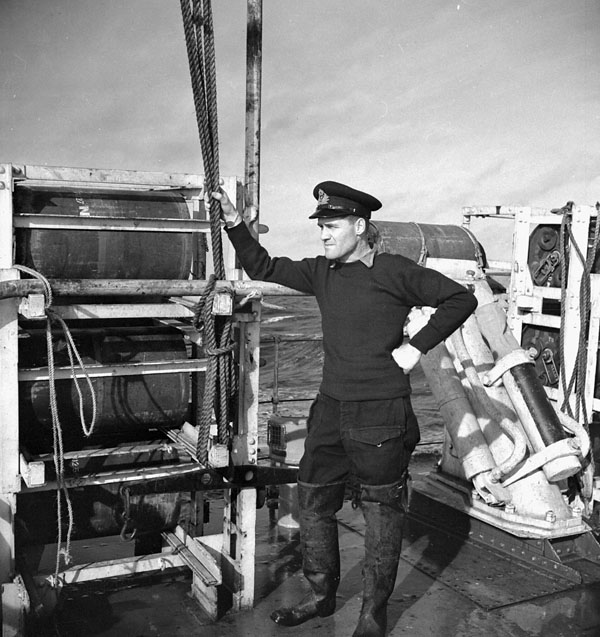
Lieutenant-Commander Alan H. Easton, DSC, Commanding Officer of the frigate HMCS Matane, Halifax, Nova Scotia, Canada, January 1944.
Lt. Gilbert A. Milne / Canada. Dept. of National Defence / Library and Archives Canada / PA-206442

Marc Milner, North Atlantic Run:

Staff preoccupation with a myriad of apparently non-essential matters also stemmed from the lack of any sense of urgency over the commissioning of the corvette fleet, at least for operational purposes. Despite Nelles’ stated concern over a possible repeat of 1917, even the Admiralty advised in February 1941 that the RCN could accept a delay in the attainment of competence by its own corvettes. Further, although the navy ardently desired to play a full role overseas in what Nelles described as the “theatre of active operations”, the Naval Staff decided in October 1940 that the products of the first construction program would go to meet home requirement first. Once fifty per cent of the latter were met, escorts would be sent to the Eastern Atlantic — the war zone — on an equal priority basis.

Despite the policy of sending auxiliaries overseas and the sure knowledge that the RN was already using its own corvettes as ocean escorts, there is no indication that the RCN believed either that its corvettes would be called up for similar activities or that they required modification to make them more suited to an ocean escort role. In fact, Canadian escorts were primarily intended for inshore duty, as had been the original intentions of the British as well. But the inshore role of Canada’s corvettes was reinforced by defense arrangements made between the US and Canada after the fall of Western Europe. In August 1940 the new Canadian-American Permanent Joint Board of Defence produce its first basic defence plan (Number 1) for North America. It adopted a worst-case scenario, the defeat of Britain by Germany, followed by a contined state of war between Germany and the Commonwealth, from which it took its sobriquet, Plan “Black”.

Canadian corvettes under Plan Black were to be formed into five-ship ASW strike forces that would hunt down and destroy U-boats for the RCN’s system of defended ports. Primarily hunting in the approaches to harbours or at the focal points of trade. “It was expected that in some cases, notably off Halifax and Sydney, corvettes would conduct some local escort, though for Canadian purposes this was not their primary role.”
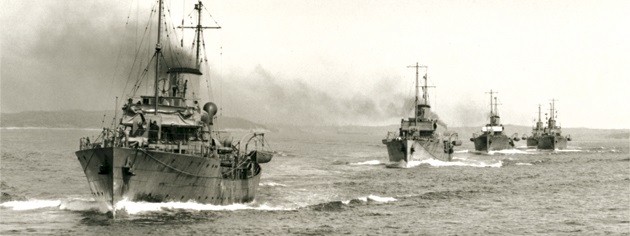
A line of corvettes departing Halifax, April 1941.
Source: Library and Archives Canada – PA105334

In addition to this offensive use of corvettes, the navy also looked forward to the commissioning of the first construction-program ships in order to proceed with many aspects of expansion, such as training. For the professional navy at least the corvette fleet was not the embodiment of naval expansion. Rather it was, as Nelles described it, a “stepping stone”. Events at sea would soon change this, but it would take some time before that change affected attitudes in Ottawa.

On the ocean, as the war at sea intensified it pushed further westward. Over the winter the dispersal points under British ASW escort had moved steadily into the mid-Atlantic. The bases in established in Iceland in April 1941 allowed escort to roughly 35 degrees west.

This move, in conjunction with a similar extension of air escort, proved initially successful. During April three convoys were attacked in the area that had previously uncovered by A/S escorts, and three U-boats were sunk in the ensuing actions. The Germans, once again finding the climate around defended trade too unhealthy, simply pushed farther west. In May they struck at Halifax-to-UK convoy HX-126 as it approached the limits of A/S cover. Before the escort could join, a U-boat pack of six attackers sank five ships. In the face of a continued threat, the convoy was dispersed, which led to further losses. To forestall further German success, the gap in continuous A/S escort of convoys between the limits of local Canadian escorts and those of the RN based in Iceland needed to be filled.

Siege of Vienna – Opening Bombardment – Extra History – #1

Filed under: Europe, History, Middle East, Military, Religion — Tags: , , , , — Nicholas @ 04:00

Extra Credits
Published on 6 Apr 2019

Mehmed IV wanted to live up to, and even surpass, the legacy of his forefather Mehmed II, who had secured the Ottomans’ inheritance to the Roman Empire through his conquest of Constantinople. So the current Mehmed decided to target Vienna — but Emperor Leopold dismissed these threats…

Over a hundred thousand Ottoman troops are heading for Vienna. Only 15,000 men defend the walls. They have only six days to prepare the city. How long can they hold?

Join us on Patreon! http://bit.ly/EHPatreon

Blue’s Dumb History Tales

Filed under: Britain, China, Economics, History, Humour — Tags: , , , , — Nicholas @ 02:00

Overly Sarcastic Productions
Published on 8 Mar 2019

Please check out That Works for the best blacksmithing on YouTube: https://goo.gl/vXsuFt

What do you get when you cross a month that has 5 Fridays with a historian who can’t do math? This nonsense, apparently.

PATREON: https://www.patreon.com/OSP

QotD: It won’t be easy to bring back politicians’ willingness to compromise

Filed under: Politics, Quotations, USA — Tags: , , , — Nicholas @ 01:00

I think the donors are a problem for both parties, in terms of driving choices that aren’t necessarily the best strategies for building the base. (Both parties completely missed the populist backlash on trade, for example. Now, as a free trader, I like the resulting policy. But they paid for it at the polls.) But the issue isn’t fundamentally the donors. The issue is that fundamentally, both sides hate each other, and both sides have an increasing “It is not enough that I win. My enemies must lose” mentality about politics. Combine that with various reforms that have empowered extremists — campaign finance reforms that empowered outside groups, yes, but also the shift to primaries from conventions, and the abolition of the earmarks and pork that used to grease legislative passage. Throw in the “Great Sort” into increasingly politically homogenous communities — those are the problems you need to fix if you want to bring back legislative compromise. And damned if I know how we get there, because you can’t tell people where to live, and anyone who suggested getting rid of primary elections and bringing back pork barrel politics would come off as a backroom sleaze.

Megan McArdle, “Ask Me Anything”, Reddit, 2017-04-10.

« Newer PostsOlder Posts »

Powered by WordPress