Quotulatiousness

April 16, 2019

The fire at Notre-Dame de Paris

Filed under: Architecture, France, Religion — Tags: , — Nicholas @ 11:29

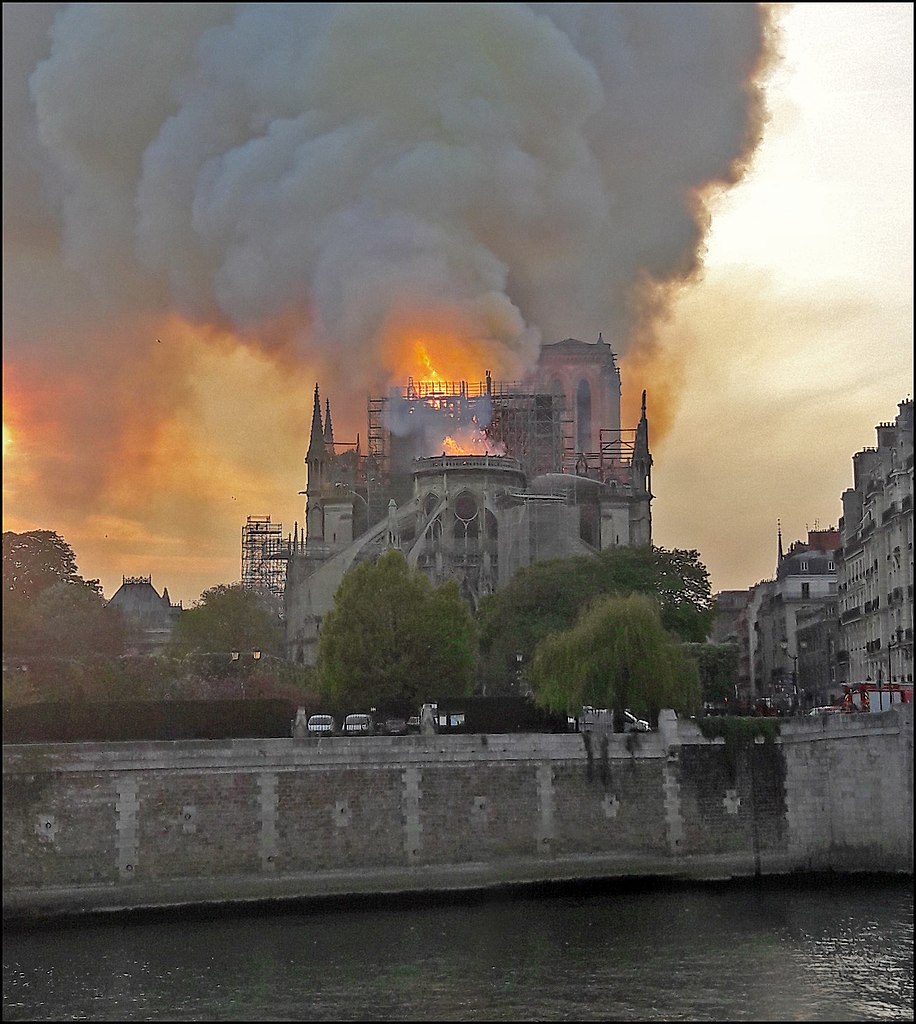
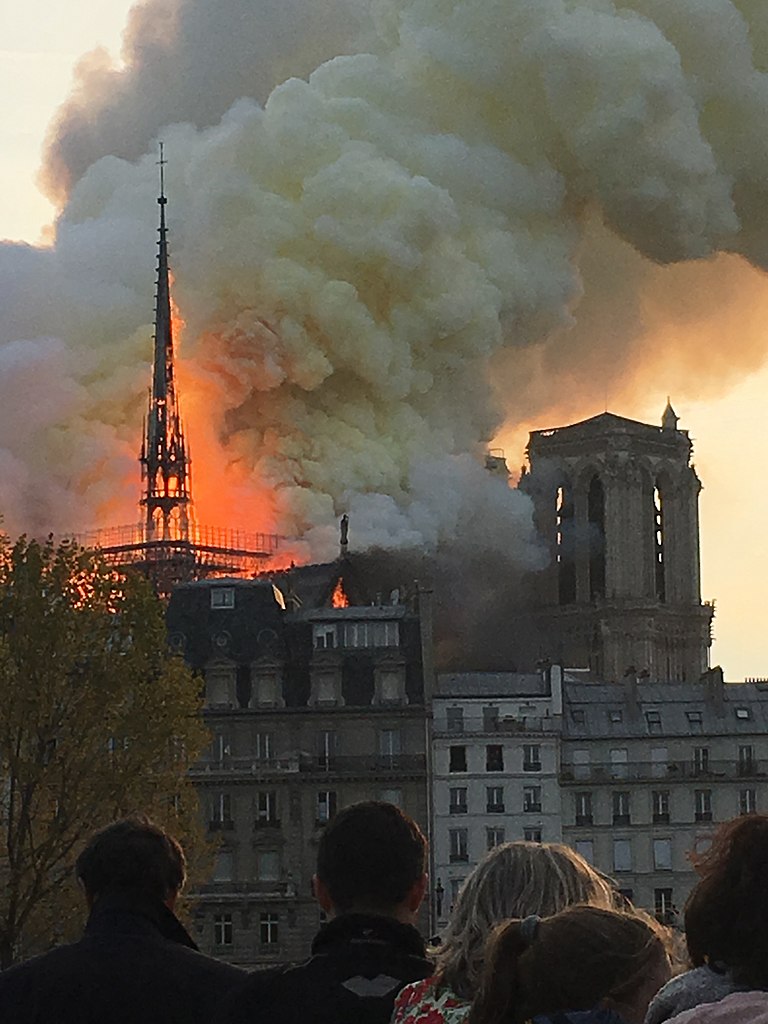
The central Paris landmark has been severely damaged by a fire that broke out beneath the roof of the cathedral early in the evening of April 15th. Here are a few images from the Wikimedia Commons page on the fire:


Officials were quick to announce that the fire was not the result of terrorist action … while the fire was still raging (that is, before anyone could have made any scientific determination on the cause), which only made those inclined to suspect terrorist activity even more suspicious. Conspiracy theorists gotta theorize, after all. Robert Harris discusses this aspect of the story at the New English Review:

Ruling out any cause other than accidental fire, at such an early stage, did seem to be an assumption made with [undue] rapidity, not least because it occurred within a week of Easter when such a religious landmark would be a prime target within a city and a nation that has suffered more than its share of acts of Islamist terrorism, and especially at a time when numerous French churches have been targeted.

The international media was similarly unanimous in describing the cause of the blaze, with some carrying critical coverage of Youtube’s automated topical descriptors linking the event with 9/11. Even Fox News’ Shepard Smith was rather more than simply unwilling to entertain the speculations of one French interviewee that tried to note some of the above surrounding circumstances.

Prima facie, it might have also been thought that it was peculiar that such a serious fire became so advanced during a time of day when the cathedral would have been in use by public visitors. There have been numerous serious fires during periods of restoration, as the mainstream media rightly noted, but less mentioned was the likely fact that such work would have ceased some hours before smoke became visible.

[…]

The prospect of a terrorist act rears but there is perhaps some reason to assume a non-terrorist motive because there doesn’t seem to have been any claims of responsibility. It may be thought that any Islamist organisation linked with the blaze of such a major Christian/Western landmark would be very keen to boast about the deed on social media when the story hit the international news. Alternatively, the inferno could have been caused by a lone-wolf terrorist attack but such individuals commonly swear allegiance to a particular group and/or make some sort of public statement before a given attack.

If religiously motivated terrorism can be deemed to be unlikely at this stage, obvious alternatives still remain, such as an act of criminal arson or non-religious terrorism in which the perpetrators might be less keen to voice their involvement with the crime. For example, the blaze could have been an act of secular quasi-terrorism/arson/vandalism by the left-wing ‘Black-Bloc’, which has been responsible for much of the recent violence within the ‘Yellow Vest’ protest movement. It may therefore be suggested that the French authorities came to an unduly prompt reaction, given the surrounding circumstances.

Modern ASW corvettes are not the answer for the Royal Navy

Filed under: Britain, Military — Tags: , — Nicholas @ 05:00

A few years, back someone floated the idea of a cheaper class of warship for the Royal Navy to address a perceived weakness in anti-submarine capabilities. I heard it mentioned as the “cheap and cheerful” frigate proposal. The idea must still be popular with the fantasy fleet set, as Sir Humphrey takes some time to explain why the Royal Navy isn’t likely to order up a big batch of the 21st century’s answer to the Flower class of corvettes any time soon:

At its heart is the difficult question about whether the Royal Navy is best placed to meet the many global operational challenges it faces by investing in a small but highly capable force of escort ships, able to operate in every threat environment against peer competitors, or whether it invests more in a larger force of less capable platforms which increase its presence around the world.

Underpinning this argument is a sense by many commentators that what the Navy needs is more ships, and that the only way to get this is to invest in buying lots of smaller ships now to improve overall levels of capability.

This argument was recently made in an article by respected defence commentator Nicholas Drummond, who argued that what was required was a force of cheaper corvette style vessels. Perhaps up to 20 would be a highly effective way of providing basic ASW defence and also increasing hulls for operations around the world. Drawing his inspiration from the WW2 ‘FLOWER’ class, he notes that the RN was able to quickly build ships that provided a basic level of defence in an all out general war.

It is tempting to see this as a strong argument for the Royal Navy – build lots of little ships, individually cheap, but which when brought together provide a level of coherent defensive capability against threats that would potentially deter a submarine captain.

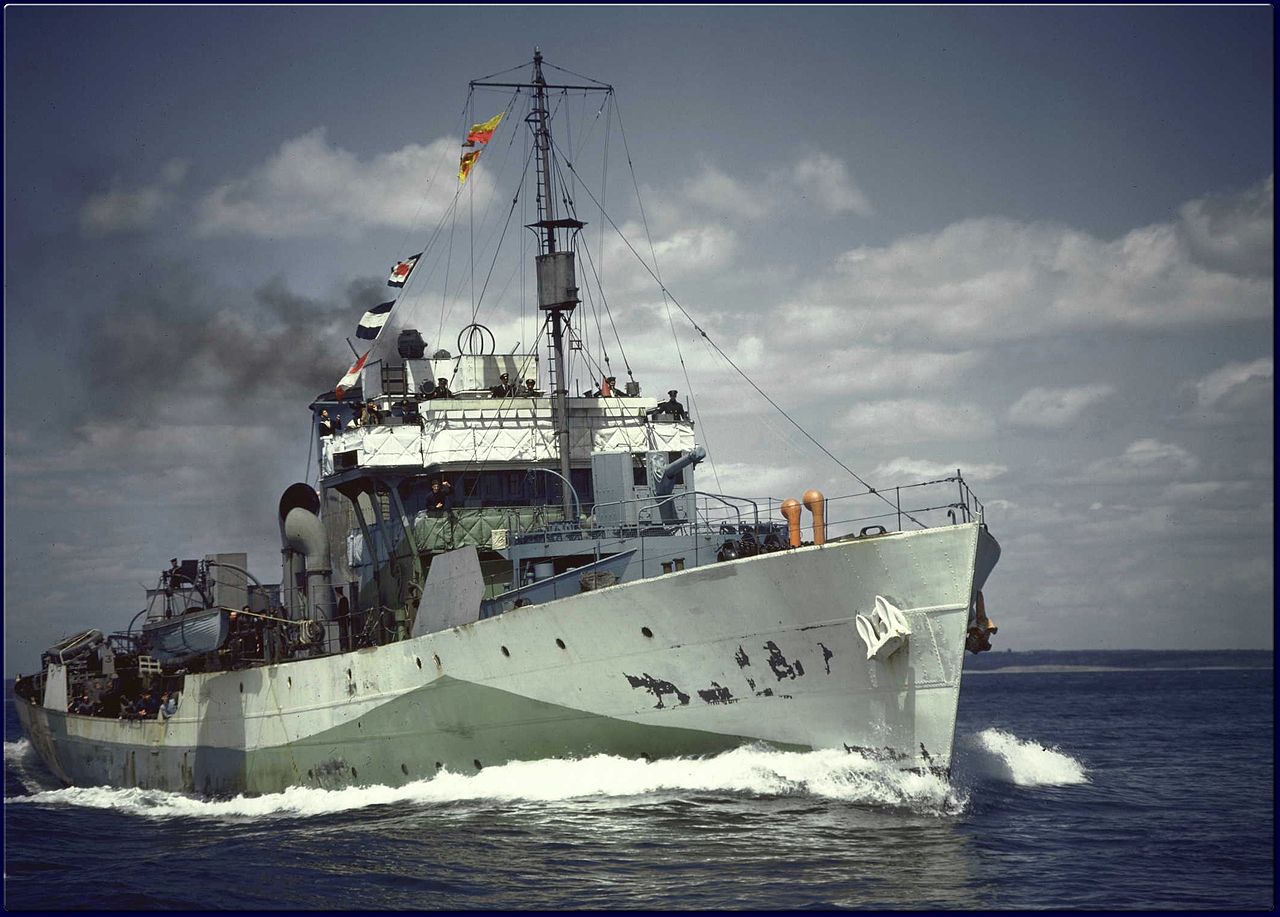
RCN Flower-class corvette HMCS Regina, pennant number K234 circa 1942-43.
Photo from the Canadian Navy Heritage site, negative number CT-252 via Wikimedia Commons.

The parallels break down because the Flower class were very cheap to build — they were built by commercial shipyards that normally worked on fishing vessels and small- to medium-sized cargo ships — they were not as heavily built as “real” warships and would have been almost helpless in surface combat with anything larger than a surfaced U-boat or light patrol craft. The enemy they were designed to fight was effectively a torpedo boat with limited underwater capabilities. WW2-era anti-submarine combat is no longer a useful guide to modern warfare.

The reality is that modern ASW is not something that can be done cheaply or via a simple platform. A credible and effective ASW frigate requires two three key assets, firstly the sonar processing power to identify, track and prosecute an attack against an extremely quiet target that does not want to be found. Secondly, it needs the means to deliver this attack as far away from the escort ship as possible – which calls for a platform capable of operating a long range helicopter capable of prosecuting an attack. Finally to prevent detection and attack, the frigate is required to be as quiet as possible to avoid notifying submarines of its presence – this requires extensive silencing and mounting of machinery to prevent it giving away a ships presence.

In turn these three characteristics raise the cost of the platform. Modern sonar equipment is incredibly expensive – particularly if you want to opt for things like Towed Array Sonars. If you want it to be able to work effectively against a highly capable target, you need to be prepared to spend a lot of money on it. There may be plenty of ‘cheap’ ASW frigate designs out there, but they almost certainly skimp on the complex underpinning sonar and software architecture required to be effective – and they are not intended to go up against peer threats like the latest Russian SSNs.

In the same vein while some of the designs on the market may have a flight deck or hangar for a small aircraft, what they are not cleared for is operating large Merlin scale helicopters. These are an essential part of the ASW battle – intended to travel quickly to successfully prosecute any contacts, the Merlin is at the heart of the modern Royal Navy frigates ASW weaponry.

World War 2 British Armour Doctrine & Tactics with David Willey of the Tank Museum at Bovington

Filed under: Britain, History, Military, WW1, WW2 — Tags: , , , , — Nicholas @ 04:00

Military History Visualized
Published on 8 Dec 2017

David Willey the Curator of the Tank Museum at Bovington explains British Interwar and World War 2 Armour Doctrine and Tactics. Especially, about the Infantry and Cruiser tank “concept”. Additionally, we talk a bit about the 2nd Battle of El Alamein, Montgomery and Rommel.

‘Tis Eastertide, and so the professional miserablists are going after Easter Eggs, of course

Filed under: Britain, Business, Economics, Environment, Food — Tags: — Nicholas @ 03:00

In the Continental Telegraph, Tim Worstall tells the worried environmentalists that no, it does not make sense to ban Easter eggs — for their “wasteful” packaging — on environmental grounds:

One of the more silly of the current environmental concerns is the worrying about the quantity of packaging that goes into – or around – Easter eggs. There’s an underlying mistake being made here, one which none of the proponents of action have bothered to recognise, let alone think about. Which is, well, what’s the purpose? The point of all this human activity we call an economy?

As any economist could and would tell you we’re after the maximisation of human utility. Given the constraints placed upon us by reality – the availability of stuff with which to do things, technologies we know about to do things to stuff with – we want humans to be as happy as they can be. We want, in short to maximise the amount of joy in the world.

At which point, packaging. Sure, no doubt there’s a certain harm that befalls us all from the creation of packaging and its disposal. Why not? There are costs and benefits to everything of course. But that’s the point, while there may be costs there are also benefits. So, yes, OK, there are costs to packaging.

[…]

At no point is even consideration given to the idea that the packaged egg might produce that joy. Which, given that we do indeed go buy these things each year to give to each other, is odd, isn’t it? Why are we giving each other expensive – as opposed to cheap – chocolate? Because, obviously enough, the dressing of the chocolate is something that produces that joy.

We can even have a stab at quantifying matters.

The cost is 3,000 tonnes of packaging. We know what that costs us, the value of the landfill tax. Around £80 a tonne. So, call it quarter of a million pounds. Spending upon Easter eggs is some £400 million a year. The joy produced must be of greater value than that £400 million otherwise we’d not be spending it in the first place. And yes, £400 million is more than £250,000.

We thus have our answer to the prodnoses worrying about the cost of Easter egg packaging. Piss off matey, you’ve missed the point entirely.

An Orgy of Innovation

Filed under: Economics — Tags: — Nicholas @ 02:00

Marginal Revolution University
Published on 20 Apr 2015

The list of famous inventions from the last few centuries is long, and you may even be making use of one right now — laptops, smartphones, tablets, and televisions, for instance. There are countless unsung improvements, too, that make our daily lives much easier. We’ve all benefited from zip top sandwich bags, twist bottle caps, and long-lasting batteries, to name a few!

The economic historian Deirdre McCloskey coined the term “innovationism” to describe the phenomenal rise in innovation over the past couple hundred years. While there have always been inventors and innovators, that number exploded after the eighteenth century, contributing to what we’ve described in previous videos as the “Hockey Stick of Human Prosperity.”

Why has innovation grown so rapidly? Economist Douglass North argues it has to do with institutions such as property rights, non-corrupt courts, and rule of law, which lay the foundation for innovation to take place. Others attribute the rise to factors such as education or access to reliable energy. McCloskey argues that what really kicked innovation into high gear is a change in attitude — ordinary people who once celebrated conquerers and kings began to celebrate merchants and inventors.

In this video, we discuss these ideas further. After all, a better understanding of what drives innovation could help poor countries that still live on the handle of the “Hockey Stick” reach a much greater level of prosperity.

QotD: Romania and the Nazi Final Solution

Filed under: Europe, Germany, History, Quotations, WW2 — Tags: , , , , — Nicholas @ 01:00

Last place goes to Romania, which had been anti-Semitic since the beginning of time and was genuinely excited to have Nazi orders as an excuse to carry out their own worse impulses:

    In Rumania even the S.S. were taken aback, and occasionally frightened, by the horrors of old-fashioned, spontaneous pogroms on a gigantic scale; they often intervened to save Jews from sheer butchery, so that the killing could be done in what, according to them, was a civilized way.

The Romanians started their own concentration camps to supplement the Nazi’s, “more elaborate and atrocious affairs than anything we know of in Germany”, but they didn’t always need them – “deportation Rumanian style consisted in herding five thousand people into freight cars and letting them die there of suffocation while the train traveled through the countryside without plan or aim for days on end; a favorite followup to these killing operations was to expose the corpses in Jewish butcher shops.” Things became so bad that Nazi emissary Manfred von Killinger, intervened and asked them to stop and defer to German efforts. I feel like when a Nazi named Commander von Killinger is horrified by your brutality, it’s time to take a step back and evaluate whether you may have crossed a line.

Other interesting profiles include Greece (hopelessly depressing), Slovakia (very Catholic, in favor of killing Jews but got in a bunch of fights with the Nazis about ethnic Jews who had been baptized into Catholicism), Hungary (ruled by an Admiral despite being landlocked; otherwise hopelessly depressing), Belgium (deliberately left the trains unlocked so the Jews could escape!), Holland (kind of like France; the local Gentiles tried to help, but the assimilated Jews sold out the refugee Jews in the hope of placating the Nazis; the Nazis were not placated; three-quarters of Jews died), and Poland (I don’t even want to talk about how hopelessly depressing this one is).

Scott Alexander, “Book review: Eichmann in Jerusalem”, Slate Star Codex, 2017-01-30.

April 15, 2019

The Lenin Boys Go To War – Hungarian Soviet Republic I THE GREAT WAR 1919

Filed under: Europe, History — Tags: , , , , , , — Nicholas @ 06:00

The Great War
Published on 14 Apr 2019

Like many European countries, Hungary experienced rapid political changes in the aftermath of the 1918 armistices. The Kingdom of Hungary used to rule big parts of South Eastern Europe and many peoples within its former boundaries are now gaining independence and expand their territory. The new Hungarian Republic is faced by external and internal pressures and after a coup becomes the Hungarian Soviet Republic, the 2nd Soviet State in Europe.

» SUPPORT THE CHANNEL
Patreon: https://www.patreon.com/thegreatwar
Merchandise: https://shop.spreadshirt.de/thegreatwar/

» SOURCES
Böhler, Jochen. “Post War Military Action and Violence (East Central Europe,” in 1914-1918 online. International Encyclopedia of the First World War. https://encyclopedia.1914-1918-online…

Borsanyi, György. The Life of a Communist Revolutionary, Bela Kun (New York: Columbia University Press, 1993).

Freud, Sigmund and Sándor Ferenczi. The Correspondence of Sigmund Freud and Sándor Ferenczi, Volume 2: 1914-1919. Eva Brabant, Ernst Falzeder, Patrizia Giampieri-Deutsch, eds. (Boston: Harvard University Press, 1993).

Gerwarth, Robert. The Vanquished. Why the First World War Failed to End, 1917-1923 (Penguin, 2017).

Gilley, Christopher. “Peasant Uprisings/Tambovshchina” in 1914-1918 online. International Encyclopedia of the First World War: https://encyclopedia.1914-1918-online…

Leidinger, Hannes. “Revolutions (Austria Hungary),” in 1914-1918 online. International Encyclopedia of the First World War https://encyclopedia.1914-1918-online…

Leonhard, Jörn. Der überforderte Frieden. Versailles und die Welt 1918-1923 (CH Beck, 2018).

Mawdsley, Evan. The Russian Civil War (New York: Pegasus Books, 2005).

Molnar, Miklos. From Bela Kun to Janos Kadar: 70 years of Hungarian Communism (New York: Berg, 1990).

Pastor, Peter. Hungary Between Wilson and Lenin (New York: Columbia University Press, 1976).

Pastor, Peter, ed. Revolutions and Interventions in Hungary and its Neighbor States, 1918-1919 (New York: Columbia University Press, 1988).

Vörös, Boldiszar. “Bela Kun,” in 1914-1918 online. International Encyclopedia of the First World War https://encyclopedia.1914-1918-online…

» SOCIAL MEDIA
Twitter: https://twitter.com/WW1_Series
Reddit: https://reddit.com/r/TheGreatWarChannel

»CREDITS
Presented by: Jesse Alexander
Written by: Jesse Alexander
Director: Toni Steller & Florian Wittig
Director of Photography: Toni Steller
Sound: Toni Steller
Editing: Toni Steller
Mixing, Mastering & Sound Design: http://above-zero.com
Motion Design: Christian Graef – GRAEFX
Maps: Daniel Kogosov (https://www.patreon.com/Zalezsky)
Research by: Jesse Alexander
Fact checking: Florian Wittig
Channel Design: Alexander Clark
Original Logo: David van Stephold

A Mediakraft Networks Original Channel

Contains licenced material by getty images
All rights reserved – Real Time History GmbH 2019

Canada and the Battle of the Atlantic, part 12

Filed under: Cancon, History, Military, WW2 — Tags: , , , — Nicholas @ 05:00

Editor’s Note: This series was originally published by Alex Funk on the TimeGhostArmy forums (original URL – https://community.timeghost.tv/t/canada-and-the-battle-of-the-atlantic-part-5-edited/1453).

Sources:

  • Far Distant Ships, Joseph Schull, ISBN 10 0773721606 (An official operational account published in 1950, somewhat sensationalist)
    [Schull’s book was published in part because the funding for the official history team had been cut and they did not feel that the RCN’s contribution to the Battle of the Atlantic should have no official recognition. It is very much an artifact of its era, and needs to be read that way. A more balanced (and weighty) history didn’t appear until the publication of No Higher Purpose and A Blue Water Navy in 2002, parts 1 and 2 of the Official Operational History of the RCN in WW2, covering 1939-1943 and 1943-1945, respectively.]
  • North Atlantic Run: the Royal Canadian Navy and the battle for the convoys, Marc Milner, ISBN 10 0802025447 (Written in an attempt to give a more strategic view of Canada’s contribution than Schull’s work, published 1985)
  • Reader’s Digest: The Canadians At War: Volumes 1 & 2 ISBN 10 0888501617 (A compilation of articles ranging from personal stories to overviews of Canadian involvement in a particular campaign. Contains excerpts from a number of more obscure Canadian books written after the war, published 1969)
  • All photos used exist in the Public Domain and are from the National Archives of Canada, unless otherwise noted in the caption.

I have inserted occasional comments in [square brackets] and links to other sources that do not appear in the original posts. A few minor edits have also been made for clarity.

Earlier parts of this series:

Part 12 — Staff needed, training needed, and Commodore Murray’s thankless tasks

Mid-May 1941 saw the few Canadian ships that remained in England involved in a series of training exercises off the Northern Irish coast. Two of the four-stackers and three corvettes practiced ASW, wireless, and visual signalling, under the watchful eyes of British officers. The results were less than satisfactory. The situation was described by Marc Milner in North Atlantic Run as

… a complete lack of understanding of what was expected of divisions within individual ships (the ASDIC team, depth-charge crew, gunners, and so on) and of ships operating as a group. The British found the Canadians keen, intelligent, and willing to learn. But no one, from the Captains on down, had any concept of ASW, and this caused the British great concern. … Most disturbing was the British training officer’s criticism of the corvettes’ commanding officers. He reported that they showed a great lack of initiative and relied entirely on the senior officer for instructions. “No one would possibly question their courage or endurance at sea,” the RN officer wrote, “and they are fine seamen. Their lack of technical knowledge is their greatest difficulty and possibly due to their age they are slow to learn.” The RCNR commanders of Canada’s first corvettes may also have had an understandable reluctance to jump too quickly when asked to do so by a young RN officer. None the less, Captain (D), Greenock, who took exception to the above officer’s dim view of Canadian COs, concluded bluntly that the low state of efficiency reached by these ships was “attributable directly to inexperience and perhaps the age of their commanding officers.” Captain (D), Greenock, recommended that they be replaced as soon as possible by younger, more experienced RCN or RCNR officers with escort experience.

Captain (D), Greenock, compiled these remarks for his chain of command, and included uncomplimentary extracts from the original work-ups of the Canadian corvettes to illustrate just how inefficient they really were. Their wireless communications had passed muster, and “bearings and distances of contacts were passed among them continuously and accurately”. Signal communication “was at times hopeless, and at best was barely adequate.” At the RN’s escort work-up base at Tobermory, where Spikenard and Hepatica trained in May, drawing similar comments from the training staff there.

From the record, it appears unlikely that any of these RN officers knew that the ten Canadian corvettes had been manned only to transfer the ships to RN crews, and that many of the officers and ratings were intended for other roles after arrival in British waters. As mentioned in earlier parts, the crews were far from seasoned professionals, as James Lamb explains in The Corvette Navy:

Corvette crews were young; officers and men were mostly right out of high school, and anyone over thirty found himself nicknamed “Pappy” and the oldest man in the ship. Consequently, corvette people were all junior in rank and rate, most of their upper-deck crews being ordinary seamen and with leading seamen often carrying out the jobs normally assigned petty officers, and the engine rooms filled with youngsters right out of mechanical training school. Early in the war, a corvette would be commanded by a Naval Reserve (ex-merchant navy) lieutenant with a Volunteer Reserve lieutenant as executive officer or “Jimmy the One”, and two other officers — junior lieutenants or sublieutenants — as watch-keepers. The corvettes were cobbled together, half a dozen at a time, into escort groups, led by an old destroyer usually commanded by a lieutenant or lieutenant-commander of either the RCN or, especially in the early days, the RN.

When you first joined a ship in the corvette navy, you passed from one world into another. You left behind the Big Navy, where you had done your training, the shoreside navy with all its braid and bands and bumf, and you joined an outfit that was run along the lines of a small corner-store. For corvette types were “family”; you soon got to know the characters in your own ship, and in the others of the group. There were chummy ships, whose destinies seemed always to be bound up with yours, and there were rivals, usually commanded by officers senior to your own. Months would go by, grow into years; the shoreside navy became a memory, although there were always officers and men joining ship for a trip or two before going back ashore to the other world where they were busy building careers.

For most of us, the corvettes, the frigates, the Bangors and the old four-stackers and other obsolete destroyers of the escort fleet became home.

From the inside, the RCN’s corvette crews may have been like families afloat, but the stiffer and more formal RN viewed-with-alarm the amateurs they would be depending upon for significant numbers of the convoy escorts critical to British survival. You can probably see their point. Marc Milner continues:

Operational and training authorities in Britain were clearly appalled by what they saw, and Captain (D), Greenock’s memo was not intended for purely internal consumption. The RCN’s expansion had got off to a poor start, and the foundations of a legacy of inadequacy and ineptitude were laid. No amount of hard work or improvement would shake it for some time.

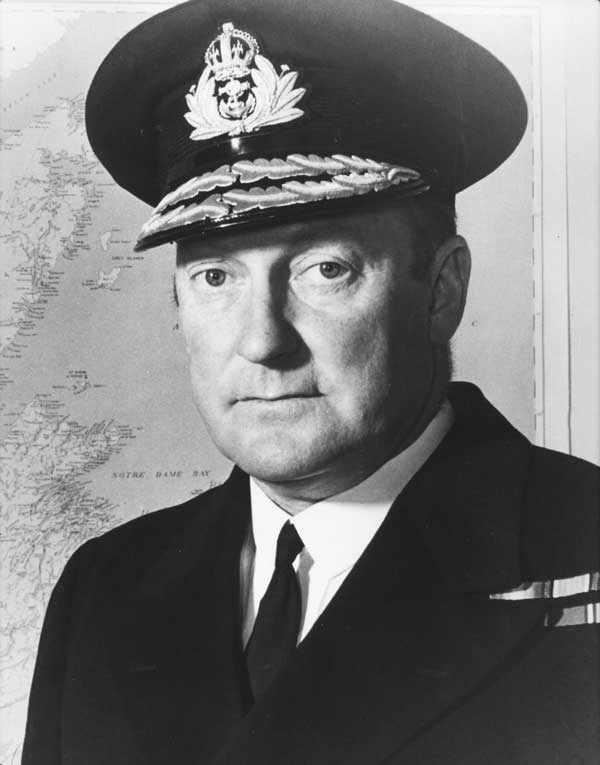
As the above report made its way through channels and the ships of the Fourth Escort Group sailed to join NEF, things moved apace in Newfoundland. Commodore Murray … arrived to assume the post of Commodore Commanding Newfoundland Escort Force (CCNF) on 15 June. Murray was a native Nova Scotian with deep roots in rural Pictou County. He attended the first class of the Royal Naval College of Canada in 1912 as a boy and went on to serve in various warships of both the RN and the RCN. His first notable appointment was to the wardroom of HMS Calcutta as a young sub-lieutenant when that ship commissioned from the builder’s yards in 1919. Calcutta‘s first commanding officer was then Captain Dudley Pound, a man who was instrumental — as First Sea Lord in 1941 — in having Murray posted to St John’s. Close links with the RN not only fostered personal connections; young Canadians also adopted many of the trappings of RN officers. Murray was not spared the effects of his long exposure to the traditions and habits of the parent service. Although he did not develop a British accent, it is unlikely that many Pictonians would have recognised him as one of their own in 1939. Yet Murray never lost his playful charm and his appreciation of his background. … This rapport carried on throughout the war; ironically, his concern for “his boys” has been cited as evidence that Murray was never capable of the type of dynamic command that his positions warranted. There is some truth in this. But few major naval commands during the Second World War were comparable to those of the RCN, where tact, diplomacy, and goodwill were essential to running an organization composed almost entirely of reservists. Murray was above all a competent and confident officer, an excellent ship handler, and an able administrator.
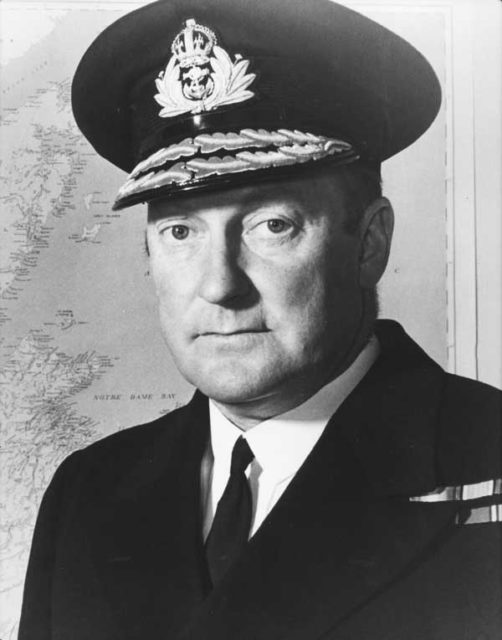
Rear Admiral Leonard W. Murray as Flag Officer, Newfoundland.
Photo via CFB Esquimalt Naval & Military Museum.

Murray’s task in Newfoundland was daunting. Not only were the facilities jury-rigged and totally inadequate; a whole administrative and support staff had to be assembled and adapted to conditions at St John’s. Perhaps because the very long-term existence of NEF — as distinct from the base itself — was an open question in the summer of 1941, the development of its staff was slow. Murray, as CCNF, was charged with overall command of naval operations off Newfoundland. But the initial staff at St John’s in May 1941 was wholly administrative, belonging to the port defence establishment. The first official record of HMCS Avalon, which appeared in the September 1941 Navy Lists, shows little more than Captain Schwerdt’s port-defence and naval-control-of-shipping staffs. Newfoundland Escort Force’s staff consisted of Murray, his chief of staff Commander R.E.S. Bidwell, RCN, and the commodore’s secretary. A more accurate indication of NEF’s supporting staff by mid-1941 was published in November. By then CCNF had added staff officers of Operations, Intelligence, and Signals and a secretary’s staff. These staffs provided the vital elements of naval operations: the processing and collecting of intelligence, handling of heavy signals traffic, and the organization and management of operational forces.

The actual administration of the escort forces themselves fell to a separate “Flotilla” staff under a “Captain (D[estroyers]).” Traditionally Captain (D) was a seagoing officer, responsible in all respects, including operational efficiency, for a flotilla of ten to twelve destroyers. Administratively the system was applicable to escort forces, but the small size of their ships and the small size of escort groups made it inappropriate for Captains (D) to go to sea. As a result the main staff of escort forces such as NEF remained ashore, while the actual seagoing duties of Captain (D) were passed to the less senior commanders of escort groups.

Captain (D) was crucial to the performance of his forces. Through a staff of specialists he monitored and was ultimately responsible for the efficacy of escort groups, individual ships, and the important warlike functions within each ship. In the early days of NEF the latter problems overwhelmed those of group coordination and the development of and adherence to a suitable tactical doctrine, for which Captain (D) was also responsible. Initially, much-needed specialists in all but a few traditional naval functions were unavailable. During 1941 Captain (D), Newfoundland, had only two specialist officers, one for gunnery and one for signals. A torpedo officer, whose duties included depth charges, was not added until 1942, while the key posts of A/S, radar, and engineering were not added until 1943. In an A/S escort force the delay in providing specialists to oversee the use of ASDIC, radar, and depth charges was serious. In the interim, St John’s-based escorts had to draw on the expertise of the base A/S and radar officers (both qualified RN officers), whose duties covered maintenance and supervision of port defences as well. Fortunately, these men found time to devote to NEF. … The RCN did what it could, but there were simply not enough qualified personnel to go around. The result was a serious deficiency in Captain (D)’s staff. In the context of a time when things were difficult all around, however, these weaknesses appear comparatively minor. Further, like the escorts themselves, Captain (D)’s initial shortfalls could be expected to diminish with time.

Theoretically at least, Captain (D) was also responsible for maintenance of existing equipment and modernization as new equipment became available. The limited facilities of St John’s made simple maintenance difficult enough, as the port was not capable of handling anything more than emergency repairs. Equipment was in very short supply, and even accommodation for extra staff was difficult or impossible to arrange. The Captain (D), Halifax, had an inspection staff for Additions and Alterations (A’s & A’s in naval parlance), so St John’s-based escorts had to turn to Halifax for anything that could not be done locally. There was nowhere within NEF’s normal operations area where new equipment could even be fitted, and a six-hundred mile trip to Halifax was hardly convenient in a changing tactical environment.

Organizationally and operationally, the NEF was a smaller version of the RN’s Western Approaches Command. The size and composition of escort groups was identical, and the NEF adopted the use of group numbers (14 through 25) following in sequence from those used by WA. NEF escort groups were more or less permanent in membership in order to foster teamwork, and as with RN groups, sailed under the command of their most senior officer (Senior Officer, Escort or SOE). This officer fulfilled the operational duties of a Captain (D) at sea.
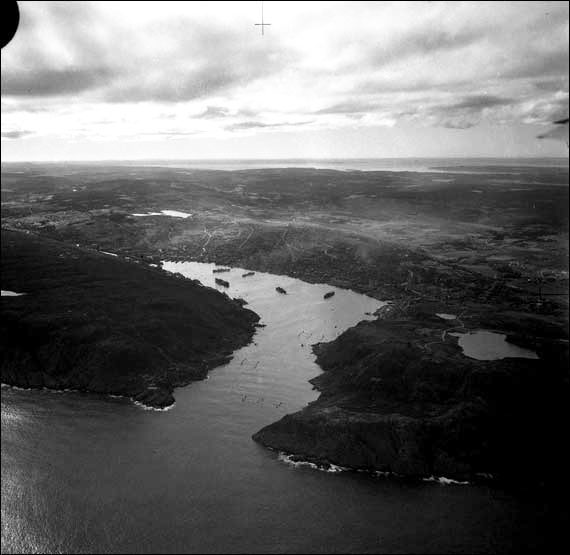
St. John’s harbour, circa 1942.
Photo from Heritage Newfoundland & Labrador (original from Library and Archives Canada MIKAN 4164991.)

Detailing tasks, issuing sailing orders, and other related duties fell to CCNF’s operational staff. It provided the link between actual naval forces and the trade and convoy organizations. The control and management of shipping was part of the bureaucratic war. The Commonwealth navies, through their trade divisions and Naval-Control-of-Shipping (NCS) organizations, rationalized and systematized the movement of merchant ships, allowing them to be defended one of two ways. On the basis of intelligence and under the indirect cover of battle fleets, shipping was routed independently along “safe” routes. This form of protection (by far the most prevalent until 1943), was predicated upon existence of British, and later Anglo-American, command of the sea. It was an effective form of defence against the surface raiders, but it would never achieve true success against U-boats, particularly as their numbers grew. The second type of naval defence of shipping was the raison d’être for NEF.


Siege of Vienna – Tunnel War – Extra History – #2

Filed under: Europe, History, Military — Tags: , , , — Nicholas @ 04:00

Extra Credits
Published on 13 Apr 2019

The siege presses on from its initial active resistance phase to the long, routine drudgery of survival on the inside and elaborate defense building on the outside: earthworks and revelins designed by Georg Rimpler. Meanwhile, the Ottomans prepared to attack via gunpowder prepared inside mining tunnels.

Winter was coming — that’s what had doomed Suleiman when he’d tried to take Vienna back in 1529. The bitter cold. The Grand Vizier swore history would not repeat itself. Because soon, his mining tunnels would be ready.

Join us on Patreon! http://bit.ly/EHPatreon

Why Are Brits So Obsessed with Tea? – Anglophenia Ep 30

Filed under: Britain, History, India — Tags: — Nicholas @ 02:00

Anglophenia
Published on 3 Jun 2015

Anglophenia’s Kate Arnell looks back at the moments in history that made Britain a tea-drinking nation.

QotD: De Gaulle and the BBC

Filed under: Britain, France, History, Media, Quotations, WW2 — Tags: , — Nicholas @ 01:00

Above all he loved France, or the idea of it. He saw in the defeat of 1940 a danger that his country would simply disappear, having failed to defend itself and having fled from the battle without properly drawing its sword. This was not a foolish fear. Great civilizations can and do vanish, and one of the best ways of doing so is to abandon the struggle to survive.

He must have greatly resented the fact that he owed so much to Britain. He was intelligent enough to know that Britain, a country few Frenchmen can ever fully trust, was his best hope and only refuge. He understood, as many French patriots could not, that the terrible attack on the French fleet by the British Navy at ­Mers-el-­Kébir in 1940 was in fact necessary, in case its great ships fell into the hands of the Germans. He would have done the same himself had the position been reversed, and he knew it. It was this generosity of mind that made him great. But how he must have loathed being dependent on the British Broadcasting Corporation for his access to the French people. For it was the BBC that made him. Until he finally appeared for the tumultuous, ecstatic liberation of Paris in 1944, he was only a voice, heard fleetingly on illegal broadcasts. Almost nobody in France had the faintest idea what he looked like. But all had a certain idea of de Gaulle, the spirit of France that refused to surrender. And when they finally saw this towering, ­fearless figure walking calmly down the Champs-Élysées amid the snipers’ bullets, he did not disappoint them. He was, it turned out, a giant so tall that one could imagine ice forming on his upper slopes when—as so often ­happened—he was annoyed or impatient with his people. His great height set him apart from the ­beginning. He once complained, “We ­giants are never at ease with others … the armchairs are always too small, the tables too low, the impression one makes too strong.”

Peter Hitchens, “A Certain Idea of France”, First Things, 2019-04.

April 14, 2019

Shooting the Inglis 8mm Bren Gun

Filed under: Britain, Cancon, History, Military, Technology, Weapons, WW2 — Tags: , , — Nicholas @ 06:00

Forgotten Weapons
Published on 13 Apr 2019

This Bren is lot #1013 at Morphy’s April 2019 auction:
https://www.forgottenweapons.com/shoo…

The Bren gun is widely regarded as one of the best light machine guns ever built, but that reputation is based on the British .303 caliber version. How does the design perform in 8mm Mauser? Today I am going to find out, using one of the John Inglis “sterile” 8mm Brens.

http://www.patreon.com/ForgottenWeapons

Cool Forgotten Weapons merch! http://shop.bbtv.com/collections/forg…

Contact:
Forgotten Weapons
PO Box 87647
Tucson, AZ 85754

British diplomatic blunders in history – German unification

Filed under: Britain, Europe, Germany, History — Tags: , , , , , — Nicholas @ 05:00

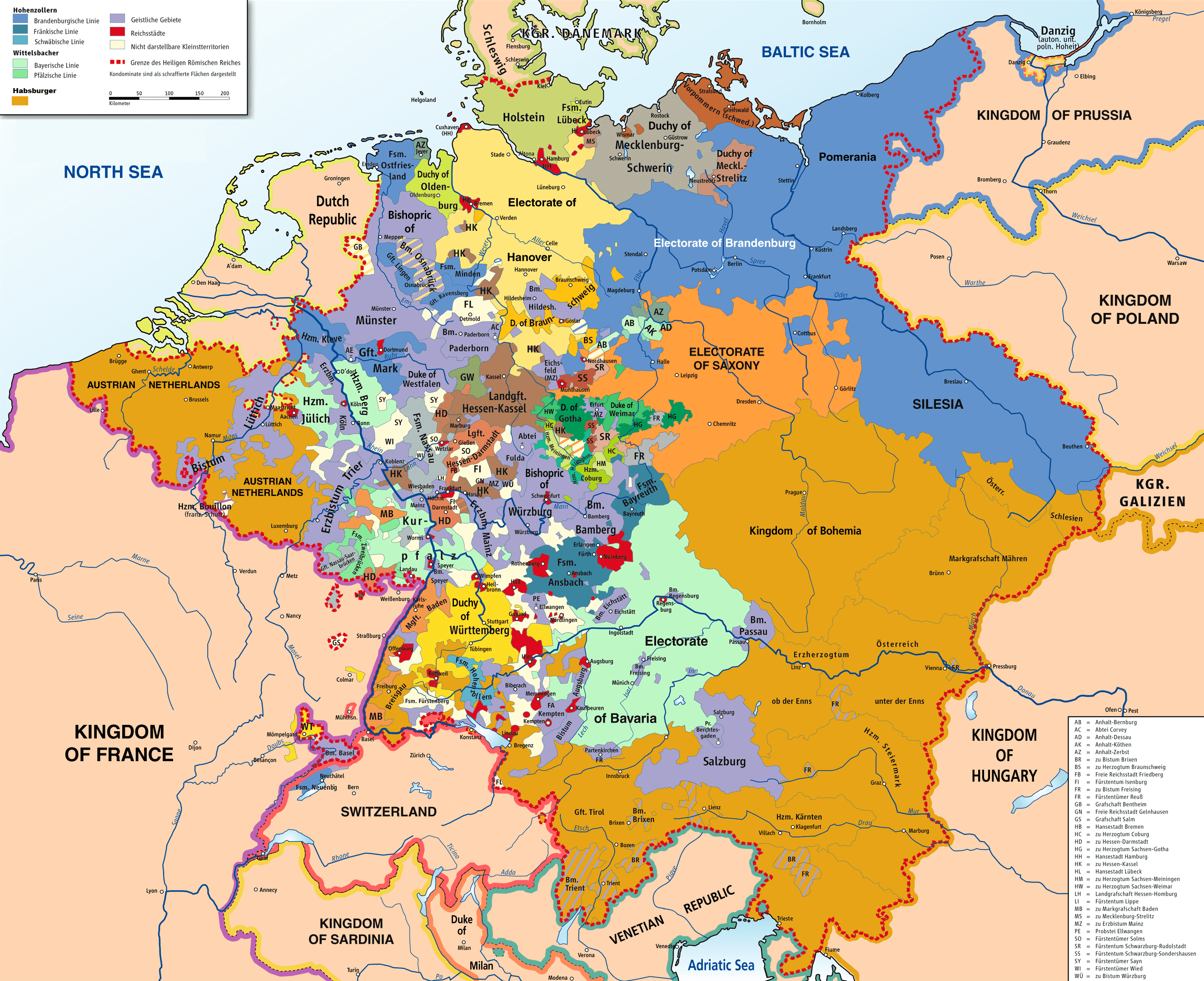
An interesting article in Vox, suggesting that the gradual unification of all the German principalities, electorates, duchies, counties, bishoprics, free cities, and miscellaneous other semi-independent bits and bobs of the Holy Roman Empire was not inevitable and that — absent British blundering after the Napoleonic wars — it would have produced a very different 20th century:

The Holy Roman Empire in 1789, before Napoleon “rationalized” hundreds of smaller entities into the Confederation of the Rhine.
Image from Wikimedia Commons.

The boundaries of states are the heart of many recent debates, be it the European refugee crisis, the Transatlantic Trade and Investment Partnership (TTIP), or Brexit (Snower and Langhammer 2019). After decades of stability, today we are again seeing heated discussions about the shape and extent of political borders. Clearly, borders are neither naturally given nor random. In Europe and elsewhere, the current state borders have been formed and changed over centuries, sometimes peacefully, often in bloody wars. In Huning and Wolf (2019), we look at the formation of the German nation state led by Prussia and trace it back to a change in borders decided at the Congress of Vienna in 1814/15.

In a nutshell, we have two findings:

  • First, the geographic position of a state can be a crucial factor for institutional change and development.
  • Second, the formation of the German Zollverein in 1834 under Prussian leadership was a truly European story, involving Britain, the Russian Empire, and the Belgian revolution of 1830/31. We show in particular that the Zollverein formed as an unintended consequence of Britain’s intervention in 1814/15 to push back Russian influence over Europe.

In theory, why would the geographic position of a state relative to that of other states matter? Intuitively, it should matter as long as the costs of trade and factor flows depend on their routes. If a large share of my trade has to pass the territory of one or several neighbours, my trade and trade policy will depend on the trade policy of my neighbours. Moreover, if tariffs are levied not only on imports but also on transit trade, as was general practice until the Barcelona Statute of 1921 (Uprety 2006), policymakers face the problem of multiple marginalisation, which is well known from the literature on supply chains. In our work, we provide a simple theoretical framework (in partial equilibrium) to show how the location of a revenue maximising state planner will affect its ability to set tariffs. Some states can increase their tariff revenue at the expense of their hinterland. Next, we show that a customs union can be beneficial for a group of states exactly because it solves the problem of multiple marginalisation.

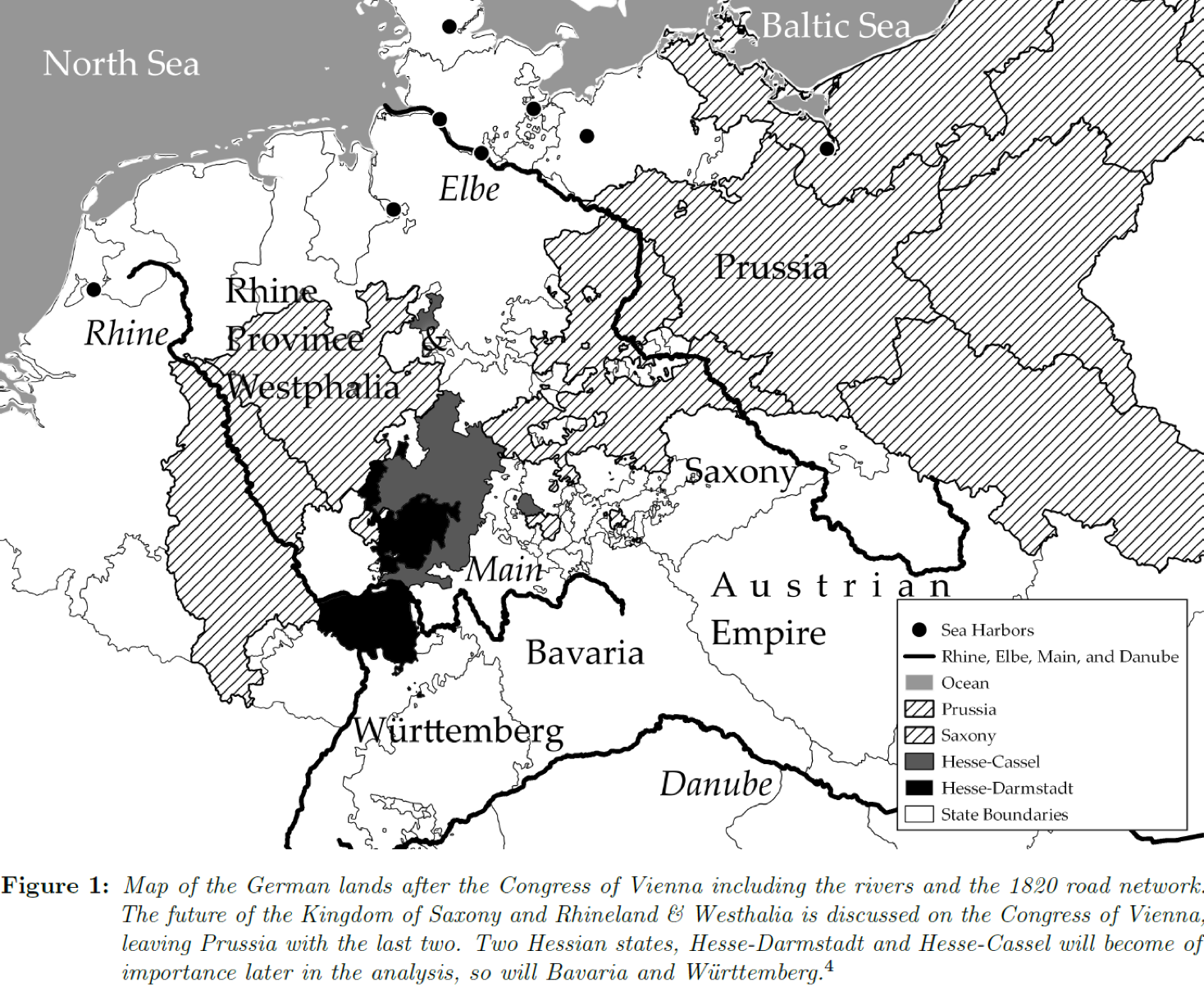
A major challenge to testing our idea empirically is that a state’s political boundaries (and hence its location) do not change very often, and if they do, the change is unlikely to be unrelated to trade or factor flows. However, the formation of the German Zollverein in 1834 can be considered as a quasi-experiment. Let us briefly revisit this historical episode. At the end of the Napoleonic wars of 1792-1814/15, only Russia and the UK were left as major military powers. Habsburg, Prussia, and the defeated France attempted to consolidate their positions at the expense of the many smaller states that had just about survived the wars, notably the former allies of Napoleon such as Saxony and Poland. Overall, the negotiations at the Congress of Vienna in 1814 were dominated by military-strategic considerations between the two great powers. Russia wanted to expand westwards, Prussia was desperate to annex the populous Kingdom of Saxony, which bordered Prussia in the south and would create a large and coherent territory. To this end, Prussia was willing to give up not only her Polish territories to Russia, but also her positions and claims on the Rhineland (Müller 1986). This met stiff resistance from Britain, joined by Habsburg and France, which feared a new Russian hegemony on the continent – the ‘Polish Saxon question’. After weeks of diplomatic struggle, the outcome was a division of Saxony, another division of Poland and Prussia being established as the “warden of the German gate against France” (Clapham 1921: 98). Figure 1 shows the result of these negotiations.

H/T to Continental Telegraph for the link.

The Invasion of Norway and Denmark – WW2 – 033 – April 13 1940

Filed under: Britain, Europe, Germany, History, Military, WW2 — Tags: , , , , , — Nicholas @ 04:00

World War Two
Published on 13 Apr 2019

This week, the Phoney War seems to come to an end when Germany invades Denmark and Norway. The Allies seek confrontation with Germany in the hope to at least deny them full access to the Swedish iron mines. Nevertheless, the Germans are prepared and have been planning this for weeks. It looks like it will cost a lot to put a stop to it.

Join us on Patreon: https://www.patreon.com/TimeGhostHistory
Or join The TimeGhost Army directly at: https://timeghost.tv

Follow WW2 day by day on Instagram @World_war_two_realtime https://www.instagram.com/world_war_t…
Join our Discord Server: https://discord.gg/D6D2aYN.
Between 2 Wars: https://www.youtube.com/playlist?list…
Source list: http://bit.ly/WW2sources

Written and Hosted by: Indy Neidell
Produced and Directed by: Spartacus Olsson and Astrid Deinhard
Executive Producers: Bodo Rittenauer, Astrid Deinhard, Indy Neidell, Spartacus Olsson
Creative Producer: Joram Appel
Research by: Indy Neidell
Edited by: Iryna Dulka
Map animations: Eastory

Colorisations by Norman Stewart and JuliusJaa (https://www.flickr.com/photos/juliusjaa/)

Eastory’s channel: https://www.youtube.com/channel/UCEly…
Archive by Screenocean/Reuters https://www.screenocean.com

Sources:
Riksarkivet
File reference: RA/PA-1209/U/Uj/L0203
Author: unknown
File reference: RA/PA-1209/U/Uj/L0203
Author: unknown

A TimeGhost chronological documentary produced by OnLion Entertainment GmbH.

From the comments:

World War Two
1 hour ago
Hey all! The Phoney war is over, and although we have learned in the last months that it wasn’t as uneventful as is generally believed, the war really takes off here. While this is going live, we are in France to film future events, which I won’t spoil in this video. If you don’t mind too much, do check out our road trip vlogs (the many specials we shot here will have to be edited and will be published over the spring). We have seen very interesting things and we will challenge many misconceptions and myths about the upcoming events of World War Two. Thank you all for your ongoing support!

Cheers,
Joram

The repressive new intellectual orthodoxy

Filed under: Britain, China, Europe, Politics — Tags: , , , , , — Nicholas @ 03:00

Roger Scruton discusses the interview he gave to the New Statesman:

I recently gave an interview to the New Statesman, on the assumption that, as the magazine’s former wine critic I would be treated with respect, and that the journalist, George Eaton, was sincere in wanting to talk to me about my intellectual life. Not for the first time I am forced to acknowledge what a mistake it is to address young leftists as though they were responsible human beings. Here is my brief response to an unscrupulous collection of out of context remarks, some of them merely words designed to accuse me of thought-crimes, and to persuade the government that I am not fit to be chairman of the commission recently entrusted to me.

[…]

In retrospect I could have chosen the words more carefully. But my purpose was to point out that anti-Semitism has become an issue in Hungary, and an obstacle to a shared national identity. As for the Soros Empire, I am the only person I know who has actually tried to persuade Viktor Orbán to accept its presence, and that of the Central European University in particular, in Hungary. I did not succeed, but that is another matter. I should add that I am neither a friend nor an enemy of Orbán, but know him from the days when I helped him and his colleagues to set up a free university under the communists. What Orbán did then was the first step towards the liberation of his country, and George Soros was one of those who helped him too. It is sad for Hungary that the two have fallen out, and that the old spectre of anti-Semitism has been reborn from their clash. Given their two aggressive personalities, however, it is hardly surprising.

[…]

Finally, my comments on China: I was describing the attempt of the Chinese Communist Party to achieve conformity of behaviour in everything that might threaten its comprehensive political control, and I think it is fair to describe this as an attempt to robotise the Chinese people. The Communist Party expects each person to replicate the behavioural code, not questioning its authority and finding safety in imitation. Many people see the threat of this in the attitude of Beijing towards Hong Kong. Far more important, to my mind, is the internment of a million or more Uighur Muslims, in order to clean their minds of the dangerous God idea and re-programme them with the Party idea instead. If we are not allowed to criticise this as the robotising of the victims, then what are we allowed to criticise and how?

We in Britain are entering a dangerous social condition in which the direct expression of opinions that conflict – or merely seem to conflict – with a narrow set of orthodoxies is instantly punished by a band of self-appointed vigilantes. We are being cowed into abject conformity around a dubious set of official doctrines and told to adopt a world view that we cannot examine for fear of being publicly humiliated by the censors. This world view might lead to a new and liberated social order; or it might lead to the social and spiritual destruction of our country. How shall we know, if we are too afraid to discuss it?

« Newer PostsOlder Posts »

Powered by WordPress