
On his (new-ish) Substack, Conrad Black discusses Tucker Carlson’s media career before he unceremoniously left Fox News and what he has been doing since then:
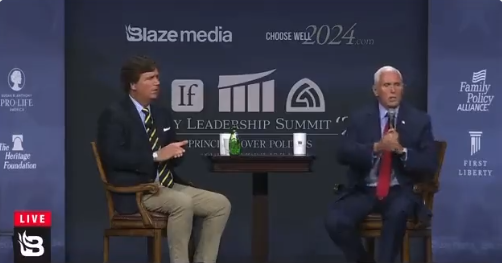
Tucker Carlson talking to Mike Pence, July 2023.
This became a dangerous cycle because the more Tucker forayed into the fringe, the harder he struck a vein of malformed but popular sentiment. Meanwhile, censorship of his relatively tame views only handed him a bigger megaphone and more incentive to go further. His sensible opposition to the Iraq and Afghanistan disasters, and his wariness of another quagmire emerging in Ukraine, curdled into progressively more unhinged forms of isolationism. His legitimate concerns about demographic trends and failed immigration policy curdled into belief in a coordinated conspiracy to erase white people from Europe and North America. Reasonable criticism of Israel and the American role in the Middle East curdled into the quasi-antisemitic trope of AIPAC as the hidden hand controlling U.S. foreign policy. His well-earned distrust of government curdled into various conspiracies involving some mix of extra-terrestrials, the CIA, and the Jews.
The pattern has become so predictable that if there was an effort to block him from praising Brussels sprouts as his favourite vegetable, at least three of his next five interview guests would spend two hours apiece insisting the maligned little cabbage is the victim of a coordinated smear campaign bankrolled by Big Salad. The attempted prohibition becomes the proof.
As a free-speech and free-market advocate, I think Tucker is entitled to say what he wants, and I congratulate him on his commercial success, even while finding many of his views idiotic. What troubles me is not so much the outlandish claims, but the skill atrophy — the phenomenon whereby any skill sharpened by adversarial pressure dulls without resistance. In boxing, the term “ring rust” is sometimes used to describe the way a boxer who stops facing strong opponents loses their timing, power, and urgency, until nothing’s left but a shell of their former selves. Looking back over his podcast guest list, with the exception of this Rees-Mogg segment, Ted Cruz last year, and perhaps a handful of others, it has been a long procession of hundreds of people brought on to confirm his own worldview back to him, in their own words. And the ring rust has set in.
I first noticed it at an event in Edmonton in January 2024, where I sat on a panel with Tucker and Jordan Peterson. I found myself in the awkward position of feeling the need to defend then-Finance Minister Chrystia Freeland in front of a packed arena of anti-Liberal partisans (with whom I would have considered myself somewhat of a kindred spirit). I was booed by parts of the audience for pointing out the fact that while Freeland, whom I know slightly and like personally, was politically hopeless, she was not, as Tucker had claimed, a fascist. The typically leftist habit of reducing every political opponent to a Hitler or Mussolini analog is lazy and obnoxious — not adjectives I would have used to describe the old Tucker. His justification was that he had recently seen a video of reporter David Menzies being detained by the RCMP after a collision with an officer while trying to get his microphone close enough to pick up Freeland’s response (or lack thereof). It was an outrageous overreaction by the officer, but there was no suggestion that Freeland had ordered the arrest. Ironically, Menzies’ question that Freeland was trying to dodge had been about why the Liberal government had gone soft on Iran’s terrorist regime — a question one might well put to Tucker.
The signs of atrophy continued to show up and in ways that, as a former admirer of Tucker’s, became progressively more alarming. At the memorial following the tragic murder of Charlie Kirk, Tucker gave an odd speech in which he claimed that the assassination was reminiscent of his “favourite story”, in which Jesus Christ was killed for telling the truth by a group of shadowy figures “in a lamp-lit room” in Jerusalem, “sitting around eating hummus”. When asked about it a few days later, Tucker employed a variation of the Jon Stewart technique of backing away from his own words to avoid serious scrutiny. With his characteristic forced laugh, he denied any implication that he had echoed the nascent conspiracy theory that Israel had murdered Charlie Kirk. His defense: hummus is a traditional Arab (rather than Jewish) food.
The evident decline grew even more pronounced in his May 2026 New York Times sit-down, when Lulu Garcia-Navarro asked why he had suggested that Donald Trump might be the Antichrist. Tucker insisted he had never said that, wasn’t even sure what the Antichrist was and insisted “those words never left my lips” — then, after he was shown a clip from his own show of the words leaving his lips, he apologized that his remarks from the clip implied “a precision I haven’t arrived at”. In other words, the jury is still out about whether Trump is the Antichrist, and he regretted jumping the gun on the verdict.
Which brings us to the latest instalment. After roughly 200 interviews, each amounting to hours-long sessions of Tucker and his guests regurgitating the same pablum into each other’s mouths, the transformation into a shell of his former self appears to be complete. In this conversation, moments after declaring that killing the innocent is “never justified under any circumstances”, he pivoted almost in the same breath into a full-throated defence of Hitler — history’s single greatest killer of innocents. He argued the invasion of Poland was understandable given that 15% of the country had been German before the Treaty of Versailles. While absurd, at least it is consistent with his position on Russia’s invasion of Ukraine. But even if, for argument’s sake, that justified Poland, Hitler didn’t stop there. What justified the invasions of Belgium and France? After all, France was faithfully adhering to the Tuckerite foreign policy of reluctant rearmament, appeasement, and assuming an entirely defensive posture (behind the Maginot Line). Stretching the flimsy logic further one could argue (feebly) that France had it coming too, since 6% of France (Alsace-Lorraine) was also German before Versailles. But there’s still no justification for the invasions of Denmark, Norway, the Netherlands, Yugoslavia, Greece, or the Soviet Union — with whom Hitler had a signed non-aggression pact. None of those countries were ever German, let alone Libya, Tunisia, and Egypt.
What’s clear is that Hitler used his early invasions to test whether anyone would stop him — and the feedback he got was a green light for more. History keeps teaching the same lesson: appeasement is just expansionism outsourced to your enemies.
Small wonder Tucker hasn’t learned this lesson from history, given that he called Darryl Cooper — a man with zero historical credentials — “the best and most honest popular historian in the United States.” Cooper spent two hours on Tucker’s show in September 2024, arguing Churchill, not Hitler, was the “chief villain” of the war, and that the deaths of millions in Nazi camps owed more to German logistical incompetence than deliberate extermination.


