
World War Two
Published 21 Oct 2023The Germans engineer a coup in Hungary to keep the Hungarian army in the war, but the Allies have finally entered Germany in force, taking Aachen in the west. The Soviets liberate Belgrade in the east, and launch new attacks in Baltics, and at the other end of the world come American landings in the Philippines, and the recall of Vinegar Joe Stilwell from China.
00:00 Intro
01:00 Recap
01:21 Raids on the Philippines
04:42 The Invasion of Leyte
06:11 Joe Stilwell is recalled from China
08:12 The Battle of Aachen
12:24 Battle of the Scheldt
14:03 Soviet attacks in the Baltics
16:23 Horthy’s fall- a coup in Hungary
19:45 Germans close in on Slovakia
21:55 Belgrade Liberated
24:47 Summary
25:01 Conclusion
(more…)
October 22, 2023
SS Commando Coup in Hungary – WW2 – Week 269 – October 21, 1944
October 16, 2023
The Allied Rape Wave of 1944 – War Against Humanity 116
World War Two
Published 12 Oct 2023Since the earliest days of humanity, where there has been war, there has been rape. This war is no different. As vast armies battle across Europe, the chaos in their wake breeds an epidemic of rape. In its action and its punishment the European rape wave is also highly racialised. It adds up to a storm of suffering.
(more…)
October 15, 2023
The Isolation of Army Group North – WW2 – Week 268 – October 14, 1944
World War Two
Published 14 Oct 2023Churchill, Stalin, and Roosevelt meet at the Moscow Conference and talk about future “spheres of influence” in the Balkans. They also make plans for the future of Poland. In the field the Soviet Red Army completes the isolation of Army Group North and also advances in Hungary and Yugoslavia. The Allies enter Aachen in the west and cross the Rubicon in Italy. The Americans are still fighting the Japanese on Peleliu, and this week also make raids against Japanese airfields ahead of next week’s invasion of the Philippines.
01:00 Recap
01:22 The Moscow Conference begins
03:43 Isolating Army Group North
06:29 Soviet advances toward Belgrade
08:14 The Debrecen Operation
13:20 Horthy and Hungary
14:30 Chiang Kai-shek accuses Joe Stilwell
16:19 American raids on Formosa
19:29 The fight for Peleliu continues
20:01 Antwerp and Aachen
22:01 The Allies cross the Rubicon
(more…)
October 13, 2023
Elvira, the Party Girl Double Agent
World War Two
Published 11 Oct 2023She’s the gambler with a hotline to the Abwehr. The party girl tearing up the London social scene. Now she’s doing her bit to hold back the Panzer divisions and pave the way for D-Day. This is the story of Elvira Concepcion Josefina de la Fuente Chaudoir, Double Cross’s most flamboyant double agent.
(more…)
Gewehr 43
Forgotten Weapons
Published 13 Oct 2013German ordnance began looking for a military self-loading rifle to augment the K98k as early as the 1930s, although the pressures of war initially made that development a second priority. By 1941, though, two competing designs from the Walther and Mauser companies had been developed to the point of mass production, as the Gewehr 41(W) and Gewehr 41(M) rifles. These both shared a gas-trap operating system to comply with an HWa requirement that no gas ports be drilled into the barrels. When it came to locking systems, the two designs differed greatly, with the Walther being the more successful of the two. Thousands of examples of both designs were put into field testing, mostly in the East, and it became clear that the gas-trap system was not suitable for combat. The Walther company responded with a new version of their design which used a much more modern short-stroke gas piston, basically copied from the Soviet SVT-40 rifle.
The G43 was very quickly recognized as a significant improvement over the G41(W), and was very quickly put into production, with approximately 400,000 being manufactured by the end of the war. Well, I found an example of the G43 that I could shoot (thank you, Mike) and took it out for some video …
(more…)
October 11, 2023
How Britain Broke Hitler’s Brain
World War Two
Published 10 Oct 2023In a re-upload of one of our D-Day 24 Hour videos, Astrid introduces you to the war’s most effective counter-espionage and deception programme, The Double Cross system. Today she’ll talk about their operations before and during D-Day and introduce you to some of the most important double agents. Their mission: fool the Führer.
(more…)
October 8, 2023
The End of the Warsaw Uprising – WW2 – Week 267 – October 7, 1944
World War Two
Published 7 Oct 2023The Warsaw Uprising comes to its conclusion, a tragic one for the Poles. In the field in Europe, there are Allied attacks toward Aachen, Bologna, and Debrecen, while in China the Japanese have begun a new phase of their Ichi Go Offensive.
(more…)
October 7, 2023
Eastern Front Tank Warfare 1944
World War Two
In this conflict, we’ve seen armored warfare on a greater scale than anything before or since. Indy takes a look at some of the tanks slugging it out on the Eastern Front, from the long-serving Panzer III and IV, to the newer and more powerful Tiger and T-34 85, and the monstrous IS-2.
(more…)
October 5, 2023
The Soviet Spies who Kickstarted the Nuclear Arms Race
World War Two
Published 4 Oct 2023Last episode we saw Klaus Fuchs steal details of the American atomic bomb for the Soviet Union. But he’s only one component of a much bigger conspiracy. Today, Astrid introduces you to the mysterious web of Soviet atomic spies. Their work changed our world forever.
(more…)
October 4, 2023
Paris under the Swastika – Collaboration and Resistance – On the Homefront 019
World War Two
Published 3 Oct 2023Occupied Paris, a paradoxical city of banality and brutality, of resistance and collaboration. Join Anna as she takes you on a tour of the city from occupation, the establishment of the Pétain regime and collaboration, the growth of resistance, and finally liberation. But the story doesn’t end there and into the 21st century, the city of lights is haunted by its occupation.
(more…)
Douglas Murray – “Canada today looks like a nation of ignoramuses”
Writing in the National Post, Douglas Murray flays the Canadian Parliament for their shameful ignorance put on display by publicly honouring a former Waffen SS officer:
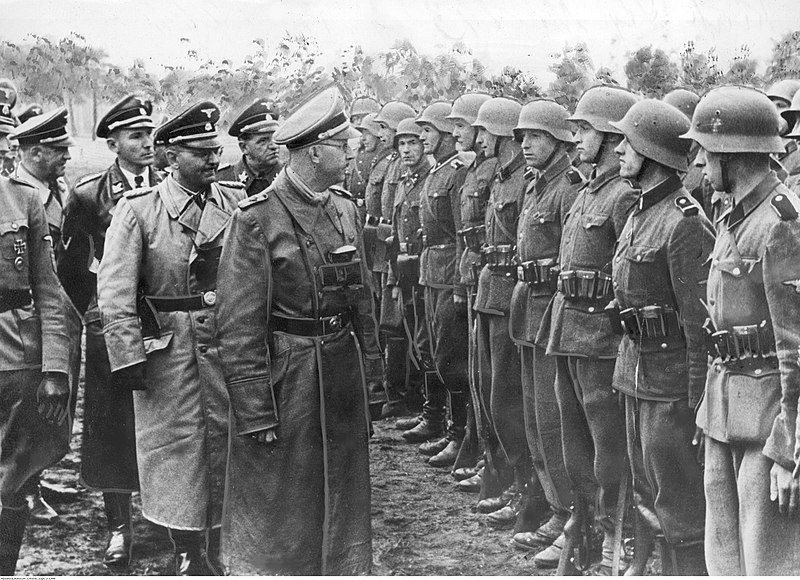
Reichsführer Heinrich Himmler (in the foreground) visiting the 14th Grenadier Division of the Waffen SS “Galizien” in May 1943.
Narodowe Archiwum Cyfrowe photo via Wikimedia Commons.
Perhaps I should say straight away that I love Canada. Some of my best friends are Canadian. That minimal throat-clearing aside, let me say — as a friendly outsider — that Canada today looks like a nation of ignoramuses.
The incident in Parliament the other week is just one case in point. Standing ovations are very rare things. They should be very special things. When a whole House stands to applaud someone they had better be very sure who they are applauding.
I know that Speaker Anthony Rota has now resigned. But here is the thing. Anybody who knows anything about the Second World War knows that if you were fighting the Soviets in Ukraine in the 1940s you were most likely fighting with the Nazis. It does not require a fine-tuned expert in the era to know this. Almost anybody could have guessed this. If almost anyone knew anything.
It seemed to be the assumption not just of Speaker Rota but of the whole Canadian Parliament that there existed in the 1940s some proto-anti-Putin fighting force and that the great cause of this moment has some direct lineage back to the fight of the 1940s. Ukrainian President Volodymyr Zelenskyy almost certainly guessed this. But it was the Canadian Parliament who was hosting him, the Canadian Parliament who embarrassed him and the Canadian Parliament who have handed the most magnificent propaganda victory to the Kremlin. In a war which Putin pretended to start in order to “de-Nazify” Ukraine, how much help has Canada given by your entire Parliament standing to applaud an actual Nazi?
What makes this worse is that this all comes after a period in which Prime Minister Justin Trudeau has been perfectly happy to call decent, ordinary Canadians Nazis. To use measures like the de-banking of his critics in moves that have horrified most of the other democracies in the West. When a bank in my country of birth — Britain — was recently found to have de-banked a politician (Nigel Farage) for what turned out to be political reasons not only did the head of the bank resign, but politicians in Britain from across the political system condemned the bank. Such moves are unlikely to be taken by another bank in Britain again. But in Canada it seems to be perfectly acceptable, because at any time the Canadian prime minister and deputy prime minister can claim that their critics are homophobes, xenophobes, racists, Nazis, misogynists and all of the rest.
The world — especially America — has looked on in horror as the Canadian government has tried to curtail speech in the country, and looked on with ever-more horror as Canadians seem willing to go along with this. It seems to be the view of the Canadian authorities that they are capable of deciding at the merest glance who is and is not allowed to speak, what is and is not acceptable speech, what any Canadians can and cannot read and who is and who is not a “Nazi”. These being the same authorities who apparently cannot even perform the most basic Google searches on their guests.
I know that Canadians often like to look down on Americans. But as someone who spends most of his time in America I can tell you that it is the American public who now wonder at what on earth is happening with our neighbour in the north.
October 1, 2023
The End of Market Garden – WW2 – Week 266 – September 30, 1944
World War Two
Published 30 Sep 2023This week, Operation Market Garden comes to its unsuccessful conclusion, but there’s a lot more going on — the Soviets launch an offensive in the Estonian Archipelago, the Warsaw Uprising is on the ropes, the Allies advance in Italy, the Americans on Peleliu, and Tito and Stalin make plans to clear Yugoslavia of the enemy.
(more…)
September 30, 2023
The Man Who Stole the Atomic Bomb
World War Two
Published 29 Sep 2023In the New Mexico desert, a secret team of scientists is working flat out to develop atomic bombs. It’s the most important American military project in history. But one of those scientists lives a double life. Klaus Fuchs has decided to betray his country and share America’s most secret technology with the Soviet Union. But is he the only person who has turned traitor?
(more…)
Why did the North Africa Campaign Matter in WW2?
The Intel Report
Published 8 Jun 2023As Erwin Rommel’s Afrika Korps rolled into Egypt in 1942, the only thing standing between them and Cairo and the Suez Canal was the British 8th Army. In this video we look at what was at stake for both sides, and why the North African campaign made a crucial impact on the outcome of the Second World War.
(more…)
September 29, 2023
WW2 Jet Engine Development
World War Two
Published 28 Sep 2023Jet planes and jet engine technology revolutionized air travel, as we are all well aware. However, the development of jet planes during WW2 was fraught with all sorts of obstacles and hurdles. Let’s take a look at it.
(more…)


