
Military History Visualized
Published on 22 Dec 2017This video discusses what killed the most tanks in World War 2. Was it anti-tank guns, mines, planes, hand-held anti-tank weapons, mechanical breakdowns, etc. Also a short look at the problems of the term “kill”, e.g., mobility, firepower and catastrophic/complete kill.
Original Question by Christopher: “What destroyed the most tanks during WW2: infantry, planes, anti-tank guns, or other tanks (I’m not sure if tank destroyers needs its own category or not).”
January 19, 2018
What “killed” the most tanks in World War 2?
Comments Off on What “killed” the most tanks in World War 2?
January 16, 2018
PIAT: Britain’s Answer to the Anti-Tank Rifle Problem
Forgotten Weapons
Published on 25 Nov 2017The British began World War Two with the Boys antitank rifle, but like all antitank rifles it rather quickly became obsolete. The replacement for it was adopted in 1942 as the PIAT – Projector, Infantry, Anti-Tank. This was a unique sort of weapon which fired a 3 pound (~1.35kg) hollow charge projectile using a combination of a massive spring and a firing charge much like a rifle grenade blank cartridge – a spigot mortar, really. The large (3.25″, 83mm) projectile was able to defeat almost any tank that would be developed during the war, as it could burn through 3-4 inches of hardened armor. However, it had a terrifyingly short effective range – 110 yards on paper and more like 50 yards in practice.
The PIAT would recock itself upon firing, but the initial cocking was something like a crossbow, requiring the shooter to brace their feet on the buttplate and pull the body of the weapon upwards, compressing the 200 pound (90kg) mainspring. When fired, the weapon has a pretty harsh recoil, although it did not have any flash or backblast like the American Bazooka did. By the end of the war more 115,000 PIATs had been made, and they would serve the British military into the 1950s, when they were replaced with more traditional rocket launchers.
Comments Off on PIAT: Britain’s Answer to the Anti-Tank Rifle Problem
January 14, 2018
M4 Sherman Tank – Crew tell how shocking it was
spottydog4477
Published on 18 Sep 2011Doctrine
As the US approached entry in World War II, armored employment was doctrinally governed by FM 100-5 Operations (published May 1941, the month following selection of the M4 tank’s final design). That FM stated that:
The armored division is organized primarily to perform missions that require great mobility and firepower. It is given decisive missions. It is capable of engaging in all forms of combat, but its primary role is in offensive operations against hostile rear areas.
In other words, the M4 was envisioned to primarily fill the role of a cruiser tank — although the US Army did not use that doctrinal term. The M4 was not primarily intended as an infantry support tank; in fact, FM 100-5 specifically stated the opposite. It placed tanks in the “striking echelon” of the armored division, and placed the infantry in the “support echelon”. Neither was the M4 primarily intended for tank versus tank action. Doctrinally, anti-tank engagements were the primary role of tank destroyers. The field manual covering the use of the Sherman (FM 17-33 The Tank Battalion, Light and Medium of September 1942) devoted one page of text and four diagrams to tank versus tank action (out of 142 pages). This early armored doctrine was heavily influenced by the sweeping initial successes of the German blitzkrieg tactics. Unfortunately, by the time M4s reached combat in significant numbers, battlefield demands for infantry support and tank versus tank action far outnumbered the occasional opportunities for cruiser tanks.
Although envisioned primarily as a cruiser-type tank, US doctrine did also contemplate the M4’s use in other roles. Unlike some other nations, which had separate medium tank designs tailored specifically for anti-tank roles (e.g., the German PzKfw III) and support roles (the PzKfw IV), the US intended the M4 to fulfill all roles. Although not optimized for tank versus tank engagements or infantry support, the M4 was capable of performing these missions to varying degrees. In the Pacific Theater, the Sherman was used chiefly against Japanese infantry and fortifications; in their rare encounters with lighter Japanese tanks with weaker armor and guns, the Shermans were vastly superior.
The doctrine of the time had Shermans as a sort of infantry tank. All anti-tank work was supposed to be done by tank-destroyer crews. Speed was essential in order to bring the tank-destroyers from the rear to destroy incoming tanks. Thankfully, for Sherman crews, this doctrine was not entirely used as it would create a small window of time of weakness in the armored battalion until tank destroyers moved to the front. Obviously this would make it harder for an armored force to achieve a breakthrough, a main objective of armor, if the enemy had tanks. It would also be easier for an opposing armored force to achieve a breakthrough against an American tank battalion which would not have all of its anti-tank assets at the front during the beginning of any attack.
Comments Off on M4 Sherman Tank – Crew tell how shocking it was
January 8, 2018
Mark Steyn reviews Darkest Hour
The latest screen depiction of Winston Churchill gets the once-over from Mark Steyn:
Churchill tends to the Churchillian, which is to say the epic. Darkest Hour, by contrast, is very finely focused. Joe Wright, director, and Edward McCarten, writer, confine their two dark hours of screen time to a couple of critical weeks in May 1940, when Hitler’s invasion of Norway precipitated Neville Chamberlain’s retreat from Downing Street. Aside from some rather elaborately choreographed overhead shots and a lush grandiose score, Darkest Hour is filmed claustrophobically, too – in poky sitting rooms, Downing Street basements, attics, Westminster ante-rooms, and chilly lavatories; the lighting is crepuscular. The fate of the world is being determined, but we never glimpse the far horizons, only the dingy backrooms.
What happened that month was a showdown between the two principal contenders for the Prime Ministership, Mr Churchill and Lord Halifax. Stephen Dillane is excellent as Halifax, the vulpine cadaver looking down (in every sense) from the Commons gallery at Churchill’s turns at the dispatch box. Unfortunately, aside from skillful deployments of his inscrutable yet condescending eyebrows, he gets somewhat short shrift on screen, so as a Churchill vs Halifax cage match it never quite comes off – presumably because the third Viscount Halifax is entirely unknown in Hollywood. (“Third Viscount Halifax? Hey, let’s see what the first two gross before we commit to that…”)
This is a pity, because the two men were on opposite ends of the seesaw, and, capacious as Churchill’s own bottom is, most of the other players – the King, Chamberlain, the parliamentary party, defeatist generals, Dominion prime ministers around the globe – were inclined to park their own butts down Halifax’s end. On May 10th, the day Winston became PM, the Germans invaded Belgium, France and the Netherlands. Ten days later, Hitler’s army reached the Channel, and was within reach of throttling the 300,000-strong British Expeditionary Force at Dunkirk, and seizing the entire French fleet. In that dreadful month of May, Churchill wanted to fight on; Halifax preferred to use Mussolini’s “good offices” to sue for a “peace” that would leave Britain and its empire more or less “intact” – save for East Africa, Suez, Malta, Gibraltar and sundry other places that would have to be addressed, per the Italian ambassador in London, “as part of a general European settlement”.
In other words, we are at the great hinge moment of the twentieth century: Had Halifax prevailed, there would have been a neutered Berlin-friendly British Empire directly bordering America on the 49th parallel and all but directly the Soviet Union in Central Asia. There would have been no potential allies for Moscow in the event of war with Germany, thus incentivizing a successful conclusion in late 1940 to Molotov’s talks in Berlin to join the Axis; and no allies whatsoever for Washington, assuming Japan still felt the need to bomb Pearl Harbor the following year. Instead, Churchill prevailed – and Britain and its lion cubs fought on, playing for time until first the Soviets and then the Americans joined the war against Germany, Italy and Japan. That year in which the moth-eaten Britiish lion and its distant cubs stood alone is, more than any other single factor, the reason why the world as ordered these last seventy years exists at all.
[…]
As with Christopher Nolan’s Dunkirk, one’s admiration for the film is tempered by a terrible profound sadness – for a people who “won the war, and lost their country anyway”. To anyone old enough to remember an England where one could “walk into any pub in the country and ask with perfect confidence if the major had been in”, the sense of loss can bring tears to the eye. Unlike Iron-Man 5 and Spider-Man 12 and Cardboard-Man 19 and Franchise-Man 37, this is the story of an actual, real-life superhero: You leave the theater with the cheers of the House ringing in your ears …and return to a world where quoting Churchill in his own land can get you arrested.
Comments Off on Mark Steyn reviews Darkest Hour
December 28, 2017
How A Cargo Ship Helped Win WW2: The Liberty Ship Story
Mustard
Published on 14 Nov 2017During World War Two, hundreds of cargo ships raced across the Atlantic in an effort to keep Britain supplied. But these ships were being sunk by German U-boats, warships and aircraft. In 1940 alone, over a thousand allied ships were lost on their way to Britain.
The United States, while not yet at war, was playing a vital role in supplying Britain. But with ships being sunk daily, Britain and America desperately needed a way to keep all that material moving across the Atlantic. In response, 18 shipyards across the coastal United States mobilized to build thousands of large cargo ships known as Liberty Ships. They would be built even faster than the enemy could sink them. At one point the shipyards were building one large Liberty Ship every eight hours.
Two revolutionary changes in shipbuilding will make this enormous feat possible. The first is welding and the second is the use of a modular assembly process. By mid 1941, the sheer number Liberties out at sea, along with increasing armed escorts overwhelmed German forces. Advances in anti-submarine technologies also started stamping out the U-boat threat.
Today, there are only three Liberty Ships remaining of the 2,710 built that remind us of their enormous contribution to winning World War Two.
Comments Off on How A Cargo Ship Helped Win WW2: The Liberty Ship Story
December 27, 2017
The Second World War – Operation Dynamo completed, The Long March has started.
TimeGhost
Published on 20 Dec 2017Thank you all for your support so far! Every minute, every hour we move closer to launching The Second World War as the largest collaborative effort on YouTube ever, and you’re making it happen!
Launch WWII: https://www.kickstarter.com/projects/…
Join the TimeGhost Army Group: https://www.facebook.com/groups/TimeGhostArmy/
Audio: Winston Churchill’s speech to the House of Commons on 4 June 1940 after the completion of Operation Dynamo, the evacuation from Dunkirk.
Footage from Frank Capra’s “Why We Fight” series from 1942 and “The True Glory” from 1945, a documentary based on photography by combat camera men produced by the governments of Great Britain and The United Sates. Both courtesy of The National Archive, all right released.
Comments Off on The Second World War – Operation Dynamo completed, The Long March has started.
December 23, 2017
The team behind “The Great War” to produce a Second World War video series
Perhaps the single question Indy Neidell and the team at “The Great War” channel have been asked most frequently was whether they were planning to do a similar kind of week-by-week history on the Second World War. They have finally committed to doing so, although it will be a much bigger effort than what they’ve been doing so far. Here’s the Kickstarter intro video:
The funding effort is going well, as the latest update indicates:
Comments Off on The team behind “The Great War” to produce a Second World War video series
December 21, 2017
The bloody 20th century and the leaders who helped make it so
Walter Williams on the terrible death toll of the 20th century, both in formal war between nations and in internal conflict and repression:
The 20th century was mankind’s most brutal century. Roughly 16 million people lost their lives during World War I; about 60 million died during World War II. Wars during the 20th century cost an estimated 71 million to 116 million lives.
The number of war dead pales in comparison with the number of people who lost their lives at the hands of their own governments. The late professor Rudolph J. Rummel of the University of Hawaii documented this tragedy in his book Death by Government: Genocide and Mass Murder Since 1900. Some of the statistics found in the book have been updated here.
The People’s Republic of China tops the list, with 76 million lives lost at the hands of the government from 1949 to 1987. The Soviet Union follows, with 62 million lives lost from 1917 to 1987. Adolf Hitler’s Nazi German government killed 21 million people between 1933 and 1945. Then there are lesser murdering regimes, such as Nationalist China, Japan, Turkey, Vietnam and Mexico. According to Rummel’s research, the 20th century saw 262 million people’s lives lost at the hands of their own governments.
Hitler’s atrocities are widely recognized, publicized and condemned. World War II’s conquering nations’ condemnation included denazification and bringing Holocaust perpetrators to trial and punishing them through lengthy sentences and execution. Similar measures were taken to punish Japan’s murderers.
But what about the greatest murderers in mankind’s history — the Soviet Union’s Josef Stalin and China’s Mao Zedong? Some leftists saw these communists as heroes. W.E.B. Du Bois, writing in the National Guardian in 1953, said, “Stalin was a great man; few other men of the 20th century approach his stature. … The highest proof of his greatness (was that) he knew the common man, felt his problems, followed his fate.” Walter Duranty called Stalin “the greatest living statesman” and “a quiet, unobtrusive man.” There was even leftist admiration for Hitler and fellow fascist Benito Mussolini. When Hitler came to power in January 1933, George Bernard Shaw described him as “a very remarkable man, a very able man.” President Franklin Roosevelt called the fascist Mussolini “admirable,” and he was “deeply impressed by what he (had) accomplished.”
Comments Off on The bloody 20th century and the leaders who helped make it so
December 7, 2017
The battleships of Pearl Harbour
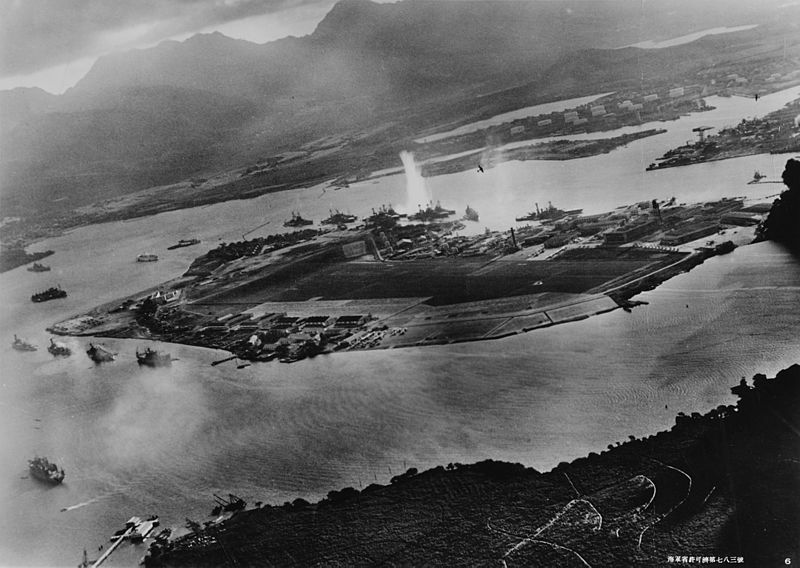
Last month Naval Gazing ran a three-part series on the US Navy battleships at Pearl Harbour on the morning of 7 December, 1941, their post-attack fates, and later careers in World War 2. Part 1 was about the initial Japanese attack:
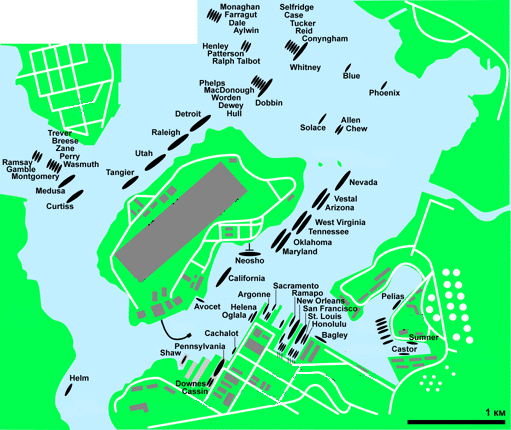
In Pearl Harbor on December 7th were eight battleships: Nevada, Oklahoma, Pennsylvania, Arizona, Tennessee, California, West Virginia and Maryland. All of them were of First World War vintage, representatives of what was known as the Standard Type. These were ships commissioned between 1914 and 1923, all of broadly the same size, and the first ships designed for long-range combat using an all-or-nothing armor scheme. All had four turrets, and all but West Virginia and Maryland mounting 14” guns. (They had 16” guns instead.)
Pearl Harbour at the beginning of the attack, Battleship Row at the top (the waterspout is the first torpedo hit on the USS West Virginia)
All of the ships except Pennsylvania (which was in drydock) were moored along Ford Island in the famous ‘battleship row’. I’m going to focus on the stories of the individual ships during the attack, moving north to south. The attack began at 0748 on Sunday, December 7th, and a total of 353 Japanese aircraft were involved, in two waves.
A map of Pearl Harbour before the attack
The second post in the series covered the salvage of the damaged US Navy battleships:
When we left Pearl Harbor, it was the evening of December 7th, and most of Battle Force was on the bottom of the harbor. But what happened to the ships afterwards? We’ll go through the ships in the order which they returned to service (if they did) and then look more broadly at the use of the survivors during the war.
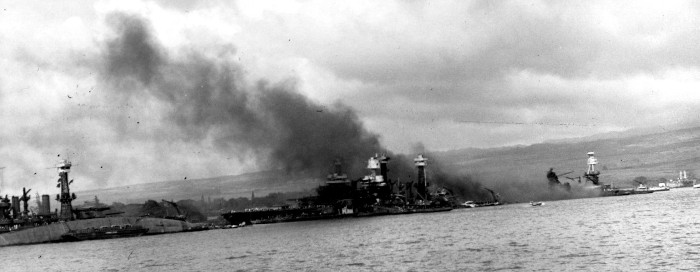
Battleship Row, 8 December 1941. Left-to-right: Maryland, Oklahoma, Tennesee, West Virginia, Arizona.
Maryland was the first ship ready to go to sea again, albeit with some damage. Tennessee was slightly behind her, as she was wedged by the West Virginia. Both ships were sent to Puget Sound at the end of the year, and repairs were completed in February. Pennsylvania was sent to San Francisco at the same time, returning to duty in March. All three ships (along with Colorado, New Mexico, Mississippi, and Idaho) served as part of TF 1, the backup to the carrier fleet until after Midway. Tennessee and Pennsylvania were sent to the states for comprehensive refit, running 8/42-5/43 and 10/42-2/43 respectively. Both received the standard upgrade, a reconstructed superstructure resembling those on the fast battleships (although there was less work done on Pennsylvania than the others), 5”/38 secondary guns in place of the former mixed secondary battery and upgraded fire control. Tennessee was also blistered against torpedoes, restricting her to the Pacific or a long journey around South America. Maryland was never refitted.
Part 3 discussed the Pearl Harbour survivors at the battle of Leyte Gulf:
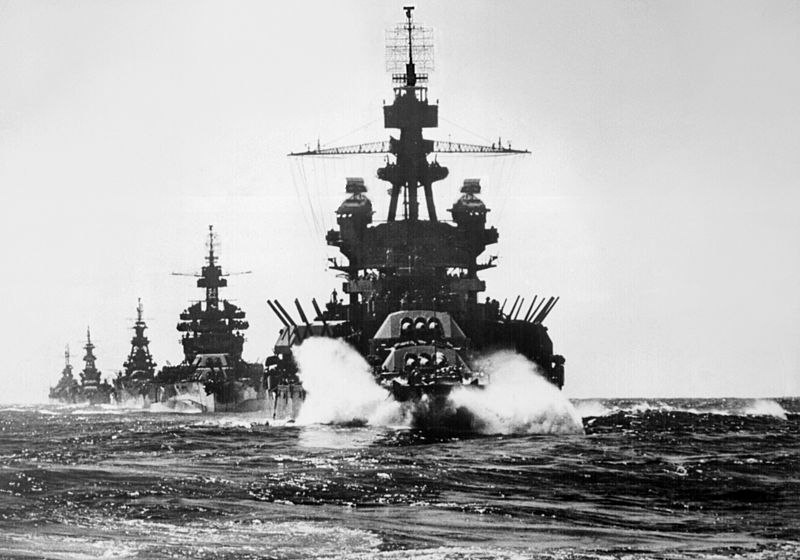
The invasion began on Leyte Island in October of 1944, and triggered the largest naval battle in history, the battle of Leyte Gulf. The Japanese, who had long planned for the ‘Decisive Battle’ between their battleships and those of the US, planned a counterattack on the US landings in three main groups. Their carriers would come in from the north and draw off the US carriers covering the invasion, while two groups of battleships would sneak up on the invasion fleet from the east, passing through the Philippines and pincering the US transports from the north and south.
USS Pennsylvania leads a column of battleships into Lingayen Gulf.
The northern group (basically without planes after severe losses in June during the Battle of the Philippine Sea) managed to draw off Admiral Halsey. He’s often criticized for this, but in fairness, he was tasked with destroying the Japanese fleet, and the US didn’t realize how badly the carrier air groups had been hammered. The center group (with the faster battleships) had been detected, and appeared to have turned back after Musashi, Yamato’s sister ship, was sunk. They in fact resumed their course, and their encounter with escort carrier group Taffy 3 is the stuff of legend, but also a matter for another time.
Comments Off on The battleships of Pearl Harbour
November 11, 2017
Mark Knopfler – “Remembrance Day”
Bob Oldfield
Published on 3 Nov 2011A Remembrance Day slideshow using Mark Knopfler’s wonderful “Remembrance Day” song from the album Get Lucky (2009). The early part of the song conveys many British images, but I have added some very Canadian images also which fit with many of the lyrics. The theme and message is universal… ‘we will remember them’.
Comments Off on Mark Knopfler – “Remembrance Day”
In memoriam
A simple recognition of some of our family members who served in the First and Second World Wars:
The Great War
 Private William Penman, Scots Guards, died 16 May, 1915 at Le Touret, age 25
(Elizabeth’s great uncle)- Private Archibald Turner Mulholland, Argyll & Sutherland Highlanders, mortally wounded 25 September, 1915 at Loos, age 27
(Elizabeth’s great uncle) - Private David Buller, Highland Light Infantry, died 21 October, 1915 at Loos, age 35
(Elizabeth’s great grandfather) - Private Harold Edgar Brand, East Yorkshire Regiment. died 4 June, 1917 at Tournai.
(My first cousin, three times removed) - Private Walter Porteous, Durham Light Infantry, died 4 October, 1917 at Passchendaele, age 18
(my great uncle) - Corporal John Mulholland, Argyll & Sutherland Highlanders, wounded 2 September, 1914 (shortly before the First Battle of the Aisne), wounded again 29 June, 1918, lived through the war.
(Elizabeth’s great uncle)
The Second World War
- Flying Officer Richard Porteous, RAF, survived the defeat in Malaya and lived through the war
(my great uncle) - Able Seaman John Penman, RN, served in the Defensively Equipped Merchant fleet on the Murmansk Run (and other convoy routes), lived through the war
(Elizabeth’s father) - Private Archie Black (commissioned after the war and retired as a Major), Gordon Highlanders, captured at Singapore (aged 15) and survived a Japanese POW camp
(Elizabeth’s uncle) - Elizabeth Buller, “Lumberjill” in the Women’s Land Army in Scotland through the war.
(Elizabeth’s mother) - Trooper Leslie Taplan Russon, 3rd Royal Tank Regiment, died at Tobruk, 19 December, 1942 (aged 23).
A recently discovered relative. Leslie was my father’s first cousin, once removed (and therefore my first cousin, twice removed).
For the curious, the Commonwealth War Graves Commission and the Royal British Legion provide search engines you can use to look up your family name. The RBL’s Every One Remembered site shows you everyone who died in the Great War in British or Empire service (Canadians, Australians, New Zealanders, South Africans and other Imperial countries). The CWGC site also includes those who died in the Second World War.
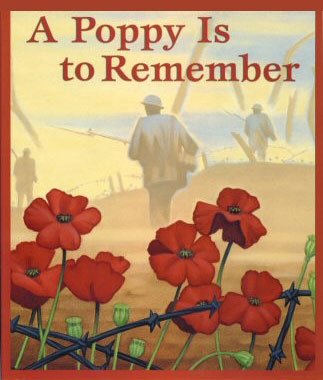
In Flanders fields the poppies blow
Between the crosses row on row,
That mark our place; and in the sky
The larks, still bravely singing, fly
Scarce heard amid the guns below.We are the Dead. Short days ago
We lived, felt dawn, saw sunset glow,
Loved and were loved, and now we lie
In Flanders fields.Take up our quarrel with the foe:
To you from failing hands we throw
The torch; be yours to hold it high.
If ye break faith with us who die
We shall not sleep, though poppies grow
In Flanders fields.Lieutenant Colonel John McCrae, MD Canadian Army Medical Corps (1872-1918)
Comments Off on In memoriam
November 2, 2017
The Short-Lived No1 Mk6 SMLE Lee Enfield
Forgotten Weapons
Published on 30 Mar 2017Prototype: Sold for $56,350 – http://jamesdjulia.com/item/1645-396/
Pre-production: Sold for $12,075 – http://jamesdjulia.com/item/1646-396/
No1 Mk6: Sold for $12,075 – http://jamesdjulia.com/item/1650-396/
No4 Mk1: Sold for $5,750 – http://jamesdjulia.com/item/1658-396/The SMLE No1 Mk3 was the iconic British infantry rifle of World War 1, but not the final evolution of the Lee Enfield design. By World War 2 it had been replaced by the new No4 Mk1 Lee Enfield, and this is the story of the interim models.
At the end of WW1, the British recognized several areas where the SMLE could be improved: a heavier barrel, a lighter bayonet, and aperture sights. This led to the development of the No1 Mk5 rifle (the Mk4 being a designation for a .22 rimfire training variation), with 20,000 examples made for troop trials in the mid 1920s. The Mk5 was well received by troops, with its rear-mounted aperture sight being seen as a substantial improvement over the previous tangent notch sight. However, experimentation continued and by 1926 prototypes of a Mk6 rifle were being made.
In 1929 a series of 1000 No1 Mk6 rifles was put into production, which would fit a new style of short and light spike bayonet as well as an improved type of aperture sight. They also featured a very distinctive large area of deep square checkering on the hand guard, intended to improve one’s grip on the rifle during bayonet drill. These rifles were nearly the same as what was ultimately adopted as the new No4 Mk1 rifle – so much so that in 1931 that designation was applied to the rifles and a batch of 2500 more made for trials. These trials rifles were mostly issued out to troops in the aftermath of Dunkirk, making them very scarce to find today, as most did not survive the war. Those that did will sport a new serial number with an “A” suffix to indicate their non-standard parts (in comparison to the production model No4 Mk1. Today were will look at the progressive development of a pre-prototype Mk6, Mk6 rifle number 1, a Mk6 trials rifle, and one of those 2500 trials No4 Mk1 rifles.
Comments Off on The Short-Lived No1 Mk6 SMLE Lee Enfield
October 30, 2017
Tank Chats #19 Matilda II
Tank Museum
Published on 28 Apr 2016The name Matilda means Strength in Battle from the Germanic roots Maht, meaning strong and Hild meaning battle.
The Matilda was regarded as a superb tank in its day and carved a remarkable career for itself. A few served in France in 1940 but in the early stages of the North African campaign, under General Wavell, it virtually ruled the desert. Even when the Afrika Korps arrived it remained a formidable opponent, immune to everything but the notorious 88mm gun. Its main failings were its slow speed and small gun, which could not be improved.
Comments Off on Tank Chats #19 Matilda II
October 25, 2017
History of the Royal Navy 1914 to 1970
James Lyon
Published on 16 Jun 2016
Comments Off on History of the Royal Navy 1914 to 1970
October 23, 2017
The Spitfire’s Fatal Flaw
Real Engineering
Published on 3 Aug 2016
Comments Off on The Spitfire’s Fatal Flaw


