
Published on 13 May 2017
Chair of Wisdom Time! This week Indy talks about Junkers fighter planes, the plans for an invasion of Switzerland and he Whiter Feather Movement.
May 14, 2017
Junkers Fighter Planes – Whiter Feather Movement – Swiss Invasion Plans I OUT OF THE TRENCHES
Comments Off on Junkers Fighter Planes – Whiter Feather Movement – Swiss Invasion Plans I OUT OF THE TRENCHES
May 13, 2017
The Physics of World War 1 Planes feat. The Great War Channel
Published on 29 Apr 2017
Comments Off on The Physics of World War 1 Planes feat. The Great War Channel
May 12, 2017
The Macedonian Standoff – The Five Nation Army Is Repelled I THE GREAT WAR Week 146
Published on 11 May 2017
Italy, France, Serbia, Britain and Russia joined forces at the Macedonian Front and the “five nation army” wants to break through the lines held by Bulgaria with some German support. But the Bulgarian defences can withstand the attack and so Maurice Sarrail is forced to abandon all hopes for a breakthrough. Meanwhile another offensive is about to proceed at the Italian front which had been quiet all winter.
Comments Off on The Macedonian Standoff – The Five Nation Army Is Repelled I THE GREAT WAR Week 146
May 9, 2017
US Joins WW1 – Spring Offensives 1917 I THE GREAT WAR Summary Part 9
Published on 8 May 2017
After a rather quiet winter, the war erupts into action in 1917. Not only do the United States join the war after weeks of unrestricted submarine warfare and the uncovering of the Zimmermann Telegram. The British and French launch their own spring offensives. In the East, chaos spreads in post-revolutionary Russia and Lenin returns from exile. And in Mesopotamia the British take Baghdad.
Comments Off on US Joins WW1 – Spring Offensives 1917 I THE GREAT WAR Summary Part 9
May 7, 2017
Joffre The Imbecile – Nivelle’s Catastrophe I OUT OF THE ETHER
Published on 6 May 2017
It’s time to shine a light on some of the great comments we received and in the past days you guys had a lot to say about Nivelle and the French High Command in general.
Comments Off on Joffre The Imbecile – Nivelle’s Catastrophe I OUT OF THE ETHER
May 6, 2017
History of the Royal Navy – Steam, steel and Dreadnoughts (1806-1918)
Published on 1 Mar 2013
Here’s also an older post covering the technological challenges faced by the Royal Navy in the post-Napoleonic era, and some of the reasons for all those “weird” ship designs in the Victorian era.
Comments Off on History of the Royal Navy – Steam, steel and Dreadnoughts (1806-1918)
May 5, 2017
The Battle of Arleux – Robert Nivelle Gets Fired I THE GREAT WAR Week 145
Published on 4 May 2017
The Battle of Arras continued in smaller scale attacks this week 100 years ago. Fighting focused on Arleux and the Scarpe river. Neither of these battles was able to repeat the success of the early Arras offensive. The casualties of the Nivelle Offensive were now costing Robert Nivelle his job as he was still blaming everyone but himself.
Comments Off on The Battle of Arleux – Robert Nivelle Gets Fired I THE GREAT WAR Week 145
May 2, 2017
Reinventing Cavalry in WW1 – Bulgarian General Ivan Kolev I WHO DID WHAT IN WW1?
Published on 1 May 2017
Cavalry was seen as leftover from the past in the dawn of modern warfare during World War 1. But Bulgarian General Ivan Kolev was one of the few who still saw a place for them on the modern battlefield. He reinvented the cavalry role and used them together with early motorised infantry – with great success during the Romanian campaign. He died before the war was over but people like August von Mackensen or Heinz Guderian were still impressed with his legacy.
Comments Off on Reinventing Cavalry in WW1 – Bulgarian General Ivan Kolev I WHO DID WHAT IN WW1?
Tank Chats #8 Renault FT-17
Published on 4 Aug 2015
The eight in a series of short films about some of the vehicles in our collection presented by The Tank Museum’s historian David Fletcher MBE.
Conceived by General Jean-Baptiste Estienne and manufactured under the control of the Renault Company this was the world’s first mass-produced tank, 3800 being built in all.
They went into action for the first time on 31 May 1918 near Ploissy-Chazelle and proved very successful when they were used in numbers. British forces used a few Renaults as liaison vehicles while the United States Army used them in combat and copied the design.
Comments Off on Tank Chats #8 Renault FT-17
April 30, 2017
Fight For Air Supremacy – Bloody April 1917 I THE GREAT WAR Special feat. Real Engineering
Published on 29 Apr 2017
Check out Real Engineering and their video about WW1 airplanes: https://www.youtube.com/watch?v=MI08NGCgISE
Meet us and see original WW1 airplanes: http://bit.ly/TGWStowMaries
“Bloody April” was the result of two competing aviation strategies: The more defence oriented German Luftstreitkräfte and the more offensive oriented British Royal Flying Corps. The RFC needed air reconnaissance for the Battle of Arras and the Germans needed to deny them them. With the superior German Albatross D.III fighters, the German Jagdstaffeln inflicted heavy losses on the RFC.
Comments Off on Fight For Air Supremacy – Bloody April 1917 I THE GREAT WAR Special feat. Real Engineering
April 28, 2017
The Battle of Doiran – Turmoil In The French Army I THE GREAT WAR Week 144
Published on 27 Apr 2017
The Salonica Front had been quiet over the winter, but much like the recent battles on the Western Front, it erupted this week. The British Army tried to take the Bulgarian positions at Doiran – these positions might have been some of the best defences of the entire war. After the failed Nivelle Offensive, some French soldiers start to question the whole war.
Comments Off on The Battle of Doiran – Turmoil In The French Army I THE GREAT WAR Week 144
April 25, 2017
German Trade Submarines – Beutepanzer Upgrades – Dan Carlin I OUT OF THE TRENCHES
Published on 24 Apr 2017
Check out Dan Carlin’s Podcast about WW1: http://bit.ly/DanCarlinArmageddon
It’s Chair of Wisdom Time again and this week we talk about German Trade Submarines (Deutschland class), Beutepanzer upgrades and Dan Carlin’s Blueprint for Armageddon series.
Comments Off on German Trade Submarines – Beutepanzer Upgrades – Dan Carlin I OUT OF THE TRENCHES
April 22, 2017
Flamethrower Units – Handling of Prisoners – Artillery Fuses I OUT OF THE TRENCHES
Published on 22 Apr 2017
In this week’s episode, Indy talks about flamethrower units, the handling of war prisoners and different types of artillery fuses.
Comments Off on Flamethrower Units – Handling of Prisoners – Artillery Fuses I OUT OF THE TRENCHES
Movie on the Armenian Genocide attracts massive number of Turkish trolls
One of the worst aspects of the First World War was the attempt by Ottoman forces to eliminate the Armenian “threat” by launching an organized campaign of murder and deportation that killed an estimated 1.5 million Armenians. A new movie which is set in this time has been drawing trollish attention from Turkish detractors:
The Promise, the grandest big-screen portrayal ever made about the mass killings of Armenians during World War I, has been rated by more than 111,300 people on IMDb — a remarkable total considering it doesn’t open in theaters until Friday and has thus far been screened only a handful of times publicly.
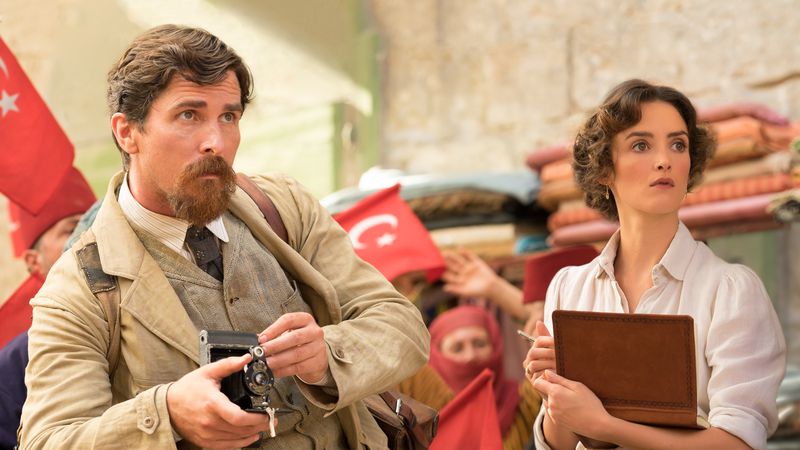
The passionate reaction is because The Promise, a $100-million movie starring Oscar Isaac and Christian Bale, has provoked those who deny that 1.5 million Armenians were massacred between 1915 and 1923 by the Ottoman Empire or that the deaths of Armenians were the result of a policy of genocide. Thousands, many of them in Turkey, have flocked to IMDb to rate the film poorly, sight unseen. Though many countries and most historians call the mass killings genocide, Turkey has aggressively refused that label.
Yet that wasn’t the most audacious sabotage of The Promise, a passion project of the late billionaire investor and former MGM owner Kirk Kerkorian.
In March, just a few weeks before The Promise was to open, a curiously similar-looking film called The Ottoman Lieutenant appeared. Another sweeping romance set during the same era and with a few stars of its own, including Ben Kingsley and Josh Hartnett, The Ottoman Lieutenant seemed designed to be confused with The Promise. But it was made by Turkish producers and instead broadcast Turkey’s version of the events — that the Armenians were merely collateral damage in World War I. It was the Turkish knockoff version of The Promise, minus the genocide.
“It was like a reverse mirror image of us,” said Terry George, director and co-writer of The Promise. George, the Irish filmmaker, has some experience in navigating the sensitivities around genocide having previously written and directed 2004’s Hotel Rwanda, about the early ’90s Rwandan genocide.
George bought a ticket to see it. “Basically the argument is the Turkish government’s argument, that there was an uprising and it was bad and we had to move these people out of the war zone — which, if applied to the Nazis in Poland would be: ‘Oh, there was an uprising in the Warsaw Ghetto and we need to move these Jews out of the war zone,’” says George. “The film is remarkably similar in terms of structure and look, even.”
The movie itself, however, didn’t win over A.V. Club critic Ignatiy Vishnevetsky:
Among the many virtues of James Gray’s The Lost City Of Z is its sense of proportion, which turns a decades-spanning historical epic into a pas de deux between vision and madness. Unfortunately, most recent historical epics have been more on the order of Terry George’s The Promise: messes of soap and cheese. Here at last is a film that tackles the Armenian genocide by way of a flimsy love triangle and an international cast (it really captures the diversity of the Armenian people), straining so hard to show its good intentions that it doesn’t bother to be directed. What does a movie that can’t even mount a competent horse chase — despite repeated attempts — have to say about the murder of 1.5 million people? At least George can rest easy knowing that his film is less bungled than Bitter Harvest, the February release that turned the Holodomor into the stuff of schmaltz. Up next, presumably, is Nicholas Sparks’ Auschwitz.
Doing his best impression of Omar Sharif, Oscar Isaac stars as Mikael Boghosian, a village apothecary who agrees to marry doe-eyed local girl Maral (Angela Sarafyan) in order to use her dowry to finance his dream of becoming a doctor. (Pity poor Maral, as no two members of the cast seem to agree on how to pronounce her name.) Arriving in Constantinople, the capital of the Ottoman Empire, Mikael moves in with his wealthy uncle and enrolls in medical school, but soon develops a crush on Ana (Charlotte Le Bon), the modern young woman who tutors his uncle’s children. But it’s 1914, and the Ottoman Empire is about to enter World War I as an ally of Germany and Austria-Hungary and within months will begin a strategic elimination of its large Armenian minority. As if to make matters worse, Ana has an American boyfriend, Chris Myers (Christian Bale), the Associated Press’ bureau chief of Armenian genocide exposition.
Still from The Promise, by Open Road Films.
Comments Off on Movie on the Armenian Genocide attracts massive number of Turkish trolls
Tank Chats #7 British Mark II
Published on 2 Jul 2015
The seventh in a series of short films about some of the vehicles in our collection presented by The Tank Museum’s historian David Fletcher MBE.
Only fifty tanks each of Marks II and III were produced. They were unarmoured, in the sense that the steel from which they were built was not heat treated to make it bullet proof. The reason being that these tanks were only intended for use as training machines.
The chief external differences from Mark I lay in the tail wheels, which were not used on Marks II and III and later heavy tanks, the narrower driver’s cab and the ‘trapezoid’ hatch cover on the roof.
Comments Off on Tank Chats #7 British Mark II


