
Forgotten Weapons
Published on 21 Feb 2019Don’t wait like a chump! Get the whole 8-part series right now at:
https://candrsenal.com/product/lighte…
Project Lightening is a collaborative series with Othais and Mae of C&Rsenal in which we test all seven light machine guns and automatic rifles of World War One and put them through a series of tests and evaluations. Each week we will be posting one video on Forgotten Weapons and one on C&Rsenal. Today we have the walking fire here, and the field strip assessment over on C&Rsenal:
http://www.patreon.com/ForgottenWeapons
Cool Forgotten Weapons merch! http://shop.bbtv.com/collections/forg…
Contact:
Forgotten Weapons
PO Box 87647
Tucson, AZ 85754
February 22, 2019
Project Lightening Episode 03: Walking Fire
Comments Off on Project Lightening Episode 03: Walking Fire
February 18, 2019
WTF is Jesse? Introducing the new Great War Host
The Great War
Published on 16 Feb 2019ASK US ANYTHING: https://www.reddit.com/r/TheGreatWarC…
Pilot episode of the Patreon Podcast: https://www.patreon.com/posts/great-w…
Beat from Jesse’s application video: https://www.youtube.com/watch?v=OYyKn…
» SUPPORT THE CHANNEL
Patreon: https://www.patreon.com/thegreatwar
Merchandise: https://shop.spreadshirt.de/thegreatwar/» SOCIAL MEDIA
Twitter: https://twitter.com/WW1_Series
Reddit: https://reddit.com/r/TheGreatWarChannel»CREDITS
Presented by: Jesse Alexander
Written by: Jesse Alexander
Director: Toni Steller & Florian Wittig
Director of Photography: Toni Steller
Sound: Toni Steller
Editing: Toni Steller
Mixing, Mastering & Sound Design: http://above-zero.com
Motion Design: Christian Graef – GRAEFX
Maps: Daniel Kogosov (http://patreon.com/Zalesky)
Research by: Jesse Alexander
Fact checking: Florian WittigChannel Design: Alexander Clark
Original Logo: David van StepholdA Mediakraft Networks Original Channel
Contains licenced material by getty images
All rights reserved – Real Time History GmbH i.Gr. 2019
Comments Off on WTF is Jesse? Introducing the new Great War Host
February 17, 2019
Project Lightening Episode 02: 100 Yard Test
C&Rsenal
Published on 14 Feb 2019Project Lightening is the first collaborative project between C&Rsenal and Forgotten Weapons. It features SEVEN World War One light machine guns put head to head to see which is the best!
We’re releasing two episode a week but you can get them all at once over at C&Rsenal AND support both shows at the same time!
Comments Off on Project Lightening Episode 02: 100 Yard Test
February 16, 2019
Project Lightening Episode 01: Introduction
Forgotten Weapons
Published on 14 Feb 2019Don’t wait like a chump! Get the whole 8-part series right now at:
https://candrsenal.com/product/lighte…
I am excited to introduce Project Lightening! This is a collaborative series with Othais and Mae of C&Rsenal in which we test all seven light machine guns and automatic rifles of World War One and put them through a series of tests and evaluations. Each week we will be posting one video on Forgotten Weapons and one on C&Rsenal. Today we have the introduction here, and the 100 yard accuracy testing over on C&Rsenal (https://youtu.be/-hSZbo8Hvn4).
http://www.patreon.com/ForgottenWeapons
Contact:
Forgotten Weapons
PO Box 87647
Tucson, AZ 85754
Comments Off on Project Lightening Episode 01: Introduction
January 29, 2019
history of japan
bill wurtz
Published on 2 Feb 2016patreon: http://patreon.com/billwurtz
spotify: https://play.spotify.com/artist/78cT0…
itunes: http://itunes.apple.com/us/artist/bil…
twitter: http://twitter.com/billwurtz
vine: http://vine.co/billwurtz
donate: http://paypal.com/cgi-bin/webscr?cmd=…
Comments Off on history of japan
December 27, 2018
The 1914 Christmas Truce
Mark Felton Productions
Published on 25 Dec 2018As we celebrate Christmas today, perhaps its worth recalling the Christmas Truce of 1914, when, for a few days 104 years ago, the terrible slaughter of World War I stopped and the ordinary officers and men of both sides met in No Man’s Land to sing carols, exchange gifts and play soccer.
Support Mark’s work on Patreon or PayPal – see below:
Comments Off on The 1914 Christmas Truce
December 18, 2018
Conflicts & Wars In The Aftermath of WW1 I THE GREAT WAR Epilogue
The Great War
Published on 17 Dec 2018In our last epilogue special we outline the wars and conflicts that followed World War 1, some of them immediately and some of them with only a brief period of peace. Even in 1919 it was already clear that “the war to end all wars” didn’t in fact do that and that the new world order would be shaped by violence.
—
hey guys and girls, with this last video, our epilogue series is over and this was the very last episode featuring Indy. Again, this was more meant as an appetizer for the future of the show now. When we filmed this, we didn’t know, yet that we could continue working on the show. We will make an announcement about what to expect next year this week. Cheers Flo
—
– CREDITS –
Presented by: Indiana Neidell
Written by: Indiana Neidell
Director: Toni Steller & Florian Wittig
Director of Photography: Toni Steller
Sound: Toni Steller
Mixing, Mastering & Sound Design: www.above-zero.com
Editing: Toni Steller, Julian Zahn
Motion Design: Christian Graef
Research by: Indiana Neidell
Fact checking: Markus LinkeThe Great War Theme composed by Karim Theilgaard: http://bit.ly/karimyt
A Mediakraft Networks Original Channel
Based on a concept by Spartacus Olsson
Author: Indiana Neidell
Visual Concept: David van Stephold
Producer: Toni Steller & Florian Wittig
Social Media Manager: Florian WittigContains licenced Material by British Pathé
All rights reserved – © Mediakraft Networks GmbH, 2018
Comments Off on Conflicts & Wars In The Aftermath of WW1 I THE GREAT WAR Epilogue
December 17, 2018
QotD: Woodrow Wilson’s repressive regime
Not surprisingly, such intellectual kindling was easy to ignite when World War I broke out. The philosopher John Dewey, New Republic founder Herbert Croly, and countless other progressive intellectuals welcomed what Mr. Dewey dubbed “the social possibilities of war.” The war provided an opportunity to force Americans to, as journalist Frederick Lewis Allen put it, “lay by our good-natured individualism and march in step.” Or as another progressive put it, “Laissez faire is dead. Long live social control.”
With the intellectuals on their side, Wilson recruited journalist George Creel to become a propaganda minister as head of the newly formed Committee on Public Information (CPI).
Mr. Creel declared that it was his mission to inflame the American public into “one white-hot mass” under the banner of “100 percent Americanism.” Fear was a vital tool, he argued, “an important element to be bred in the civilian population.”
The CPI printed millions of posters, buttons, pamphlets, that did just that. A typical poster for Liberty Bonds cautioned, “I am Public Opinion. All men fear me!… [I]f you have the money to buy and do not buy, I will make this No Man’s Land for you!” One of Creel’s greatest ideas – an instance of “viral marketing” before its time – was the creation of an army of about 75,000 “Four Minute Men.” Each was equipped and trained by the CPI to deliver a four-minute speech at town meetings, in restaurants, in theaters – anyplace they could get an audience – to spread the word that the “very future of democracy” was at stake. In 1917-18 alone, some 7,555,190 speeches were delivered in 5,200 communities. These speeches celebrated Wilson as a larger-than-life leader and the Germans as less-than-human Huns.
Meanwhile, the CPI released a string of propaganda films with such titles as The Kaiser, The Beast of Berlin, and The Prussian Cur. Remember when French fries became “freedom fries” in the run-up to the Iraq war? Thanks in part to the CPI, sauerkraut become “victory cabbage.”
Under the Espionage Act of 1917 and the Sedition Act of 1918, Wilson’s administration shut down newspapers and magazines at an astounding pace. Indeed, any criticism of the government, even in your own home, could earn you a prison sentence. One man was brought to trial for explaining in his own home why he didn’t want to buy Liberty Bonds.
The Wilson administration sanctioned what could be called an American fascisti, the American Protective League. The APL – a quarter million strong at its height, with offices in 600 cities – carried government-issued badges while beating up dissidents and protesters and conducting warrantless searches and interrogations. Even after the war, Wilson refused to release the last of America’s political prisoners, leaving it to subsequent Republican administrations to free the anti-war Socialist Eugene V. Debs and others.
Jonah Goldberg, “You want a more ‘progressive’ America? Careful what you wish for: Voters should remember what happened under Woodrow Wilson”, Christian Science Monitor, 2008-02-05.
Comments Off on QotD: Woodrow Wilson’s repressive regime
December 14, 2018
Dreadnought: The Battleship that Changed Everything
Historigraph
Published on 24 Nov 2018So it’s probably worth noting here that when Dreadnought made all other battleships irrelevant, it didn’t do so equally. For example, Japan had constructed two ‘semi-dreadnoughts’ a couple of years earlier, with more 10-inch guns than was standard at the time. The Americans too were moving towards building an ‘all-big-gun’ battleship, but they were much slower at getting them built than the British.
If you enjoyed this video and want to see more made, consider supporting my efforts on Patreon: https://www.patreon.com/historigraph
Sources:
Robert K. Massie, Dreadnought: Britain, Germany and the Coming of the Great War
Ben Wilson, Empire of the Deep: The Rise and Fall of the British Navy
Comments Off on Dreadnought: The Battleship that Changed Everything
December 12, 2018
WW1 World Leaders & Generals After The War I THE GREAT WAR Epilogue
The Great War
Published on 10 Dec 2018The First World War was a historic event that challenged established power structures, political and military leaders. It also catapulted new ideas, new leaders and new officers onto the world stage. In this video we briefly explore what happened to them after the Great War.
Comments Off on WW1 World Leaders & Generals After The War I THE GREAT WAR Epilogue
December 5, 2018
The Spanish Flu I THE GREAT WAR Epilogue 2
The Great War
Published on 3 Dec 2018The Spanish flu has quickly spread all over the world since the spring of 1918 and will become the disease that killed more people in a shorter period of time than any other disease in human history.
Comments Off on The Spanish Flu I THE GREAT WAR Epilogue 2
December 4, 2018
Sex, Drugs, and the Right to Vote I BETWEEN 2 WARS I 1920 Part 4 of 4
TimeGhost History
Published on 2 Dec 2018When many of the fighting men of The Great War return home addicted to drugs and infected with venereal disease, their sweethearts have decided that it’s time for some serious changes! It’s time for women’s liberation!
Join us on Patreon: https://www.patreon.com/TimeGhostHistory
Hosted by: Indy Neidell
Written and directed by: Spartacus Olsson
Produced by: Astrid Deinhard
Executive Producers: Bodo Rittenauer, Astrid Deinhard, Indy Neidell, Spartacus Olsson
Edited by Wieke Kapteijns and Spartacus OlssonColorized picture of Greta Garbo in the thumbnail courtesy of Olga Shirnina aka Klimbim
Images of Canadian WWI troops courtesy of the Canadian War Museum.
Video Archive by Screenocean/Reuters http://www.screenocean.com
A TimeGhost chronological documentary produced by OnLion Entertainment GmbH
Comments Off on Sex, Drugs, and the Right to Vote I BETWEEN 2 WARS I 1920 Part 4 of 4
December 2, 2018
Canada’s initial WW1 infantry weapon, the Ross rifle
During the Boer War, the British were busy producing Lee-Enfield rifles for the British army and didn’t have enough extra manufacturing capacity to fulfill a modest Canadian order. The government of the day took this opportunity to try to find a distinctly Canadian weapon to equip the (tiny) Canadian militia. They ended up purchasing the Ross rifle, which is what the men of the Canadian Corps took into the field during the First World War. It didn’t go well, as the highly accurate Ross was not well-suited to the rough-and-tumble life of an infantry weapon in the trenches of Flanders. The mechanism was prone to jamming in muddy conditions and did not work well with low-quality ammunition. It became a national scandal, and eventually most of the Ross rifles were replaced with British Lee-Enfields, except for the sniper weapons (where the Ross was much better suited to the needs of the job). The National Interest has the story:
Ross rifle model 1910B
Photo by Vaarok via Wikimedia Commons.
Tested head to head with the Lee-Enfield Mark I, the Ross did well in some of the trials but came up short in other crucial ones, such as the endurance test. Some 1,000 rounds were fired through each rifle and, while the Lee-Enfield functioned well, the Ross repeatedly jammed. After the 300th round, the heat of firing melted away the foresight, which was fastened with common solder. Ross explained that prior tests had been conducted with ammunition of American and Austrian manufacture and that “the standard called for in the manufacture of British .303 cartridges is not of the same precision and quality of material hence greater limits have to be allowed.” His dubious explanation was accepted by the committee.
Already the enterprise was off on the wrong foot. Due to Borden’s choices, the investigative committee leaned in favor of the Ross. It was obvious that no accurate appraisal of anything can result from a biased investigative body. Hughes in particular championed the rifle, and his stubborn resistance to evidence that contradicted his opinions bordered on the irrational. To the end he would insist that the Ross was superior to the Lee-Enfield, even after thousands of Canadian soldiers had simply thrown theirs away on the battlefield.
If the weapon had flaws, so did the purchase contract. Under its terms, Ross was to provide 12,000 rifles during 1903 and 10,000 every year thereafter, with a 75 percent advance on all rifles ordered for the duration of the contract, which was not stipulated. The cost of the Ross was not to exceed that of a Lee-Enfield in Britain, yet the price set was $25, compared to $18.27 the War Office paid for a Lee-Enfield. The contract also stated that materials and machinery Ross needed to import to meet the manufacturing requirements were to be exempt from import taxes. Because there was no division outlined between military and sporting rifles, Ross could get all his imports duty-free, regardless of whether they were built for government contract or not. There was no guarantee Ross would provide more rifles in the event of a national emergency, only that he would provide 10,000 annually after the initial 12,000. There was also no mention in the contract of providing a bayonet.
[…]
The final verdict on the Ross was rendered in the vile ooze of mud, filth, and rotting corpses that characterized trench warfare during the Great War. From the first day of fighting, the frequent jamming of the Ross forced soldiers to strike the bolts with entrenching tools or boot heels to clear them. The problem was attributed to the British ammunition being used, which was slightly larger than Canadian- manufactured rounds, but a significant factor was faulty manufacturing that resulted in deformed firing chambers. Long and unwieldy, the Ross was also not well suited for use in narrow trenches. Soon, British Small Magazine Lee-Enfield rifles began appearing in the Canadian ranks, causing First Division commander Lt. Gen. E.A.H. Alderson to issue an order that his men were not permitted to be in possession of SMLE rifles. It was an order largely ignored.
If earlier investigations had repeatedly given the rifle a pass and rendered a skewed verdict, the Canadian soldiers in the trenches did not. In April 1915, after the bloody fight at the Second Battle of Ypres, Belgium, which also saw the first gas attacks of the war, 1,452 of the 5,000 surviving Canadian soldiers threw away their Ross rifles and picked up Lee-Enfields from British casualties. The verdict of the fighting soldier had been delivered. With confidence in the rifle badly damaged, British Commander in Chief Sir John French issued orders rearming the First Canadian Division with the SMLE.
Not all the reports from the line were negative; the superb accuracy and faster loading capability of the Ross made it an excellent sniper’s rifle, as Sergeant William Carey, one of Canada’s top snipers, discovered one morning at St. Eloi. He and a German sniper spotted each other at the same time and both fired, each missing the other. But the bolt action of the Ross gave Carey the edge; he was able to reload and fire faster than the German, and his next shot was lethal. Although it would be replaced as the standard issue service rifle, the Ross would remain a valuable sniper’s weapon.
Comments Off on Canada’s initial WW1 infantry weapon, the Ross rifle
November 29, 2018
The Royal Navy’s “Nelsol” and “Rodnol” – a battleship design driven by lessons from Jutland
One of my favourite quirky ship designs is profiled at Naval Gazing: HMS Nelson and HMS Rodney. These two ships, known derisively by the names “Nelsol” and “Rodnol” (because of their odd profile resemblance to a class of RN oilers, whose names all ended in “-ol”), were the first post-WW1 British battleships designed to incorporate the bitter lessons learned at the battle of Jutland in 1916. Their construction was also influenced by the round of naval treaty talks that aimed to stop a renewed naval arms race and limit the major navies in both number and size of ships.
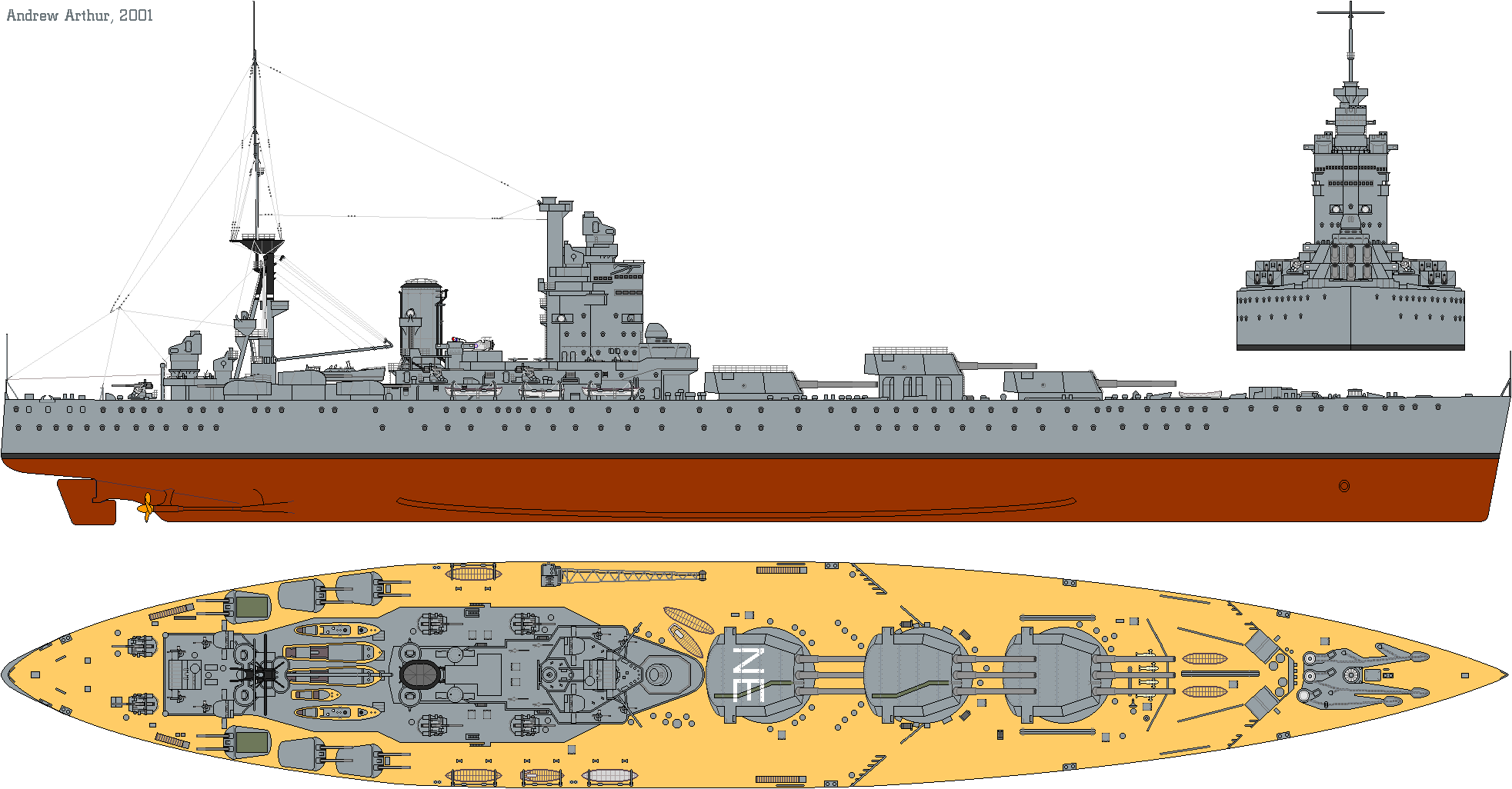
HMS Nelson profile drawing as she appeared circa 1931.
Image by Emoscopes via Wikimedia Commons.
At the end of WWI, the Royal Navy faced a crisis. During the war, it had suspended new capital ship construction except for a handful of battlecruisers, while the American and Japanese building programs had continued to churn out ships that were more modern than the bulk of the British fleet. Worse, the British battlefleet had seen hard war service, and many of the early dreadnoughts were in bad shape and essentially unfit for further service. New battleships would be needed, ships that fully reflected the lessons of the war.
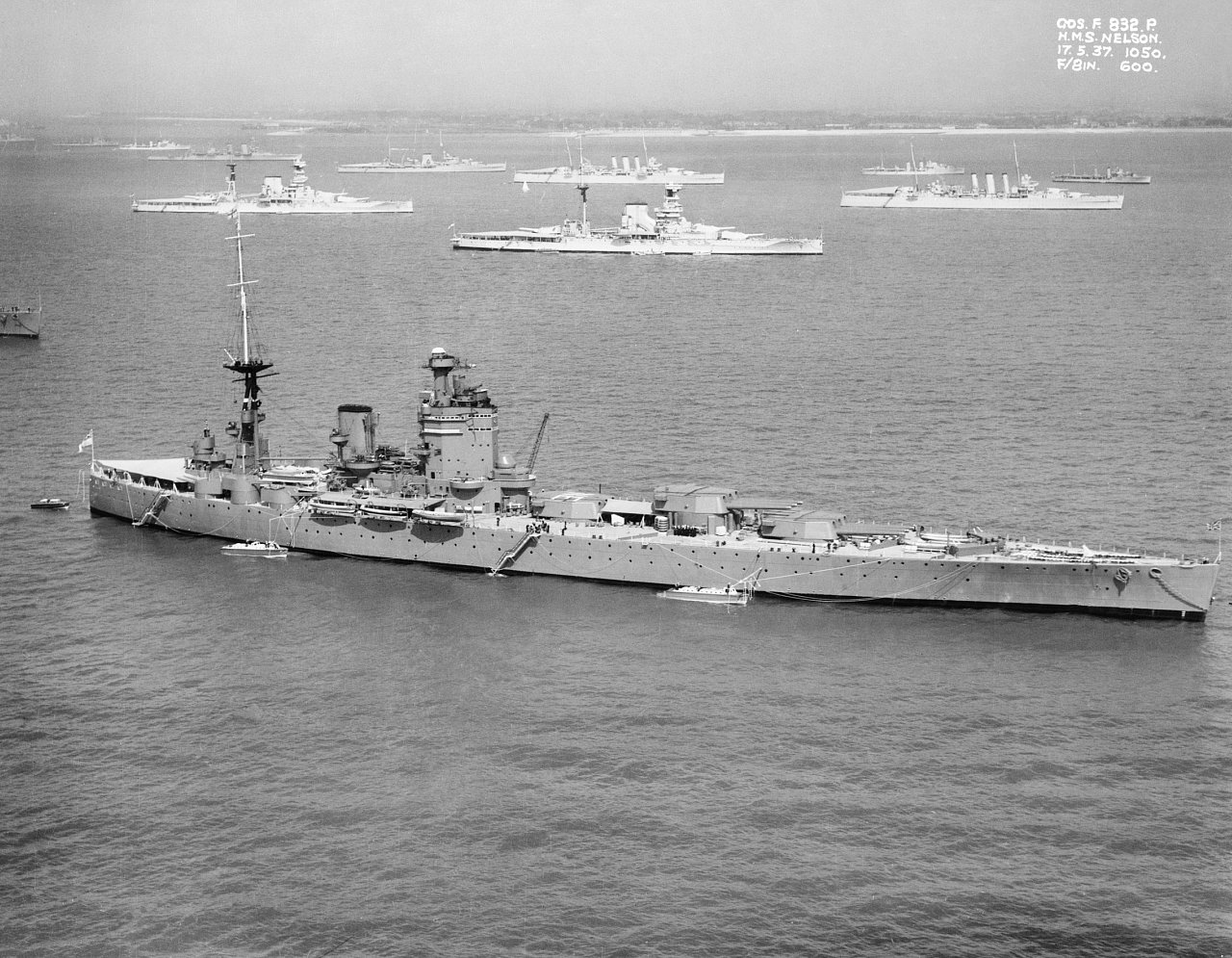
HMS Nelson off Spithead for the 1937 Fleet Review. Anchored in the background are two Queen Elizabeth-class battleships and two cruisers of the London class.
Photo via Wikimedia Commons.The most important of these was the need for an all-or-nothing armor scheme, as developed in the US. The war had seen major improvements in armor-piercing shells, and they required significantly more armor than previous vessels. However, the increased range gave designers a way out. Previously, the size of citadels had been set by the need to preserve stability and buoyancy if the ends were riddled. At long range, the many hits necessary to riddle the ends would not happen, and the citadel could be shrunk to thicken the armor. The British also looked to improve on the 15″ gun due to the proliferation of 16″ weapons in the American and Japanese navies. They investigated the triple turret, abandoned a decade earlier amid fears of increased mechanical complexity, and the 18″ gun under the cover name of 15″/B.
Two parallel design series were started, one for battleships, the other for battlecruisers. As this series was developed, the designers saw a serious problem with the battlecruisers. The boiler uptakes would leave large holes in the armored deck, and if the ship was headed towards the enemy, shells might be able to pass through the holes and into the aft magazines. The solution was to move all three turrets forward of the engines, on the basis of war experience showing that ships rarely if ever engaged targets directly aft.
Comments Off on The Royal Navy’s “Nelsol” and “Rodnol” – a battleship design driven by lessons from Jutland
November 28, 2018
The Difficult Road To Peace 1919 I THE GREAT WAR Epilogue 2
The Great War
Published on 26 Nov 2018After 4 1/2 years of war and millions of dead and wounded any kind of peace would be difficult. The peace process in 1919 was even more difficult because it happened in turbulent times with a rapidly changing landscape and new ideas about a future world order that should prevent this level of bloodshed in the future.
Comments Off on The Difficult Road To Peace 1919 I THE GREAT WAR Epilogue 2


