Editor’s Note: This series was originally published by Alex Funk on the TimeGhostArmy forums (original URL – https://community.timeghost.tv/t/canada-and-the-battle-of-the-atlantic-part-1-edited/1433).
Sources:
- The Far Distant Ships, Joseph Schull, ISBN 10 0773721606 (An official operational account published in 1950, somewhat sensationalist) [Schull’s book was published in part because the funding for the official history team had been cut and they did not feel that the RCN’s contribution to the Battle of the Atlantic should have no official recognition. It is very much an artifact of its era, and needs to be read that way. A more balanced (and weighty) history didn’t appear until the publication of No Higher Purpose and A Blue Water Navy in 2002, parts 1 and 2 of the Official Operational History of the RCN in WW2, covering 1939-1943 and 1943-1945 respectively.]
- North Atlantic Run: the Royal Canadian Navy and the battle for the convoys, Marc Milner, ISBN 10 0802025447 (Written in an attempt to give a more strategic view of Canada’s contribution than Schull’s work, published 1985)
- Reader’s Digest: The Canadians At War: Volumes 1 & 2 ISBN 10 0888501617 (A compilation of articles ranging from personal stories to overviews of Canadian involvement in a particular campaign. Contains excerpts from a number of more obscure Canadian books written after the war, published 1969)
- All photos used exist in the Public Domain and are from the National Archives of Canada, unless otherwise noted in the caption.
I have inserted occasional comments in [square brackets] and links to other sources that do not appear in the original posts. A few minor edits have also been made for clarity.
Canada and the Battle of the Atlantic, part 1
Canada’s navy before WW2
This is my modest attempt to illustrate Canada’s contribution to the Battle of the Atlantic and the war at sea in general. In my honest opinion it was the most important thing we did as a nation aside from the BCATP (British Commonwealth Air Training Plan).
The Naval Service of Canada/Royal Canadian Navy before World War 2
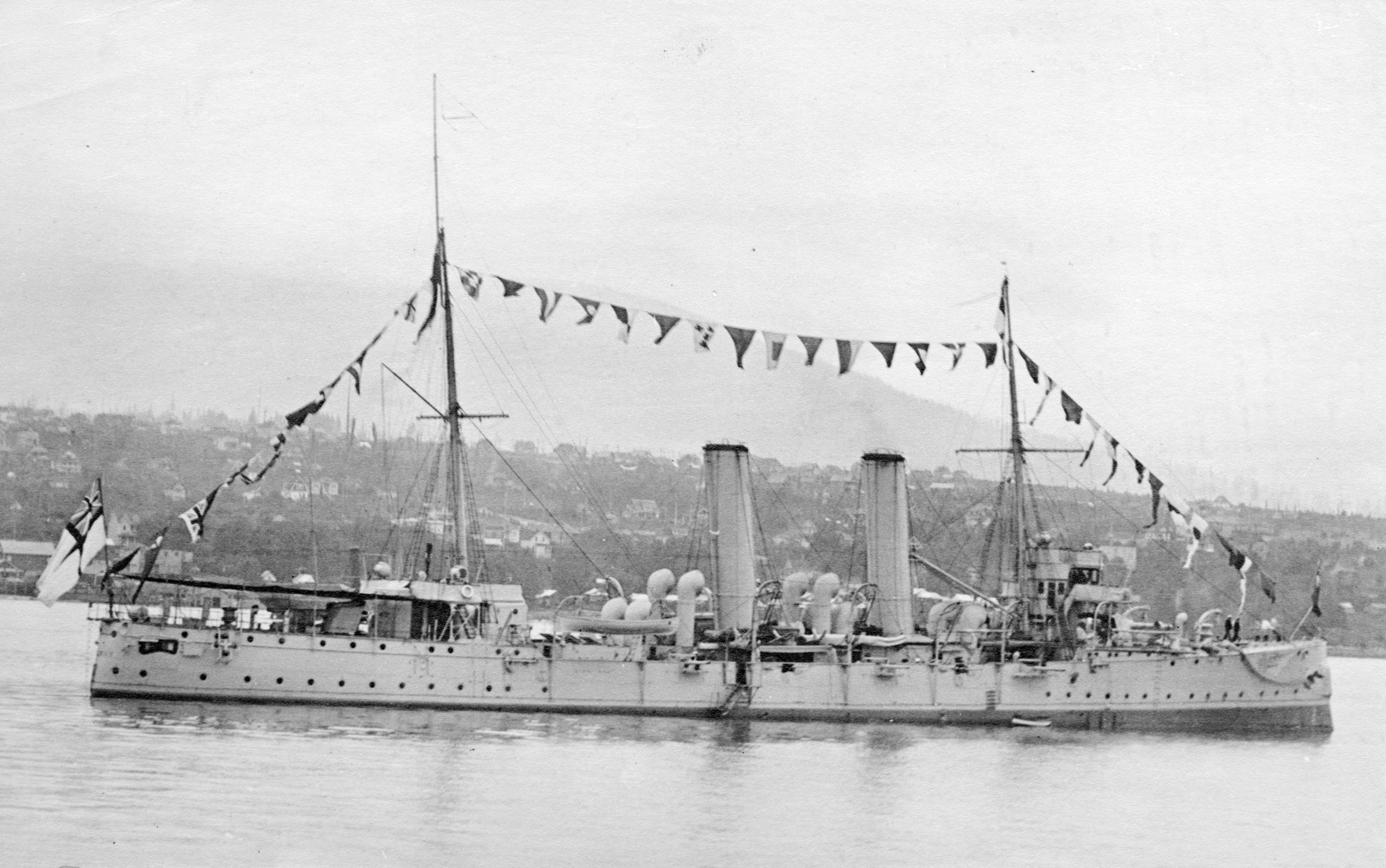
The Royal Canadian Navy (RCN) was founded in 1910 under the Naval Service Bill re-introduced by Prime Minister Wilfrid Laurier (its first attempt at approval under George Foster in 1909 had failed), creating the Naval Service of Canada [Wikipedia – https://en.wikipedia.org/wiki/Origins_of_the_Royal_Canadian_Navy]. A distinct naval force for the Dominion of Canada to be maintained and manned by Canadians, which could be placed under British control if needs be. Two ex-Royal Navy vessels were obtained for the purposes of training [cruisers HMCS Niobe and HMCS Rainbow].
[There actually was an even earlier attempt to create a Canadian navy, as related by Joseph Schull:]
There had been one hint, in 1880, of an awareness of naval needs. A dispatch from the Governor General to the Colonial Secretary had suggested that Canada “would not be averse to instituting a ship for training purposes if the Imperial Government would provide the ship.” To the restrained enthusiasm of this proposal the Admiralty had responded with appropriate generosity. Charybdis, an ancient steam corvette, was at the time limping homeward from the China Station. The Canadian Government could have her.
When Charybdis arrived in the United Kingdom it was discovered that her boilers were worn out. Canada paid for their replacement. The ship was then coaxed and coddled across the Atlantic by a redoubtable Captain Scott, R.N., retired. Upon arrival in Saint John, Charybdis broke loose from her moorings in a gale and damaged much of the shipping in harbour. She had hardly been secured, and the clamour of aggrieved shipowners had not died down, when two Saint John citizens, attempting to come on board, fell through the rotting wood of her gangplank and were drowned. It was sufficient naval experience for the Canadian Government of that time. The wreck was towed from Saint John and turned over to the unwelcoming authorities of the Royal Navy. Charybdis became a gruesome memory, a political Flying Dutchman which heaved over the horizon when any naval proposal was advanced during the next thirty years.
The election of a new government (which had opposed the original bill) in 1911 left the new service in limbo. [Also in 1911, the Naval Service was given permission by King George V to rename itself the Royal Canadian Navy.] Nevertheless, between the two ex-Royal Navy vessels, two submarines purchased from the US [by the provincial government of British Columbia(!)], and two government patrol vessels pressed into military service the RCN spent the early years of World War 1 patrolling the east and west coasts of North America and sometimes as far south as Panama to deter the German naval threat. As that real or perceived threat slowly evaporated, the Canadian Navy’s patrols became less frequent.
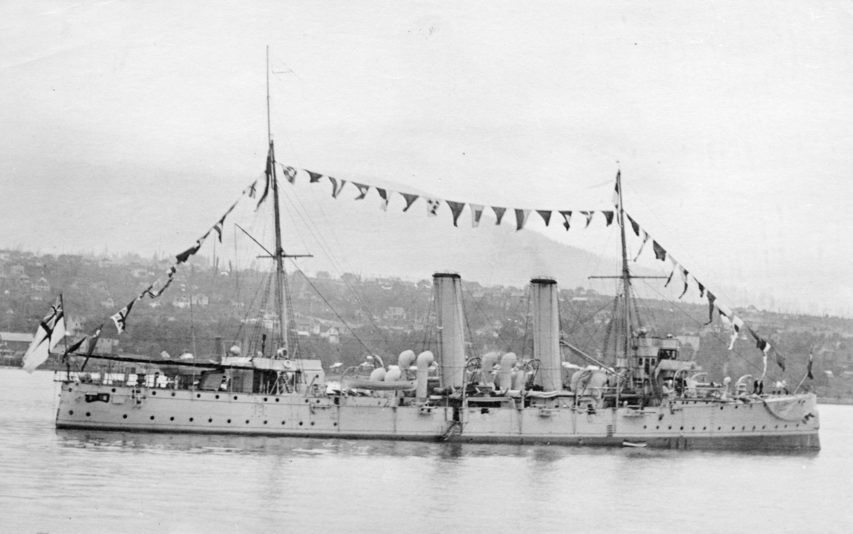
HMCS Rainbow at North Vancouver, 1910.
Photo from the City of Vancouver Library, the collection of Matthews, James Skitt, Major (1878-1970) via Wikimedia Commons.
The First World War saw the modest beginnings of the Canadian Navy, although it should be pointed out that many more Canadians chose to serve in the Royal Navy than the Canadian one, some as officers.
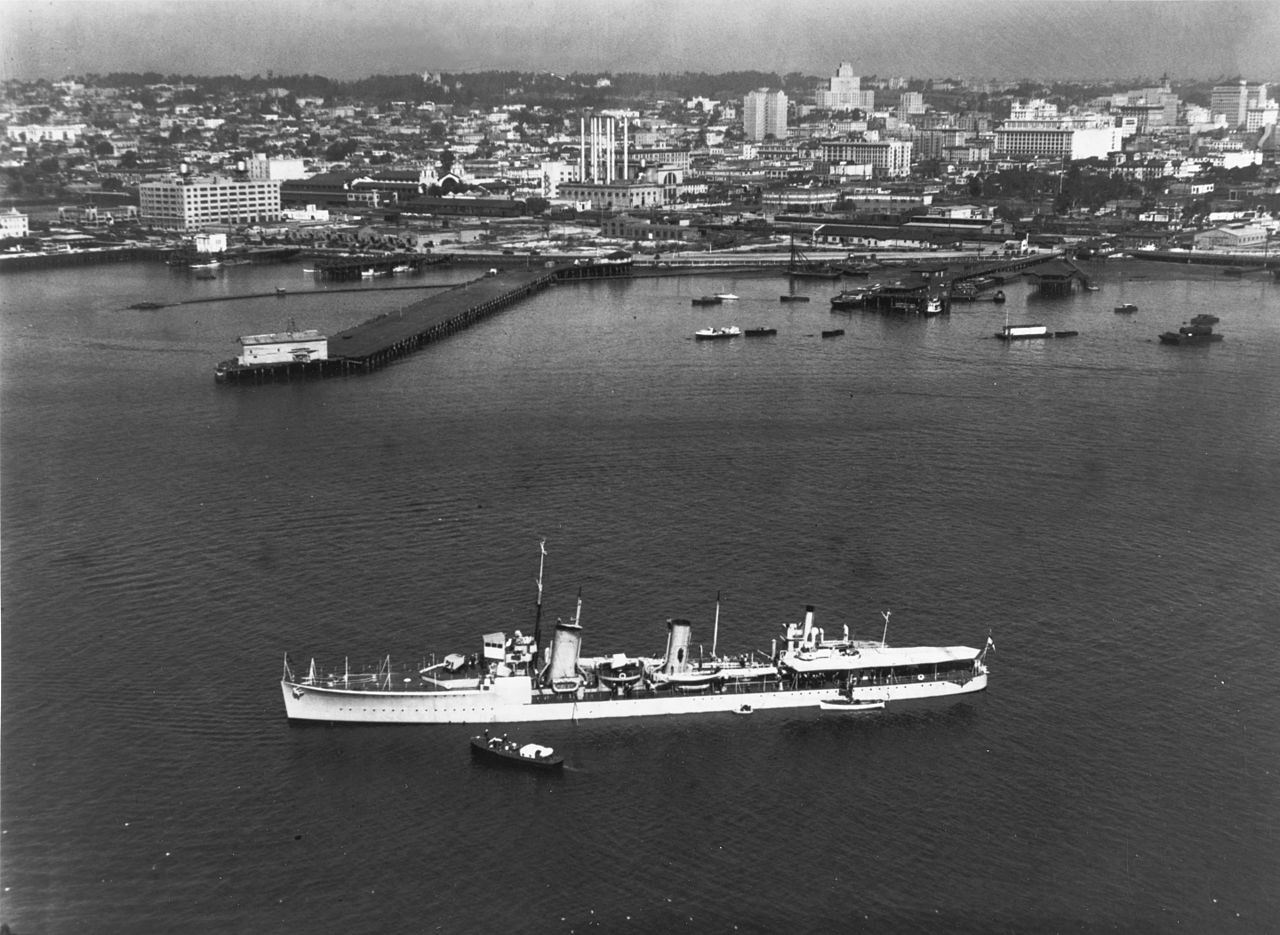
The inter-war years saw very little growth for the RCN. The post-war drawdown naturally occurred, and by 1922 the service had only 366 men and had paid off their only remaining cruiser. The Naval Volunteer Reserve was firmly established in Canadian cities across the country (and numbered around 1,000 men) but the Navy itself only kept two destroyers donated by the Royal Navy in service [HMCS Patriot and HMCS Patrician], until these were replaced by two more destroyers in the late 1920s (once again, ex-RN [ships renamed as HMCS Champlain and HMCS Vancouver]). 1931 saw a major facelift with the first ships built specifically for the RCN: HMCS Skeena and HMCS Saguenay.
The early 1930s saw the Navy along with the other Canadian service branches almost completely starved of funding, although by the late 30s, escalating world tension convinced the Canadian government to slowly begin rebuilding. Two more destroyers were purchased from the Royal Navy in 1937 (HMCS Fraser and HMCS St Laurent) and then two more in 1938 (HMCS Ottawa and HMCS Restigouche).
Marc Milner outlines the RCN’s original expansion plans in North Atlantic Run:
In January 1939 the government, reacting to the Munich crisis, announced its intentions to proceed with building a fleet capable defending Canada’s two coasts. The expansion plan, when completed, would give the RCN a strength of eighteen modern destroyers, sixteen minesweepers, and eight anti-submarine vessels, the numbers split evenly between Pacific and Atlantic commands, and a flotilla of eight motor torpedo boats for the east coast. Not surprisingly, little came of this plan before war broke out. In fact, by May the government had sharply cut the navy’s estimates. The 1939 building program (four anti-submarine vessels and two motor torpedo boats) was scrapped, and there was just enough money left to acquire the necessary plans. It is, however, significant that the RCN’s expansion plans were laid down in the last days of peace. Later developments would thrust a new form of expansion on the RCN, one more easily attainable in wartime than a fleet of destroyers, yet one which did not conform to the long-term goals of the professional navy.
Thus, by the outbreak of the Second World War in September 1939, the RCN consisted of six River-class destroyers, five minesweepers, and two small training vessels.
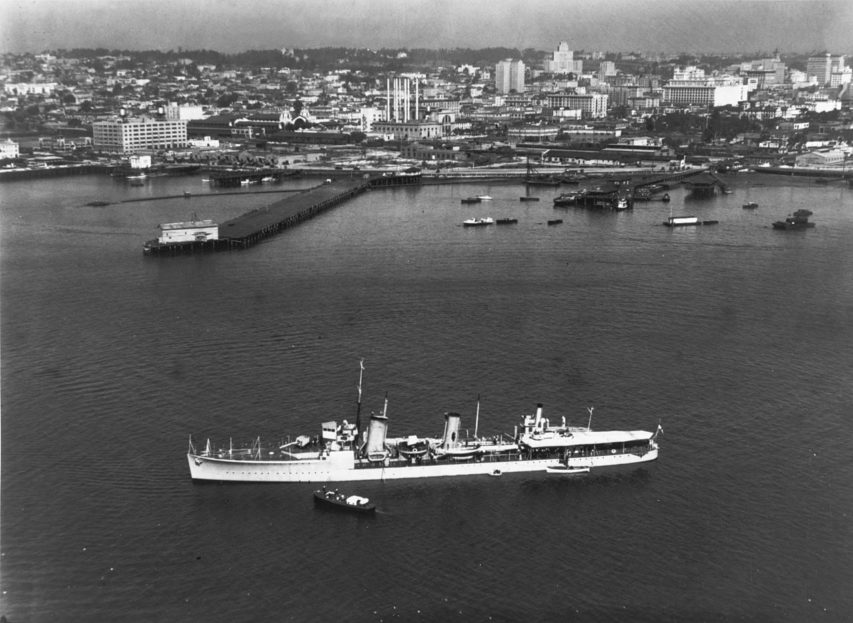
HMCS Vancouver (F6A) anchored off San Diego, California (USA), on 5 March 1929.
Official U.S. Navy photo 80-G-416377 from the U.S. Navy Naval History and Heritage Command, via Wikimedia Commons.
The January 1939 expansion plan belied the fact that the RCN was a traditional, gun-oriented navy. The experiences of the First World War and technological developments since had confirmed the sanctity of the gun as the pre-eminent naval weapon. Admittedly, the threat from Germany’s U-boats in 1917 had been grave. But her indiscriminate use of the submarine had brought the United States into the conflict on the Allied side and (or so it seemed) therefore cost Germany the war. It was felt that in future no nation would risk the sanction of a world coalition by resorting to “piracy” on the high seas. But even if Germany, or any other nation, turned once again to unrestricted submarine warfare on merchant shipping, the means of defeating the threat was already in service with Commonwealth navies — convoy and ASDIC.
During the First World War, before the adoption of the convoy system, German U-Boats preferred to use their deck guns to destroy lone merchant vessels, using their precious torpedoes sparingly. With the introduction of the convoy system, the days of easy targets vanished and the proximity of naval escort forced the U-Boat to either risk fighting an unequal surface battle against more heavily gunned escorts or to operate submerged. Convoys made the oceanic routes much safer, but this success was not unmixed. Cargo ships continued to sail independently and unescorted to and from convoy assembly ports in British coastal waters, and the U-boats resorted to submerged attack tactics inshore. Although Britain was never again threatened with defeat by starvation, losses to merchant shipping remained high for the rest of the war because of the virtual immunity of a submerged submarine to any threat of effective counter-attack by escort ships.
With the U-Boats relegated to nuisance status through the use of convoys, their final telling defeat simply awaited the perfection of a reliable underwater-detection device. The Allied Submarine Detection Investigation Committee was established in 1918 to resolve this problem, but it was not until the early twenties that an effective underwater sound locating and ranging set (now called sonar) was in use. ASDIC, as the British called the device, was to spell the doom of the submarine. As late as 1936 the First Sea Lord [the professional head of the Royal Navy], Admiral A.E.M. Chatfield, claimed that the RN’s anti-submarine measures were 80% effective. With location no longer a problem, it was believed that destruction of a submarine by a few well-placed depth charges would follow with equal certainty.
…
If anything, Canadian planners, like those elsewhere, were absorbed by the unknown dangers of air attack on trade (particularly on convoys) and by the very real threat of powerful enemy surface raiders. Both of these also presented Canada with the only real threat of direct enemy action. The RCN was therefore charged with defence against surface and air attacks on Canada and on trade in adjacent waters — the two were really inseparable. The “forms and scales of attack to which Canada would be subject,” as anticipated in 1939, reflected the preoccupation with surface and air threats. Bombardment by a single battleship and/or one or two large cruisers, by armed merchant cruisers (AMCs), or even by heavily gunned submarines was felt likely. Attacks could also be expected in the form of MTBs launched from larger ships, mines, small assault parties, or aircraft carrying torpedoes, bombs, or gas. Indeed, it was thought that aircraft launched from remote points along the Canadian coast might penetrate as far inland as Toronto. Certainly, the major coastal centres were in danger of quick and unexpected raids.
The expansion plan of January 1939 was naturally intended to counter these threats. To make good its intentions, the navy hoped to acquire the most powerful destroyers then in service, the Tribal-class. The Tribal’s high speed and heavy armament (eight 4.7-inch guns and four torpedo tubes) made it a veritable “pocket” cruiser, and several acting in concert posed a credible threat to a lone battleship. Not surprisingly, the RCN would pursue its intention to acquire Tribals throughout the entirety of the war, eventually absorbing dockyard space, resources, and trained manpower which could have been better used to maintain the escort fleet.
[Editor’s Note: On the other hand, had they not pursued a Tribal-class building program, the RCN might well have suffered a similar or even worse drawdown after the war as it did in 1919-22.]
On the eve of the Second World War the submarine was therefore considered by the RN to be a manageable problem. The same held true in the RCN. In a pre-war analysis of the threats to trade and possible countermeasures, Commodore Nelles summarized Canadian reaction to the submarine:
If international law is complied with, Submarine attack should not prove serious. If unrestricted warfare is again resorted to, the means of combating Submarines are considered to have so advanced that by employing a system of of convoy and utilizing Air Forces, losses of Submarines would be very heavy and might compel the enemy to give up this form of attack.
Nelles went on to point out that the RCN would provide anti-submarine equipment and mines “for prosecution of offensive measures against submarine attack.” His choice of words illustrates clearly the thinking of naval contemporaries on how best to deal with submarines — offensive action. The countermeasures outlined by the CNS indicated that some lessons had been drawn from the previous war, and in the long term the combination of convoy, air power, and aggressive anti-submarine warfare proved more than a match for the U-boats. Unfortunately, Britain and her allies lacked the necessary means for a very long time, and the resilience of modern submarines proved a surprise to virtually everyone.
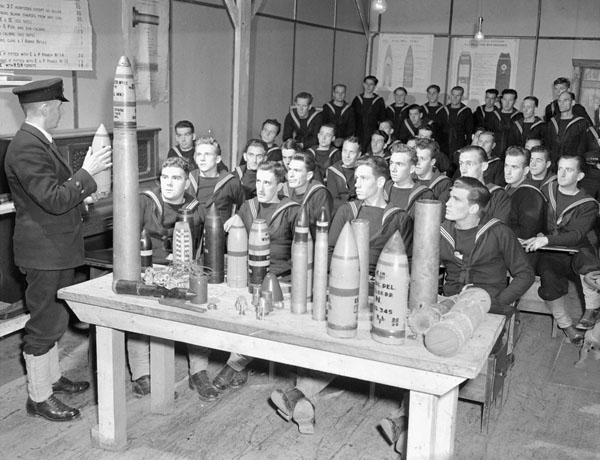
Chief Petty Officer Lowther delivering a lecture about various types of ammunition, Royal Canadian Navy Gunnery School, Halifax, Nova Scotia, Canada, 1940.
Credit: Canada. Dept. of National Defence / Library and Archives Canada / PA-104417