Quotulatiousness

March 13, 2020

“The Price of a Mile” – The Battle of Passchendaele – Sabaton History 058 [Official]

Filed under: Britain, Germany, History, Media, Military, WW1 — Tags: , , , , — Nicholas @ 04:00

Sabaton History
Published 12 Mar 2020

So tell me what’s the price of a mile? The Battle of Passchendaele in 1917 is often remembered as a dismal and dreadful campaign. Fighting over endless mud, waterlogged shell-holes and unrecognizable, bombed out ground, the battle became a slog where everybody was just miserable. Hundreds of thousands of men became casualties for the advance of a handful of miles.

The Art of War online: https://sites.ualberta.ca/~enoch/Read… [PDF]

Support Sabaton History on Patreon: https://www.patreon.com/sabatonhistory

Listen to “Price of a Mile” on the album The Art of War:
CD: http://bit.ly/TheArtOfWarStore
Spotify: http://bit.ly/TheArtOfWarSpotify
Apple Music: http://bit.ly/TheArtOfWarAppleMusic
iTunes: http://bit.ly/TheArtOfWariTunes
Amazon: http://bit.ly/TheArtOfWarAmz
Google Play: http://bit.ly/TheArtOfWarGooglePlay

Check out the trailer for Sabaton’s new album The Great War right here: https://www.youtube.com/watch?v=HCZP1…

Listen to Sabaton on Spotify: http://smarturl.it/SabatonSpotify
Official Sabaton Merchandise Shop: http://bit.ly/SabatonOfficialShop

Hosted by: Indy Neidell
Written by: Markus Linke and Indy Neidell
Directed by: Astrid Deinhard and Wieke Kapteijns
Produced by: Pär Sundström, Astrid Deinhard and Spartacus Olsson
Creative Producer: Joram Appel
Executive Producers: Pär Sundström, Joakim Broden, Tomas Sunmo, Indy Neidell, Astrid Deinhard, and Spartacus Olsson
Post-Production Director: Wieke Kapteijns
Edited by: Karolina Kosmowska
Sound Editing by: Marek Kaminski
Maps by: Eastory – https://www.youtube.com/c/eastory

Archive by: Reuters/Screenocean https://www.screenocean.com
Music by Sabaton.

Sources:
– Imperial War Museum: Q 20705;Q 45462;Q 5989;6Q 2890;Q 3117 Q 3008;Q 2712;Q 23779;Q 7806;Q 5937;Q 5726;Q 2902;Q 2713;Q 57299;Q 57247;Q 45390;Q 51569;Q 1426;Q 540;Q 17868;Q 50237;Q 47725;Q 45382;Q 2639;Q 29088;Q 42251;Q 5714;Q 2868;Q 5938;Q_005935;Q 2625;Q 5723;Q 2627;Q 29090;Q 52862;Q 88098;Q 88017;Q 2706;Q 5936;Q 5904;Q 5940;Q 5941;Q 5902;Q 47741;Q 3001;Q 5947;Q 6458;Q 3252;Q 29088;Q 5767;Q 45461;Q 42251;Q 2682;Q 20705;Q 6346;Q 6223;Q 11688;Q 2708.;Q 47719;Q 3103;Q 2679;;Q 2640;Q 2858;Q 2735;Q 2707;Q 2757;Q 5901;Q 3006.;Q 5904;Q 5928;Q 3104;Q5903;Q 29089;Q 5865;Q 11668;Q 3002;Q 2978;Q 3121;Q5706;Q 47741;Q 2755;Q 55558;Q 3012;Q 5874;Q 5888;Q 7806;Q 6327;Q 54408;Q 2866;Q 56567;Q 6047;Q 6049;Q 3252; 3140;Q 2868;Q 61034;Q 42250;Q 3025;Q 7814.;Q 2893;Q 2737;E00777;Q 3029;Q 2763;Q 5773;Q 2756;Q 47741;Q 45369;Q 2707;Q 6327;Q 5902.;Q 3006;Q 5871;Q 5733; CO 1757;CO 2241;CO 1757;CO 2252;CO 2241;CO 1757;CO 2246;CO 2252;CO 1763;CO 2241; E(AUS) 941;(E(AUS) 719);E(AUS) 1233.;(E(AUS) 719),
– Art IWM: ART 1921; ART 1150,
– The Australian War Memorial: E00693; E04678; E01912; E00874; E00807; E00874; E01229; A02653; E00927
– National Army Museum: 1952-01-33-55-391; 1985-04-48-412; 2001-02-256-96;1997-12-75-81; 2010-01-56-40; 1994-12-31-1; 1978-11-157-24-36;
1965-10-209-27; 1972-08-67-1-40; 1917-07-31,
– Canadian War Museum: CWM 19930013-511;CWM 19890222-001;CWM 19930013-464;CWM 19930013-511;CWM 19710261-0093.;
165-BO-1503,
– Library and Archives Canada: 040139

An OnLion Entertainment GmbH and Raging Beaver Publishing AB co-Production.

© Raging Beaver Publishing AB, 2019 – all rights reserved.
March 12, 2020

Canadian Ross MkIII Sniper Rifle with Warney & Swasey Scope

Filed under: Cancon, History, Military, USA, Weapons, WW1 — Tags: , , , , — Nicholas @ 04:00

Forgotten Weapons
Published 11 Mar 2020

http://www.patreon.com/ForgottenWeapons

https://www.floatplane.com/channel/Fo…

Cool Forgotten Weapons merch! http://shop.bbtv.com/collections/forg…

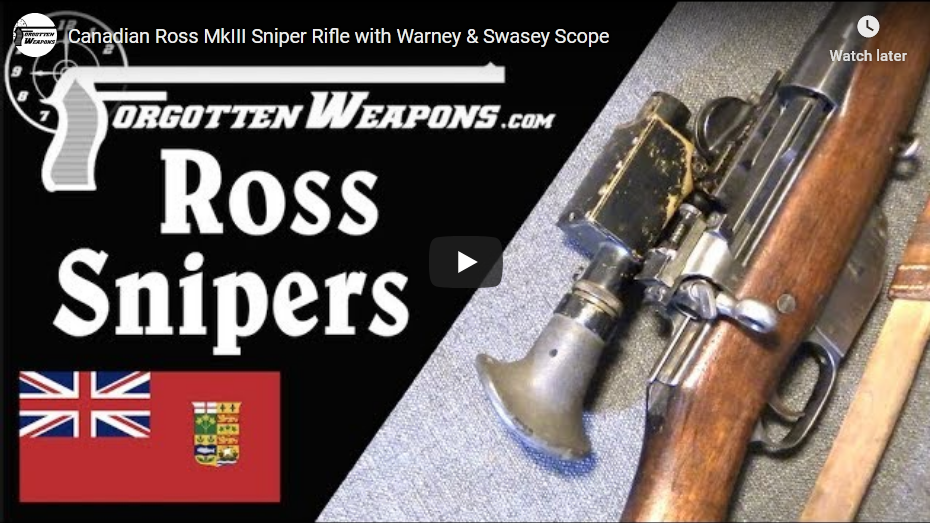
The Canadian infantry that went to Europe in the early years of World War One were equipped primarily with the Ross MkIII rifle. The Ross would become quite the scandal, and was replaced in service with the SMLE in 1916 — but as a sniper rifle the Ross excelled. Its problems in service were largely based on poor quality ammunition, and this was not an issue for the sniper corps. In addition, Great Britain was having enough trouble equipping its own snipers to have any extra scoped rifles to hand over to the dominions.

And so, the Canadians modified 500 Ross rifles into a sniper configuration using American-sourced Warner & Swasey M1913 “Musket Sight” scopes. These were 5x magnification prismatic scopes, also used by American forces on the M1903 sniper rifle and the M1909 Benet-Mercie machine guns. The scope was not very good, suffering from fogging and other issues, but it was available. The Canadian rifles were made in two batches of 250 each, one in 1915 and one in 1917. This was actually more rifles than needed, and many of them (including the two in this video) remained in Canada for training (and were used at least until 1942).

Canadian Warner & Swasey scopes can be identified by three elements. They have elevation dials marked out to 2400 yards, serial numbers between 1 and 500, and no data plate on top. Canadian scope cases are marked with the serial numbers of the scope and the rifle they were issued with.

Contact:
Forgotten Weapons
6281 N. Oracle #36270
Tucson, AZ 85740

March 11, 2020

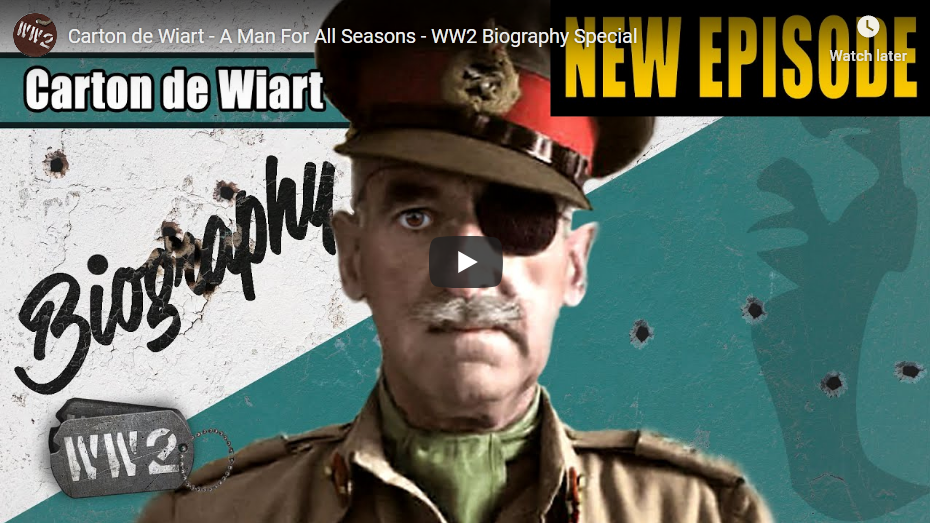
Carton de Wiart – A Man For All Seasons – WW2 Biography Special

Filed under: Africa, Britain, Europe, History, Italy, Military, WW1, WW2 — Tags: , , , , , — Nicholas @ 06:00

World War Two
Published 10 Mar 2020

Carton de Wiart was a remarkable figure in World War One, but his story continues in World War Two, where he rolls from one adventure into the next.

Join us on Patreon: https://www.patreon.com/TimeGhostHistory
Or join The TimeGhost Army directly at: https://timeghost.tv

Follow WW2 day by day on Instagram @World_war_two_realtime https://www.instagram.com/world_war_t…
Between 2 Wars: https://www.youtube.com/playlist?list…
Source list: http://bit.ly/WW2sources

Hosted by: Indy Neidell
Written by: Francis van Berkel
Produced and Directed by: Spartacus Olsson and Astrid Deinhard
Executive Producers: Bodo Rittenauer, Astrid Deinhard, Indy Neidell, Spartacus Olsson
Creative Producer: Joram Appel
Post-Production Director: Wieke Kapteijns
Research by: Keith Kevelson
Edited by: Mikołaj Cackowski

Colorizations by:
Julius Jääskeläinen – https://www.facebook.com/JJcolorization/

Sources:
IWM Q 101768, Q 82958, Q 15472, Q 53680, Q 92257, Q 4511, Q 11429, Q 92207, Q 92214, N 228, N 110, N 68, H 7393, HU 128168, E(MOS) 1315, SE 3547, A 31225, A 20588, Q 92218
Skull by Mahmure Alp from the Noun Project
foot bone by Maxicons from the Noun Project
Ear by Vectors Market from the Noun Project
Hip Bones by ProSymbols from the Noun Project
Collection of Auckland Museum Tamaki Paenga Hira, 2001.25.480 Brent Mackrell Collection
Narodowe Archiwum Cyfrowe
Picture of Combe, Carton de Wiart, Todhunter and Gambier-Parry in Vincigliata Castle Prison, courtesy Michael Todhunter

Soundtracks from the Epidemic Sound:
Hakan Eriksson – “Epic Adventure Theme 3”
Jo Wandrini – “Dawn of Civilization”
Rannar Sillard – “March of the Brave 4”
Johannes Bornlof – “Death And Glory 3”
Farrell Wooten – “Blunt Object”
Philip Ayers – “Trapped in a Maze”
Phoenix Tail – “At the Front”

Archive by Screenocean/Reuters https://www.screenocean.com.

A TimeGhost chronological documentary produced by OnLion Entertainment GmbH.

From the comments:

World War Two
40 minutes ago (edited)
This episode was made thanks to our research volunteer Keith Kevelson. It is also the first of its kind, being the first proper Biography Special of our World War Two series. We will do one of these every other week, so be prepared to get to know the main protagonists of the Second World War up close and personal. Please support us on Patreon so we can continue making these. Sign up at www.patreon.com/timeghosthistory or https://timeghost.tv.

Cheers,
Joram

March 7, 2020

History Buffs: Lawrence of Arabia

Filed under: Britain, History, Media, Middle East, Military, WW1 — Tags: , , , , , , — Nicholas @ 02:00

History Buffs
Published 17 Apr 2016

BIG THANK YOU TO THE GREAT WAR CHANNEL FOR COLLABORATING WITH ME AND MAKING AWESOME VIDEOS!

Check out their T.E. Lawrence video here –
https://www.youtube.com/watch?v=iqvcjL6ObH0

And the rest of their awesome channel here 🙂
https://www.youtube.com/user/TheGreatWar

And thank you History Buffs so very much for being patient whilst I was in Ireland working on the Vikings podcasts for the History Channel and moving house at the same time. I sincerely hope you guys enjoy this review!

● Follow us on Twitter: https://twitter.com/HistoryBuffsNH

________________________________________­­_________________________________

Lawrence of Arabia is a 1962 epic historical drama film based on the life of T. E. Lawrence. It was directed by David Lean and produced by Sam Spiegel through his British company Horizon Pictures, with the screenplay by Robert Bolt and Michael Wilson. The film stars Peter O’Toole in the title role. It is widely considered one of the greatest and most influential films in the history of cinema. The dramatic score by Maurice Jarre and the Super Panavision 70 cinematography by Freddie Young are also highly acclaimed. The film was nominated for ten Academy Awards and won seven in total including Best Director, Best Sound Editing, Best Film Editing, and Best Picture.

The film depicts Lawrence’s experiences in the Arabian peninsula during World War I, in particular his attacks on Aqaba and Damascus and his involvement in the Arab National Council. Its themes include Lawrence’s emotional struggles with the personal violence inherent in war, his own identity, and his divided allegiance between his native Britain and its army and his new-found comrades within the Arabian desert tribes.

In 1991, Lawrence of Arabia was deemed “culturally, historically, or aesthetically significant” and selected for preservation in the United States Library of Congress National Film Registry.

February 29, 2020

Forced-Air Cooling in an Experimental Ross Machine Gun

Filed under: Cancon, History, Military, Weapons, WW1 — Tags: , , , , , — Nicholas @ 04:00

Forgotten Weapons
Published 28 Feb 2020

http://www.patreon.com/ForgottenWeapons

https://www.floatplane.com/channel/Fo…

Cool Forgotten Weapons merch! http://shop.bbtv.com/collections/forg…

In addition to building three main patterns of straight-pull bolt action rifle for the Canadian military and the commercial market, Sir Charles Ross also experimented with self-loading rifles. Starting with a standard Ross Mk III, this experimental rifle has a gas piston and trigger to allow automatic fire and a very neat forced-air cooling system. A one-way ratchet mechanism (now broken, unfortunately) spins the fan when the bolt cycles, pushing air into a barrel shroud similar to that of a Lewis gun. This rifle was most likely made in 1915 or 1916 with an eye to a military light machine gun or automatic rifle contract — which never happened.

Thanks to the Canadian War Museum for providing me access to film this Ross for you!

https://www.warmuseum.ca

Contact:
Forgotten Weapons
6281 N. Oracle #36270
Tucson, AZ 85740

February 28, 2020

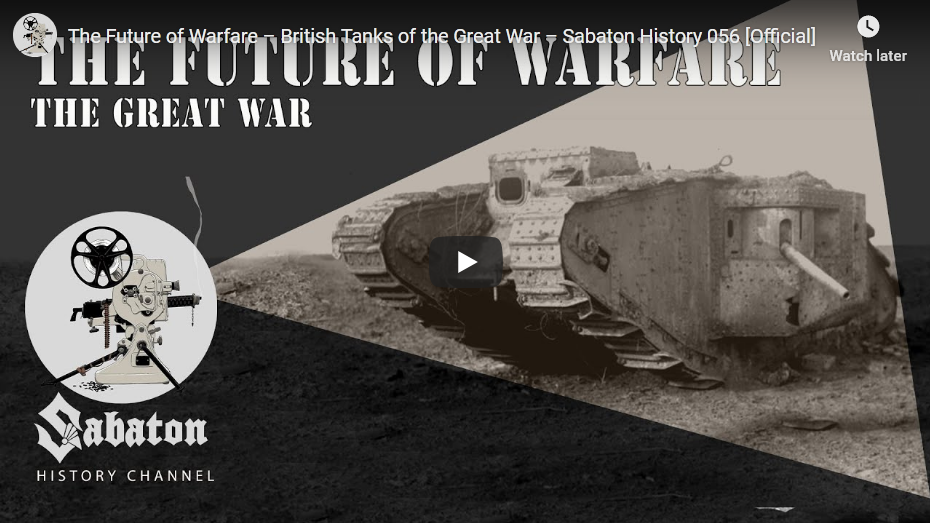
“The Future of Warfare” – British Tanks of the Great War – Sabaton History 056 [Official]

Filed under: Britain, Germany, History, Media, Military, WW1 — Tags: , , , , , — Nicholas @ 04:00

Sabaton History
Published 27 Feb 2020

Tanks! What a terrible and frightening sight they must have been for the Germans, the first time they had appeared on the battlefield at the Somme in 1916. The tanks were the product of many different ideas and prototypes, that all sought to overcome the perils of the modern battlefield — the machine gun, the bombed out ground and the barbed wire. The British Mark I tank would crush those obstacles through its sheer weight and begin a new age of mechanized warfare!

Support Sabaton History on Patreon: https://www.patreon.com/sabatonhistory

Listen to “The Future of Warfare” on the album The Great War:
CD: http://nblast.de/SabatonTheGreatWar
Spotify: https://sabat.one/TheGreatWarSpotify
Apple Music: https://sabat.one/TheGreatWarAppleMusic
iTunes: https://sabat.one/TheGreatWarItunes
Amazon: https://sabat.one/TheGreatWarAmazon
Google Play: https://sabat.one/TheGreatWarGooglePlay

Watch the official lyric video of “The Future of Warfare” here:
https://www.youtube.com/watch?v=t8qJi…

Check out the trailer for Sabaton’s new album The Great War right here: https://www.youtube.com/watch?v=HCZP1…

Listen to Sabaton on Spotify: http://smarturl.it/SabatonSpotify
Official Sabaton Merchandise Shop: http://bit.ly/SabatonOfficialShop

Hosted by: Indy Neidell
Written by: Markus Linke and Indy Neidell
Directed by: Astrid Deinhard and Wieke Kapteijns
Produced by: Pär Sundström, Astrid Deinhard and Spartacus Olsson
Creative Producer: Joram Appel
Executive Producers: Pär Sundström, Joakim Broden, Tomas Sunmo, Indy Neidell, Astrid Deinhard, and Spartacus Olsson
Post-Production Director: Wieke Kapteijns
Edited by: Iryna Dulka
Sound Editing by: Marek Kaminski
Maps by: Eastory – https://www.youtube.com/c/eastory

Archive by: Reuters/Screenocean https://www.screenocean.com
Music by Sabaton.

Sources:
– Bundesarchiv
– Bibliothèque nationale de France
– Library and Archives Canada
– National Library of Scotland
– Australian War Museum
– National Army Museum
– IWM: Q 53204, Q 115391, Q 1419, Q 78121, Q 72864, HU 55578, Q 14496, Q 14495, Q 2487, Q 2486, Q 5574, Q 52, Q 43463, Q 3565, Q 3542, Q 5578, Q 80026, Q 68975
– IWM ART: REPRO 000684 7
– Sound of tracktor engine by viertelnachvier, tank sound by nicstage, from freesound.org

An OnLion Entertainment GmbH and Raging Beaver Publishing AB co-Production.

© Raging Beaver Publishing AB, 2019 – all rights reserved.
February 22, 2020

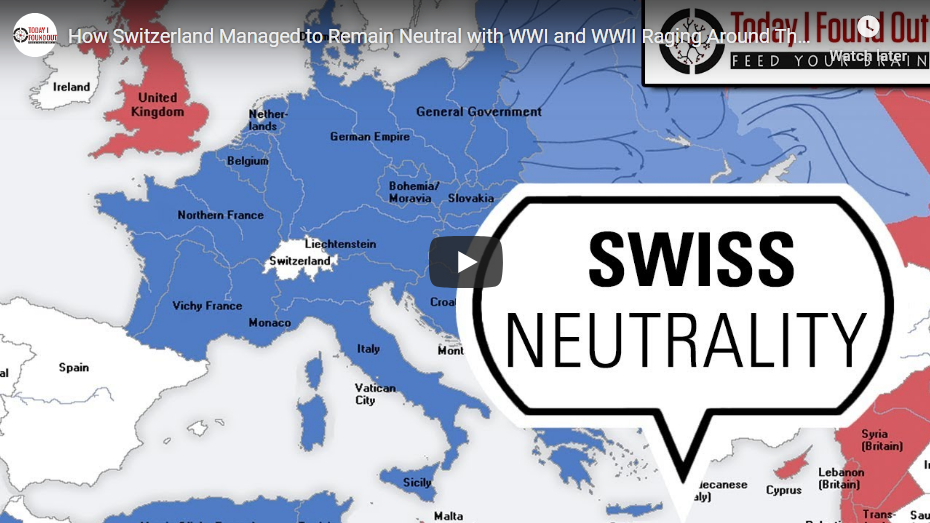
How Switzerland Managed to Remain Neutral with WWI and WWII Raging Around Them

Filed under: Europe, History, Military, WW1, WW2 — Tags: , , , , , — Nicholas @ 06:00

Today I Found Out
Published 30 Apr 2018

Signup for your FREE trial to The Great Courses Plus here: http://ow.ly/dCMa30hIugB

If you happen to like our videos and have a few bucks to spare to support our efforts, check out our Patreon page where we’ve got a variety of perks for our Patrons, including Simon’s voice on your GPS and the ever requested Simon Whistler whistling package: https://www.patreon.com/TodayIFoundOut

The Great Courses Plus is currently available to watch through a web browser to almost anyone in the world and optimized for the US, UK, and Australian markets. The Great Courses Plus is currently working to both optimize the product globally and accept credit card payments globally.

Never run out of things to say at the water cooler with TodayIFoundOut! Brand new videos 7 days a week!

In this video:

The tiny mountainous country of Switzerland has been in a state of “perpetual neutrality” since the major European powers of the time declared it as such during the Congress of Vienna after the end of the Napoleonic wars in 1815.

Want the text version?: http://www.todayifoundout.com/index.p…

February 18, 2020

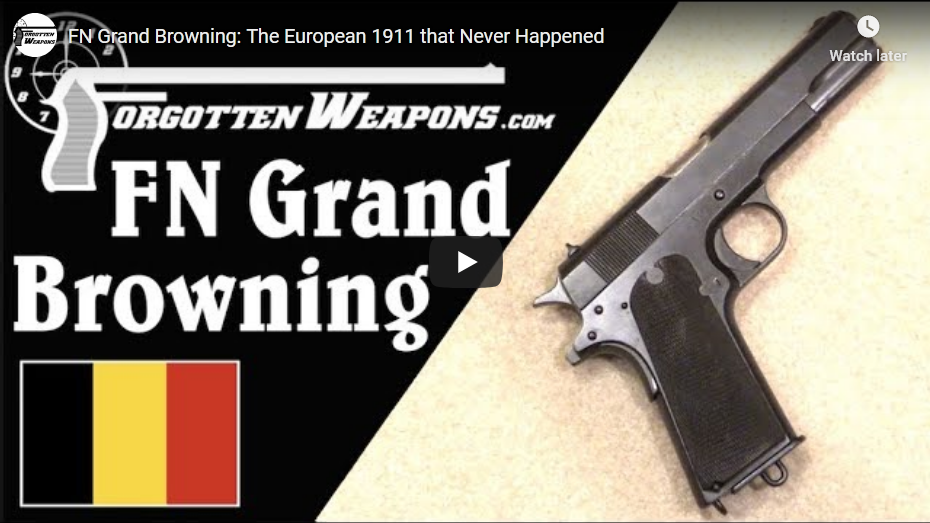
FN Grand Browning: The European 1911 that Never Happened

Filed under: Europe, History, Military, Weapons, WW1 — Tags: , , , , — Nicholas @ 04:00

Forgotten Weapons
Published 17 Feb 2020

http://www.patreon.com/ForgottenWeapons

https://www.floatplane.com/channel/Fo…

Cool Forgotten Weapons merch! http://shop.bbtv.com/collections/forg…

When John Browning licensed his handgun patents, the North American rights were granted to Colt, and the Western European rights to FN in Belgium. Browning provided the patents and patent model guns to the companies, and they were then free to interpret the design however they thought best. In the case of the shrouded-hammer blowback system, the Colt interpretation (the Pocket Hammerless) was a civilian concealed pistol in .32ACP, while the FN interpretation (Model 1903) was a substantially larger gun in 9×20 Browning Long intended for military service.

The locked-breech patent was the same. Colt developed it into the Model 1911 adopted by the US military, and FN built a slightly smaller version in 9.65x23mm intended for European military service. However, while the Colt pistol became tremendously popular, FN’s development was disrupted by World War One, and never completed in its aftermath. Only a couple dozen examples of the Grand Browning, as it was called, were made before the war, and just a few survive today. We will never know how European militaries would have responded to a Browning locked-breech pistol at the time…

Contact:
Forgotten Weapons
6281 N. Oracle #36270
Tucson, AZ 85704

February 13, 2020

The Animated History of Italy | Part 2

Filed under: Europe, History, Italy, Military, WW1, WW2 — Tags: , , , , — Nicholas @ 02:00

Suibhne
Published 23 Apr 2018

The Armchair Historian Collab: https://youtu.be/vGM54x0LsII

Beginning part two, Italy has been recaptured by the Byzantines thanks to the tenacious ambitions of Emperor Justinian. But throughout the Middle Ages, the land became a battleground for more powerful empires. The 19th Century Italian revolution would see the peninsula swept up in the waves of nationalism that was taking the continent by storm.

February 11, 2020

Maxim Pom-Pom 37mm Machine Gun

Filed under: History, Military, USA, Weapons, WW1 — Tags: , , , , , , — Nicholas @ 02:00

Forgotten Weapons
Published 13 Sep 2016

Failed to sell at auction.

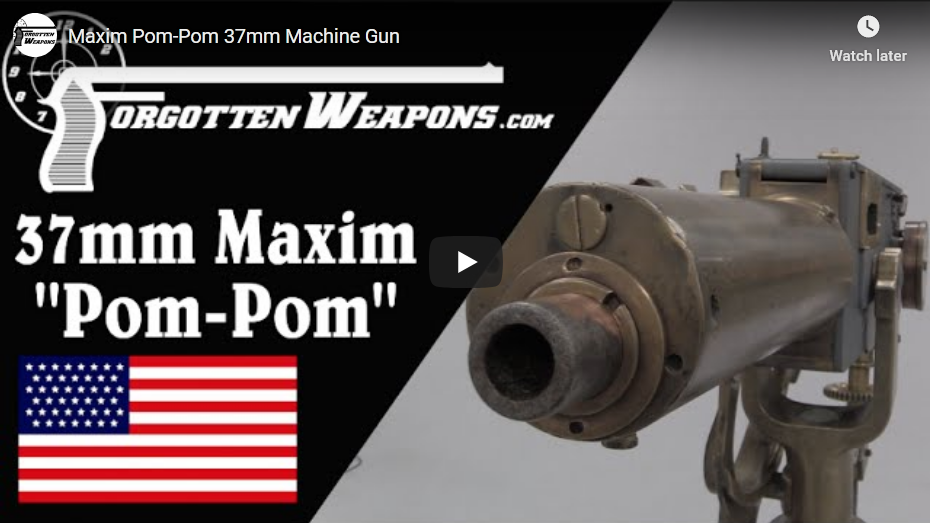
“Pom-Pom” was the name given to the 37mm Maxim gun by the Boers of South Africa, based on the gun’s sound. It was a Maxim machine gun scaled up to the quite impressive 37mm caliber, intended primarily for naval use defending large vessels against small torpedo boats. This particular example is serial number 2024, made in 1889 and then sold three times before being ultimately purchased by the United States Coast Guard and installed on the USS Manning (along with a second gun, number 2026). The Manning was promptly put into military service by the Navy and steamed down to Cuba, where it participated in the first bombardment of Cuba during the Spanish-American War.

These 37mm guns could fire a wide variety of projectiles, including solid rounds which could pierce an inch (25mm) of iron armor at 100 yards and hollow rounds filled with black powder and fused to explode on impact. During World War One, they would be pushed into anti-aircraft service, with the explosive rounds being extremely effective on early aircraft (when you could get a hit, anyway).

Related:
Bethlehem Steel 37mm Gun: https://www.youtube.com/watch?v=abEq7…
Vickers 2.95″ Mountain Gun: https://www.youtube.com/watch?v=-b53i…
Maxim lMG08/15: https://www.youtube.com/watch?v=Gbt1_…

February 5, 2020

Submarine Warfare WW1 vs WW2 – Differences & Commonalities

Filed under: Britain, Germany, History, Military, WW1, WW2 — Tags: , , , — Nicholas @ 04:00

Military History Visualized
Published 15 Nov 2016

A comprehensive view that compares submarine warfare in the First and Second World Wars. Due to the lack of a submarine warfare in the Pacific in World War 1, the Pacific isn’t covered at all, but there will be an episode on it in the future.

Military History Visualized provides a series of short narrative and visual presentations like documentaries based on academic literature or sometimes primary sources. Videos are intended as introduction to military history, but also contain a lot of details for history buffs. Since the aim is to keep the episodes short and comprehensive some details are often cut.

» HOW YOU CAN SUPPORT MILITARY HISTORY VISUALIZED «
(A) You can support my channel on Patreon: https://www.patreon.com/join/mhv

(B) Alternatively, you can also buy “Spoils of War” (merchandise) in my online shop: https://www.redbubble.com/people/mhvi…

» SOURCES & LINKS «

Milner, Marc: “The Atlantic War, 1939-1945”; in: Cambridge History of the Second World War, Volume 1

Blair, Clay: Hitler’s U-Boat War – The Hunters 1939-1942

Owen, David: Anti-Submarine Warfare – An Illustrated History

Germany & The Second World War – Volume VI

Germany & The Second World War – Volume II

Breemer, Jan S.: “Defeating the U-boat. Inventing Antisubmarine Warfare”. Naval War College Newport Papers 36
https://www.usnwc.edu/getattachment/e…

Das Deutsche Reich und der Zweite Weltkrieg – Band VI.

Das Deutsche Reich und der Zweite Weltkrieg – Band II.

Rahn, Werner: “Die Deutsche Seekriegsfürung 1943 bis 1945”; in: Das Deutsche Reich & der Zweite Weltkrieg, Band X/1, S. 3-276

Erster Weltkrieg – Zweiter Weltkrieg: Ein Vergleich.

U-boat losses by cause
https://web.archive.org/web/201006112…

Differences German U-Boat Design WW1 vs. WW2
https://www.reddit.com/r/AskHistorian…

» CREDITS & SPECIAL THX «
Song: Ethan Meixsell – “Demilitarized Zone”

February 1, 2020

The Greco-Turkish War & The Turkish War Of Independence I THE GREAT WAR 1920

The Great War
Published 31 Jan 2020

Sign up for Curiosity Stream and Nebula: https://curiositystream.com/thegreatwar

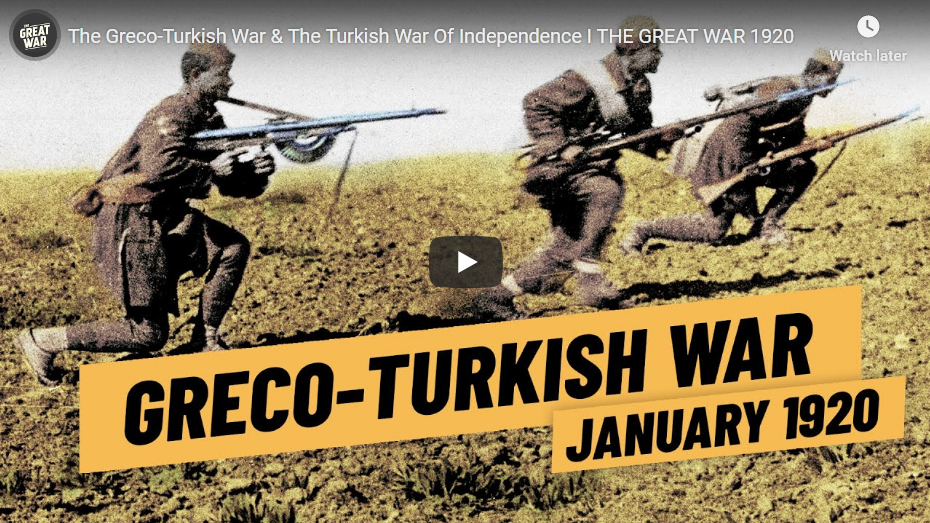
The Ottoman Empire was among the losing powers of World War 1 and left a power vacuum after the armistice of Mudros. The Great Powers had already made plans for the territory beforehand and now Greece had ambitions to take over the parts of Turkey where Greeks lived.

» SUPPORT THE CHANNEL
Patreon: https://www.patreon.com/thegreatwar
Merchandise: https://shop.spreadshirt.de/thegreatwar/

» SOURCES
Criss, Nur Bilge: “Occupation during and after the War (Ottoman Empire)”, in: 1914-1918-online. International Encyclopedia of the First World War, ed. by Ute Daniel, Peter Gatrell, Oliver Janz, Heather Jones, Jennifer Keene, Alan Kramer, and Bill Nasson, issued by Freie Universität Berlin, Berlin 2015-08-05 https://encyclopedia.1914-1918-online…

Leonhard, Jörn. Der überforderte Frieden. Versailles und die Welt 1918-1923 (CH Beck, 2018).

Macmillan, Margaret. The Peacemakers: Six Months that Changed the World (London: John Murray, 2001).

Karsh, Efraim and Inari Karsh. Empires of the Sand (London: Harvard UP, 1999).

Llewllyn Smith, Michael. Ionian Vision: Greece in Asia Minor (London: Hurst, 2016 (1973))

Gerwarth, Robert. The Vanquished. Why the First World War Failed to End, 1917-1923 (Penguin, 2017).

Fromkin, David. A Peace to End All Peace (New York: Avon, 1989)

McMeekin, Sean. The Ottoman Endgame (Penguin, 2015)

» SOCIAL MEDIA
Instagram: https://instagram.com/the_great_war
Twitter: https://twitter.com/WW1_Series
Reddit: https://reddit.com/r/TheGreatWarChannel

»CREDITS
Presented by: Jesse Alexander
Written by: Jesse Alexander
Director: Toni Steller & Florian Wittig
Director of Photography: Toni Steller
Sound: Toni Steller Editing: Toni Steller
Mixing, Mastering & Sound Design: http://above-zero.com
Maps: Daniel Kogosov (https://www.patreon.com/Zalezsky)
Research by: Jesse Alexander
Fact checking: Florian Wittig Channel

Design: Alexander Clark

Original Logo: David van Stephold

A Mediakraft Networks Original Channel

Contains licensed material by getty images
All rights reserved – Real Time History GmbH 2019

January 24, 2020

“The Attack of the Dead Men” – Gas Warfare on the Eastern Front – Sabaton History 051 [Official]

Filed under: Germany, History, Media, Military, Russia, WW1 — Tags: , , , — Nicholas @ 04:00

Sabaton History
Published 23 Jan 2020

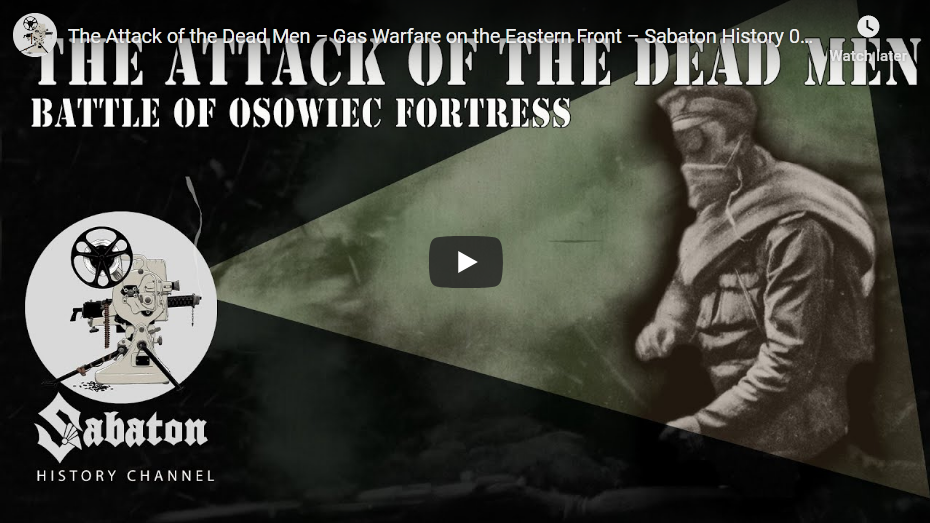
This episode is about the “Attack of the Dead Men”. During the third battle for Osowiec Fortress in July 1915 during the Great War, German artillery was bombarding the defending Russian soldiers with a new deadly weapon: Poison Gas. The fatal mixture of chlorine and bromine descended like a green fog over the Russian trenches. Without adequate gas-masks to protect themselves, the defenders were believed to all have died in agony. However, as the German infantry advanced, they did not only march right into a Russian counterattack but also encountered the dead, seemingly rising from their graves.

Support Sabaton History on Patreon: https://www.patreon.com/sabatonhistory

Listen to The Great War (where “The Attack of the Dead Men” is featured):
CD: http://nblast.de/SabatonTheGreatWar
Spotify: https://sabat.one/TheGreatWarSpotify
Apple Music: https://sabat.one/TheGreatWarAppleMusic
iTunes: https://sabat.one/TheGreatWarItunes
Amazon: https://sabat.one/TheGreatWarAmazon
Google Play: https://sabat.one/TheGreatWarGooglePlay

Check out the trailer for Sabaton’s new album The Great War right here: https://www.youtube.com/watch?v=HCZP1…

Listen to Sabaton on Spotify: http://smarturl.it/SabatonSpotify
Official Sabaton Merchandise Shop: http://bit.ly/SabatonOfficialShop

Hosted by: Indy Neidell
Written by: Markus Linke and Indy Neidell
Directed by: Astrid Deinhard and Wieke Kapteijns
Produced by: Pär Sundström, Astrid Deinhard and Spartacus Olsson
Creative Producer: Joram Appel
Executive Producers: Pär Sundström, Joakim Broden, Tomas Sunmo, Indy Neidell, Astrid Deinhard, and Spartacus Olsson
Post-Production Director: Wieke Kapteijns
Edited by: Iryna Dulka
Sound Editing by: Marek Kaminski
Maps by: Eastory – https://www.youtube.com/c/eastory

Archive by: Reuters/Screenocean https://www.screenocean.com
Music by Sabaton.

Sources:
– IWM: Q 78100, Q 86635
– The New York Public Library
– Narodowe Archiwum Cyfrowe

An OnLion Entertainment GmbH and Raging Beaver Publishing AB co-Production.

© Raging Beaver Publishing AB, 2019 – all rights reserved.
January 23, 2020

Book Review – The Lee Enfield, by Ian Skennerton

Filed under: Britain, History, Military, Weapons, WW1, WW2 — Tags: , , — Nicholas @ 02:00

Forgotten Weapons
Published 21 May 2017

Available from Amazon: http://amzn.to/2qBntgB

Ian Skennerton is a leading authority on British rifles, having written extensively on Sniders, Martinis, Enfields, and more. This specific book, The Lee Enfield is the most recent iteration of his compendium of Lee-Enfield information, printed in 2007 (previous versions were The Lee Enfield Story of the 1980s and The British Service Lee of the 90s). It is an absolute wealth of information, including a large amount of original British military documents. Skennerton covers a huge array of developmental and experimental versions of the Enfield as well as the standard production models (including American, Canadian, Australian, and Indian production).

Strange WW1 modifications and accessories, grenade launchers, snipers, lightweight guns, carbines, long rifles, semiautomatic conversions, you name it — it’s all here. Unfortunately, the organization and editing leaves a lot to be desired, in my opinion. It is a book that looks magnificent when idly flipped through, but can be frustrating to use to understand the history of a gun or guns. The text often jumps from one subject to another, forcing the reader to piece together elements from different sections to figure out a coherent story.

That said, it remains an indispensable book for the Enfield enthusiast, as it has a ton of information not found elsewhere. I hope that if a new revision or edition is ever produced, Mr. Skennerton will employ the services of a ruthless editor to help him form the raw information into a more navigable history.

Cool Forgotten Weapons merchandise! http://shop.bbtv.com/collections/forg…

http://www.patreon.com/ForgottenWeapons

If you enjoy Forgotten Weapons, check out its sister channel, InRangeTV! http://www.youtube.com/InRangeTVShow

January 22, 2020

Introduction to Military Flamethrowers with Charlie Hobson

Filed under: History, Military, Weapons, WW1, WW2 — Tags: , , — Nicholas @ 04:00

Forgotten Weapons
Published 5 May 2016

http://www.flamethrowerexpert.com

You can find Charlie Hobson’s book, US Portable Flamethrowers here:
http://amzn.to/1SP9yc5

Flamethrowers are a significant piece of military weapons history which are very widely misunderstood, as flamethrowers have never been the subject of nearly as much collector interest as other types of small arms. The US military removed its flamethrowers from inventory in 1985, and all other major national militaries have done the same. In the US, the lack of general interest led to most of the surplussed weapons being destroyed as scrap, and few survive in private collections. At the same time (and for the same reason) a great deal of the information on these weapons was also discarded and lost.

One of the people who has done a tremendous amount of work to recover practical information on historical military flamethrowers as well as restore, service, and operate them is Charlie Hobson. He has worked extensively with the US military museum system as well as the entertainment industry (if you have seen a movie of TV show using a real flamethrower, it was almost certainly done under his supervision).

Today I am discussing the basic of flamethrowers with Charlie. The goal is to provide a good baseline foundation so we can go on to look at a couple specific historical flamethrowers and understand them in context. So sit back, relax, and enjoy a chat with a man who is truly passionate about this underappreciated aspect of military history!

« Newer PostsOlder Posts »

Powered by WordPress