Quotulatiousness

September 6, 2019

Browning M2 .50cal “Ma Deuce” | HEAVY MACHINE GUN

Filed under: History, Military, USA, Weapons, WW2 — Tags: , , , , — Nicholas @ 02:00

Matsimus
Published on 22 Jul 2019

The Browning heavy machine gun was designed towards the end of World War I. Development of a large-caliber machine gun in the USA was initiated at the direct request of General Pershing, the commander of US expeditionary corps in Europe. He requested a large-caliber machine gun, capable of destroying military aircraft and ground targets such as armored cars and tanks. The task of developing such a gun was passed to John Browning. The task of developing ammunition for this new weapon was passed to Winchester Arms company.

This machine gun is similar to John Browning’s earlier M1919 machine gun, that was chambered for a standard rifle cartridge. In around 1917 Browning started to redesign his weapon for a larger caliber. His new machine gun was chambered for much larger and much more powerful 12.7×99 mm (.50 caliber) cartridge, that was developed alongside this weapon by Winchester. That’s why sometimes this weapon is simply referred as Browning .50 caliber machine gun. After the John Browning’s death in 1926, the design of this weapon was finalized by other designers.

This machine gun entered service with the US armed forces in 1933 and was manufactured by Colt. Design of this weapon proved to be extremely successful. Since the 1930s it has been used extensively to the present day. This remarkable weapon has seen service during countless wars all over the world. Only during WWII nearly 2 million of these HMGs were produced. It has been in production longer than any other machine gun and its production still continues. Furthermore the M2 machine gun has been in use longer than any other small arm in the US armed forces inventory, except the M1911 pistol, that was also designed by John Browning. The M2 machine gun is currently manufactured by General Dynamics and US Ordnance companies. Since the 1930s this weapon is license-produced by FN Herstal of Belgium. Currently the M2 is used by about 100 countries all over the world. It is the primary heavy machine gun of NATO countries.

The M2 is typically used as a vehicle weapon or helicopter armament. It can be also used from a tripod. This heavy machine gun is highly effective against infantry, unarmored or lightly armored vehicles, boats, light fortifications and helicopters. It is closer in power to a small cannon.

This weapon is typically used with standard ball, tracer, armor-piercing, armor-piercing incendiary, or armor-piercing incendiary tracer rounds. There is also an M962 SLAP-T (Saboted Light Armor Penetrator) round, fitted with a tungsten penetrator.

The M2 is fed from disintegrating belt. Spent cartridge cases are extracted down. It can be adapted to feed from the left or right side of the weapon by reinstalling some parts. This conversion takes two minutes. The charging handle can be also changed from right to left hand side.

The M2 has slow and rapid firing modes. It can fire full-auto, as well as single shots. This weapon fires from a closed bolt.

When used as a crew served weapon, the M2 is mounted on an M3 tripod. This tripod weights 20 kg. So the complete weight of the machine gun on tripod is 58 kg. When fired from the tripod this HMG has an effective range of 1 830 m. Maximum effective range is 2 000 m.

The M2 comes with standard iron sights. However various types of telescopic and night sights can be installed using appropriate mountings.

Hope you enjoy!!

💰 Want to support my channel? Check out my Patreon Donation page! https://www.patreon.com/user?u=3081754

👕 Check out my Merch: https://teespring.com/stores/matsimus…
📬Wanna send me something? My PO Box: Matthew James 210A – 12A Street N Suite
#135 Lethbridge Alberta Canada T1H2J

🎼 Twitch: https://www.twitch.tv/matsimus_9033

👋DISCORD: https://discord.gg/B7cbXgy

🐩Twitter: https://twitter.com/MatsimusGaming

⛔ (DISCLAIMER: This video is for informative and entertainment purposes only. The views and opinion come from personal experience and not that of others or other organizations. This content and information is there to provide information from public accessible sources.)

September 5, 2019

Making a Gun-Stock War Club (feat. Green Beetle)

Filed under: Tools, Weapons, Woodworking — Tags: , , — Nicholas @ 04:00

Rex Krueger
Premiered 31 minutes ago

More video and exclusive content: http://www.patreon.com/rexkrueger
(more…)

September 2, 2019

What You Didn’t Know About the 1968 Machine Gun Amnesty

Filed under: Bureaucracy, History, Law, USA, Weapons — Tags: , , , — Nicholas @ 02:00

Forgotten Weapons
Published on 11 Oct 2017

Sold for $23,000.

When the 1968 machine gun amnesty was announced in the US, it was treated with widespread suspicion among gun collectors. Some thought it would merely a pretense to find and arrest owners of unregistered machine guns. Others though it was just the first step in a prohibition and confiscation of machine guns. Both of these groups would prove to be wrong, however and the amnesty was in fact a true amnesty.

In fact, the amnesty was even more substantial than people recognize even today. It was not just an amnesty for possession of an unregistered machine gun, but also pretty much any crime associated with the gun. For example, it would legalize guns that had been stolen from military property rooms, and guns with defaced serial numbers. In fact, it even allowed felons to register machine guns, and retain the legal right to own them to this very day.

http://www.patreon.com/ForgottenWeapons

Cool Forgotten Weapons merch! http://shop.bbtv.com/collections/forg…

If you enjoy Forgotten Weapons, check out its sister channel, InRangeTV! http://www.youtube.com/InRangeTVShow

August 30, 2019

Is The Roman Gladius (Sword) Really That Good?

Filed under: Europe, History, Military, Weapons — Tags: , , , — Nicholas @ 02:00

scholagladiatoria
Published on 15 Jul 2019

Is The Roman Gladius (Sword) Really That Good?

August 27, 2019

H&K Mk23 SOCOM .45 Development

Filed under: History, Military, Technology, USA, Weapons — Tags: , , , , — Nicholas @ 02:00

Forgotten Weapons
Published on 28 Jun 2019

http://www.patreon.com/ForgottenWeapons

Cool Forgotten Weapons merch! http://shop.bbtv.com/collections/forg…

The H&K Mk 23 pistol was developed in the 1990s for the US Special Operations Command and US Navy. The goal was to produce an “offensive handgun” that could serve as a primary armament for a special forces operator as well as a backup arm. It was required to be no more than 12 inches long, fit a suppressor and aiming module with laser and illumination options in both visible and IR spectrum, have at least 10-round magazines, chamber .45 ACP (specifically a 185gr +P loading), and pass a 30,000 round endurance test.

Only two companies were able to supply acceptable initial pistols; H&K and Colt. The Colt pistol failed to pass the 1st phase testing. H&K presented a gun based on the recently-developed USP design, was ultimately chosen as the project winner; adopted as the Mk 23 pistol in 1996. The testing this pistol went through during development is really quite remarkable.

Contact:
Forgotten Weapons
PO Box 87647
Tucson, AZ 85754

August 26, 2019

Belgian GP35: The First Military Browning High Power

Filed under: Europe, History, Military, Weapons, WW2 — Tags: , , , , — Nicholas @ 02:00

Forgotten Weapons
Published on 29 Jul 2019

http://www.patreon.com/ForgottenWeapons

Cool Forgotten Weapons merch! http://shop.bbtv.com/collections/forg…

The Grande Puissance — High Power — was John Browning’s last firearms design. In fact, he only began the design; it was taken to completion by his protege DieudonnĂ© Saive at FN in Belgium. It was the best military handgun of the time, with a double-stack 13-round magazine capacity, and chambered for the 9x19mm cartridge. Belgium was the first nation to adopt it for military service, purchasing 1,000 guns for field trials and approving them in 1935 for standard issue as the GP-35.

The Belgian trials guns have a distinctive oval ejection port, which would be changed on production models. They were also fitted with flat board shoulder stocks and tangent sights adjustable up to 500 meters. These features would last until German occupation of the FN factory complex during World War Two, when the guns were simplified under German occupation production.

Contact:
Forgotten Weapons
PO Box 87647
Tucson, AZ 85754

August 23, 2019

Sterling S11: Donkey in a Thoroughbred Race

Filed under: Britain, History, Military, Technology, Weapons — Tags: , , , , — Nicholas @ 02:00

Forgotten Weapons
Published on 26 Jun 2019

http://www.patreon.com/ForgottenWeapons

Cool Forgotten Weapons merch! http://shop.bbtv.com/collections/forg…

In the 1960s, the Sterling company began to worry about the prospects of continued sales of the Sterling (Patchett) SMG, especially in light of new competitors like the H&K MP5. Its chief design engineer, Frank Waters, created the S11 as a gun to replace the classic Sterling. The S11 was based on a simple stamped/folded steel receiver, and was intended to have a lower unit cost than the Sterling. It kept the excellent Patchett magazine, but had a barrel and sights offset to the left side, and offered two separate bayonet lugs – one for the No5 rifle and one for the L1A1/FAL.

Unfortunately for Sterling, it was determined that the tooling cost would have made the S11 actually more expensive than the existing guns, whose tooling costs had been long since covered. Also, the S11 was just not a very good or very reliable design – a “donkey in a thoroughbred race” to quote one Sterling manager. This one prototype was the only example ever made, and the project was shelved in 1967 in favor of expanding into more civilian models of the original Sterling.

Many thanks to the Royal Armouries for allowing me to film and disassemble this one of a kind submachine gun! The NFC collection there – perhaps the best military small arms collection in Western Europe – is available by appointment to researchers:

https://royalarmouries.org/research/n…

You can browse the various Armouries collections online here:

https://royalarmouries.org/collection/

Contact:
Forgotten Weapons
PO Box 87647
Tucson, AZ 85754

August 21, 2019

Slow Motion Malfunctions of Exotic Firearms

Filed under: Technology, Weapons — Tags: , , , — Nicholas @ 02:00

Forgotten Weapons
Published on 25 Jun 2019

http://www.patreon.com/ForgottenWeapons

Cool Forgotten Weapons merch! http://shop.bbtv.com/collections/forg…

Over many years of filming with my high speed camera, I have a decent little library of malfunctions in a wide variety of guns. These don’t normally make it into videos, and I figured it would be neat to present a bunch of them together. Enjoy!

Contact:
Forgotten Weapons
PO Box 87647
Tucson, AZ 85754

QotD: The cult of Japanese cultural superiority

Filed under: Japan, Media, Technology, Weapons — Tags: , , , , — Nicholas @ 01:00

The Forged in Fire people have a new show: Knife or Die. It’s hard to discuss, because I don’t want to ridicule anyone. Any person with a desire to compete can show up with a big knife, and they will turn you loose on an obstacle course of things to cut. The first episode featured a Caucasian man wearing an Aikido costume and running shoes. I am serious. He carried a katana or “samurai sword,” even though aikido guys aren’t taught how to fight with swords. He hit a block of ice with it, and it bent in the middle.

That was a major blow to the Japan cult. Katanas are supposed to cut concrete blocks! At least that’s what they say in the Tokyo airport gift shop.

Why does aikido attract troubled people with unrealistic expectations? A high school friend of mine took up aikido. The Internet says he runs a dojo now. He gave his life to aikido. Unfortunately, aikido has a serious problem: it doesn’t work at all. Sure, you can twist people’s wrists and immobilize them if they are stupid enough to give you their hands, but everyone who has tried aikido in the ring has had his behind handed to him in individually wrapped slices. I can’t understand devoting your life to a martial art which can be defeated easily by 95% of angry untrained drunks. Would you open a store that only sold appliances that didn’t work?

Here are the words that start every single aikido demonstration: “Give me your hand.”

People are enchanted by Japan. They think the Japanese have deep wisdom we lack. They do, and here it is: do your job well and treat your elders and your boss with respect. That’s about it; the rest is hocus pocus. There are no Japanese superpowers. There is no chi. Steven Seagal has never once used magical Japanese aikido to fight a real fight because he knows he would experience humiliating losses.

Forged in Fire has its funny moments, but Knife or Die is a little too ridiculous to lampoon. It’s almost sad. It’s probably dangerous, too. Untrained eccentrics swinging razor-sharp knives of unknown quality in a timed test are a recipe for deep wounds and severe blood loss. I would hate to be in the studio when half of a knife goes flying off at 60 miles per hour.

Steve, “Knives for Knaves”, Tools of Renewal, 2018-05-31.

August 18, 2019

AAI 2nd Gen SPIW Flechette Rifles

Filed under: History, Military, Technology, USA, Weapons — Tags: , , , , — Nicholas @ 02:00

Forgotten Weapons
Published on 24 Jun 2019

http://www.patreon.com/ForgottenWeapons

Cool Forgotten Weapons merch! http://shop.bbtv.com/collections/forg…

The SPIW program began in 1962 with entries from Colt, Springfield, AAI, and Winchester. The first set of trials were a complete failure, and both Colt and Winchester abandoned the project at that point. AAI pressed on, producing these second generation rifles – one for trials in 1966 and one after. Both are chambered for the XM-645 5.6x57mm single-flechette cartridge. Under testing, both showed multiple serious problems in reliability, noise, cook-offs, and accuracy. The company would struggle on for years continuing to develop the flechette rifle system, but would be ultimately unsuccessful.

Thanks to the Rock Island Arsenal Museum for allowing me access to film this very interesting rifle! If you are in the Quad Cities in Illinois or Iowa, the Museum is definitely worth a visit. They have a great number of small arms on display as well as an excellent history of the Rock Island Arsenal.

http://www.arsenalhistoricalsociety.o…

Contact:
Forgotten Weapons
PO Box 87647
Tucson, AZ 85754

August 17, 2019

The “remarkably worthless” Sea Sparrow missile launchers on RCN Iroquois-class destroyers

Filed under: Cancon, History, Military, Weapons — Tags: , , , — Nicholas @ 05:00

Earlier this week, Tyler Rogoway posted a fascinating article about one of the original weapon systems installed on Royal Canadian Navy Iroquois-class destroyers. It was developed specifically for this class, and was eventually replaced with modern Mark 41 Vertical Launch Systems during the ships’ mid-life modernization refits:

Image posted to the Reddit r/WarshipPorn subreddit by u/Admhawk.

From manually aimed box launchers, to automated ones like the Mk29 still in use today, to vertical launch variants, the Sea Sparrow was adapted for many different launching methods. Yet the strangest had to the one found on Canada’s Iroquois class. About seven years ago, someone who had worked with RIM-7s on U.S. Navy vessels told me about how nuts the Canadian launch system was that he had seen demonstrated in the late 1980s. In fact, he said it was so clumsy and slow reacting, that it largely defeated the main purpose of the missile system, at least in a multitude of circumstances. “Remarkably worthless” was the way he described it. I had long forgotten about this exchange until recently when pictures of this exact system popped up on the always lively Reddit page r/Warshipporn. At first, when I saw the images I was flabbergasted as to how weird the setup was, then the memory of the conversation hit me. This is what my contact was talking about!

Four Iroquois-class destroyers were commissioned between 1972 and 1973 and all served until 2005, with the last example being retired two years ago, in 2017. They featured the MKIII Sea Sparrow system fitted inside their forward deckhouse, with doors that opened up on each side and overhead swing-arm launchers carrying four missiles each (eight in total, four on each side) that extended out from their garage-like enclosure that hung out off the side of the ship strangely when at the ready. The whole arrangement looks like something far from conducive to high sea state, not to mention rocket blast from the missiles, or a combat environment, for that matter. 32 missiles were carried in all, with twelve at the ready on each side, but reloading the system as a whole was a slow process.

In addition, it’s said that the Hollandse Signaal Mk22 Weapon Control System wasn’t really up to the task and just deploying the missiles and warming up their guidance systems could take minutes or longer. All of this is far from ideal for what is supposed to have been a fast-reacting point defense system capable of quickly fending off sea-skimming anti-ship missiles that arrive with little warning from over the horizon.

HMCS Iroquois (DDG 280) at Port of Hamburg, near Övelgönne, after mid-life refit replaced the Sea Sparrow launchers (via Wikimedia Commons)

August 15, 2019

How Does it Work: Stoner’s AR System

Filed under: Technology, USA, Weapons — Tags: , , — Nicholas @ 02:00

Forgotten Weapons
Published on 18 Jun 2019

http://www.patreon.com/ForgottenWeapons

Cool Forgotten Weapons merch! http://shop.bbtv.com/collections/forg…

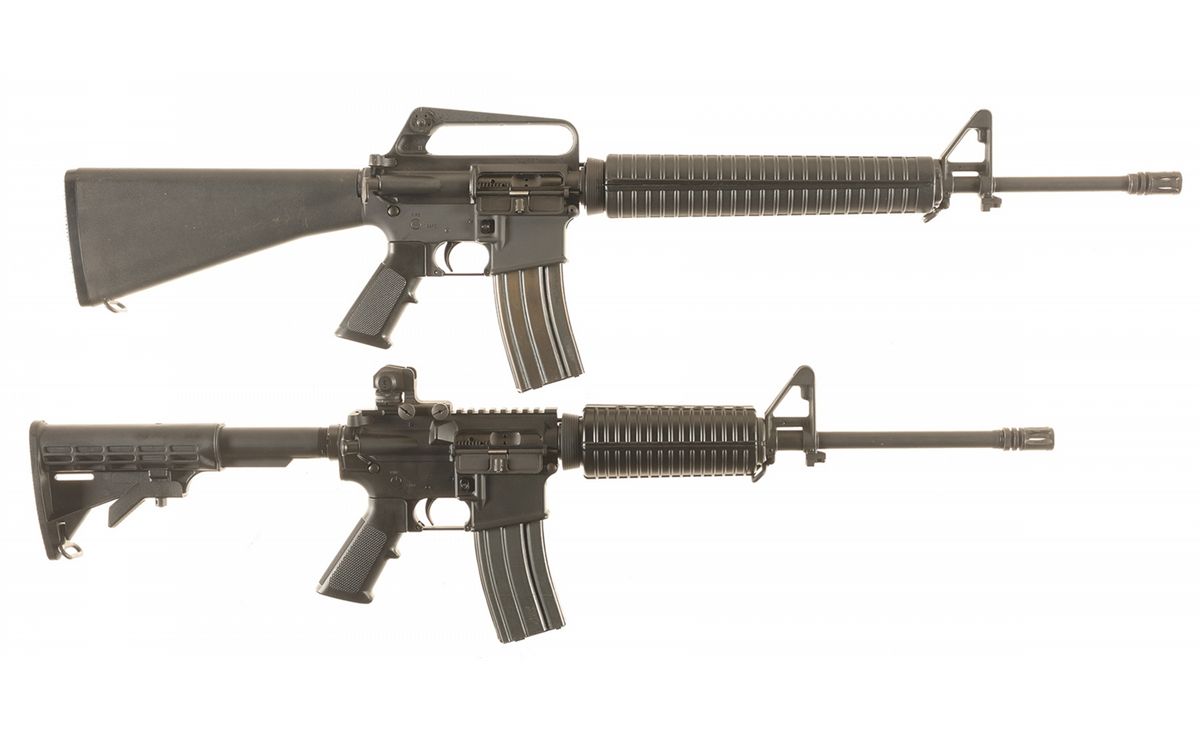
Eugene Stoner’s AR-10 and AR-15 use an operating mechanism that is often called “gas impingement,” but which is actually a cleverly structured gas piston located within the bolt carrier. Gas is tapped from the barrel and moved all the way back to just behind the chamber, where it enters the bolt carrier. There the carrier and bolt act as the two parts of a sealed piston, and when the bolt carrier moves rearward the cam pin forces the bolt head to rotate and unlock. The expanding gas is then vented out through holes in the side of the bolt carrier. By locating the piston on the same axis as the barrel, the harmonics are improved and the overall weight of the gun can be reduced by using the gas piston elements as mass in the bolt carrier assembly. Contrary to the old adage “it shits where it eats,” the operating gasses are not vented into the magazine or chamber, and the system has proven to be very reliable.

Contact:
Forgotten Weapons
PO Box 87647
Tucson, AZ 85754

August 13, 2019

Hands on with the Sutton Hoo sword I Curator’s Corner Season 5 Episode 1

Filed under: Britain, History, Weapons — Tags: , , , , — Nicholas @ 04:00

The British Museum
Published on 5 Aug 2019

Sue Brunning and her trusty foam sword (newly dubbed Flexcalibur by commentator Pipe2DevNull) are back for another sword story. This time Sue takes us up close and personal with one of the most famous swords ever discovered.

Sue has also written a blog about Sutton Hoo available here: https://bit.ly/2yQkfYV (there are lots of other great articles there too!)

#CuratorsCorner #SwordswithSue #SuttonHooSue

August 12, 2019

At the Range with the Iconic MP5A3

Filed under: Germany, Technology, Weapons — Tags: , , — Nicholas @ 02:00

Forgotten Weapons
Published on 15 Jun 2019

http://www.patreon.com/ForgottenWeapons

Cool Forgotten Weapons merch! http://shop.bbtv.com/collections/forg…

The MP5 is widely considered the best submachine gun ever made, for its reliability, its handling, and its closed-bolt delayed-blowback action. It is so widely praised, in fact, that H&K’s efforts to replace it with less expensive polymer submachine guns have largely failed, as their customers simply insist on the MP5.

I have had only a brief bit of experience actually using the MP5 myself, and I wanted to take this opportunity while visiting H&K to fix that. So, does it live up to its reputation?

In a word, yes.

Many thanks to H&K USA for providing me access to this MP5A3, and to Trijicon for graciously providing use of their range!

Contact:
Forgotten Weapons
PO Box 87647
Tucson, AZ 85754

August 9, 2019

Lightweight Experimental Lanchester SMGs

Filed under: Britain, History, Military, Weapons, WW2 — Tags: , , — Nicholas @ 02:00

Forgotten Weapons
Published on 14 Jun 2019

http://www.patreon.com/ForgottenWeapons

Cool Forgotten Weapons merch! http://shop.bbtv.com/collections/forg…

George Lanchester was the engineer responsible for originally reverse engineering the German MP28 submachine gun for production by the British, under the designation Lanchester. Once he finished that design work, the gun was put into production by the Sterling Engineering Company, and Lanchester went to work for them as part of the manufacturing process. Once there, he began tinkering with improved designs to reduce the weight of the gun – one of its main drawbacks. He created these three prototypes, but went no further, as government officials ordered him to stop when they discovered this work in 1942. By that time the Sten was in production, and continued development of the Lanchester was seen as a waste of time and resources.

The guns remained in the Sterling company’s reference collection, and elements of the final stock design would resurface in a later prototype design in the 60s. Beyond that, these guns were a simple dead end of design.

Many thanks to the Royal Armouries for allowing me to film and disassemble these unique submachine guns! The NFC collection there – perhaps the best military small arms collection in Western Europe – is available by appointment to researchers:

https://royalarmouries.org/research/n…

You can browse the various Armouries collections online here:

https://royalarmouries.org/collection/

Contact:
Forgotten Weapons
PO Box 87647
Tucson, AZ 85754

« Newer PostsOlder Posts »

Powered by WordPress