Quotulatiousness

July 5, 2025

“This is what happens when a major label morphs into a copyright and IP management business”

Filed under: Business, History, Media, USA — Tags: , , , — Nicholas @ 04:00

Ted Gioia reads the tea leaves of the big music labels and says that the future does not look good. At all:

I follow music industry news the way other people read obituaries.

Those two kinds of articles have a lot in common — both death notices and music biz news deal mostly with the past. The only new thing in the story is that something was living, and now it ain’t.

Here’s an example from yesterday:

This sounds like a happy story, no? These smart people are investing in music.

But it isn’t a happy story. They are investing in the rights to old music. They won’t spend any of that money on new music.

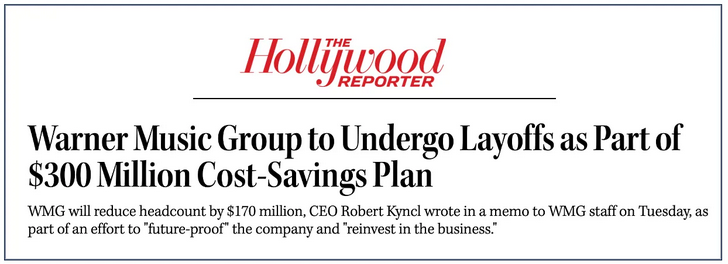
If you have any doubts about Warner’s priorities, here’s another headline — also from yesterday.

If you’re looking for a clear signal from a major record label, it won’t get any clearer than this.

This is exactly what a record label does when it no longer views music as a vital creative force in the current day. This is what happens when a major label morphs into a copyright and IP management business — which can be run by a small team of lawyers and accountants.

Yes, you can make money living off the past — but not for long.

I keep waiting to read a news story about a major label investing a billion dollars in developing new artists. But I never see that story.

I’ve written in the past about fans who prefer old music. But big record labels are even more obsessed with vintage and retro songs.

And it’s not just Warner Music. Universal Music is doing the same thing. So is Sony and Concord and other big labels.

That’s disturbing.

These are the same companies who should be creating the future of music. They should be convincing the public to listen to new songs and new artists. After all, if record labels don’t invest in the future of music, who will?

Maybe nobody.

A few years ago, investment firms started viewing old songs as investments. That didn’t work out very well. The most prominent song investment fund crashed and burned — as I predicted long in advance.

At that point, the smart money headed for the exits.

In the aftermath, the only enthusiastic buyers of old songs were the big record labels. They are the buyers of last resort.

NYC selects its own Justin Trudeau clone

Filed under: Media, Politics, USA — Tags: , , , , , — Nicholas @ 03:00

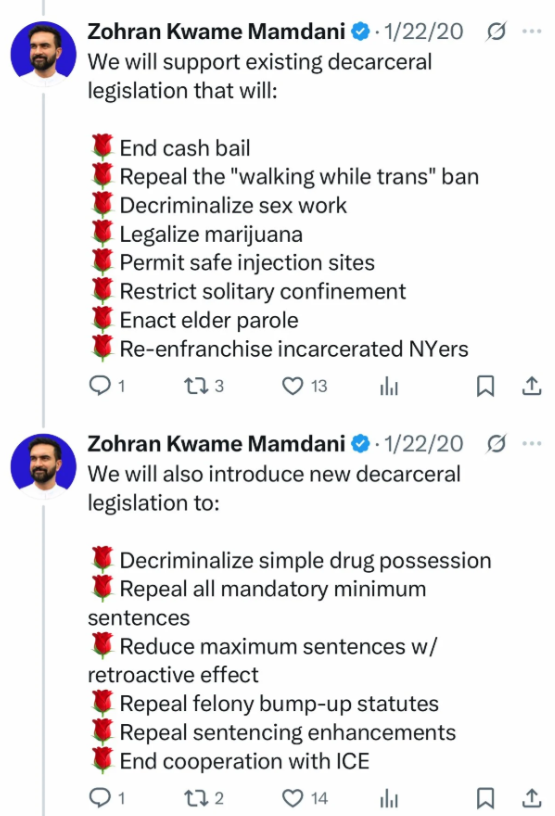
The winner of the Democratic primary is almost always subsequently elected as the mayor of New York City, so it’s fair to assume that Zohran Mamdani is going to be NYC’s next mayor. And he’s an American version of ultra-progressive former Prime Minister Justin Trudeau:

New York State Assemblymember Zohran Mamdani photographed in Assembly District 36, 10 February 2024.
Photo by Kara McCurdy via Wikimedia Commons.

American politics often seem to balance themselves out in the worst possible way. Even as the GOP sheds its last vestiges of affection for limited government and free markets, the opposition Democrats openly embrace bigotry and crazy economic nostrums. Case in point: the rise in New York City of Zohran Mamdani, an avowed socialist who flirts with antisemitism, to represent the Democratic Party in this year’s mayoral election.

The primary race in New York was a snapshot of the Democratic Party’s woes. Despite the presence of other candidates seeking the mayoral nomination, the race ultimately came down to two candidates: Mamdani and Andrew Cuomo, the disgraced former governor of New York.

Before resigning over allegations of sexual harassment, Cuomo, the 67-year-old son of another former governor, was best known for a “controversial directive that told nursing homes they couldn’t deny patients coming from hospitals admission based on a COVID-19 diagnosis”, according to StatNews. He then covered up the large number of ensuing deaths. He was the favoured candidate of the Democratic establishment and the early front-runner for the nomination.

Standing out from the pack of political hopefuls facing Cuomo was Zohran Mamdani, the 34-year-old son of an Oscar-nominated filmmaker and a Columbia University political science professor. Before being elected to the state legislature as a Democrat and a socialist, Mamdani tried his hand as a government employee and a rapper. His musical output included the song “Salaam”, which, as The Independent put it, “praised the ‘Holy Land Five’ — five men convicted in 2008 of donating over $12 million to Hamas”.

To say that New Yorkers are tired of Cuomo is a wild understatement. Like most Americans, New Yorkers are deeply sick of the old party establishment that rallied around Cuomo as well as the man himself. Yet, he was expected to walk away with the nomination and then cruise to victory in a largely one-party city.

But Mamdani sweetened the pot in the expensive metropolis with promises to freeze rent, make buses free, offer no-cost childcare, lower grocery prices with city-owned grocery stores, and use “public dollars” to build 200,000 apartments. He swears that he “knows exactly how to pay for it, too” with higher taxes on those making more than $1 million per year. Not explicitly part of his campaign, but on the record as his intention, is “the end goal of seizing the means of production”.

In the 2021 recording in which he advocated seizing the means of production, Mamdani endorsed BDS as an issue “that we firmly believe in”. The BDS movement — shorthand for “Boycott, Divestment, and Sanctions” — aims to economically pressure Israel into withdrawing from so-called “occupied territories” and allowing Palestinians to settle throughout Israel. At its extremes, BDS seeks to eliminate the world’s only Jewish-majority state. It’s inspired by the movement against South Africa’s old apartheid regime.

July 4, 2025

July 4, 1826

Filed under: Government, History, USA — Tags: , , — Nicholas @ 02:00

The History Guy: History Deserves to Be Remembered
Published 4 Jul 2022

On the fiftieth anniversary of the ratification of the Declaration of Independence, the US lost two of the men most responsible for its creation. Independence Day 1826 might be the most important since July 4, 1776.
(more…)

QotD: US-Canadian conflict before Confederation

Filed under: Cancon, History, Military, Quotations, USA — Tags: , , , , , — Nicholas @ 01:00

Canada has never fought a direct war against the United States. However, before confederation (1867) when Canada became a self-governing dominion, the territories that would later form that dominion, which had been under the control of the British, engaged in a small number of military conflicts with the United States (or as they were known previously, the Thirteen American Colonies). The total is four, if we only count significant engagements which involved organized forces. Economic wars, or trade disputes, are another story. We’ll get there.

The Aroostook War (1838–1839) drew no blood. The conflict concerned the Maine-New Brunswick border and was resolved amicably by the Webster-Ashburton Treaty of 1842. A quarter of a century later the Fenian Raids (1866–1871) saw the Irish-American Fenian Brotherhood make multiple non-state sanctioned attacks in British North America in an effort to sway Britain to withdraw forces from Ireland.

The other far more consequential military struggles between the two North American friends and neighbours occurred first in the late eighteenth century, and second in the early nineteenth century. During the American Revolutionary War (1775-1783), which saw limited involvement of areas north of the 49th parallel, British North America thwarted a particularly serious invasion by the Americans in 1775 known as The Battle of Quebec.

It was fought during a snowstorm on December 31, 1775 (one of few battles fought in such miserable conditions during the revolutionary war). The American intention was to conscript the British colony, which today forms the province of Quebec (and also included parts of Ontario) into their struggle against the British. The Patriots of the Thirteen Colonies had earlier that year begun rebelling against British taxation and governance. They surmised that the French-speaking Quebec settlers, disaffected with the imposition of British rule as it was laid out in the 1763 Treaty of Paris (which ended the Seven Years War), would join the American cause. A significant miscalculation, to say the least.

The battle was fought on two fronts against a British garrison of 1800 soldiers led by British commander, Governor Guy Carleton. The combined total of American troops was only 1200. The first front was commanded by Brigadier General Richard Montgomery, who led his troops in an attack of the Lower Town from the south. The second assault occurred from the north and was led by Colonel Benedict Arnold (who would later become an infamous American traitor).

Montgomery and several officers were killed instantly on their initial advance. This sparked a retreat amongst his remaining soldiers. Arnold had slightly more luck. His army penetrated northern defences but were stymied in the narrow streets of Quebec. During fighting Arnold was wounded, after which he handed the command to Daniel Morgan. After hours of fighting, Morgan and his men were forced to surrender. The Americans lost the battle decisively ensuring Quebec would remain a loyalist stronghold.

The second of the two significant conflicts involving British North America and the Thirteen American Colonies was the infamous War of 1812 – a more well-known period of antagonism between proto-Canada and her American neighbours.

Here is a topline summary with some extra history concerning the U.S.-Canada border (the world’s longest undefended border), from Terry Glavin:

    The War of 1812 — which the Americans still pretend they won — was officially concluded with the Treaty of Ghent in 1814. Then came the Rush-Bagot Pact of 1817 and the Convention of 1818, which set the border at the 49th parallel.1

The War of 1812 took place during Britain’s struggle against Napoleonic France. The two most famous Canadian battles from this tragic conflict were the Battle of Queenston Heights and the burning of York (now Toronto) – British troops would even the score of the latter by burning Washington D.C.

The war was unpopular. Like today, there were too many bonds between the Americans and proto-Canadians. But also like today, with Canada and the United States once again bickering over trade and various political interests, the disagreements were accompanied by a reluctance to engage in hostilities.

From Pierre Burton’s War of 1812:

    At the outset, it was a gentleman’s war. Officers on opposing sides met for parlays under flags of truce, offered hospitality, exchanged cordialities, murmured the hopes that hostilities would quickly end.2

No matter what time period we are examining, we can never forget that Britons, Canadians and Americans are all first cousins. Yes we disagree from time to time, sometimes we even fight. But always over some unfortunate political dispute, and never for each other’s annihilation.

In 1812, for a variety of reasons, the Americans, especially a minority of hawkish elites in Washington, felt they had no other choice but to invade the north. Some of them felt it would be easy. An aggravating factor concerned Britain’s support of Indian tribes in the north west, at a time when the Americans were aggressively expanding into that region. But also, during their imperial contest with France, the British were impressing sailors in the American navy (forcing them to join British forces), because they considered them traitors of the British crown. Further, they blocked key trade ports under Napoleon’s control, disrupting trade between America and France.

Isn’t it curious how trade so often appears as the rift in Canadian-American relations? Further examples include: the Reciprocity Treaty of 1854 which allowed for free trade of natural resources between the American and British colonies. However, the Americans abrogated that treaty in 1866 partly out of frustration at perceived British support of the confederacy after the Civil War. A post-confederation trade war with the Americans ensued after Canada’s first Prime Minister John A. MacDonald adopted the National Policy in 1879, which imposed high tariffs to protect Canadian industry. Triggering the Americans to respond with tariffs of their own.

James Pew, “Canadians and our ties to Americans”, Woke Watch Canada, 2025-03-30.


July 3, 2025

QotD: Why Marxists turned away from space exploration and colonization

Devon Eriksen recently pointed out that today’s Marxists are hostile to space flight and off-world colonization. But in Cold War times, Marxists who ran countries were aggressively futuristic about space, treating it as the empire of their dreams.

What caused this turnaround?

To understand this, it’s helpful that to notice that spaceflight is not the only technology about which Marxist attitudes have done a 180. Nuclear power is another. More generally, where Marxists used to be pro-growth and celebrate industrialization and material progress, they’re now loudly for degrowth and renunciation.

But the history of western Marxism is more interesting than that. Western Marxists flipped to strident anti-futurism in the late 1960s and early 1970s while futurist propaganda in the Communist bloc did not end until its post-1989 collapse.

That 20-year-long disjunct was particularly strong about nuclear power, with the Soviets providing ideological support and funding to the foundation of European Green parties and the US’s anti-nuclear-power movement at the same time as they were pouring resources into nuclearizing their own power grid.

And that’s your clue. Domestic Marxism favored making power cheap and abundant, while their Western proxies pushed to keep it expensive and scarce and preached degrowth rather than expansion. Futurism vs. anti-futurism: why?

We don’t need to theorize about this. Yuri Bezmenov, a former gear in the Soviet propaganda machine, told us the answer starting in the early 1980s. Fewer people listened than should have.

Bezmenov explained that unlike Marxism in the Sino-Soviet bloc, Western Marxism was a mind virus, a memetic weapon designed to weaken and degrade its host societies from within, softening them up for totalitarianism and an eventual Soviet takeover. The West was to be denied power, both in a literal and figurative sense.

Ever wonder why today’s Marxists are so quick to make alliances with radical religious Islamists? This shouldn’t happen. According to Marxist theory, Islamism is a regression to an earlier stage of the dialectic than capitalism, and today’s Marxists ought to fear and hate it as a counter-ideology more than capitalism. But they don’t, because to them Islam is a tool to be used for nihilistic ends.

That nihilism is the actual purpose of Western Marxism and all its offshoots, including “woke”. One sign of this is how fervently it embraces the sexual mutilation of children.

The Soviets are gone but their program is still running autonomously in the brains of people who were infected by their Cold-War-era proxies and the successors of those proxies. And that program is nihilism all the way down.

Yuri Bezmenov should have been heeded. There is no simpler theory that fits the observed facts.

Eric S. Raymond, Twitter, 2024-05-14.

July 2, 2025

The Korean War Week 54 – The War is One Year Old – July 1, 1951

Filed under: China, History, Military, Russia, USA — Tags: , , , , , , , — Nicholas @ 04:00

The Korean War by Indy Neidell
Published 1 Jul 2025

Over a year has passed since North Korean forces crossed the 38th Parallel and invaded South Korea, and while the war has seen the advantage switch hands time and again, one thing it has not seen is any sort of cease fire or peace negotiations. However, that might change soon, as this week both the Chinese and the Americans indicate their willingness to sit down and talk. South Korean President Syngman Rhee, however, is against any cease fire talks that do not set out to meet a big variety of his demands, demands which which the other warring parties do not see as being in their own best interests.
(more…)

July 1, 2025

Like a cheap suit, Canada folds under Trumpian pressure on the Digital Services Tax grab

Filed under: Cancon, Government, Media, Politics, USA — Tags: , , , , , — Nicholas @ 05:00

A couple of days back, I characterized Prime Minister Mark Carney’s determination to push ahead with the Digital Services Tax “insane”, as it was overwhelmingly likely to trigger a strong reaction from the Trump administration. As it did. So, finally recognizing they were in a no-win situation, the federal government announced at the last minute that they wouldn’t be demanding the literally billions of dollars from the US “tech giants” after all. Michael Geist can legitimately say “I told you so” on this issue:

President Trump Attends G7 Summit in Canada by White House https://www.whitehouse.gov/gallery/president-trump-attends-g7-summit-in-canada/ CC BY 3.0 US

After years of dismissing the warnings of likely retaliation, the Canadian government caved last night on the digital services tax. Faced with the prospect of the U.S. suspending trade negotiations, Finance Minister François-Philippe Champagne announced that the government would drop the DST altogether, payments scheduled for Monday would be cancelled, and legislation will be forthcoming to rescind the legislation that created it in the first place. Over the weekend, I wrote about the repeated warnings that the DST was a serious trade irritant with the U.S. that cut across party and presidential lines. While ignoring the risks was bad enough, I argued that Canada played its DST card too early. Rather than delaying implementation in the hopes of incorporating it into a broader trade deal with U.S., it marched ahead, leading to an entirely predictable response from U.S. President Donald Trump. That left Canada in a no-win situation: stick with the DST but face the prospect of higher tariffs or embarrassingly drop the DST (and $7.2 billion in revenue over five years) with only restarting negotiations that were on until government overplayed its hand to show for it.

It is hard to overstate how badly the government managed the DST issue over the past five years. It alienated allies by pushing ahead with the DST despite efforts at an international deal at the OECD, stood alone in rejecting an extension of a moratorium on new DSTs, made the DST retroactive which solidified opposition, and continually downplayed the concerns of successive U.S. Presidents and Members of Congress from both sides of the aisle. Meanwhile, when companies began passing along the costs of the DST to Canadian businesses, it did nothing. And when they urged the government to delay implementation to at least allow for the issue to be incorporated into a broader trade pact, it ignored the advice.

At every step, there were better options. This year, the likelihood that the DST would come to a boil was obvious to anyone who was paying attention. But rather than following the UK strategy, which managed to salvage a smaller DST (2% rather than 3%) as part of a bigger agreement that includes a commitment to support UK digital access to the U.S. market and to negotiate a larger digital trade deal, Canadian officials seemingly assumed that the U.S. was bluffing and would not retaliate.

If this sounds familiar, it is because the Canadian government misreading the tech sector has become a hallmark of its policy. Talk tough, practically dare companies and foreign governments to respond, and then frantically seek an exit strategy when they do. This was the case with the Online News Act and Meta’s blocking of news links, with the government’s AI regulation which new Minister of AI Evan Solomon says will not be re-introduced, with the Online Harms bill, and now with the DST.

The Food Professor explains what Trump got right in his Trade War

On the social media site formerly known as Twitter, Dr. Sylvain Charlebois, aka @FoodProfessor explains how Trump’s Trade War strategy is working out for US interests, in contrast to the Trudeau/Carney governments’ approach:

The Globalism Hangover: What Trump’s Trade War Got Right

“Trump’s bombastic style aside, his nationalist approach to trade and food policy is forcing global institutions to justify their existence — and that’s a conversation Canada can no longer afford to ignore.”

For the past six months, President Donald Trump’s trade policies have been widely mocked, criticized, and condemned. Some of it is certainly warranted. The Wall Street Journal, for instance, recently likened his tariff-heavy approach to global trade as a direct path toward another Great Depression. But data out of the United States tells a more nuanced story — one that challenges conventional wisdom.

Despite persistent headwinds, the U.S. economy continues to outperform expectations. The Federal Reserve Bank of Atlanta projects second-quarter GDP growth at 3.8%. In May, the U.S. economy added 139,000 jobs, outpacing forecasts, while inflation remained subdued at 0.1% month-over-month and 2.4% annually. The U.S. trade deficit has been cut nearly in half, pointing to stronger export performance and a rebalancing of trade relationships.

Canada, by contrast, is showing signs of economic strain. The national economy is shrinking, manufacturing is struggling under U.S. trade pressure, and food inflation is outpacing general inflation. In short, our economy is not keeping pace—despite our public criticism of the Trump administration.

To make matters worse, the Trump administration has now halted all trade negotiations with Canada, signaling that our bilateral economic relationship holds little strategic value for Washington. For the U.S., Canada is no longer a priority — especially under a Carney-led government that has visibly pivoted toward Europe, a market still heavily invested in maintaining close ties with the United States. From an agri-food standpoint, this shift is consequential: access to our largest trading partner is narrowing, while Ottawa appears more focused on diplomatic optics than on securing stable, competitive trade channels for the Canadian agrifood economy.

This is the one thing the ‘Elbows Up’ crowd never understood — and still doesn’t. We’re not in a trade war with the U.S. There’s no war to be won. For Trump, this is about a realignment of the global order, plain and simple — one centered entirely on American supremacy.

Love him or loathe him, Trump is not destroying the U.S. economy — not yet, anyway. His unapologetically nationalist agenda extends far beyond tariffs. He has withdrawn U.S. support from key global institutions such as the WHO and is threatening to sever ties with others, including NATO and several UN-affiliated agencies. Among them is the Food and Agriculture Organization (FAO), the UN’s most authoritative body on food security.

At a recent event in Brazil, a senior FAO official acknowledged that fundraising dynamics have shifted. In the Trump era, governments are asking harder questions: Why should we fund the FAO? What domestic benefit does it provide? What used to be assumed support is now conditional — and arguably, more accountable.

This shift isn’t unique to Washington. Many countries are quietly aligning with the U.S. position, scrutinizing globalist institutions with renewed skepticism. Transparency and accountability are byproducts of this anti-globalist sentiment — something not inherently negative.

For decades, globalism pushed the world to believe that trade liberalization was the only viable path to growth and prosperity. It became conventional wisdom. But globalism has made some nations — and some people — richer, while leaving others behind. In the process, domestic sectors, including agriculture, were often sidelined or sacrificed in the name of global efficiency.

The problem with globalism, particularly in agri-food policy, is its tendency to pursue uniformity over relevance. Canada, for example, adopted the carbon tax under a globalist climate agenda that often overlooks the vital role food producers play in feeding people. Instead of being supported, the sector is too often vilified as a problem. But agriculture is not a liability — it is a necessity.

Trump’s message — wrapped, of course, in provocative and often abrasive language — is that one-size-fits-all global policies rarely work. Nations have different socio-economic realities, and those should come first. While cooperation is essential, so is recognizing local and regional priorities. In this sense, his “America First” approach is not without logic — especially when it seems to be yielding short-term economic gains.

For Canada’s agri-food sector, the lesson is clear: striking a better balance between global commitments and national imperatives is overdue. We should not abandon multilateral cooperation, but we must stop anchoring policy to global agendas we have little influence over. Instead, let’s define what works for Canadians — what supports our farmers, protects our food security, and reflects our unique landscape — while keeping the broader global context in view.

We are not there yet. But if this moment of disruption sparks a more realistic and regionally attuned approach to food policy, we’ll be better for it.


June 30, 2025

“This is not toxic empathy, it’s psychotic empathy”

Filed under: Media, Politics, USA — Tags: , , — Nicholas @ 05:00

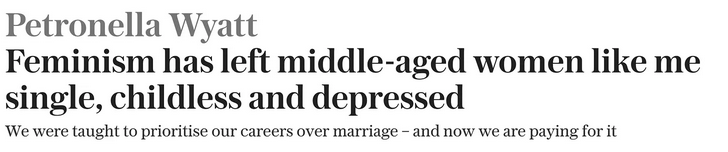
Elizabeth Nickson suggests that we’re well past peak political feminism:

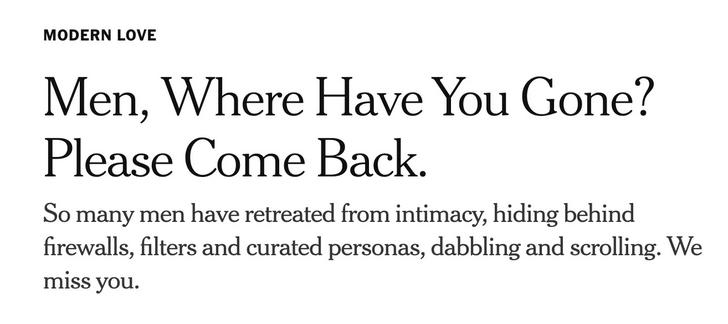
Last week, no month, there have been cries from the heights of official culture begging men to come back. I joked on Facebook that they are all at my house, hiding out with someone who doesn’t hate them, which is sort of true; my immediate family is all male, and Christmases are a bro-fest with me in the kitchen. I exaggerate. No. Yes. I don’t know. Of course they help but I do wish for one daughter/sister in law to keep the chaos down. My father once said, “women civilize men, that’s their job”. I don’t think he meant harangue, demand, prosecute and imprison.

In any case, I started the first feminist theatre in Canada. I know this because a grad student did her master’s thesis on Feminist Theatre in Canada (poor thing) and called to interview me. I was 22, and dumb as a rock. But eager to tell the world its faults (plus ca change). My artistic director Svetlana — who was in the MFA program — and I decided that we would only hire women, do women’s plays, etc.

Problem was there were no plays. Aphra Behn was the only one we could find that wasn’t trivial, and she lived 250 years ago. That was when I discovered I loved writing because we had to write our own. Now, of course, there is a massive, over the top, gold-platinum-diamond-and rubies Renaissance in women’s art, and my silly self was as usual so far ahead of the game I didn’t profit from it. Well, I did, it helped my college expenses no end.

So I got a couple of grants, and we collected box office, and ran “plays” and workshops on how to have difficult feminist conversations, one memorably at the Vancouver Art Gallery, where the wife of a famous poet told us that all this guff was going to be forgotten once the estrus cycle kicked in. Svetlana telegraphed ignorance at me, and I back; no one had any idea what she meant. We 22 year olds argued her down, she clung to her thesis and, guess what, turned out she was right. Everyone “met” someone, got pregnant, built marriages and families, but Svetlana who decided she was gay (at the time we worked together she was married), and died young from alcoholism. Is that my fault? It was my idea.

Feminism marched on. To this:

I repent here and now. What feminism has become is anathema. I am actually scared of women. I am afraid of their anger, and I am afraid of their cruelty, their harshness, and I see it everywhere. Luckily through my work I have met women who think like me and we are friends and I am not afraid of them. But I shrink from all other friendships. Female friendships today are built on one thing: are you on side? Are you for abortion, against the patriarchy, for Hamas and most recently, the Mullahs, celebrate female politician wins as long as they are on side, ally with the LBGTZQ+ community, etc.? I am none of these things, so were I to venture into ‘women’s spaces’ eventually the furies would plot revenge. I would be cast afloat, thrown into the wild to fend for myself, as an uppity woman would have been in clan or tribal times, to which we are reverting.

In business, conform or be ruined. Think like us or we cancel your dates, your performance, your promotion. Even the mega-famous:

Therefore I now avoid the friendship of women, in which I used to luxuriate. So if I can’t even spend time in their presence, how the hell are men supposed to marry them?

This is how stupid political women have become. This was last weekend in Germany, and, well, everywhere these women breathe, and that means everywhere in the west.

This is not toxic empathy, it’s psychotic empathy.

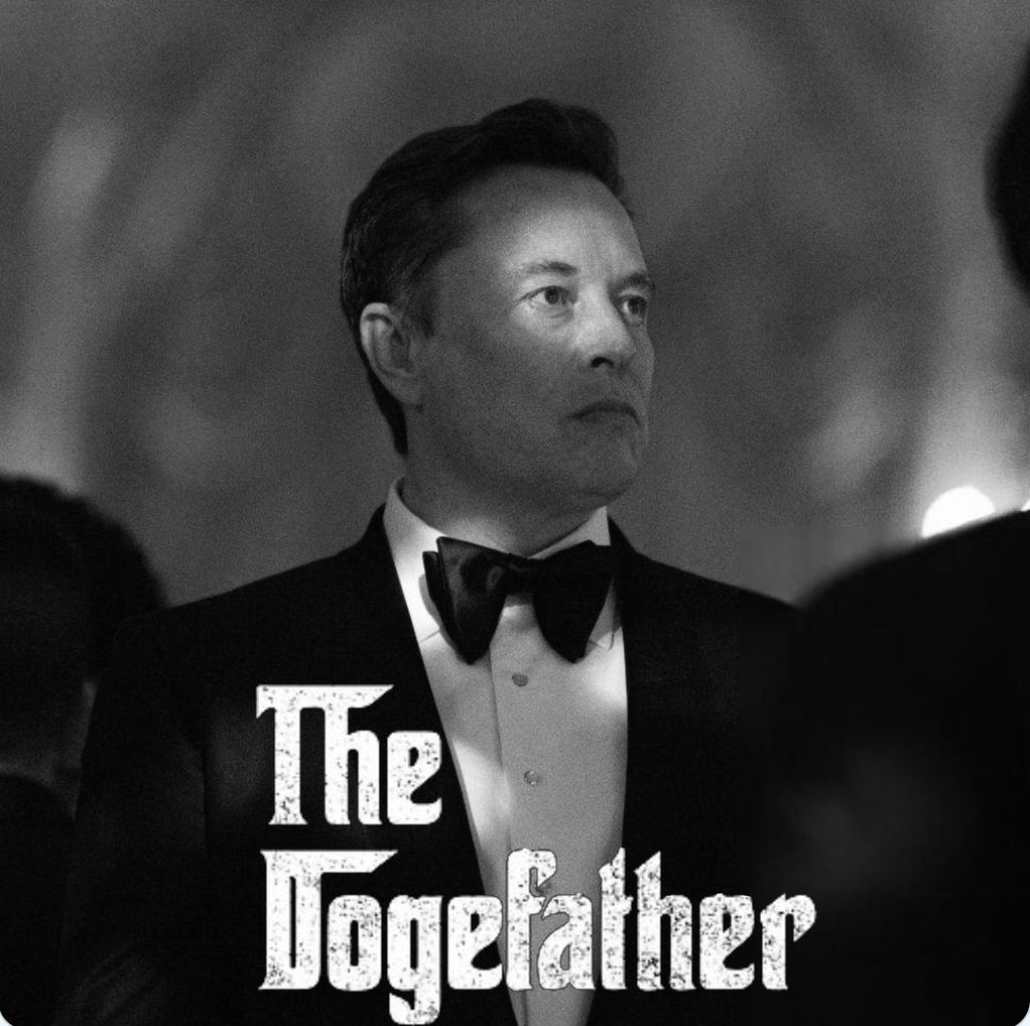
DOGE couldn’t address the structural problems with the US government

At the Foundation for Economic Education, Mohamed Moutii looks at the reasons DOGE was unable to come close to achieving the lofty goals it was launched with:

DOGE’s biggest failure was its inability to deliver its promised sweeping transformation. From the start, its $2 trillion savings target was unrealistic. Cutting nearly 30% from a $7 trillion budget was never feasible, especially with politically untouchable programs like Social Security, Medicare, Medicaid, and Defense off the table.

Musk’s claim that eliminating waste alone could close the gap didn’t hold up. While most budget experts support cutting inefficiencies, they agree that waste isn’t the main driver of the fiscal crisis. Even slashing all discretionary spending would save only $1.7 trillion. The real pressure comes from mandatory programs, which account for nearly two-thirds of the budget, leaving only a quarter of spending truly up for debate.

As reality set in, Musk’s savings claims shrank from $2 trillion to just $150 billion. While DOGE cites $170 billion saved, independent estimates suggest closer to $63 billion, less than 1% of federal spending, with many claims either inflated or unverifiable. Some savings were credited to long-canceled contracts. Though headline-grabbing layoffs and cuts were made, they were often botched, forcing agencies to rehire staff or reverse course. Meanwhile, federal spending rose by $166 billion, erasing any gains. Trump’s fiscal agenda worsens the outlook with the first-ever $1 trillion defense budget, sweeping tax cuts, and protected entitlements — all while annual deficits approach $2 trillion.

Yet DOGE’s failures ran deeper than mere fiscal naiveté. What began as Musk’s role as a “special government employee” quickly expanded into an unchecked exercise of executive power, raising constitutional alarms. His team reportedly accessed classified data, redirected funds, and sidelined entire agencies — actions taken without Senate confirmation, potentially in violation of the Appointments Clause of the Constitution. Legal pushback swiftly followed, with fourteen states suing Trump and Musk over the constitutionality of Musk’s White House-granted authority.

Meanwhile, glaring conflicts of interest became impossible to ignore. Musk’s companies — X, SpaceX, and Tesla — hold $38 billion in federal contracts, loans, tax breaks, and subsidies while facing over 30 federal investigations. His push to dismantle regulatory agencies like the Consumer Financial Protection Bureau (CFPB) — while X launches the “X Money Account“, a mobile payment service subject to CFPB oversight — only deepened concerns. Musk was legally obligated to separate his business dealings from government decisions. One major result has been the impact on Musk’s reputation. Once hailed as a visionary for his promotion of electric cars, he is now viewed unfavorably by many former fans.

June 29, 2025

Carney’s insane determination to keep the Digital Services Tax

One of the most noted features of Prime Minister Mark Carney’s attitude toward, well, everything is his unwillingness to take the concerns of his opponents into account. He seems to feel that he always knows best and therefore any opposition is therefore, by his definition, wrong. The government had been warned by pretty much every observer that the attempt to impose a protectionist digital service levy had incredibly high chances of triggering blowback … and it has:

Mark Carney’s thought process when he encounters dissent, probably

In other words, you can have many reactions to the current DST battle, but surprise should not be one of them. Canada pushed ahead despite efforts at an international agreement on the issue and later dismissed the increasing friction over the issue with the U.S., which has been signalling its opposition to the DST for many years. Donald Trump has taken action, but his views are not dissimilar from Joe Biden’s on the issue nor Members of Congress from both parties. Further, the companies directly affected by the rules have been similarly responsive. For example, Google began levying a 2.5% DST fee on Canadian advertisers last year in anticipation of the DST taking effect in 2025, thereby passing along much of the DST cost to Canadian businesses and consumers.

To be clear, Canada is free to adopt whatever tax policies it wants and tech companies should pay their fair share of taxes. Ensuring tech companies collect and remit sales taxes on digital sales and services is now well established in Canada. But the government’s policy of “making web giants pay” by going above taxes all companies pay with a percentage of revenues to support Canadian film and television, millions for the news sector, and now the DST was always going to spark a reaction.

Further, the Canadian DST is exceptionally complex, covering a wide range of digital revenues that occur in Canada. The baseline applicability is for companies that generate 750 million euros (about C$1.1 billion) in global revenue of which at least $20 million is digital services revenue in Canada. Digital services revenue can arise from (1) online marketplace services revenue (which would cover an Ebay, Airbnb or Uber), (2) online advertising services revenue (Google or Microsoft), (3) social media services revenue (Facebook or TikTok), and (4) user data revenue (any company that collects and sells user data). Targeting these services means there is a lot stake, estimated by the Parliamentary Budget Officer at $7.2 billion over five years.

Other countries have DSTs, but Canada was the only one to introduce one despite an agreement to institute a moratorium on new DSTs years ago at the OECD. And then it was one of the only countries to reject an extension of that moratorium. The government insisted it would move ahead without delays and indicated it was confident it could avoid retaliation.

Given the trade tensions with the U.S. since the election of Donald Trump, unilaterally dropping the DST in the midst of a trade battle did not make much sense as we needed policy certainty under a broader deal. In other words, the DST was a card we had to play as part of a negotiation. But once we played that card by announcing the tax would take effect next week, it virtually guaranteed the U.S. would respond as it did. The priority should have been a broader deal. The government could have adopted a Trump-style delay for a month to give more time for negotiations. It could have have followed the UK model of weaving it into a broader agreement and committing to a larger digital trade deal. Instead, the government continued years of dismissing the trade risks associated with the DST, potentially creating bigger economic problems in the process.

Dan Knight on how Ottawa deliberately baited Trump, despite all the warnings that this was an incredibly stupid idea:

Donald Trump has officially walked away from the negotiating table. The trigger? Canada’s ill-conceived Digital Services Tax (DST) — a reckless, retroactive grab for revenue targeting U.S. tech firms. Trump isn’t mincing words: he’s calling it a “blatant, discriminatory attack” on American innovation, and now he’s moving to punish Canada economically for it.

So what exactly is this tax?

The Digital Services Tax, passed by the Liberal government and implemented under Mark Carney’s leadership, applies a 3% levy on revenue — not profits — earned by large digital firms operating in Canada. And it’s retroactive. That means it’s being applied to earnings from as far back as January 1, 2022, with companies forced to make lump-sum payments by June 30, 2025.

This tax specifically targets companies with global revenue of at least 750 million and Canadian digital revenue of at least CAD 20 million. Translation: It’s a direct hit on American giants like Google, Amazon, Meta, Airbnb, and Uber, and it spares Canadian firms and EU-based entities from equivalent exposure. It’s not tax fairness — it’s protectionism with a smiley-face sticker.

Trump has responded in kind. As of June 27, all trade negotiations with Canada are suspended. Retaliatory tariffs — already mounting since February — are set to escalate. Trump is drawing a red line, and he’s daring Canada to cross it.

What’s at stake?

Everything. Canada sends over 75% of its exports to the United States. We’re talking about nearly a trillion dollars in annual trade. With Trump now actively leveraging tariffs and ending negotiations, entire sectors — from automotive to agriculture, energy to manufacturing — are in the crosshairs.

Already this year, Trump has slapped 25% tariffs on Canadian imports, with specific hits to steel, aluminum, vehicles, and auto parts, and 10% tariffs on Canadian oil, gas, and potash. These moves have already disrupted markets. Ending trade negotiations is a body blow to an already wobbly Canadian economy — still reeling from Trudeau-era mismanagement and Carney’s corporate globalist agenda.

So who could have seen this coming?

Almost everyone.

The oddity of Donald Trump’s personal “golden share” in US Steel

Filed under: Business, Government, Japan, USA — Tags: , , — Nicholas @ 04:00

In the National Post, Colby Cosh points out the weirdest element of President Trump’s deal with Nippon Steel for the takeover of venerable US Steel:

A “golden share” is a special kind of equity that gives its holder veto power over specified corporate decisions. It is often used in privatizations to give governments some vestige of control over corporate entities originally created by the state (or, in Canada, the Crown) for public purposes. In this unusual case, the U.S. government is magically gaining a golden share in exchange for permitting the sale of one private company to another. The government will be given the right to choose some U.S. Steel board directors, to forbid any name change, and to veto factory closures, offshoring, acquisitions and other moves.

As the Cato Institute immediately pointed out, this is a de facto nationalization of U.S. Steel — the sort of thing that would have had Cold War conservatives climbing the walls and hooting about socialism. But at least socialism professes to be social! Yesterday a lefty energy reporter named Robinson Meyer was nosing around in the revised corporate charter for the newly-acquired U.S. Steel, and he discovered a remarkable detail that the Cato folks had missed: the decision powers of the golden share have been legally assigned to Donald Trump in person and by name for the duration of his presidency. Only after Trump has left the White House do those golden-share powers revert to actual U.S. government departments (Treasury and Commerce).

The stench of banana-republicanism here is truly overwhelming. Again, any species of government foreign-investment review is bound to have a personal character, but such decisions are not supposed to involve the legally explicit assignment of a valuable corporate asset to the decision-maker in his own person. Can this be described as anything but legalized, open bribery — assuming that U.S. courts will find it legal if the terms of sale are challenged? Where in the U.S. Constitution, or in the history of the United States, can any warrant for this extraordinary behaviour conceivably be found? And will unholy bargains of this nature soon become routine?

A parent reviews “Alpha School”

Filed under: Education, Technology, USA — Tags: , , — Nicholas @ 03:00

At Astral Codex Ten, an anonymous reviewer offers his views on a new “AI-powered” school that claims radically better results for children than traditional schooling methods:

Unbound Academy website screencap

In January 2025, the charter school application of “Unbound Academy“, a subsidiary of “2 Hour Learning, Inc“, lit up the education press: two hours of “AI-powered” academics, 2.6x learning velocity, and zero teachers. Sympathetic reporters repeated the slogans; union leaders reached for pitchforks; Reddit muttered “another rich-kid scam“. More sophisticated critics dismissed the pitch as “selective data from expensive private schools”.

But there is nowhere on the internet that provides a detailed, non-partisan, description of what the “2 hour learning” program actually is, let alone an objective third party analysis to back up its claims.

[…]

Unfortunately, the public evidence base on whether this is “real” is thin in both directions. Alpha’s own material is glossy and elliptical; mainstream coverage either repeats Alpha’s talking points, or attacks the premise that kids should even be allowed to learn faster than their peers. Until Raj Chetty installs himself in the hallway with a clipboard counting MAP percentiles it is hard to get real information on what exactly Alpha is doing, whether it is actually working beyond selection effects, and if there is anyway it could scale in a way that all the other education initiatives seemed to fail to do.

I first heard about Alpha in May 2024, and in the absence of randomized-controlled clarity, I did what any moderately obsessive parent with three elementary-aged kids and an itch for data would do: I moved the family across the country to Austin for a year and ran the experiment myself (unfortunately, despite trying my best we never managed to have identical twins, so I stopped short of running a proper control group. My wife was less disappointed than I was).

Since last autumn I’ve collected the sort of on-the-ground detail that doesn’t surface in press releases, or is available anywhere online: long chats with founders, curriculum leads, “guides” (not teachers), Brazilian Zoom coaches, sceptical parents, ecstatic parents, and the kids who live inside the Alpha dashboard – including my own. I hope this seven-part review can help share what the program actually is and that this review is more open minded than the critics, but is something that would never get past an Alpha public relations gatekeeper:

  1. Starting Point: My Assumptions: how my views on elite private schools, tutoring and acceleration shaped the experiment (and this essay). WHAT is the existing education environment.
  2. A Short History of Alpha: from billionaire-funded microschool to charter aspirations. HOW Alpha came to be.
  3. How Alpha Works Part 1: Under the Hood: What does “2-hour learning” actually look like – what is the product and the science behind the product? HOW is Alpha getting kids to learn faster (Spoiler: “Two hour learning AI learning” closer to three hours, with a 5:1 teacher:student ratio and zero “generative AI”).
  4. How Alpha Works Part 2: Incentives & Motivation: The secret sauce that doesn’t get mentioned in the PR copy, but I have discovered is at least as important as the fancy technology. The “other HOW” that no one is talking about.
  5. How Alpha is Measured: Effectiveness: The science says it should work, but how do you measure if it is working? How is the vaunted “2.6x” number calculated? WHAT data is Alpha using to make its claims and what does that data actually say?
  6. Why this time might be different: Most promising educational initiatives fail to have impact when expanded beyond their initial studies. Bryan Caplan might argue this is because most education education is just signaling anyway (“The Case Against Education“). He also argues that most parental interventions have no impact (“Selfish Reasons to Have More Kids“) – He claims that how kids turn out is a combination of genetics and non-shared environment (randomness; nothing to do with parenting choices). How can we reconcile Caplan’s buttoned-up data with the idea that the “parenting choice” to educate your kids differently (like with Alpha) might result in different outcomes than would be expected from genetics alone? WHY could Alpha work?
  7. What Comes Next? The Scaling Problem: The Alpha founders have a vision of completely re-inventing the way the world serves education. But even if Alpha works, it is up against a history of education programs that were never able to scale. It is also going to face resistance for being “weird”. WHAT comes next?

After twelve months I’m persuaded that Alpha is doing something remarkable — but that almost everyone, including Alpha’s own copywriting team, is describing it wrong:

  • It isn’t genuine two-hour learning: most kids start school at 8:30am, start working on the “two-hour platform” sometime between 9am-930am and are occupied with academics until noon-1230pm. They also blend in “surges” from time to time to squeeze in more hours on the platform.
  • It isn’t AI in the way we have been thinking about it since the “Attention is all you need” paper. There is no “generative AI” powered by OpenAI, Gemini or Claude in the platform the kids use – it is closer to “turbocharged spreadsheet checklist with a spaced-repetition algorithm”
  • It definitely isn’t teacher-free: Teachers have been rebranded “guides”, and while their workload is different than a traditional school, they are very important – and both the quantity and quality are much higher than traditional schools.
  • The bundle matters: it’s not just the learning platform on its own. A big part of the product’s success is how the school has set up student incentives and the culture they have built to make everything work together

… Yet the core claim survives: Since they started in October my children have been marching through and mastering material roughly three times faster than their age-matched peers (and their own speed prior to the program). I am NOT convinced that an Alpha-like program would work for every child, but I expect, for roughly 30-70% of children it could radically change how fast they learn, and dramatically change their lives and potential.

June 27, 2025

QotD: The dangers of “doing too much principal component analysis”

John: I’ve never read a fashion magazine or watched a runway show, so I just naively assumed that models were stunningly attractive and feminine. But as Mears points out, the models are not actually to most men’s tastes. They tend to have boyish figures and to be unusually tall.1 Is this because the fashion industry is dominated by gay men, who gravitate towards women who look like teen boys? Whatever the origins of it, there is a model “look”, and the industry has slowly optimized for a more and more extreme version of it, like a runaway neural network, or like those tribes with the rings that stretch their necks or the boards that flatten their skulls. There’s actually a somewhat uncanny or even posthuman look to many of the models. The club promoters denigrate women who lack the model look as “civilians”, but freely admit that they’d rather sleep with a “good civilian” than with a model. The model’s function, as you say, is as a locus of mimetic desire. They’re wanted because they’re wanted, in a perfectly tautological self-bootstrapping cycle; and because, in the words of one promoter: “They really pop in da club because they seven feet tall”.

[…]

By the way, the fact that models are beautiful in a highly specific way, and that there exist women who are similarly beautiful but condemned to be “civilians”, is a good reminder of the dangers of doing too much principal component analysis.2 In so many areas of life, we are obsessed with collapsing intrinsically high-dimensional phenomena onto a single uni-dimensional axis. You see this a lot with the status games that leftists play around privilege and oppression — I feel like a rational leftist would say that a disabled white lesbian and a wealthy scion of Haitian oligarchs are just incomparable, each more privileged than the other in some senses and less in other senses. But no, instead there’s an insistence that we find an absolute total ordering of oppression across all identity categories, a single hierarchy that allows us to compare any two individuals and produce a mathematical answer as to which one is more deserving of DEI grants. My hunch is a lot of the internal tensions and bickering within American leftism are actually produced by this insistence, which makes sense because it’s totally zero sum.

But the disease of trying to pin everything to a single number is hardly confined to the left. You see it on the right in the obsession with IQ, as if a single number could capture the breathtaking range of variation of cognitive capabilities across all humanity. I mean for goodness sake, Intel learned the hard way that this doesn’t even work for computers, and human brains are much weirder and more complicated than microprocessors. But the even dumber version of this is the 1-10 scale of female beauty. There’s something so sublime about seeing a beautiful human being, because so much of it is either bound up in subtle interrelationships between different features (this is why plastic surgery often makes people uglier — there’s no such thing as a “perfect nose”, and if you pick one out of a catalog you’ll probably end up with one that doesn’t fit your face), or it’s irretrievably evanescent — a fleeting glance, or the way her hair falls across her face just so, gone the moment after it happens. Taking something so ineffable and putting it on a 1-10 scale only makes sense as a form of psychological warfare. And I get it, amongst the young people relations between the sexes have degenerated to the point of more or less open warfare, but come on, this is pornbrained nonsense.

Speaking of both the DEI olympics and the classification of female beauty, some parts of this book are really charmingly naive, and I snickered a bit at Mears’s mystification at why all of the models are white and blonde. The really funny part is that she says something like: “I expected this legacy of white supremacy to be in retreat given that so many of the big spenders in clubs these days are from Asia and the Middle East”. Is she really not aware that men of other races have an even stronger aesthetic preference for white women than white men do?3

John Psmith and Gabriel Rossman, “GUEST JOINT REVIEW: Very Important People, by Ashley Mears”, Mr. and Mrs. Psmith’s Bookshelf, 2024-03-04.


    1. In fact, an unusually high proportion of models are intersex individuals with a Y-chromosome and androgen insensitivity syndrome.

    2. Not the only danger of too much principal component analysis!

    3. Gabriel: Kimberly Hoang did an ethnography as a bar girl in several Vietnam bars. At the bar that catered to Vietnamese elites, the other bar girls made her lighten her skin with cosmetics and wear a black minidress, with the target look being tall, pale, and slender K-pop idol. When she moved to another bar catering to white sex tourists, the other bar girls told her to wear bronzer and a slutty version of traditional Asian dress with the target look being exoticized sexiness. See: Hoang, Kimberly Kay. 2015. Dealing in Desire: Asian Ascendancy, Western Decline, and the Hidden Currencies of Global Sex Work. University of California Press.

June 26, 2025

NYC doubles down on Luxury Beliefs

Filed under: Media, Politics, USA — Tags: , , , , , — Nicholas @ 05:00

New York City voters appear to have selected the ultimate “luxury beliefs” candidate as the presumptive next mayor of NYC in Zohran Mamdani:

The luxury belief class has just done the equivalent of plucking a random grad student from an Ivy League Hamas encampment and nominating them for mayor.

Take the New York City subway early in the morning from the outer boroughs and you’ll find it packed with cleaners, nannies, restaurant staff, hotel workers and construction workers coming off the night shift. Some are heading home. Some are just starting their day. It’s “the help” arriving and departing.

Like many other large cities, New York runs on a two-tier system. There’s the professional class clustered in the centre, and there are the people who keep the centre running but can’t afford to live in it.

And so they must endure long rides on public transportation to get to work. They keep their heads down and ignore the trash, the smell, the homeless men passed out across the seats. Working-class commuters see the sprawled-out bodies and try to make it through the ride without being harassed or stepping in puddles of urine.

Many politicians and media outlets act like the public disorder problem is overblown. But fare evasion, open drug use and serious mental illness on the subway are still part of daily life.

It’s in this polarised environment that the mayoral candidate Zohran Mamdani has gained traction among the city’s richest voters. At only 33, Mamdani is one of the youngest people ever to run for mayor of America’s largest city. Mamdani, a self-proclaimed nepo baby who has spent four years as an Albany assemblyman and is described by The New York Times as a “a TikTok savant”, has virtually no experience for the job.

And yet, what’s really worrying about this candidate is that he’s a poster child for luxury beliefs.

“Luxury beliefs” — a term I coined years ago — means opinions that confer status on the upper class at little to no cost for them, while inflicting serious cost on the lower classes. And the very people who back Mamdani are the ones who most resemble him: affluent, overeducated, and eager to prove their virtue at someone else’s expense.

As is often true of those who embrace luxury beliefs, Mamdani purports to care most about the working class. He says he wants free buses, government-run grocery stores, and a freeze on rent increases.

But his platform would hurt the working classes a lot more than it would help them.

« Newer PostsOlder Posts »

Powered by WordPress