
What the well-dressed riot controller is wearing this year:
I’ve hinted already at my severe disenchantment with the riot control manual. Most of the following will tend to indicate some of why. Note that this is pretty military specific, but you all ought to know what’s happening, what should happen, and what isn’t happening with regards to riot control.
Head: Protection of the head involves also protection of the face, neck, and, especially, the eyes. The standard military issue Kevlar helmet is adequate for protecting the head from blunt force trauma and even some bullets . It does nothing for the face. There are shields that attach to the helmets to protect the face and which usually reach down enough for neck guard. However, after a cursory search or three for what’s on offer now, as with the old style ones I discussed previously, they can be blurred and ruined with solvents. Yes, this would seem to include polycarbonate as well; that’s how pieces of Lexan are glued together, actually. It’s a problem. Neither can I find a face shield that is glass over Lexan, though they may exist.
Moreover, while there are masks – nicely intimidating motorcycle rider masks, for example – that are black and which could have relatively cheap replaceable clear eyepieces made, they are close fitting, hence would interfere with donning the protective mask when it comes time to use RCA or when smoke from burning buildings gets to be a bit much. The only solution I can see is twofold: 1) Have a ready supply of extra face shields on hand, and 2) make the immediate penalty for attacking a mask with solvents a reasonably severe beating with some kicks and stomping.
Special Tip #1: If you’re using your issued helmets, troops and commanders, turn the camouflage band around so the rioters can’t see your name. This is for two reasons. One is to prevent personal retaliation against your men or their families. The other is to send a message the rioters will understand very clearly because they’re using anonymity for the same purpose, to stay out of court. In other words, the message you send is, “Get close enough to this soldier or policeman for him to hurt you and he will, all the more readily because you can’t identify him for civil suit or criminal complaint.
Chest: The current issue torso armor seems adequate for most threats it will encounter in riot control, but, at thirty-three pounds, strikes me as awfully heavy for an activity that is already about as physically intense as a battlefield, if not even more so. With an E-SAPI plate in front, that runs nearly to forty pounds, which is simply too damned much. There is room for some minor weight savings, as will be shown below, under “Protective Mask.”
There are lighter and quite likely better armor suites coming along or already on hand for the special operations folks, but if they are not available for a unit tasked for riot control, I’ll have to say, “Suck it up; wear the vests you have; keep about ten percent of your force in reserve, unarmored but ready and drilled to suit up in a hurry, to relieve people who become exhausted from the weight and heat retention.
Special Tip #2: You want the armor not only to protect your men, but also to protect them enough to keep them from losing their tempers and running wild. When they hurt somebody, it needs to be because the commander wants that somebody hurt, that the mission is advanced by that somebody being hurt, and not because of a breakdown in discipline.
Armament: For a number of reasons, I recommend against using bayoneted rifles. The downsides are numerous, so I’ll limit myself to a few. 1) They require both hands; this means that the riot controller cannot use a shield. 2) The act of fixing bayonets, all on its own, constitutes deadly force. Yeah, just fixing them. So you won’t be allowed to do it. 3) That means you end up with this bullshit:
https://en.wikipedia.org/wiki/Flower_Power_(photograph)
Instead, use batons. However, for that I have no less than two tips.
Special Tip #3: Grease the last eighteen inches or so of the batons with something non-water soluble, like Vaseline. No, this is not as an aid to anally raping the rioters with the batons, however tempting that may come to seem. Rather, it is to keep the rioters from snatching your batons away, which snatching encourages them to no end. If you don’t have petroleum jelly handy, thicker rifle lubricant, like LSA, can work, but spread it very thinly, so it doesn’t run.
Special Tip #4: Drive finishing nails into the ends of your batons and snip them off to leave about an inch sticking out. No need to sharpen the part sticking out; it’s sharp enough to penetrate and leave a painful puncture wound, whether directed at arms or torsos or thighs or groins (ouch!).
Shields: There are any number of makers of perfectly serviceable riot control shields, some of which are, although frightfully heavy, bullet proof. If you need bullet proof shields, I would suggest that you’re way past the point of suppressing a riot and already involved in a civil war. In that case, shoot back accordingly.
Assuming for discussion’s sake, however, that we aren’t quite at that point yet, the shields are extremely useful. They deflect rocks and bags of shit. They can cause a Molotov to go off somewhere other than on the riot controller or at his feet. They are, themselves, offensive weapons. As Suetonius said, just before kicking Boudicca’s Britannic ass: “Knock them down with your shields, then finish them off with your swords”.
The world being as it is, however, full of iniquity and injustice, when Battalion X of the YYth division gets alerted for riot control, the shields will probably not be available. A careful search by J4 will show that “They are either in Iraq or were left behind on Johnson Island, lest Greenpeace show up some day. Or maybe they were turned into a reef for some endangered fish. Who knows?” Hence, make your own. The example below was made by one of the handier troops of B-3/5 Infantry, Panama Canal Zone, in 1983. It’s just half inch plywood, 19 by 24 inches, though they can be cut larger to fit the larger troops, with arm straps cut from condemned nylon webbing and bolted on. The almost horizontal piece is one shoulder strap from the harness of nylon load bearing equipment, stapled on and serving as a shock pad for the arm. Yes, if you actually have to make something like these do not forget the shock pad. I’d recommend not painting them with unit insignia. We were, at the time, on testosterone overload and wanted people to know who was kicking their butts.
Note, a larger shield doesn’t necessarily protect more, it just moves more slowly to protect what needs protection. These shields are very light and, given the geometry of the matter, able to be moved very quickly indeed to protect any exposed part of the body, to include the thighs and crotch. Speaking of the …
Crotch: Move your/have the troops move their protective mask and carrier from the left hip to right in front of the family jewels. It won’t slow down donning the mask appreciably and it will save a little weight while providing adequate crotch coverage.
Tom Kratman, Twitter, 2025-06-09.
September 12, 2025
QotD: Modern riot-control gear
September 11, 2025
Charlie Kirk, RIP
I don’t follow US conservative figures, so while I’d heard of Charlie Kirk, I didn’t know much about him or what differentiated him from other right wing figures. He was assassinated on Wednesday while speaking to an audience at Utah Valley University:
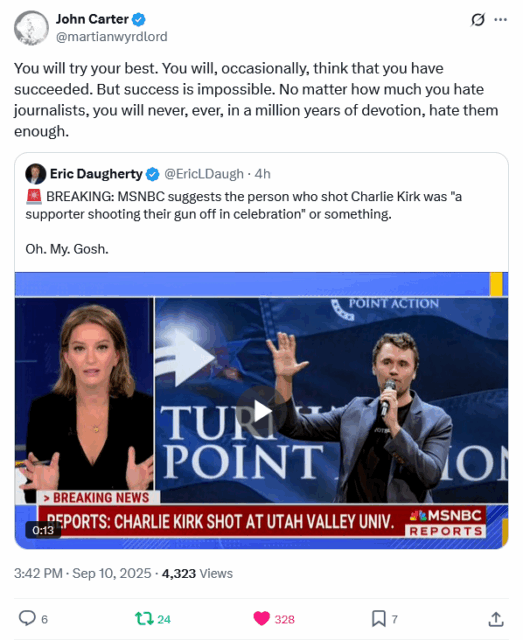
An assassin’s bullet struck down Charlie Kirk, the prominent conservative commentator and founder of Turning Point USA, while he was speaking at an event at Utah Valley University on Wednesday. He was 31.
Graphic video footage of the killing, which occurred as Kirk addressed a large outdoor crowd of students and supporters, showed him being shot in the neck. He was rushed to the hospital but did not recover.
The shocking tragedy has prompted an outpouring of lamentations from Kirk’s many friends in conservative media and Republican politics. Announcing his death on Truth Social, President Donald Trump wrote that Kirk was “Great, and even Legendary”.
“No one understood or had the Heart of the Youth in the United States of America better than Charlie,” wrote Trump.
Kirk was influential among young people. He launched Turning Point USA in 2012, with financial backing from Tea Party activist Bill Montgomery. The organization’s stated goal was to foster a conservative movement on college campuses, following in the footsteps of past groups such as Young Americans for Freedom. He was adept at creating catchy slogans and useful talking points for conservative students to deploy against leftwing thinkers; he popularized the phrase “Socialism Sucks” and added it to t-shirts, posters, and banners. He took advantage of dramatically increased interest in crazy campus happenings among the broader American public, and he encouraged dissenting kids to challenge their liberal professors, form right-leaning organizations, and invite Republican speakers to campus. Under Kirk’s leadership, the group became the undisputed king of conservative campus activism, helping turn thousands of non-liberal students into fans of the Republican Party and its rising stars: Candace Owen, Tucker Carlson, Ben Shapiro, Matt Walsh, and of course Trump.
Chris Bray posted some brief thoughts on the assassination as a way marker on the path to modern day nihilism:

Ryan Gerritsen on X – “People have yet to realize how the media affects the minds of so many. Just look at these headlines on Charlie Kirk. This affects people. It’s targeted & purposeful.”
First, the murder of Charlie Kirk is just the next level up the behavioral chain from the way Robert F. Kennedy was just treated in front of a Senate committee. He wasn’t mistaken, or wrong: He was an unforgivable monster, wholly illegitimate in every imaginable sense, who had no views or arguments that were worth considering in any way, and the only possible response to him is personal destruction. Our institutional left is a rage mob with formal titles. We’re not having a debate.
Second, the transition to radical violence is a reflection of the events that followed the death of the radical dream of the 1960s New Left. After the hippies, the Weatherman and the Symbionese Liberation Army. The turn to radical violence is the turn that follows obvious failure. It’s an acknowledgement of political impotence, and a last-ditch emergency reflex: If they won’t submit to our political vision, we’ll coerce them into submission. It’s the death rattle. It means the arguing and convincing has failed, and they see the failure.
Third, Camille Paglia persistently describes late-cultural-stage sexual disorder, especially widespread transgenderism, as a turn to sadomasochism, and I didn’t get that description for a long time. I’m seeing it now. It comes from an impotent rage over the limits of personal will, a Veruca Salt disgust that the world doesn’t do what I want, and a desire to hurt the body that’s trapped by a nature that won’t yield to ideology. I’m going to dive back into Sexual Personae today. Notice how much left-oriented political identities are currently invested in causing literal, physical injury, and in celebrating moments in which political opponents suffer actual pain. Go look for leftists celebrating Charlie Kirk’s death on social media, if you want to wade into that sewer. “Progressive” politics is becoming a torture fetish.
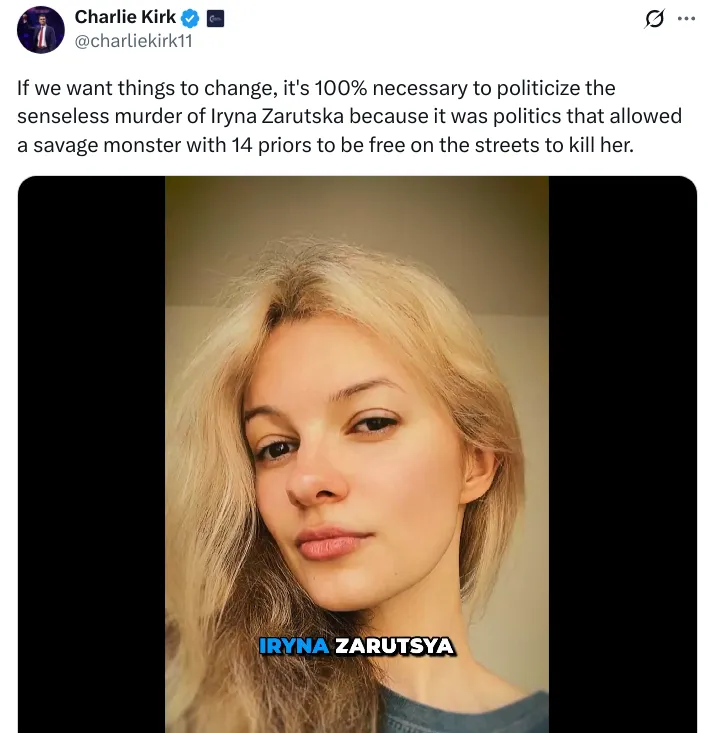
John Carter explains why we all need to watch the video to understand what happened. The post was originally about the murder of Iryna Zarutska on the light rail system in Charlotte, North Carolina. Before he published it, he heard about the shooting of Charlie Kirk:
Just as I got to this point in the article, I received word that Charlie Kirk was shot in the throat with a high-power rifle.
Once again, this is a difficult video to watch. Once again, I think you should watch it. Do not turn away from this. In case you’re hesitant, here is the last tweet Charlie Kirk will ever write.
[…]
Initial reports were that the assassin was some hapless boomer, but the police seem to have arrested the wrong person; FBI director Kash Patel has recently announced that the actual perpetrator has been apprehended, although as of the time of this writing the shooter’s identity hasn’t been released. Kirk was brought to hospital, and there were reports that he’d been stabilized and was receiving blood accompanied by prayers for his recovery. Soon after that we received confirmation of his death.
[…]
Reports are that his children were present for his assassination.
If Iryna’s death was the murder of peace, Charlie Kirk’s was the death of debate. Dialogue was shot in the throat, the very organ that produces speech. That probably wasn’t intentional: it’s likely the shooter was aiming for the head. Regardless, the symbolism is profound. Kirk was no bigoted firebrand, for all that the left cast him in the role of a fascist racist Nazi rabble-rouser. If anything, those on the right considered his politics to be rather milquetoast, though it’s certainly true he became more based in recent years. His modus operandi was to go to college campuses and enter into calm, reasonable, good-faith debate with the students there, because he believed profoundly that when we stop talking to one another, we begin to see one another as evil, and violence follows. Kirk was no stranger to violence himself: he’d received numerous death threats, he’d been driven off campus and out of restaurants by Antifa, he’d been assaulted. He knew full well the risks that he took by making himself such a high-profile public figure, and he took those risks anyhow, in full knowledge that he risked life and limb. Those are the actions of a man possessed of great physical courage.
No sooner did news of Kirk’s shooting hit the Internet, than the lying media was spreading doubt about the incident and heaping scorn upon the victim. Perhaps the shooter had been a supporter, one talking head suggested, and had been firing his rifle in celebration … it was all a big accident, and that’s just what you get for supporting the Second Amendment. Other journalist scum were at pains to emphasize that Kirk was divisive, polarizing, controversial … implying that if he’d just been a good boy and said what all the other good boys are supposed to say, he would have been safe. Getting shot in the throat is just what you get for speaking out of turn, so shut your mouth, bigot.
Leftists on social media were far less circumspect than their counterparts on the major networks. Almost without exception – by which I mean that I have seen no exceptions, though of course I have seen only the screenshots that people have shared, and cannot rule out that there are a few, for all that I doubt it – they are exulting in Kirk’s death. There is no surprise to this. The left is vicious, and to take pleasure in the death of an enemy may be the only healthy instinct they have left. I’m not even angry at them for that. I expect nothing else from them. Nevertheless, the gloating pleasure the left takes in Kirk’s death only serves to underline that dialogue is dead.
Thanks in part to Kirk’s tireless efforts, the left has been steadily losing the war of ideas, and with it their hold on the mass mind. They no longer have the ability to define the boundaries of the Overton window, because every single one of their claims has been shown to be baseless, deceptive, and destructive of both individual lives and society itself. Since the advent of mass media the left has had the ability to delineate the acceptable boundaries of discourse; since the rise of social media, and the advent of the meme war, this power has slipped through their fingers. Truth has leaked into peoples’ brains, and the people have realized that they have been lied to shamelessly on an almost incomprehensible scale about almost everything that matters. The people have seen the left for what it is, a malign force that delights in their humiliation, that glories in their annihilation, an influence whose special talent is to take the best impulses of people and twist them into something self-destructive and foul. And so, the people have turned from the left, and coalesced into into an opposition that has become determined to put an end to the left’s tyrannical parasitism. Not all the people, to be sure. But a lot of them.
QotD: Heritable IQ and the ability to think critically
It has become well-known recently that at IQ 90 and downward people start having real trouble handling counterfactual conditionals. “How would you feel if you hadn’t eaten breakfast this morning?” is the probe of this capability that has gone viral.
How are you going to do critical thinking if you can’t process counterfactual conditionals? It would be like trying to dance when you can’t walk. But this is a problem that extends above the normal IQ 85 threshold for mental subnormality. We’re looking at 20% to 25% of the U.S. population here.
Eric S. Raymond, Twitter, 2024-05-19.
September 10, 2025
The Korean War Week 64: Inexperienced UN Recruits Face Disaster – September 9, 1951
The Korean War by Indy Neidell
Published 9 Sep 2025The Battle of Bloody Ridge comes to its end, having very much earned its name. One issue the UN is really having though, is with replacement troops. They don’t have the training or experience that the war requires. And yet, a new offensive to test them further is just around the corner.
Chapters
00:00 Intro
00:53 Recap
01:22 Problems With New Troops
04:36 Company C Attacks
06:09 Operation Talons
07:32 Operation Minden
08:19 Flying Aces
08:57 San Francisco Conference
14:13 Summary
14:28 Conclusion
(more…)
September 9, 2025
MG38: Colt’s Interwar Water-Cooled Machine Gun
Forgotten Weapons
Published 7 May 2025After World War One, Colt was the sole owner of license to produce Browning machine guns. With production tooling well established from the war, the company set about looking for international sales. The water cooled .30 caliber (the M1917 in US service, essentially) was designated the Model 1919 Automatic Machine Gun. In 1931, it was renamed the MG38, although basically the same gun as in 1919. It had a few distinctions from the US military pattern, including:
- Manual safety on the backplate
- Self-contained recoil spring
- Large water fill and drain fittings, identical to the ones used on Colt’s .50 caliber guns
- Slightly different top cover latch
Colt offered the guns with lots of options and features, including a variety of calibers (basically any modern rifle cartridge of the time), flash hiders, lightened anti-aircraft bolts, and spade grips (guns sold with spade grips were designated MG38B). From 1919 until commercial production ceased in January 1942, Colt had sold 2,720 water-cooled Brownings in total. Most went to South America in 7.65mm, with Argentina being the single biggest buyer.
Full video on the Browning M1917:
• Browning M1917: America’s World War O…
(more…)
September 7, 2025
Long before the “Bad Orange Man”, there was “T.R.”
In the Coolidge Review, Amity Shlaes points out some strong similarities between Donald Trump’s career and that of the Bull Moose himself, Theodore Roosevelt:
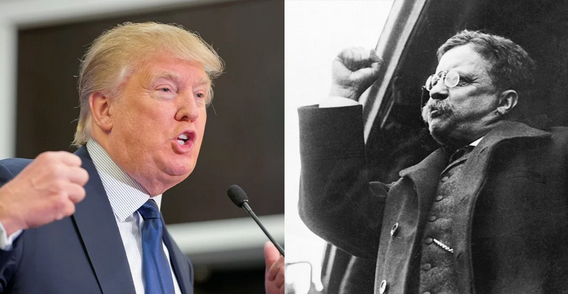
Though a century apart—TR served from 1901 to 1909 — these two chief executives have favored the same modus operandi: using unpredictability to amass power. And the record of Theodore Rex, as Edmund Morris titled his TR biography, bodes ill for both the economy and the Republican Party.
The Trump-TR Parallels
But to the similarities. They start, for both men, pre–White House. As Trump did, TR staged his pre-presidential efforts as much with an eye to public recognition as to sustained reform or strengthening institutions.
Whenever TR stumbled, he pivoted to a new venture and publicized it like mad, though the medium in those days was the printed word, not season after season on The Apprentice. Before the cognoscenti had even absorbed the meaning of the young Roosevelt’s humiliating fourth-place score in a key 1886 New York City mayoral contest, for example, TR was off to the Badlands, memorializing his ranching experiences in dispatches and books such as Ranch Life and the Hunting Trail.
As Trump does, TR routinely alienated GOP grandees, circumventing them to get ahead. As Trump has, TR skillfully cultivated the media — so skillfully that members of Congress were left trying catch up with whatever shifts in public opinion resulted from the politician’s press alliances. TR’s Rupert Murdoch was the widely syndicated William Allen White of Kansas’s influential Emporia Gazette. TR’s equivalent of Fox News was the New York Journal, whose owner, William Randolph Hearst, drummed a steady beat of support when Roosevelt called for war against Spain.
Today, Murdoch must be scratching his head over what his showcasing Trump has wrought, especially now that Trump decided to sue both Murdoch and his Wall Street Journal. White, too, found that he had second thoughts about his decision to back TR: “Roosevelt bit me and I went mad,” White reportedly told a colleague.
[…]
BULLY
The occupant of what he labeled the Bully Pulpit — “bully” as in “excellent” — proved a literal bully as well.
As president, TR perpetually unnerved fellow Republicans, pivoting back to domestic politics. As Trump has, TR cast his campaigns in moral terms rather than economic ones. Where Trump launched his tariff war, TR made war against trusts, large combinations of companies. Relying more on whim than statute, Roosevelt segregated trusts into “good trusts” and “bad trusts”.
TR targeted an invincible-looking industry that, in those days, mattered as much as the interstate highways, or the internet, do today: railroads. James Hill’s Great Northern Railway took over a struggling competitor, Northern Pacific. Roosevelt asked Hanna what he made of the combined entity, Great Northern Securities. Hanna replied that it was “the very best thing possible for the future of the whole Northwest territory”. Roosevelt nonetheless sicced the Justice Department on the Great Northern.
J. Pierpont Morgan, a participant in the beleaguered deal, called on the president to inquire, as desperate steel importers these days do from time to time, whether their attorneys might work out the matter behind the scenes.
No.
Next, the disconcerted Morgan asked whether other investments of the House of Morgan might be assailed. Roosevelt’s reply captures the chill of arbitrary leadership. The administration would not go after the other Morgan companies, he said — unless “they have done something we regard as wrong”.
As Edmund Morris reports in Theodore Rex, to observers such as French ambassador Jules Jusserand, Roosevelt seemed “more powerful than a king”. That power suited many voters fine, which is why Roosevelt won so headily when he ran for office on his own in 1904.
Of course TR, like Trump, occasionally supported laws that aligned with his impulses. One example is the Elkins Act of 1903, which made it illegal for railroads to charge different freight rates for different customers. This shallow effort to achieve market “fairness” deprived the railroads of a standard business tool: the ability to provides discounts to those who buy the product in larger quantities. Shares in railroads promptly dropped more than 20 percent, a shift that undermined TR’s premise of railroad invincibility.
QotD: Generation X
The concept of “selling out” — and the degree to which that notion altered the meaning and perception of almost everything — is the single most nineties aspect of the nineties. The complexity, nuance, and application of the term sellout was both ubiquitous and impossible to grasp. Nothing was more inadvertently detrimental to the Gen X psyche.
Or, as I like to put it, we were so obsessed with “authenticity” that we took as our guru an exquisitely sensitive longhaired goof who fronted a band named after spooge. […] But Klosterman does have genuine insights sometimes:
The detail always noted in remembrances of the Bronco chase is the throngs of bystanders cheering for Simpson as the car rolled down the freeway, congregating on overpasses and holding makeshift cardboard signs proclaiming, “The Juice Is Loose”. It seemed perverse then and still seems perverse now. Yet this can also be understood as the primordial impulse of what would eventually drive the mechanism of social media: the desire of uninformed people to be involved with the news, broadcasting their support for a homicidal maniac not because they liked him, but because it was exhilarating to participate in an experience all of society was experiencing at once.
Sailer thinks that’s clever and perceptive, and I agree. Too bad you have to read some masturbatory bullshit about Zima to get to it.
Sadly, he doesn’t take that out a step (or, at least, he doesn’t get quoted doing so in Sailer’s review). Here’s Klosterman’s verdict on why Gen X, for all its faults, wasn’t so bad:
The enforced ennui and alienation of Gen X had one social upside: Self-righteous outrage was not considered cool, in an era when coolness counted for almost everything. Solipsism was preferable to narcissism. The idea of policing morality or blaming strangers for the condition of one’s own existence was perceived as overbearing and uncouth. If you weren’t happy, the preferred stance was to simply shrug and accept that you were unhappy.
True enough, but look: Of all the things that made the Boomers so fucking insufferable, right near the top was their utter inability to let go of their youth. Instead of seeing Forrest Gump as a metaphor so unsubtle, an anvil to the head seems sneakier, they thought it was a lighthearted celebration of a simpler, more innocent time. We knew better. Since they couldn’t let go of their youth, we made “being old and jaded long before our time” into our signature thing.
But where, my fellow alterna-dudes, is that attitude now, when it matters? We’re in the same position in 2022 as our parents were in 1992: Staring down the barrel of middle age, teeing off on life’s back nine, pick your metaphor. It’s time to put away childish things. Grow the fuck up already, the way we wish our parents would’ve done for us back in 1992. Instead, we’re letting our lunatic children smear their pathologies all over what’s left of America, because … ?
I know why Klosterman does it: That’s what they pay him for. What’s our excuse?
Severian, “A Meta-Review”, Founding Questions, 2022-02-24.
September 6, 2025
Unique British Crankfire .58 Morse Manual Machine Gun
Forgotten Weapons
Published 30 Apr 2025This is a really interesting piece with a mostly unknown origin. It was manufactured in the UK (the barrel was deemed Enfield-made by former Royal Armouries curator Herb Woodend) and is chambered for the .58 Morse centerfire cartridge. The date of production is unknown. It uses a gravity-feed magazine and fires via hand crank. Turning the crank cycles the bolt forward and back, not completely unlike a Maxim gun but without the automatic operation. It came out of a small Canadian museum in the 1950s, but its provenance before that is unknown.
(more…)
September 5, 2025
QotD: Hillary Clinton in the White House
Among the military who served in the White House and the professional White House staff, the Clinton administration was infamously known for its lack of professionalism and courtesy, though few ever spoke about it. But when it came to rudeness, it was Hillary Clinton who was the most feared person in the administration. She set the tone. From the very first day in my assignment.
When I first arrived to work in the White House, my predecessor warned me. “You can get away with pissing off Bill but if you make her mad, she’ll rip your heart out.” I heeded those words. I did make him mad a few times, but I never really pissed her off. I knew the ramifications. I learned very quickly that the administration’s day-to-day character, whether inside or outside of DC, depended solely on the presence or absence of Hillary. Her reputation preceded her. We used to say that when Hillary was gone, it was a frat party. When she was home, it was Schindler’s List.
In my first few days on the job, and remember I essentially lived there, I realized there were different rules for Hillary. She instructed the senior staff, including me, that she didn’t want to be forced to encounter us. We were instructed that “whenever Mrs. Clinton is moving through the halls, be as inconspicuous as possible”. She did not want to see “staff” and be forced to “interact” with anyone. No matter their position in the building. Many a time, I’d see mature, professional adults, working in the most important building in the world, scurrying into office doorways to escape Hillary’s line of sight. I’d hear whispering, “She’s coming, she’s coming!” I could be walking down a West Wing hallway, midday, busier than hell, people doing the administration’s work whether in the press office, medical unit, wherever. She’d walk in and they’d scatter. She was the Nazi schoolmarm and the rest of us were expected to hide as though we were kids in trouble. I wasn’t a kid, I was a professional officer and pilot. I said “I’m not doing that”.
There was also a period of time when she attempted to ban military uniforms in the White House. It was the reelection year of 1996, and she was trying to craft the narrative that the military was not a priority in the Clinton administration. As a military aide, carrying the football, and working closely with the Secret Service, I objected to that. It simply wasn’t a matter of her political agenda; it was national security. If the balloon went up, the Secret Service would need to find me as quickly as possible. Seconds matter. Finding the aide in military uniform made complete sense. Besides, what commander in chief wouldn’t want to advertise his leadership and command? She finally relented because the Secret Service weighed in.
The Clintons are corrupt beyond words. Hillary is evil, vindictive, and profane. Hillary is a bitch.
Buzz Patterson, Twitter, 2025-05-17.
September 4, 2025
Net Zero targets and Britain’s ever-declining car industry
At the Foundation for Economic Education, Jake Scott charts the decline of the British auto manufacturing centres and the government’s allegiance to its Net Zero programs:

Custom image by FEE
Britain was once a giant of car manufacturing. In the 1950s, we were the second-largest producer in the world and the biggest exporter. Coventry, Birmingham, and Oxford built not just cars, but the reputation of an industrial nation; to this day, it is a source of great pride that Jaguar–Land Rover, a global automotive icon, still stands between Coventry and Birmingham. By the 1970s, we were producing more than 1.6 million vehicles a year.
Today? We have fallen back to 1950s levels. Last year, Britain built fewer than half our peak output—800,000 cars, and the lowest outside the pandemic since 1954. Half a year later, by mid-2025, production has slumped a further 12%. The country that once led the automotive revolution is now struggling to stay afloat, and fighting to remain relevant.
This is why the news that BMW will end car production at Oxford’s Mini plant, shifting work to China, is so damning, bringing this decline into sharp focus. The Mini is not only a classic British car; Alec Issigonis’s original design made it an international icon. For decades, the Mini has been the bridge between British design flair and foreign investment. Its departure leaves 1,500 jobs at risk at a time when the government is desperate to fuel growth and convince a wavering consumer market that there is no tension between industrial production and Net Zero goals.
It’s a bitter reminder that we in Britain have been here before: letting an industrial crown jewel slip away.
The usual explanations will be offered: global competition, exchange rates, supply chains. All true, in the midst of a global trade war that is heating up and damaging major British exports. But such a diagnosis is incomplete. The truth is that Britain’s car industry is being squeezed by a mix of geopolitical realignment and government missteps.
The car industry has become the frontline of a new trade war. Washington has already moved aggressively to shield its own firms: the Inflation Reduction Act offers vast subsidies for US-made EVs and batteries, an unapologetic attempt to onshore production, and something that became a flashpoint of tension in Trump’s negotiation with the EU in the latest trade deal. On the production side, the Act has poured billions into US manufacturing: investment in EV and battery plants hit around $11 billion per quarter in 2024.
Ripples have been sent across the world in the US’s wake: Europe, faced with a flood of cheap Chinese EVs, has imposed tariffs of up to 35% after an anti-subsidy investigation. Talks have even turned to a system of minimum import prices instead of tariffs. Unsurprisingly, China has threatened retaliation against European luxury marques, while experts warn the tariffs may slow the EU’s green transition by raising prices.
This is no longer a free market: cars are treated as strategic assets, the 21st-century equivalent of shipbuilding or steel. Whoever controls the supply chains, particularly for EV batteries and the mining of lithium, controls not only the future of the industry but an important lever of national power.
The results are visible. In July 2025, Tesla’s UK sales collapsed nearly 60%, while Chinese giant BYD’s deliveries quadrupled. Europe responded by talking up new tariffs. Britain did nothing. In this asymmetric contest, our market risks becoming a showroom for foreign producers — subsidizing both sides of the trade war without defending our own.
September 3, 2025
The Korean War Week 63: The Battle of Bloody Ridge – September 2, 1951
The Korean War by Indy Neidell
Published 2 Sep 2025The South Koreans have won their fight northeast of the Punchbowl, but not that far away the Battle of Bloody Ridge is earning its name, with casualties rising into the thousands for both sides.
Chapters
00:41 Recap
01:11 A ROK Success
01:47 Bloody Ridge
06:17 Soviet Reinforcements
07:08 Operation Strangle
11:06 Summary
11:45 Conclusion
13:37 Call to Action
(more…)
September 2, 2025
2 September, 1945 marked the formal end to the Second World War
On The Conservative Woman, Henry Getley notes the 80th anniversary of the formal surrender of Japan to the United Nations forces represented by Douglas MacArthur on board the battleship USS Missouri:
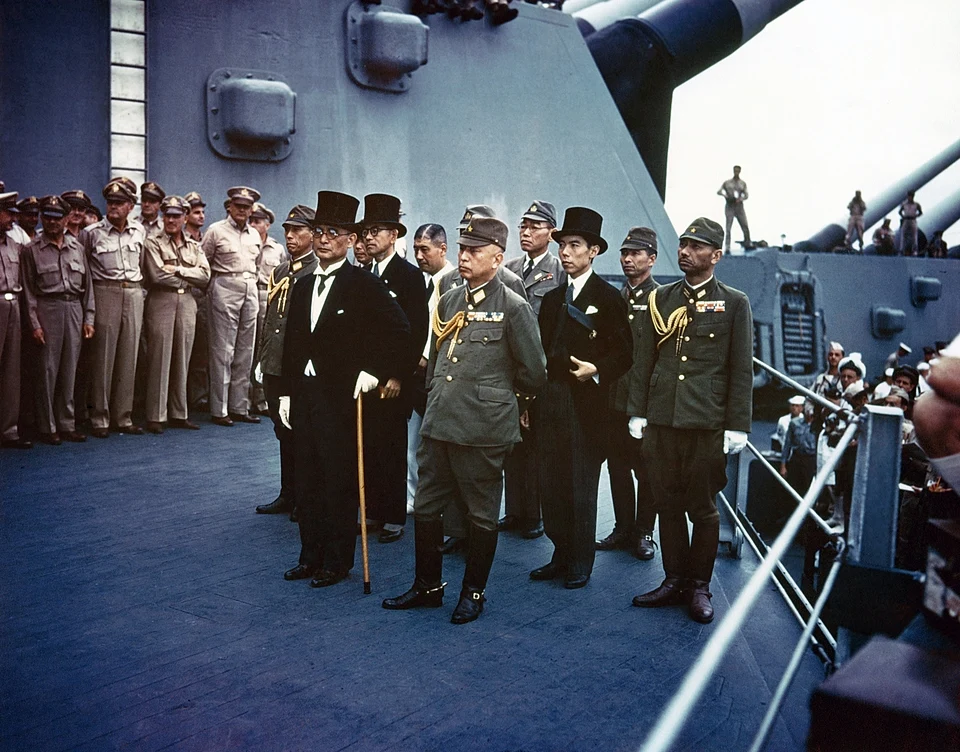
Representatives of the Japanese government on the deck of USS Missouri before signing the surrender documents, 2 September 1945.
Naval Historical Center Photo # USA C-2719 via Wikimedia Commons
ON September 2, 1945 – 80 years ago today – General Douglas MacArthur, Supreme Commander for the Allied Powers, accepted Japan’s formal surrender in a ceremony aboard the US battleship Missouri in Tokyo Bay. Then with the words “These proceedings are closed”, he brought the Second World War to an end.
That final sentence, broadcast worldwide by radio, came five years and 364 days after the global conflict started. Germany invaded Poland on September 1, 1939, but Britain – followed by France – did not declare war on Germany until September 3.
Six years later, on his enforced retirement, MacArthur told the US Congress: “I still remember the refrain of one of the most popular barrack ballads which proclaimed most proudly that ‘old soldiers never die, they just fade away'”.
Now, with the 80th anniversary of the war’s end, Britain’s old soldiers, sailors, marines and airmen have indeed faded away. At the war’s peak, 3.5 million men served in the Army, 1.2 million in the RAF and almost one million in the Royal Navy. Today, fewer than 8,000 veterans of those fighting forces are thought to be left. Most will be 98 or older.
It’s a striking thought for those of us who were brought up in the immediate post-war years. As I recalled in an earlier TCW blog, back in those days almost everyone’s father, uncle or brother had served in the military in some capacity.
The men we kids saw going to work in the offices, shops and factories of Civvy Street were the unsung heroes of the River Plate, Dunkirk, the Battle of Britain, the Battle of the Atlantic, the Arctic Convoys, the Western Desert, Italy, Normandy, Arnhem, the Rhine, Imphal, Kohima, the jungles of Malaya and Burma and many other battles large and small.
Being interested in military history, I was lucky enough to have become friends with several veterans of the Second World War, all sadly no longer with us. They were without exception the finest of men – modest, generous, good-humoured, gentlemanly. All had been at the sharp end in battle, but the last thing any of them would have called himself was a hero. They shared their memories with me reluctantly, anxious not to be thought they were “shooting a line” – that is, exaggerating or boasting. I was honoured and humbled to have known them.
Their passing reminded me that while the war was obviously seared into the very being of those who had experienced it, we of the first post-war generation inherited a lot of what you might call its folk memories and thus it loomed large in our perceptions.
Too much empathy can be more dangerous than too little
Spaceman Spiff explains why boundaries matter, in so many different areas of modern life:

Empathy is a virtue many strive to demonstrate. But few will discuss its downsides. Why it is not universally good or useful. How it can be misdirected.
In some situations it is lethal. It can reflect a suicidal urge we now see in Western nations.
Much empathy in society is in fact sentimentality, which is dangerous. Sentimental ideas about mixing cultures, elevating poor performers through quotas, or tinkering with traditional gender roles have real world effects.
With such an emphasis on empathy, which many think of as niceness, we overlook the need for boundaries to maintain a functioning society.
This is the issue at the heart of much that is damaging us today.
Individual rights
We live in an era that champions individual rights to an almost autistic degree. This is a product of Western liberalism, which now seems to be entering its terminal phase as its effects ultimately destroy what made Western societies strong.
Since an individual’s rights trump everything we cannot easily enforce boundaries our ancestors could take for granted. Try challenging a gay pride parade or transgender material in schools on the grounds of public decency and the least you can expect is to lose your job.
Profound changes have happened just in the last few decades and all in the name of individual rights. The erosion of boundaries on behaviour is one of the most visible aspects of this.
Physical boundaries
The concept of boundaries is almost universal and spans everything from the mundane to the spiritual.
Most countries recognize the right to private property and inherent within this is the notion of boundaries. My car is mine and no one else’s, for example.
This is applied to our homes and gardens. These are ours and defendable from theft. Ultimately this in turn includes a neighbourhood or locale, even a region or state. All these things have visible boundaries that demarcate where they begin and end.
Most famously this applies to national borders, a traditional form of boundary in use for thousands of years. Failing to enforce this barrier is national suicide. The world is not like us and if it comes to us we will look like the world in return. Borders keep the barbarians out.
Everyone instinctively grasps these kinds of boundaries. We close our windows and have locks on our doors because of this understanding.
Using boundaries to exclude others feels natural.
Cultural boundaries
Less explicitly visible are cultural boundaries, often transmitted via tradition and convention. We have spent the last century attacking many of these as old fashioned, with little pause to consider why tradition emerges in the first place.
Marriage between men and women. Complementary gender roles. Sexual mores kept private. The sanctity of childhood, its innocence protected from intrusion.
As we removed constraints in the name of progress we destroyed much of the glue that held our societies together. We are now watching things unravel as people marry less and produce fewer children. We see widespread mental illness and anguish as the few basic certainties of life are destroyed in the name of progress.
People don’t know who or what they are when cultural boundaries are deleted. Women, men, natives, newcomers, the working class. Who are we really without some certainties in life?
September 1, 2025
Who Killed Pakistan’s First Prime Minister, Liaquat Ali Khan? – W2W 42
TimeGhost History
Published 31 Aug 2025October 1951: Pakistan’s first Prime Minister is gunned down on stage, and the world is left asking — who ordered his death? Was it the British, the Americans, or his own allies in Pakistan? Dive deep into a tangled web of espionage, conspiracy, and Cold War politics as we follow the murder mystery that set the course for South Asia’s future.
(more…)
QotD: The Ivy League
The Ivies are now what they’ve pretty much always been — the equivalent of those Higher Party Academies in Moscow. They’re finishing schools for the Apparat. Oh sure, you can probably find a graduate of Ohio State or some such place at Quantico or Foggy Bottom … but I promise you, he hears about it every single day of his life. If they don’t actually teach classes called “How to be a Toady in the DOJ” and “Catching a Senator’s Farts” at Dartmouth, they might as well.
Take your Basic College Girl, make her unisex, crank her up way past eleven on meth and steroids, and that’s the typical Ivy League grad. And they all go directly into Government. Just in case you still cherished some vague hope we could vote our way out of this, remember that guys like Robert McNamara and McGeorge Bundy were the absolute best the Ivy League has produced in the modern era. The Democratic People’s Republic of Vietnam says hi!
Severian, “First Mailbag of the New Year”, Founding Questions, 2022-01-07.
Update, 2 September: Welcome, Instapundit readers! Please do have a look around at some of my other posts you may find of interest. I send out a daily summary of posts here through my Substack – https://substack.com/@nicholasrusson that you can subscribe to if you’d like to be informed of new posts in the future.


