
Published on 7 Mar 2016
Indy and Flo sat down for one of our live streams about historical firearms again. Othais from C&Rsenal explained the various Austro-Hungarian rifles and pistols of the First World War. Among them of course the famous Mannlicher rifles. In our next episode we will also have a look at the iconic Austro-Hungarian pistols.
March 9, 2016
Austro-Hungarian Rifles of WW1 I THE GREAT WAR – Special feat. C&Rsenal
Comments Off on Austro-Hungarian Rifles of WW1 I THE GREAT WAR – Special feat. C&Rsenal
March 5, 2016
Mechanical computers
ESR posted this video on Google+, saying “Mind…utterly…blown. This is how computers worked before electronic gate logic. There’s a weird beauty of mathematics made tangible about it.”
Uploaded on 13 Jul 2011
A 1953 training film for a mechanical fire control computer aboard Navy Ships. Amazing how problems of mathematical computation were solved so elegantly in “permanent” mechanical form, before microprocessors became inexpensive and commonplace.
February 12, 2016
QotD: Military developments from 1870 onwards
The period of Colonial expansion coincided with three major developments in weapon-power: the general adoption of the small-bore magazine rifle, firing smokeless powder; the perfection of the machine gun; and the introduction of quick-firing artillery.
By 1871, the single-shot breech-loading rifle had reached so high a standard of efficiency that the next step was to convert it into a repeating, or magazine, rifle. Although the idea was an old one, it was not fully practicable until the adoption of the all-metal cartridge case, which reduced jamming in the breech. The first European power to introduce the magazine rifle was Germany who, in 1884, converted her 1871 pattern Mauser rifle to the magazine system; the magazine was of the tube type inserted in the fore-end under the barrel, it held eight cartridges. In 1885, France adopted a somewhat similar rifle, the Lebel, which fired smokeless powder — an enormous advantage. Next, in 1886, the Austrians introduced the Mannlicher with a box magazine in front of the trigger guard and below the entrance to the breech. And two years later the British adopted the .303 calibre Lee-Metford with a box magazine of eight cartridges, later increased to ten. By 1900 all armies had magazine rifles approximately of equal efficiency, and of calibres varying from .315 to .256; all were bolt operated, fired smokeless powder, and were sighted to 2,000 yards or metres.
Simultaneously with the development of the magazine rifle proceeded the development of the machine gun — another very old idea. Many types were experimented with and some adopted, such as the improved Gatling, Nordenfeldt (1873), Hotchkiss (1875), Gardner (1876), Browning (1889) and Colt (1895). The crucial year in their development was 1884, when Hiram S. Maxim patented a one barrel gun which loaded and fired itself by the force of its recoil. The original model weighed 40lb., was water cooled and belt fed, and 2,000 rounds could be fired from it in three minutes. It was adopted by the British army in 1889, and was destined to revolutionize infantry tactics.
The introduction of quick-firing artillery arose out of proposals made in 1891 by General Wille in Germany and Colonel Langlois in France. They held that increased rate of fire was impossible unless recoil on firing was absorbed. This led to much experimental work on shock absorption, and to the eventual introduction of a non-recoiling carriage, which permitted of a bullet-proof shield being attached to it to protect the gun crew. Until this improvement in artillery was introduced, the magazine rifle had been the dominant weapon, now it was challenged by the quick-firing gun, which not only outranged it and could be fired with almost equal rapidity, but could be rendered invisible by indirect laying.
J.F.C. Fuller, The Conduct of War, 1789-1961, 1961.
Comments Off on QotD: Military developments from 1870 onwards
February 9, 2016
Zeppelins – Majestic and Deadly Airships of WW1 I THE GREAT WAR Special
Published on 8 Feb 2016
Zeppelins pioneered the skyways, could fly long distances and reached heights like none of the British fighter-interceptor aircraft before. Because of that, they were used for scouting and tactical bombing early in the First World War. In this special episode we introduce these majestic floating whales and their usage in WW1.
Comments Off on Zeppelins – Majestic and Deadly Airships of WW1 I THE GREAT WAR Special
How John Perry Barlow might have revised his 20-year-old Declaration
From a short interview in The Economist:
I probably wouldn’t have imitated the grandiloquent style of a notorious former slave holder. And I would have been a bit more humble about the “Citizens of Cyberspace” creating social contracts to deal with bad behavior online. The fact remains there is not much one can do about bad behavior online except to take faith that the vast majority of what goes on there is not bad behavior. Yeah, I hate spam, and viruses, and worms, and surveillance [by America’s National Security Agency], but the fact remains that if you can censor one of these bad behaviors, you’ve endowed yourself with the ability to censor almost anything you don’t like online. This is not an ability I wish to extend to any existing government in the physical world. If we assert it, what’s to prevent Saudi Arabia from doing the same.
And I would make it more obviously clear that I knew that cyberspace was not sublimely removed from the physical world, with which it has exactly the same relationship that the mind has with the body: deeply interdependent but qualitatively different. I think that point often got lost.
Over the decades, it has been continuously fashionable to make a straw man of my declaration, to hoist it up as the sort of woolly-headed hippie nonsense you’d expect from techno-utopians like me. This is done largely by people who have never read it, or take a strong interest in believing that government is about to come stomping into town, there to “civilize cyberspace.
Comments Off on How John Perry Barlow might have revised his 20-year-old Declaration
January 31, 2016
“To be honest, the spooks love PGP”
If nothing else, it’s a needle in their acres of data haystacks. Use of any kind of encryption doesn’t necessarily let CSIS and their foreign friends read your communications, but it alerts them that you think you’ve got something to say that they shouldn’t read:
Although the cops and Feds wont stop banging on and on about encryption – the spies have a different take on the use of crypto.
To be brutally blunt, they love it. Why? Because using detectable encryption technology like PGP, Tor, VPNs and so on, lights you up on the intelligence agencies’ dashboards. Agents and analysts don’t even have to see the contents of the communications – the metadata is enough for g-men to start making your life difficult.
“To be honest, the spooks love PGP,” Nicholas Weaver, a researcher at the International Computer Science Institute, told the Usenix Enigma conference in San Francisco on Wednesdy. “It’s really chatty and it gives them a lot of metadata and communication records. PGP is the NSA’s friend.”
Weaver, who has spent much of the last decade investigating NSA techniques, said that all PGP traffic, including who sent it and to whom, is automatically stored and backed up onto tape. This can then be searched as needed when matched with other surveillance data.
Given that the NSA has taps on almost all of the internet’s major trunk routes, the PGP records can be incredibly useful. It’s a simple matter to build a script that can identify one PGP user and then track all their contacts to build a journal of their activities.
Even better is the Mujahedeen Secrets encryption system, which was released by the Global Islamic Media Front to allow Al Qaeda supporters to communicate in private. Weaver said that not only was it even harder to use than PGP, but it was a boon for metadata – since almost anyone using it identified themselves as a potential terrorist.
“It’s brilliant!” enthused Weaver. “Whoever it was at the NSA or GCHQ who invented it give them a big Christmas bonus.”
Comments Off on “To be honest, the spooks love PGP”
January 14, 2016
Conspicuous consumption, firearms division
Cabot Guns is planning to forge a matching pair of 1911 pistols from a fragment of a meteorite:
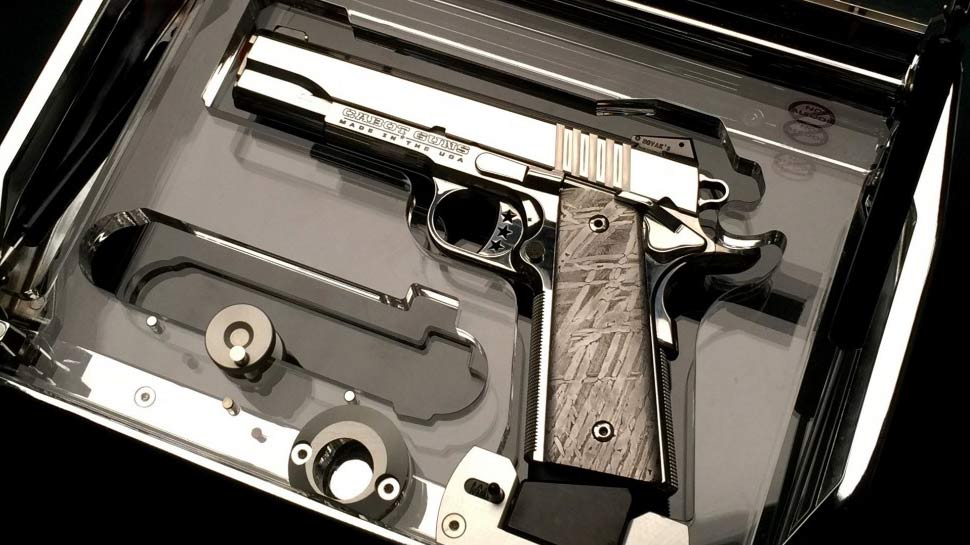
It may have plummeted to Earth over prehistoric Namibia, but the Gibeon meteorite has had quite a bit of interaction with modern humans. In the years since it was found in 1836, fragments of the giant space rock have been formed into just about everything: from jewelry, to knives, to works of art. Now, a luxury firearms company in Pennsylvania plans to build a mirror-image pair of pistols from a 35-kilogram (77-lb) piece.
Tentatively called the “Big Bang Pistol Set,” the builds will be a first for Cabot Guns, a company that specializes in 1911-style firearms. “We wanted to raise the bar again,” says founder and President Rob Bianchin. “The pistol set will be a modern work of functional art.” Cabot rolled out pistol grips constructed from meteorite several years ago (pictured below), but the new set will be formed completely from the interstellar metal – something that has (according to the team) never been done before.
We estimate that the original, uncut fragment, which Cabot acquired from a private meteorite collector, would fetch around $110,294 at auction. Once completed, the company hopes to get anywhere from $500,000-$1,000,000 for the pair of pistols. “Meteorite is hardly an optimum material for firearms, so numerous technical matters have been overcome to construct the pistols using advanced aerospace techniques to make the pistols fully functional,” explains Bianchin. “The construction of each component has been a science experiment but we are confident they will be fully completed.”
H/T to ESR for the link.
Comments Off on Conspicuous consumption, firearms division
January 13, 2016
The death of the duel
ESR has a theory on the rapid decline of the duelling culture that had lasted hundreds of years until the mid-19th century:
I’ve read all the scholarship on the history of dueling I can find in English. There isn’t much, and what there is mostly doesn’t seem to me to be very good. I’ve also read primary sources like dueling codes, and paid a historian’s attention to period literature.
I’m bringing this up now because I want to put a stake in the ground. I have a personal theory about why Europo-American dueling largely (though not entirely) died out between 1850 and 1900 that I think is at least as well justified as the conventional account, and I want to put it on record.
First, the undisputed facts: dueling began a steep decline in the early 1840s and was effectively extinct in English-speaking countries by 1870, with a partial exception for American frontier regions where it lasted two decades longer. Elsewhere in Europe the code duello retained some social force until World War I.
This was actually a rather swift end for a body of custom that had emerged in its modern form around 1500 but had roots in the judicial duels of the Dark Ages a thousand years before. The conventional accounts attribute it to a mix of two causes: (a) a broad change in moral sentiments about violence and civilized behavior, and (b) increasing assertion of a state monopoly on legal violence.
I don’t think these factors were entirely negligible, but I think there was something else going on that was at least as important, if not more so, and has been entirely missed by (other) historians. I first got to it when I noticed that the date of the early-Victorian law forbidding dueling by British military officers – 1844 – almost coincided with (following by perhaps a year or two) the general availability of percussion-cap pistols.
The dominant weapons of the “modern” duel of honor, as it emerged in the Renaissance from judicial and chivalric dueling, had always been swords and pistols. To get why percussion-cap pistols were a big deal, you have to understand that loose-powder pistols were terribly unreliable in damp weather and had a serious charge-containment problem that limited the amount of oomph they could put behind the ball.
This is why early-modern swashbucklers carried both swords and pistols; your danged pistol might very well simply not fire after exposure to damp northern European weather. It’s also why percussion-cap pistols, which seal the powder charge inside a brass casing, were first developed for naval use, the prototype being Sea Service pistols of the Napoleonic era. But there was a serious cost issue with those: each cap had to be made by hand at eye-watering expense.
Then, in the early 1840s, enterprising gunsmiths figured out how to mass-produce percussion caps with machines. And this, I believe, is what actually killed the duel. Here’s how it happened…
Comments Off on The death of the duel
December 30, 2015
German Pistols of World War 1 feat. Othais from C&Rsenal I THE GREAT WAR Special
Published on 28 Dec 2015
In the second part of our German weapons special, Othais introduces us to pistols. Among them are oddities like the Reichsrevolver but also iconic pieces of German engineering like the Luger including the rare Trommelmagazin.
Comments Off on German Pistols of World War 1 feat. Othais from C&Rsenal I THE GREAT WAR Special
Elon Musk, Jeff Bezos and the future of spaceflight
Colby Cosh on the real significance of the private space companies’ successes:
The science fiction authors who originally imagined spaceflight thought it would be classically capitalistic in nature — a Wild West of chancers, gold-diggers, outlaws, and even slave-traders transposed to the skies. It ended up, in its first incarnation, being a government program. This had the merit of showing that some impossible technical problems could be solved if you threw near-infinite resources and human lives at them. But the money and will ran out before NASA got around to figuring out how to make orbital spaceflight truly routine. Reusable rockets are the important first step that NASA didn’t have time to try in the Golden Age, under the pressure of a “space race” between governments.
Musk and Bezos are trying, I think very consciously, to revive the public interest and inspiration that this race narrative once brought. When SpaceX stuck its landing this week, having previously had a couple of flops, Bezos tweeted “Welcome to the club!” Musk will not mind the cheap shot too much. Bezos is doing him a favour by making a game of it.
It is hard for us to feel passion about accounting, even when “accounting” translates to cheaper satellite technology that means subtle advances in science and cost cuts in earthbound communications tech. Anything you can turn into a mere clash of personalities will get the attention of journalists and readers more readily. Musk and Bezos are exploiting their position as two of the great stage characters of our day.
The benefit they’re really going for is to bring a slightly larger margin of the human neighbourhood within reach for spaceships assembled on orbital platforms — the only practical kind of spaceship, as it seems to have turned out. Routine orbital access means affordable space tourism; it means possible Mars missions predicated on traditional exploration/adventure motives; it means deeper scientific scrutiny and even commercial study of the Moon, the asteroids, perhaps the inner planets. It means space stations that aren’t just for handpicked careerist supermen.
It means — well, we don’t know, from this side of the future, what it means. Some grade-three kid out there may already have a “killer app” for reusable rockets that nobody has considered yet. (If the cost comes down far enough, are we certain rockets won’t re-emerge as a possibility for long-haul terrestrial travel? That’s another assumption of early SF we have discarded, perhaps carelessly!) But it is probably a good guess that the balletic SpaceX triumph will turn out, after the fact, to have been one of the biggest stories of 2015.
Comments Off on Elon Musk, Jeff Bezos and the future of spaceflight
December 27, 2015
The refit and modernization program for the RCN’s Halifax class frigates
In the Chronicle Herald, Andrea Gunn reports on the Royal Canadian Navy’s refit program for the twelve ships in the HMCS Halifax class, being done in Victoria and Halifax:
A $4.3-billion, decade-long life extension and modernization of Canada’s Halifax-class frigates has now been completed on more than half the fleet.
Work started in 2010 on the mid-life refit and modernization process, which has been concluded on HMCS Halifax, Fredericton, Montreal and Charlottetown at the Irving-owned Halifax Shipyard, and on HMCS Calgary, Winnipeg and Vancouver at Seaspan in Victoria.
The other five vessels, HMCS St. John’s, Ottawa, Ville de Quebec and Toronto, have all entered refit and are at various stages of completion and testing. All major work for the program, which is on schedule and on budget, is set to be finished by 2019.
The project’s aim is to extend the lifespan of the fleet to sustain Canada’s naval operations during the design and construction phase of the new fleet of Canadian surface combatants, set to be delivered by 2033. The Halifax-class frigates have been in operation since 1992, and planning and preparation for the modernization project began in 2002.
Royal Canadian Navy Commodore Craig Baines, commander of the Atlantic fleet, recently returned from two months of major multinational exercises that utilized three of the modernized vessels. HMCS Halifax, Montreal and Winnipeg participated in Joint Warrior, and Winnipeg and Halifax participated in Trident Juncture, the largest NATO military exercise since the Cold War.
“From where we were previously to where we are now, it’s like you have a brand new ship,” Baines told The Chronicle Herald.
The modernized vessels are equipped with a new radar suite and have had major upgrades to the communications and warfare systems. But it’s the $2-billion upgrade to the fleet’s combat management systems — a completely redesigned command and control centre with plenty of new features — that is largely responsible for that new ship feel.
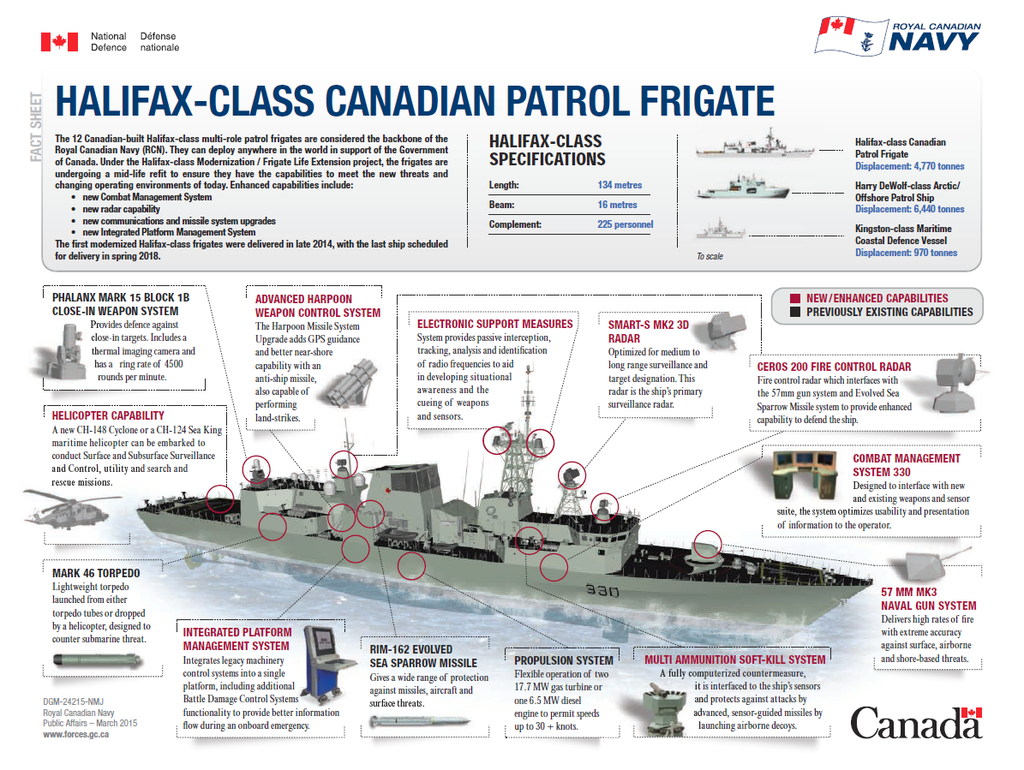
Click image to see full-sized. H/T to @RUSI_NS for the link.
Comments Off on The refit and modernization program for the RCN’s Halifax class frigates
December 26, 2015
QotD: Progress
Yes, Moist thought, there would be changes. You’d still find horses in town and Iron Girder couldn’t plough, although for a certainty Mr Simnel could make her do so. “Some people will lose out and others will benefit, but hasn’t that been happening since the dawn of time?” he said out loud. “After all, at the beginning there was the man who could make stone tools, and then along came the man who made bronze and so the first man had to either learn to make bronze too, or get into a different line of work completely. And the man who could work bronze would be put out of work by the man who could work iron. And just as that man was congratulating himself for being a smarty-pants, along came the man who made steel. Its like a sort of dance, where no one dares stop because if you did stop you’d be left behind. But isn’t that just the world in a nutshell?”
Terry Pratchett, Raising Steam, 2013.
Comments Off on QotD: Progress
December 23, 2015
SpaceX Falcon 9 performs successful launch and controlled landing
William Harwood reports for CBS News:
Making its first flight since a catastrophic launch failure last June, an upgraded, more powerful SpaceX Falcon 9 rocket roared to life and shot into space Monday, boosting 11 small Orbcomm data relay satellites into orbit in a major milestone for the California rocket builder.
In a significant space “first,” the Falcon 9’s first stage fell back into the atmosphere and pulled off a powered landing at the Cape Canaveral Air Force Station, settling to a smooth tail-first touchdown in a convincing demonstration of reusability, a key requirement for lowering commercial launch costs.
In a scene resembling a launch video running in reverse, the booster quickly dropped out of a cloudy sky atop a jet of flame from one of its Merlin 1D engines, heralded by twin sonic booms that rumbled across Florida’s Space Coast. Cheers erupted in company headquarters in Hawthorne, California, as the stage settled to a smooth touchdown.
In another first, the Falcon 9 used colder, denser-than-usual liquid oxygen and kerosene propellants, a significant upgrade allowing the booster’s nine first-stage engines to generate more power, increasing their combined liftoff thrust from 1.3 million pounds to 1.5 million, or 170,000 pounds of thrust per engine.
The launch, first-stage landing and satellite deployments all appeared to proceed without a hitch, a welcome success for a company returning to flight after a disheartening failure.
“Everything we’ve seen thus far in the mission appears to be perfect,” SpaceX founder Elon Musk said in a conference call with journalists. “The satellites were deployed right on target and the Falcon 9 booster came back and landed. Looks like almost dead center on the landing pad. … As far as we can see right now, it was absolutely perfect. We could not have asked for a better mission.”
There and back again pic.twitter.com/Ll7wg2hL1G
— Elon Musk (@elonmusk) December 22, 2015
Comments Off on SpaceX Falcon 9 performs successful launch and controlled landing
December 16, 2015
How Did Submarine Warfare Change During World War 1? I OUT OF THE TRENCHES
Published on 12 Dec 2015
Indy sits in the Chair of Wisdom again to answer your questions of WW1. This time we are talking about submarine warfare during the First World War.
Comments Off on How Did Submarine Warfare Change During World War 1? I OUT OF THE TRENCHES
December 13, 2015
How to Sharpen a Knife with Paul Sellers
Published on 11 Dec 2015
Paul shows his very simple method of how to get a razor sharp edge on your kitchen, carving, pocket or any form of knife using just a few pieces of sandpaper or some diamond paddles.
Comments Off on How to Sharpen a Knife with Paul Sellers


