Quotulatiousness

July 20, 2019

50th anniversary

Filed under: History, Space, Technology, USA — Tags: , , — Nicholas @ 11:41

Astronaut Buzz Aldrin, lunar module pilot, stands on the surface of the moon near the leg of the lunar module, Eagle, during the Apollo 11 moonwalk. Astronaut Neil Armstrong, mission commander, took this photograph with a 70mm lunar surface camera. While Armstrong and Aldrin descended in the lunar module to explore the Sea of Tranquility, astronaut Michael Collins, command module pilot, remained in lunar orbit with the Command and Service Module, Columbia. *This is the actual photograph as exposed on the moon by Armstrong. He held the camera slightly rotated so that the camera frame did not include the top of Aldrin’s portable life support system (“backpack”). A communications antenna mounted on top of the backpack is also cut off in this picture. When the image was released to the public, it was rotated clockwise to restore the astronaut to vertical for a more harmonious composition, and a black area was added above his head to recreate the missing black lunar “sky”. The edited version is the one most commonly reproduced and known to the public, but the original version, above, is the authentic exposure.

Bootprint in lunar dust created and photographed by Buzz Aldrin for the boot penetration (soil mechanics) task during the Apollo 11 moon walk.

QotD: Spices

Filed under: Food, Health, Quotations, Science — Tags: , , , , — Nicholas @ 01:00

Why do we use spices in our foods? In thinking about this question keep in mind that (1) other animals don’t spice their foods, (2) most spices contribute little or no nutrition to our diets, and (3) the active ingredients in many spices are actually aversive chemicals, which evolved to keep insects, fungi, bacteria, mammals and other unwanted critters away from the plants that produce them.

Several lines of evidence indicate that spicing may represent a class of cultural adaptations to the problem of food-borne pathogens. Many spices are antimicrobials that can kill pathogens in foods. Globally, common spices are onions, pepper, garlic, cilantro, chili peppers (capsicum) and bay leaves. Here’s the idea: the use of many spices represents a cultural adaptation to the problem of pathogens in food, especially in meat. This challenge would have been most important before refrigerators came on the scene. To examine this, two biologists, Jennifer Billing and Paul Sherman, collected 4578 recipes from traditional cookbooks from populations around the world. They found three distinct patterns.

1. Spices are, in fact, antimicrobial. The most common spices in the world are also the most effective against bacteria. Some spices are also fungicides. Combinations of spices have synergistic effects, which may explain why ingredients like “chili power” (a mix of red pepper, onion, paprika, garlic, cumin and oregano) are so important. And, ingredients like lemon and lime, which are not on their own potent anti-microbials, appear to catalyze the bacteria killing effects of other spices.

2. People in hotter climates use more spices, and more of the most effective bacteria killers. In India and Indonesia, for example, most recipes used many anti-microbial spices, including onions, garlic, capsicum and coriander. Meanwhile, in Norway, recipes use some black pepper and occasionally a bit of parsley or lemon, but that’s about it.

3. Recipes appear to use spices in ways that increase their effectiveness. Some spices, like onions and garlic, whose killing power is resistant to heating, are deployed in the cooking process. Other spices like cilantro, whose antimicrobial properties might be damaged by heating, are added fresh in recipes.

Thus, many recipes and preferences appear to be cultural adaptations adapted to local environments that operate in subtle and nuanced ways not understood by those of us who love spicy foods. Billing and Sherman speculate that these evolved culturally, as healthier, more fertile and more successful families were preferentially imitated by less successful ones. This is quite plausible given what we know about our species’ evolved psychology for cultural learning, including specifically cultural learning about foods and plants.

Among spices, chili peppers are an ideal case. Chili peppers were the primary spice of New World cuisines, prior to the arrival of Europeans, and are now routinely consumed by about a quarter of all adults, globally. Chili peppers have evolved chemical defenses, based on capsaicin, that make them aversive to mammals and rodents but desirable to birds. In mammals, capsicum directly activates a pain channel (TrpV1), which creates a burning sensation in response to various specific stimuli, including acid, high temperatures and allyl isothiocyanate (which is found in mustard or wasabi). These chemical weapons aid chili pepper plants in their survival and reproduction, as birds provide a better dispersal system for the plants’ seeds than other options (like mammals). Consequently, chilies are innately aversive to non-human primates, babies and many human adults. Capsaicin is so innately aversive that nursing mothers are advised to avoid chili peppers, lest their infants reject their breast (milk), and some societies even put capsicum on mom’s breasts to initiate weaning. Yet, adults who live in hot climates regularly incorporate chilies into their recipes. And, those who grow up among people who enjoy eating chili peppers not only eat chilies but love eating them. How do we come to like the experience of burning and sweating — the activation of pain channel TrpV1?

Research by psychologist Paul Rozin shows that people come to enjoy the experience of eating chili peppers mostly by re-interpreting the pain signals caused by capsicum as pleasure or excitement. Based on work in the highlands of Mexico, children acquire this gradually without being pressured or compelled. They want to learn to like chili peppers, to be like those they admire. This fits with what we’ve already seen: children readily acquire food preferences from older peers. In Chapter 14, we further examine how cultural learning can alter our bodies’ physiological response to pain, and specifically to electric shocks. The bottom line is that culture can overpower our innate mammalian aversions, when necessary and without us knowing it.

Joseph Henrich, The Secret of Our Success: How Culture Is Driving Human Evolution, Domesticating Our Species, and Making Us Smarter, 2015.

July 17, 2019

QotD: “The United States government [became] the greatest and most potent maker of criminals in any recent century”

Filed under: Health, History, Law, Quotations, USA — Tags: , , , , — Nicholas @ 01:00

For most of the history of the United States, drugs were legal. People could buy opiates and cocaine-based products from their local pharmacy. An opiate-laced brew called Mrs. Winslow’s Soothing Syrup, for example, was particularly popular with housewives. One person who viewed this legal system with skepticism was a Los Angeles doctor named Henry Smith Williams. When a small number of his patients became addicted, he was disgusted, and he came to see them as despicable “weaklings.” So when opiates and cocaine were banned in 1914, he welcomed this first birth-pang of the drug war with glee.

But then he noticed what happened to his addicted patients. They didn’t stop using. Instead, “here were tens of thousands of people, in every walk of life, frantically craving drugs that they could in no legal way secure,” he wrote in one of his books. “They craved the drugs, as a man dying of thirst craves water. They must have the drugs at any hazard, at any cost.”

At the same time, Smith Williams realized that the drug war was “in effect ordering a company of drug smugglers into existence.” Because pharmacists could no longer sell these drugs, the Mafia and other criminal organizations stepped in, selling a vastly inferior product at extortionate prices. In the pharmacies, morphine had cost two or three cents a grain, but the criminal gangs charged a dollar.

The death rate among addicts rose, and those who survived began to behave very differently. An official government study had found that, before the drug war kicked in, three-quarters of self-described addicts had steady and respectable jobs: some 22% were wealthy, while only 6% were poor. They were more sedate as a result of their addiction, but they were rarely out of control or criminal. Yet faced with the need to meet these extortionate new prices, many of the men started to commit property crimes, and many of the women started to steal or prostitute themselves.

So Smith Williams watched as the drug war created two waves of crime: first a wave of violent criminal drug-dealers, and then a wave of criminality among addicts. “The United States government,” Henry wrote in shock, had become “the greatest and most potent maker of criminals in any recent century.”

Johann Hari, “A 1930s California story shows why the war on drugs is a failure”, Los Angeles Times, 2017-06-16.

July 16, 2019

Bitcoin mining’s massive carbon buttprint

Filed under: China, Economics, Environment, Technology — Tags: , , , — Nicholas @ 03:00

Lincoln Swann explains why Bitcoin has become a huge environmental liability as its per-unit cost-to-mine has risen:

Bitcoin is more than a rather volatile imitation currency, it is also a huge energy monster.

The digital “mining” to create more Bitcoins and the recording of transactions uses up vast, crazy, amounts of electricity – something like 70TWh a year. That is about the same as Austria, say 20% of UK power consumption. As an added horror much if it is done in China where most of the power is coal generated.

All that adds up to a CO2 output from Bitcoin stuff of about 35mt a year. Planet friendly it definitely aint.

July 7, 2019

Does this sound like your gym?

Filed under: Business, Health, USA — Tags: — Nicholas @ 05:00

Instapundit linked to this older Sean Kelly article about the “Planet Fitness” chain of health clubs. According to him, it’s even less pretty than you might have thought:

Here’s what you need to know…

  1. Planet Fitness: The gym for people who don’t really want to get in shape, owned by people who really can’t afford for the members to be there.
  2. A survey of over 20 different Planet Fitness locations in 12 different states revealed that they provide no nutritional guidance. They do however supply candy and pizza.
  3. Planet Fitness seems to promise that health and fitness will ultimately be comfortable and not involve any real effort.
  4. Planet Fitness is a big, purple-colored adult daycare marketed to people afraid to go to an actual gym.
  5. Many Planet Fitness members do want to make progress of course, but the gym’s own rules and operating guidelines seem to dissuade this.

July 4, 2019

Assorted green scams

David Warren briefly returns to the current day (away from his normal 13th-century preferences) to look at a few of the many green scams being run by various government and industry scam artists:

Speaking with a gentleman who vends in a neighbourhood farmers’ market, I learnt something interesting, and probably true. Surviving family farms usually lack “organic” credentials. This is because getting them, from the bureaucracies that dispense them, is an immensely time-consuming process, and involves costs that would erase most of the little farmer’s profits. You have to be a big, faceless, industrial operation to afford the official “organic” labels that sucker big city consumers into paying double for essentially the same goods. That the whole system is massively corrupt, can almost go without saying. It was designed to be.

Organic scams are far from new, but perhaps more insidious because corporations love to add that “organic” label on stuff to jack up the prices on all sorts of things, like spices, wine, and many, many other items. Restaurants do the same trick on their menus, frequently assuming nobody will ever check up on them. That said, it’s mostly the well-off who get fooled because, well, they’re eager to be fooled on that score. The US government even admitted that organic certification is not about food safety or nutrition: it’s all marketing.

By coincidence, the same day my eye caught, by accident on the Internet, the announcement of a Green Award to a big car assembly “park.” They had changed all the light bulbs in their factory buildings, thus saving themselves a few thousand dollars on their multi-million electric bill, and seem to have installed new toilets, too. This sprawling high-tech carriage works remains three hundred acres of unspeakable aesthetic horror, in which human beings are enslaved to machines. But now it is “Green.”

The greenwashing of modern industrial and commercial buildings is a long-running scam, with the much-desired “LEED Platinum” certification usually, if not always, awarded to those who game the system most successfully. “What LEED designers deliver is what most LEED building owners want – namely, green publicity, not energy savings

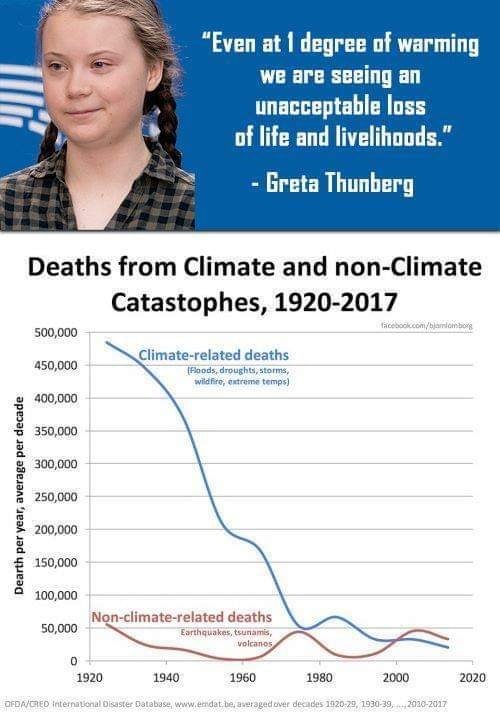
The environmental business — currently buoyed by unprovable, often fatuous claims of anthropogenic global warming — is perhaps the most cynical. It has spawned vested interests on a global scale, that will not be overturned by occasional exposure. At its heart is the manipulation of statistics, and scare-mongering through compliant mass media. The general public are hypnotized by repetition. I have noticed in desultory dips into the news that e.g. anomalous weather will invariably be attributed to “climate change,” when more plausible explanations are easily at hand.

This zombification extends to most other areas of reportage: invisible bogeys blamed for imaginary trends. Solutions to “environmental problems” are proposed that will not make the slightest dent in them.

Of course, the constant demands for “clean energy” almost always explicitly reject the use of nuclear power because reasons.

Darlington Nuclear Generating Station in Clarington, Ontario.
Photo by Óðinn via Wikimedia Commons.

But nuclear power, most easily in the form of molten salt reactors (on which research was killed fifty years ago), could replace most uses of coal, oil, and gas within a decade, through much smaller facilities eliminating huge transmission costs. It would be the cheaper because the fuels are readily available to start in the form of recycled nuclear waste, and the raw materials would be abundantly available thereafter.

On the question of safety, the death toll from mining, drilling, hydro dams, &c, is quite considerable — in the tens of thousands at least, post-War. Except for Chernobyl (one of many Soviet-era environmental disasters), the death toll from nuclear accidents remains about nil. No one died at Three Mile Island. Not one death was caused by the flooded Fukushima reactors (though well over twenty thousand were killed by the tsunami that caused the difficulty there).

In short, “clean energy” is not a problem. It had to be made into one by the fright campaigns of the environmentalcases, whose own power and income depends on sustaining the problem, and preventing the most obvious solutions.

June 29, 2019

Determining who the “original” inhabitants were

Filed under: Africa, Americas, Australia, Europe, History, Pacific, Science — Tags: , , , — Nicholas @ 03:00

It’s become quite common in some countries to pay formal lip service to the “original” peoples who inhabited the land before being dispossessed of that territory by various Europeans. Actually determining who were the first human inhabitants, however, is much more fraught … you can’t exactly expiate some residual guilt of your culture by acknowledging the previous culture if the previous culture in their turn dispossessed an even earlier group, can you? How far down the rabbit hole do you need to go? Tim Worstall explains:

Detail from a 1688 map of western New France by Vincenzo Coronelli that locates “Lac Taronto” at Lake Simcoe.
City of Toronto Culture Division/Library and Archives Canada via the National Post

… within all that the accurate answer to “Whose land are we on?” is the land of the latest bunch of murderous bastards who killed all the previous inhabitants. Perhaps moderated to say the peeps who killed all the previous men then dated the remaining womenfolk. Because once we’ve got past that nullius stage that’s the way it has been. The Moriori are in short supply these days on the Chatham Islands given that the Maori decided to eat them.

The original inhabitants of the British Isles, the Beaker Folk, were entirely replaced by the next lot, the Iron Age Celts and similar. The Angles displaced to the west the Romano Celts in their turn, detailed DNA studies showing rather more of the female side of the R-C’s bred into the new population than the male. The Franks weren’t indigenous to France, the Allemani to Germany, the Turks to Turkey.

In fact, we’ve between little and no proof that the varied Amerinds were the original inhabitants of the lands where the White Europeans found then from 1492 onwards. In the case of both the Incas and Aztecs as political powers, proof they weren’t. And horses and Plains Indians simply weren’t a thing until the Eurasian horse was introduced post 1492.

Basically, this is indeed true. Anywhere is the possession of simply the last group of people to have slaughtered, or outbred, the previous group.

An interesting observation – if we apply the oft stated Americas example elsewhere, that Whitey stole it all and should give it back, then the Bantu should be back in Nigeria and Central Africa returned to the Pygmies, Southern to the Khoi San. We don’t say that and for the life of me I can’t work out why.

June 28, 2019

What does £1 trillion buy you?

Not much, apparently:

Tory MPs have been told by CCHQ to share this graphic boasting about their new commitment to make the UK carbon-neutral by 2050. No other major country has committed to the pledge although Theresa May is planning a desperate attempt at the G20 to talk other leaders into it. The fact that developed countries going ‘net zero’ simply means they’ll outsource all their emissions to the developing world instead seems to be completely lost on her…

The pledge will cost the UK at least £1 trillion, much of which will be borne by individuals and businesses rather than the exchequer, we don’t know the true cost as May hasn’t even done a proper Treasury analysis. Eco-fanatics love to talk about the burden this generation is placing on children and grandchildren. For a fleeting PR stunt Tory MPs are being told to boast about piling on mountains of economic harm for future generations by a leader who won’t be in office to deal with the consequences…

This is exactly the sort of virtue signalling that Justin Trudeau indulges in … I imagine he’s quite miffed that Theresa May got there first.

QotD: “Intelligence” is just a noun

Filed under: Books, Health, Media, Quotations — Tags: , , , — Nicholas @ 01:00

Howard Gardner has also convinced us that the word intelligence carries with it undue affect and political baggage. It is still a useful word, but we shall subsequently employ the more neutral term cognitive ability as often as possible to refer to the concept that we have hitherto called intelligence, just as we will use IQ as a generic synonym for intelligence test score. Since cognitive ability is an uneuphonious phrase, we lapse often so as to make the text readable. But at least we hope that it will help you think of intelligence as just a noun, not an accolade.

We have said that we will be drawing most heavily on data from the classical tradition. That implies that we also accept certain conclusions undergirding that tradition. To draw the strands of our perspective together and to set the stage for the rest of the book, let us set them down explicitly. Here are six conclusions regarding tests of cognitive ability, drawn from the classical tradition, that are by now beyond significant technical dispute:

  1. There is such a thing as a general factor of cognitive ability on which human beings differ.
  2. All standardized tests of academic aptitude or achievement measure this general factor to some degree, but IQ tests expressly designed for that purpose measure it most accurately.
  3. IQ scores match, to a first degree, whatever it is that people mean when they use the word intelligent or smart in ordinary language.
  4. IQ scores are stable, although not perfectly so, over much of a person’s life.
  5. Properly administered IQ tests are not demonstrably biased against social, economic, ethnic, or racial groups.
  6. Cognitive ability is substantially heritable, apparently no less than 40 percent and no more than 80 percent.

Charles Murray, “The Bell Curve Explained”, American Enterprise Institute, 2017-05-20.

June 26, 2019

“… what’s happening now is even better than Apollo”

Filed under: Space, Technology, USA — Tags: , , , , , — Nicholas @ 05:00

At Popular Mechanics, Joe Pappalardo reminds us that the 50th anniversary of the Apollo 11 lunar landing is coming up next month, but that current developments in space are worth celebrating too:

Astronaut Buzz Aldrin, lunar module pilot, stands on the surface of the moon near the leg of the lunar module, Eagle, during the Apollo 11 moonwalk. Astronaut Neil Armstrong, mission commander, took this photograph with a 70mm lunar surface camera. While Armstrong and Aldrin descended in the lunar module to explore the Sea of Tranquility, astronaut Michael Collins, command module pilot, remained in lunar orbit with the Command and Service Module, Columbia.

Apollo was born of Cold War desperation: a political exercise that paid enormous scientific and technological dividends. After the launch of Sputnik in 1957, it became vital to beat the Soviet Union to the Moon, a geopolitical urge that created an enormous budgetary effort.

The problem with politically motivated — well, anything — is that the faucet of support can be closed just as quickly as it opened. It happened to Apollo, as follow on missions were cancelled and the focus shifted to a reusable craft to service low-earth orbit. This pattern of shifting space priorities and strategies whipsawed NASA, most noticeably when the Obama administration’s cancellation of the Bush-era Constellation moon program in 2010.

But multiple private companies pursuing their niches in space have an obvious redundancy. While companies may rise and fall, the very nature of a commercial effort isn’t as dependent on government funding. If it’s worth doing, especially if it makes money, space industry will endure political shifts. The objectives of a well-run company do not change that much every four years.

That leaves today’s NASA with a choice: Do it themselves and control everything (the traditional way), or fund private companies to develop the tech the agency needs and then allow them to sell their services to any nation, company, or individual (the new way). With those services on the open market, NASA would be one of many customers for a new U.S.-based space economy.

This debate is boiling over right now. The ongoing effort to return to the moon, called Artemis (after Apollo’s sister), is becoming a lesson in the advantages of the commercial model.

[…]

If only investment guaranteed results. For those who miss bloated, government-run spaceflight, there is already a NASA spacecraft mired in the old ways of thinking. The feds have sunk a lot of money into the Space Launch System, a mega-rocket built to NASA specs for deep space missions. It was supposed to fly in 2017, but we’ll be lucky to see a first flight in 2020 — and it busted the $9.7 billion estimated budget, now costing about $12 billion.

But something happened during these SLS delays: the commercial space industry started delivering on its promises. Most visibly, private firms have been delivering supplies to the International Space Station for years and (hopefully soon) will ferry astronauts as well. Blue Origin and SpaceX has started development of crewed spacecraft able to reach to the moon and Mars. Elon Musk even sold a moon trip to a Japanese billionaire.

June 25, 2019

QotD: Perpetual adolescence

Filed under: Books, Health, Quotations, USA — Tags: , , — Nicholas @ 01:00

JOHN DICKERSON, HOST: Before we leave, let me ask you about your book The Vanishing American Adult. You see a very serious problem here for America. Explain what you mean. It’s a nonpolitical problem.

SENATOR BEN SASSE: Yes, so this book is 100 percent not about politics, and it’s 99 percent not about policy. It’s about this new category of perpetual adolescence. And, first, let’s just say that, over the last two millennia or so, the emergence of a category called adolescence is a pretty special gift. We believe that, when our kids become biological adults, when they hit puberty, they don’t have to be fully formed, morally, emotionally, economically, educationally, in terms of household structure. They don’t have to go out and be fully adult immediately. They don’t have to go off to war, and they don’t have to become economically self-sufficient. That’s glorious, to have that protected space between childhood and adulthood. But it’s only glorious if you understand that it’s a transitional state, it’s a means to an end. Peter Pan’s Neverland is a hell. It’s a dystopia. And we don’t want to be — have our kids caught at a place where they’re not learning how to be adults. And, right now, we’re not tending to the habit formation aspects of a republic.

“Face the Nation transcript, May 14, 2017: Schiff, Sasse, Gates”, CBS News, 2017-05-14.

June 24, 2019

The idea of “infinity”

Filed under: Religion, Science — Tags: , , — Nicholas @ 03:00

David Warren, staunch man of the 13th century, might be termed an opponent of the notion of infinity:

The term “infinity” was an invention of the Devil. This, gentle reader will understand, is my humble opinion. Or if the Devil didn’t invent it, he “evolved” it, from the more innocent usages that conveyed “unlimited,” or “countless,” or “unknowably” large or small. What is finite has an ending, can be finished, finis. What is infinite cannot be; it is open-ended. There is, where we look for an end, nothing there.

Portrait of Georg Cantor
Photographer unknown, via Wikimedia Commons.

Nothing is quite the opposite of something. Perhaps this is a fact no longer taught in our schools: that “nothing” can do nothing for you. Whereas, “something” might. For in its modern usage, “infinity” has become a thing. It has become “virtually” an agent, a kind of god, demanding to be worshipped. The very Christian idea of Alpha and Omega — from the first to the last letter of the (Greek) alphabet, from beginning to end — is subtly replaced in our minds with the progressive idea, “from one to infinity.”

Which is where the human mind checks out. “So what is infinity plus one?” one asks. There can be no answer. Today we are hanging on a cross of “infinity.”

The mathematician Georg Cantor (1845–1918), in his lucid moments (when out of insane asylums), invented set theory. It may be found, lodged in the heart of post-modern reasoning. My hero Wittgenstein, among others, explained how pernicious it was. Scholastic theologians had already spotted the fly in the “infinite” ointment. It is pantheist, and in Cantor’s “final” posit of an infinity of infinities, it is a direct challenge to the unity or uniqueness of the revealed God. Cantor himself was under the impression that God existed, in the sense that God had communicated set theory to Cantor of all people. I, at least, am sceptical of those who claim direct communication with God, especially those who spend a lot of time in bat houses, and wonder with whom they were really chatting. (I don’t doubt that the mad can be brilliant, however.)

June 21, 2019

QotD: Caloric intake and weight gain

Filed under: Food, Health, Quotations, Science — Tags: , , — Nicholas @ 01:00

The average person needs about 800,000 calories per year. And it takes about 3,500 extra calories to gain a pound of weight. So if somebody stays about the same weight for a year, it means they fulfilled their 800,000 calorie requirement to within a tolerance of 3,500 calories, ie they were able to match their food intake to their caloric needs with 99.5% accuracy.

By this measure, even people who gain five or ten pounds a year are doing remarkably well, falling short of perfection by only a few percent. It’s not quite true that someone who gains five pounds is ((5*3,500)/800,000) = 98% accurate, because each pound you gain increases caloric requirements in a negative feedback loop, but it’s somewhere along those lines.

Take a second to think about that. Can you, armed with your FitBit and nutritional labeling information, accurately calculate how many calories you burn in a given day, and decide what amount of food you need to eat to compensate for it, within 10%? I think even the most obsessive personal trainer would consider that a tall order. But even the worst overeaters are subconsciously managing that all the time. However many double bacon cheeseburgers they appear to be eating in a single sitting, over the long term their body is going to do some kind of magic to get them to within a few percent of the calorie intake they need.

It’s not surprising that people overeat, it’s surprising that people don’t overeat much more. Consider someone who just has bad impulse control and so eats whatever they see – wouldn’t we expect them to deviate from ideal calorie input by more than a few percent, given that this person probably has no idea what their ideal input even is and maybe has never heard of calories?

Scott Alexander, “Book Review: The Hungry Brain”, Slate Star Codex, 2017-04-27.

June 18, 2019

Blitzkrieg on Speed – Nazis on Crystal Meth Part 2 – WW2 SPECIAL

Filed under: Germany, Health, History, Military, WW2 — Tags: , , , — Nicholas @ 04:00

World War Two
Published on 17 Jun 2019

While many armies use performance enhancing drugs during WW2, the Wehrmacht takes it to extremes in 1940, with more than debatable consequences.

Join us on Patreon: https://www.patreon.com/TimeGhostHistory
Or join The TimeGhost Army directly at: https://timeghost.tv

Join our Discord Server: https://discord.gg/D6D2aYN.
Between 2 Wars: https://www.youtube.com/playlist?list…
Source list: http://bit.ly/WW2sources

Hosted by: Indy Neidell
Written by: Astrid Deinhard, Joram Appel and Spartacus Olsson
Produced and Directed by: Spartacus Olsson and Astrid Deinhard
Executive Producers: Bodo Rittenauer, Astrid Deinhard, Indy Neidell, Spartacus Olsson
Creative Producer: Joram Appel
Post Production Director: Wieke Kapteijns
Research by: Joram Appel and Astrid Deinhard
Edited by: Spartacus Olsson
Sound Engineering: Joakim Brodén

Colorisations by Spartacus Olsson

Archive by Reuters/Screenocean http://www.screenocean.com

A TimeGhost chronological documentary produced by OnLion Entertainment GmbH.

From the comments:

World War Two
1 hour ago
Read before you comment; “it wasn’t just the Germans” This video treats the use of methamphetamine by the German Wehrmacht and its cultural background. The purpose of this video is not to attribute any atrocities that the Nazis perpetrated to that they were simply on drugs – we know that this was not a contributing factor to what they did, although it perhaps influenced how they did it. It is also not the purpose of this video to single out Germany as the only belligerent to use drugs in WW2. As we point out in the video, many belligerents (to not say all) used drugs, especially amphetamines during WW2. In fact amphetamines are still in official, monitored used by for instance the US Army in some situations to this day. However, the Wehrmacht and a few of the Axis allies used methamphetamine which is different than amphetamine as the effects of meth is unpredictable and comes on faster and harder. These unpredictable effects include hallucinations and delusions, which amphetamines do not induce, or at least to a lesser and more predictable degree. Methamphetamine metabolizes into amphetamine in the body, but in that process it creates a number of side effects that contribute to its unstable effects. Of course this was poorly understood in 1940 and meth was also available commercially over the counter in many places like the US and Australia, mostly as a dieting pill and (somewhat ironically) an anti-depressant. While amphetamines like Benzedrine are still administered by doctors for certain conditions, methamphetamine is now known to be a very dangerous, potentially lethal, drug that only has recreational use, and in 2019 it is therefore illegal almost everywhere in the world. Last but not least, the Wehrmacht was singular in how liberal they were in distributing drugs to the troops, at least to begin with. It is important to also point out that beside the official use of drugs, many soldiers throughout the ages have resorted to intoxicating themselves to deal with the unfathomable horrors of war, and in this respect WW2 was no different. We will cover drug use by other belligerents and in general during the war in future videos.

June 17, 2019

How does RADAR work? | James May Q&A | Head Squeeze

Filed under: History, Military, Science, Technology, WW2 — Tags: , , , , — Nicholas @ 04:00

BBC Earth Lab
Published on 29 Nov 2013

How does RADAR work? It’s a bit like shouting very loudly at a cliff and waiting for the echo to come back to you. Whether you use rude words or not is completely up to you.

RADAR is emitting a sound wave and waiting for the echo to come back to you. By timing the returning echo you can work out where exactly another object is.

The really interesting thing about radar is if you use multiple angled receivers you can work out the position and height of a target. This technology was essential in winning the Battle of Britain in 1940.

But that was 1940, what about radar now? Is it as defunct as the 3 ½ inch floppy disk? Well, no actually. Radar is still pretty important in the military but the technology is a lot more advanced. In fact each time you connect to a sat nav to figure out where you are, you are using the network of satellites that calculate your position using the same principles of radar.

Thanks to Alyssa Ann for her portrait of Jeremy Clarkson: http://alyssamenold.com/

« Newer PostsOlder Posts »

Powered by WordPress