Quotulatiousness

August 5, 2009

Blotting out Rorschach tests

Filed under: Health, Technology — Tags: , , — Nicholas @ 07:50

Colby Cosh examines the furor around James Heilman’s posting of the original Rorschach inkblots to Wikipedia:

It is probably no great loss. Critics of Heilman complain that “decades” of research will have to be abandoned if the Rorschach test becomes impossible to use. But most of this research has been shown, in the last 20 years, to be flapdoodle. As soon as the test became popular — so much so that it became a staple of comedy routines about Freudian psychotherapists, along with couches and thick German accents — it had critics who pointed out that there was little or no statistically validated basis for its interpretation. After the psychiatric profession got around to trying to establish such a basis — and this happened disgracefully late in history — there was little or nothing left of what had once been perceived as the broad general usefulness of the Rorschach.

Much of the folklore that had grown up around specific elements of the test had to be thrown in the trash. It appears to have modest predictive or diagnostic power for a few very specific aspects of personality, and even this surviving foundation is shaky. Yet supporters gave, and some are still giving, the same indignant defences that pseudoscience always receives. Interpreting responses to Rorschach blots is more “art” than “science,” they have insisted. (The mating call of the quack.) Only those who are intimately familiar with the test — i. e., those who believe in it and have come to depend on it — are really qualified to judge whether it “works.”

But can the thousands of psychologists and psychiatrists who have considered the Rorschach test a useful item in the healing toolbox for generations really all have been wrong? Keep in mind that the same practitioners were eagerly recommending and performing lobotomies throughout the same period, and you have your answer.


July 31, 2009

Cue up the ominous music . . .

Filed under: Asia, Science — Tags: — Nicholas @ 12:58

. . . ’cause it’s the return of Krakatoa:

Krakatoa_July2009(Detail of image from the article)

With an explosive force 13,000 times the power of the atomic bomb that annihilated Hiroshima, the 1883 eruption of Krakatoa killed more than 36,000 people and radically altered global weather and temperatures for years afterwards.

The eruption was so violent and catastrophic that no active volcano in modern times has come close to rivalling it, not even the spectacular eruption of Mount St Helens in the U.S. in 1980. Now, almost a century-and-a-half on, are we about to experience the horrors of Krakatoa once again?

‘Volcanic prediction is getting better,’ says Professor Jon Davidson, chair of Earth Science at Durham University and a volcanologist who has studied Krakatoa first-hand. ‘But we are never going to be able to fully predict big and unusual eruptions, precisely because they are unusual.’

Yet there is little doubt that if Krakatoa were to erupt again with such force and fury, the impact would be far more devastating than that which was experienced in the 19th century.

H/T to Nick Packwood.

July 30, 2009

Organic food shock: no better than non-organic

Filed under: Environment, Food, Science, Wine — Nicholas @ 07:59

This is another one of those “someone paid money to conduct the study?” studies. Organic food has been a boon to certain producers, but it doesn’t provide the kind of benefits most purchasers expect:

But organic is certainly more expensive. A new study in the American Journal of Clinical Nutrition finds:

On the basis of a systematic review of studies of satisfactory quality, there is no evidence of a difference in nutrient quality between organically and conventionally produced foodstuffs. The small differences in nutrient content detected are biologically plausible and mostly relate to differences in production methods.

The study was commissioned by Britain’s Food Standards Agency.

I’ve been skeptical about the claims for “organic” products for quite some time. Similarly, I’m not convinced that there’s any great value in the “biodynamic” model for wine. My strong suspicion is that the same general quality of wine would be produced without all the new age woo-woo mystic crap, because the vineyard owner or manager is paying closer attention to the vines. That, IMO, is the key.

Another argument against “intelligent design”

Filed under: Science — Tags: — Nicholas @ 07:36

Actually, ten arguments:

1 Sea mammal blowhole. Any animal that spends appreciable time in the ocean should be able to extract oxygen from water via gills. Enlarging the lungs and moving a nostril to the back of the head is a poor work-around.

2 Hyena clitoris. When engorged, this “pseudopenis,” which doubles as the birth canal, becomes so hard it can crush babies to death during exit.

3 Kangaroo teat. In order to nurse, the just-born joey, a frail and squishy jellybean, must clamber up Mom’s torso and into her pouch for a nipple.

July 28, 2009

QotD: Re-interpreting that number

Filed under: Government, Health, Quotations, USA — Tags: — Nicholas @ 07:38

There have been two trends in US health care over the last decade. On the one hand, a lot of Americans have become, in any rational sense, over-insured: They get tested for things they’ll never get. On the other, there has been an abandonment of health insurance by the rich. If you peel the Census Bureau and DHHS figures, of those alleged “45 million uninsured Americans”, one-fifth aren’t Americans; another fifth aren’t uninsured but are covered by Medicare; another two-fifths are the young and mobile (they don’t have health insurance, but they don’t have life insurance or home insurance, either: they’re 22 and immortal and life’s a party); and the remaining fifth are wealthier than the insured population. Really. According to a 2006 Census Bureau report, 19 per cent of the uninsured have household income of over $75,000. Since the last round of government “reform” in the Nineties, wealthy Americans have been fleeing insurance and opting to bring health care back to a normal market transaction. And, if you look at the “uninsured discount” offered by doctors, one can appreciate that, for everything but chronic disability, it’s not an irrational decision to say I’ll get a better deal for my broken leg or my colonoscopy or my heavy cold if I just write a check for it.

Mark Steyn, “The Nationalization of Your Body”, National Review, 2009-07-28

July 24, 2009

There are spinoffs, and then there are spinoffs

Filed under: Space, Technology — Tags: , , — Nicholas @ 13:59

The space program has lots of detractors (and, to be fair, lots of starry-eyed, er, boosters), but here are some spinoffs from the space program that may not be obvious:

Or: more accurately, in strictly economic terms — what has the space program done for us?

Well, for starters: without the space program we’d probably be dead. Spy satellites are the very keystone of arms verification; without spysats the cold war would quite possibly have turned hot by the early 1960s, due to misinformation and fear permeating the chain of command on either side. Subsequently, gamma-ray detector satellites such as the American Vela constellation and its Soviet equivalents gave some reassurance to the superpowers by giving them the ability to know with a degree of confidence in whether or not nuclear explosions were taking place anywhere on the planet — a prerequisite for nuclear deterrence without a launch-on-warning policy.

But the cold war’s over. So what else?

* Weather satellites. We tend to forget how primitive weather forecasting was before we could look down on developing weather systems from above; the evidence is on your TV set every day.

* Communications. The first live trans-Atlantic TV transmission took place as recently as July 23rd, 1963; go back even a few years before that, and intercontinental TV was an element of science fiction. Today, you can buy a premium-priced mobile phone that gives you coverage from the middle of the ocean, by way of satellite services such as Inmarsat and Iridium, and see news from the far side of the world in real time. It has quite literally shrunk the world.

Is this the original “Eye of Horus”?

Filed under: Space — Tags: — Nicholas @ 11:04

original_eye_of_horus

Full story here.

More on scapegoating plastic bags

Filed under: Cancon, Economics, Environment — Tags: , — Nicholas @ 09:22

Back on the old site, I posted an item that related tangentially to the issue of plastic bags in supermarkets. Russ LeBlanc sent me a note, which I published as an update to that post. He’s now expanded on that idea, with a letter to newsdurhamregion.com:

You’d think in these tough economic times our public officials would avoid “trash talk.” Enough already!

Get to the real issues. Dwelling on emotional fallacies such as the dreaded plastic bag while people are left with little economic hope is unforgivable. Sorry, Camille, banning plastic bags will do less than little to save the planet. It isn’t even a start, but it does sound warm and fuzzy.

If our politicians feel it necessary to spend our hard-earned tax dollars on recycling studies then they should do due diligence and commission a study by independent biologists to find out if the other study is even worth it. Better yet, spend the money where it counts, attracting jobs.

See-through bags and supporting a big-business cash grab for something that represents less than one per cent of a landfill (plastic bags) is irresponsible. Heaven forbid we see a politician questioning this issue.

By the way, Madam Mayor, I’m sure the big retailers would welcome the reward card incentive program (even though it’s really a form of big business getting around the right to privacy issue). Perhaps we can use the points for a garborator?

July 23, 2009

Realizing Heinlein’s “The Man Who Sold the Moon”

Filed under: Space — Tags: , , , — Nicholas @ 07:40

Unlike in the original story, this isn’t going to be just a ploy to get advertisers to help fund the first moon shot:

“If you’re interested, the logo of your choice could go lunar for as little as the minimum $46,000 bid. (Hurry! Bidding started two days ago.)”

Update, 24 July: For a very interesting discussion of the Apollo program, and the design choices taken, see Charles Stross’s blog post. Good stuff (even if I’m way late in linking to it).

July 22, 2009

Looking for Canadian health stats?

Filed under: Bureaucracy, Cancon, Health — Tags: , , — Nicholas @ 09:59

Kathy Shaidle has some useful advice for Americans who may be looking for information on the Canadian healthcare system.

Up here, the key word in discussions is “wait times”. That’s what we say, when you say “rationing.” The ONLY way for our system to work is to “hope” somebody ahead of you in the line for care dies, and you can take their place. A very cynical, nasty way to run a country, to say the least.

So go to Google.ca (especially the “News” section) and look up “wait times” if you want to get the real Canadian conversation on our health care system.

July 21, 2009

iPhone as convenient marijuana lookup device

Filed under: Health, Technology — Tags: , , — Nicholas @ 14:50

This is quite a cool idea:

We’ve seen a lot of unexpected, and sometimes cool, iPhone apps approved by Apple, but today’s news might top the rest. Apple has approved a marijuana — that’s right, marijuana — app called “Cannabis,” which lets users find the nearest (don’t worry: legal) supplier of medicinal marijuana.

Created by the founder of Ajnag.com, which was founded in 2006 and was the first medicinal marijuana locater on the Web, the new app is quick and easy to use. Simply open it up on your iPhone or iPod Touch and you’ll see a map with the nearest distributors. The app gives you information on each of the locations, and even step-by-step directions with Google Maps.

That’s not all, though — the creators thought of everything. If you run into any, erm, legal troubles with your newly-secured marijuana, Cannabis also gives you the locations of the nearest lawyers who specialize in marijuana cases. And, if you happen to live in one of the 37 states where marijuana is not legal, the app also provides you with the location of the nearest marijuana activist groups — so you can do your part to promote reform.

QotD: ” . . . Apollo was a government boondoggle”

Filed under: Politics, Quotations, Space — Tags: , , , — Nicholas @ 08:44

To keen spacenuts like yours truly, the moonshot was a brilliant climax. That was the problem, it was THE climax. Nothing since has some close in daring or accomplishment. The moon, the wisemen told us, was only the first step. Mars was next, by 1990 surely. 1990 came and went. Whatever the scientific merits of sending men rather than machines to the planets, the spacenuts wanted Captain Kirk to follow logically from Neil Armstrong. It was the future. It was progress. It was inevitable.

We didn’t notice, until rather late, the problem with Apollo. The clever crew cut men, hard cold and objective, gazing at their computer screens — ancient to modern eyes, but so beautiful — using mind boggling math to do the amazing. Beneath the math, the engineering and the hard science was the dismal science. Apollo was a government boondoggle, a creature of politicians it died when its political masters saw that it was no longer a vote getter.

Publius, “Destination Moon”, Gods of the Copybook Headings, 2009-07-20

July 20, 2009

QotD: TANSTAARTHC

Filed under: Economics, Health, Liberty, Quotations — Tags: , , — Nicholas @ 12:37

There. I said it. Someone had to.

The acronym would be TANSTAARTHC. Nowhere near as euphonius as TANSTAAFL.

I broach the subject because I can’t seem to turn on a TV or radio without hearing, “Health care is a human right.” The phrase has entered the zeitgeist. Google it and you’ll get 25k hits. Google “right to health care” and you get 200k. Maybe I’m not listening hard enough, but I hear no one questioning its validity.

A right is intrinsic. It’s not given to you, it’s something you’re born with. Its existence is not dependent on the actions of others. In fact, only by the actions of others can it be taken from you.

F. Paul Wilson, “There ain’t no such thing as a right to health care “, Libertarian Enterprise, 2009-07-19

That’s one small miscue for a man, one giant leap for Mankind

Filed under: History, Space — Tags: , , , — Nicholas @ 07:44

It was 40 years ago:

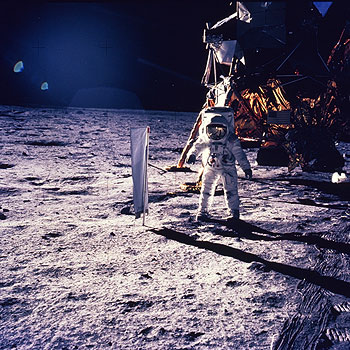
Armstrong and fellow astronaut Buzz Aldrin left the Apollo 11 command module (piloted by Michael Collins) in orbit and performed a landing in the lunar module Eagle. At 4:18 p.m. EDT, Armstrong announced to a watching and waiting world that “The Eagle has landed.”

Six-and-a-half hours later, he stepped onto the powdery surface with the words, “That’s one small step for man, one giant leap for mankind.” Aldrin soon followed Armstrong down the ladder to become the second man to stand on the moon.

One_Small_Step

The mission was by no means a slam dunk. There was real fear that once on the lunar surface the astronauts might end up marooned and beyond rescue. In fact, President Nixon had a condolence speech ready to go in the event things turned out badly.

Nostalgia is an interesting phenomenon . . . the very term “President Nixon” is pried out of deep archaeological layers of memory, yet the first moon landing still seems fresh and no-longer-new but still somehow “recent”.

If you’re still eager for more, Wired has a convenient round-up of Apollo 11-related sites and events.

July 18, 2009

Healthcare costs

Filed under: Economics, Health — Tags: — Nicholas @ 17:43

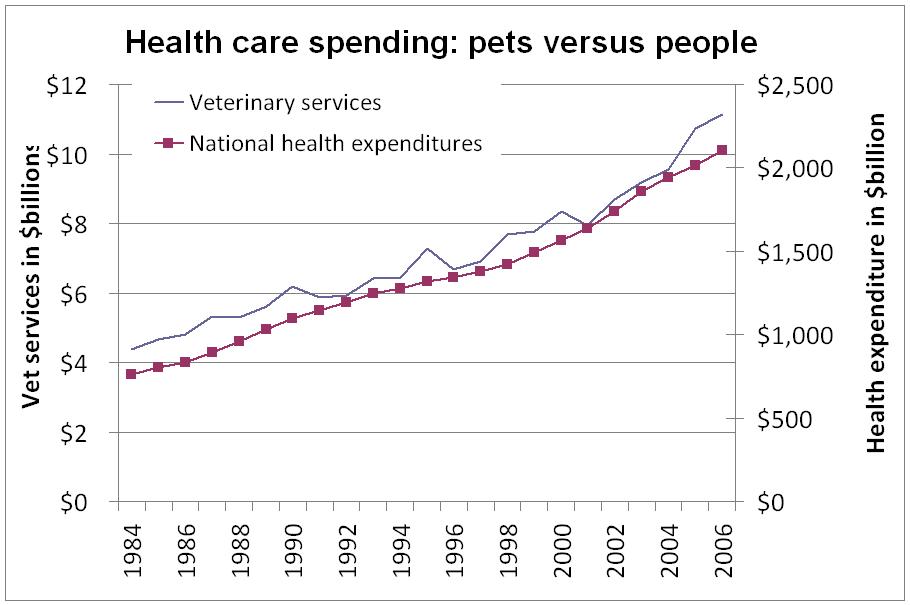
Several years back, Elizabeth worked as an office manager at a vet clinic. She enjoyed the work, although it didn’t pay well. One of the most frequent complaints from the customers was the high cost of vet care. This graph from The Enterprise Blog shows that the rates of increase in healthcare costs are intriguingly similar between pets and their owners (note the different scales on the left and right side of the chart):

Health care costs: pets versus people

The chart [. . .] shows spending on veterinary care, which I pulled from the Consumer Expenditure Survey, and national health expenditures (for people) from the National Income and Product Accounts. Two things are interesting here: first, the rate of growth of spending from 1984 to 2006 wasn’t all that different — and in both cases, spending grew faster than the rate of economic growth. As new technologies are developed for humans, we adopt them for Bowser and Fifi — because we can afford to and we think it’s worth it.

Here in Canada, where we almost never know the actual costs of the healthcare services we receive, the stark reality that healthcare costs money is a nasty surprise. We don’t spend anything like the same real dollars on our dogs, cats, and other pets as on ourselves or our family, and the fact that we don’t have a clue how expensive it is fuels the constant political demand that we provide more “free” healthcare.

On the other hand, in much of Canada, it’s possible to get X-rays, MRI, CT scans, and other diagnostic tests done in hours or days . . . for your pet. For you, weeks or months before you’ll get your appointment. If only there were some obvious conclusion we could draw from these data points . . .

I wrote about the pet health/human health disconnect all the way back in 2004.

« Newer PostsOlder Posts »

Powered by WordPress