It’s extremely important in this connection to remember that psychology is not a science, not even remotely. It is not the product of careful hypothesis-formation and controlled, repeatable, peer-reviewed experiment. It is nothing more than a collection of folklore and the armchair opinions of committees, less credible and valid than global warming. The authority it speaks from is purely political.
I know all of this because in college, I was a psychology major, myself, until I saw how empty the field is of anything resembling science or a decent, genuine regard for the well-being of other people. I read Dr. Thomas Szasz, beginning with his The Manufacture of Madness — in which he defines schizophrenia as a particular relationship between a therapist and his patient — and changed my major.
Five hundred years ago, if you were discovered to be in possession of a volume of the Book of Common Prayer that had a misplaced comma on Page 151, you might ultimately be burned at the stake for heresy. This had absolutely nothing to do with religion, it was simply an easy way for the political elite to justify disposing of its perceived enemies.
Psychology, as a body of “knowledge”, is more than just a little fallible. It will commonly declare some violent criminal “cured” and fit to interact peacefully and productively with society, following which the monster will immediately go out and axe-murder an entire family.
Psychology can be fooled into incarcerating individuals who are perfectly sane, as it once did with Nellie Bly, a courageous reporter investigating conditions in a New York mental asylum late in the 19th century. Nor have its powers of diagnosis much improved since then. On the other hand, if, like Ezra Pound or Frances Farmer (look them up), you hold opinions contrary to those the government wants you to hold — especially today on global warming, gun ownership, race relations, or the meaning and significance of the U.S. Constitution — it will more than question your sanity, it will lock you up and tear it to bits.
And today, when it does that, uniformed and armored thugs will show up at your home to shoot your dogs, stomp your kittens to death, terrify your family, empty out your gun safe, and murder you if you resist. Soon it may be enough to say that if you own guns you must be insane.
L. Neil Smith, “The New Inquisition”, Libertarian Enterprise, 2014-03-16
March 17, 2014
QotD: Psychology
March 16, 2014
QotD: American “cheese”
Everyone thinks America Alone is about Islam and demography, but in fact it has a whole section in it on cheese, called “The Pasteurization is Prologue”. Page 181:
I’ve never subscribed to that whole “cheese-eating surrender-monkey” sneer promoted by my National Review colleague Jonah Goldberg. As a neocon warmonger, I yield to no one in my contempt for the French, but, that said, cheese-wise I feel they have the edge.
When I’m at the lunch counter in America and I order a cheeseburger and the waitress says, “American, Swiss or Cheddar?” I can’t tell the difference. They all taste of nothing. The only difference is that the slice of alleged Swiss is full of holes, so you’re getting less nothing for your buck. Then again, the holes also taste of nothing, and they’re less fattening. But, either way, cheese is not the battleground on which to demonstrate the superiority of the American way.
Most of the American cheeses bearing European names are bland rubbery eunuch versions of the real thing. I wouldn’t mind if this were merely the market at work, but it’s not. It’s the result of Big Government, of the Brieatollahs at the United States Department of Agriculture:
In America, unpasteurized un-aged raw cheese that would be standard in any Continental fromagerie is banned. Americans, so zealous in defense of their liberties when it comes to guns, are happy to roll over for the nanny state when it comes to the cheese board… The French may be surrender monkeys on the battlefield, but they don’t throw their hands up and flee in terror just because the Brie’s a bit ripe. It’s the Americans who are the cheese-surrendering eating-monkeys — who insist, oh, no, the only way to deal with this sliver of Roquefort is to set up a rigorous ongoing Hans Blix-type inspections regime.
I’m not exaggerating about that. Nothing gets past their eyes, and everything gets pasteurized. That’s why American “cheesemakers” have to keep putting stuff into the “cheddar” — sun-dried tomatoes, red peppers, chocolate chips — to give it some taste, because the cheese itself has none. And, if you try to bring in anything that does taste of something, the US Government’s Brie Team Six seizes it:
The US fate of the bright-orange, mild-tasting French cheese has been in jeopardy for months and the Food and Drug Administration has blocked all further imports.
Why? Because US regulators determined the cantaloupe-like rind of the cheese was covered with too many cheese mites, even though the tiny bugs give mimolette its unique flavor.
No formal ban has been put in place, but 1.5 tonnes (3,300 pounds) of cheese were blocked from being imported, and nothing is going through US customs.
“No formal ban has been put in place” — because that would involve legislators passing laws in a legislature and whatnot. So they just banned it anyway.
Mark Steyn, “Live Brie or Die!” SteynOnline.com, 2014-03-13
David Friedman responds to William Nordhaus on global warming costs
At his blog, David Friedman links to a recent New York Review of Books article by William Nordhaus (itself a response to a Wall Street Journal article) which argues for economic action to address the impact of global warming:
His final, and possibly most important point, is based on his own research, which he complains that the WSJ article is misrepresenting. He starts with a correct point—that it is the difference between benefit and cost, not the ratio, that matters. He goes on to summarize his conclusion:
My research shows that there are indeed substantial net benefits from acting now rather than waiting fifty years. A look at Table 5-1 in my study A Question of Balance (2008) shows that the cost of waiting fifty years to begin reducing CO2 emissions is $2.3 trillion in 2005 prices. If we bring that number to today’s economy and prices, the loss from waiting is $4.1 trillion. Wars have been started over smaller sums.
What he does not mention is that his $4.1 trillion is a cost summed over the entire globe and the rest of the century. Put in annual terms, that come to about $48 billion a year, a less impressive number. Current world GNP is about $85 trillion/year. So the net cost of waiting, on Nordhaus’s own numbers, is about one twentieth of one percent of world GNP. Not precisely a catastrophe.
I suggest a simple experiment. Let Nordhaus write a piece explicitly arguing that the net cost of waiting is about .06% of world GNP and see whether it is more popular with the supporters or the critics of his position. I predict that at least one supporter will accuse him of having sold out to big oil.
[…]
The future is very much too uncertain to have confidence in estimates of what will be happening fifty years from now — for an extended demonstration, see my Future Imperfect. If we follow Nordhaus’s current advice and tax carbon now in order to slow warming, it may turn out that the costs were unnecessary or even counterproductive. We may be spending money in order to make ourselves poorer, not richer.
I conclude, on the basis of Nordhaus’s own figures and without taking account of my past criticism of his calculations, that he has his conclusion backwards. The sensible strategy is to take no actions whose justification depends on the belief that increased CO2 produces large net costs until we have considerably better reason than we now do to believe it.
Alcoholics Anonymous and addiction
In Maclean’s, Kate Lunau talks to Dr. Lance Dodes about Alcoholics Anonymous:
Dr. Lance Dodes has spent more than 35 years treating people who are battling addiction, including alcoholism. In his new book (co-written with Zachary Dodes), The Sober Truth: Debunking the Bad Science Behind 12-Step Programs and the Rehab Industry, Dodes takes a hard look at Alcoholics Anonymous, a worldwide organization that describes itself as a “non-professional fellowship of alcoholics helping other alcoholics get and stay sober.” Today, there are more than 5,000 AA groups in Canada alone, which are free and open to anyone. Dodes, a retired assistant clinical professor of psychiatry at Harvard Medical School, argues that some groups — and many for-profit private rehab centres based on the 12-step model — are often ineffective, and can cause further damage to addicts.
Q: How did you come to work on addiction?
A: I first became involved with alcoholism and addiction in the ’70s, when the place I was working, which is now part of Massachusetts General Hospital in Boston, needed to develop an alcoholism treatment unit. I was director of psychiatry, so I said, “I’ll develop it.” Afterward, I became involved in various addiction treatment programs, including running the state’s largest compulsive-gambling program. Over the years, I became very familiar with AA. It became clear that, while AA works for some people, the statistics just didn’t back it up. The real problem is that [doctors] refer 100 per cent of their patients with alcoholism to AA, and that’s the wrong thing to do 90 per cent of the time.
Q: AA has more than two million members around the world. You say its success rate is between five and 10 per cent. How, then, do you account for its enduring popularity?
A: AA is a proselytizing organization. The 12th step is to go out and spread the word, and they do. Because there are so many people in prominent positions who are members of AA, it gets tremendously good press. If AA were simply harmless, then I would agree that a seven per cent success rate is better than zero. But that’s not the case. It can be very destructive. According to AA, AA never fails — you fail. AA says that if you’re not doing well in the program, then it’s you. So you should go back and do the same thing you did before: Do more of the 12 steps, and go to more meetings.
March 13, 2014
It’s not just your imagination – this is a truly terrible winter
In Maclean’s, Michael Friscolanti and Kate Lunau round-up the tales of cold weather misery from across the country:
From coast to coast, Canadians have done everything they can to survive this winter of discontent. The Old Man arrived early and never let go, unleashing a harsh brew of bone-chilling mornings, wicked gusts of wind and collective pleas for mercy. We learned a new scientific term — “polar vortex” — and felt it, firsthand, on our fingertips. It’s been so bleak that, as of early March, 92.2 per cent of the Great Lakes were covered in ice, the most since 1979. On March 1, Regina broke a 130-year-old record for that day’s temperature: -36° C, with a wind chill of -53° C. In Kenora, Ont., where all-time winter lows have wreaked havoc on its maze of underground pipes, the city is in the midst of a two-week boil-water advisory.
In Toronto, where the mercury also nosedived to the lowest point in two decades, the city surpassed its record for consecutive days with at least one centimetre of snow on the ground: 89, as of March 7, and counting. No town, though, amassed more white stuff than Stephenville, N.L. (population 7,800). The winter isn’t even over, and the seaside community has already been hammered with more than two metres (the same height, for the record, as Michael Jordan.) “In December, it snowed 26 days,” says Mayor Tom O’Brien. “The snow kept coming and coming. It wasn’t one big wallop.”
[…]
GDP fell by 0.5 per cent in December, a dip triggered almost entirely by the pre-Christmas ice storms that rocked Ontario, Quebec and Atlantic Canada. Canadian retail stores reported their biggest one-month drop in a year. And in a spat that garnered significant headlines, the country’s two main railways — CP and CN — blamed “the harshest winter in 60 years” for their inability to ship millions of tonnes of grain sitting in bins across the Prairies.
Economists are fairly confident the gloomy numbers will eventually pass, like winter itself. By the second quarter, they say, the season’s losses will be almost entirely recouped, with the North American economy picking up significant steam on its road to recovery. But that rosy economic outlook glosses over a much frostier reality: This winter for the ages will cost Canadian cities untold millions in extra snow-clearing, pothole maintenance and other infrastructure repair bills that have yet to arrive. In this era of climate change — when scientists expect severe bouts of weather to become the rule rather than the exception — the past few months have provided a disturbing glimpse of the overwhelming costs to come.
[…]
In Toronto alone, the ice storm cost the public purse more than $100 million; throw in Hamilton and the rest of the GTA, and the liability climbs to $275 million. Point to any Canadian city these days, and it’s hard to find one that won’t be digging deeper into its pockets to pay for this brutal winter.
In Edmonton, potholes are already such an epidemic that the city is teaming up with the University of Alberta engineering department to figure out ways to make roads more robust in chilly conditions. (Last year, the City of Champions paid out a record $464,000 to motorists whose cars were damaged by craters.) In Chatham, Ont., one winter pothole went so deep, it revealed the city’s original yellow brick road. Down the highway in Windsor, councillors were forced to commit an extra $1 million to their snow-removal budget — by early January. And in Niagara Falls, the unbearable cold triggered 42 water-main breaks by the end of February, more than half the total of the entire year before.
March 3, 2014
What doesn’t kill you makes you stronger – bacon and booze
At The Register, Lester Haines fights the killjoys in public health journalism to bring forth the revolutionary booze-and-bacon diet:
“Bacon is particularly problematic,” doomwatched the Daily Mail, a noted proponent of the “if it’s tasty it’ll kill you” school of scientific killjoyery.
It gets worse. Scientists have indicated that bacon also reduces fertility, while a daily consumption of of more than 20g of processed meat in general — “equivalent to one meagre rasher of bacon” — is a surefire shortcut to the hereafter.
Or so they’d have you believe. Among the amazing powers of bacon is its ability to cure hangovers. The negative effects of excessive alcohol consumption are well known — impotence, cirrhosis of the liver, maudlin pub musings, alcopop-fuelled teen pregnancies, the Saturday-night reduction of British city centres to vomit-spattered warzones, and so forth — but booze too has extraordinary properties.
In fact, it benefits cardiovascular health, fights asthma, provides immunity to Mike Tyson and, critically, wards off dementia and makes you clever.
So, here’s the thing: if bacon can be used to combat the negatives effects of alcohol, while alcohol can prevent you from losing your marbles as a result using bacon to counter the downside of alcohol (something we have dubbed the “Baco-Booze Harmonious Feedback Loop”), then you are in a position to exploit the increased intelligence alcohol confers.
March 2, 2014
QotD: The voices are coming from inside your head
The thesis of the article was simple: though the content of schizophrenic delusions changes wildly in different cultural contexts, there’s an underlying motivation for them that never varies and produces a fundamental sameness.
The simple, constant thing is that delusional schizophrenics lose the capability to identify all the thoughts in their head as belonging to themselves. In an effort to make sense of their experience, they invent elaborate theories which attribute their disconnected thoughts to external agencies. Gods, demons, orbital mind-control lasers — the content of such delusions varies wildly, but the function is always the same — to restore a sense of causal order to the schizophrenic’s universe, to impose a narrative on the eruptions that he or she can no longer recognize as “self”.
It’s a startling shift in perspective to realize that the construction of schizophrenic delusions arises from the same drive that yields scientific theory-building. Both are Heideggerian rearrangements of the cognitive toolkit, strategies driven by the necessity of coping with the experienced world. The schizophrenic’s tragedy is that the most important fact about his or her experiential world (how much of it is self looking at self) is inaccessible.
Eric S. Raymond, “Sometimes I hear voices”, Armed and Dangerous, 2013-10-06
February 26, 2014
Carl Sagan and when warnings about a new ice age switched to global warming instead
As a youngster, Robert Tracinski was a huge fan of Carl Sagan’s Cosmos TV series. It was a formative experience for him, yet he found that Sagan’s concerns about global warming were not convincing … because those warnings were actually antithetical to his larger message:
It might seem strange to say it, but I am a global warming skeptic because of Carl Sagan.
This might seem strange because Sagan was an early promoter of the theory that man-made emissions of carbon dioxide are going to fry the globe. But it’s not so strange when you consider the larger message that made Sagan famous.
As with many people my age, Sagan’s 1980 series Cosmos, which aired on public television when I was eleven years old, was my introduction to science, and it changed my life. Cosmos shared the latest developments in the sciences of evolution, astronomy, and astrophysics, but its real heart was Sagan’s overview of the history of science and the distinctive ethos behind the scientific method. Sagan returned again and again to one central theme: that the first rule of science is to follow the evidence wherever it leads, regardless of one’s wishes or preconceptions. He spoke eloquently about the Ancient Greek Pythagoreans and their attempt to suppress the facts about “irrational numbers” that didn’t fit their theory. And he spoke admiringly about the 17th-century astronomer Johannes Kepler, who started out pursuing a theory in which the planets move in circular orbits reflecting the ratios of the perfect Pythagorean solids — and ended up being driven by the evidence to reject this theory and discover completely new laws of planetary motion.
I didn’t end up becoming a scientist, but I absorbed Sagan’s basic lesson and have tried my best to adhere to it in my own field: follow the evidence wherever it leads.
But this can be a difficult rule to follow. It is easy to spot the unexamined assumptions of others, but harder to root out your own prejudices. A few years ago, while watching Cosmos again for the first time in 25 years, I was reminded that Sagan did not always practice what he preached, and his error sheds light on the global warming theory’s original sin against science. It is a sin that has only gotten worse and which explains the scandalous state of today’s debate over global warming.
[…]
This is a bit of a cultural time capsule, preserving the precise moment at which scientific alarmists were switching from warning about a new ice age, in the 1970s, to warning about runaway warming.
February 23, 2014
Winter storms uncover a “Welsh Atlantis”
A story in the Express about waves from recent storms having uncovered a previously unknown ancient forest on the shores of Cardigan Bay:
Gales stripped the sand from a beach at Borth in Ceredigion, West Wales, revealing the remains of a 6,000-year-old forest.
A picture of the same spot taken before the storms shows a strip of pristine sand.
The ancient oaks and pines date back to the Bronze Age.
They were discovered by Deanna Groom and Ross Cook from the Royal Commission on the Ancient and Historical Monuments of Wales.
Miss Groom, a maritime archeologist said: “The site around Borth is one where if there’s a bad storm and it gets battered, you know there’s a good chance something will be uncovered as the peat gets washed away.
“It’s regularly monitored and that’s why we went to have a look there again now to see if anything new had emerged.”
The ancient remains are said by some to be the origins of the legend of Cantre’r Gwaelod, a mythical kingdom now submerged under the waters of Cardigan Bay.
It has been described as a “Welsh Atlantis” and has featured in folklore, literature and song.
H/T to Elizabeth for the link.
Update: Elizabeth also sent a link that shows that ancient oak stumps aren’t the only things being uncovered by the waves:
The latest hazard caused by this winter’s devastating storms and floods has been revealed by police — unexploded bombs.
The storms that have ravaged and reshaped parts of the British coastline have led to the discovery of wartime shells long-buried on beaches.
There are also fears that flooding along the Thames will erode riverbanks, leading to the discovery of bombs dropped on the area by the Luftwaffe during the Second World War.
Police say that high tides and huge waves have either exposed devices or brought them closer to the surface.
Further storms and flooding are expected today as a new front moves in from the Atlantic. The Met Office has issued three severe rain warnings and gusts of wind are expected to reach 70mph.
The Environment Agency also still has 48 severe flood warnings issued across the UK following what the Met Office has described as the wettest winter on record.
Now walkers are being urged not to touch unidentified metal objects but to alert police to their finds instead.
In South West England and West Wales, which bore the brunt of the storms, six devices have been handled by bomb disposal units in six weeks.
The Navy’s Southern Diving Group said it had received a 20 per cent increase in reports of unexploded bombs since January.
A 100lb Mk XIX Second World War British anti-submarine mine was found by surfers at Watwick Bay, Haverfordwest, while a rare First World War German mine surfaced on a beach near the popular Cornish resort of Newquay.
David Friedman looks at the “missing heat is going into the deep ocean” claim
David Friedman is an economist, so of course he doesn’t claim to be a climate scientist. He can, however, do math and examine numerical evidence … which doesn’t seem to support the most recent explanation for the pause in global warming:
One claim I have repeatedly seen in online arguments about global warming is that it has not really paused, because the “missing heat” has gone into the ocean. Before asking whether that claim is true, it is worth first asking how anyone could know it is true. A simple calculation suggests that the answer is one couldn’t. As follows …
Part of the claim, which I assume is true, is that from 90% to 95% of global heat goes into the ocean, which implies that the heat capacity of the ocean is 10 to 20 times that of the rest of the system. If so, and if the pause in surface and atmosphere temperatures was due to heat for some reason going into the ocean instead, that should have warmed the ocean by 1/10 to 1/20th of the amount by which the rest of the system didn’t warm.
The global temperature trend in the IPCC projections is about .03°C/year. If surface and atmospheric temperature has been flat for 17 years, that would put it about .5° below trend. If the explanation is the heat going into the ocean, the average temperature of the ocean should have risen as a result above its trend by between .025° and .05°.
Would anyone like to claim that we have data on ocean temperature accurate enough to show a change that small? If not, then the claim is at this point not an observed fact, which is how it is routinely reported, but a conjecture, a way of explaining away the failure of past models to correctly predict current data.
February 20, 2014
Anti-tobacco campaigners – “a great bunch of puritanical Cnuts”
In sp!ked, Rob Lyons looks at the way e-cigarettes are being marketed in the UK and how it’s driving anti-tobacco campaigners absolutely insane:
For the tobacco-control lobby, an advert like Dorff’s is an absolute nightmare. It makes no health claims. It is clearly targeted at adults. It plays to the fact that even smokers dislike aspects of old-fashioned cigarettes, and are happy to compromise in order to get most of the pleasure of smoking without the hassle or the irritation to others. And then – God forbid – it even plays to the annoyance of smokers at the health fanatics. The last thing smoke dodgers want is for anyone to be able to take their freedom back. Even the existence of the sanitised offer from Vype’s say-nothing advert is anathema.
This was made abundantly clear in a report published by Cancer Research UK last year, The marketing of electronic cigarettes in the UK [PDF]. The authors are forced to admit that e-cigs ‘are accepted as being much safer than their conventional equivalents, so if smokers can be encouraged to switch there is the potential for significant public health gain’.
However, this message is quickly lost in a cloud of public-health cant. The threats, say the authors, include concerns that ‘hard-won tobacco-control policies (smokefree public places, the ad ban, age restricted sales, tobacco industry denormalisation, POS [point-of-sale] restrictions) are being undermined’ and that ‘there is evidence that young people, who have always been the key to the long-term viability of the tobacco industry, may be being pulled into the market’. The danger, say the authors, is that tobacco companies don’t want you to give up your addiction, just switch to a different delivery system. The problem with this argument is that the new delivery system is much, much safer. Why shouldn’t corporations try to sell us safe products?
[…]
In reality, what the anti-tobacco lobbyists (and their fans in Westminster and Whitehall) are really afraid of is the loss of their power and influence over our lives. They fear they will be helpless against the tide of e-cigs, like a great bunch of puritanical Cnuts. (Note to sub-editor: that’s definitely ‘Cnuts’, as in the Danish king who famously – probably apocryphally – tried to turn back the sea. Honest.)
E-cigs are a safe, practical alternative to smoking. For all the huffing and putting-a-stop-to-puffing, tobacco control has been an illiberal failure. E-cigs are encouraging smokers to switch, cut down or stop altogether far more successfully than all the bans, taxes, restrictions and useless nicotine-replacement therapies that have gone before. ‘Vaping’ is an unexpected but nonetheless happy success story.
February 16, 2014
Winter ice approaching modern record on the Great Lakes
In USA Today, Eric Lawrence talks about the ongoing cold weather’s impact on the Great Lakes:
“In the last one to two weeks, we’ve seen rapid accumulations on Lakes Superior, Huron and Michigan,” said Jeff Andresen, an associate professor in Michigan State University’s geography department who also is the state climatologist.
The ice cover on the lakes increased from 79.7% to 88.4% just in the past week, putting the region close to the record of almost 95% set in February 1979, according to data compiled by the National Oceanic and Atmospheric Administration’s Great Lakes Environmental Research Laboratory in Ann Arbor.
The extensive ice cover has had some interesting and positive effects, like shutting off lake-effect snow, making it sunnier in portions of states near the lakes and limiting evaporation, which could help boost lake levels.
And the ice cover could help delay the spring warm-up — good news for farmers as it helps keep certain crops, like fruit trees, dormant longer and less susceptible to freezing early in the growing season — Andresen said.
Conversely, it’s bad news for the shipping industry, whose vessels can’t go anywhere when the ports are frozen solid.
The winter of 2013-14 also is shaping up to be one of the five coldest, at least in Michigan’s recorded history, Andresen said, although it’s still early to say for certain.
“We haven’t seen many winters like this that are cold from beginning to end,” he said, noting that this is the fourth consecutive month that is colder than normal. “It has been an extraordinary winter, and the ice cover is a manifestation of that unusually cold winter.”
He cautioned that temperatures forecast in the 40s next week could hurt the chances to break an ice-cover record.
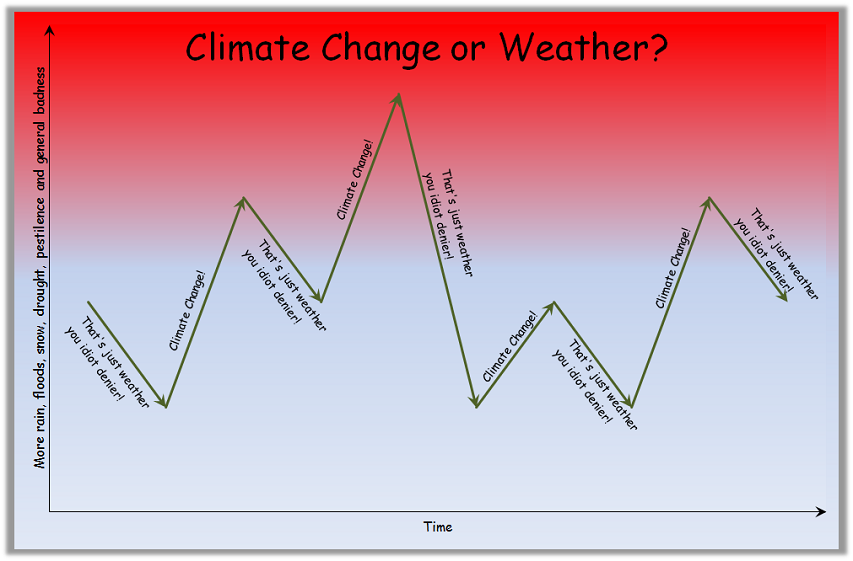
Is it climate change or is it just weather?
Ant O’Fearghail has developed a useful model to help you determine if a particular situation is caused by climate change or if it’s just ordinary weather:
February 14, 2014
QotD: Anthropology
Readers who are all too familiar with popular works on anthropology may be interested to learn that some recent investigations have involved a completely novel approach. The ordinary anthropologist is one who spends six weeks or six months (or even sometimes six years) among, say, the Boreyu tribe at their settlement on the Upper Teedyas River, Darndreeryland. He then returns to civilization with his photographs, tape recorders, and notebooks, eager to write his book about sex life and superstition. For tribes such as the Boreyu, life is made intolerable by all this peering and prying. They often become converts to Presbyterianism in the belief that they will thereupon cease to be of interest to anthropologists; nor in fact has this device been known to fail. But enough primitive people remain for the purposes of science. Books continue to multiply, and when the last tribe has resorted to the singing of hymns in self-defense, there are still the poor of the backstreets. These are perpetually pursued by questionnaire, camera, and phonograph; and the written results are familiar to us all.
C. Northcote Parkinson, “Palm Thatch To Packard Or A Formula For Success”, Parkinson’s Law (and other studies in administration), 1957.
February 13, 2014
Flooding in Britain – call for the Witchfinder Floodfinder General!
Rob Lyons asks who is to blame for the current flooding in Britain. The answer may be … nobody:
Floods in the UK are getting worse. There’s not much we can do it about it. It’s caused by climate change, which in turn is caused by human beings. It’s payback time.
There you go. In one paragraph, I’ve saved you having to read British newspapers or watch British TV news for the next few days. Of course, the recent flooding is a nightmare for those affected. It’s also a dream for lazy TV news editors who want to plonk their reporters in front of some interesting backdrop offering trite statements about a human-interest story. But the discussion about the causes of the floods and whether we can – or should – do anything about them is rather more worrying than TV’s dumbed-down ‘news values’.
[…]
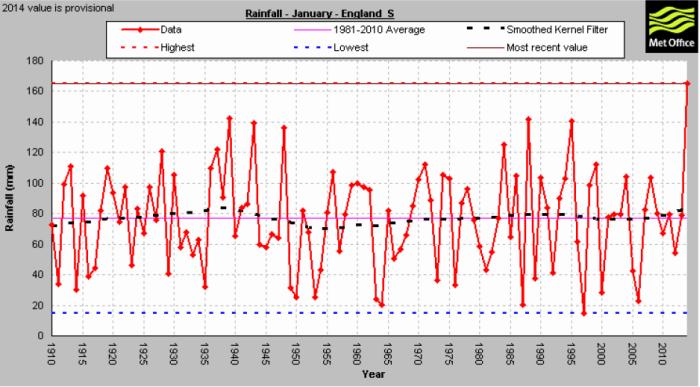
A briefing published by the UK Met Office earlier this month highlights just how unusual the weather is at present. ‘Although no individual storm can be regarded as exceptional, the clustering and persistence of the storms is highly unusual. December and January were exceptionally wet. For England and Wales this was one of, if not the most, exceptional periods of winter rainfall in at least 248 years. The two-month total (December + January) of 372.2mm for the south-east and central southern England region is the wettest any two-month period in the series from 1910.’ It’s the conveyor belt of stormy weather, rather than any particular individual event, which is causing the problems. The ground is already soaked and rivers are already high; further rainfall has nowhere to go but out on to the flood plains.
However, a quick look at the Met Office briefing shows that while rainfall in southern England in January was very exceptional, it is hard to glean any particular overall pattern – other than that rainfall is very variable.
January rainfall, southern England, 1910-2014. Source: Met Office
Indeed, just two years ago, Britain was in drought. Consecutive winters of below-average rainfall had left water companies enforcing restrictions on supply. Then the heavens opened, and it seems to have barely stopped raining since. So how on earth did the head of the Met Office, Dame Julia Slingo, conclude that while there was ‘no definitive answer’ to what caused the storms, ‘all the evidence suggests there is a link to climate change’? Indeed, Slingo is not alone in her assessment. The prime minister, David Cameron, said in January that he ‘suspected’ climate change was behind the floods. Labour leader Ed Miliband declared that climate change was sure to bring ‘more flooding, more storms’. Yet less than a year ago, scientists were assuring us that climate change would lead to more droughts in the future in the UK.