
Prohibition was the culmination of nearly a century’s worth of propaganda, and repeated failed attempts to get such laws to work at the local and state level. Read J.C. Furnas’ The Life and Times of the Late Demon Rum for an overview of the pre-1919 Temperance/Prohibition movement.
… [T]he original Temperance movement started out with the very best of intentions, and was trying to deal with a real problem. In colonial and early-19th-century America, people (men, women and OH HORRORS even children!) drank enough that by modern standards we’d call them alcoholics. Modern Russians drink more, but if they were transported back to that time and place, they’d fit right on in. Part of it was because water was often not safe to drink (tea and coffee were often expensive and hard to get, while beer and other alcoholic drinks were made just about everywhere), part of it was snobbery (only really poor people drank water!) and part of it was because people back then believed that alcohol strengthened and warmed the body.
Two of the good side effects of the Temperance/Prohibition movement were the provision of safe, clean drinking water in American cities and towns, and the modern fruit-juice industry (as a lot of churches went hot-Prohibition, they got uneasy about serving wine at Communion, so they went to work and came up with non-alcoholic substitutes.) Welch’s Grape Juice was started by a pastor who wanted non-alcoholic “wine” for Communion, and caught on, real big.
Eric Oppen, posting to the Lois McMaster Bujold mailing list, 2020-06-18.
September 21, 2020
QotD: Prohibition and the Temperance movement
September 13, 2020
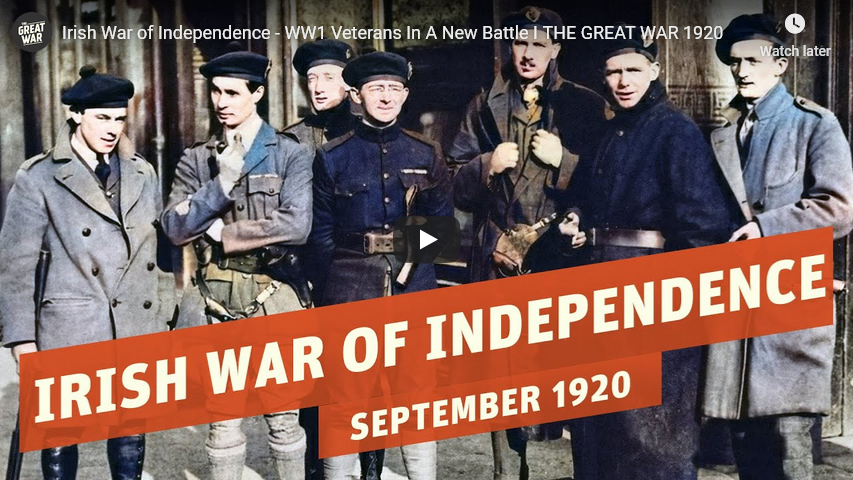
Irish War of Independence – WW1 Veterans In A New Battle I THE GREAT WAR 1920
The Great War
Published 12 Sep 2020Sign up for Curiosity Stream and get Nebula bundled in: https://curiositystream.com/thegreatwar
The conflict between the Irish independence movement and the UK government had been heating up since 1919. The summer of 1920 brought a new level of escalation with the arrival of the the Auxiliary Division of the Royal Irish Constabulary. Former veterans of the First World War were brought in to quell the rebellion and get hold of the strongholds controlled by the IRA.
» SUPPORT THE CHANNEL
Patreon: https://www.patreon.com/thegreatwar» OUR PODCAST
https://realtimehistory.net/podcast – interviews with World War 1 historians and background info for the show.» BUY OUR SOURCES IN OUR AMAZON STORES
https://realtimehistory.net/amazon *
*Buying via this link supports The Great War (Affiliate-Link)» SOURCES
Hart, Peter: The IRA and Its Enemies (Oxford: Oxford University Press, 1998)Harvey, A.D: “Who Were the Auxiliaries?” The Historical Journal, Vol. 35, No. 3 (Sep. 1992)
Hopkinson, Michael: The Irish War of Independence (Montreal & Kingston: McGill-Queen’s University Press, 2002)
Leeson, David: The Black and Tans: British Police and Auxiliaries in the Irish War of Independence, 1920-1921 (Oxford: Oxford University Press, 2011)
McMahon, Sean: The War of Independence (Cork: Mercier Press, 2019)
O’Brien, Paul: Havoc: The Auxiliaries in Ireland’s War of Independence (Cork: Collins Press, 2017)
Riddell, George: Lord Riddell’s Intimate Diary of the Peace Conference and After: 1918-1923 (London: Victor Gollancz Ltd, 1933)
Roxbourgh, Ian: “The Military: The Mutual Determination of Strategy in Ireland, 1912-1921” in Duyvendak, Jan Willem & Jasper, James M. (eds) Breaking Down the State: Protesters Engaged (Amsterdam: Amsterdam University Press, 2015)
Townshend, Charles: The Republic: The Fight for Irish Independence 1918-1923 (London: Penguin Books, 2014)
“Tubbercurry”, Manchester Guardian, 4 October 1920.
Hugh Martin: “‘Black and Tan’ Force a Failure”, Daily News, 4 October 1920.
» MORE THE GREAT WAR
Website: https://realtimehistory.net
Instagram: https://instagram.com/the_great_war
Twitter: https://twitter.com/WW1_Series
Reddit: https://reddit.com/r/TheGreatWarChannel»CREDITS
Presented by: Jesse Alexander
Written by: Jesse Alexander
Director: Toni Steller & Florian Wittig
Director of Photography: Toni Steller
Sound: Toni Steller
Editing: Toni Steller
Motion Design: Philipp Appelt
Mixing, Mastering & Sound Design: http://above-zero.com
Maps: Daniel Kogosov (https://www.patreon.com/Zalezsky)
Research by: Jesse Alexander
Fact checking: Florian WittigChannel Design: Alexander Clark
Original Logo: David van StepholdContains licensed material by getty images
All rights reserved – Real Time History GmbH 2020
September 7, 2020
Who Was Leif Erikson?
Atun-Shei Films
Published 9 Oct 2019Happy Leif Erikson Day! Allow me to regale you with the saga of the daring Viking who sailed to North America five hundred years before Columbus (that hack) and called it Vinland. We all know his name and his famous deeds – but what sort of man was Leif Erikson?
Support Atun-Shei Films on Patreon ► https://www.patreon.com/atunsheifilms
#LeifErikson #Viking #History
Watch our film ALIEN, BABY! free with Prime ► http://a.co/d/3QjqOWv
Reddit ► https://www.reddit.com/r/atunsheifilms
Twitter ► https://twitter.com/alienbabymovie
Instagram ► https://www.instagram.com/atunsheifilms
Merch ► https://atun-sheifilms.bandcamp.com

September 5, 2020
History Summarized: The Viking Age
Overly Sarcastic Productions
Published 4 Sep 2020The Vikings are enjoying a new wave of enthusiasm in popular culture, but these seafaring Norsemen are still quite clearly a misunderstood force in medieval European history. So let’s take a wide look at the European world during The Viking Age!
Check out Yellow’s livestreams over at https://Twitch.tv/LudoHistory
SOURCES & Further Reading: The Vikings by Walaker Nordeide and Edwards, Vikings: A Very Short Introduction by Richards, Age of the Vikings and The Conversion of Scandinavia by Winroth, The Vikings By Harl via The Great Courses, The Viking World by Graham-Campbell, The Viking Way by Price.
This video was edited by Sophia Ricciardi AKA “Indigo”. https://www.sophiakricci.com/
Our content is intended for teenage audiences and up.
DISCORD: https://discord.gg/kguuvvq
PATREON: https://www.Patreon.com/OSP
MERCH LINKS: https://www.redbubble.com/people/OSPY…
OUR WEBSITE: https://www.OverlySarcasticProductions.com
Find us on Twitter https://www.Twitter.com/OSPYouTube
Find us on Reddit https://www.Reddit.com/r/OSP/
From the comments:
Ludohistory
23 hours ago (edited)
Thanks so much for having me on and letting me help out! It was a lot of fun (even if I talked a little too fast sometimes)! To clarify a piece that I know I did cover too briefly — missionary trips to Scandinavia occurred in Denmark around 823, on the orders of Louis the Pious, and in Sweden in 829, when Ansgar, a Frankish monk, traveled to the town of Birka, where he found a very small Christian community, probably mostly enslaved or formerly enslaved people, and converted a couple of Norse people, including the town prefect. (The graveyard for that town, incidentally, is where the 10th century “female warrior” that made waves a few years ago was buried).There’s a lot we didn’t get a chance to talk about about the diaspora and its ending, so if there’s anything you all are curious on or find unclear, let me know here or on twitter 🙂
Finally, if you liked this, all the VODs for my personal streams (where I try to ramble about history in games) can be found by clicking on my name, and tomorrow I’ll be streaming CKIII on twitch (link in the description)!
September 4, 2020
QotD: Muhammad Ali Jinnah
Jinnah’s political intentions are hotly contested. According to New York Times Pakistan expert, Jane Perlez, many Pakistan researchers contend Jinnah had no interest in an Islam-dominated state, but “used the idea of Pakistan as a mere bargaining chip for Muslim majority rights within a loosely united post-colonial India.” With no autobiography or recollections from close friendships for our guidance, Jinnah remains a shadowy historical player, a political loner with an indeterminate goal beside Nehru, Gandhi and Viceroy Lord Mountbatten.
It is quite possible, for example, that Jinnah created the Muslim League and employed the rhetoric of Islam (slogan: “Islam in Danger”) and started wearing native clothes to harness religious fervour to political ambitions never fully articulated. But we can’t ever know, as a lifetime of chain smoking caught up with Jinnah, and he died before the first (bloody) year of Pakistan’s existence was out.
In Jinnah’s first speech to his newly minted country, though, we have this strong intentional clue: “You are free. You are free to go to your temples, you are free to go to your mosques or to any other place of worship in this state of Pakistan. You may belong to any religion or caste or creed — that has nothing to do with the business of the state.”
Barbara Kay, “A celebrated figure today could well be the condemned sinner of tomorrow”, National Post, 2018-06-05.
September 1, 2020
“John from America” and the South Pacific cargo cults
Steven W. Aunan responds to Vicky Osterweil’s recent book on the joy of looting (which was clearly informed by her almost total innocence of any economic understanding) and also tells the story of the perhaps mythical “John from America” and the cargo cults of islanders in the South Pacific during and after World War II:

Ceremonial cross of John Frum cargo cult, Tanna island, New Hebrides (now Vanuatu), 1967.
Photo by Tim Ross via Wikimedia Commons.
In 1940, or so goes the myth, a man who identified himself as “John from America” appeared in a native village in the New Hebrides Islands with a message: Rebel against the colonizers, their missions, their schools, their laws, and John would reward them with free housing, clothing, food, and transportation.
The result was the “John Frum Cargo Cult” that persists to this day in the modern-day South Pacific nation of Vanuatu.
Frum’s message was remarkably similar to Vicky Osterweil’s message: rebel against settler domination, against the history of whiteness, and someone will reward you with all the free stuff you need.
Like Osterweil’s chaotic myth of impossibly contradictory Marxist worlds, we can’t be sure who the mythical John Frum was, how or when he arrived, whether he was a man or a spirit-being, if he lived in the U.S. or in the island’s active volcano, or if he first appeared as a tiger on an island where no tigers live, as a black man with a moustache, or as a white man who magically spoke the native language.
You can pick your own truth about Frum, because Marxists will tell you it’s no better than anyone else’s truth.
And, like every other false promise spoken by the fork-tongued followers of the dead white male devil Karl Marx, John Frum brought with him a vision of the future in which the old social order is violently dismantled, a new world is born, and the people emerge with material wealth, happiness, hope, and success.
After Frum left the islands, large numbers of Americans in their flying machines immediately and miraculously followed, building military airstrips and bringing in enormous quantities of cargo. Everything came to pass just as John Frum had promised.
The residents of the islands, of course, did not understand modern manufacturing or transportation, or that World War II was underway. The cargo simply arrived at the airstrip in the jungle, apparently by magic.
Kind of like the Target stores around the country that are repeatedly looted only to be magically restocked by the invisible hand of an invisible genius named John Galt.
August 27, 2020
Margaret Murray’s highly influential The Witch-Cult in Western Europe
In First Things, Francis Young discusses the impact Murray’s work had when it was published in the 1920s:
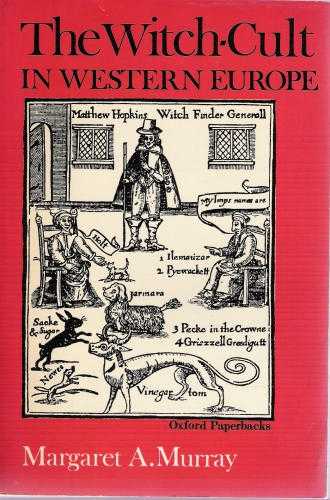
Just under a century ago, in 1921, one of the strangest books ever to be published by Oxford University Press appeared in print: The Witch-Cult in Western Europe by Margaret Alice Murray. By today’s academic standards — in fact, even by the standards of the 1920s — Murray’s book was filled with transparent flaws in methodology and research. Furthermore, the book’s author (a leading Egyptologist) was not qualified to write it. The few scholars then working on the history of European witchcraft dismissed Murray’s contribution. Yet in spite of this, The Witch-Cult in Western Europe became an instant hit and captured the imaginations of readers. Within three decades, the book had not only profoundly influenced cultural understandings of witchcraft, but also directly led to the rise of neopaganism and the foundation of a new religion, Wicca, that today has millions of adherents throughout the world.
Margaret Alice Murray (1863–1963) was born and brought up in British India — an upbringing that, as with so many Anglo-Indians of the nineteenth century, may have opened her mind to interests beyond Victorian culture. Determined to pursue a career of her own at a time when opportunities for women were limited, Murray tried out both nursing and social work before entering the progressive University College London in 1894, where she studied Egyptology under W. Flinders Petrie. Murray rapidly rose through the academic ranks, and by 1914, she was effectively running the Egyptology department. Her impressive achievements in advancing knowledge of ancient Egypt and higher education for women have, however, been largely overshadowed by her decision to take a detour into writing about European witchcraft.
In The Witch-Cult in Western Europe, Murray seized on some unusual testimonies in 16th-century Scottish witch trials to elaborate a radical theory: She claimed that what medieval and early modern people called witchcraft was, in fact, the last traces of a pagan fertility cult that originated in the Neolithic period. The witch trials of the 15th–17th centuries represented Christianity’s last attempt to stamp out this cult, which was practiced in secret covens (groups of thirteen people) who worshipped a horned god (who was mistaken for the devil). Knowledge of this cult was passed through families or, occasionally, to new initiates, but kept secret from the outside world.
Murray’s use of a single set of problematic sources from one country (Scotland) to argue that a previously unnoticed religion had existed since prehistory failed to meet basic historiographical and anthropological standards of research. She was given to making huge conceptual leaps on the basis of contentious interpretations of meager evidence. Using a small range of hostile trial records designed to discredit women accused of witchcraft (along with testimonies extracted under torture), Murray reconstructed what she believed were real religious practices lurking behind the demonological construct of the Witches’ Sabbath. In so doing, she brought together traditions of interpretation honed by the anthropologist Sir James Frazer (1854–1941), the author of The Golden Bough, and the French historian Jules Michelet (1798-1874). Murray followed Michelet in arguing that those accused of witchcraft were not the innocent victims of trumped-up charges, but were in fact adherents of a subversive cult; and she followed Frazer in her belief that prehistoric religious beliefs, associated with fertility, had survived into recent times.
August 20, 2020
Thomas Becket, Archbishop of Canterbury 1162-1170
Reverend Steve Morris tries to show why St. Thomas of Canterbury needs a “reboot” for modern eyes:
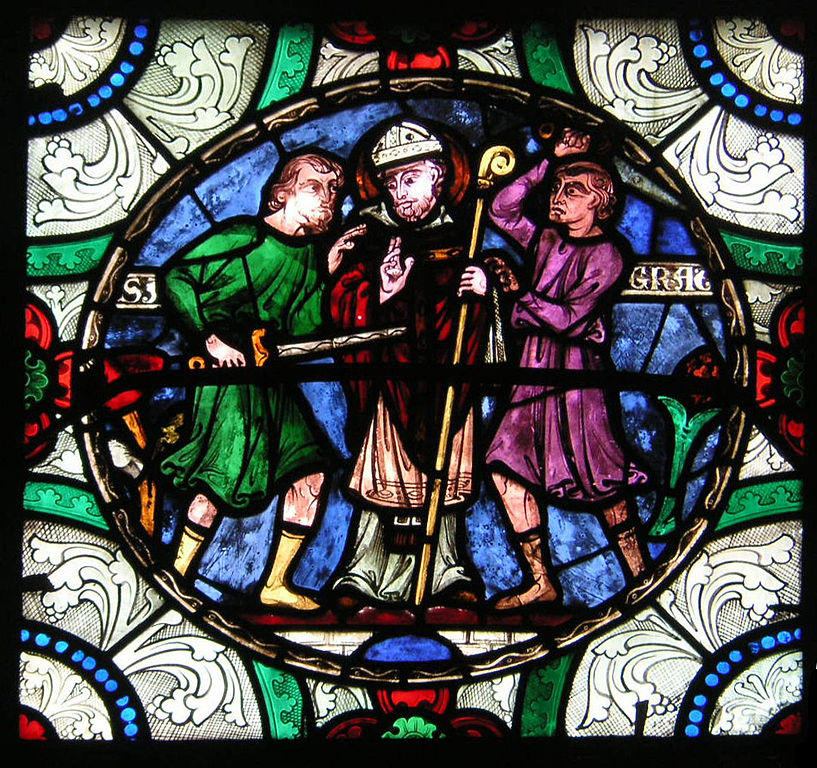
Stained glass showing the murder of St. Thomas at Canterbury on 29 December, 1170.
Wikimedia Commons.
It’s 850 years since that night when four knights murdered the Archbishop of Canterbury. It’s been a rocky old road for Thomas Becket despite hundreds of years as the poster-boy of the cult of saints which swept medieval England. His reputation, his legacy and his conduct have been filleted over the last few centuries and we are left with just a ghost of the man who, once upon a time, stood for all that was good.
It is a cautionary tale of historical revisionism, measuring yesterdays’ saints by today’s “standards” and assembling a set of half-truths to trash the reputation of England’s great, perhaps greatest, saint. It is high time he made a comeback – especially in these political times. After all, Becket was perhaps the greatest political martyr we have. Of course, there is always truth in just about any criticism. And Becket lays himself open. He was, to say the least, stubborn. He was a contrarian and he was reckless with his own safety. In an age of kingly power, it doesn’t do to embarrass the monarch.
The charge sheet does quickly stack up. Becket was a canny careerist (although you’d be hard pushed to find anyone of influence at the time who wasn’t). He seemed to have a death wish, or at least refused to listen to perfectly sensible advice on taking a more circumspect path. And his cause, seen through a certain lens, seems off-beam for modern times. He has been painted as standing for the ancient legal power of the church against a reforming king who began to kick-start Common Law. But of course, it’s never as simple as this.
But none of this was the real problem and none of it was what caused our great saint to be consigned to the historical dustbin. As is often the way, the problem comes down to background and class. Becket was born to only modestly well-off parents in London (he has always been London’s saint). His father was middle-class, and a merchant. Becket was “trade” by background and it was something he couldn’t shake off. But his rise was an astounding feat of defying gravity.
In an era of complex geopolitics and conflicts between pope and state Thomas rose through the ranks and became Archbishop of Canterbury. At first, he seemed like the king’s man, but relations soured. Becket and the king were entangled in a fight to the death, with the archbishop excommunicating various opponents and generally throwing his weight around.
His death was gruesome. Four knights ambushed him. He could have run or barricaded himself in the cathedral, but he told his followers that God’s house should not be made a fortress. He pushed one of his attackers. What followed was a flurry of sword-strokes to the head – one of which took his tonsured skull right off. The contemporaneous reports paint a ghastly picture of brain fluid and blood mixing freely on the cathedral floor. But it didn’t end there.
August 18, 2020
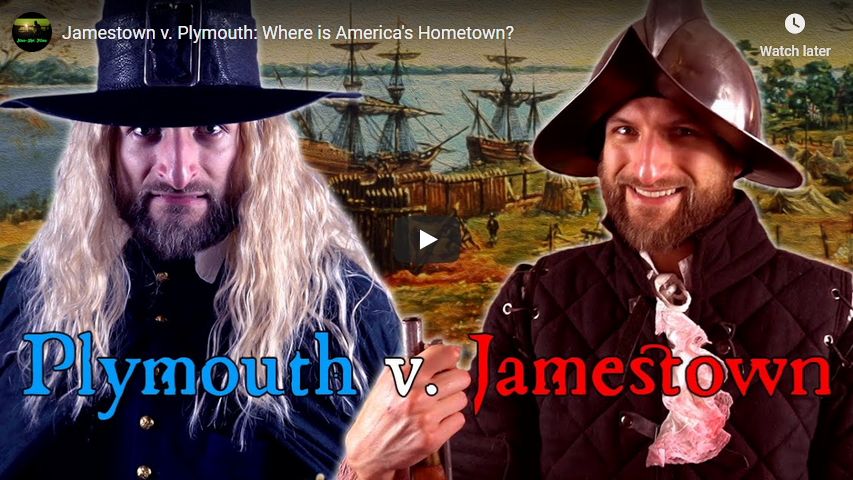
Jamestown v. Plymouth: Where is America’s Hometown?
Atun-Shei Films
Published 11 Feb 2020With the help of the Witchfinder General, I examine the historical mythology surrounding Jamestown and Plymouth, the first two permanent English colonies in the continental United States. Can we confidently point to the founding of these two settlements as the origin of American identity and culture? No, thou knave!
Support Atun-Shei Films on Patreon ► https://www.patreon.com/atunsheifilms
#Jamestown #Plymouth #AmericanHistory
Watch our film ALIEN, BABY! free with Prime ► http://a.co/d/3QjqOWv
Reddit ► https://www.reddit.com/r/atunsheifilms
Twitter ► https://twitter.com/alienbabymovie
Instagram ► https://www.instagram.com/atunsheifilms
Merch ► https://atun-sheifilms.bandcamp.com
August 17, 2020
Dateline Ayodhya, Uttar Pradesh, 5 August 2020
That’s a significant date, as Tom Holland explains at UnHerd:
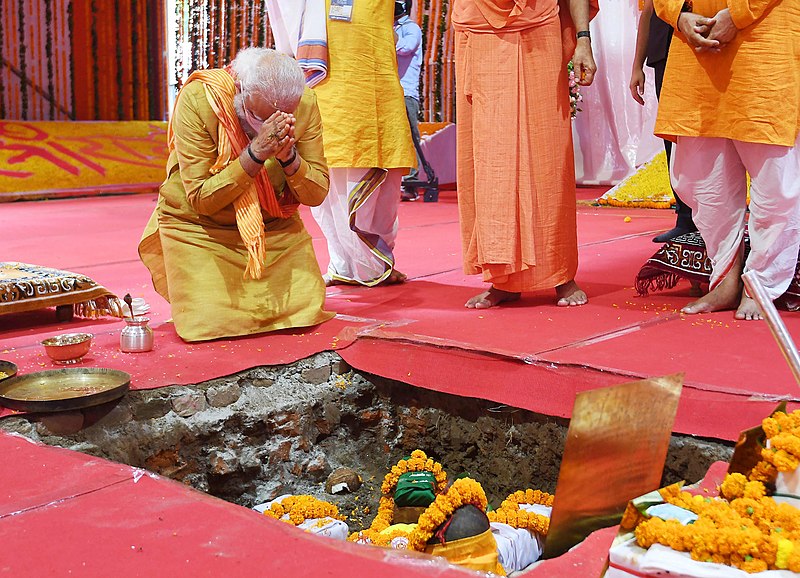
Indian Prime Minister Narendra Modi performing Bhoomi Pujan at Shree Ram Janmabhoomi Mandir, in Ayodhya, Uttar Pradesh on August 05, 2020.
Photo released by the Press Information Bureau on behalf of the Prime Minister’s Office, (ID 90071) via Wikimedia Commons.
Last week, on 5 August, the Prime Minister of India laid a foundation stone and helped bury a distinctive period in global history. Narendra Modi had travelled to Ayodhya, a city long identified by Hindus with one of their most beloved gods. Lord Rama — avatar of Vishnu and hero of the Sanskrit epic, the Ramayana — was said to have ruled within its walls as the very model of those who uphold truth and justice. Like Camelot, the court of Rama glimmers tantalisingly in the imaginings of those who fall beneath its spell: the reminder of a vanished golden age, the hope that it might come again.
In recent decades, the mingled regret and yearning that the memory of Rama’s capital can inspire among Hindus had come to be focused on one particular location in the modern city of Ayodhya: the Ram Janmabhoomi, the “birthplace of Rama”. At the moment, nothing serves to mark the sacred spot. But soon enough that will change. A great complex of buildings will rise. As Modi, officially declaring the process of construction begun, put it: “A great temple will now be built for our Lord Rama.”
A fortnight earlier, the President of Turkey had celebrated a similar reconsecration. In 1453, when the Christian capital of Constantinople fell to the Ottomans, its most stupefying building, the great cathedral of Hagia Sophia, had been converted into a mosque, and duly served for almost half a millennium as a monument to the triumph of Islam over a defeated and superceded order. Then, in 1935, a decade and more after the collapse of the Ottoman Empire and its replacement within its heartlands by a Turkish republic, the mosque of Ayasofya was turned into a museum. So, for decades, it remained. Then, this summer, the museum once again became a mosque. On 24 July, Hagia Sophia opened for Friday prayers. “It is breaking away from its chains of captivity,” President Erdogan declared rhapsodically. “It was the greatest dream of our youth. It was the yearning of our people and it has been accomplished.”
The synchronicity between Modi’s trip to Ayodhya and Erdogan’s to Hagia Sophia is striking, and only flimsily obscured by the fact that the Prime Minister of India is trampling the legacy of an Islamic empire much as the President of Turkey has trampled the legacy of a Christian one. In the early sixteenth century, shortly after the Moghul conquest of the lands that once, so Hindus believed, had constituted the Ram Rajya, the “realm of Rama”, a mosque was built in Ayodhya. By the twentieth century, large numbers of Hindus had come to believe that this same mosque, the Babri Masjid, stood directly on the site of the Ram Janmabhoomi. In the 1980s, the BJP — the party to which Modi belongs — began a campaign to demolish it. In 1992 a mob duly tore it down. Communal riots exploded. Thousands died.
Last November, even as the site was formally granted to Hindus, the Supreme Court of India condemned the demolition of the mosque as a crime. But a crime by whose standards? Not, it would seem, by Modi’s. Just as Erdogan justified the conversion of Hagia Sophia to a mosque by “right of conquest”, so the Prime Minister of India, hailing the opportunity to build a temple on the site where the Babri Masjid had stood, invoked the ancient traditions of his country. It was, he declared, “a unique gift from law-abiding India to truth, non-violence, faith and sacrifice.” History as well as justice stood on his side.
QotD: Orwell and faith
Charles Curran, “Orwell: The man behind 1984 — and all that”, Daily Mirror, 1954-12-14.
August 15, 2020
Miscellaneous Myths: The Book Of Invasions
Overly Sarcastic Productions
Published 14 Aug 2020The quintessential Irish mythological text, and … it’s about getting steamrolled by invaders. Now that’s what I call brand consistency!
Our content is intended for teenage audiences and up.
PATREON: https://www.Patreon.com/OSP
DISCORD: https://discord.gg/kguuvvq
MERCH LINKS: https://www.redbubble.com/people/OSPY…
OUR WEBSITE: https://www.OverlySarcasticProductions.com
Find us on Twitter https://www.Twitter.com/OSPYouTube
Find us on Reddit https://www.Reddit.com/r/OSP/
August 14, 2020
From protests to riots to …
In the Claremount Review of Books, Angelo M. Codevilla looks at historical patterns that may prefigure what is going on in major urban areas today:
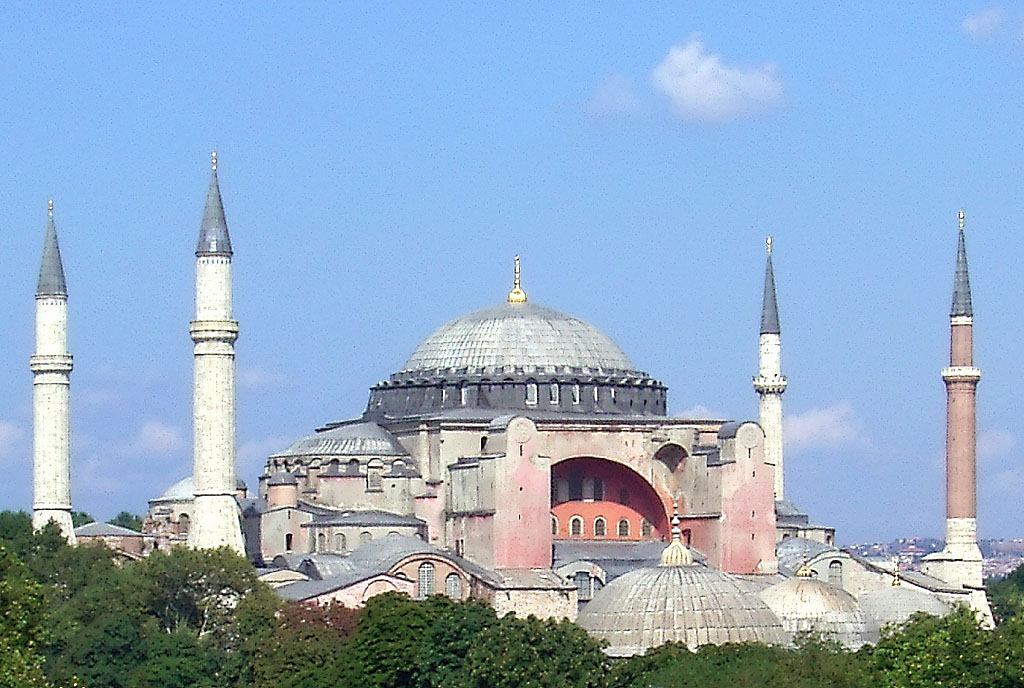
Hagia Sophia in the Faith district of Istanbul, 18 November 2004.
Photo by Robert Raderschatt via Wikimedia Commons.
The Americans who confess other people’s racism absolve themselves inexpensively by a moral mechanism common to humanity: the more I profess to hate evil, the more I showcase my own goodness. Such confessions, however, have a particular history of tragedy in Christian civilization. Again and again over the centuries, persons who have imagined themselves cleansed by ritual confessions have believed themselves elevated above the rest of humanity and, hence, entitled to oppress or even annihilate those around them. Today’s self-purifiers, arms outstretched in supine submission, who then countenance violence against persons, property, and cultural symbols, are mostly unwitting protagonists in yet another chapter of a hoary history.
Although Judeo-Christianity teaches that perfection is not of this world, nevertheless the Old Testament (see the Book of Daniel) and the New (Revelation, chapter 20) refer tangentially to a final state in human affairs in which all evil will have been defeated and the virtuous will have triumphed over their enemies. In the Book of Revelation, this final stage is to last for a thousand years. Jesus Christ’s warnings notwithstanding, people have hearkened periodically to “false prophets” who brandish the prospect of ultimate vengeance over evil. Between the 11th and 16th centuries, any number of movements of this sort used ritual confessions to cleanse themselves, and energized the mobs that waged Europe’s bloodiest wars of that age. Thereafter, though such movements secularized their terms, they fit into the same moral and intellectual categories. Now as ever, they are about destroying civilization in the name of altering the human condition.
But whereas revolutionary movements from the Middle Ages to roughly the middle of the 20th century opposed the ruling classes wholeheartedly and found no friends among them, this generation’s movements have intense, problematic relations with those classes, about which more below.
Today we see scenes of monuments which had stood for decades, now destroyed and defaced, as well as the forceful cancellation of names from circulation. Smashing others’ idols was, and remains, a staple of tribal warfare. The Old Testament recalls the divine command to destroy idols, and the clashes between Christian and Muslim armies always aimed as much at symbols as at people. The Song of Roland contains a lyrical account of Charlemagne’s iconoclasm in his campaign against the Saracens. In the 6th century, Emperor Justinian made Constantinople’s Hagia Sophia cathedral the Christian world’s biggest and most important church. The Muslims who added that city to the Ottoman Empire in 1453 killed its priests, toppled its statues, and made it into the principal mosque of the Muslim caliphate at war with Christendom. In 1923, Kemal Atatürk, Turkey’s modernizer, turned the building into a museum in order to end that war. But in July 2020 Turkey’s Islamist president Recep Erdogan, consistent with his hostility to Judeo-Christian civilization, turned it into a mosque again and began covering up what remain of the Christian frescoes on its walls. Destroying symbols, however, has had no place within Christian civilization. As the equivalent of torturing dead men, it has always been the work of cowards likelier to run from living enemies. On the other hand, war against statues, paintings, books, biographies, etc., has been a defining feature of civilization’s revolutionary enemies, consistent with their chosen identities as alien tribes.
What follows is a glance at the bloody history of this little-known flaw. It is a tale whose cautionary moral Aleksandr Solzhenitsyn best expressed: the line between good and evil runs not between persons — never mind between parties, classes, or races — but down the middle of every human heart. That is central to our civilization.
H/T to David Warren for the link.
August 11, 2020
The Vanishing Aral Sea
The History Guy: History Deserves to Be Remembered
Published 22 May 2017The History Guy examines the Aral Sea and the confluence of geography and history.
The History Guy uses images that are in the Public Domain. As photographs of actual events are often not available, I will sometimes use photographs of similar events or objects for illustration.
Patreon: https://www.patreon.com/TheHistoryGuy
The History Guy: Five Minutes of History is the place to find short snippets of forgotten history from five to fifteen minutes long. If you like history too, this is the channel for you.
Awesome The History Guy merchandise is available at:
teespring.com/stores/the-history-guyThe episode is intended for educational purposes. All events are presented in historical context.
#history #thehistoryguy #worldhistory

August 10, 2020
QotD: Gandhi’s legacy
We can only wonder, furthermore, at a public figure who lectures half his life about the necessity of abolishing modern industry and returning India to its ancient primitiveness, and then picks a Fabian socialist, already drawing up Five-Year Plans, as the country’s first Prime Minister. Audacious as it may seem to contest the views of such heavy thinkers as Margaret Bourke-White, Ralph Nader, and J.K. Galbraith (who found the film’s Gandhi “true to the original” and endorsed the movie wholeheartedly), we have a right to reservations about such a figure as a public man.
I should not be surprised if Gandhi’s greatest real humanitarian achievement was an improvement in the treatment of Untouchables — an area where his efforts were not only assiduous, but actually bore fruit. In this, of course, he ranks well behind the British, who abolished suttee — over ferocious Hindu opposition — in 1829. The ritual immolation by fire of widows on their husbands’ funeral pyres, suttee had the full sanction of the Hindu religion, although it might perhaps be wrong to overrate its importance. Scholars remind us that it was never universal, only “usual.” And there was, after all, a rather extensive range of choice. In southern India the widow was flung into her husband’s fire-pit. In the valley of the Ganges she was placed on the pyre when it was already aflame. In western India, she supported the head of the corpse with her right hand, while, torch in her left, she was allowed the honor of setting the whole thing on fire herself. In the north, where perhaps women were more impious, the widow’s body was constrained on the burning pyre by long poles pressed down by her relatives, just in case, screaming in terror and choking and burning to death, she might forget her dharma. So, yes, ladies, members of the National Council of Churches, believers in the one God, mourners for that holy India before it was despoiled by those brutish British, remember suttee, that interesting, exotic practice in which Hindus, over the centuries, burned to death countless millions of helpless women in a spirit of pious devotion, crying for all I know, Hai Rama! Hai Rama!
Richard Grenier, “The Gandhi Nobody Knows”, Commentary, 1983-03-01.


