
The Annales school is a style of historical thinking that emerged in France in the early 1900s; at least for pre-modernists, the dominating figures here tend to be Marc Bloch and Fernand Braudel. It got its name because of its close association with Annales d’Historie Economique et Sociale. Fundamentally, what sets the Annales approach apart is first its focus and then the methods that focus demands.
The big shift in focus for the Annales school was an interest in charting the experience of society below the level of elites (though the elites are not abandoned either), what is sometimes termed “history from below”, as distinct from traditional elite-centered “great man” history or the more deterministic Marxist models of history at the time. You can see the political implications, of course, in the very early 1900s, of declaring the common man worthy of study; this is generally a history from the left but not the extreme left. That focus in turn demanded new approaches because it turned the focus of social history towards people who by and large do not write to us.
In reaching for that experience, Annales scholars tended to frame their thinking in terms of la longue durée (“the long run”); history was composed of three parts: événements (“events”), conjonctures (“circumstances”) and finally la longue durée itself. Often in English this gets rendered as a distinction between “events” (kings, wars, politics, crises) and “structures” (economics, social thought and at a deeper level climate, ecology, and geography). What Annales scholars tended to argue was that those structures were often more important than the events that traditional historians studied: the farmer’s life was far more shaped by very long-term factors like the local ecology, the organization of his farming village, the economic structure of the region and so on. And then the idea goes, that by charting those structures, you can figure things out about the lives of those farmers even if you don’t have many – or any – of those farmers writing to you.
Important to this was the idea of enduring patterns of thought within a society, what Bloch termed mentalités (“mentalities”, like longue durée, this is a technical term usually used in French to make that fact clear). Mentalités – Bloch’s original example was the idea that kings had a holy healing touch, but this could be almost any kind of social construct or pattern of ideas (indeed, one critique of it is that the notion of mentalités is broad and ill-defined) – can last a long time and can inform or constrain the actions of many actors within a society; think of how successive generations of kings can have their decisions shaped or constrained by their societies view – their own view – of kingship. That view of kingship might be more impactful than any one king and so pervasive that even a king would struggle to change it.
So how does this influence my work? I tend to be very much a “history from below” kind of historian, interested in charting the experience of regular farmers, soldiers, weavers and so on. The distinction between the long-term structures that shape life and the short-term events that populate our history is very valuable to think with, especially for identifying when an event alters a structure, because those tend to be very important events indeed. And I think a keen attention to the way people thought about things in the past and how those mentalités can be different than ours is very important.
That said, the Annales stress on mentalités has in some ways been overtaken by more data-driven historical methods on the one hand or a strong emphasis on local or individual experience (“microhistory”) on the other. Mentalités tend to be very big picture, asking how, say, “the French” thought about something over a period of decades or centuries and seeking to know how that shaped their experience. But archaeology, demographics or economic data can reveal patterns of behavior which might not correspond to the mentalités that show up in written texts; this is fundamentally the interaction that informs the “revenge of the archaeologists” in the study of the ancient economy, for instance. On the other hand, not everyone in that big group thinks the same and a microhistory of an individual or a single village might reveal telling local variations not captured in massive-scale structures.
Fortunately, historians do not need to be doctrinaire in our use of theory, we don’t have to pick one and stick to it. Different projects also lend themselves to different approaches. I think the Annales school offers a lot of really useful tools to have my historian’s toolbox, but they sit alongside military theory, archaeological material culture studies methods, philological approaches, a smattering of economic and demographic tools, etc.
Bret Devereaux, “Referenda ad Senatum: January 13, 2023: Roman Traditionalism, Ancient Dates and Imperial Spies”, A Collection of Unmitigated Pedantry, 2023-01-13.
July 13, 2023
QotD: The Annales school of history
July 12, 2023
QotD: Media gullibility on military issues
The Media, of course, does not do this. They’d be happy to write up a whole big feature story about how the Russians’ Q-35 matter modulator wasn’t nearly what Vlad Putin, that lying bastard, bragged it up to be. And with the new Lepage gun gluing all those Russian planes together, the brave Ukrainians will be in Moscow for Easter!
Are they lying? Not really. Some very serious-looking persyn in a snazzy uniform with a lot of very colorful ribbons told them that the Q-35 matter modulator isn’t all that, and why would some brave freedom fighter lie to them? And besides — this is crucial — “fact checking” the stats on the Q-35 matter modulator would entail that you’ve never heard of it before …
… which is anathema to our intrepid reporterette’s sense of xzhyrself as a hard-hitting newshound who is very very Smart. After all, she scored a 35,000 on her SATs and graduated from the Assjammer School of Journalism with a 9.98 GPA. She’s got fellowships and awards and whatnot out the yingyang, plus 1.2 million Twitter followers. And it says “war correspondent” right there on her Facebook page. If the Q-35 matter modulator weren’t actually a thing, surely she would know.
Severian, “The Becky Cycle”, Founding Questions, 2023-02-27.
July 11, 2023
QotD: The Calgary Stampede
The Stampede itself is very solvent, earning an operating surplus of $3.1 million in 2011, but if the costs and benefits to the city were all counted up, the former would have to include the salaries of the thousands of high-paid Calgary professionals who see major parts of their calendar devoured by Stampede preparations and aftermath. It would include the tacit outright cancellation of nine-to-five work for the duration of the Stampede at key Calgary oil patch companies and law firms. And it would include the arms race of conspicuous consumption that sees expensive entertainers like Cirque du Soleil and the Tragically Hip brought into town for exclusive corporate affairs at Stampede time.
Meanwhile, the perceived importance of the Stampede has led to the entrenchment of a shadowy, at least slightly sinister relationship between the city’s government and the Stampede board. It took a long skein of bailouts, sweetheart deals and low-interest loans from Calgary’s city government to make the show what it is today. Over the decades, Calgary has repeatedly used its power to borrow cheaply to fund Stampede expansions, and even expropriated land outright in the Victoria Park neighbourhood in the late 1960s when some homeowners were reluctant to sell. Because the city technically owns the Stampede grounds, the Stampede pays no property tax on them. Conflicts of interest are rampant and ignored, except on those occasions when the Stampede tries to pull off some particularly ambitious business or real estate deal. Local media know they must tread carefully before broadcasting or printing anything even slightly negative about the various entities that sustain the city’s totemistic event.
Of course the Stampede has made the name of Calgary world-famous. Calgarians abroad are as sure to be asked about their Stampede as Edmontonians are to be asked about their big mall. But the marketing effect is double-edged. Andy Sayers, a communications specialist for a mid-sized Calgary oil-patch-service company, says he and others in his field “struggle with themselves” every year as the bacchanal he compares to “the last days of Rome” approaches. “I spend most of my time trying to inculcate the image of our firm as ultra-modern thought leaders”, he says. “Then I have to create the invitations to our Stampede event. It’s tricky to wrap yourself in the blanket of the Stampede — to offer a down-home feeling to visitors without making yourselves look small-time.”
Colby Cosh, “The Calgary Stampede at 100: It may be over-the-top and at times dangerous, but Calgary’s Wild West show is the best party in Canada”, Maclean’s, 2012-07-06.
July 10, 2023
QotD: Liberal and conservative views on innovation
A debate on the merits of change between these two psychological profiles helps guarantee that change benefits society instead of ruining it. Conservatives act as gatekeepers enforcing quality control on the ideas of progressives, ultimately letting in the good ones (like democracy) and keeping out the bad ones (like Marxism). Conservatives have often been wrong in their opposition to good ideas, but the need to win over a critical mass of them ensures that only the best-supported changes are implemented. Curiously, when the change in question is technological rather than social, this debate process is neutered. Instead, we get “inevitablism” — the insistence that opposition to technological change is illegitimate because it will happen regardless of what we want, as if we were captives of history instead of its shapers.
This attitude is all the more bizarre because it hasn’t always been true. When nuclear technology threatened Armageddon, we did what was necessary to limit it to the best of our ability. It may be that AI or automation causes social Armageddon. No one really knows — but if the pessimists are right, will we still have it in us to respond accordingly? It seems like the command of the optimists to lay back and “trust our history” has the upper hand.
Conservative critics of change have often been comically wrong — just like optimists. That’s ultimately not so interesting, because humans can’t predict the future. More interesting have been the times when the predictions of the critics actually came true. The Luddites were skilled artisans who feared that industrial technology would destroy their way of life and replace their high-status craft with factory drudgery. They were right. Twentieth century moralists feared that the automobile would facilitate dating and casual sex. They were right. They erred not in their predictions, but in their belief that the predicted effects were incompatible with a good society. That requires us to have a debate on the merits — about the meaning of the good life.
Nicholas Phillips, “The Fallacy of Techno-Optimism”, Quillette, 2019-06-06.
July 9, 2023
QotD: Military history informs modern concepts of conflict
At the same time, something has not changed, which is the human propensity for conflict. And so the most obvious reason to study the history of human conflict remains: to prepare for the conflicts of our day which, despite our best efforts, are sure to occur. And since political decision-making is no longer confined to a small elite, it makes sense that both the target and scope of military history has changed. This is part of why the focus on the broader “war and society” lens is important: if average citizens need to (through elections) make choices on the security posture of their country, they are going to want to know “what is conflict going to be like for me and my family?” Thus the greater focus on the experience of the common soldier (what is sometimes called the “Face of Battle” school of military history, after J. Keegan, The Face of Battle (1976)) and on the experience of the “homefront” as well as on the victims of conflict. I know that last focus sometimes frustrates the “cult of the badass” adherents, but frankly, no matter how many reps you can do, you were always more likely to be one of Alexander the Great’s victims than one of Alexander’s soldiers (much less Alexander himself).
Bret Devereaux, “Collections: Why Military History?”, A Collection of Unmitigated Pedantry, 2020-11-13.
July 8, 2023
QotD: The amputation of the soul
It was absolutely necessary that the soul should be cut away. Religious belief, in the form in which we had known it, had to be abandoned. By the nineteenth century it was already in essence a lie, a semi-conscious device for keeping the rich rich and the poor poor. The poor were to be contented with their poverty, because it would all be made up to them in the world beyound the grave, usually pictured as something mid-way between Kew Gardens and a jeweller’s shop. Ten thousand a year for me, two pounds a week for you, but we are all the children of God. And through the whole fabric of capitalist society there ran a similar lie, which it was absolutely necessary to rip out.
Consequently there was a long period during which nearly every thinking man was in some sense a rebel, and usually a quite irresponsible rebel. Literature was largely the literature of revolt or of disintegration. Gibbon, Voltaire, Rousseau, Shelley, Byron, Dickens, Stendhal, Samuel Butler, Ibsen, Zola, Flaubert, Shaw, Joyce — in one way or another they are all of them destroyers, wreckers, saboteurs. For two hundred years we had sawed and sawed and sawed at the branch we were sitting on. And in the end, much more suddenly than anyone had foreseen, our efforts were rewarded, and down we came. But unfortunately there had been a little mistake. The thing at the bottom was not a bed of roses after all, it was a cesspool full of barbed wire.
It is as though in the space of ten years we had slid back into the Stone Age. Human types supposedly extinct for centuries, the dancing dervish, the robber chieftain, the Grand Inquisitor, have suddenly reappeared, not as inmates of lunatic asylums, but as the masters of the world. Mechanization and a collective economy seemingly aren’t enough. By themselves they lead merely to the nightmare we are now enduring: endless war and endless underfeeding for the sake of war, slave populations toiling behind barbed wire, women dragged shrieking to the block, cork-lined cellars where the executioner blows your brains out from behind. So it appears that amputation of the soul isn’t just a simple surgical job, like having your appendix out. The wound has a tendency to go septic.
The gist of Mr Muggeridge’s book is contained in two texts from Ecclesiastes: “Vanity of vanities, saith the preacher; all is vanity” and “Fear God, and keep His comandments: for this is the whole duty of man”. It is a viewpoint that has gained a lot of ground lately, among people who would have laughed at it only a few years ago. We are living in a nightmare precisely because we have tried to set up an earthly paradise. We have believed in “progress”. Trusted to human leadership, rendered unto Caesar the things that are God’s — that approximately is the line of thought.
Unfortunately Mr Muggeridge shows no sign of believing in God himself. Or at least he seems to take it for granted that this belief is vanishing from the human mind. There is not much doubt that he is right there, and if one assumes that no sanction can ever be effective except the supernatural one, it is clear what follows. There is no wisdom except in the fear of God; but nobody fears God; there fore there is no wisdom. Man’s history reduces itself to the rise and fall of material civilizations, one Tower of Babal after another. In that case we can be pretty certain what is ahead of us. Wars and yet more wars, revolutions and counter-revolutions, Hitlers and super-Hitlers — and so downwards into abysses which are horrible to contemplate, though I rather suspect Mr Muggeridge of enjoying the prospect.
George Orwell, “Notes on the Way”, Time and Tide, 1940-03-30.
July 7, 2023
QotD: Nazi Germany’s plans for Eastern Europe versus their actual implementation of those plans
… at least in some places, and at least initially. There’s a second inference here: “the exigencies of war led Germany to behave tactfully”. Here’s where our initial ground rules of evidence become extremely important. Those anecdotal reports of civilian / military interaction, above: What weight do we assign those? And why?
If I’m arguing for the “greeted as liberators” theory, I can use all those recollections of cordial civilian / military interaction. But I need to be consistent: If I say “You can trust those, even though they’re personal memories written down long after the fact, because XYZ”; then I can’t turn around and dismiss contrary evidence of the same type: “All those reports of brutality are just personal memories written down long after the fact.” That’s one of the ways you catch a propagandist: they constantly conflate the two.
Fortunately, in this case we’re dealing with two totally ideologized societies. Even better, one of those totally ideologized societies was German, with their well-documented love of paperwork. All armies generate scads of paperwork, and an ideologized army’s paperwork is full of ideology. So: How does the Army of Occupation’s paperwork tell the tale? That should give us some clues as to their future plans — obviously the occupiers would need to be part of it — and some insight as to the day-to-day.
As it turns out, the second part of your inference — “the exigencies of war led Germany to behave tactfully” — is false. We’ve got the paperwork on it, starting with the infamous “Commissar Order” and working down. Ideology trumps exigency. It seems clear from Wehrmacht paperwork that so long as military efficiency was maintained, you could do pretty much whatever you wanted out there.
[Interestingly, in a bit of meta-irony, the Wikipedia “thumbnail” — the little box you get on the side of the search results page — says of the Commissar Order: “Nazi conspiracy-enforcing unit of the Nazi military.” [Sic], of course — they really want you to know these guys were Nazis. Also, what’s a “conspiracy-enforcing unit”? One imagines a Q-tard goon squad, beating up people whose faith in the God-Emperor is wavering. Finally, it wasn’t a “conspiracy” — they were right out in the open with it. We’ve got lots of copies of the Commissar Order, because it was read out to the troops before the invasion. ALL the troops].1
That segues into the “Organizational Darwinism” thing. The paperwork shows us that “the Nazis” really did have grandiose plans for settling a whole bunch of Germans in the depopulated East. They even got a pilot program underway, as I recall — a whole bunch of ethnic Germans from Bohemia or someplace getting stuck in a transit camp in eastern Poland, or even Ukraine. But notice I put “the Nazis” in quotation marks. The guys with the grandiose plans were RuSHA, the Main Race and Settlement Office. And not even all of them: It was the fourth department, “Settlement”, inside RuSHA. And RuSHA was inside the SS, which was inside — but also outside, over, under, around, and through — the rest of the Nazis’ plate-of-spaghetti org chart.
And it’s actually way more complicated than that, because of course it is — these are the Nazis we’re talking about. I’m not going to dive into the details (not least because it all makes my head hurt), but if you were an ethnic German who wanted to get resettled in Ukraine for some reason — and this is all mostly theoretical, I hasten to add, very few actually moved so far as I know — you’d have to deal with a bewildering array of bizarrely-acronymed organizations. RuSHA, VOMI, the Generalgovernment (Occupied Poland), the SS (in general; over and above RuSHA), the army, the whole bewildering array of groups represented in Generalplan Ost, which was a “plan” in much the same way the “Holy Roman Empire” was holy, Roman, and an empire. Various Party goons would want to get their beaks wet, as would the Gestapo (hell yes they want to know if people are moving around the Reich, especially towards the front on military railroads), and so on.
As weird as this sounds, all this elaborate mishmash of ass-pulled “organization” was by largely by design. For one thing, it diffuses responsibility for really nasty shit — when it comes to certain events on the Eastern Front, even scrupulously neutral historians are often reduced to Ilhan Omar’s level: some people did some things. Who gave what order? Who was he reporting to? And in what capacity? Insufficient data.
Severian, “Organizational Darwinism”, Founding Questions, 2023-01-30.
1. Side note: Ideology really increases military efficiency, up to a point. Recalling that I’m not even an armchair general, it seems like the American military is really missing a trick there. Imagine what the Americans could’ve done in Vietnam if their regular forces had been better indoctrinated, instead of punting military-civilian relations off to CORDS. Properly indoctrinated, I mean, with an ideology that kinda sorta makes sense and is internally consistent and at least somewhat intersects with the real world. “Spreading democracy” would work ok, if they actually ideologized the ranks (instead of having the PR guys just parrot it to the cameras). The AINO military is of course fully indoctrinated, but see above: we’re talking combat efficiency here, not butt stuff.
July 6, 2023
QotD: Liberalizing the US Army after WW2
And here it ruined them.
They had lived their lives in semibitter alienation from their own culture (What’s the matter, Colonel; can’t you make it on the outside?) but now they were sought after, offered jobs in business, government, on college campuses.
Humanly, the generals liked the acclaim. Humanly, they wanted it to continue. And when, as usual after all our wars, there came a great civilian clamor to change all the things in the army the civilians hadn’t liked, humanly, the generals could not find it in their hearts to tell the public to go to hell.
It was perfectly understandable that large numbers of men who served didn’t like the service. There was no reason why they should. They served only because there had been a dirty job that had to be done. Admittedly, the service was not perfect; no human institution having power over men can ever be. But many of the abuses the civilians complained about had come not from true professionals but from men with quickie diplomas, whose brass was much more apt to go to their heads than to those of men who had waited twenty years for leaves and eagles.
In 1945, somehow confusing the plumbers with the men who pulled the chain, the public demanded that the Army be changed to conform with decent, liberal society.
The generals could have told them to go to hell and made it stick. A few heads would have rolled, a few stars would have been lost. But without acquiescence Congress could no more emasculate the Army than it could alter the nature of the State Department. It could have abolished it, or weakened it even more than it did — but it could not have changed its nature. But the generals could not have retained their new popularity by antagonizing the public, and suddenly popularity was very important to them. Men such as Doolittle, Eisenhower, and Marshall rationalized. America, with postwar duties around the world, would need a bigger peacetime Army than ever before. Therefore, it needed to be popular with the people. And it should be made pleasant, so that more men would enlist. And since Congress wouldn’t do much about upping pay, every man should have a chance to become a sergeant, instead of one in twenty. But, democratically, sergeants would not draw much more pay than privates.
And since some officers and noncoms had abused their powers, rather than make sure officers and noncoms were better than ever, it would be simpler and more expedient — and popular — to reduce those powers. Since Americans were by nature egalitarian, the Army had better go that route too. Other professional people, such as doctors and clergymen, had special privileges — but officers, after all, had no place in the liberal society, and had better be cut down to size.
T.R. Fehrenbach, This Kind of War: A Study in Unpreparedness, 1963.
July 5, 2023
QotD: The role of merchants in pre-modern societies
It thus tends to come as something of a surprise that with stunning consistency, the merchant class tended to be at best cordially disliked and at worst despised by the broader community (although not typically to the point of suffering legal disability, as did some other jobs; see S. Bond, Trade and Taboo: Disreputable Professions in the Roman Mediterranean (2016) for this in Rome). This often strikes students as strange, both because we tend to think rather better of our own modern merchants but also because the image they have of the merchant class certainly looks elite.
For the farmers who need to sell their crops (for reasons we will get to in a moment) and purchase the things they need that they cannot produce, the merchant feels like an adversary: always pushing his prices to his best advantage. We expect this, but remember that our pre-modern farmers are just not that exposed to market interactions; most of their relationships are reciprocal, not transactional – the horizontal relationships we discussed before. The merchant’s “money-grubbing” feels like a betrayal of trust in a society where you banquet your neighbors in the good years so they’ll help you in the bad years. The necessary function of a merchant is to transgress the “rules” of village interactions which – and this resounds from the sources – the farmers tend to understand as being “cheated”.
At the same time, while most merchant types are humble, the high-risk and potentially high-reward involved in trade meant that some merchants (again, a small number) could become very rich. That, as you might imagine, did not go over well for the traditionally wealthy in these societies, the large landholders. Again, the values here often strike modern readers as topsy-turvy compared to our own, but to the elite large landholders (who dominate the literary and political culture of their societies), the morally correct way to earn great wealth is to inherit it (or capture it in war). The morally correct way to hold that wealth is with large landed estates. Anything else is morally suspect, and so the idea that a successful merchant could – by a process that again, strikes the large landholder, just like the small farmer, as “cheating” – leap-frog the social pyramid and skip to the top, without putting in the work at either having distinguished wealthy ancestors or tremendous military success was an open insult to elite values. Often laws were put in place to limit the ability of wealthy non-aristocrats (likely merchants or successful artisans) from displaying their wealth (sumptuary laws) so as to keep them from competing with the aristocrats; at Rome, senators were forbidden from owning ships with much the same logic (Roman senators being clever, they still invested in trade through proxies while at the same time disapproving of the activity in public politics).
[…] As far as elites were concerned, merchants didn’t seem to produce anything (the theory of comparative advantage which explains how merchants produce value without producing things by moving things to where they are most valued would have to wait until 1776 to be mentioned and the early 1800s to be properly explained) and so the only explanation for their wealth was that they made it by deception and trickery, distorting the “real” value of things (this faulty assumption that the “real value” of things is inherent in them, or a product of their production, rather than their use value to an end user or consumer, does not go away in the modern period).
Merchants also – almost by definition being foreigners in their communities – often suffered as members of “middleman minorities“, where certain tasks, particularly banking, commerce and tax collection are – for the reasons just discussed above – outsourced to foreigners or ethnic minorities who then tend to face violence and discrimination because of the power and prominence those tasks give them in society. Disdain for merchants was thus often packaged with ethnic hatred or racism – anyone exposed to the tropes of European or Near Eastern antisemitism (or more precisely, anti-Jewish sentiment) is familiar with this toxic brew, but the same tropes were applied to other middlemen minorities engaged in trade – Chinese people in much of South East Asia, Armenians in Turkey, Parsis in India and on and on. Violence against these groups was always self-destructive (in addition to being abhorrent on its face) – the economic services they provided were valuable to the broader society in ways that the broader society did not understand.
Bret Devereaux, “Collections: Bread, How Did They Make It? Part IV: Markets, Merchants and the Tax Man”, A Collection of Unmitigated Pedantry, 2020-08-21.
July 4, 2023
Shock! Horror! Apparently you can’t trust that Abraham Lincoln quote about not believing what you read on the internet!
As a long-time collector of quotations, I almost had to take to my fainting couch when it became clear that President Lincoln never said anything about the internet being a tissue of lies. My original quotations collection (webbed here, but no longer actively maintained) was not particularly well-policed in the sense of ensuring that the quotations were both accurate and properly attributed. This is because I began collecting them before the internet was a thing for most people. When I began the blog, I tried to ensure that anything I quoted could at least be traced back to the site I found it on (which isn’t a particularly rigorous chain of evidence, but at the least it ensured I couldn’t be accused of making shit up).
In James Delingpole’s article on this topic, I was sorry to find that the very first fake quote he listed is indeed one that I had included in my original collection:
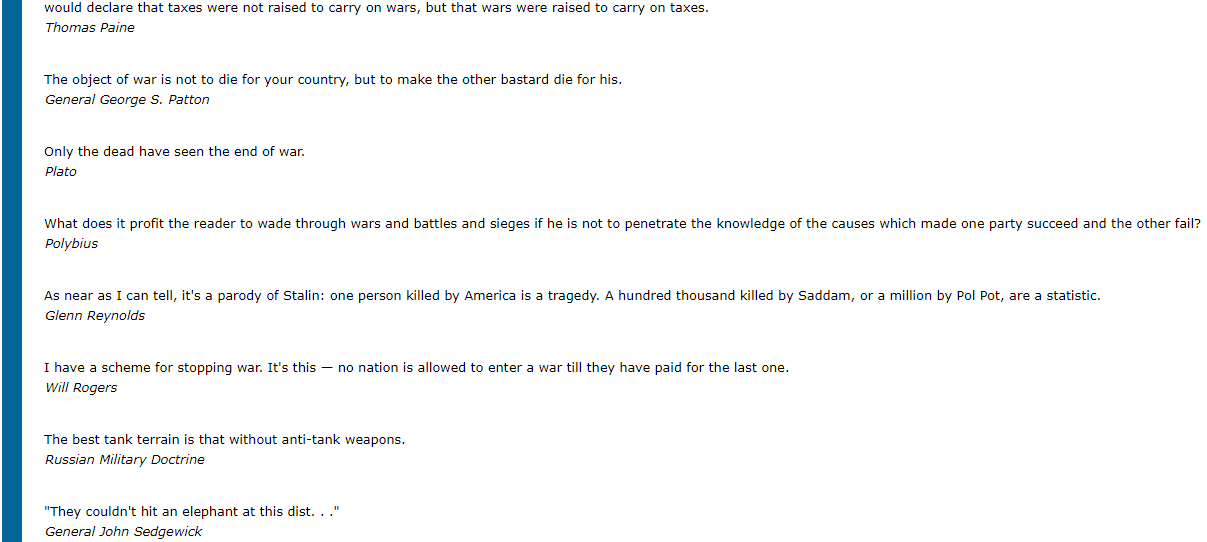
Only the dead have seen the end of war – Plato
I became aware of this marvellous quotation – so wise, pithy and dark – on one of my frequent trips to the Imperial War Museum. It’s one of a series inscribed on the wall beside the ramp leading down to the World War I/trench section. Another of my favourites is attributed to Thucydides: “There were great numbers of young men who had never been in a war and were consequently far from unwilling to join in this one.”
The Plato quote is so good it has been used many times since, inter alia by General Douglas MacArthur in a speech at West Point in 1962, as an aphorism apparently oft-cited by grunts in the ‘Nam, and by Ridley Scott in Black Hawk Down. But the quote is fake. Or at least its attribution is.
In fact it derives not from the Classical Age but from the early 20th century. It was invented by the Madrid-born philosopher, poet and later Harvard professor George Santayana. He clearly had a gift for this sort of thing for he also coined another of those phrases which you’ve always thought was devised by someone much more famous: “Those who cannot remember the past are condemned to repeat it.” Usually this is attributed, in various forms, to Edmund Burke or Winston Churchill. But the former didn’t say it and the latter – as I suspect he quite often did – plagiarised it.
Fake quotes, whether genuine sayings that have been misattributed or fabrications which have been lent authenticity by putting them in the mouths of someone famous, have been a bugbear of mine for a while. I can probably date this to the time someone called me out on my favourite George Orwell quote: “In times of universal deceit, truth-telling becomes a revolutionary act”.
Annoyingly, I had used it a good half dozen times in articles and in internet chats before I learned that Orwell had never said it. I felt cheated and also foolish: surely as an English literature graduate I ought to have known such a thing, in the way that film buffs know that Ingrid Bergman never said “Play it again, Sam”.
But these are easy mistakes to make now that fake quotes are everywhere. Probably, this has always been the case but they have definitely proliferated with the advent of the internet, the shortening of attention spans (which make us more susceptible to gnomic verities that appear to sum everything up and obviate the need for further thought) and the corresponding appetite for meme-friendly aphorisms.
Many of these fake quotes, I’ve noticed, are printed over photographs or images of the alleged author. It’s a cheap trick but an effective one. No one ever is going to be fooled by a joke quote like: “Don’t believe everything you read on the internet. Abraham Lincoln, 1865.” But shove it on top of a picture of the 16th president with those familiar features – the wart, the chin beard, the lined skin and sunken eyes – and for a fraction of a second, the subconscious is taken in.
He finishes off the article thusly:
I’m reminded here, somewhat, of the introductory talk that Mark Crispin Miller used to give his students when he was still allowed by New York University to conduct his course on Propaganda. I paraphrase – you really should listen to this podcast interview for the full account – but essentially Miller warned his audience: “Be prepared to be very upset. You may be shocked to discover how many of the ideas you imagined to be your own are in fact the result of propaganda.”
It would definitely have come as a shock to the younger me. When you’ve had what you consider to be a superb education, steeped in classical literature, you tend to kid yourself that you are just too damn clever, too well-read, to fall for the kind of cheap confidence tricks that fool the unwashed masses.
Which, when you think about it, is what makes the faking of those classical quotes so cunning. They deviously exploit one of one of the cultural assumptions most deeply embedded in both the “educated” and “uneducated” classes alike: this idea that if one of the Ancient Greeks or Romans said it, it must be true because there’s almost nothing about the world that they didn’t know. Another thing they exploit is that the “educated” are rarely as clever as we pretend to be. For example, presented with a vaguely plausible quote with a fancy classical name attached, passing few of us are going to go: “Hang on a second. Did he really say that? Let me check …” Instead, we’ll go “Ah. The great Thucydides. He was the Greek general who wrote Anabasis. The sea! The sea!” and congratulate ourselves on what marvellously well-informed people we are.
Did you catch that palmed card there? Thucydides didn’t write Anabasis because he was far too busy writing the Commentarii de Bello Gallico!
QotD: The (arguments over the) founding of America
No, in its ambitious and often excellent 1619 Project, the New York Times wants to do more than that. So it insists that the very ideals were false from the get-go — and tells us this before anything else. Even though those ideals eventually led to the emancipation of slaves and the slow, uneven and incomplete attempt to realize racial equality over the succeeding centuries, they were still “false when they were written”. America was not founded in defense of liberty and equality against monarchy, while hypocritically ignoring the massive question of slavery. It was founded in defense of slavery and white supremacy, which was masked by highfalutin’ rhetoric about universal freedom. That’s the subtext of the entire project, and often, also, the actual text.
Hence the replacing of 1776 (or even 1620 when the pilgrims first showed up) with 1619 as the “true” founding. “True” is a strong word. 1776, the authors imply, is a smoke-screen to distract you from the overwhelming reality of white supremacy as America’s “true” identity. “We may never have revolted against Britain if the founders had not understood that slavery empowered them to do so; nor if they had not believed that independence was required in order to ensure that slavery would continue. It is not incidental that 10 of this nation’s first 12 presidents were enslavers, and some might argue that this nation was founded not as a democracy but as a slavocracy,” Hannah-Jones writes. That’s a nice little displacement there: “some might argue”. In fact, Nikole Hannah-Jones is arguing it, almost every essay in the project assumes it — and the New York Times is emphatically and institutionally endorsing it.
Hence the insistence that everything about America today is related to that same slavocracy — biased medicine, brutal economics, confounding traffic, destructive financial crises, the 2016 election, and even our expanding waistlines! Am I exaggerating? The NYT editorializes: “No aspect of the country that would be formed here has been untouched by the years of slavery that followed … it is finally time to tell our story truthfully”. Finally! All previous accounts of American history have essentially been white lies, the NYT tells us, literally and figuratively. All that rhetoric about liberty, progress, prosperity, toleration was a distraction in order to perpetrate those lies, and make white people feel better about themselves.
Andrew Sullivan, “The New York Times Has Abandoned Liberalism for Activism”, New York, 2019-09-13.
July 3, 2023
QotD: The key weakness of the royal cause in the English Civil War
[T]he power of the mighty hath no foundation, but in the opinion and belief of the people.
A king whose knights won’t ride out to battle on his behalf is just a weirdo in funny clothes. Charles I lost for a lot of reasons, but far from the least of them was that his “foundation” was badly cracked. However attached one might be to the notion of monarchy in the abstract, it – monarchy – is always intimately connected to the personality of the monarch … and Charles I was a real piece of work, even by the world-class standards of Renaissance princes. Parliament was outgunned, often outmanned, and suffered from what should’ve been a critical shortage of experienced leadership. But all those massive advantages were offset by the fact that the Royalist forces were fighting for Charles I, personally.
(This is not the place for a long discussion of the course of the English Civil Wars – and I’m not qualified to give you one in any case – but a quick look at the top commanders of the opposing sides will illustrate the point. Prince Rupert was arguably the equal, mano-a-mano, of any Parliamentary general, up to and including Cromwell. But he was still a Prince, and carried on like one (like a young one, to boot) … and even if he weren’t, he was still running the show on behalf of his uncle. Cromwell, on the other hand, inspired fanatic loyalty, not least because he embodied a cause that was much higher than himself).
Severian, “Hobbes (III)”, Founding Questions, 2020-12-12.
July 2, 2023
QotD: Processes for fighting the last war
The same applies to “cyber” or “information warfare”; there is no doubt that technology has changed the so-called “battlespace”, making it bigger and more complex by, in effect, adding an invisible dimension. We have been conducting “information operations” for decades, even millennia — I would argue that at the end of the Third Servile War (73-72 BCE) when Marcus Licinius Crassus crucified 6,000 of Spartacus’ followers on the Appian Way (it is not clear if Spartacus, himself was among them) that it was psychological warfare which is either a subset of or a near relation to information warfare. But the tools have changed and with them, tactics need to change, too, but some principles will remain as they were 2,000 years ago, or 100 years ago (the Zimmerman Telegram) or 75 years ago (Turing, the Enigma machine and Bletchley Manor).
Ted Campbell, “Following the blind leader (3)”, Ted Campbell’s Point of View, 2019-05-21.
July 1, 2023
QotD: The ever-increasing size and number of artillery pieces in WW1 trench battles
So by the Second Battle of Artois (May, 1915), the barrage was four days long and included 293 heavy guns and 1,075 lighter pieces. At Verdun (February, 1916) the Germans brought in 1,201 guns, mostly heavy indirect fire artillery (of which the Germans had more than the French) with a shifting barrage that expected to fire 2 million shells in the first six days and 4 million during the first 18 days. At the Somme (1916) the British barrage lasted from the 24th of June to the attack on July 1 (so a seven-day barrage); a shorter barrage was proposed but could not be managed because the British didn’t have enough guns to throw enough shells in the shorter time frame. A longer barrage was also out: the British didn’t have the shells for it. By Passchendaele (1917) the British were deploying some 3,000 artillery pieces; one for every 15 yards of frontage they were attacking.
These efforts didn’t merely get to be more, but also more complex. It was recognized that if the infantry could start their advance while the shells were still falling, that would give them an advantage in the race to the parapet. The solution was the “creeping” barrage which slowly lifted, moving further towards the enemy’s rear. These could be run by carefully planned time-table (but disaster might strike if the infantry moved too slow or the barrage lifted too early) or, if you could guarantee observation by aircraft, be lifted based on your own movements (in as much as your aircraft pilots, with their MK1 eyeballs, could tell what was happening below them). […]
I find that most casual students of military history assume that these barrages generally failed. I suspect this has a lot to do with how certain attacks with ineffective barrages (e.g. the Somme generally, the ANZAC Corps’ attack at Passchendaele) have ended up as emblematic of the entire war (and in some cases, nationality-defining events) in the English-language discussion. And absolutely, sometimes the barrages just failed and attacks were stopped cold with terrible losses. But rather more frequently, the barrages worked: they inflicted tremendous casualties on defenders and allowed the attackers to win the race to the parapet which in turn meant the remaining defenders were likely to be swiftly grenaded or bayoneted. This is part of why WWI commanders continued to believe that they were “on the verge of a breakthrough”, that each attack had come so close, because initially there were often promising gains. They were wrong, of course, about being that close, but opening attacks regularly overran the initial enemy positions. Even the worst debacles of the war, like at the Somme, generally did so.
And at this point, you may be wondering if you’d been lied to, because you were always told this was a war where advances where measured in feet and meters instead of miles or kilometers and how can that be if initial attacks generally did, in fact, overrun the forward enemy positions? I’ll push this even further – typically, in the initial phases of these battles (the first few days) the casualty rates between attacker and defender were close to even, or favored the attacker. This is of course connected to the fact that the leading cause of battle deaths in the war was not rifle fire, machine guns, grenades, bayonets but in fact artillery fire and the attacker was the one blasting fixed positions with literal tons of artillery fire. So what is going on?
Because both sides quickly figured out that their forward positions were badly exposed to artillery barrages and began designing defenses in depth, with rear positions well out of the reach of all but the largest enemy artillery. For instance, most of the so-called “Hindenburg Line” (the Germans called it the Siegfriedstellung or “Siegfried Position”) was set in multiple lines […] The plan consisted of a thin initially defense which was assumed to fall in the event of an attack, but still featured channels made by heavy barbed wire and machine guns designed to inflict maximum casualties on an advancing force (and be dangerous enough to require the artillery barrage and planned assault). Then behind that was more open ground and then a second line of trenches, this time much more solid, with communications trenches cutting vertically and the battle positions horizontally, enabling reserves to be brought up through those trenches without being exposed to fire. Finally the reserves themselves were in a third line of trenches even further back, well outside of the enemy’s barrage (or indeed the range of all but their heaviest guns). Of course while your artillery is in the back, out of range of the enemy artillery, the enemy infantry is attacking into your artillery range. This keeps your artillery from being disabled into the initial barrage (you hope) so that it can be brought into action for the counter-attack.
And now the enemy of the attacker is friction (as we’ve discussed before with defense in depth). If everything possible goes right, you open with the barrage, your infantry sweeps forward, the creeping barrage lifts and you win the race to the parapet. The forward enemy defenders are either blasted apart by the barrage or butchered in their holes by your gas, grenades and bayonets. Great! Now you need to then attack again out of those enemy positions to get to the next line, but your forces are disorganized and disoriented, your troops are tired and your supplies, reinforcements and artillery (including many heavy guns that weigh many tons and shoot shells that also weigh 100+lbs a pop) have to get to you through the terrain the barrage created […]
So rapidly the power of your initial attack runs out. And then the counter-attacks, as inevitable as the rising sun, start. Your opponents can shell you from nice, prepared positions, while your artillery now has to move forward to support you. Their troops can ride railways to staging posts close to the front lines, advance through well-maintained communications trenches directly to you, while your troops have to advance over open group, under artillery fire, in order to support you. The brutal calculus begins to take its toll, you lose ground and the casualty ratios swings in favor of the “defender” (who to be clear, is now attacking positions he once held). Eventually your footholds are lost and both sides end up more or less where they started, minus a few hundreds or thousands of dead. This – not the popular image – this is the stalemate: the attacker frequently wins tactically, but operational conditions make it impossible to make victory stick.
The brutal irony of this “defensive” stalemate is that at any given moment in a battle that might last months and swing from offensive to defensive and back again that casualties typically favored the side which was attacking at any given moment. More ironic yet, the problem here is that the artillery itself is digging the hole you cannot climb out of, because it is the barrage that tears up the landscape, obliterating roads, making movement and communication nearly impossible for the attacker (but not for the defender). But without the barrage, there’s no way to suppress enemy artillery and machine guns to make it possible to cross no man’s land. Even with tanks, an attack without supporting artillery is suicide; enemy artillery will calmly knock out your tanks (which are quite slow; this is in 1918, not 1939).
The problem, for the attacker and the defender isn’t machine guns, it is artillery: the artillery that makes assaults possible in the first place makes actual victory – breaking through the enemy and restoring maneuver – impossible.
Bret Devereaux, “Collections: No Man’s Land, Part I: The Trench Stalemate”, A Collection of Unmitigated Pedantry, 2021-09-17.
June 30, 2023
QotD: Changing patterns of combat on the Great Plains
F.R. Secoy (op. cit.) essentially breaks warfare into four phases, which happen at different times in different places, based on if they have horses, guns, both or neither. Because horses entered the Great Plains from the South (via the Spanish) but firearms entered the region from the North (via the British and the French, the Spanish having prohibited gun-sales to Native Americans) and spread out from there, for a brief time many of these systems were active on the Plains at once, as both guns and horses diffused through the region.
In the pre-horse, pre-gun phase (described by McGinnis as well, op. cit., 8-9), battles consisted of long-range missile exchanges between warriors who stood behind large shields which protected their whole bodies. Native American warriors in this system also wore armor, heavy leather coats, laminated in multiple layers using thick hide with glue that was sometimes mixed with sand or gravel (one more example of how “leather armor” is almost always hardened leather armor, not modern clothing-leather). Some of this armor may have been effectively quilted leather as well. Clearly, there was plenty of concern about survivability here.
Both guns and horses were apt to disrupt this system. Horses allowed attackers to rapidly close the distance between the two opposing lines of shield-protected foot-missile-warriors, causing the shield-lines to drop away (though smaller shields, used on horseback to ward off arrows and blows were still used) and for both sides to seek instead the mobility of mounted fighting. That was not the end for armor though, because contact with a supply of horses meant contact with the Spanish, and the Apache at least swiftly adopted some of the Spanish methods of making leather “buff coats” into their own armor tradition and copied the shape and pattern of the buff coat itself (while often still making the material using their own tradition). As Secoy notes (op. cit., 18-20), our sources are quite clear that these forms of armor (both original and Spanish-influenced Native armors) were quite effective at resisting the archery fire that dominated both the pre-horse, pre-gun system and the post-horse, pre-gun system.
Meanwhile on the Northern Plains, while the horse had not yet arrived, firearms had, and these had different effects. Firearms spelled the end of the armor once they became common enough, since there was no protection which could resist bullets; some shield use survived, since arrows remained fairly common as well. But this didn’t lead to suicidal warfare. Instead – as had happened on the East Coast as well, Native Americans adapted their warfare to the increased lethality of firearms (on this, note Lee, op. cit. above) by mostly avoiding pitched battles as they became too lethal (which, by the by, the relatively low lethality of pitched battles pre-gunpowder is often taken to mean that Native North American warfare in general was low-lethality; this is wrong. As with most forms of non-state warfare, most of the killing happened in surprise raids and ambushes, which could be extremely lethal and were still quite common).
Once the horse and the firearm were both in wide use in an area, warfare shifted again. War parties became smaller, faster moving and more reliant on surprise (essentially an extension of the raiding-focus of the pre-horse, post-gun system to the high mobility horses supplied). Infantry battle dropped away entirely because it was too lethal and resulted in casualties that low-population density nomads could not sustain (the contrast with the much higher population-density agrarian United States, which was self-immolating in massively costly massed-infantry engagements during the American Civil War, 1861-1865, at exactly this time is striking). These are fairly big, noticeable changes in warfare patterns!
In short, the tactics used in all four of these systems were conditions by casualty aversion, which makes a lot of sense in the context of a low-population density society which simply cannot afford massive losses.
Bret Devereaux, “Collections: That Dothraki Horde, Part IV: Screamers and Howlers”, A Collection of Unmitigated Pedantry, 2021-01-08.


