
In one of my favorite parts of the book [Against The Grain], Scott discusses how this shaped the character of early Near Eastern warfare. Read a typical Near Eastern victory stele, and it looks something like “Hail the glorious king Eksamplu, who campaigned against Examplestan and took 10,000 prisoners of war back to the capital”. Territorial conquest, if it happened at all, was an afterthought; what these kings really wanted was prisoners. Why? Because they didn’t even have enough subjects to farm the land they had; they were short of labor. Prisoners of war would be resettled on some arable land, given one or another legal status that basically equated to slave laborers, and so end up little different from the native-born population. The most extreme example was the massive deportation campaigns of Assyria (eg the Ten Lost Tribes of Israel), but everybody did it because everybody knew their current subjects were a time-limited resources, available only until they gradually drained out into the wilderness.
Scott Alexander, “Book Review: Against The Grain“, Slate Star Codex, 2019-10-15.
October 4, 2024
QotD: Farmers and slaves in ancient Mesopotamia
October 3, 2024
QotD: Historical echoes in the American left and right
The Trump movement does have some real [historical Nazi] characteristics. Many low-level people feel remarkably empowered to do things, to get creative to help the cause (and also make some coin; how many Trump medals, flags, and coffee cups does one buy?), and to get out there and just stir the pot for the Orange guy. Then we saw The Donald at the top not exercising real power, other than to exhort others to get shit done, whatever unnamed shit that needed doing.
My first run-through suggests that calling the Juggs and their minions “filthy commies” actually is not just a kneejerk response, but it lands mostly true, in the ways that matter. The Jugg argument that Trump and his people are a bunch of Nazis also has some real truthy elements to it as well (though the true elements are generally probably far afield from the Nazi stuff the Juggs have in mind).
Commies and Nazis gain traction when the basic job of governance is found lacking, and the caliber of people tasked with getting things back in line is not up to the task. Then the various totalitarian solutions become more popular. Even when the intentions are pure (I will give most of the Trump people that assumption), unfettered ambitions, allowed to flower, will go bad if the normal checks and balances of the system are all out of whack. It is just human nature.
Our systems are all out of whack. That is why AOC can call for impeachment of [six US Supreme Court justices] with a straight face, and there is no broadly based “hey, wait a minute, Bucko” response. Things might be too far gone, and there is no way to pull back into a system that actually well serves the average American (think of what constituencies the typical elected official actually serves — the deep state apparat, the ultra-rich guys, and the corporate lobbyists). It all means the Trump movement is a tool, not to restore something, but to accelerate the “get through it and start afresh”. With that in mind, the November results tend to be more of “six of one, half a dozen of the other” than people think they are.
“Dutch”, commenting on “How Juggs Think the World Works”, Founding Questions, 2024-07-02.
October 2, 2024
QotD: Alternative history Operation Barbarossa
Knowing full well how dumb it is to bring up World War II on the Internet, consider that a pretty reasonable case can be constructed for Operation Barbarossa. Having purged all their competent, experienced officers, the Red Army had just gotten their clocks cleaned by the Finns in the Winter War. Yeah, the Soviets “won” in the end, but with that disparity of forces, there’s pretty much no possible “win” that doesn’t look like a loss … and the Soviets, to put it mildly, were nowhere near that best-case scenario. Moreover, even if you took the show trials for exactly that — kangaroo courts — their very existence showed there was a deep rift at the very top of the Soviet leadership. Anyone, not just Hitler, could be forgiven for thinking that the Soviet Union would collapse under one big sledgehammer blow.1
It works the other way, too. If we accept the “Suvorov Thesis”, that Hitler only attacked Stalin because Stalin was gearing up to attack Hitler, then we can easily construct a similar case from The Boss’s perspective: The Wehrmacht can’t play defense. The one time they came up against anything approaching a real opponent with technological parity (the Battle of Britain), it was at best a bloody draw, more than likely a stinging defeat. And the Hitler regime was reeling, internally. No show trials for der Führer, but Rudolf Hess, who was at least the number three man in the Reich and at the time Hitler’s heir apparent, had just defected to the British. Anyone, not just Stalin, could be forgiven for thinking that the Third Reich would collapse under one big sledgehammer blow.
See what I mean? Both of those cases are quite plausible, and fit with most known historical facts … and yet, they’re retcons. “Rationalizations” might even be a better word, because the thing is, even though those arguments are “logical”, and might indeed have been convincing to important people at the time, that’s not why Hitler did what he did, or why Stalin would’ve done what he would’ve done under the Suvorov Thesis. No, the truth is simpler, and much more horrifying: They would’ve done it anyway, because that’s who they were.
That’s what the Castle Wolfenstein people got right about the Nazis. Same deal with that Amazon show (which was interesting for a season) The Man in the High Castle. In the real world, there’s no possible way the Nazis could’ve invaded the USA, no matter how it turned out on the Eastern Front …
… but in the real world they would’ve tried nonetheless, somehow, because that’s just who they were. Everything Stalin, Khrushchev, et al did during the Cold War here in the real world, Hitler, Heydrich, and the gang would’ve done in the Castle Wolfenstein world where the Battles of Stalingrad and Kursk went the other way.2 They couldn’t have done any different, without being different people, and while it’s fun to speculate on questions like “who would’ve been the Nazi Gorbachev, who self-destructed the Reich by attempting however you say ‘perestroika‘ in German”, it’s not really germane.
Severian, “The Man in the High Chair”, Rotten Chestnuts, 2021-07-05.
1. And Soviet losses were stupendous, utterly mind-boggling, in the first few months of Barbarossa. Tanks and planes destroyed in their tens of thousands, prisoners captured in millions. Even as it became clear that OKW had underestimated Red Army strength by orders of magnitude, it was still almost inconceivable that they had anything left to fight with. Just one more push …
2. This is actually the world of a fun novel, Robert Harris’s Fatherland.
October 1, 2024
QotD: Napoleon Bonaparte and Tsar Alexander I
the houseRussia! — but even without knowing how horribly that turns out, you feel sorry for the guy. Napoleon thinks they have something important in common, and Alexander thinks Napoleon’s very existence is the enemy of the entire old world of authority and tradition and monarchy that he represents.Good thing the Russian Empire never gets decadent and unknowingly harbors the seeds of its own destruction!
John: Yeah, I think you’ve got the correct two finalists, but there’s one episode in particular on St. Helena that edges out his time bro-ing out with Tsar Alexander on the raft. It’s the supremely unlikely scene where old, beaten, obese, dying Napoleon strikes up a bizarre friendship with a young English girl. It all begins when she trolls him successfully over his army freezing to death in the smoldering ruins of Moscow, and after a moment of anger he takes an instant liking to her and starts pouring out his heart to her, teaching her all he knows about military strategy, and playing games in her parents’ yard where the two of them pretend to conquer Europe. Call me weird, but I think this above all really showcases Napoleon’s greatness of soul. That little girl later published her memoirs, btw, and I really want to read them someday.
Jane and John Psmith, “JOINT REVIEW: Napoleon the Great, by Andrew Roberts”, Mr. and Mrs. Psmith’s Bookshelf, 2023-01-21.
September 30, 2024
QotD: Compound eyes as models of how the surveillance state operates
The compound eye is a good way to imagine how the surveillance state will keep tabs on the subjects in the near future. Unlike the dystopian future imagined by science fiction, it will not be one eye focusing on one heretic, following him around as he goes about his business. Instead it will be tens of millions of eyes obtaining various bits of information, sending it back to the data-centers run by Big Tech. That information will be assembled into the broad mosaic that is daily life.
For example, rather than use informants and undercover operatives to flesh out conspiracies against the state, the surveillance state will use community detection to model the network of heretics. Since everyone is hooked into the grid in some fashion and everyone addresses nodes of the grid on a regular basis, keeping track of someone is now something that can be done from a cubicle. There is no need to actually follow someone around as they go about their life.
For example, everyone has a mobile phone. At every point, the phone is tracking its location, which means it is tracking your location. It also knows the time and day when you go into various businesses. Most people use cards to pay miscellaneous items, so just that information would tell the curious a lot about you. Combine that information with the same information from other phones that come into close proximity with your phone and figuring out the community structure is simple.
Of course, the mobile phone is not the only input device. Over Christmas, millions of Americans were encouraged to install surveillance devices in their homes by friends and family. Maybe it was an Alexa listening device from Amazon or a Nest Doorbell surveillance device from Google. All of these gadgets are collecting data on your life inside and around your home. It is then fed to the same data-centers that have all of your movements and associations collected from your phone.
The Z Man, “The Compound Eye”, The Z Blog, 2020-01-08.
September 29, 2024
QotD: Pyrrhus, King of Epirus
This week, we’re going to look at Rome’s first experience of that military system, delivered at the hands of Pyrrhus, King of Epirus (r. 297-272). The Pyrrhic Wars (280-275) are always a sticking point in these discussions, because they fit so incongruously with the rest. From 214 to 148, Rome will fight four “Macedonian Wars” and one “Syrian War” and utterly demolish every major Hellenistic army it encounters, winning every single major pitched battle and most of them profoundly lopsidedly. Yet Pyrrhus, fighting the Romans some 65 years earlier manages to defeat Roman armies twice and fight a third to a messy draw, a remarkably better battle record than any other Hellenistic monarch will come anywhere close to achieving. At the same time, Pyrrhus, quite famously, fails to get anywhere with his victories, taking losses he can ill-afford each time (thus the notion of a “Pyrrhic victory”), while the Roman armies he fights are never entirely destroyed either.
So we’re going to take a more in-depth look at the Pyrrhic Wars, going year-by-year through the campaigns and the three major battles at Heraclea (280), Ausculum (279) and Beneventum (275) and try to see both how Pyrrhus gets a much better result than effectively everyone else with a Hellenistic army and also why it isn’t enough to actually defeat the Romans (or the Carthaginians, who he also fights). As I noted last time, I am going to lean a bit in this reconstruction on P.A. Kent, A History of the Pyrrhic War (2020), which does an admirable job of untangling our deeply tangled and honestly quite rubbish sources for this important conflict.
Believe it or not, we are actually going to believe Plutarch in a fair bit of this. So, you know, brace yourself for that.
Now, Pyrrhus’ campaigns wouldn’t have been possible, as we’ll note, without financial support from Ptolemy II Philadelphus, Antigonus II Gonatus and Ptolemy Keraunos. So, as always, if you want to help me raise an Epirote army to invade Italy (NATO really complicates this plan, as compared to the third century, I’ll admit), you can support this project on Patreon.
Bret Devereaux, “Collections: Phalanx’s Twilight, Legion’s Triumph, Part IIIb: Pyrrhus”, A Collection of Unmitigated Pedantry, 2024-03-08.
September 28, 2024
QotD: Doom! Doom! And more Doom!
Monty used to use this image at Ace of Spades H.Q., and I certainly think it’s appropriate to include it here.
Lately I’ve become an awful old woman. My reaction, during the con, to the little card hotels leave in your bathroom, in the hopes that you’ll save them laundry money — you know the one that says that if you want to help save the Earth or the Environment (I don’t remember which, precisely, these pagan divinities all run together in my head) you’ll hang up your towel and use it another day — was to sigh and say: Deary, the Earth has been here for billions of years before I was born. It will be here for billions of years before my very atoms have been dispersed in its general Earthness. I can’t save it. There isn’t a tupperware large enough. And besides where would I put it? Who would dust it?
In the event, the only audience for my musings was my husband who consented to chuckle at it, as he went on. And we didn’t hang up the towels. We might have, had they made a sensible business appeal “if you save us money, we’ll be able to keep our prices lower” but we’re not at home to religious pandering to religions not our own. As far as I’m concerned they might as well ask me not to use electricity so as to spare the feelings of Zeus, god of thunderbolt.
So, yes, you see, I have become an awful woman. Or if you prefer, I’ve become a fool or a sadist in Heinlein’s definition of such: Someone who tells the truth in social situations.
But you see, I am so very tired of all the genuflecting and bowing to the doom du jour, as well as the market distortions, worsening of problems and outright damage to people and deaths or grievous arm (not to mention not being born) while trying to avoid largely imaginary dangers and issues.
What do I mean? Well, how many people had no children because they were pounded about the face and head with the impending doom of “overpopulation”? How many of those people, now nearing their last decades, bitterly regret the childlessness? Worse, how many people in how many third world countries were encouraged to be sterilized due to both the “coming doom” of overpopulation, and the horrific mid-century misapprehension that children caused poverty? How many women in China were forcibly aborted? How many toddlers confined to dying rooms? How many women in India were strongly persuaded to abort female children, or expose unwanted ones newly born? (Yes, I know it might have happened anyway, but the westerners were encouraging people to have fewer and fewer children, which only fed that nonsense.)
Other dooms? So many dooms, so little time to catalogue them. When I was little, I knew I’d probably starve or die of thirst due to overpopulation. What was worse, it was overpopulation far away, since most people near me couldn’t afford more than one or two kids, if they ever hoped to live a middle class life. (Spoiler: it was taxes, requiring work from both parents that caused poverty, not an excess of children.) I also expected to freeze in the coming ice age, caused by all the pollution, from people making things in factories, having cars, and using electrical light. Also, as it happened, in the seventies we were told fossil fuels were running out, so while we were freezing, we wouldn’t even be able to take a flight somewhere warmer, to escape the advancing glaciers. But that was all right, because we were all going to die in a nuclear exchange that would happen any day now, in a conflagration between the USSR and the US, whom we were assured were absolutely equal in morality, and both just wanted supremacy for … no reason really.
Of course, the things urged to stop all of this ranged from criminal — the aforementioned forced abortions and killing of children — to the merely dangerous — urging the nuclear disarmament of the West (mostly propaganda from the Soviet Union, mind) which we were assured would bring about peace and not world communism (which in the way of such things would shortly after be followed by world famine and world depopulation.)
By the time the Gaia cultists flipped from a fear of freezing to a fear of boiling, I only half went along, and only until I realized once more it made no sense whatsoever.
Sarah Hoyt, “Doom Doom Doom!”, According to Hoyt, 2024-06-26.

September 27, 2024
Ronald Reagan never said this … but Karl Marx did
At The Take, Jon Miltimore discusses a fake Ronald Reagan quote-on-a-poster being sold through Amazon and reveals that the quote actually originates with Karl Marx:
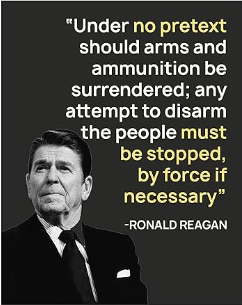
For just $9.99, people can go on Amazon and buy wall art of Ronald Reagan apparently defending the Second Amendment.
“Under no pretext should arms and ammunition be surrendered,” the text reads next to a picture of Reagan; “any attempts to disarm the people must be stopped, by force if necessary”.
There are a few problems with the quote, but the biggest one is that Reagan never said it.
As numerous fact checkers have noted — including Reuters, Snopes, Factcheck.org, and Politifact — the author of the quote is none other than Karl Marx, the German philosopher and author of The Communist Manifesto who used language nearly verbatim to this in an 1850 address in London.
“Under no pretext should arms and ammunition be surrendered; any attempt to disarm the workers must be frustrated, by force if necessary,” Marx said in his “Address of the Central Committee to the Communist League“.
Marxists Not Embracing Marx’s Messaging?
In fairness to the many internet users duped by the fake Reagan meme, the quote sounds a bit like something Reagan could have said (though it’s highly unlikely the Gipper, a skilled and careful orator, would have ever said “by force if necessary”).
Reagan, after all, generally — though not universally — supported gun rights and was skeptical of efforts to restrict firearms.
“You won’t get gun control by disarming law-abiding citizens,” Reagan famously noted in a 1983 speech.
Some might be surprised that Marx and Reagan had similar views on gun control. Marx was of course the father of communism, whereas Reagan was famously anti-communist. Moreover, Marx’s modern disciples are staunch supporters of gun control, whether they identify as socialists or progressives.
“Guns in the United States pose a real threat to public health and safety and disproportionately impact communities of color,” Nivedita Majumdar, an associate professor of English at John Jay College, wrote in the Marxist magazine Jacobin. “Their preponderance only serves corporate interests, a corrupt political establishment, and an alienated capitalist culture.”
This distaste for guns goes beyond socialist magazines. As The Atlantic reported during the 2020 presidential election cycle, progressive politicians are increasingly embracing more stringent federal gun control laws.
“No longer are primary candidates merely calling for tighter background checks and a ban on assault weapons,” journalist Russell Berman wrote; “in 2019, contenders like Senator Cory Booker of New Jersey and Representative Beto O’Rourke of Texas were calling for national licensing requirements and gun-buyback programs”.
The point here is not to disparage politicians like O’Rourke and Booker as “Marxists”, a label they’d almost certainly object to. The point is that progressive politicians like Rep. Alexandria Ocasio-Cortez (D-NY) might channel Marx in their class rhetoric, but they are not embracing his messaging when it comes to the proletariat’s access to firearms.
As it happens, this is a common theme with Marxists throughout history.
QotD: Nietzsche – a gamma male incel?
If you aren’t familiar with Vox Day’s sociosexual hierarchy [SSH], you can find the definition of its categories at his Sigma Game Substack here. Briefly, the SSH classifies men (and only men) according to the ways they relate to one another, and therefore (since women are exquisitely socially sensitive), to women. It divides men into the following categories: alphas, the natural leaders who get most of the female attention; betas or bravos, who are not Pyjama Boy, but rather the alpha’s lieutenants and capos, enforcing the alpha’s rule and getting some of the female attention that spills out of his penumbra; gammas, who are essentially low-t nerds with poor social skills that scare the hoes; deltas, who are basically the workers, the ordinary joes who keep everything running, and are sometimes after much struggle successful in landing a waifu; omegas, who are at the bottom of the hierarchy, neither receiving much from it nor contributing anything to it, and never leave their dirty basements; sigmas, who are essentially lone wolves with an ambivalent relationship to the hierarchy, which they don’t really care about (they have their own, more interesting thing they’re doing, which they’re happy to do alone if necessary), but nevertheless do quite well within it, often challenging the alpha’s authority without intending to; and lambdas, who exist outside of the sociosexual hierarchy because they are literally gay.
If you want an image of the SSH, consider your typical American high-school in the 1980s. The alpha is the captain of the football team; the betas are the other football team players; the gammas are the chess club nerds; the deltas are the normal kids with nothing much remarkable about them; the sigma is the kid in the metal shirt who cuts class because it bores him and then shows up at the party with a hot girl from a different school that no one has met before; the omegas are the dropout welfare trash kids; and the lambdas are the theatre kids.
So, was Nietzsche a gamma male incel? Was he a loser and a nerd?
Of course he was. Vox is absolutely correct about this.
Christians will usually follow up the gamma male incel attack by noting the absurd contrast between Nietzsche’s lived reality, as a frail neurasthenic with a terminal case of oneitis who could be sent into days of migraines by a chance encounter with a caffeinated beverage, and the concept of the Ubermensch he preached in his writings, most notably in his very strange novel? prose poem? mental breakdown? Thus Spake Zarathustra. By the same token we might note that Virgil was no Aeneas. The character created by the artist is not the artist; if the artist was the character, he’d be too busy running around doing heroic character things, not hunched over in his scriptorium scribbling away with ink-stained fingers.
And make no mistake about it – Nietzsche was as much the poet as the philosopher, indeed, probably more poet than philosopher. One of the most common complaints you’ll hear about Nietzsche is that it’s not at all clear, much of the time, what he’s getting at. What is the actual argument here? people will ask. They’re used to philosophers whose turgid prose is a loose string of logical syllogisms, composed with all the charm of a mathematical derivation. The wild electricity of Nietzsche’s divine madness is an entirely different genre.
We call Nietzsche a philosopher because that’s the closest category we have to throw him in, but this is a poor categorization. Nietzsche’s mind – and yes, this may well be because it was broken by syphilis – did not proceed according to the narrow rails enforced by a rigid adherence to logic and reason. It was not weighed down by the gravity of methodological rigour. That is not to say that he did not apply reason, simply that he was not limited to it. He made use of revelation, of inspiration, just as much. He felt as much as he thought when he wrote, inhabiting the ideas he developed with his passion as much as his intellect. He thought with his whole brain, using both his left hemisphere and his right – in Nietzsche’s language, the Apollonian and the Dionysian. Being aware that philosophy specifically, and Western thought more generally, was to an extraordinary and even pathological degree locked into the left-hemisphere mode, into the Apollonian realm of rational dialectic, he went out of his way to cultivate the Dionysian instead, to get into touch with his intuitive, subconscious, “irrational” mind. As much as Nietzsche was a philosopher, he was also an artist, a poet1, a mystic, and even, dare I say it, a prophet.
None of which is to say that he was not also a giant loser.
But then, most philosophers are nerds who are bad with the ladies. There are exceptions, of course. There is no record of Plato being bad with the ladies; Plato’s tastes are reputed to have run in different directions.
John Carter, “The Prophet of the Twentieth Century”, Postcards from Barsoom, 2024-06-25.
1. He published a volume of actual poetry, which wasn’t very good; he also dabbled in musical composition, which was even worse.
September 26, 2024
QotD: The Asshole License, First Class
Passive-aggressive behavior is characterized by a pattern of passive hostility and an avoidance of direct communication. Inaction where some action is socially customary is a typical passive-aggressive strategy (showing up late for functions, staying silent when a response is expected). Such behavior is sometimes protested by associates, evoking exasperation or confusion. People who are recipients of passive-aggressive behavior may experience anxiety due to the discordance between what they perceive and what the perpetrator is saying.
There’s definitely a lot of that going around, but it doesn’t describe the behavior of the apple polishers, or the people who have issued themselves the Asshole License. You know the ones I mean: SJWs, of course, but also CrossFitters, vegans, cyclists … basically, anyone who takes up a certain cause or lifestyle seemingly for the sole purpose of being an enormous douchebag about it in every possible social situation. Neither I nor anyone else would have a problem with vegans, say, if they really were doing it for their health, as they so often claim, because if they really were doing it for their health, they’d bring it up once, and then forever shut the fuck up about it.
But they don’t. Similarly, nobody would have a problem with bike riders if they’d just follow the goddamn rules of the road. But they don’t, and the more “cyclist” shit they own — the racing bikes made out of space station parts, the lycra bodysuits, the helmets that look like cranial jockstraps — the less the rules of the road apply to them. Spot one of those fuckers in full kit, and you’re guaranteed to see him weaving in and out of four lanes, turning abruptly without signaling, and blowing through stop signs at full speed, with nary a glance at cross traffic. They’re possessors of the Asshole License First Class, you see, so obviously the rules don’t apply when they’re doing their Official Asshole Thing.
See what I mean? That’s not “passive-aggressive”. But it’s not “active-aggressive” either. They’re not trying to pick a fight. It’s like virtue-signaling, in that you, the audience, are absolutely necessary, but unlike the standard virtue-signal, which is strictly an intra-Leftist competition, this one entails hostility towards the rest of the world, not just toward fellow Leftists …
Severian, “The Passive-Aggressive Society”, Rotten Chestnuts, 2021-07-24.
September 25, 2024
QotD: “Rooting for the meteor”
So far, the meteor has a horrible track record. It showed up once in the clutch for mammals millions of years ago and that’s about it. We need to stop rooting for the meteor. If the meteor even does show up it’ll likely cause all kinds of problems. We need to start rooting for more sensible and practical ways to end a game with both teams losing. Options like:
- Root for Bane
- Root for the large sinkhole
- Root for the tornado
- Root for the alien abduction
- Root for spontaneous player combustion
- Root for lightning
- Root for the ball ending up being a bomb
- Root for the dune sandworm
- Root for the unexpected plane crash. We almost got this one once!
- Root for the Killdozer to show up
- Root for the nerve gas attack
- Root for the Brown Note
- Root for spiked Gatorade that gets everybody sick
- Root for stadium structural failure
- Root for both teams to become friends and refuse to fight
- Root for acid rain
- Root for the big squid from the end of the original Watchmen comic
- Root for the suitcase nuke
- Root for everyone to suddenly become naked, a state of being it is hard to play football in
- Root for a dragon to show up. Any dragon. Pick your favorite. I choose Volvagia from Ocarina of Time
- Root for the solar flare
- Root for the uprising of the skeleton army
Dave Rappoccio, “Rooting for the Meteor Only Worked Once”, The Draw Play, 2024-06-24.
September 24, 2024
QotD: Is vexillology considered part of the LGBT sexual spectrum?
But activists love their flags, and Pride Month™ wouldn’t be complete without the full range of other designs to represent the innumerable sexualities and genders that we’ve only just heard of but have apparently always existed.
There are flags to signify people who identify as nonbinary, polyamorous, polysexual, agender, genderfluid, genderqueer, neutrois, two-spirit and many more. If you haven’t heard of all of these terms, don’t worry. There’s a concerted effort in the public sector to fly these flags at every opportunity and educate the bigoted masses. In April, staff at Royal Stoke Hospital were photographed holding a banner with twenty-one of these flags. And in January, Network Rail unveiled its “Pride Pillar” at London Bridge station, which displayed a similarly garish range.
There are flags for pansexuals (those who are attracted to all sexual identities), somnisexuals (those who are only attracted to people in their dreams), parasexuals (those who don’t feel sexual attraction but will have sex for reproductive purposes) and dozens more. There’s even a flag for “allosexuals”, which apparently means anyone capable of experiencing sexual attraction. Presumably “Allo Allo Sexuals” are people who get aroused by dodgy French accents.
Andrew Doyle, “How many flags does one movement need?”, Andrew Doyle, 2024-06-22.
September 23, 2024
QotD: On Roman Values
Now, of course it isn’t surprising to see Roman exemplars mobilized in support of this or that value system, as people have been doing that since the Romans. But I think the disconnect between how the Romans actually thought and the way they are imagined to have thought by some of their boosters is revealing, both of the roman worldview and often the intellectual and moral poverty of their would-be-imitators.
In particular, the Romans are sometimes adduced by the “RETVRN” traditionalist crowd as fundamentally masculine, “manly men” – “high testosterone” fellows for whom “manliness” was the chief virtue. Romans (and Greeks) are supposed to be super-buff, great big fellows who most of all value strength. One fellow on Twitter even insisted that the chief Roman value was VIRILITAS, which was quite funny, because virilitas (“manhood, manliness”) is an uncommon word in Latin, but when it appears it is mostly as a polite euphemism for “penis”. Simply put, this vision bears little relation to actual Roman values. Roman encomia or laudationes (speeches in praise of something or someone) don’t usually highlight physical strength, “high testosterone” (a concept the Romans, of course, did not have) or even general “manliness”. Roman statues of emperors and politicians may show them as reasonably fit, but they are not ultra-ripped body-builders or Hollywood heart-throbs.
Bret Devereaux, “Fireside Friday, March 29, 2024 (On Roman Values)”, A Collection of Unmitigated Pedantry, 2024-03-29.
September 22, 2024
QotD: The work of Le Corbusier
Theodore Dalrymple, “Architectural Dystopia: A Book Review”, New English Review, 2018-10-04.
September 21, 2024
QotD: Progressivism
What it seeks is not, however, goodness, or security, or higher living standards, or even better health care. What it seeks is the celebration of its own brilliance. “Smug” is a small word that perfectly captures the nature of the progressive mind.
This gnostic trait is the source of all of the damage liberalism has wrought for more than 300 years. From the French Revolution to the Third Reich, from Stalinism to North Korea, liberalism has brought with it repression of liberty, death camps, and executions on a mass scale. What’s often not well understood is the fact that violence and repression are inevitable because liberalism seeks to change what does not wish to change – and it does so not for the purpose of making things better, but as an attempt to confirm the superiority of the liberal mind and its ability to manage society.
Most Americans find this conception of existence repulsive. They follow the true path of love, marriage, childbirth, hard work, and faith in God and country. Liberals actively seek to destroy this conception of existence because it rejects their mission of transforming society. It’s either the true path or liberalism. Both cannot be true.
To succeed, liberalism must acquire and retain clients in need of change. It is not in the interest of the liberal to solve problems. What the liberal needs is continually to discover new problems and hold them up as in need of solution. The fate of the “DREAMers”, held in limbo by generations of liberals, is one example. The “downtrodden”, as they were once called, are indeed the pawns of liberal politicians.
Jeffrey Folks, “Leftists versus the People”, American Thinker, 2018-02-24.


