Quotulatiousness

February 18, 2023

Nikki Haley’s presidential bid is clearly doomed because … she uses her middle name? Let me read that again.

Filed under: India, Media, Politics, USA — Tags: , , , , , — Nicholas @ 05:00

Jim Treacher (whose name I should now probably put in scare quotes because it’s a nom-de-plume) explains why Nikki Haley is a no-hoper in the next Republican presidential primaries:

As I revealed over a decade ago, “Jim Treacher” isn’t my real name. This is just a message-board pseudonym that got way out of hand, and now I guess I’m stuck with it. My government name is Robert Sean Medlock, but my parents have always called me Sean. I don’t know why they didn’t just name me Sean Robert Medlock, but I was in no position to argue my case at the time because I couldn’t talk yet.

So now, every time I need to fill out paperwork somewhere, I have to explain that I go by my middle name. Doctors, dentists, car repairs, insurance, what have you. The routine is kind of annoying, but at this point I’m used to it.

I’m not deceiving anybody by using my middle name. It’s just my name, man. Lots of people go by their middle name.

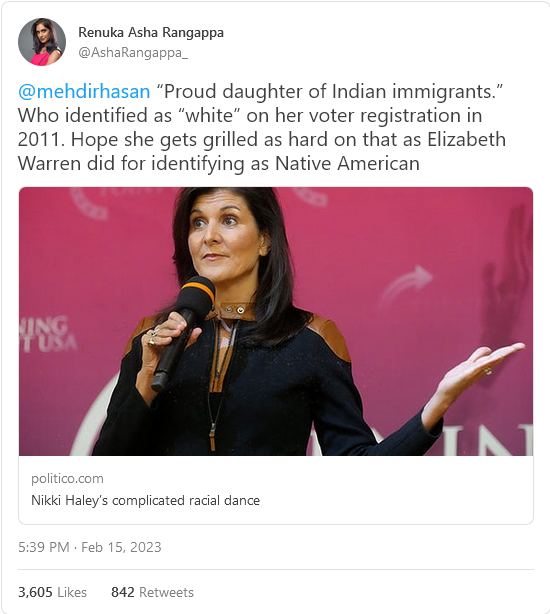
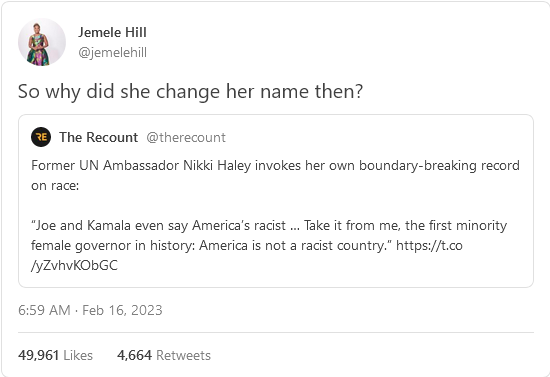
In other news: This week Nikki Haley announced she’s running for president. I don’t know if she has a shot, but the libs sure seem to think so. They’re already attacking her for … going by her middle name.

Check out this idiot:

She didn’t. Her birth name was Nimarata Nikki Randhawa. Not “Nimrata”, as it’s commonly misspelled by supposedly sophisticated libs:

My goodness. Guess it runs in the family, huh?

The Randhawa family referred to their daughter as Nikki, which is Punjabi for “little one”. And she changed her last name to Haley when she married a man named Michael Haley.

Y’know, like Hillary Rodham did when she married Bill Clinton.

Here’s another dummy, who of course works for CNN:

Yeah. Wait. What?
And if that scandal wasn’t enough to sink Nikki Haley’s chances utterly, CNN’s Don Lemon helpfully points out that she’s way, way, way past her peak:

Now, you know I’m not one to cry sexism often. Frankly, when I found out a hot college professor of mine had been fired for doing a #MeToo, I was offended for not being involved. I’d gone to office hours, for godsakes. But there is sexism this week we have to call out. Nikki Haley announced she is running for president. She’s a reasonable Republican candidate who is, of course, a long shot against Trump. There are plenty of ways to criticize her politics, but for some reason a bunch of people we are meant to respect tried to say that the real problem is that she’s a woman, that she’s not young, and that she’s Indian.

You may think I’m exaggerating.

Here is Don Lemon on CNN: “Nikki Haley isn’t in her prime. Sorry”, he says, looking to camera, a little smile on his face. “When a woman is considered to be in her prime in 20s and 30s and maybe 40s …” His co-hosts, both women, balk. (“Prime for what?”) But Lemon keeps going. Watch the extremely stressful video here, where he goes on … and on … about how Nikki Haley, who is 51, cannot criticize Biden’s age. Because women peak in their 20s, and she’s long past that.

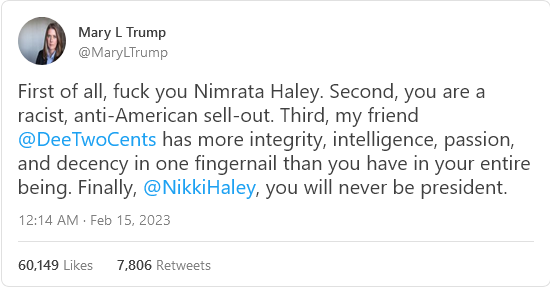
Or here’s progressive hero Mary Trump, Donald’s niece, who disavowed him and became a star of the intelligentsia. She decided that the best way to insult Nikki Haley this week was by highlighting that she’s Indian, because Nikki is her middle name. Again, this is a real statement Mary Trump released on Twitter: “First of all, fuck you Nimrata Haley.” Sorry, I’m slow: If you’re a white person trying to insult someone who’s not white and you do it by highlighting their race, what’s that called again? I’m sure there’s a Robin DiAngelo chapter on this somewhere.


February 17, 2023

Quebec suddenly realizes there are significant problems with Bill C-11

Filed under: Cancon, Government, Law, Media, Politics, Technology — Tags: , , , , — Nicholas @ 03:00

Michael Geist, who has been doing heroic work covering the federal government’s attempts to seize control of what Canadians can see and publish online, says that Quebec has finally woken up to the threat to their culture embedded in the federal government’s Bill C-11:

Bill C-11 – and its predecessor Bill C-10 – have long been driven by the government’s view that the bill was a winner in Quebec. Bill C-10 was headed for easy passage in 2021, but was derailed by the government’s decision to remove safeguards over regulating user generated content that came largely from the Quebec-based music lobby. Nearly two years later, Canadian Heritage Minister Pablo Rodriguez and his staff have ignored the concerns of thousands of digital creators, disrespected indigenous creators, and indicated that he will likely reject Senate amendments designed to craft a compromise solution, all in the name of keeping Quebec lobby interests satisfied. Yet as the government considers the Senate amendments, the Quebec legislative assembly this week passed a last minute motion calling for further changes to the bill, including scope to enact its own rules and mandatory consultations with the province on the contents of a policy direction to the CRTC that Rodriguez has insisted on keeping secret until after the bill receives royal assent (a full copy of the motion is contained at the bottom of this post). The Conservatives have been calling for the Quebec motion and the Senate amendments to be sent back to committee for further study, which the Globe reports may delay the government’s response to the Senate amendments.

It is not clear what prompted the Quebec government to finally wake up to the centralizing power over digital culture that comes from the bill (and just wait until it realizes that Bill C-18 encroaches on provincial jurisdiction with the regulation of newspapers). But this issue has been there from the beginning. In March 2021, Philip Palmer, a former Justice counsel, argued that Bill C-10 was unconstitutional, making the case it fell outside federal jurisdiction. In a post on his submission, I noted:

    Quebec has a long history of taking issue with federal involvement in broadcasting, putting a potential challenge in play. Indeed, it is odd to see this legislation viewed as a political winner in Quebec, when it effectively asserts federal jurisdiction over an area that has long been contested in the province.

Palmer appeared before the House committee studying Bill C-11 and warned MPs about the constitutional jurisdictional overreach. His opening statement noted:

    C-11 lacks a foundation in Canadian constitutional law. Internet streaming services do not transmit to the public by radio waves, nor do they operate telecommunications facilities across provincial boundaries. They and their audiences are the clients of telecommunications common carriers, which are subject to federal regulation. Netflix, for instance, in this case is no more a federal undertaking than a law firm such as McCarthy Tétrault or a chain store like Canadian Tire, both of which rely extensively on telecommunications services.

Liberal MP Anthony Housefather followed up on the issue, asking Palmer to cite caselaw to back his claim. His response:

    The principal case for all federal regulation of broadcasting space is, of course, the radio reference of 1932. In that, the court relied upon the provisions of subsection 92(10) of the Constitution Act to find that, in transmitting radio waves, they necessarily exceeded provincial boundaries and, therefore, could only be effectively regulated at the federal level. The key is that, in order to be regulated by the federal government, the “undertaking”, as the Constitution uses the word, has to be one that has the facilities to exceed provincial limitations and provincial boundaries.

Housefather wasn’t convinced and asked Professor Pierre Trudel, a vocal supporter of Bill C-11, for his view. Trudel didn’t deny the issue. In fact, he confirmed it, suggesting that the Supreme Court would ultimately have to determine the question:

    If this were unconstitutional, it would be because it would be a matter of provincial jurisdiction. The question would then have to be asked: is it better for 10 provinces to put in place regulations on these matters or for the federal authority to do so? There are arguments that radio waves are not the only basis for federal jurisdiction in these matters. There is, among other things, the question of national interest and the inherently interprovincial nature of the activity. In short, all these arguments may have to be argued before the Supreme Court. Either the federal government has authority, or the provinces do. Therefore, it is to be expected that the Canadian state will intervene sooner or later, whether through the provinces or through the federal government.

The takeaway from this exchange – a former justice lawyer citing caselaw to confirm the shaky constitutional foundation of the bill and a professor confirming the Supreme Court would have to decide – should have provided a wakeup call to Quebec, which has a long history of challenging federal jurisdiction in communications that dates back nearly 100 years with repeated efforts to enact provincial laws and policies in the area. Left unsaid is that if the “national interest” dictates federal regulation of anything that touches the Internet, there are few limits on federal powers and little left for the provinces.

February 16, 2023

The mass spell to destroy Hogwarts Legacy turns out to be a squib

Filed under: Business, Gaming, Media, Politics, USA — Tags: , , , , , — Nicholas @ 05:00

All the angry people on social media had a new thing to be angry about: the release of a new online game based on the works of she-who-must-not-be-named (that’d be J.K. Rowling if you haven’t been keeping up with the woke’s ledger book of cancelled persons). They’d gather in their mighty legions, denounce the evil woman and the tech company would shiver and shake and then apologize for offending them and pull the game from the market, just like so many other companies had fallen to their online rage before.

It hasn’t quite worked out that way, as Tom Knighton relates:

The extreme left, those we term as “woke”, like to think they have a great deal of power. They think they’re the majority of the nation, and that they can shift the world based on their own whims.

And, in the past, it sure looked like it.

They’d get on Twitter and scream in outrage and brands would back down. They’d issue apologies and capitulate with the mob.

Then JK Rowling got on their bad side. She doesn’t think transwomen are women, that they haven’t lived with the struggles that women grow up with.

So, they decided to destroy anything they can associate with her.

That included the new video game, Hogwarts Legacy. Before the game came out, they tried to sabotage it on Steam, describing it as a “genocide simulator”.

I’ll be honest, that made me want to play the game. Apparently, I was far from alone.

    Hogwarts Legacy has got off to a very big start at UK games retail, and is comfortably the No.1 game of the week (GfK data).

    It is the biggest launch for any Harry Potter game ever, with sales 64% higher than the previous best — Harry Potter and the Philosopher’s Stone from 2001. In fact, the biggest week for a Harry Potter game wasn’t a launch week at all, it was the second week of the Philosopher’s Stone (due to hype around the movie). Even compared to that week, Hogwarts Legacy was still bigger by 2%.

    This result is more impressive when you consider this is just for physical sales. Hogwarts Legacy would have received a substantial number of digital downloads (that data will come later in the week), whereas Philosopher’s Stone didn’t have any digital sales back in 2001. Therefore, the success will be even more pronounced once all the data is in.

In other words, the woke don’t have the pull they like to believe they do.

In a rational world, companies would see this and take it to heart: despite their apparent popularity on some social media sites, the very very woke are a tiny layer of froth on the ocean of non-woke customers. It’s often said that the terminally online think that Twitter is the real world — which is why Elon Musk taking over their preferred online megaphone was so traumatic to so many of them — but they’re mostly bellowing at one another, not at the population as a whole.

A modern irregular verb: I mis-spoke. You spread misinformation. He has been banned from social media

I derive my headline from the original words of Bernard Woolley: “That’s one of those irregular verbs, isn’t it? I give confidential security briefings. You leak. He has been charged under section 2a of the Official Secrets Act.” It was a joke in Yes, Minister, but as Jon Miltimore shows, it’s a model for how the powers-that-be want to treat how information is shared on social media:

As Reuters reported in a recent fact-check, Mr. Gore was guilty of misrepresenting scientific data — or “spreading ‘misinformation'”.

In 2009, many responded playfully to Gore’s faux pas.

“Like most politicians, practicing and reformed, Al Gore has been known to stretch the truth on occasion”, NPR noted, adding that Gore had also claimed he’d helped create the internet.

Today, misinformation is treated in a much different way — at least in some instances. Throughout the COVID-19 pandemic, many writers and scientists who questioned the government’s use of lockdowns, mask mandates, enforced social distancing, and vaccine mandates were banned from social media platforms while others lost their jobs.

San Francisco attorney Michael Senger was permanently banned from Twitter after calling the government’s pandemic response “a giant fraud”. Prior to him, it was former New York Times reporter Alex Berenson who got the boot after questioning the efficacy of vaccines in preventing COVID-19 transmission. Months earlier it was author Naomi Wolf, a political advisor to the presidential campaigns of Bill Clinton and Al Gore.

All of these accounts were reinstated after Elon Musk purchased the company. Twitter is hardly alone, however. Facebook and YouTube also announced policies banning the spread of COVID misinformation, particularly information related to vaccines, which is what got Drs. Peter McCullough and Robert Malone ostracized and banned.

Some may argue these policies are vital, since they protect readers from false information. However, there is nothing that says Big Tech can only ban information that is false. On the contrary, in court proceedings Twitter has claimed it has “the right to ban any user any time for any reason” and can discriminate “on the basis of religion, or gender, or sexual preference, or physical disability, or mental disability”.

Facebook, meanwhile, has argued in court that the army of fact-checkers they employ to protect readers from false information are merely sharing “opinions”, and are therefore exempt from defamation claims.

[…]

What Big Tech is doing is concerning, but the fact that this censorship is taking place in coordination with the federal government makes it doubly so.

In July, in arguably the most anti-free speech pronouncement made at the White House in modern history, White House press secretary Jen Psaki noted the White House is “flagging problematic posts for Facebook”.

“We are in regular touch with these social media platforms, and those engagements typically happen through members of our senior staff, but also members of our COVID-19 team”, Psaki explained. (Today we know that these companies are staffed with dozens of former CIA and FBI officials.)

All of this is being done in the name of science, but let’s be clear: there’s nothing scientific about censorship.

QotD: Obituaries

Filed under: Humour, Politics, Quotations — Tags: , — Nicholas @ 01:00

We are enjoined to say nothing ill of the dead — the recently dead, that is, guidance being somewhat less clear as to when denigration of the dear departed may with decency begin. On the whole I agree that death should result in a moratorium on backbiting and other popular forms of character examination, for most people’s deaths bereave someone and most people’s faults are rather minor by comparison with the eternal oblivion that has befallen them. This is not an absolute rule, of course, for some people are so awful that no decent interval before vituperation begins is due to them. The length of the moratorium should be roughly proportional to character, as punishment should be roughly proportional to the crime. The deceased having been a public figure also reduces the decent interval before which his sins can be examined and aired with propriety.

Most obituary notices are quite properly mealymouthed, the word “irreplaceable” being a standby. Strictly speaking, it is never false, for no one is exactly the same as anyone else, and therefore everyone is irreplaceable. “Sadly missed” is another favorite. “Yes, but by whom and for how long?” one is inclined to ask. Frankness is not the first thing that one looks for or expects in obituary notices.

Theodore Dalrymple, “Obit Snit”, Taki’s Magazine, 2018-06-09.

February 15, 2023

J.K. Rowling’s critics reach the “Burn the witch!” phase

Filed under: Books, Health, Media, Politics — Tags: , , , , — Nicholas @ 05:00

In The Free Press, Megan Phelps-Roper introduces a new audio series featuring extensive interaction with J.K. Rowling herself:

J.K. Rowling’s Harry Potter books were insanely popular among Millennials until she had the temerity to say things the Trans* activists hated. Now, they try to sell customized copies of her books that omit her name completely.

J.K. Rowling is arguably the most successful author in the history of publishing, with the possible exception of God. And “Harry Potter” was a kind of bible for my generation. Since its publication beginning in the late ’90s, the series has taught tens of millions of children about virtues like loyalty, courage, and love — about the inclusion of outsiders and the celebration of difference. The books illustrated the idea of moral complexity, how a person who may at first appear sinister can turn out to be a hero after all.

The author herself became part of the legend, too. A broke, abused, and depressed single mother — writing in longhand at cafes across Edinburgh while her baby girl slept in a stroller beside her — she had spun a tale that begat a global phenomenon. If “Harry Potter” was a bible, then Rowling became a kind of saint.

When she gave the Harvard commencement address in 2008, she was introduced as a social, moral, and political inspiration. Her speech that day was partly about imagination: “the power that enables us to empathize with humans whose experiences we have never shared”.

“We do not need magic to transform our world,” Rowling told the rapt audience. “We carry all the power we need inside ourselves already.”

The uproarious applause that greeted her in 2008 is hard to imagine today. It’s hard to imagine Harvard — let alone any prestigious American university — welcoming Rowling. Indeed, I’m not sure she’d be allowed to give a reading at many local libraries.

That’s because to many, Rowling has since become a kind of Voldemort — the villain of villains in her own stories.

It all blew up in the summer of 2020.

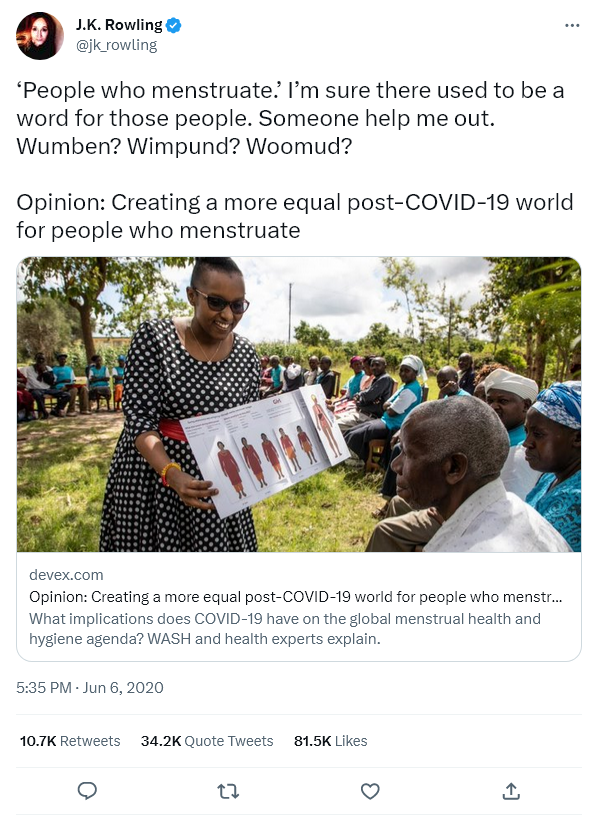
“‘People who menstruate'”, Rowling wrote on Twitter, quoting a headline. “I’m sure there used to be a word for those people. Someone help me out. Wumben? Wimpund? Woomud?”

She continued: “If sex isn’t real, there’s no same-sex attraction. If sex isn’t real, the lived reality of women globally is erased. I know and love trans people, but erasing the concept of sex removes the ability of many to meaningfully discuss their lives. It isn’t hate to speak the truth.”

It’s hard to capture the breadth of the firestorm that followed.

QotD: The divine right of kings

Filed under: Books, Britain, Government, History, Media, Politics, Quotations, USA — Tags: , , , , — Nicholas @ 01:00

The best case for divine right monarchy is the voters’ behavior in a democracy. Unfortunately, the worst case for divine right monarchy is: divine right monarchs.

England’s James I, for instance, was a deeply weird dude. Though he wrote a whole book about his divine right to rule, he kept his weirdness sufficiently in check so as not to alienate his court. Alas, his heir didn’t bother, and we know how that turned out. And so it went with just about any divine right monarch — the more people who actually saw him, the flimsier the theory seemed. History is full of examples of kingdoms “ruled” by insane kings, but not too many of kingdoms thriving when the people knew the king was a lunatic. Feebleminded monarchs are generally kept under lock and key by their courtiers, or they end up Epsteined.

Even democracies once understood this. Pick any 19th century American legislator, for example. As P.J. O’Rourke once said about rock stars, to call one of these guys a drunken, borderline-illiterate pervert just means you’ve read his autobiography. But they knew enough to keep it sufficiently in check around the voters, so that so long as they didn’t actually Chappaquiddick someone, they’d face no repercussions.

Speaking of Chappaquiddick, the Media has always been complicit in the great game of Fool-the-Rubes. They only do it for Democrats now, of course, but that’s the real problem these days: the Media has been doing all this for so long, and so successfully, that they no longer feel the need to bother. Just as Charles I decided to let his freak flag fly because hey, why not, I’m the king, so the Democrat-Media complex went all-in in 2008. You watch these guys — Don Lemon, say, mocking Trump voters as illiterate hicks — and the expression on their face is one of relief. It feels good to finally let it all out, and the more you do it, the better it feels.

Severian, “Rule by Lunatic”, Rotten Chestnuts, 2020-01-29.

February 14, 2023

Are you not a PATRIOT? Do you hate FREEDOM?

I sometimes wonder if any bill ever gets passed in the United States without a catchy acronym anymore. Rob Henderson notes the anti-patriotic PATRIOT act and the anti-freedom FREEDOM act as examples of bills named in a way to almost exactly invert the true purpose of the legislation:

Many fully-grown adults have never developed the ability to think beyond words. Others are keenly aware of how easily people fall for this language game. And tactically exploit this mental weakness.

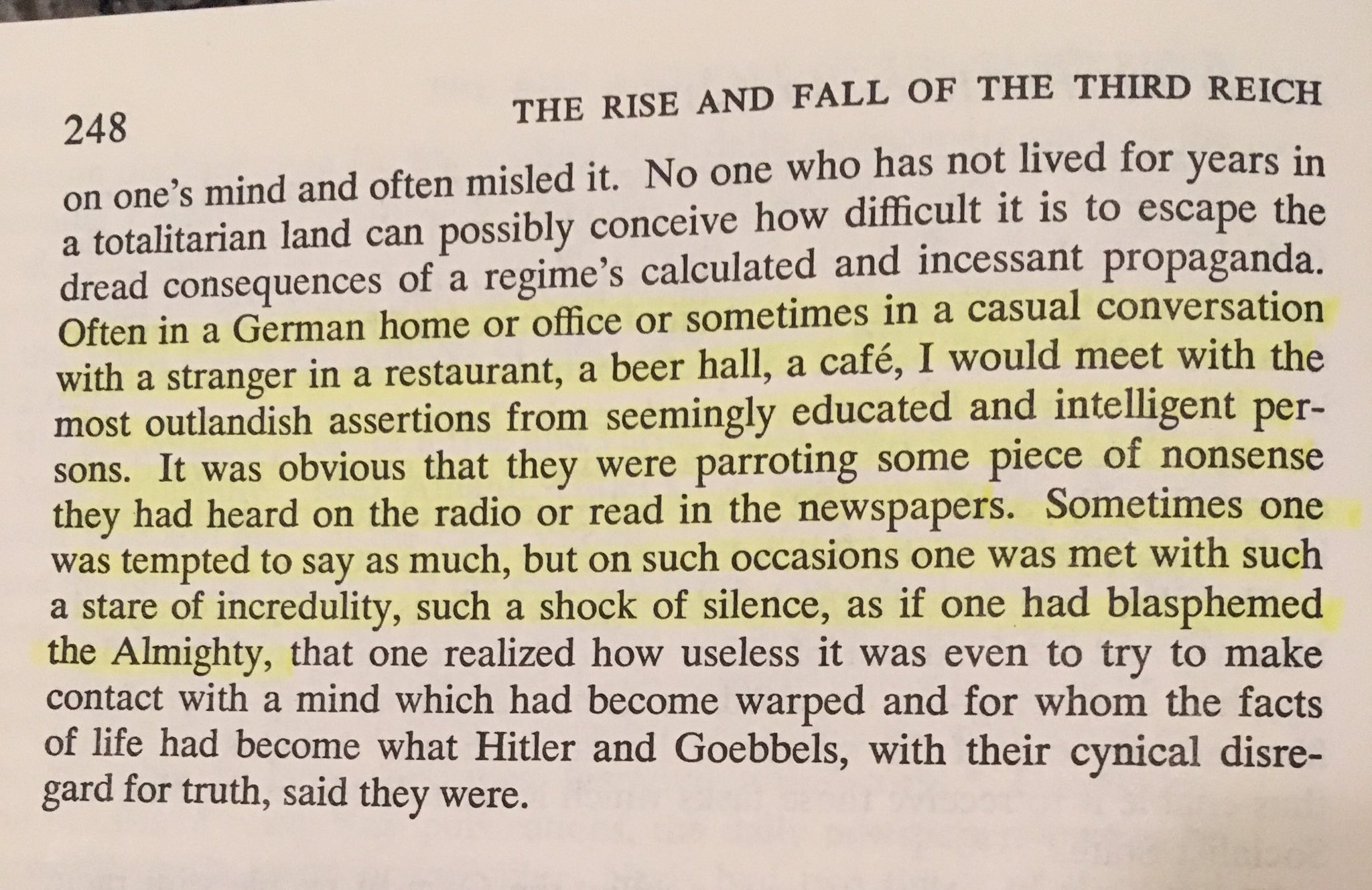
This isn’t a new phenomenon. William Shirer, the American journalist and author of The Rise and Fall of the Third Reich, described his experiences as a war correspondent in Nazi Germany:

The strangest variant of this way of thinking is the belief that just because a word or a term sounds good, the reality behind it is also unquestionably good.

In October of 2001, the Bush Administration famously decided to expand state surveillance. This allowed federal agencies to monitor domestic telephone conversations, online activity, email, and financial records, among other intrusions, without a court order.

And what did they call this decision? The Uniting and Strengthening America by Providing Appropriate Tools Required to Intercept and Obstruct Terrorism Act.

USA PATRIOT Act.

Better known as the PATRIOT Act. And if you were against it, what did supporters say that your criticisms implied?

In June of 2015, the PATRIOT Act expired. The Obama Administration then restored most of the provisions under the title Uniting and Strengthening America by Fulfilling Rights and Ensuring Effective Discipline Over Monitoring Act.

USA FREEDOM.

Better known as the FREEDOM Act. And if you were against it, what did supporters say that your criticisms implied?

There’s a country in which the first three names are “Democratic”, “People’s”, and “Republic”. The first and third words essentially mean the same as the middle — this state belongs to the people, and represents them.

In the modern era, government legitimacy is derived from this concept — representation of the people.

So the name of this particular country basically begins: “Legitimate Legitimate Legitimate”. Officially it known as the Democratic People’s Republic of Korea (DPRK). Sounds like a lovely place. It’s more commonly known as North Korea.

The Soviet Union was officially the Union of Soviet Socialist Republics.

China today is officially known as the “People’s Republic of China”.

Who could be against entities with names containing words like Republic, Democratic, People’s, and Union? They sound so nice. Even socialist is cleverly named — who could be against anything with the word “social” in it?

There’s a violent organization that calls themselves Antifa. Short for antifascist.

There are people who will say with a straight face that if you criticize Antifa, then you are a fascist. Or they will imply that you harbor fascist sympathies.

Interestingly, as William Shirer notes in the book referenced above, Antifa collaborated with the Nazis to help elect Adolf Hitler. Antifa has its origins in Germany, and, as a communist organization, their primary goal was to accelerate the forces of history. Antifa in the 1930s aimed to bring forth the revolution. They partnered with the Nazis to overthrow the Social Democrats who controlled the Weimar Republic. Antifa supporters believed that a fascist regime was a necessary step to end capitalism and usher in a communist utopia.

During this period, fascist was used as an epithet against capitalist society and anyone opposed to communism. They used this term to describe the center-left party in control of the Weimar Republic. As Stalin put it, “Fascism and social democracy are twin brothers, social democracy is only a wing of fascism.”

QotD: Outrage

Filed under: Britain, History, Humour, Politics, Quotations — Tags: , , , — Nicholas @ 01:00

Though they bang on about polyamory, I can’t help thinking that outrage is to this generation what sex was to mine. We used to sneer at Mrs Whitehouse when I was young and snigger that if she had more sex she wouldn’t be so cross all the time. It was a childish response, I know. But I can’t help thinking that if the young of today actually practised their kinks more and wailed for validation of them less, they might cheer up a bit.

Julie Burchill, “The pervert community? Oh please”, Spiked!, 2019-05-08

February 12, 2023

JunkScientific American

Filed under: Media, Politics, Science, USA — Tags: , , , , , — Nicholas @ 05:00

The editors of Scientific American have been steadily injecting more political and progressive content into their traditional coverage of hard scientific topics:

Scientific American magazine has been around since 1845, evolving into a reader-friendly purveyor of hard science, a respected, slightly intimidating denizen of supermarket checkout lines. But judging by the recent ridiculous trend of stories and editorials, it’s been wholly captured by the woke blob.

On the surface the monthly still does what it says on the label in providing long articles, short reviews, and cool photographs for an intelligent audience, with almost-comprehensible stories on the physics of black holes for science buffs, and stunning photos of deep-sea creatures for the rest of us.

But then there’s the ludicrously left-wing ideology that seeps into every issue. A NewsBusters perusal of the contents of each 2022 regular-release monthly issue revealed 34 stories grounded in liberal assumptions and beliefs, nearly three per issue. That’s even after skipping stories with liberal themes that were nonetheless science-based — for example, a cover story on melting glaciers in Antarctica wasn’t included.

Of course, the COVID pandemic in particular tugged the magazine toward government interventionism and the smug rule of health “experts”.

Some of the most bizarrely “woke” material is online-only, with a wider potential reach. The most notorious recent example is a January 6, 2023 opinion piece, cynically seizing on the on-field collapse of a Buffalo Bills player to label the NFL racist: “Damar Hamlin’s Collapse Highlights the Violence Black Men Experience in Football — The “terrifyingly ordinary” nature of football’s violence disproportionately affects Black men“. It’s written by Tracie Canada, who is, no surprise, an assistant professor of cultural anthropology.

So what’s the solution? Surely Canada wouldn’t recommend banning blacks from the National Football League for their own protection?

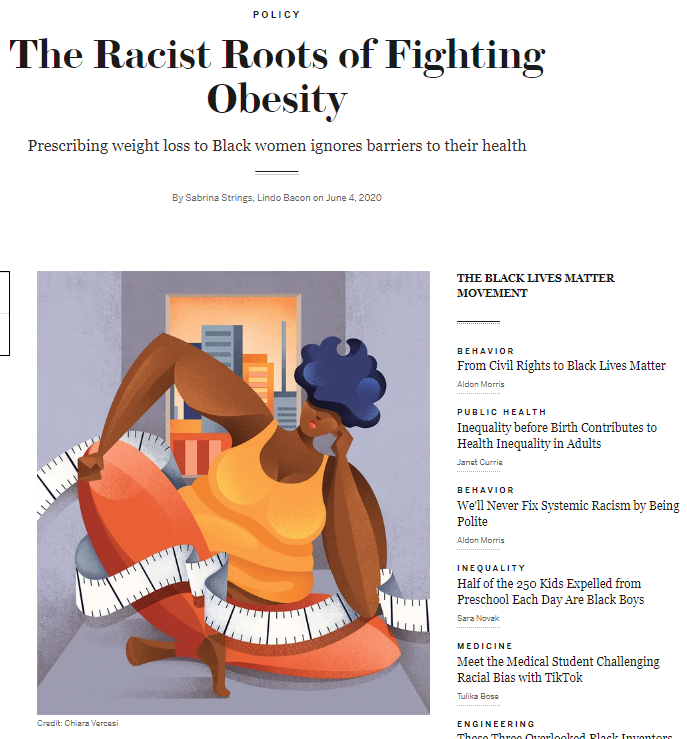
But plenty of bizarre pieces fill the print edition. Here’s a headline from the July 2020 issue of this purported science magazine: “The Racist Roots of Fighting Obesity“. Yet a June 2019 SA article argued that the nation’s “biggest health problem” was obesity. So is Scientific American, for being concerned about obesity, by its own bizarre standard racist as well?

February 11, 2023

QotD: “The rest of philosophy is not, as Alfred North Whitehead would have it, a series of footnotes to Plato … but all secular religions are”

Filed under: Books, Education, Politics, Quotations, Religion — Tags: , , , , , , — Nicholas @ 01:00

Which is why I’m not going to humbug you about “the Classics.” Commanding you to “read the Classics!” would do you more harm than good at this point, because you have no idea how to read the Classics. Context is key, and nobody gets it anymore. Back when, that’s why they required Western Civ I — since all the Liberal Arts tie together, you needed to study the political and social history of Ancient Greece in order to read Plato (who in turn deepened your understanding of Greek society and politics … and our own, it goes without saying). I can’t even point you to a decent primer on Plato’s world, since all the textbooks since 1985 have been written by ax-grinding diversity hires.

And Plato’s actually pretty clear, as philosophers go. You’d really get into trouble with a muddled writer … or a much clearer one. A thinker like Nietzsche, for example, who’s such a lapidary stylist that you get lost in his prose, not realizing that he’s often saying the exact opposite of what he seems to be saying. To briefly mention the most famous example: “God is dead” isn’t the barbaric yawp of atheism triumphant. The rest of the paragraph is important, too, especially the next few words: “and we have killed him.” Nietzsche, supposedly the greatest nihilist, is raging against nihilism.

[…]

So here’s what I’d do, if I were designing a from-scratch college reading list. I’d go to the “for Dummies” versions, but only after clearly articulating the why of my reading list. I’d assign Plato, for example, as one of the earliest and best examples of one of mankind’s most pernicious traits: Utopianism. The rest of philosophy is not, as Alfred North Whitehead would have it, a series of footnotes to Plato … but all secular religions are. The most famous of these being Marxism, of course, and you’d get much further into the Marxist mindset by studying The Republic than you would by actually reading all 50-odd volumes of Marx. “What is Justice?” Plato famously asks in this work; the answer, as it turns out, is pretty much straight Stalinism.

How does he arrive at this extraordinary, counter-intuitive(-seeming) conclusion? The Cliff’s Notes will walk you through it. Check them out, then go back and read the real thing if the spirit moves you.

Articulating the “why” saves you all kinds of other headaches, too. Why should you read Hegel, for example? Because you can’t understand Marx without him … but trust me, if you can read The Republic for Dummies, you sure as hell don’t have to wade through Das Kapital. Marxism was a militantly proselytizing faith; they churned out umpteen thousand catechisms spelling it all out … and because they did, there are equally umpteen many anti-Marxist catechisms. Pick one; you’ll get all the Hegel you’ll ever need just from the context.

Severian, “How to Read ‘The Classics'”, Rotten Chestnuts, 2020-02-13.

February 10, 2023

“What’s happening to children is morally and medically appalling”

Filed under: Health, Politics, USA — Tags: , , , , — Nicholas @ 03:00

In The Free Press, Jamie Reed explains why she gave up her job as as a case manager at The Washington University Transgender Center at St. Louis Children’s Hospital and is now speaking out against the early and aggressive therapeutic treatment of gender-confused children and teens:

Reed in her office. (Theo R. Welling).

Soon after my arrival at the Transgender Center, I was struck by the lack of formal protocols for treatment. The center’s physician co-directors were essentially the sole authority.

At first, the patient population was tipped toward what used to be the “traditional” instance of a child with gender dysphoria: a boy, often quite young, who wanted to present as — who wanted to be — a girl.

Until 2015 or so, a very small number of these boys comprised the population of pediatric gender dysphoria cases. Then, across the Western world, there began to be a dramatic increase in a new population: Teenage girls, many with no previous history of gender distress, suddenly declared they were transgender and demanded immediate treatment with testosterone.

I certainly saw this at the center. One of my jobs was to do intake for new patients and their families. When I started there were probably 10 such calls a month. When I left there were 50, and about 70 percent of the new patients were girls. Sometimes clusters of girls arrived from the same high school.

This concerned me, but didn’t feel I was in the position to sound some kind of alarm back then. There was a team of about eight of us, and only one other person brought up the kinds of questions I had. Anyone who raised doubts ran the risk of being called a transphobe.

The girls who came to us had many comorbidities: depression, anxiety, ADHD, eating disorders, obesity. Many were diagnosed with autism, or had autism-like symptoms. A report last year on a British pediatric transgender center found that about one-third of the patients referred there were on the autism spectrum.

Frequently, our patients declared they had disorders that no one believed they had. We had patients who said they had Tourette syndrome (but they didn’t); that they had tic disorders (but they didn’t); that they had multiple personalities (but they didn’t).

The doctors privately recognized these false self-diagnoses as a manifestation of social contagion. They even acknowledged that suicide has an element of social contagion. But when I said the clusters of girls streaming into our service looked as if their gender issues might be a manifestation of social contagion, the doctors said gender identity reflected something innate.

To begin transitioning, the girls needed a letter of support from a therapist — usually one we recommended — who they had to see only once or twice for the green light. To make it more efficient for the therapists, we offered them a template for how to write a letter in support of transition. The next stop was a single visit to the endocrinologist for a testosterone prescription.

That’s all it took.

When a female takes testosterone, the profound and permanent effects of the hormone can be seen in a matter of months. Voices drop, beards sprout, body fat is redistributed. Sexual interest explodes, aggression increases, and mood can be unpredictable. Our patients were told about some side effects, including sterility. But after working at the center, I came to believe that teenagers are simply not capable of fully grasping what it means to make the decision to become infertile while still a minor.

February 7, 2023

Making Canada’s gun laws more illogical, but appealing to urban Liberal voters, regardless of the political cost elsewhere

Filed under: Bureaucracy, Cancon, Government, Law, Politics, Weapons — Tags: , , — Nicholas @ 05:00

In The Line, Matt Gurney recounts the federal government’s political gyrations over their attempt to ban vast numbers of rifles and shotguns owned by law-abiding Canadians:

Classifying guns is complicated. There are a lot of ways to do it. You can do it by the “action”: is it a pump action? A lever action? Is it semi-automatic, or even fully automatic? You can do it by the length of the total firearm, or the length of just the barrel. You can do it by the caliber of the ammunition. You can do it by the type of magazine the firearm uses, and what its capacity is (the magazine is the compartment, which can be removable or integrated with the firearm, that holds the ammunition). You can try and be targeted with your definitions, or you can just go across the board and say “All rifles are allowed but all handguns are banned.” The point here isn’t to argue what the policy should be, but simply to note that whatever your policy is, you have to be able to define it in a way that makes sense.

Canada’s current gun laws date, more or less, to the 1990s. They’ve been changed a bunch of times since, for better or worse, but that’s when the current overall system of firearms legislation began. We came up with three broad categories of firearm then. There are “non-restricted” firearms, which you must be licensed to own, and mostly mean very typical rifles and shotguns, of which millions of licensed Canadians own many millions. There’s also the “restricted” category, which basically meant handguns — either semi-automatic pistols or revolvers. These require extra licensing, more background checks and training, and are subject to much stricter conditions for storage and use. And then there’s the very rare “prohibited” firearms, which are mostly either very compact handguns, or fully automatic weapons, including machine guns, which were owned by Canadians already when the new laws came in almost 30 years ago. These owners were given a special and highly limited rights to retain the firearms they already owned, but not to transfer them to others, except to someone else with a rare prohibited licence, or to a direct descendent. (That last bit was to cover family heirlooms.)

None of the above is as simple as I’ve just described it. Weird absurdities have been part of the system from the outset. The reason for these absurdities was always political. Back in the 1990s, the Liberals, under then-prime minister Jean Chrétien, realized that the categories above would result in certain kinds of rifle (including the AR-15) being classified as non-restricted, and subject to the least onerous controls. Unhappy with the optics of that, and other similar examples, they wrote in exceptions to the way some firearms are categorized. A firearm would be categorized by its technical specifications unless the government specifically ordered it classified as something else, is probably the easiest way to summarize a complicated policy.

Using the AR-15 again, according to the “evergreen” technical definitions we settled on in the 1990s, that’s a non-restricted gun. To avoid awkward political questions, the then-Liberals deemed it a “restricted” firearm, and therefore subject to tighter controls.

There were other similar examples, and they resulted, as noted above, in a lot of absurdities, with very similar guns categorized differently, but since only a relatively small number of firearms were so specially categorized, the system more or less functioned reasonably well for decades. The absurdities were limited enough to be broadly known and adapted to, and the overall system made enough sense to function coherently enough to do a reasonably good job regulating the sale, ownership and use of firearms in Canada. And very successfully: gun crime by licensed gun owners in Canada is, as is well known, quite rare. The system basically worked, and was working.

[…]

But hey, then politics happened. The sunny ways days ended. Liberal fortunes waned. Scandals and baggage and awkward photos of the PM in his younger days accumulated. And suddenly, the Liberals were talking a lot about banning assault rifles. They talked about it even more after the 2019 election reduced them to a parliamentary minority, leaving them dependent on a cluster of urban and suburban ridings in Quebec and Greater Toronto where support for just about any half-coherent sounding gun-control measure is typically high. The Liberals didn’t do much of anything — mostly just talk, as is their style. Then, in early 2020, there was the horrific massacre in Nova Scotia, and within days, the Liberals announced they were banning 1,500 models of assault rifle. (It was actually far fewer — closer to 20 — but the Liberals counted each different version and brand as an entirely different rifle to get to a more-impressive sounding figure. Those fierce opponents of disinformation at work again!)

Anything even close to meeting a broadly shared definition of “assault rifle” was already banned in Canada, of course — it had been classified “prohibited” back in the 1990s. There’s no universally agreed upon definition of an “assault rifle”, but those who know guns could agree in broad terms what it would mean — and in Canada, they were all banned, and had been for decades. So the Liberals, keen to have their lookin’-tough-and-bold moment, started talking about “assault-style” rifles.

Appending “-style” to anything is a gigantic red flag for bullshit, as I’ve noted here before. That somehow failed to deter them, alas, setting the stage for their current woes.

Disney – An Empire In Collapse

Filed under: Business, Media, Politics, USA — Tags: , , , , , — Nicholas @ 04:00

The Critical Drinker
Published 6 Feb 2023

Disney isn’t looking too healthy these days, with massive financial losses, collapsing stock prices and internal power struggles threatening to tear the House of Mouse apart at the seams. How did this happen? Let’s find out.
(more…)

Big Sky fascism, according to the New York Times

Filed under: China, Media, Politics, USA — Tags: , , , — Nicholas @ 03:00

In The Free Press, Walter Kirn expresses dismay to discover that he’s been living in a “quasi-fascist” state for 30 years and didn’t even notice until the Grey Lady informed him about it recently:

Just a few weeks back, I sat down with my morning coffee, opened up the paper and learned that I now live in a quasi-fascist state. It said so in the paper.

The paper wasn’t a local publication but one from a couple thousand miles away, the New York Times, whose glossy Sunday magazine included a lengthy, illustrated feature with the five-alarm headline How Montana Took a Hard Right Turn Toward Christian Nationalism. To illustrate the state’s alleged swerve toward neo-fascist theocratic rule — a dire development I’d somehow missed — the story included a scary gothic photo, heavily filtered to bring out its dark tones, of a ghostly white cross on a bare hillside reflected in a passing rearview mirror. It also included, of course, a Yellowstone reference and Kevin Costner’s name — right up top, where the search engines would see them.

Since moving to small-town Montana from New York City over 30 years ago, I’d lived through at least a couple of cycles of ominous national coverage of my state. Without going into the details, let me assure you that this article was bunk, as exaggerated as the photo.

But fiction is fact where Montana is concerned, particularly on the country’s coasts, where tales are told about the country’s interior that the country’s interior lacks the clout to counter, much as our guns lack the range to bring down aircraft. Despite our legendary swagger, Montanans are largely helpless against the country’s more powerful forces. The missiles on our prairies aren’t missiles we asked for, just missiles that formidable others wished to plant here. They make us a target, but we don’t control them.

Do I sound defensive? Perhaps I am.

I live in a state with zero big-league sports teams, not a single Fortune 500 corporation, and no national media influence to speak of — unless you count made-up shows about fake ranchers slugging it out in scripted brawls. I’m one of about a million residents, all of whom, no matter their circumstances, are up against the myth-making machines of cities and states of imperial wealth and numbers. And imperial attitudes, dare I say, which emerge in their basic, perennial story about us: those folks from the steppes and mountains are growing restless, including the ones who’ve just moved there to go skiing, who appear to be worse than the ones already living there, who we’ve always found unsettling enough.

When the spy balloon floated across America, the rest of the country got a taste, perhaps, of Montana’s stoic colonial impotence. For days, we could point, but we weren’t allowed to shoot — great-power diplomacy prevented it. Americans may think we’re tough, as Montanans may think they’re tough, but it seems that we’re tough in the way that actors in westerns are: only with the permission of the director, only symbolically. Down went the balloon on Saturday to much applause, but the spectacle was pure cinema by then, like a fistfight on Yellowstone that draws fake blood.

But at least we proud Montanans kept our honor. We spied the lurking villain, we called the sheriff, we warned our neighbors, we did what we could do. I suspect we’ll continue in this role, watchful vigilantes of the skies. There’s trouble afoot – you can feel it everywhere, particularly if you dwell near nuclear missiles, particularly if you live where there’s no cover — and someone has to stand lookout on the hill.

« Newer PostsOlder Posts »

Powered by WordPress