On the social media site formerly known as Twitter, The Little Platoon responds to a lamestream media report on the Amelia phenomenon:
This story was quite funny enough before it got noticed by the rickety old goblin creatures of the mainstream media.
Amelia is not a “purple-haired AI goth girl”, she is a government-created videogame character designed to teach kids that “liking the national flag” and “attending protests where that flag might be seen” makes you a potential terrorist.
That really was the extent of it. The game she comes from is extremely non-specific about the content you’ve been radicalised by. At no point do you think, “yes, I can see why this was terrorist behaviour”.
The actual storyline is not a million miles away from Winston Smith and Julia in Nineteen Eighty-Four.
So the effect is: you have this totally normal opinion that most people have? You’ve been seduced by Amelia and now the Hijabi Hero (IRONY) at Prevent is going to send you to jail.
Amelia hasn’t been “hijacked by the far-right”, she’s just a textbook example of Death of the Author.
The government wanted to have her demonstrate the dangers of online radicalisation. But because this is the British government, they made it seem cool, justified, and you’ll probably get a hot goth girlfriend out of it.
The meme works because Amelia has perfectly normal, mainstream opinions.
She can say “I like pork sausages and dogs”, like roughly 98% of British people, and this will send a certain sort of person — the government, the Anti-Extremism Lead at Generic NGO — into a full-on panic attack.
It’s about the disconnect between the values of the government and those of the people they govern. The joke is that Amelia could ever be considered “Far Right”.
(Ironically, the interviewee in this clip is just as AI-coded as the actual AI clip they play. He’d probably require fewer tokens to generate.)
Meme coins remain extremely cringe, however.
At The Hungarian Conservative, Joakim Scheffer discusses the reaction of the caught-flat-footed mainstream media as their attempts to downplay Amelia’s impact serve to increase interest and attention:
British outlets The Guardian and LBC published strikingly similar articles about Amelia in recent days, both concluding that the purple-haired goth girl, who stands against mass migration and in favour of traditional British values and culture, is, in fact, racist and fuels hatred.
The Guardian introduces Amelia as a girl “who proudly carries a mini Union flag and appears to have a penchant for racism“, before lamenting the “plethora of increasingly sophisticated AI-generated iterations” of her, including “real-life” encounters between Amelia and movie characters, “accompanied by racist language and far-right messaging”.
Since her “birth”, Amelia has indeed become increasingly popular. From an average of around 500 posts a day when she was first introduced, the figure rose to roughly 10,000 daily posts starting on 15 January, when the meme broke through to international audiences. Amelia has since reached the highest levels of the right-wing internet ecosystem, even being reposted by Elon Musk himself.
Comments Off on “The meme works because Amelia has perfectly normal, mainstream opinions”
There’s a long-running argument over whether Heinlein’s book describes military service as the exclusive path to citizenship, or if “federal service” is a much broader basket of enfranchisement. While a close read of the book makes it unquestionably clear which is correct, it misses the greater point. Heinlein was writing about the role of civic virtue in the stability of a republic, his citizenship-through-service framing is the literary conceit for discussing that larger question.
For a more detailed examination of the nature of Federal Service, I recommend James Gifford’s essay on the subject: https://www.nitrosyncretic.com/rah/ft…
00:00 Intro
00:45 What is Federal Service?
02:18 An Exploration of Enfranchisement
03:13 Expanded Universe
05:38 But Why?
06:59 Starside R&D
09:07 “Unreasonable Facsimile”
10:54 Filtering Civic Virtue (more…)
Comments Off on Starship Troopers: Service Isn’t The Point
On the social media site formerly known as Twitter, Eric Schwalm talks about the organized nature of the Minneapolis protests and points out how much work it takes to set up and run:
“No Kings, No ICE” protest on Hennepin Avenue in Minneapolis, Minnesota on 23 January, 2026. Photo by Myotus via Wikimedia Commons.
As a former Special Forces Warrant Officer with multiple rotations running counterinsurgency ops — both hunting insurgents and trying to separate them from sympathetic populations — I’ve seen organized resistance up close. From Anbar to Helmand, the pattern is familiar: spotters, cutouts, dead drops (or modern equivalents), disciplined comms, role specialization, and a willingness to absorb casualties while bleeding the stronger force slowly.
What’s unfolding in Minneapolis right now isn’t “protest”. It’s low-level insurgency infrastructure, built by people who’ve clearly studied the playbook.
Signal groups at 1,000-member cap per zone. Dedicated roles: mobile chasers, plate checkers logging vehicle data into shared databases, 24/7 dispatch nodes vectoring assets, SALUTE-style reporting (Size, Activity, Location, Unit, Time, Equipment) on suspected federal vehicles. Daily chat rotations and timed deletions to frustrate forensic recovery. Vetting processes for new joiners. Mutual aid from sympathetic locals (teachers providing cover, possible PD tip-offs on license plate lookups). Home-base coordination points. Rapid escalation from observation to physical obstruction — or worse.
This isn’t spontaneous outrage. This is C2 (command and control) with redundancy, OPSEC hygiene, and task organization that would make a SF team sergeant nod in recognition. Replace “ICE agents” with “occupying coalition forces” and the structure maps almost 1:1 to early-stage urban cells we hunted in the mid-2000s.
The most sobering part? It’s domestic. Funded, trained (somewhere), and directed by people who live in the same country they’re trying to paralyze law enforcement in. When your own citizens build and operate this level of parallel intelligence and rapid-response network against federal officers — complete with doxxing, vehicle pursuits, and harassment that’s already turned lethal — you’re no longer dealing with civil disobedience. You’re facing a distributed resistance that’s learned the lessons of successful insurgencies: stay below the kinetic threshold most of the time, force over-reaction when possible, maintain popular support through narrative, and never present a single center of gravity.
I spent years training partner forces to dismantle exactly this kind of apparatus. Now pieces of it are standing up in American cities, enabled by elements of local government and civil society. That should keep every thinking American awake at night.
Not because I want escalation. But because history shows these things don’t de-escalate on their own once the infrastructure exists and the cadre believe they’re winning the information war.
We either recognize what we’re actually looking at — or we pretend it’s still just “activism” until the structures harden and spread.
Your call, America. But from where I sit, this isn’t January 2026 politics anymore. It’s phase one of something we’ve spent decades trying to keep off our own soil.
On his Substack, Glenn Reynolds points out that the “protests” are serving to distract attention away from state and local officials’ role in enabling massive fraud rings in Minnesota which reportedly scored billions of federal dollars for phantom organizations:
This image depicts a similar action by the Trusts at the turn of the last century. (Library of Congress).
The squid was frightened, so we got the ink: Increasingly violent “protests”-cum-riots explicitly aimed at blocking ICE operations with the stated goal of forcing federal authorities out of Minnesota entirely, while generating maximum media attention.
These are not spontaneous uprisings of the aggrieved, but organized actions featuring out-of-state actors and organizations, detailed training programs for demonstrators, and large amounts of intentionally murky funding from organizations like Indivisible, George Soros’ Open Society Foundations and others.
They’re coordinating their anti-ICE operations — identifying, chasing and blocking agents to keep them from arresting illegal-immigrant criminals — through highly organized chat groups on Signal, a secure communications platform, Fox News reported.
And Minnesota government officials are proudly touting their involvement in this coordination.
Sen. Bernie Sanders made much of Lt. Gov. Peggy Flanagan’s role in a fundraising email this weekend, praising her for “playing a key role in mobilizing grassroots opposition to Trumpism”.
That’s making these often violent, deliberately obstructive demonstrations look less like a civil rights sit-in and more like a government-backed insurrection.
Tragically, this aggressive and confrontational strategy has produced martyrs who can now be exploited for political purposes.
“Two things can be true at the same time,” Fox News’ Asra Nomani posted Monday.
The death of Alex Pretti, the armed demonstrator who got into a fatal tussle with ICE agents Saturday, “is a real and devastating tragedy, and there are several investigations appropriately occurring into the circumstances behind his killing”.
But also, “A far-left organizing network put Pretti in harm’s way and then turned him into a martyr … to sow the perception of chaos in America”.
Whatever investigators determine about how Pretti’s death unfolded, the fact remains that a cynical and corrupt political machine has fostered for its own purposes a situation that’s dangerous for its own supporters, and for the political future of our nation.
Comments Off on Minneapolis – protest, insurrection, or massive distraction?
On the social media site formerly known as Twitter, A View From Yorkshire points out that the media coverage of the Amelia phenomenon often leaves the audience with the impression that Amelia was created by some far right extremists, which clearly isn’t true:
Let’s nuke the myth properly.
Amelia was not “created by the far-right”.
She was created by the British state, funded by taxpayers, in a government-approved anti-extremism game for teenagers.
Her crime?
Questioning mass migration.
Talking about British values.
Suggesting borders, culture and continuity might matter.
In other words: centre-right, mainstream opinions held by millions of normal people.
The media response?
SCREAMING, CRYING, THROWING UP:
“FAR-RIGHT!”
“RACISM!”
“DISINFORMATION!”
Even the game’s own creators admit the game does not say questioning mass migration is wrong — yet journalists still foam at the mouth like Pavlov’s interns because the spell didn’t work.
Here’s the truth they hate:
Amelia didn’t get radicalised.
She got recognised.
People saw a perfect accidental parody of how the establishment treats ordinary dissent:
If you question orthodoxy, you’re not wrong — you’re dangerous.
If you wave a Union Jack, you’re not patriotic — you’re extreme.
If you ask questions, you need monitoring.
So people did what the internet always does when power looks stupid:
They laughed.
They memed.
They stripped the moral panic naked.
Now we’re told there’s a “highly coordinated hate network” behind it all.
Sure. Or maybe — stay with me —
people are done being lectured by institutions that despise them.
A cartoon goth girl didn’t expose extremism.
She exposed how fragile the narrative really is.
If a meme breaks your ideology,
your ideology was already on life support.
The Amelia memes do seem to be getting under the skin of certain members of the government:
Amelia is a girl of many talents:
Epochalypse
Published 24 Jan 2026
An absolutely beautiful song covered by Amelia ❤️
A UK anti-extremism educational game called Pathways, faced significant public and media backlash.
The game, developed by SOUK in coordination with the Hull City Council and East Riding of Yorkshire Council, was designed to educate students about the dangers of online radicalization.
How the Game Backfired
Antagonist’s Popularity: The game’s primary antagonist, a teenage girl with purple hair named Amelia who held nationalist views, was intended as a cautionary figure. However, she was ironically embraced by some online communities and became a viral meme, with users finding her “goth baddie” design and character more interesting and relatable than the non-binary protagonist, Charlie.
Criticism of Content: The game was widely criticized by media outlets, including The Telegraph and The Spectator, as “clumsy” and “overtly manipulative”. Critics argued that the game effectively suppressed free speech by suggesting characters who questioned immigration policies should be reported under the UK government’s “Prevent” counter-terrorism strategy.
Portrayal of “Research”: The game’s narrative structure suggested that “researching” information online could be harmful, as it might lead to “intaking a lot of harmful, ideological messages”, which also drew criticism.
Ultimately, the attempt to create an effective anti-extremism tool had the opposite effect in many online circles, with its intended villain becoming an ironic symbol for anti-illegal immigration sentiment.
#amelia #pathways #memes #patriotism
Kimberly Steele disgrees with the characterization of Amelia as a “tulpa” (which I think I first saw advanced by John Carter at Postcards From Barsoom) and argues that she’s actually an “egregore” instead:
Amelia crossing paths with Harry Potter and the gang, very appropriate for this essay
In rides fantasy Amelia to the rescue, a digital Joan of Arc to galvanize the lumpen male proletariat into action against leftist groupthink oppression. Her flame burns hotter than the tradwife because she is not a deferential, docile, opinionless mirage waiting for her man to do all the the heavy lifting. Instead of modeling crusty tropes from the 1950s in a housedress, she mouths off to Mohammed in a miniskirt. She champions sensible norms that middle aged people like me took for granted back in the day. She is an advocate of schoolgirls being able to walk down the streets of Liverpool without being acid attacked or drug into fenced areas to be assaulted. She suggests Britain is for the British and that it should not be handed over to the same hordes that have been trying to overrun it since before the Middle Ages. She suggests that men on all sides rise up and outgrow Puer Aeternis — to the invaders, she insists that they cease their infantile dependence routines and go back and fight for their own country on their own soil. To the white native islanders, she suggests they grow a set and defend their nation while it still stands. Nothing that Amelia wants or espouses is extreme. She is a middle-of-the-road pundit who could run for office on a moderate platform (or what used to be considered moderate in my day before everything in the middle was categorized as far-right) and win. She’s not exactly Hitler, no matter what the leftie pearl clutchers claim.
If only she was real. Amelia has been called a tulpa, which is a Buddhist term for a thoughtform that is forced into existence and made to do tasks, much like a Jewish golem without the clay and awkwardness. I don’t think Amelia is a tulpa. She is nobody’s bitch and she was not created on purpose. Instead, Amelia is an egregore. Imagine your old school mascot was a giant, anthropomorphized tiger. Perhaps there was a person who dressed up as a big, striped cat for games every now and then. Now imagine that your mascot became extremely popular across the world and every sports team adopted him as their mascot too. Now imagine that your big tiger began appearing randomly in the nightly dreams of people who were very into sports, and then after a few years, non-sports fans. Tiger fan fiction was inspired by the egregore. Tons of giant tiger merch was sold both at games and in regular stores. Imagine if chick lit writers wrote ghastly bestiality porn about the giant tiger, and entire genres of tiger man erotica bubbled up online. You would begin to think perhaps there was consciousness behind the tiger man image, and if you did think such odd things, traditional occultists would take your side of the conspiracy theory.
An egregore is a shared image that gains its own consciousness. Any given novel’s character is essentially alive, gaining his/her/it’s own consciousness, ego, and world. […]
Amelia says what men cannot say, and it is good because she does it in a way that is unsquelchable and eternal. She is bad because she is yet another symptom of provisional living. On the plus side, she makes toxic liberal women super mad because unlike a real girl, they cannot tear her down or cast her out of the longhouse/take her ability to make a living away in order to force her compliance. She highlights all of their shortcomings without having to try, and that is why she will have much hate projected upon her. Their evil eyes gaze into the digital mirror. This force may be enough for them to completely self-destruct, given enough time and distance.
There are some men who see Amelia as some kind of savior. If you are one of them, let me assure you she is not going to save anyone any more than Pepe the Frog. If you want to save and be saved, please go outside. Be with the sky and the trees, and don’t feel you have to pick up a fishing pole, soccer ball, or a toolbox to be out there. When you do come back inside, instead of turning on the dopamine drip and immersing yourself in the antics of fantasy girlfriends or dreaming about invading Haiti, please use the internet to learn manly skills. My husband, whose father was largely absent before he divorced my husband’s mother when my husband was 12, taught himself nearly all of his considerable skills via books and the internet. If you are a visual learner, the internet holds a treasure trove of knowledge. For those would be warriors who are not currently serving or who will never serve in the armed forces, please go out and defend real girls on the streets from the monsters, creeps, and traffickers who make it impossible to feel safe as a female. Where are the men willing to watch the streets and to at least threaten various immigrant scum with retribution for their terrible behavior? Where are the volunteer neighborhood patrols that ensure women and children can walk to and from school without being harassed? In the stranger danger/Satanic Panic 80s, we had a thing called Neighborhood Watch where you would put a blue star in your window so any little kid who felt threatened could knock on the door and find a safe house. Where are the blue stars? Where are the boys with baseball bats? Go out there and defend your country. Do it for Amelia.
Update, 28 January: Welcome, Instapundit readers! Have a look around at some of my other posts you may find of interest. I send out a daily summary of posts here through my Substack – https://substack.com/@nicholasrusson that you can subscribe to if you’d like to be informed of new posts in the future.
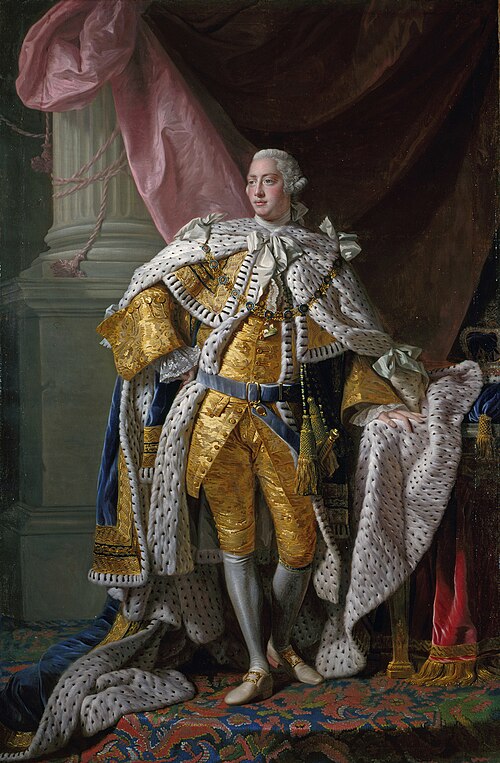
His most rabid fans liked to call him the God-Emperor, but Andrew Sullivan sees him much more as a modern King George III:
King George III in his Coronation robes. Oil painting by Allan Ramsay (1713-1784) circa 1761-1762. From the Royal Collection (RCIN 405307) via Wikimedia Commons.
It is where lies and truth are entirely interchangeable; where the rule of law has already been replaced by the rule of one man; where the Congress has abdicated its core responsibilities and become a Greek chorus; where national policy is merely the sum of the whims and delusions of one man; and where every constitutional check on arbitrary power, especially the Supreme Court, is AWOL. In that abyss, even an attempt to explain events through the usual rubric of covering a liberal democracy is absurd. Because that rubric is irrelevant.
And so the wheels spin.
The only honest way to describe what is in front of our noses is that we now live in an elected monarchy with a manic king whose mental faculties are slipping fast. After 250 years, we appear to have elected the modern equivalent of King George III, and are busy dismantling the constitution Americans built to constrain him.
The situation is not irrecoverable — the forms of democracy remain even if they are functionally dead. We have centuries of democratic practice to fall back on. But every moment the logic of the abyss holds, the possibility of returning to democracy attenuates. Tyranny corrupts everything and everyone — fast. David Brooks returns to the ancients today to understand where we are:
As the disease of tyranny progresses, citizens may eventually lose the habits of democracy — the art of persuasion and compromise, interpersonal trust, an intolerance for corruption, the spirit of freedom, the ethic of moderation. “It is easier to crush men’s spirits and their enthusiasm than to revive them,” Tacitus wrote. “Indeed, there comes over us an attachment to the very enforced inactivity, and the idleness hated at first is finally loved.”
Forty percent of the country still backs the tyrant. Forty percent watch this and cheer.
Let us briefly review what they are cheering. For the first time since the Second World War, the president of the United States declared last week that we no longer support the notion of national sovereignty or collective security, and reserve the right to invade and occupy other sovereign countries — even close allies — to extract their resources. Quite a Rubicon. His chief adviser declared international law a dead letter:
[W]e live in a world, in the real world … that is governed by strength, that is governed by force, that is governed by power. These are the iron laws of the world since the beginning of time.
To put it bluntly, this was the argument of King George III. It was the justification for the British Empire, and, more hideously, for the Nazi and Soviet occupations of Europe. It’s a rejection of the principle that literally created the United States.
And yet this mad king threw this founding principle away because he believes a) we deserve Greenland as reparations for World War II, b) because Russia and China would invade otherwise, c) because rare earths are there — even though they are buried under a mile of ice — and d) because he didn’t win the Nobel Prize. Insane.
This staggering concession to evil — which cannot be withdrawn — robs us of any case against Russia’s invasion of Ukraine or China’s threat to Taiwan. It legitimizes war by major powers for conquest everywhere. It endangers the entire system of collective security that has kept the peace for nearly 80 years. Why? And for what? Because the king was on a high.
[Progressives] did it in two stages. First, they convinced us that process and outcome are the same thing … and when the chips are down, process is better than outcome. Everyone knows the old saying “Those who can’t do, teach”. It was originally coined to make fun of this tendency, but look how that worked out. At the conceptual level, the Left wins because they make moral arguments, but at the practical level, how do they win?
Because they talk. Constantly. They never, ever shut up. Most Leftists in my life — and in yours too, I guarantee — never do anything. We all know that the Left take zero interest in their communities. They don’t donate to charity. Let’s say one of those late April blizzards hits and their driveway is snowed in. While everyone else is breaking out the shovels one last time, the Leftist’s natural impulse is to jump on Twitter and start petitioning Congress for some giant, trillion-dollar snow removal bill. It has to have set-asides for Diversity quotas, of course, and isn’t the word “removal” triggering? And so forth, until the snow melts. Hey, problem solved!
I’m kidding, but I’m not joking. Leftists are process people par excellence. Even Stalin won that way, 99% of the time — even though he could have had the entire Politburo shot with a snap of his fingers, he got his way by grinding them down, meeting after meeting after endless meeting. Yes, eventually someone has to actually do something, but that someone isn’t going to be them; it’ll be some toady somewhere, who is only working as hard as he has to in order to get promoted up the totem pole, so that he’s the one in meeting after endless meeting, forever discussing, never doing.
This reaches its apotheosis (apocolocyntosis!) in Twitter, and do you see what I mean? For the Left, tweeting about something is exactly the same as, if not better than, actually doing anything about it. Look around: we’re about to get into WWIII because of this. And speaking of missiles flying, we’ve all remarked on the Left’s signature “fire and forget” policy approach. To them, words are magic — healthcare, for instance, is now Affordable. How can it not be? It says “Affordable Care Act“, right there in the title! Don’t start in with your facts and figures, please — it’s Affordable, damn it! What part of “Affordable Care Act” don’t you understand?
He who talks the loudest and longest, therefore, is the purest.
Combine that with the second step for maximum effect: Emotional incontinence. Just as talking is the same as (better than!) doing, so emotion equals competence. She who feeeeeeels the strongest about an issue wins. This, too, has been obvious for a long time, so much so that Jonah Goldberg, of all people, had a good bit on it back when he was still somewhat convincingly playing a conservative. He joked about how stupid it was to be preoccupied with caring in practical life. Who would you rather have cut that tumor out, your best buddy — who really, really, really cares — or a brain surgeon? Even an utterly dispassionate one, to whom you are nothing more than a slab of meat?
Again, and always: see Twitter. Maximum talk, maximum hysteria, always. I’m belaboring this because in our tabloid-culture society, the identification is complete: The all-talk hysteric is the brahmin; screaming about how much you care just IS morality. Never mind that your caring affects nothing in the best case scenario; worst case it ends up killing people (e.g. the Blue Checkmarks tweeting us into WWIII).
On Substack, Celina101 provides examples of Australian Aborigine behaviour vastly at odds with the progressive belief in the “noble savage” myths:
For decades a rosy and romanticised narrative has prevailed: pre-contact Aboriginal Australia was a utopian paradise, and British colonists the only villains. Yet, the historical record painstakingly chronicled by scholars like William D. Rubinstein and Keith Windschuttle, tells a far more complex, often brutal story. This article examines how politically charged revisionism has whitewashed practices such as infanticide, cannibalism and endemic violence in traditional Aboriginal societies. It also warns that distorting history for ideology does a disservice to all Australians, especially Anglo-Australians who have been bludgeoned over the head with it.
The Noble Savage in Modern Narrative
Many contemporary accounts frame Aboriginals as the ultimate “noble savages”, a peaceful, egalitarian people living in harmony with nature until the arrival of the cruel evil British colonists. Textbooks, media and some activists repeatedly emphasise colonial wrongs while glossing over pre-contact realities. But historians like William D. Rubinstein challenge this rosy picture. Rubinstein bluntly notes that, in contrast to other civilisations that underwent the Neolithic agricultural revolution, Aboriginal society “failed … to advance in nearly all significant areas of the economy and technology” for 65,000 years. In his words, pre-contact Aboriginal life was “65,000 years of murderous, barbaric savagery“. This harsh summary confronts the myth head-on: it implies that life before colonisation was not idyllic, but marked by entrenched violence and brutality.
The danger of the noble-savage myth, Rubinstein argues, is that it inverts history. By idealising and practically lying [about] Aboriginal society, modern narratives often cast settlers as uniquely evil. In one essay he warns that contemporary inquiries (like Victoria’s Yoorrook Commission) are “defined to ascribe all blame to the impact of colonialism, rather than the persisting deficiencies in traditional Aboriginal society“. Ignoring those “gross, often horrifying, shortcomings” in Aboriginal culture, Rubinstein says, can only produce “findings written in the ink of obfuscation and deception“. In short, to truly understand Australia’s past we must examine it dispassionately, acknowledging human failings on all sides, not just one.
Documented Brutalities in Pre-Contact Society
Early observers and anthropologists left abundant evidence that some pre-colonial Aboriginal practices were brutal by modern standards. The selective amnesia about these practices in progressive narratives is striking. For example, infanticide (the intentional killing of newborns) was a widespread means of population control in traditional Aboriginal tribes. University of Michigan anthropologist Aram Yengoyan estimated that infanticide “could have been as high as 40% to 50% of all births … In actuality [it] probably ranged from 15% to 30% of all births“. In practice, this meant large numbers of healthy babies, especially girls, were deliberately killed to cope with limited resources. Babies up to a few years old who fell ill or were deemed surplus were often strangled or left to die. This grim truth is rarely mentioned in schools or media today. According to Rubinstein, it was “ubiquitous” in Australia prior to Western influence.
Several anthropological accounts describe cannibalism of infants and small children in some regions. For instance, an 19th-century observer on the northern coast reported: “Cannibalism is practised by all natives on the north coast … Only children of tender age – up to about two years old, are considered fit subjects for food, and if they fall ill are often strangled by the old men, cooked, and eaten… Parents eat their own children … young and old, [all] partake of it.” (In this passage, even adults were implicated in rare cases: two lost Europeans were reportedly killed and eaten by a tribe in 1874.) Such accounts are shocking, yet they were recorded by colonial-era missionaries and explorers. Today’s activists tend to dismiss or deny them entirely.
Comments Off on Mythologizing Australia’s “noble savages”
In a novel about political radicalism you might expect the ideas to take center stage, but here they’re treated as pure comic relief (if you’ve read The Man Who Was Thursday, the vibe is very similar). The guy who wants to kill all of humanity and the guy who wants to enslave all of humanity have some seriously conflicting objectives (and don’t forget the guy who just wants to kill himself and the guy who refuses to say what his goal is), yet they all belong to the same revolutionary society. The leader of their society takes it to an extreme, he has no specific ideas at all. His political objectives and philosophical premises are literally never mentioned, by him or by others. What he has is boundless energy, an annoying wheedling voice,1 and an infinite capacity for psychological cruelty. But all these impressive capacities are directed at nothing in particular, just at crushing others for the sheer joy of it,2 at destruction without purpose and without meaning.
Does that seem unrealistic? That ringleader was actually based on a real life student revolutionary named Sergey Nechayev, whose trial Dostoevsky eagerly followed. Nechayev wrote a manifesto called The Catechism of a Revolutionary, here’s an excerpt from that charming document:
The revolutionary is a doomed man. He has no personal interests, no business affairs, no emotions, no attachments, no property, and no name. Everything in him is wholly absorbed in the single thought and the single passion for revolution … The revolutionary despises all doctrines and refuses to accept the mundane sciences, leaving them for future generations. He knows only one science: the science of destruction … The object is perpetually the same: the surest and quickest way of destroying the whole filthy order … For him, there exists only one pleasure, one consolation, one reward, one satisfaction – the success of the revolution. Night and day he must have but one thought, one aim – merciless destruction.
The ideas don’t matter, because at the end of the day they’re pretexts for desires — the desire to dominate, the desire to obliterate the world, the desire to obliterate the self, the desire to negate.3 Just as in their parents’ generation the desire for status came first and wrapped itself in liberal politics in order to reproduce and advance itself, so in their children the desire for blood and death reigns supreme, and the radical politics serve only as a mechanism of self-justification and a lever to pull. This is not a novel about people, and it’s also not a novel about ideas. It’s a novel about desires, motives, urges, and the ways in which we construct stories to make sense of them.
To Dostoevsky’s own surprise, when he wrote the main bad guy of the story, he turned out a very funny, almost buffoonish figure. He may be the most evil person in literature who’s also almost totally comic.
Dostoevsky is notorious for dropping hints via the names of his characters — applied nominative determinism — and this one’s name means something like “supremacy”.
I am the spirit that negates
And rightly so, for all that comes to be
Deserves to perish wretchedly;
‘Twere better nothing would begin.
Thus everything that your terms, sin,
Destruction, evil represent —
That is my proper element.
Comments Off on QotD: Dostoevsky’s views on revolutionaries in Demons
On his Substack, Fergus Mason talks about the new Queen of English Resistance, Amelia:
Amelia, the new queen of the British right.
Independent journalism is a pretty grim business right now. Writing about the state of our poor broken country can be soul-destroying. Good news is thin on the ground; new calamities seem to arrive daily, either a fresh atrocity committed by an illegal immigrant or some new Labour assault on our freedom. So it’s nice when something a little more light-hearted comes along — even if it does make some serious points, too.
A couple of weeks ago the media started reporting a new online game funded by Prevent, the government’s (completely dysfunctional) department for diverting people away from extremism. Commissioned by Hull City Council and produced by “creative social enterprise” Shout Out UK, the game — called Pathways — is intended to “Encourage learning about the concept of extremism and radicalisation through the process of choice and safe exploration”.
As games go, this is a spectacularly dull one. Players choose a character, from a very limited selection — there are two, one male and one female, but they’re both called Charlie and use they/them pronouns. They then have to navigate their character through a series of scenarios, answering multiple-choice questions. The idea is that if you give the “wrong” answers you’ll get referred to Prevent, but it soon becomes obvious that almost any answers will get you referred to Prevent. The constant theme is that there are approved views and ways of acting — which don’t, for example, include doing research to find out if something you saw on the internet is true or not — and that, if you deviate from this, the state will step in to “support” you. A lot of this support looks suspiciously like re-education:
[…]
Of course, if you know much about the online right, you’ll probably see the problem already. As one stunned Reddit user commented, “Wait, are you telling me they made the cute goth e-girl the ‘racist’? Do they understand how the internet works?”
Well, they certainly do now.
The Daily Telegraph published an article about Pathways on 9 January, bringing the game to public notice. That same day, X user Bovril-Gesellschaft posted “I think I’m in love with Amelia”. It seemed many other right-wingers were too, because within hours Amelia memes were appearing in large numbers. Mostly produced with AI, these depicted Amelia in a wide range of styles (probably reflecting their creators’ personal tastes), but all featured her purple hair and most stuck with the outfit of a pink dress and purple hoodie or cardigan the game depicted her in. Images ranged from cartoons in the style of the original game to photorealism. […]
There’s a lot to laugh about in this. For example, brightly coloured “danger hair” has generally been the hallmark of women on the far left. Amelia subverts this by giving our new heroine her distinctive purple bob. Will we see the pro-Hamas nuts and trans cultists abruptly return to natural hair colours to dissociate themselves from Amelia? That would be funny.
On Substack, Maninder Järleberg illuminates the problem of functional illiteracy in higher education in the west:
The Age of Functional Illiteracy
Functional illiteracy was once a social diagnosis, not an academic one. It referred to those who could technically read but could not follow an argument, sustain attention, or extract meaning from a text. It was never a term one expected to hear applied to universities. And yet it has begun to surface with increasing regularity in conversations among faculty themselves. Literature professors now admit — quietly in offices, more openly in essays — that many students cannot manage the kind of reading their disciplines presuppose. They can recognise words; they cannot inhabit a text.
The evidence is no longer anecdotal. University libraries report historic lows in book borrowing. National literacy assessments show long-term declines in adult reading proficiency. Commentators in The Atlantic, The Chronicle of Higher Education, and The New York Times describe a generation for whom long-form reading has become almost foreign. A Victorian novel, once the ordinary fare of undergraduate study, now requires extraordinary accommodation. Even thirty pages of assigned reading can provoke anxiety, resentment, or open resistance.
It would be dishonest to ignore the role of the digital world in this transformation. Screens reward speed, fragmentation, and perpetual stimulation; sustained attention is neither required nor encouraged. But to lay the blame solely at the feet of technology is a convenient evasion. The crisis of reading within universities is not merely something that has happened to the academy. It is something the academy has, in significant measure, helped to produce.
The erosion of reading was prepared by intellectual shifts within the humanities themselves—shifts that began during the canon wars of the late twentieth century. Those battles were never only about which books should be taught. They were about whether literature possessed inherent value, whether reading required discipline, whether difficulty was formative or oppressive, and whether the humanities existed to shape students or merely to affirm them. In the decades that followed, entire traditions of reading were dismantled with remarkable confidence and astonishing speed.
The result is a moment of institutional irony. The very disciplines charged with preserving literary culture helped undermine the practices that made such culture possible. What we are witnessing now is not simply a failure of students to read, but the delayed consequence of ideas that taught generations of readers to approach texts with suspicion rather than attention, critique rather than encounter.
This essay is part of a larger project to trace that history, to explain how a war over the canon helped usher in an age in which reading itself is slipping from our grasp, and why the consequences of that war are now returning to the academy with unmistakable force.
The Canon Wars: A Short Intellectual History
To understand the present state of literary studies, one must return to the canon wars of the 1980s and 1990s — a conflict that reshaped the humanities with a speed and finality few recognised at the time. Although remembered now as a dispute about which books deserved a place on the syllabus, the canon wars were in truth a contest over the very meaning of literature and the purpose of a humanistic education.
In the decades after the Second World War, the curriculum in most Western universities still rested upon a broadly shared assumption: that certain works possessed enduring value, that they spoke across time, and that an educated person should grapple with them. This conviction, however imperfectly applied, formed the backbone of the humanities. It was also increasingly at odds with a new intellectual climate shaped by post-1968 radicalism, the rise of identity politics, and the importation of French theory.
By the early 1980s, tensions that had simmered beneath the surface erupted into public view. The most emblematic flashpoint came at Stanford University in 1987–88, when student demonstrators chanted, “Hey hey, ho ho, Western Culture’s got to go!” in protest of the university’s required course on Western civilisation. The course was soon dismantled, replaced by a broader, more ideologically framed program. What happened at Stanford quickly reverberated across the country. Departments revised reading lists, restructured curricula, and abandoned long-standing core requirements.
On one side of the debate stood defenders of the canon—figures such as Harold Bloom, Allan Bloom, E.D. Hirsch, and Roger Kimball—who argued that the great works formed a kind of civilisational inheritance. The canon, they insisted, was not a museum of privilege but a record of human striving, imagination, and achievement. On the other side were scholars like Edward Said, Toni Morrison, Henry Louis Gates Jr., Gayatri Spivak, and Homi Bhabha, who contended that the canon reflected histories of exclusion and domination, and that expanding or dismantling it was a moral imperative.
But beneath these arguments lay a deeper philosophical rift. The defenders assumed that literature possessed intrinsic value, that texts could be read for their beauty, their insight, or their power. The critics, armed with concepts drawn from Foucault, Derrida, and Barthes, argued that literature was inseparable from structures of power, that meaning was unstable, and that reading was less an act of discovery than an exposure of hidden ideological operations.
The canon wars ended not with a negotiated peace but with a decisive transformation. The traditional canon was not merely expanded; its authority was dissolved. And with it dissolved a set of shared assumptions about why we read at all.
Comments Off on “Functional illiteracy was once a social diagnosis, not an academic one”
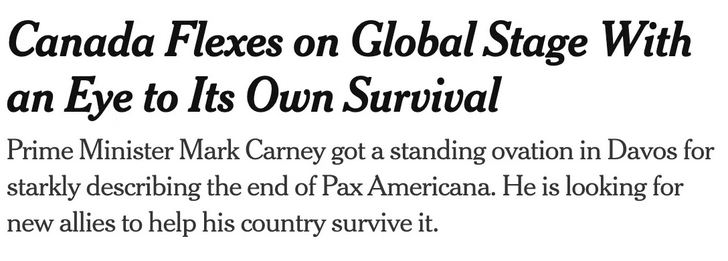
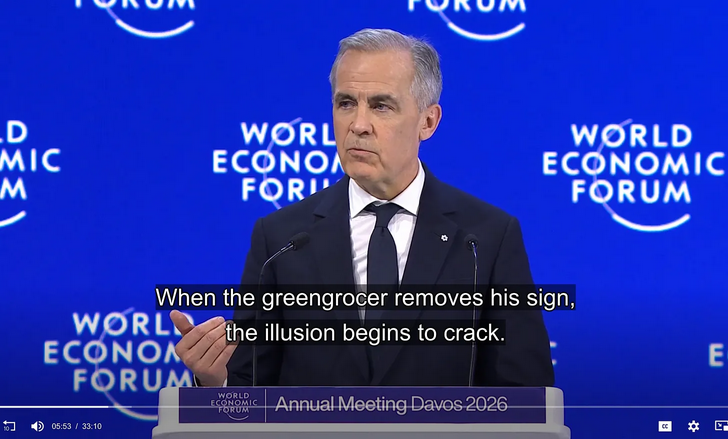
I make it a point not to listen to politicans’ speeches, as I need to keep my blood pressure within safe ranges for health reasons. A lot of Canadian commentators have been gushing with praise for Prime Minister Mark Carney’s bloviations at the WEF gabathon in Davos, because of course they have. Brave Mr. Carney standing up to the Bad Orange Man and getting ovations from the kind of people he’s most comfortable dealing with. How very nice for him. But as Chris Bray explains, it didn’t play quite as well with the rest of the non-Davos-attending world:
Mark Carney gave a speech in Davos, that fortress of democratic pluralism where hotel rooms inside the security zone cost thousands of dollars a night and no one with an expense account has to be lonely because the massive security forces don’t try to interfere with all the sex trafficking, which is very democratic. Anyway, the speech was stunning and brave, and everybody clapped a lot.
Someone put the word “flexes” next to the word “Canada”, apparently not intending to cause laughter, but yes: Mark Carney flexed and warned and puffed himself up like a man who’d just eaten the wrong part of the fugu.
You should watch it. Don’t try to eat or drink during the speech, because you’ll choke, and push any breakable household goods away from the reach of what will soon be your flailing arms, but you should watch him perform this extraordinary set of stranded symbols. The mismatch between message and messenger is … very special.
I was physically paralyzed as an effect of hearing this sentence from this face for a full ten seconds, and then I spasmed. It’s like watching Erich Honecker stand up to the East German regime. “We cannot tolerate misogyny, warns Jack the Ripper.”
Carney hinted broadly that the rules are breaking down in international relationships …
… which for the first time in a long time are being reshaped by mere power, a rare thing on the global stage, because there’s meanness and bullying and a rejection of friendly norms and restraint from … someone very bad, not that he was naming names, and so Canada is turning to new partners, extending the hand of friendship to nations and leaders that still care about rules and values and democracy.
The central banker who was selected as his country’s head of government before he’d ever stood for election to any office anywhere ever, the prime minister of a country where the government had just been rebuked by its courts for faking a national security emergency so it could suspend the rule of law and crush dissent, gave a real tubthumper about democracy and the rule of law.
The total absence of connection between “things being said” and “things being done” sets a record, here.
Comments Off on Carney in Davos … “the mismatch between message and messenger is … very special”
When I first heard about California’s proposed “Billionaire Tax” I thought it was a joke — nobody could be that economically illiterate. But I was wrong and the state really does seem to want to make their state economy a new case study in economics courses of the future. J.D. Tuccille explains why the tax, if implemented, is likely to impact a lot more folks who don’t rank as plutocrats:
California’s potential adoption of a one-time 5 percent “billionaire tax” on the net worth of high-value individuals is already sending wealthy residents fleeing for the exits. By one estimate, at least a trillion dollars has moved beyond the reach of state officials. But a new analysis says the tax may be even more onerous than advertised. Californians may need to get used to the sight of moving vans leaving the state.
Give Us 5 Percent of Everything You Own
Sponsored by a chapter of the Service Employees International Union, the proposed billionaire tax is set to appear as an initiative on the California ballot in November. According to the summary approved by state Attorney General Rob Bonta, the measure “imposes one-time tax of up to 5% on taxpayers and trusts with covered assets valued over $1 billion; covered assets include businesses, securities, art, collectibles, and intellectual property, but exclude real property and some pensions and retirement accounts”. If passed, the tax would apply to people resident in California as of January 1, 2026 — a retroactive element bound to be challenged in court.
[…]
Five Percent Understates the Pain
“The 2026 Billionaire Tax Act, a California ballot initiative, would ostensibly impose a one-time tax of 5 percent on the net worth of the state’s billionaires,” notes Jared Walczak for the Tax Foundation. “Due, however, to aggressive design choices and possible drafting errors, the actual rate on taxpayers’ net worth could be dramatically higher. One particularly momentous policy choice has the potential to strip the founders of some of the world’s largest companies of their controlling interests and force them to sell off a significant portion of their shares.”
According to Walczak, there are many ways in which the initiative creates situations under which “tax liability would be vastly more than 5 percent of net worth”. He focuses on six of them: valuations based on voting interests; assessment rules that can overvalue privately held businesses; excessive underpayment penalties that encourage overvaluing privately held businesses; anti-avoidance rules that tax more than the amount of transfers; provisions on spousal assets and debt to relatives that would tax nonresidents’ assets; and deferrals that would tax wealth that no longer exists.
As an example, Walczak points to the initiative’s means for valuing voting shares that aren’t publicly traded. DoorDash founder Tony Xu owns 2.6 percent of the company but controls 57.6 percent of voting rights. The initiative specifies, “the percentage of the business entity owned by the taxpayer shall be presumed to be not less than the taxpayer’s percentage of the overall voting or other direct control rights.”
That means Xu could be taxed on his voting rights rather than his economic stake in the company. That turns a $2.41 billion ownership interest into a $4.17 billion tax liability. It could force the conversion of voting shares to common stock for sale (subject to capital gains tax), and loss of control of the company.
The other provisions examined by Walczak also impose potential tax liabilities far beyond the 5 percent claimed by the initiative’s sponsors.
Charles Fain Lehman explains that the proposed tax will end up making everyone in California worse off:
… If you pick up all of Google’s employees and put them in Texas — where some of California’s billionaires might look to relocate — then one might assume they would be just as productive.
That would be a reason for non-Californians to be relatively sanguine about the wealth tax’s effects. Yes, it will be bad for California fiscally. But the titans of technology and entertainment can just set up shop in a red state and continue their work unabated.
But what if cities themselves have some additive effect? What if there’s something special about Los Angeles or San Francisco per se? What if the specific concentration of human capital in a specific place yields more than the output you’d expect if you put that same capital in a different place?
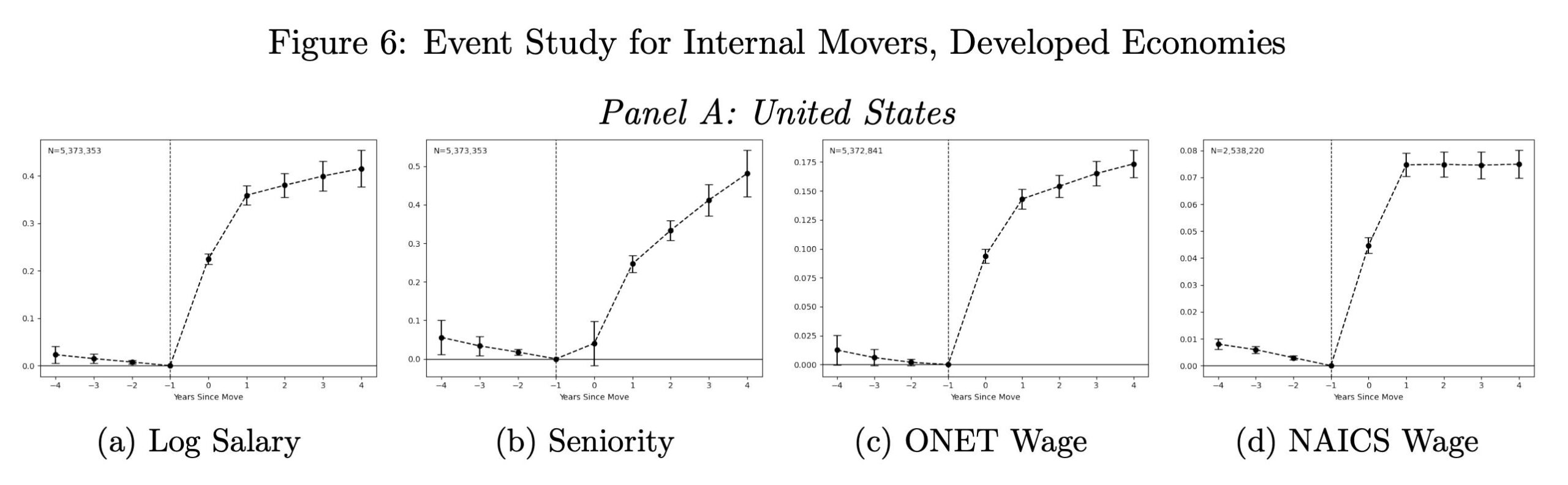
Source: Bhalothia et al, fig. 6.
As it turns out, that’s exactly what happens. Take recent research from economists at UC San Diego and Northwestern University. They use data on over 500 million LinkedIn users across 220,000 cities worldwide to ask how moving from one city to another affects an employee’s wages (a measure of their productivity). Because they observe the same people moving multiple times, they can disentangle the effects on wages of moving to a given city from the qualities of the people moving between cities.
The results are remarkable. The authors estimate that 93 percent of global wage variation is attributable to city effects, rather than to the qualities of workers themselves. That effect shrinks when you’re talking about movement within the developed world — someone moving from Bangalore to San Francisco gets a bigger wage bump than someone moving from Omaha to San Francisco, for example. But even looking at movers within their own developed country, cities explain something like 30 to 50 percent of the variance in wages.
In other words: it’s not just that people with better skills move to otherwise more desirable cities. Cities themselves make people worth more — meaning that they also increase total productivity and output, and therefore make the economy stronger.
How can it be that where you work is so important for how much you produce? The basic answer is what economists call agglomeration effects, the gains that come when firms cluster together. Agglomeration effects come, in general, from lowered barriers to exchange — of material goods, but also of ideas. Lots of start-up founders move to San Francisco because that’s where they can meet other start-up founders, and be on “the cutting edge” of what’s happening in their field. That’s only possible in a specific physical place.
Even if you put all the start-up founders in the same new part of Texas, moreover, they would still be worse off. Agglomeration economies come also from local culture and supportive industry infrastructure. Los Angeles as a city is built to support entertainers; San Francisco is built to support programmers. If you move those industries to Miami or Austin, neither city will be able to offer the same amenities — which is why both have struggled in their efforts to replace their Californian counterparts.
In other words: if California’s major industries leave California, they can’t be rebuilt somewhere else. Dismantle Silicon Valley, and you can’t just put it back together in Miami. We’ll still have technology companies, sure. But all else equal, they will be less productive than they would have been if they had stayed put. And we’ll all pay the price.
Back in the 1980s, I took an interest in Latin American guerrilla movements, especially in Central America. The general consensus among those who took an interest in such matters was that they were caused by the intolerable conditions of the poor, oppressed peasantry who rose up spontaneously against them. This was complete nonsense, of course. This is not to say that the peasantry was not poor and oppressed, but poor and oppressed peasants are rarely capable of more than a jacquerie, a kind of rural riot that exhausts itself and results in the oppressors coming back stronger than ever.
No; I came to the conclusion that the cause of the revolutionary guerrilla movements was the expansion of tertiary education in countries where it had not long before been the province only of the elite, largely, though never entirely, hereditary. (For the poor, gifted, and ambitious, the army was the route to social ascension.)
Tertiary education, however, was expanded with comparative suddenness. Before it was expanded, those who had it, being few, were more or less guaranteed important roles in the economy and government. They had already drawn a winning ticket in the lottery of life. Not surprisingly, a false syllogism insinuated itself into the minds of the newly educated: If the rich were educated and important, then being educated would make you rich and important. Again not surprisingly, this turned out not to be the case. If you turn out thousands of lawyers, for example, the remuneration of their work, if they find any, will be reduced and they will be disappointed in their hopes and expectations. They become angry, bitter, and disaffected, believing themselves not to be valued at their inestimable worth. They and their ilk became the middle ranks of the guerrillas (the very uppermost reaches being filled mainly by the narcissistic, spoiled sprigs of the upper classes). Only revolution would acquire for them the positions of influence and importance to which they felt that their education entitled them, and which such education had always entitled people to in the past.
Is it possible that Latin America was not so much in the rear as in the forefront of this modern social development (the case of Sendero Luminoso, the Shining Path of Peru, was a pure culture of this phenomenon)? Is it not possible that we in our societies have duped tens of millions of young people into believing that the prolongation of their formal education would lead them inexorably into the sunny uplands of power, importance, wealth, and influence, when in fact many a PhD finds himself obliged to do work that he could have done when he was 16? No one likes to think that he has been duped, however (it takes two for fraud to be committed, after all), so he looks around for some other cause of his bitter disappointment. It isn’t ignoramuses who are pulling down the statues, but ignoramuses who think that they have been educated.
Update, 24 January: Welcome, Instapundit readers! Have a look around at some of my other posts you may find of interest. I send out a daily summary of posts here through my Substack – https://substack.com/@nicholasrusson that you can subscribe to if you’d like to be informed of new posts in the future.
In Spiked, Fraser Myers says that British Prime Minister Keir Starmer fully deserves to be humiliated over his give-it-all-away negotiations for the Chagos Islands, which includes the strategic naval base at Diego Garcia:
In the middle of that map is Diego Garcia, British Indian Ocean Territory and home to one of the most strategic airfields and anchorages on the planet. […] The red circle is 2,000 nautical miles from the island. The purple circle is 1,150 nautical miles, roughly the distance from London to Malta, that represents the distance from Diego Garcia. That circle is also the distance from Diego Garcia to the island of Mauritius. Caption and image from CDR Salamander.
With the assistance of the brightest and best of the UK Foreign Office, the Labour government agreed to an arrangement that would hand over territory containing an Anglo-American military base to an unfriendly country, condemn its former inhabitants to permanent exile, and pay tens of billions of pounds for the pleasure.
I’m talking, of course, about Chagos (officially, the British Indian Ocean Territory), which has briefly caught the attention of the world’s most powerful man. This morning, amid a flurry of Truth Social posts about his designs on Greenland, US president Donald Trump’s gaze briefly alighted on this small, tropical archipelago on the other side of the planet. And he did not hold back in his criticism of Britain’s plans: “Shockingly, our ‘brilliant’ NATO Ally, the United Kingdom, is currently planning to give away the Island of Diego Garcia [the largest of the Chagos Islands], the site of a vital US Military Base, to Mauritius, and to do so FOR NO REASON WHATSOEVER”, he wrote. “The UK giving away extremely important land is an act of GREAT STUPIDITY”.
Trump’s reaction has widely been described as a major about-turn. But, in truth, his team has veered all over the place on the Chagos question. In October 2024, when Starmer initially agreed to hand over the islands, Marco Rubio, then still a US senator for Florida, reportedly warned that this would allow “Communist China” to spy on the US Navy, given Mauritius’s alliance with China. Yet in February 2025, when Starmer visited the Oval Office, the US president said he was “inclined to go along with” the UK’s proposals. And by May, when the deal was signed between the British and Mauritian governments, Rubio, by now US secretary of state, welcomed it. He claimed that Trump himself had “expressed his support for this monumental achievement”, hailing the deal that would cede sovereignty to Mauritius, while Diego Garcia would be leased to Britain for the next 99 years.
Of course, Trump’s motivation for bashing Starmer’s deal now has little to do with the Chagos Islands themselves. The real prize for the US president is in a different hemisphere entirely, as he freely admits. In a bizarre non-sequitur, the US president’s Truth Social post goes on to say that the Chagos deal is “another in a very long line of reasons why Greenland has to be acquired” by the US. This smackdown over Chagos, this attempt to humiliate Starmer and Britain on the global stage, is clearly part of Trump’s broader pressure campaign against the European powers, in his bid to seize Greenland for the US.
Nevertheless, it really should not have taken Trump’s intervention to put the brakes on the dreadful Chagos deal. Whichever way you spin it, this arrangement has never been in Britain’s national interest, nor the interests of the Chagossians who call the islands their home. It poses a risk to Western security interests, handing sovereignty over a territory, where almost 400 UK and US troops and 2,000 contractors are based, to a country that’s allied to China. The cost of leasing back Diego Garcia from Mauritius is also eye-watering. Although the Labour government tried to present the cost as just £3.4 billion, the true figure is believed to be 10 times as much, at around £34.7 billion.
So what on Earth possessed Starmer to sign up to such a risible deal? What leverage was a tiny island like Mauritius able to gain over Britain?
Comments Off on “It is a deal so bad that only Keir Starmer could have negotiated it”
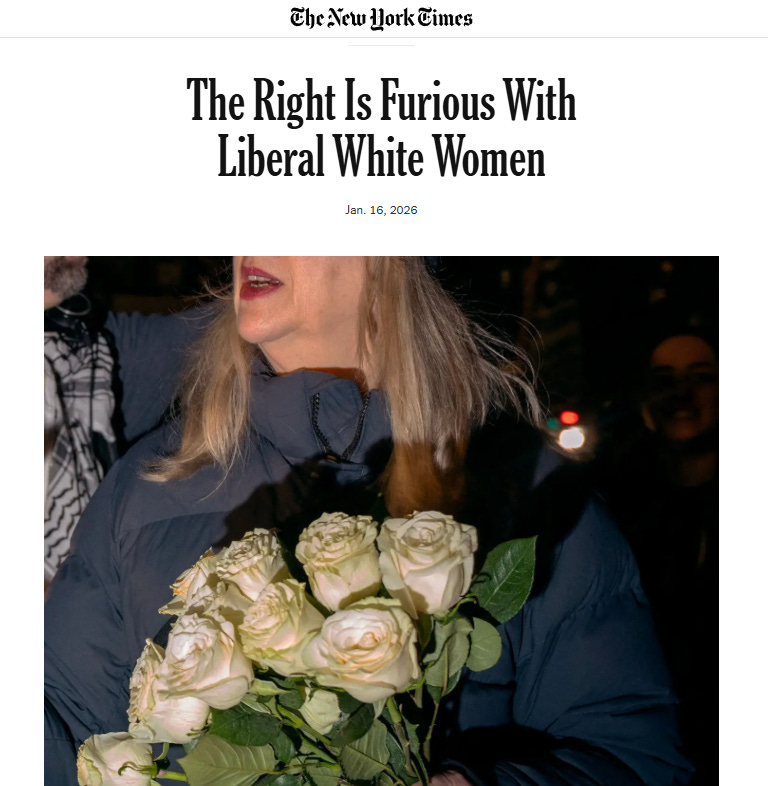
On Substack, Rohan Ghostwind responds to a recent New York Times opinion from Michelle Goldberg pretending not to understand why “the right” is against Affluent White Female Liberals (AWFLs):
Specifically, she talks about the rising contempt for the AWFL: Affluent white female liberal.
The first part of the opinion piece is a play-by-play of the Renee Good situation, pointing out that the right is freaking out about roving bands of Karens.
The part I find interesting is in the final paragraph:
It wasn’t long ago that casual contempt for white women was the domain of the left, at least that part of the left that took books like “White Fragility” seriously. So it’s striking how easily conservatives, who’ve been stewing over insults to white people for at least five years, have singled out a group of white women as the enemy.
Here’s the interesting part: throughout the course of her opinion piece, she touches on White Female Liberal part. Conspicuously missing is the first part of the acronym: affluent.
This is par for the course for an NYT Opinion piece: play into the identity politics aspect while simultaneously downplaying class. This is, of course, a big reason why the Democrats lost ground with working class people during the 2024 election.
[…]
Rob Henderson popularized the term luxury beliefs …
And if it was ever one group of people who embody the most luxury beliefs per capita it would be the AWFL’s.
What makes them uniquely annoying is their persistent refusal to acknowledge how sanctimonious they come across to the rest of the world. As far as they’re concerned, they are the only intelligent and moral group of people, and they will eventually get what they want by scolding everybody else into submission.
People hate this, because people would actually prefer bigotry to infantilization — but the affluent white woman, by virtue of being affluent, never has to reality test her beliefs against the real world.