
[White Fragility author Robin] DiAngelo uses similar techniques to support her second core theory that all white people are racist. For example, DiAngelo lays another trap that makes it impossible for white people to speak ill of any neighborhood with high crime rates in which many people of color reside. When DiAngelo’s friends warned her not to buy a home in neighborhoods with relatively high crime rates and poorly rated schools, DiAngelo later discovered that the neighborhoods had a high percentage of black and brown residents. From this, she concluded that her friends’ warnings were racially motivated and that “my fellow whites had communicated the racial boundaries to me.” Did you spot the trap?
If DiAngelo’s friends had told her not to live in the neighborhoods because they had black and brown residents, she could call them out for overt racism. But even when her friends made no mention of race whatsoever, DiAngelo attributed their warnings to racism as well. There was no way for her friends to mention the neighborhood’s high crime rates without DiAngelo finding them guilty of racism.
DiAngelo also supports her theory that all white people are racist by interpreting ambiguous events to support her conclusions, despite other plausible explanations. In one anecdote, DiAngelo describes an incident in which a white female teacher had two black students at her desk. The teacher prefaced something she said with the word “girl.” One student felt that the use of the word “girl” was racist. The other student disagreed, saying that the teacher called all her students “girl” regardless of their race.
Any reasonable person would conclude that if the teacher called every student — white, black, Asian, Latinx — “girl,” the teacher’s use of the word resides somewhere between “not racist” and “open to interpretation.” But DiAngelo reached a different conclusion, demonizing the teacher’s lack of concern for the offended student’s feelings, and calling the teacher arrogant for thinking the use of “girl” was not racist. To be clear, while teachers should listen to their students’ concerns, there is no proof this teacher’s word choice was racially motivated. And ironically, DiAngelo is guilty of everything she criticizes the teacher for because DiAngelo arrogantly ignores the other black student who did not think the comment was racist.
David Edward Burke, “The Intellectual Fraud of Robin DiAngelo’s White Fragility“, The Logical Liberal, 2020-06-13.
November 6, 2020
QotD: When you use a racist lens, everything looks like racism
November 5, 2020
QotD: The idiocy of tariffs
The true sadness here being that the spiral works the other way too. But hugely, vastly, more slowly. GATT was founded in 1947, it became, the process was transferred to, the WTO and it has taken them since then, that two generations, to reduce tariff levels to where they’re not really all that important in trade matters. Something that is being undone in just a couple of months of foolishness. GATT being something of a response to the economic demolition work done by Smoot Hawley of course.
Trade protection does spiral up and spiral down, the sadness being that here’s an asymmetry to the process. The reductions that make us richer take very much longer than the nonsenses that impoverish.
Tim Worstall, “The China, US, Trade War – It’s All Mutual On The Way Down As Well As Up”, Continental Telegraph, 2018-07-11.
November 2, 2020
In the University of Michigan’s Sexual Health Certificate Program, “mainstream sexual health issues that affect wide swaths of the population, such as marriage, reproduction, and family life, were treated as niche topics”
In Quillette, Tim Courtois explains what the University of Michigan’s Sexual Health Certificate Program is actually intended to teach:

When I signed up for the University of Michigan’s unique, year-long “Sexual Health Certificate Program” (SHCP), however, I truly did believe the experience would be both professionally and intellectually rewarding. I care about sexuality. I know that it is a fundamental component of the human search for joy and meaning. As a Michigan-based psychotherapist and licensed professional counselor, I wanted to deepen my understanding of sexuality, and become better equipped to provide care for the many clients who come to me with issues related to sexual health. The American Association of Sexuality Educators, Counselors, and Therapists sounded like the perfect fit for me, and the idea of becoming an AASECT-certified sex therapist appealed to me. I applied and was accepted for the 2019-2020 cohort. When I showed up, my class included participants from around the world — including Iceland, Egypt, Lebanon, and China — just as you’d expect at the kind of high-value, authoritative program that we all believed we’d signed up for.
The doubts started to creep in early, though — on day one, to be exact. Our first classroom module was titled “Sexual Attitude Reassessment.” I amused myself with the thought that this sounded like an unsettling euphemism for a brainwashing session. Sadly, that’s what it was.It quickly became clear that the issue of sexuality — the ostensible subject — often would serve merely as a pretext for more general harangues about society, and the urgent need to remake it according to AASECT’s ideological blueprint. In a keynote lecture entitled “Why Fetishism Matters,” the speaker argued that the world we inhabit is socially constructed, and told us (with what now seems like admirable candor), “I’m not neutral. I’m here to recruit you to a particular point of view about how kink should be valued.” The same speaker said that he’d been accused of teaching students that any form of sexual behavior is acceptable as long as there is consent from all parties. “Yes, that’s exactly right,” he said. Clearly, our attitude “reassessment” was well underway.
From the get-go, the scientific content was mostly superficial, and was often undercut by claims that the very idea of truth is a harmful (and even oppressive) construct. The teaching was not so much impartial and informative as it was evangelistic. Yet it was also self-contradictory: Declarations that there are no real “correct” moral values were uttered (without irony) alongside absolutist proclamations about the correct way to understand sex — and morality.As I learned, “Sexual Attitude Reassessment” (SAR) is an established term in the field, one that is often used to describe curriculum content that serves to educate sexual-health professionals about the wide range of sexual experiences that they may encounter among clients. The object is to ensure they won’t be shocked when such encounters occur, and to invite them to reassess their judgments and assumptions about various expressions of sexuality. These are valid and important goals. Unfortunately, the SAR in the SHCP descended into an exercise in overstimulation and desensitization — specifically, two full days of pornographic videos and interviews. At times, it felt like the famous brainwashing scene from A Clockwork Orange. There was a series of videos of people masturbating (one of which involved a strange interaction with a cat), a woman with “objectiphilia” who had a sexual attraction to her church pipe organ, various sadomasochistic acts, and a presentation on polyamory designed to make it clear that the polyamorous lifestyle is healthy, wholesome, and problem-free.
The focus on BDSM was a particular fixation throughout the program. In the SAR, we were shown videos of a woman meticulously applying genital clamps to the scrotum of a willing man, and a dominatrix teaching a class how to properly beat people while demonstrating on an eager participant. We also watched an interview with a sex-dungeon “dom” (the male equivalent of a dominatrix) who described one of his experiences: His client had instructed him, as the dom recounted it, “I want you to bind me and then beat me until I scream. And no matter how much I scream or beg you to stop, I want you to keep beating me.” The dom did as he was told, continuing the beatings through the customer’s begging and pleading, until the client went totally limp and silent, seeming to dissociate. At this point, the dom unbound the man, who then began to weep uncontrollably in the dom’s arms.
BDSM is a real and active sexual subculture, and I don’t object to its inclusion in the course materials. But I was shocked to see how much further the professors in the program took things, insisting that BDSM behaviors — up to and including the sexual “Fight Club” style of behavior described above — must be uncritically viewed as wholesome and beautiful. Students learned to sing from the same psalm book, with one memorably exclaiming “I’m so inspired by the wisdom and beauty in the BDSM community!” and insisting that the behavioral codes observed among BDSM participants can help us create a similar climate of safety and respect “in all our relationships.”
The program was focused on an agenda of “centering” the experience of minorities — in this case, sexual minorities. This meant that huge portions of time in class after class were spent focusing on BDSM, LGBTQIA+ issues, and polyamory, not to mention the obligatory discussions of oppression and privilege that were shoehorned into every discussion. Meanwhile, mainstream sexual health issues that affect wide swaths of the population, such as marriage, reproduction, and family life, were treated as niche topics. Further, while many Americans view sexuality through the prism of faith, religion hardly came up at all. And when it did, it was typically so that religious values could be denigrated. Even the few religious people in the program got the message: Whenever any made passing reference to their own observant religiosity, it was usually in a spirit of shame or penance.
In a few brief web searches to find a public domain or Creative Commons image to use for this post, I realized that web search engines offer “safe” options for a reason…
QotD: The Patriarchy
Thus it is okay to hate all men – they are all infected by the canker of patriarchy which, unlike individual thoughts and motivations, is a kind of all-powerful super-organism, a hive mind controlling its male worker bees. Men as individuals are simply tokens of something deeper – structural misogyny embedded in institutional power. If you’re a man who thinks you are not a misogynist, who in fact thinks you like women perfectly well, you are deluding yourself. For such men, their sexism is simply unconscious, just as in classical Marxism the “good” bourgeois was unconscious of the fact that he could not avoid exploiting his workers or employees, even though he might be providing them with a decent wage, good working conditions, and health and pension benefits.
This analysis, given a moment’s thought, doesn’t make a lot of sense. Even if you accept that all the ills of the world are down to patriarchy and the dominance of men, you have to concede the corollary – that all the triumphs of humankind are down to the patriarchy also, from medicine and science to the highest reaches of art and culture.
Women may point out that they have been excluded from these fields until now, and that’s largely true, although biology – the lack of control women have historically had over their own fertility and the greater physical strength of men – might be a far more simple and plausible explanation than the existence of a hypothetical, all-powerful super-organism. However, the very act that men hold the balance of power is proof of the existence of patriarchy, according to this belief system.
Tim Lott, “Why It’s Not OK to Hate Men”, Quillette, 2018-08-14.
November 1, 2020
QotD: Trumbo
And it was. Needless to say, the movie made villains of the conservatives who opposed the Marxist infiltration: people like John Wayne and Hedda Hopper in particular, Wayne because Wayne, and Hopper because she had a son serving in the U.S. Navy during the Korean War. Of course Wayne was made out to be a bully and Hopper a vindictive bitch — and the Senators and Congressmen who haled the Commies in front of the Senate and House Un-American Committee (HUAC) were depicted as ideological purists who saw Communists behind every bush — even though, in the case of Hollywood, there were Commies behind every bush at the time.
Of course, much was made of the fact that being a Communist wasn’t actually illegal (then, and now), and Trumbo made a great show of this being a First Amendment issue — which it was — and how these Commies all wanted to improve America, but of course there were evil right-wingers like Wayne, Joe McCarthy and HUAC harassing them at every turn.
The execution of the traitors Julius and Ethel Rosenberg got a little puff piece in the movie, which didn’t — couldn’t — actually say they weren’t guilty of
treasonespionage, so it was brushed over with the throwaway that it was the first execution for espionage in peacetime, as though peacetime should give espionage a pass. And if that wasn’t enough, the Rosenberg children were paraded around as sympathy magnets — as they still are — because Communists have no problem using children to serve their own purposes.Kim du Toit, “Blacklists Matter”, Splendid Isolation, 2020-07-28.
October 29, 2020
QotD: The art of the politician
The perfect politician, as the perfect salesman, sells this “vision” — dwarfing any specific programme with its stated assumptions and checkable facts. Details, details; to the uninitiated, these are always boring, and the voting masses will never be initiated. The people, especially in this Age of Netflix, want entertainment, and what they call “leadership.” A leader is a person who does your thinking for you. In politics, he has a rôle like that of film director, in a movie where he will be the principal star. We must go through the movie emotionally on his side; grieve his little setbacks, feel that we participate when he wins. Black hats, white hats: his opponents are clearly marked and can be seen at every moment to be deplorable.
David Warren, “Now playing”, Essays in Idleness, 2018-07-13.
October 27, 2020
America’s “brutal system of slavery [was] unlike anything that had existed in the world before”
I missed this article by Kay S. Hymowitz when it was published by City Journal a couple of weeks back:
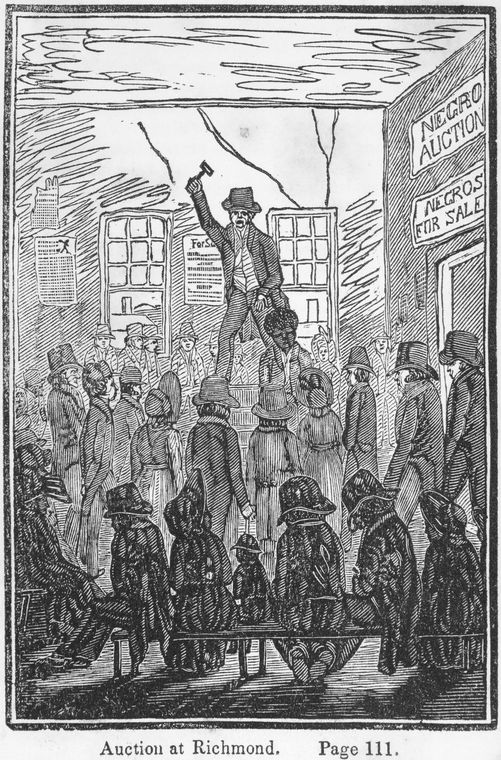
Auction at Richmond. (1834)
“Five hundred thousand strokes for freedom ; a series of anti-slavery tracts, of which half a million are now first issued by the friends of the Negro.” by Armistead, Wilson, 1819?-1868 and “Picture of slavery in the United States of America. ” by Bourne, George, 1780-1845
New York Public Library via Wikimedia Commons.
… slavery was a mundane fact in most human civilizations, neither questioned nor much thought about. It appeared in the earliest settlements of Sumer, Babylonia, China, and Egypt, and it continues in many parts of the world to this day. Far from grappling with whether slavery should be legal, the code of Hammurabi, civilization’s first known legal text, simply defines appropriate punishments for recalcitrant slaves (cutting off their ears) or those who help them escape (death). Both the Hebrew Bible and the New Testament take for granted the existence of slaves. Slavery was so firmly established in ancient Greece that Plato could not imagine his ideal Republic without them, though he rejected the idea of individual ownership in favor of state control. As for Rome, well, Spartacus, anyone?
In the ancient world, slaves were almost always captives from the era’s endless wars of conquest. They were forced to do all the heavy labor required for building and sustaining cities and towns: clearing forests; building roads, temples, and palaces; digging and transporting stone; hoeing fields; rowing galley ships; and marching to almost-certain death in the front line of battle. Women (and often enough boy) slaves had the task of servicing the sexual appetites of their masters. None of that changed with the arrival of a new millennium. Gaelic tribes took advantage of the fall of the Roman Empire to raid the west coast of England and Wales for strong bodies; one belonged to a 16-year-old later anointed St. Patrick, patron saint of Ireland. “In the slavery business, no tribe was fiercer or more feared than the Irish,” writes Thomas Cahill in How the Irish Saved Civilization.
Today, of course, the immorality of slave-owning is as clear as day. But in the premodern world, no neat division existed between evil slaveowners and their innocent victims. Once the Vikings arrived in their longboats in the 700s, the Irish enslavers found themselves the enslaved. Slavery became the commanding height of the Viking economy; Norsemen raided coastal villages across Europe and brought their captives to Dublin, which became one of the largest slave markets of the time. The Vikings thought of their slaves as more like cattle than people; the unlucky victims had to sleep alongside the domestic animals, according to the National Museum of Denmark in Copenhagen. Norsemen rounded up captured Irish men and women to settle the desolate landscape of Iceland; scientists have found Irish DNA in present-day Icelanders, a legacy of that time. The Slavic tribes in Eastern Europe were an especially fertile supplier for Viking slave traders as well as for Muslim dealers from Spain: their Latin name gave us the word slave. Slavs were evidently not deterred by the misery they must have suffered; when Viking power waned by the twelfth century, the Slavs turned around and enslaved Vikings as well as Greeks.
Slavery was a normal state of affairs well beyond the territory we now call Europe. The Mayans had slaves; the Aztecs harnessed the labor of captives to build their temples and then serve as human sacrifices at the altars they had helped construct. The ancient Near East and Asia Minor were chockfull of slaves, mostly from East Africa. According to eminent slavery scholar Orlando Patterson, East Africa was plundered for human chattel as far back as 1580 BC. Muhammad called for compassion for the enslaved, but that didn’t stop his followers from expanding their search for chattel beyond the east coast into the interior of Africa, where the trade flourished for many centuries before those first West Africans arrived in Jamestown. Throughout that time, African kings and merchants grew rich from capturing and selling the millions of African slaves sent through the Persian Gulf and Indian Ocean to Persians and Ottomans.
From the fifteenth to the eighteenth centuries, the North African Barbary coast was a hub for “white slavery.” This episode was relatively short-lived in the global history of slavery, but one with overlooked impact on Western culture. Around 1619, just as the first Africans were being sailed from the African coast to Jamestown, Algerian and Tunisian pirates, or “corsairs” as they were known, were using their boats to raid seaside villages on the Mediterranean and Atlantic for slaves who happened in this case to be white. In 1631, Ottoman pirates sacked Baltimore on the southern coast of Ireland, capturing and enslaving the villagers. Around the same time, Iceland was raided by Barbary corsairs who took hundreds of prisoners, selling them into lifetime bondage.
Conspiracy theories grow thanks to mistrust of public officials and media
It’s commonplace to say that such-and-such a conspiracy theory is merely an intellectual playground for the paranoid and the gullible, but conspiracy theories don’t spontaneously generate — at least not the ones that gain wide audiences. Daniel Miller looks at some of the reasons these theories become attractive and gain adherents:

QAnon alleged clues about the NYC bombing, 10 December 2017.
Wikimedia Commons.
In the wake of six months of mixed-messages and baffling government policies, following four years, if not twenty years, of mystifying imponderables, the concept of a “conspiracy theory” has recently reentered the lexicon of semi-criminalized thought.
In August The New York Times stigmatized anti-lockdown protesters in Berlin as a worrying admixture of “neo-Nazi groups, conspiracy theorists as well as Germans who said they were fed up with the restrictions” and similar language was used about the protesters in London, as social media companies began purging accounts linked to the QAnon conspiracy theory, which conjectures that the world is controlled by a secret global cabal of blood-drinking sex criminals.
Believing conspiracy theories, evidently, is a Bad Thing, but any concept capacious enough to incorporate both the tens, even hundreds of millions of people skeptical about the global political response to SARS-2, and the much smaller number entertaining more involved explanations demands a careful analysis.
Really the first question is who you can trust. One answer is the official authorities, as represented by the esteemed New York Times, but the news website which welcomed the 45th US President to office with three years of spurious coverage of what turned out to be the Russiagate hoax, before pivoting to the historical phantasmagoria of the 1619 Project, no longer strikes everyone as the impeccable source which revealed the existence of Saddam Hussein’s WMD stockpile and links to Al-Qaeda before the 2003 invasion of Iraq, or whose Pulitzer Prize winning journalist Walter Duranty discounted rumours of a 1933 famine in the Soviet Union as “an exaggeration or malignant propaganda.”
This leaves individuals only to their own wits and devices in the face of a puzzling world in which information is everywhere, much of it questionable, not all the facts are available, and many are ultra-politicized, and meanwhile, unknown agendas are being continually carried out.
What’s really going on? As with any speculative enterprise, the problem is to construct a plausible hypothesis by using various models to interpret limited data. There is no question that, at different moments in history, individuals and groups have worked together in secrecy to launch conspiratorial exploits and there is no obvious reason for thinking this practice has now totally ceased. “People of the same trade seldom meet together,” observed Adam Smith in 1776, “even for merriment and diversion, but the conversation ends in a conspiracy against the public.” Still, this is not in itself evidence of any specific plot happening now.
October 25, 2020
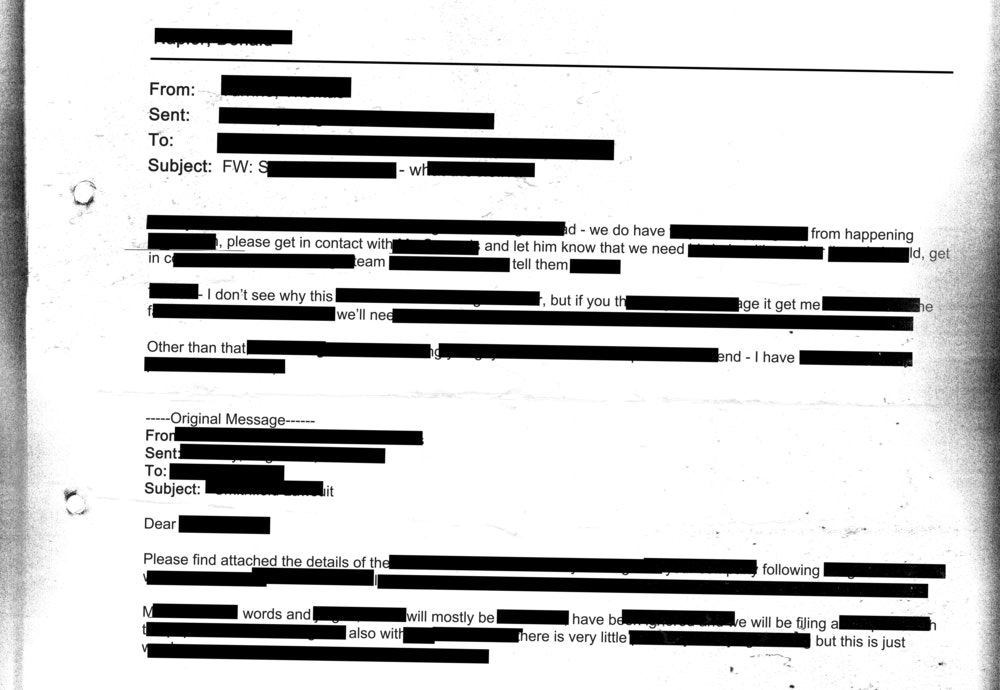
Canada’s broken [REDACTED] to [REDACTED] [REDACTED]
In The Line, a look at the failings of the federal government’s promises to fix the badly broken Access to Information system:
Sometimes, Line readers, though we always strive to be fair, we cannot deny that certain politicians are just fun to skewer. Because some of them are just terrible, terrible people, and while we polite Canadians don’t normally report too much on the personal lives of our elected leaders, well, what can we say? When you can, within responsible journalistic bounds, give a dirtbag a hard time for falling down on the job, hey. Life is good!
Patty Hajdu, the federal minister of health, is actually … perfectly pleasant. This isn’t unheard of in our politicians, but it’s rare enough to mention here, all to make very clear that we take no particular pleasure in reporting on her pathetic performance this week. But report it we must. And pathetic it surely was.
Under sharp questioning by Tory MP Michelle Rempel Garner, Hajdu very carefully and deliberately aimed a soon-to-be-banned .44 Magnum revolver at her foot, waited a dramatic second for effect, and then figuratively blew her poor extremity to smithereens. Rempel Garner had been asking about the abysmally broken state of the federal access-to-information systems, and Hajdu, with all-too-Liberal scorn, stood up and declared:
Mr. Speaker, I have spoken to hundreds, if not thousands, of Canadians since the pandemic was first announced, when COVID-19 arrived on our shores. In fact, not once has a Canadian asked me to put more resources into freedom of information officers. What they have asked me for is to ensure that all the resources of Canada are devoted to one thing, and that is the health, safety and economic prosperity of our country. We are going to continue to make sure that Canada has the most robust response possible.
There are two gigantic problems with Hajdu’s answer there.
The first is that Canada’s access-to-information regime is notoriously dysfunctional, and her government has long admitted that. Indeed, fixing this disgrace was a major plank in the party’s 2015 platform.
In the years since, the government has effectively accomplished the square root of zero.

October 24, 2020
“So – a Truth and Reconciliation Commission in America?”
Arthur Chrenkoff responds to this tweet from Robert Reich:
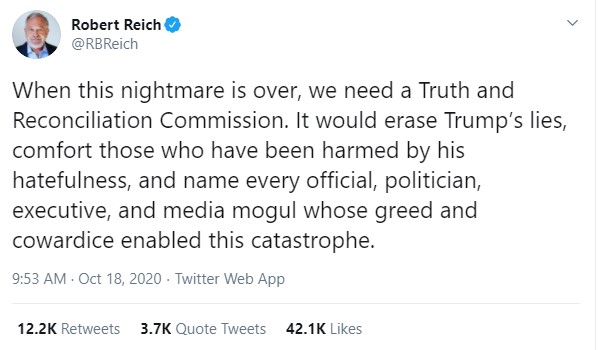
In case you are unfamiliar with the term, the Truth and Reconciliation Commission was instituted in the post-apartheid South Africa as a way of non-violently and non-punitively coming to terms with the painful racist past. It was a forum where the victims of human right abuses were able to testify about their experiences, and where some of the perpetrators could respond on record – ideally with some contrition – and request amnesty for their misdeeds. It was an exercise in “not forgotten, but possibly forgiven”, a way forward in transition to democracy that would not have to involve mass incarceration of those connected with the old regime. While criticised by many, this model of community healing is thought to have been quite successful in as much as it has been replicated in numerous other countries around the world as a way of dealing with the past and moving on. As the Good Book says, “the truth shall set you free”.
So – a Truth and Reconciliation Commission in America? You don’t have to have actually lived in a totalitarian society (even if, like with yours truly, it helps) to be taken aback at the insensitivity and the sheer tone deafness exhibited by a privileged member of the American elite (Clinton’s Labor Secretary, Berkley professor, 1 million Twitter followers) comparing the last four years in the United States to the four decades of South African apartheid or a quarter of a century of a military dictatorship in some coup-prone South American republic. Are these people really so lacking in self-awareness?
The answer is yes, and in turn it points to a more interesting socio-political phenomenon. For the past few decades, intellectuals (the great majority at various distances to the left of centre) have been looking at activists and dissidents outside of the developed, democratic “First World” – people like Nelson Mandela and Archbishop Desmond Tutu in South Africa, Ang Sang Suu Kyi in Burma/Myanmar, academics and trade unionists throughout Latin America fighting against right-wing dictatorships, and to a lesser extent those in opposition to communist dictatorships like the Dalai Lama, Lech Walesa in Poland, Vaclav Havel in Czechoslovakia, and Sakharov, Sharansky, Solzhenitsyn and others in the Soviet Union – and I think their main, if secret, reaction was envy and guilt.
Guilt because their own lives in the West were by and large safe, secure, privileged and prosperous, while their counterparts (intellectuals, artists, community leaders) in the Second and the Third World (now developing world) were putting their lives, freedom and livelihoods on the line for the principles and ideals they believed in. And envy because, as the stakes were so much higher “over there”, the lives of all these dissidents, oppositionists and human rights activists seemed so much more meaningful – and, yes, exciting. While you were pondering on the next New York Times op-ed you are going to write, while turning up to your monthly faculty meeting in your new Prius, somewhere in Africa or Asia or Latin America a prisoner of conscience was on a hunger strike, actually living the ideas you believed in and not just writing about them. Sure, it’s terrible, yet how much more interesting and consequential than your placid and predictable existence of mortgage repayments and the Monday morning undergraduate class in political theory?
October 23, 2020
The EU’s sudden but inevitable betrayal on Brexit deal
After a long absence, Nigel Davies posts on the breakdown of the British talks with the EU:

… I suggested that the EU would finally have to face the fact that the failure of their system was nothing to do with xenophobic little countries in the Balkans, or corrupt east European dictatorships, or incompetent Mediterranean democracies in permanent crisis.
No this disaster — the disaster that finally reveals just how impossible the European “project” is — will be at the hands of the morally superior, self righteous goody two shoes of Europe … principally France and the Netherlands.
And it will be for the obviously domestic partisan, (and completely ethically unfathomable), reason, of protecting the unnatural rights of a few fisherman who have had the unlikely and unreasonable benefit of unfettered access to British fishing waters for the decades that Britain has been in the EU.
(An unwarranted privilege for which they probably should pay compensation … Certainly if Britain was an “unjustly persecuted” Asian or African country instead of an “obviously evil” European one, compensation for this unnatural practice would be a demand of every new age propagandist of any colour.)
Nonetheless I have been amazed at the number of column inches wasted in the last week as some journalists try and pretend that it must be the British who are being unreasonable. Or indeed that there is even a remote possibility that the EU could ever come to an agreement, no matter what the British do. (Short of the British admitting that it was all a ghastly mistake, and submitting to total and permanent subservience to the benign dictatorship of the Brussels bureaucrats of course.)
The truth is that the EU is completely incapable of accepting any agreement, because that presumes that 27 individual nations can agree to overcome the drag of their own domestic policies to agree on a common good. (Or on a common decency that would require even the slightest domestic discomfort in one or more of their members.)
The British Library goes “woke”
David Warren views this development with alarm and disdain:

British Library reading room.
Photo from the British Library website.
Did you know? That, “Racism is the creation of white people”?
Of course you did, if you are young, woke, and poorly educated, like the white woman who is now the British Library’s Chief Librarian. (“Liz Jolly.”) Her statement, in a video to staff last summer, promoting her Decolonizing Working Group, though perfectly acceptable to Guardian subscribers, was mocked by several African and Asiatic scholars who have depended upon that library’s resources over the years. Noting that history is more complicated than Ms Jolly was ever told, they criticized her as “pig ignorant,” &c.
But her explicitly racist “anti-racist” programme proceeds, with aggressive “anti-racist” exhibitions, new “anti-racist” signage, and so forth. The demand to de-acquisition authors who do not reinforce the current ideological stereotypes has not yet gathered to full force, but has started.
The capture of essentially all major cultural institutions by unhinged political fanatics with daddy issues, is among the signs of our times. Those who resist are driven out of employment; those who accede have a lock on the splendidly-paid positions, for which beleaguered taxpayers are billed. The consequences to Western Civ are not trifling.
Perhaps I am unfair to single out just the one career arts bureaucrat, when there are thousands to choose from. I may even be prejudiced, not only against white people, but against those of the scheduled races who have cooperated in trashing the institutional heritage of the Big Wen.
For London was my Athens, back in the day, and I take these things personally. My British Museum Library ticket was among my most cherished possessions, and the old Reading Room among my favourite haunts. I am now so old that I can remember when such places were ruled, and staffed, by respectably boring establishment types with Oxbridge degrees.
In a different context, we’ve seen just how eager Oxbridge types of the 1930s were eager to join the Soviet spy networks, so the change in establishment staff at non-explicitly communist establishments was only a matter of time…
October 21, 2020
“[A]ll white people are racists … because they participate in a system that secures their own structural advantages”
In The Line, Meaghie Champion commits some sort of thought crime by quoting Martin Luther King’s famous words (which I have been assured more than once are now “forbidden” to non-POC speakers because reasons):
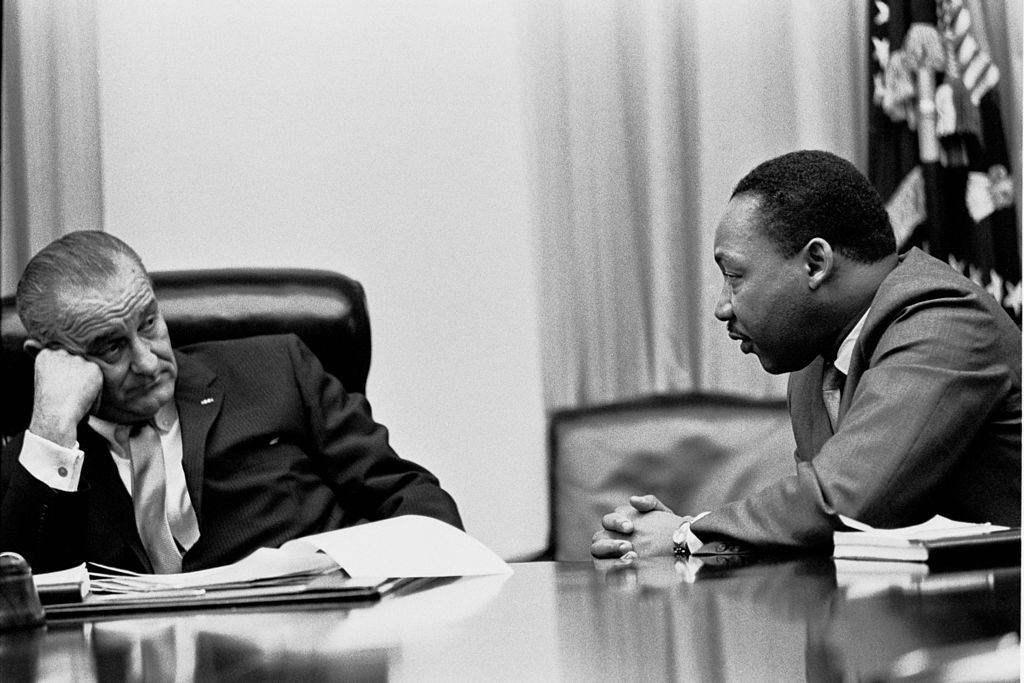
President Lyndon B. Johnson meets with Martin Luther King, Jr. in the White House Cabinet Room, 18 March 1966.
Photo by Yoichi Okamoto via Wikimedia Commons.
Most of us have been committed to the ideals of anti-racism since Martin Luther King famously delivered his “I Have a Dream Speech.” This was a masterclass of persuasion and rhetoric; one that convinced generations to re-frame their positions on racial inequity.
King said that he hoped that one day his children would grow up to be judged, not by the colour of their skin, but by the content of their character. That’s the ethos [BC NDP leader John] Horgan channelled when he said: “I don’t pay attention to skin colour or ethnicity.”
But this is not good enough for those who promote Critical Race Theory, an emerging ideology that tips these values on their head. CRT presupposes that the world is dominated by white supremacists. Further, that all white people are racists — regardless of their individual actions — simply because they participate in a system that secures their own structural advantages. CRT redefines what “racism” has traditionally meant: bigotry or discrimination based on skin colour.
Under this new ethos, only white people are capable of racism, because racism is systemic and works towards keeping all power vested in the hands of the white supremacists. I’m simplifying this, of course, because CRT is a rabbit hole best tackled by people with a lot more patience than me. One of the laziest rebuttals that CRT’s adherents use to deflect criticism is that its critics simply don’t understand it well enough, and therefore need to spend endless hours of their lives “doing the work,” integrating key academic texts, and absorbing their meaning until they fully accept the unerring truth of the ideology. If this tactic sounds indistinguishable from a deeply manipulative religious movement, well …
I’m a “person of colour” and I have spent my whole life trying to be anti-racist. I agree with the idea that there are systemic problems involving racism in many institutions within society. Some of those systemic problems are destroying Indigenous nations, including my own. Where I disagree with the Critical Race Theory crowd is in their depiction of everyone who is not a person of colour as being inherently racist. I don’t agree with their solutions for solving the racism problems we have to confront as a society. I don’t believe that they are the only ones working against racism, or coming up with viable strategies for how to do so. We can have differing views about racism and how to combat it; failing to adhere to one single philosophy, or parrot a specific set of terminology, does not mean a person is racist.
Horgan has worked for decades to do what he thought best for all the people. He’s been on our side in the struggle against racism all his life. The fact that he wasn’t up-to-date on the latest acceptable phrases to speak on the matter doesn’t negate that.
“Canadian conservatism often suffers from a unique form of self-loathing”
In his latest essay for The Dominion, Ben Woodfinden reviews an old book by Peter Brimelow and how it influenced the Canadian conservative scene at the time and why the book’s insights mattered so much to Stephen Harper:

Published in 1986, The Patriot Game captures the ideas and sentiment of an entire generation of Canadian conservatism. One quick note on Brimelow. He’s a controversial figure and has been called a “leader within the alt-right.” He’s also the founder of VDARE, an American anti-immigration website. I’m not getting into a back and forth with anyone about how best to describe his views, I’ll just say that none of this means his older work like The Patriot Game should be discounted or ignored, especially given the influence it’s had.
The game Brimelow is describing is the manufacturing of a new national identity that was undertaken by what he terms “Canada’s New Class.” This is a term he borrows from Irving Kristol. It refers to Canada’s politicians, civil servants, academics, business elites, writers, and journalists, who have a disproportionate influence shaping public discourse and national consciousness.
The manufacturing of a new national identity by this class, centred on the Liberal Party, was one that both rejected our heritage and replaced it with a self-serving and contradictory ideology that serves the interests of this New Class. The strategy of the Canadian New Class throughout Canada’s history has been “to concentrate rents from a resource-based economy in Central Canadian hands.”
The nationalism they manufactured to do this was an entirely artificial one, built around multiculturalism, bilingualism, anti-Americanism and heavy federal government involvement in the economy. At its core Brimelow’s argument is that 20th-century Canada is the creation of the Liberal party, but ultimately that it is fake and built to serve the interests of the New Class. This was done especially by placating Quebec at the expense of the West, and attempting to construct a new national identity that could unite English and French Canada.
This game played by Canada’s elite to enrich them and their bases of support in places like Quebec not only took money from the West and transferred it elsewhere, it dragged down the Canadian economy by crippling it in overbearing and burdensome regulation and the heavy hand of government involvement.
The most interesting, and clarifying part of the book to me is Brimelow’s description of the identity and nationalism that he thinks the Liberals consciously destroyed and then replaced with their own. Brimelow thinks that the New Class are consciously and actively anti-British, not just anti-American, and that this new identity was built as both a rejection of British heritage and the cultural affinities English Canada has with “North American identity.”
According to Brimelow “All of Anglophone Canada is essentially part of a greater English-speaking North American nation … Canada is a sectional variation within this super nation.” Our British heritage is at the core of who we are along with our common Anglo affinities with Americans, and this new national project is doomed to failure. Brimelow suggests that “Canada’s fundamental contradictions cannot be resolved in the present Confederation” and while English Canada is currently in a strange period of identity agnosticism, it will eventually recover and “assert its North American identity.” This process will only be accelerated by regional tensions within Canada that expose the futility of this new Liberal national identity. Modern Canada, in short, is a fraud and doomed to failure.
QotD: The Guardian
A less impressed commenter, unrelated to the editor, asks,
What is it with people’s inability to ignore the things they don’t like?
Meaning things you don’t like and which have no bearing whatsoever on your everyday life or the turning of the world. Say, “our” alleged “obsession” with cupcakes and their supposedly debilitating effects on helpless, hapless womenfolk. Women being so mentally insubstantial that even a tiny cake can unhinge their minds, apparently. But fretting ostentatiously about things of no importance has long been a standard template for Guardian articles, especially if you can shoehorn in some sophomoric theorising. It’s something most papers do to some extent, due to the obligation to Fill Space Somehow, but the Guardian is by far the greatest exponent and the most grandiose. Many of its contributors have mastered inadvertent surrealism. First you find some tiny, utterly trivial personal anecdote or grumble and then inflate it to sociological status with lots of wild, baseless assertion. Anything from the feminist politics of toddler excrement to the cruel, cruel agonies of spellcheck software. Whether the complaint is valid, or even sane, or can withstand a minute’s scrutiny, really doesn’t matter. It’s all about display — being outraged as theatre and social positioning. Which is why something as dull as temporary building renovation can be described vehemently, repeatedly and in all seriousness as “cultural apartheid.”
David Thompson, “The Cupcake Menace”, David Thompson, 2013-10-20.


