Jabzy
Published 14 May 2015Thanks for the 5,000 subs

Jabzy
Published 14 May 2015Thanks for the 5,000 subs
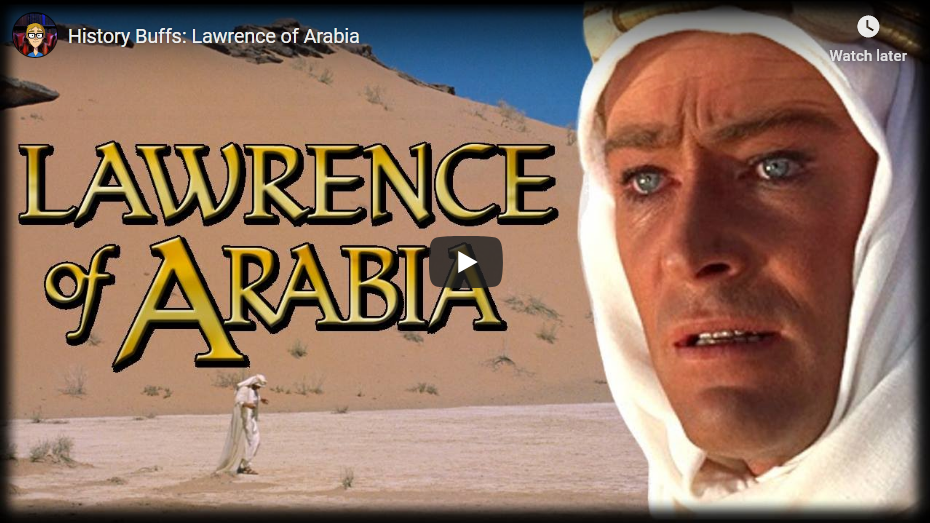
History Buffs
Published 17 Apr 2016BIG THANK YOU TO THE GREAT WAR CHANNEL FOR COLLABORATING WITH ME AND MAKING AWESOME VIDEOS!
Check out their T.E. Lawrence video here –
https://www.youtube.com/watch?v=iqvcjL6ObH0And the rest of their awesome channel here 🙂
https://www.youtube.com/user/TheGreatWarAnd thank you History Buffs so very much for being patient whilst I was in Ireland working on the Vikings podcasts for the History Channel and moving house at the same time. I sincerely hope you guys enjoy this review!
● Follow us on Twitter: https://twitter.com/HistoryBuffsNH
_________________________________________________________________________
Lawrence of Arabia is a 1962 epic historical drama film based on the life of T. E. Lawrence. It was directed by David Lean and produced by Sam Spiegel through his British company Horizon Pictures, with the screenplay by Robert Bolt and Michael Wilson. The film stars Peter O’Toole in the title role. It is widely considered one of the greatest and most influential films in the history of cinema. The dramatic score by Maurice Jarre and the Super Panavision 70 cinematography by Freddie Young are also highly acclaimed. The film was nominated for ten Academy Awards and won seven in total including Best Director, Best Sound Editing, Best Film Editing, and Best Picture.
The film depicts Lawrence’s experiences in the Arabian peninsula during World War I, in particular his attacks on Aqaba and Damascus and his involvement in the Arab National Council. Its themes include Lawrence’s emotional struggles with the personal violence inherent in war, his own identity, and his divided allegiance between his native Britain and its army and his new-found comrades within the Arabian desert tribes.
In 1991, Lawrence of Arabia was deemed “culturally, historically, or aesthetically significant” and selected for preservation in the United States Library of Congress National Film Registry.
Jabzy
Published 20 Mar 2015I will try and cover the other Crusades soon
TED-Ed
Published 9 Apr 2018Check out our Patreon page: https://www.patreon.com/teded
View full lesson: https://ed.ted.com/lessons/the-rise-a…
Most history books will tell you that the Roman Empire fell in the fifth century CE, but this would’ve come as a surprise to the millions who lived in the Roman Empire through the Middle Ages. This Medieval Roman Empire, today called the Byzantine Empire, began when Constantine, the first Christian emperor, moved Rome’s capital. Leonora Neville details the rise and fall of the Byzantine Empire.
Lesson by Leonora Neville, animation by Remus & Kiki.
Thank you so much to our patrons for your support! Without you this video would not be possible! Abhijit Kiran Valluri, Mandeep Singh, Sama aafghani, Vinicius Lhullier, Connor Wytko, Marylise CHAUFFETON, Marvin Vizuett, Jayant Sahewal, Quinn Shen, Caleb ross, Elnathan Joshua Bangayan, Gaurav Rana, Mullaiarasu Sundaramurthy, Jose Henrique Leopoldo e Silva, Dan Paterniti, Jose Schroeder, Jerome Froelich, Tyler Yoshizumi, Martin Stephen, Justin Carpani, Faiza Imtiaz, Khalifa Alhulail, Tejas Dc, Govind Shukla, Srikote Naewchampa, Ex Foedus, Sage Curie, Exal Enrique Cisneros Tuch, Vignan Velivela, Ahmad Hyari, A Hundred Years, eden sher, Travis Wehrman, Minh Tran, Louisa Lee, Kiara Taylor, Hoang Viet, Nathan A. Wright, Jast3 , Аркадий Скайуокер, Milad Mostafavi, Singh Devesh Sourabh, Ashley Maldonado, Clarence E. Harper Jr., Bojana Golubovic, Mihail Radu Pantilimon, Sarah Yaghi, Benedict Chuah, Karthik Cherala, haventfiguredout, Violeta Cervantes, Elaine Fitzpatrick, Lyn-z Schulte, cnorahs, Henrique ‘Sorín’ Cassús, Tim Robinson, Jun Cai, Paul Schneider, Amber Wood, Ophelia Gibson Best, and Cas Jamieson.
Lindybeige
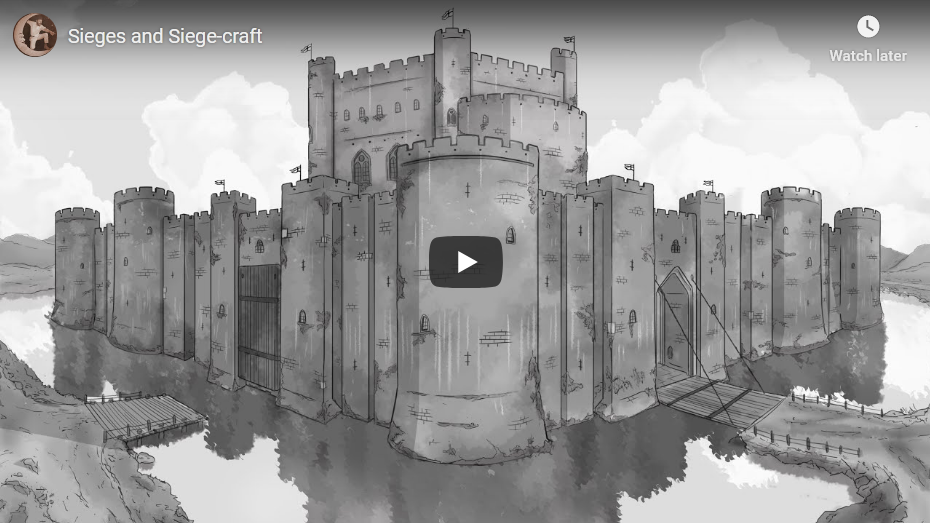
Published 2 Jun 2016Sieges in the ancient and medieval worlds were on quite different scales. 10,000 men can do things differently from 500.
Support me on Patreon: https://www.patreon.com/Lindybeige
This video’s subject was chosen by Jack Sargeant, the winner of the DeepArt art competition a couple of weeks ago. The topic is a large one, but I hope I gave it a decent enough shot.
Castle illustration by Mathew Nielsen.
Buy the music – the music played at the end of my videos is now available here: https://lindybeige.bandcamp.com/track…
Lindybeige: a channel of archaeology, ancient and medieval warfare, rants, swing dance, travelogues, evolution, and whatever else occurs to me to make.
▼ Follow me…
Twitter: https://twitter.com/Lindybeige I may have some drivel to contribute to the Twittersphere, plus you get notice of uploads.
website: http://www.LloydianAspects.co.uk
Overly Sarcastic Productions
Published 14 Feb 2020Happy Valentine’s Day! Celebrate the history of Love with a rundown of these outstanding couples — for better and for worse.
Our content is intended for teenage audiences and up.
This video was edited by Sophia Ricciardi, AKA “Indigo”.
PATREON: https://www.Patreon.com/OSP
DISCORD: https://discord.gg/h3AqJPe
MERCH LINKS: https://www.redbubble.com/people/OSPY…OUR WEBSITE: https://www.OverlySarcasticProductions.com
Find us on Twitter https://www.Twitter.com/OSPYouTube
Find us on Reddit https://www.Reddit.com/r/OSP/

History Buffs
Published 15 Aug 2015Apparently, Orlando Bloom was suffering from a nasty cold when shooting a big chunk of this movie. I think it shows … Anyway, it’s time for a brand new episode of History Buffs! Enjoy guys and thank you so much for all your support!
HistoryMatters
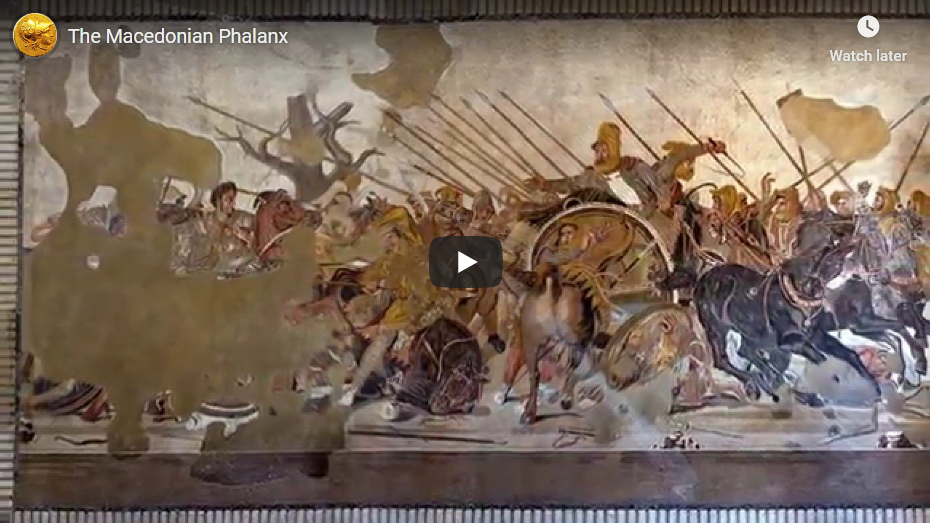
Published 30 Jan 2016A short introduction to the Macedonian phalanx, from conception to demise.
Ted Campbell on the recent peace plan proposed by US president Donald Trump:
On the subject of the Trump Mideast Peace Plan, I agree with both The Economist which says, “as a blueprint for a two-state solution it was dead on arrival,” and with the Globe and Mail‘s Mark MacKinnon who writes that “President Donald Trump’s Middle East peace plan … aims to resolve the Israeli-Palestinian conflict almost completely on Israel’s terms [and, while] Mr. Trump’s allegiances came as no surprise [to the Palestinian leaders, but] some of [their] bitterness was reserved for the leaders of Arab states that Palestinians see as quietly going along with the designs of the U.S. President and Israeli Prime Minister Benjamin Netanyahu.”
I think that is because President Trump, and much of the world, has lost patience with the Palestinians who still demand a right of return that, if ever seriously considered by anyone, would destroy Israel. Only Iran really wants that.
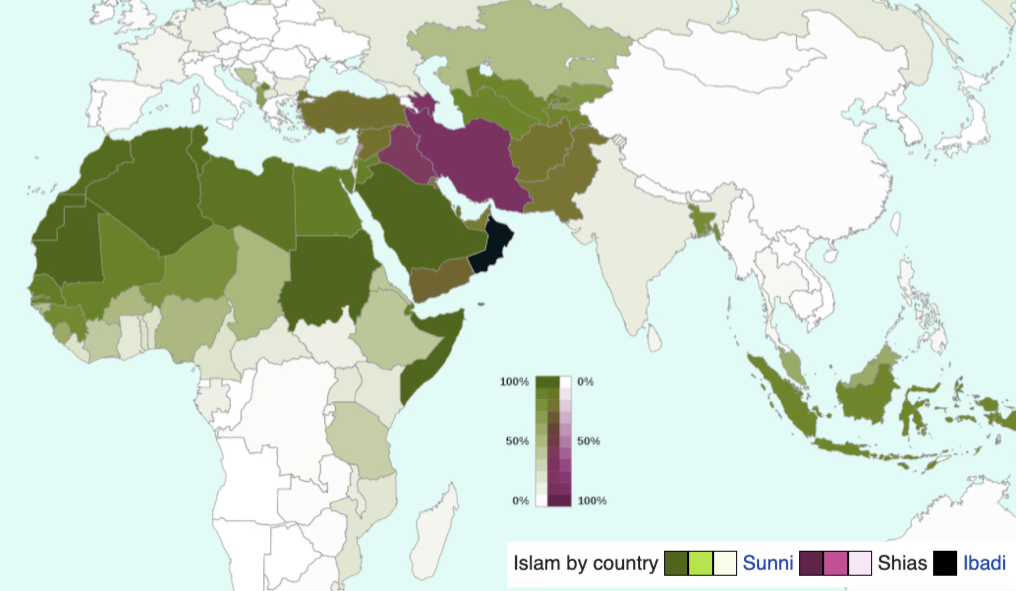
The strategic situation in the region, indeed in the entire Islamic Crescent which stretches from Mauritania and Morocco on the Atlantic coast of West Africa to Indonesia in East Asia, has changed in the past 70 years. There is no longer a unified Muslim “world” that opposes the very existence of a Jewish state in the Middle East. Indeed, a few Arab and Islamic states have correct, even friendly relations with Israel and others trade with the Jewish state (without having diplomatic relations) to their mutual advantage. The current problems in the region are centred on a power struggle between the Shia Islamic community, centred in Iran and the larger but socially and politically fragmented Sunni Islamic community …
… the differences are more than just religious. Iran, backed by China and Russia, and Saudi Arabia, backed by the USA, are engaged in something close to a real shooting war while Egypt and Turkey egg them both on. All four have some claim to dominance in the region and none is a real “friend” to any of the others and none gives a damn about Palestine or the Palestinian people.
[…]
President Trump has done a big political favour for Benjamin Netanyahu … but, ultimately it is probably pointless, and he and his successor and her (or his) successor, too, will likely still be seized with this issue in 2025 and 2030 and beyond.
Eventually, a solution will be found … it will, I suspect, involve Israel ceding a bit of territory to a new Palestinians state and, perhaps, establishing some sort of controlled, limited access corridor from the West Bank, possibly across the Northern Negev Desert. More importantly, it will involve Israel and Jordan, working in tandem, helping the new state to grow and prosper and live in peace with its neighbours. It’s a dream, of course, but it’s better, better for everyone, than is another war.
Overly Sarcastic Productions
Published 3 Feb 2015Funny story. Exporting this monster was almost as difficult as getting back to Ithaca was for our intrepid hero, who — as viewers of The Iliad may note — has inexplicably lost his Solid Snake voice in this production.
PATREON: http://www.patreon.com/user?u=4664797
Find us on Twitter @OSPYouTube!
Forgotten Weapons
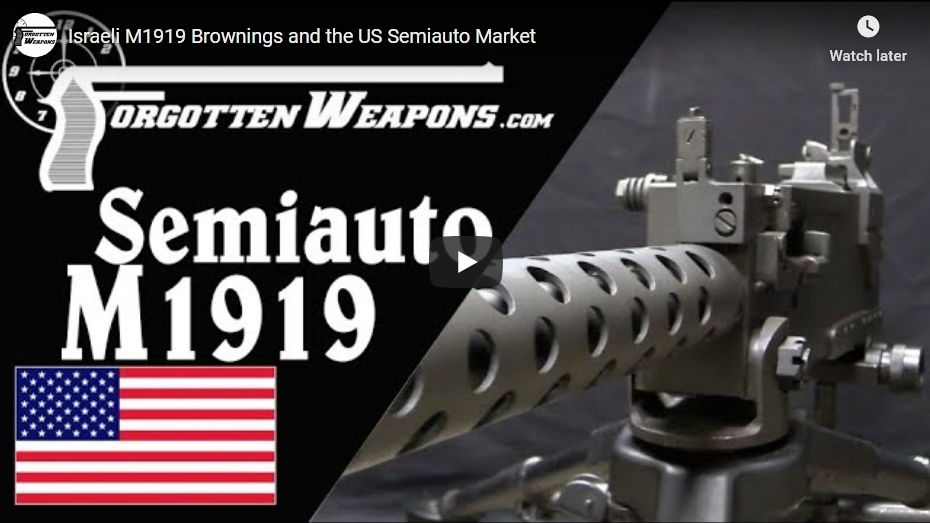
Published 28 Mar 2018Sold for $4,888.
In the world of converted semiautomatic “machine guns,” the Browning 1919 is a happy example of one of the most iconic and historically important US machine guns and also one of the cheapest semiautomatic belt fed guns available. This stems from two factors, primarily. One is that the Browning 1919, being developed from the water-cooled M1917 Browning, is a closed bolt system. Open bolt semiautomatic designs are not allowed by ATF, and so most semiauto machine gun conversions require substantial alteration to convert from open bolt to closed bolt — which the M1919 does not need. Second, the IDF used the Browning M1919 for many years and in large numbers, and surplussed many of them in the late 1990s. These guns came into the United States as parts kits in large numbers. This meant a glut of cheap guns, easily built as semi autos, and in an easily shootable caliber — 7.62mm NATO (as converted by Israel from their original .30-06 chambering).
Today, we are looking at an example of a semiautomatic converted M1919, and specifically at the various changes made by Israel to both improve the design and convert it successfully to the NATO cartridge.
http://www.patreon.com/ForgottenWeapons
Cool Forgotten Weapons merch! http://shop.bbtv.com/collections/forg…
If you enjoy Forgotten Weapons, check out its sister channel, InRangeTV! http://www.youtube.com/InRangeTVShow
The Great War
Published 31 Jan 2020Sign up for Curiosity Stream and Nebula: https://curiositystream.com/thegreatwar
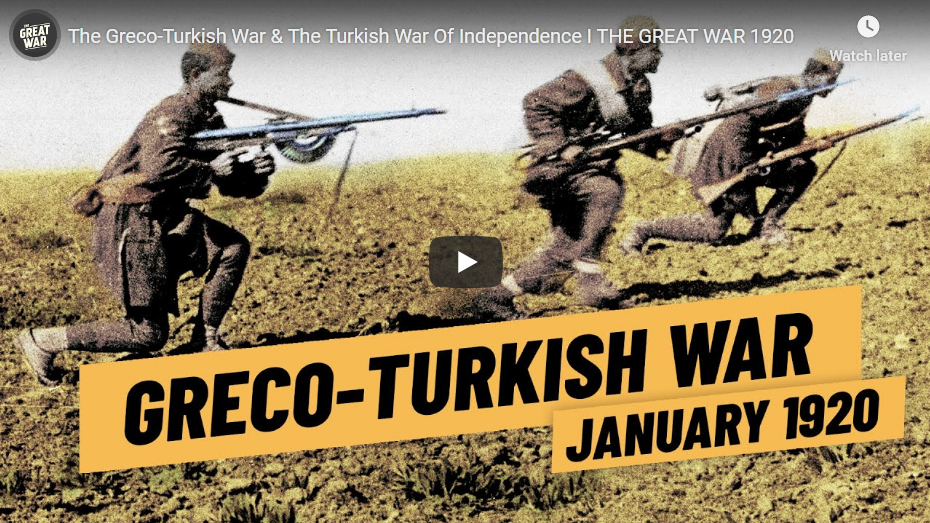
The Ottoman Empire was among the losing powers of World War 1 and left a power vacuum after the armistice of Mudros. The Great Powers had already made plans for the territory beforehand and now Greece had ambitions to take over the parts of Turkey where Greeks lived.
» SUPPORT THE CHANNEL
Patreon: https://www.patreon.com/thegreatwar
Merchandise: https://shop.spreadshirt.de/thegreatwar/» SOURCES
Criss, Nur Bilge: “Occupation during and after the War (Ottoman Empire)”, in: 1914-1918-online. International Encyclopedia of the First World War, ed. by Ute Daniel, Peter Gatrell, Oliver Janz, Heather Jones, Jennifer Keene, Alan Kramer, and Bill Nasson, issued by Freie Universität Berlin, Berlin 2015-08-05 https://encyclopedia.1914-1918-online…Leonhard, Jörn. Der überforderte Frieden. Versailles und die Welt 1918-1923 (CH Beck, 2018).
Macmillan, Margaret. The Peacemakers: Six Months that Changed the World (London: John Murray, 2001).
Karsh, Efraim and Inari Karsh. Empires of the Sand (London: Harvard UP, 1999).
Llewllyn Smith, Michael. Ionian Vision: Greece in Asia Minor (London: Hurst, 2016 (1973))
Gerwarth, Robert. The Vanquished. Why the First World War Failed to End, 1917-1923 (Penguin, 2017).
Fromkin, David. A Peace to End All Peace (New York: Avon, 1989)
McMeekin, Sean. The Ottoman Endgame (Penguin, 2015)
» SOCIAL MEDIA
Instagram: https://instagram.com/the_great_war
Twitter: https://twitter.com/WW1_Series
Reddit: https://reddit.com/r/TheGreatWarChannel»CREDITS
Presented by: Jesse Alexander
Written by: Jesse Alexander
Director: Toni Steller & Florian Wittig
Director of Photography: Toni Steller
Sound: Toni Steller Editing: Toni Steller
Mixing, Mastering & Sound Design: http://above-zero.com
Maps: Daniel Kogosov (https://www.patreon.com/Zalezsky)
Research by: Jesse Alexander
Fact checking: Florian Wittig ChannelDesign: Alexander Clark
Original Logo: David van Stephold
A Mediakraft Networks Original Channel
Contains licensed material by getty images
All rights reserved – Real Time History GmbH 2019
Overly Sarcastic Productions
Published 31 Jan 2020What do you do when life takes away half of your empire? Well, if you’re the Medieval Byzantines, you make comprehensive structural reforms to better manage a changing geopolitical landscape — And then you make an absolute crapload of mosaics.
Our content is intended for teenage audiences and up.
This video was edited in part by Sophia Ricciardi, AKA “Indigo”.
FURTHER SOURCES: A Short History of Byzantium by John Julius Norwich.
PATREON: https://www.Patreon.com/OSP
DISCORD: https://discord.gg/h3AqJPe
MERCH LINKS: https://www.redbubble.com/people/OSPY…
OUR WEBSITE: https://www.OverlySarcasticProductions.com
Find us on Twitter https://www.Twitter.com/OSPYouTube
Find us on Reddit https://www.Reddit.com/r/OSP/
Overly Sarcastic Productions
Published 23 Jan 2015I’m baaaaaaaack!
This one took me a while. The reason why should be pretty obvious. Enjoy your adorable murderfest.
Troy may be a good movie (though I have my doubts) but it sure as hell isn’t the Iliad.
PATREON: https://www.patreon.com/user?u=4664797
Find us on Twitter @OSPYouTube!
Forgotten Weapons
Published 24 Jan 2020http://www.patreon.com/ForgottenWeapons
https://www.floatplane.com/channel/Fo…
Cool Forgotten Weapons merch! http://shop.bbtv.com/collections/forg…
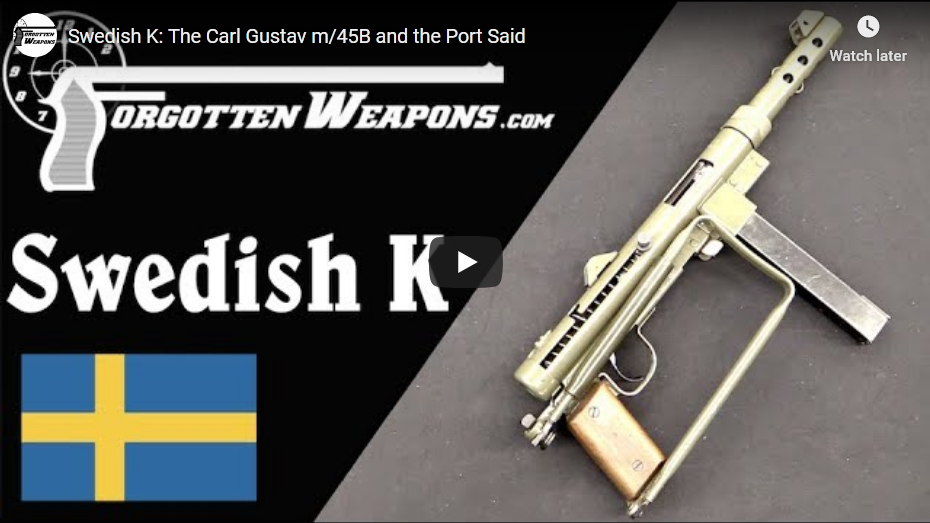
During the 1930s, Sweden acquired an assortment of different submachine guns, including Bergmanns, Thompsons, and Suomis. As World War Two progressed, they decided that they really needed to standardize on a single caliber and model of gun, and requested designs from both the Carl Gustav factory and Husqvarna. The Carl Gustav design won out, and was adopted as the m/45.
It was a very simple open-bolt, tube-receiver, fixed-firing-pin design chambered for 9x19mm Parabellum ammunition. The original guns were built around Finnish Suomi magazines, both 71-round drums and 50-round “coffin” mags. After the war these were replace by a new 36-round traditional box magazine, and magazine well adapters were fitted to the guns which precluded the use of the larger mags. The new magazines were much more convenient to carry, less expensive, and more reliable.
The name “Swedish K” comes form the full designation: Kulsprutepistol m/45. The guns were used by American special operations forces in Vietnam until the Swedish government stopped export sales to the US, at which point the Navy commissioned Smith & Wesson to produce the Model 76 submachine gun (essentially a copy of the m/45). The design was also licensed by Egypt, which also licensed the AG-42 Ljungman rifle at the same time. The Egyptian copy was called the Port Said, and shows the features fo the original Swedish m/45 pattern, where the guns in Swedish service were mostly updated to the m/45B pattern.
Photo of m/45C with bayonet from: http://www.gotavapen.se/index_eng2g.htm
Check them out for a ton of information on Swedish small arms!
Contact:
Forgotten Weapons
6281 N. Oracle #36270
Tucson, AZ 85740



Powered by WordPress