
Published on 25 Feb 2017
The Good The Bad & The Ugly: Why Is It So Good? is a great movie to look back on. It made 5 times its money back, making it a big success. But even Clint Eastwood himself thought the movie would do either really well or really bad.
It didn’t have the greatest reception from critics at that time. One of the most memorable criticisms from The LA Times said that the movie should have been called The Bad, The Dull and the Interminable”. The main reason for this negativity was due to the movie belonging to a not so popular sub genre, the Spaghetti Western, which when compared to a Hollywood western was considered as a cheap, inferior, foreign version.
In your typical Hollywood Western everything looked clean… where the heroes were handsome, and wore freshly pressed suits and had shiny new guns. But in a Spaghetti or Italian Western thing were far more gritty, dirty and violent as a whole they were perceived as been more realistic Its main characters weren’t well groomed nor necessarily handsome.
The musical scores were pretty different, from the amazing high energy music by Ennio Morricone compared to the more stately orchestral scores by Elmer Bernstein, like in The Magnificent Seven. In the 1960s the Hollywood hero was usually a great gunslinger who faced insurmountable odds taking on the bad guys and out smarting them. They were usually unselfish and down to earth. The main villains were very one dimensional, their badness was not explained, and they were often a outcasts, which meant they were either feared or hated by the local townspeople. However Italian films featured anti-heroes: instead of the protagonist saving everyone, the main character himself was either neutral or more interested in personal gain. While the bad guy was often as charismatic or powerful as the hero in order to give the protagonist a real challenge.
In Hollywood westerns the death of an antagonist simply meant the triumph of the good over the bad… going back home or having a reunion with loved ones, concluded the movies story. Whereas in its European counterpart, the death of the antagonist usually completed the narrative.
Sergio Leone had only directed a “fistful” of low budget movies at this point of his career, but you wouldn’t think that watching this film. What makes this movie truly amazing is Leone’s scope and vision. He had the special ability to use silence to help build suspicion, and paranoia when it came to one of his famous shootout scenes. Or Leone would use a long pause combined with music that slowly increased in tempo to make his action scenes feel more exciting and have a far greater payoff, even though the action would be over within a blink of an eye
Leone’s unique style involved shots of scenery that were very pulled back, where he would have small figures moving around in the distance, these wide shots were then followed by tight close ups of faces, giving you the audience this fantastic operatic feeling whenever a new chapter began Leone was great with people’s faces… he would deliberately hand pick his extras to find people who had very different looks and features… he would then pan across them giving his shots an extra sense of realism
Leone also establishes a rule where a characters vision is limited by the sides of the frame, everything outside the frame is invisible. This allows you the viewer to see only from the perspective of what the characters sees. So when Blondie and Tuco are heading towards the cemetery, they don’t notice the massive Union army in front of them and neither do you. Leone often thought that Hollywood Westerns had too much dialog, so he had his characters say more by saying less. Where most of them make eye contact with each other… pause and then start shooting!
Clint Eastwood as Blondie aka the good, is easily recognizable due to his iconic brown hat, poncho and fondness for cigarillos. But apart from that, his character is pretty mysterious… not much is known about him he says very little, and technically isn’t `good’ in a traditional sense… however he has a certain sense of honour and tries to do the right thing from time to time. Tuco aka the Ugly is the exact opposite or his partner Blondie, he never stops talking… Eli Wallach steals the show with his acting, and is easily the most complex character… always lying, switching sides, where he goes from trying to kill Blondie in one scene to pretending to be his best friend in another… He truly represents `the ugliest’ side of humanity, But that doesn’t stop you from loving his character Angel Eyes aka The Bad is evil personified. Lee Van Cleef was born to play this part
September 15, 2017
The Good The Bad & The Ugly: Why Is It So Good?
QotD: The sexist TV shows of the 1960s
Speaking of a different world, there was one big barrier to entry into [the original Star Trek]: its ladies. I’m still not quite sure how to deal with the way women were treated in the show. I’ve found that when watching many movies or shows from the ’60s and ’70s, it’s incredibly hard to relate the characters — not just because plot pacing was slower and diction was different than it is on TV today, but because I’m almost guaranteed to be disappointed by the way the story treats women. Generally, one just has to accept that there is going to be out-and-out sexism in a lot of old movies and TV, and you can either toss out the whole thing or watch it from afar like you’re in a museum, analyzing an ancient culture.
Megan Geuss, “I watched Star Trek: The Original Series in order; you can too, Or: Filling the gaps in your cultural knowledge is equal parts boring and fun”, Ars Technica, 2015-09-05.
September 14, 2017
Ken Burns and Lynn Novick: The Vietnam War Is the Key to Understanding America
Published on 13 Sep 2017
Nick Gillespie interviews Ken Burns and Lynn Novick about their new documentary series: The Vietnam War.
The Vietnam War led to more than 1.3 million deaths and it’s one of the most divisive, painful, and poorly understood episodes in American history.
Documentarians Ken Burns and Lynn Novick have spent the past decade making a film that aims to exhume the war’s buried history. Their 10-part series, which premieres on PBS next week, is a comprehensive look at the secrecy, disinformation, and spin surrounding Vietnam, and its lasting impact on two nations. The 18-hour film combines never-before-seen historical footage, with testimonies from nearly 80 witnesses, including soldiers on both sides of the conflict, leaders of the protest movement, and civilians from North and South Vietnam.
A two-time Academy Award winner, Burns is among the most celebrated documentary filmmakers of our time, best-known for the 1990 PBS miniseries The Civil War, which drew a television viewership of 40 million. He and Novick are longtime collaborators, and in 2011 she co-directed and produced Prohibition with Burns. In 2011, Reason’s Nick Gillespie interviewed Burns that film and the role of public television in underwriting his work.
With the release of The Vietnam War, Gillespie sat down with Burns and Novick to talk about the decade-long process of making their new film, and why understanding what happened in Vietnam is essential to interpreting American life today.
Produced by Todd Krainin. Cameras by Meredith Bragg, Mark McDaniel, and Krainin.
Full interview transcript available at http://bit.ly/2x0e5U4
September 11, 2017
Harvey, Irma, and Frédéric – the “Broken Window Fallacy” returns
Jon Gabriel tries to set the record straight on what a natural disaster means for the economy (hint, ignore anyone who says the GDP will rise due to the recovery efforts):
Ever since Hurricane Harvey slammed into Texas two weeks ago, we’ve seen countless images of heroic rescues, flooded interstates and damaged buildings.
As awful as the human toll was, it was not as bad as many of us feared. But it will take months to repair the homes, businesses and infrastructure of Houston and the surrounding area. The same will be true in Florida after Hurricane Irma.
The economic impact could be felt for years, but many economists and financial experts think there’s a silver lining.
The Los Angeles Times crowed that Harvey’s destruction is expected to boost auto sales. CNBC reported that Harvey “could be a slight negative for U.S. growth in the third quarter, but economists say it may ultimately provide a tiny boost to the national economy because of the rebuilding in the Houston area.”
Even Goldman Sachs is looking at the bright side, noting that there could be an increase in economic activity, “reflecting a boost from rebuilding efforts and a catchup in economic activity displaced during the hurricane.”
Economically speaking, it’s great news that all this damage in Texas and Florida needs to be fixed, right? Not only does this mean big bucks for cleanup crews, but think of all the money that street sweepers, construction workers and Home Depots will rake in.
And what about all those windows broken by the high winds? This will be the Golden Age of Texas Glaziery!
Not so fast.
All of this is based on a misunderstanding of what the GDP actually measures. It’s a statistic that often gets mentioned in the newspapers and on TV, but it is almost always used in a way that misleads people about what is happening in the economy. GDP — Gross Domestic Product — is intended to show the approximate total of goods and services produced in a national economy. Thus, when the GDP goes up, it means that the current period being measured recorded more goods and services produced than in the previous period.
When a natural disaster like a hurricane, earthquake, flood, or tornado strikes a city, state or region, all the work required to fix the damage will artificially boost the recorded GDP for that year. But the affected area isn’t that much richer than it was before, despite the GDP going up, because the GDP does not measure the losses suffered during the natural disaster.
This is where Frédéric comes in. I’m referring to the French economist and author Frédéric Bastiat, who brilliantly illustrated the GDP misunderstanding in his essay “What Is Seen and What Is Not Seen“:
In the economic sphere an act, a habit, an institution, a law produces not only one effect, but a series of effects. Of these effects, the first alone is immediate; it appears simultaneously with its cause; it is seen. The other effects emerge only subsequently; they are not seen; we are fortunate if we foresee them.
There is only one difference between a bad economist and a good one: the bad economist confines himself to the visible effect; the good economist takes into account both the effect that can be seen and those effects that must be foreseen.
Yet this difference is tremendous; for it almost always happens that when the immediate consequence is favorable, the later consequences are disastrous, and vice versa. Whence it follows that the bad economist pursues a small present good that will be followed by a great evil to come, while the good economist pursues a great good to come, at the risk of a small present evil.
The GDP problem I identified at the start of this post is a general case of what Bastiat called the “Broken Window Fallacy”:
Have you ever been witness to the fury of that solid citizen, James Goodfellow, when his incorrigible son has happened to break a pane of glass? If you have been present at this spectacle, certainly you must also have observed that the onlookers, even if there are as many as thirty of them, seem with one accord to offer the unfortunate owner the selfsame consolation: “It’s an ill wind that blows nobody some good. Such accidents keep industry going. Everybody has to make a living. What would become of the glaziers if no one ever broke a window?”
Now, this formula of condolence contains a whole theory that it is a good idea for us to expose, flagrante delicto, in this very simple case, since it is exactly the same as that which, unfortunately, underlies most of our economic institutions.
Suppose that it will cost six francs to repair the damage. If you mean that the accident gives six francs’ worth of encouragement to the aforesaid industry, I agree. I do not contest it in any way; your reasoning is correct. The glazier will come, do his job, receive six francs, congratulate himself, and bless in his heart the careless child. That is what is seen.
But if, by way of deduction, you conclude, as happens only too often, that it is good to break windows, that it helps to circulate money, that it results in encouraging industry in general, I am obliged to cry out: That will never do! Your theory stops at what is seen. It does not take account of what is not seen.
It is not seen that, since our citizen has spent six francs for one thing, he will not be able to spend them for another. It is not seen that if he had not had a windowpane to replace, he would have replaced, for example, his worn-out shoes or added another book to his library. In brief, he would have put his six francs to some use or other for which he will not now have them.
Let us next consider industry in general. The window having been broken, the glass industry gets six francs’ worth of encouragement; that is what is seen.
If the window had not been broken, the shoe industry (or some other) would have received six francs’ worth of encouragement; that is what is not seen.
And if we were to take into consideration what is not seen, because it is a negative factor, as well as what is seen, because it is a positive factor, we should understand that there is no benefit to industry in general or to national employment as a whole, whether windows are broken or not broken.
Now let us consider James Goodfellow.
On the first hypothesis, that of the broken window, he spends six francs and has, neither more nor less than before, the enjoyment of one window.
On the second, that in which the accident did not happen, he would have spent six francs for new shoes and would have had the enjoyment of a pair of shoes as well as of a window.
Now, if James Goodfellow is part of society, we must conclude that society, considering its labors and its enjoyments, has lost the value of the broken window.
From which, by generalizing, we arrive at this unexpected conclusion: “Society loses the value of objects unnecessarily destroyed,” and at this aphorism, which will make the hair of the protectionists stand on end: “To break, to destroy, to dissipate is not to encourage national employment,” or more briefly: “Destruction is not profitable.”
Related: Shared by Thomas Forsyth on Facebook:

September 8, 2017
New pro-Hillary website gets panned … even by otherwise pro-Clinton sites
Peter Daou’s Verrit, a new website for Hillary Clinton supporters, isn’t getting rave reviews even from pro-Clinton sources:
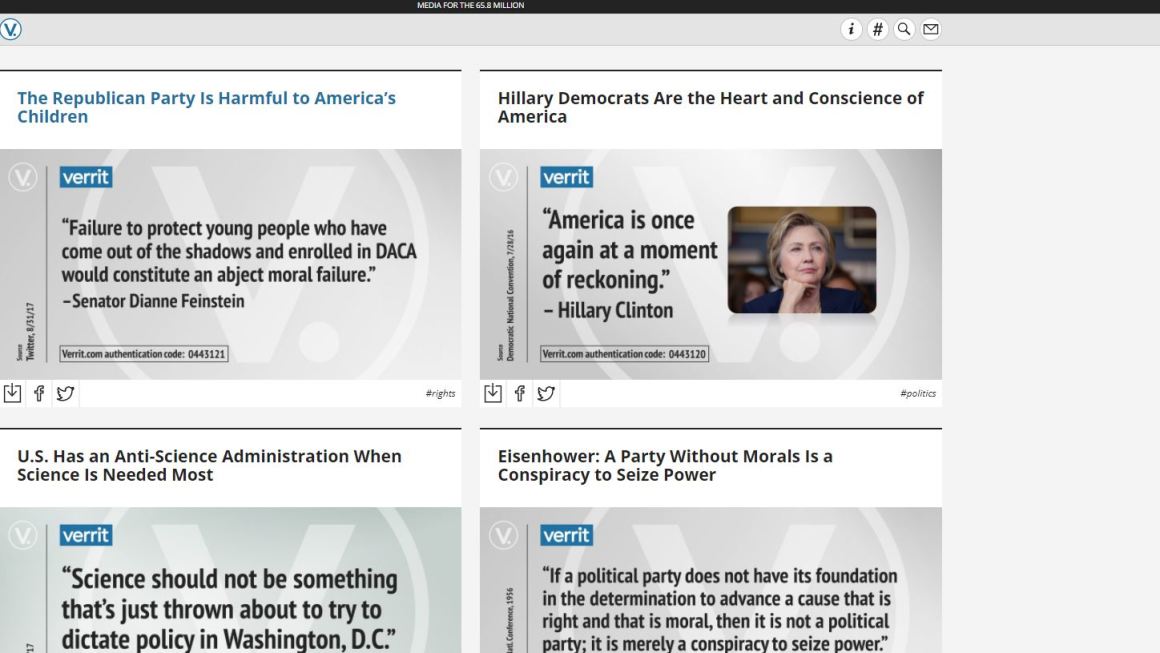
This Pro-Hillary Website Looks Like North Korean Agitprop
Peter Daou, the prickly pro-Clinton operative, has launched a propaganda rag so shameless it would make Kim Jong Un blush.Who would buy stock in a twice-defeated presidential candidate?
If the candidate under question is Hillary Clinton, that zealous buyer would be Peter Daou, one-time rocker, seasoned political blogger, former campaign adviser to John Kerry and Hillary Clinton, ambitious litigant, propagandist and internet entrepreneur. A couple of days ago, Daou launched his self-funded Verrit.com, a slavishly pro-Clinton site (endorsed by Hillary!) to carry on her failed crusade.
The derision greeting Verrit is so universal it inspires sympathy for Daou, as Gizmodo, the Washington Post, Outline, New Republic, New York, The Ringer and others have broken its back with their snap judgments. “Verrit, a Media Company for Almost Nobody,” read one headline. “No One Asked for Verrit, But Here We Are,” stated another. “What Is Verrit and Why Should I Care? (Unclear; You Shouldn’t.),” said a third. “Peter Daou Continues to Embarrass Hillary Clinton,” asserted the best in show.
People, people! It’s only a website!
Granted, Verrit is a goofy website, as websites go. If you don’t possess the courage to visit it right now, here’s a description: Imagine if Matt Drudge created a Hillary fan site, only instead of listing news stories in a text-heavy fashion, he arranged them on the Web equivalent of 3×5 cards, and in addition to typing headlines onto the cards, he pulled out salient facts and stats from the stories (called “verrits”). Each card carries a unique serial number that you can plug into the Verrit database to prove … well, I don’t know exactly what it proves other than Verrit drew its facts and stats from the news source cited.
September 6, 2017
A feminist retelling of Lord of the Flies
Benedict Spence on the reported new movie retelling the story of William Golding’s Lord of the Flies from a female point of view:
It’s not always beneficial to know what an author thinks of his or her own work (J.K. Rowling demonstrates how infuriating this can be on a daily basis). But before his death, Golding specifically said that the characters in Lord of the Flies were supposed to be all boys, because: ‘I didn’t want this book to be about sex.’ ‘It’s too trivial a thing to get into a book like this, which was about the problem of evil’, he said.
You would have thought that Golding’s reasoning would make sense to feminists, who often argue that maleness (especially white maleness) is evil. So, if a matriarchal society would be more pacifist and just, how could an island of little girls descend into the same chaos as happens to the boys in Lord of the Flies?
None of this is to say that remakes are always destined for mediocrity. But when remakes set out to make a political point, as is clearly the case here, the result is often cringe-inducing and lacking in artistic merit. Worse still, in this case the remake entails ripping out a core part of the story for the sake of mere virtue-signalling. There’s nothing interesting or daring about that.
I don’t know why people are freaking out about this … clearly just changing one element of the original story (swapping out all the boys for girls) is going to change the outcome: that’s kind of the point, isn’t it?
As we all know, a society composed only of males will naturally collapse into barbarism due to a massive overdose of toxic masculinity. On the other hand, a society composed only of females will have zero conflict (because women are naturally co-operative), and all issues will be dealt with democratically and fairly, with equal sharing of burdens and outcomes. I’m not sure where they’re going to find any kind of conflict to build the storyline around, as by definition there can’t be any conflict in the absence of a toxic male influence and systemic patriarchal violence, so the movie may just be three hours of heartwarming sympathy and tolerance, sharing and caring, mutual respect and egalitarian problem-solving. Where’s the drama going to come from?
Of course, not everyone agrees. Here’s Heather Wilhelm to ruin everyone’s egalitarian dream:
Women Are Never Evil, You Sick Chauvinist Pigs
“An all women remake of Lord of the Flies makes no sense because…the plot of the book wouldn’t happen with all women,” New York Times columnist Roxane Gay declared on Twitter, making me wonder if she’s ever been to a sixth-grade slumber party. (If you haven’t been to one, know this: They almost always degenerate into a pillow-strewn wasteland of popcorn, treachery, and copious weeping.)
Other writers joked that a female Lord of the Flies would obviously and inevitably morph into a peaceful island paradise — you know, like the very real place where Wonder Woman grew up. By my personal scientific assessment, there is a 99 percent probability that anyone who makes this point has never spent significant time in a sorority house, where there is often unlimited cereal, a frozen yogurt machine, and occasional tales of terror that would make your hair stand on end.
“Not every story makes sense to gender-flip,” wrote Yohana Desta at Vanity Fair. “Particularly if that story is William Golding’s classic Lord of the Flies, a vicious tale about a barbaric boy-made society. The concept alone,” she continues, “disregards the point of the book!”
Get it? “The point of the book” is that boys — just boys! — are inherently bad.
September 5, 2017
QotD: Microaggressions
Whenever I first heard the word “microaggression,” sometime in the last five years, I’m sure I was unaware how big “micro” could get. The accusation of a microaggression was about to become a pervasive feature of the Internet, and particularly social media. An offense most of us didn’t even know existed, suddenly we were all afraid of being accused of.
We used to call this “rudeness,” “slights” or “ignorant remarks.” Mostly, people ignored them. The elevation of microaggressions into a social phenomenon with a specific name and increasingly public redress marks a dramatic social change, and two sociologists, Bradley Campbell and Jason Manning, have a fascinating paper exploring what this shift looks like, and what it means. (Jonathan Haidt has provided a very useful CliffsNotes version.)
Western society, they argue, has shifted from an honor culture — in which slights are taken very seriously, and avenged by the one slighted — to a dignity culture, in which personal revenge is discouraged, and justice is outsourced to third parties, primarily the law. The law being a cumbersome beast, people in dignity cultures are encouraged to ignore slights, or negotiate them privately by talking with the offender, rather than seeking some more punitive sanction.
Microagressions mark a transition to a third sort of culture: a victim culture, in which people are once again encouraged to take notice of slights. This sounds a lot like honor culture, doesn’t it? Yes, with two important differences. The first is that while victimhood is shameful in an honor culture — and indeed, the purpose of taking vengeance is frequently to avoid this shame — victim status is actively sought in the new culture, because victimhood is a prerequisite for getting redress. The second is that victim culture encourages people to seek help from third parties, either authorities or the public, rather than seeking satisfaction themselves.
Megan McArdle, “How Grown-Ups Deal With ‘Microaggressions'”, Bloomberg View, 2015-09-11.
September 4, 2017
Hollywood facing the worst box office returns in years
Ryan Faughnder reports on the bad summer movies season:
As Hollywood wraps up the all-important summer box-office season this Labor Day weekend, a sobering reality has gripped the industry.
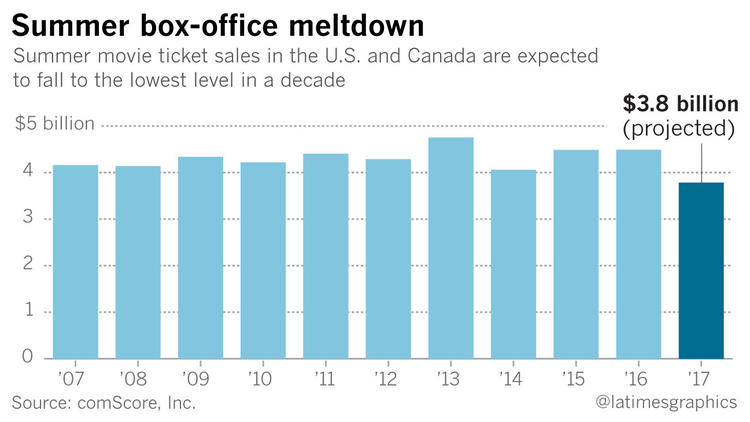
The number of tickets sold in the United States and Canada this summer is projected to fall to the lowest level in a quarter-century.
The results have put the squeeze on the nation’s top theater chains, whose stocks have taken a drubbing. AMC Theatres Chief Executive Adam Aron this month called his company’s most recent quarter “simply a bust.”
Such blunt language reflects some worrisome trends. Domestic box-office revenue is expected to total $3.78 billion for the first weekend of May through Labor Day — a key period that generates about 40% of domestic ticket sales — down nearly 16% from the same period last year, according to comScore. That’s an even worse decline than the 10% drop some studio executives predicted before the summer began.
The usual suspects are being blamed: unlike previous years, moviegoers have other calls on their entertainment time and dollars, including the rise of gaming platforms, streaming sites like Netflix, and the attraction of watching freshly painted surfaces dry. The online critics at Rotten Tomatoes also come in for their fair shame of blame for Hollywood’s plight.
Update: Fixed broken link. Sorry for any inconvenience.
August 31, 2017
“… as if millions of future lit-crit students suddenly cried out in terror and were suddenly silenced”
The late Sir Terry Pratchett hatched a cunning plan to thwart the inchoate plans of uncounted would-be literary ghouls:
A hard drive containing the unfinished books of Terry Pratchett has been destroyed by a steamroller, in fulfilment of the late author’s last wishes.
The works were crushed by a vintage John Fowler & Co steamroller at the Great Dorset Steam Fair, ahead of the opening of a new exhibition about the author’s life and work. It is thought up to 10 incomplete novels were flattened.
Friend Neil Gaiman, with whom Pratchett cowrote Good Omens, had revealed in 2015 that Pratchett had instructed that he wanted “whatever he was working on at the time of his death to be taken out along with his computers, to be put in the middle of a road and for a steamroller to steamroll over them all”.
Pratchett’s former assistant Rob Wilkins tweeted that he was “about to fulfil [his] obligation to Terry”.
The hard drive will go on display as part of a major exhibition about the author’s life and work, Terry Pratchett: HisWorld, which opens at the Salisbury Museum in September.
About to fulfill my obligation to Terry @SalisburyMuseum @Wiltshire_flo pic.twitter.com/B0xr3V5Cbg
— Terry Pratchett (@terryandrob) August 25, 2017
There goes the browsing history… Many thanks to @steamfair. Soon to be on display at @SalisburyMuseum in September https://t.co/Di8tvTO4Hi pic.twitter.com/onGGWLDYL4
— Terry Pratchett (@terryandrob) August 25, 2017
August 28, 2017
Sexism in the original Star Trek
Dave Leigh stands up for Gene Roddenberry:
… the most infamous case is in part a running gag throughout the series. It’s dictated in the Guide, runs the length of the series, and culminates in the final episode. And I’m pretty sure that very few people other than Gene Roddenberry himself knew that it was a running gag.
It’s sexism.
First… history. And this part is well-known. When the first pilot (“The Cage”) was delivered, Roddenberry cast his future wife, Majel Barrett, as “Number One”, the coldly logical second-in-command of the Enterprise. When the studio rejected that pilot and commissioned a second one, they made a few demands. They wanted to “get rid of the guy with the ears” (as Roddenberry told it). They also wanted to axe Number One, because they claimed that their test audiences didn’t like a woman as executive officer. For decades, Roddenberry told the joke that he kept the alien and married the woman because the other way ’round wouldn’t be legal. He also transferred Number One’s coldly logical nature to Mister Spock.
In the years that followed, many fans and critics completely forgot this story when examining the rest of the series. For instance, there’s the fact that the captain’s yeoman is always a pretty female. This is by decree. In fact, the Guide describes the character as follows:
YEOMAN — Played by a succession of young actresses, always lovely. One such character has been well established in the first year, “YEOMAN JANICE RAND”, played by the lovely Grace Lee Whitney. Whether Yeoman Rand or a new character provided by the writer, this female Yeoman serves Kirk as his combination Executive Secretary-Valet-Military Aide. As such, she is always capable, a highly professional career girl. As with all female Crewman aboard, during duty hours she is treated co-equal with males of the same rank, and the same level of efficient performance is expected. The Yeoman often carries a small over-the-shoulder case, a TRICORDER, about the size of a small handbag, which is also an electronic recorder-camera-sensor combination, immediately available to the Captain should he be away from his Command Console.
In the real-world Navy, a yeoman is simply a clerk. Most of them are men. But in Star Fleet, this is women’s work, at least superficially. Note that in other respects these women were to be treated co-equally. What isn’t women’s work — ever (in the original series) — is the Captaincy. And this is stated explicitly in the very last episode of the series, “The Turnabout Intruder”.
Now, this has been retconned over and over, but this episode was deliberate, and it was conceived and outlined by Gene Roddenberry. By now you probably know that I don’t like retcons because they suck. They’re poor explanations that say, “it didn’t happen”. It’s better to explain why it did happen. And to do that, we have to start with an understanding of what Star Trek was for. It was first and foremost a platform for storytelling. Fantastic elements were readily employed whenever they served a storytelling need. It’s one of the strengths of science fiction:
“I was working in a medium, television, which is heavily censored, and in contemporary shows I found I couldn’t talk about sex, religion, politics and all or the other things I wanted to talk about. It seemed to me that if I had things happen to little polka-dotted people on a far-off planet I might get past the network censors, as Swift did in his day. And indeed that’s what we did.”
— Gene Roddenberry
August 26, 2017
Hot takes are easy, if you’re Andy Benoit
 At the Daily Norseman, taking shots at “pro” sports personalities comes as second nature. Ted Glover and Eric Thompson have developed a particular joy in sharing the … gems … from Andy Benoit’s Twitter feed, and have taken it one step further:
August 23, 2017
Garnet Rogers catalogue now available on Bandcamp
I’ve heard Garnet play in concert many times, but over the years I’d lost a couple of his early CD recordings … now I can do the up-to-date thing and download them:

August 21, 2017
Joss Whedon’s ex-wife on Whedon’s affairs
Kai Cole at The Wrap:
I’ve been asked some questions by the press recently about my divorce from Joss Whedon, to whom I was married for 16 years. There is misinformation out there and I feel the best way to clear up the situation is to tell my truth. Let me begin by saying I am a very private person and the act of writing this is antithetical to who I am and everything I stand for. Yet, at the same time, I feel compelled to go on the record and clear up some misperceptions. I don’t think it is fair to me or other women to remain silent any longer.
I met Joss in 1991. I was driving across the country from Massachusetts on a whim, and met him when I was passing through Los Angeles. We fell in love and I moved to L.A. so we could be together.
I was with him when his Buffy the Vampire Slayer script was adapted, and the resulting movie released. It was painful to see how his vision was interpreted by the production team and on our honeymoon to England in 1995, I urged him to figure out how to turn it into a TV show. He didn’t want to work in television anymore, following in his father’s and grandfather’s footsteps, but I convinced him it was the fastest way to get the experience he needed, so he could direct his own films someday. I had no idea, in that lovely garden in Bath, that it would change everything.
There were times in our relationship that I was uncomfortable with the attention Joss paid other women. He always had a lot of female friends, but he told me it was because his mother raised him as a feminist, so he just liked women better. He said he admired and respected females, he didn’t lust after them. I believed him and trusted him. On the set of Buffy, Joss decided to have his first secret affair.
Fifteen years later, when he was done with our marriage and finally ready to tell the truth, he wrote me, “When I was running Buffy, I was surrounded by beautiful, needy, aggressive young women. It felt like I had a disease, like something from a Greek myth. Suddenly I am a powerful producer and the world is laid out at my feet and I can’t touch it.” But he did touch it. He said he understood, “I would have to lie — or conceal some part of the truth — for the rest of my life,” but he did it anyway, hoping that first affair, “would be ENOUGH, that THEN we could move on and outlast it.”
Joss admitted that for the next decade and a half, he hid multiple affairs and a number of inappropriate emotional ones that he had with his actresses, co-workers, fans and friends, while he stayed married to me. He wrote me a letter when our marriage was falling apart, but I still didn’t know the whole truth, and said, “I’ve never loved anyone or wanted to be with anyone in any real or long-term way except for you ever. And I love our life. I love how you are, how we are, who you are and what we’ve done both separately and together, how much fun we have…” He wanted it all; he didn’t want to choose, so he accepted the duality as a part of his life.
August 19, 2017
How to Safely Watch The Eclipse or CNN
Published on 18 Aug 2017
Remy has a few helpful tips for safely watching large orange balls of gas.
Written by Remy. Produced by Austin Bragg


