The right to free speech may begin and end with the First Amendment, but there is a vast middle where our freedom of speech is protected by us — by our capacity to listen and accept that people disagree, often strongly, that there are fools, some of them columnists and elected officials and, yes, even reality-show patriarchs, that there are people who believe stupid, irrational, hateful things about other people and it’s okay to let those words in our ears sometimes without rolling out the guillotines.
[…]
The trouble, I think, is when ostracizing a viewpoint as “beyond the pale” becomes not an end but a means to an end; that by declaring something unsayable, we make it so. It makes me uncomfortable, even as I see the value of it. I for one would love homophobia to fully make it on that list, to get to the point where being against gay marriage is as vulgar and shameful as being against interracial marriage. But it isn’t. Maybe it will be. But it isn’t. And kicking a reality-show star off his reality show doesn’t make that less true. Win the argument; don’t declare the argument too offensive to be won. And that’s true whether it’s GLAAD making demands of A&E or the head of the Republican National Committee making demands of MSNBC.
The bottom line is, you don’t beat an idea by beating a person. You beat an idea by beating an idea. Not only is it counter-productive — nobody likes the kid who complains to the teacher even when the kid is right — it replaces a competition of arguments with a competition to delegitimize arguments. And what’s left is the pressure to sand down the corners of your speech while looking for the rough edges in the speech of your adversaries. Everyone is offended. Everyone is offensive. Nothing is close to the line because close to the line is over the line because over the line is better for clicks and retweets and fundraising and ad revenue.
Jon Lovett, “The Culture of Shut Up: Too many debates about important issues degenerate into manufactured and misplaced outrage — and it’s chilling free speech”, The Atlantic, 2014-04-07
April 8, 2014
QotD: Making certain arguments “beyond the pale”
April 7, 2014
The Non-Libertarian Police Department
I linked to Tom O’Donnell’s “Libertarian Police Department” article last week. This week, Conor Friedersdorf presents the Non-Libertarian Police Department. The difference is that O’Donnell’s department doesn’t exist, while Friedersdorf is describing far too many actual police departments:
I can laugh along with parodies of libertarian ideology. But shouldn’t a reductio ad absurdum start with a belief that the target of the satire actually holds? Tom O’Donnell proceeds as if libertarians object to the state enforcing property rights – that is to say, one of the very few state actions that virtually all libertarians find legitimate! If America’s sheriffs were all summarily replaced by Libertarian Party officials selected at random, I’m sure some ridiculous things would happen. Just not any of the particular things that were described. That isn’t to say that there weren’t parts of the article that made me laugh. It got me thinking too. If the non-libertarian approach to policing* was the target instead, would you need hyperbole or reductio ad absurdum? Or could you just write down what actually happens under the officials elected by non-libertarians? It is, of course, hard to make it funny when all the horrific examples are true:
I was just finishing up my shift by having sex with a prostitute when I got a call about an opportunity for overtime. A no-knock raid was going down across town.
“You’re trying to have your salary spike this year to game the pension system, right?” my buddy told me. “Well, we’re raiding a house where an informant says there’s marijuana, and it’s going to be awesome – we’ve got a $283,000 military grade armored SWAT truck and the kind of flash grenades that literally scared that one guy to death.”
“Don’t start without me,” I told him. “I just have to stop by this pawn shop. It’s run by some friends of mine from ATF. They paid this mentally disabled teenager $150 dollars to get a neck tattoo of a giant squid smoking a joint. Those guys are hilarious.”
The post-legalization hellhole that is Denver
Well, we can’t say they didn’t warn us that if Denver allowed the sale of legal marijuana, it would descend into a lawless vortex of violence:
“There will be many harmful consequences,” Douglas County Sheriff David Weaver warned in a September 2012 statement. “Expect more crime, more kids using marijuana, and pot for sale everywhere.”
One California sheriff went on Denver television to warn that, as a result of marijuana in his county, “thugs put on masks, they come to your house, they kick in your door. They point guns at you and say, ‘Give me your marijuana, give me your money.'”
Three months into its legalization experiment, Denver isn’t seeing a widespread rise in crime. Violent and property crimes actually decreased slightly, and some cities are taking a second look at allowing marijuana sales.
“We had folks, kind of doomsayers, saying, ‘Oh my gosh, we’re going to have riots in the streets the day they open,'” Denver City Council President Mary Beth Susman, a supporter of legal marijuana, says. “But it was so quiet.”
[…]
Prior to legalization, opponents warned property crime would rise. Denver District Attorney Mitch Morrissey argued robbers would prey on marijuana businesses and their customers, because they’re more likely to carry cash (and, of course, the drug).
So far, city data shows no increase in property crime. Compared to the first two months of 2013, property crime in January and February actually dropped by 12.1 percent. Reports of robberies and stolen property dropped by 6.2 percent and 13 percent, respectively. Burglaries and criminal mischief to property rose by only 0.5 percent.
Denver residents don’t seem especially concerned with the issue, either. Susman recalls a recent community meeting she held with senior citizens: when she asked if the crowd wanted her to talk about marijuana, people told her they were tired of hearing about the issue.
“Based on my general understanding in my district, it is becoming ho-hum,” Susman says.
A sign is displayed outside the 3-D Denver Discrete Dispensary on January 1, 2014 in Denver, Colorado. Legalization of recreational marijuana sales in the state went into effect at 8am this morning. (Photo by Theo Stroomer/Getty Images)
April 4, 2014
Free Speech NOW!
sp!ked launches a new project:
Every man should think what he likes and say what he thinks.’ It is 350 years since Spinoza, the great Dutchman of the Enlightenment, wrote those simple but profound words. And yet every man (and woman) is still not at liberty to think what he or she likes, far less say it. It is for this reason that, today, spiked is kicking off a transatlantic liberty-loving online magazine and real-world campaign called Free Speech Now! — to put the case for unfettered freedom of thought and speech; to carry the Spinoza spirit into the modern age; to make the case anew for allowing everyone to say what he thinks, as honestly and frankly as he likes.
It is true that, unlike in Spinoza’s day, no one in the twenty-first century is dragged to ‘the scaffold’ and ‘put to death’ for saying out loud what lurks in his heart — at least not in the Western world. But right now, right here, in the apparently democratic West, people are being arrested, fined, shamed, censored, cut off, cast out of polite society, and even jailed for the supposed crime of thinking what they like and saying what they think. You might not be hanged by the neck anymore for speaking your mind, but you do risk being hung out to dry, by coppers, the courts, censorious Twittermobs and other self-elected guardians of the allegedly right way of thinking and correct way of speaking.
Ours is an age in which a pastor, in Sweden, can be sentenced to a month in jail for preaching to his own flock in his own church that homosexuality is a sin. In which British football fans can be arrested for referring to themselves as Yids. In which those who too stingingly criticise the Islamic ritual slaughter of animals can be convicted of committing a hate crime. In which Britain’s leading liberal writers and arts people can, sans shame, put their names to a letter calling for state regulation of the press, the very scourge their cultural forebears risked their heads fighting against. In which students in both Britain and America have become bizarrely ban-happy, censoring songs, newspapers and speakers that rile their minds. In which offence-taking has become the central organising principle of much of the political sphere, nurturing virtual gangs of the ostentatiously outraged who have successfully purged from public life articles, adverts and arguments that upset them — a modern-day version of what Spinoza called ‘quarrelsome mobs’, the ‘real disturbers of the peace’.
[…]
The lack of a serious, deep commitment to freedom of speech is generating new forms of intolerance. And not just religious intolerance of the blasphemous, though that undoubtedly still exists (adverts in Europe have been banned for upsetting Christians and books in Britain and America have been shelved for fear that they might offend Muslims). We also have new forms of secular intolerance, with governmental scientists calling for ‘gross intolerance’ of those who promote quackery and serious magazines proposing the imprisonment of those who ‘deny’ climate change. Just as you can’t yell fire in a crowded theatre, so you shouldn’t be free to ‘yell “balderdash” at 10,883 scientific journal articles a year, all saying the same thing’, said a hip online mag this week. In other words, thou shalt not blaspheme against the eco-gospel. Where once mankind struggled hard for the right to ridicule religious truths, now we must fight equally hard for the right to shout balderdash at climate-change theories, and any other modern orthodoxy that winds us up, makes us mad, or which we just don’t like the sound of.
April 1, 2014
Libertarian Police Department
In The New Yorker, Tom O’Donnell goes on the road with the hardworking cops of the LPD:
I was shooting heroin and reading The Fountainhead in the front seat of my privately owned police cruiser when a call came in. I put a quarter in the radio to activate it. It was the chief.
“Bad news, detective. We got a situation.”
“What? Is the mayor trying to ban trans fats again?”
“Worse. Somebody just stole 474 million dollars’ worth of bitcoins.”
The heroin needle practically fell out of my arm. “What kind of monster would do something like that? Bitcoins are the ultimate currency: virtual, anonymous, stateless. They represent true economic freedom, not subject to arbitrary manipulation by any government. Do we have any leads?”
“Not yet. But mark my words: we’re going to figure out who did this and we’re going to take them down… provided someone pays us a fair market rate to do so.”
“Easy, chief,” I said, “Any rate the market offers is, by definition, fair.”
He laughed. “That’s why you’re the best I got, Lisowski. Now you get out there and find those bitcoins.”
“Don’t worry,” I said. “I’m on it.”
H/T to Walter Olson:
The New Yorker correctly tagged this as libertarian satire, Salon would have run it as a documentary [h/t D.H.] http://t.co/oZa3SLVCMg
— Walter Olson (@walterolson) April 1, 2014
March 31, 2014
Trust is the key to civilization
Victor Davis Hanson explains why the drop in trust — specifically the peoples’ trust in government — is on a steep downward trajectory:
Transparency and truth are the fuels that run sophisticated civilizations. Without them, the state grinds to a halt. Lack of trust — not barbarians on the frontier, global warming or cooling, or even epidemics — doomed civilizations of the past, from imperial Rome to the former Soviet Union.
The United States can withstand the untruth of a particular presidential administration if the permanent government itself is honest. Dwight Eisenhower lied about the downed U-2 spy plane inside the Soviet Union. Almost nothing Richard Nixon said about Watergate was true. Intelligence reports of vast stockpiles of WMD in Iraq proved as accurate as Bill Clinton’s assertion that he never had sexual relations with Monica Lewinsky.
Presidents fib. The nation gets outraged. The independent media dig out the truth. And so the system of trust repairs itself.
What distinguishes democracies from tinhorn dictatorships and totalitarian monstrosities are our permanent meritocratic government bureaus that remain nonpartisan and honestly report the truth.
The Benghazi, Associated Press, and National Security Agency scandals are scary, but not as disturbing as growing doubts about the honesty of permanent government itself.
March 30, 2014
“[E]very Ohio political candidate has escaped from a lunatic asylum and all Ohio ballot initiatives are the work of Satan”
P.J. O’Rourke finally made his mom proud by filing a brief of Amici Curiae to the US Supreme Court:
Ilya Shapiro, with a J.D. from the University of Chicago Law School, is Senior Fellow in Constitutional Studies at Cato and editor-in-chief of the Cato Supreme Court Review. He often files amicus briefs, especially in cases where constitutionally guaranteed rights are imperiled. But these briefs are serious in tone even though Ilya is funny in person.
He’s also self-effacing, saying, “There are people who know more about Constitutional law than I do, and there are people who are funnier than I am, but I do occupy the very small area of overlap in that Venn diagram.”
The Venn diagram seemed like the only proper approach to a law that would make you a criminal in Ohio for saying that Buckeye president William Howard Taft was so fat his wife had to grease the doorframe and tell him there was a banana cream pie in the Blue Room to get him into the White House.
The fight-a-laugh-with-a-laugh brief was Cato Legal Associate Gabriel Latner’s idea. He wrote the first draft. Cato Research Fellow Trevor Burrus added research. And more jokes. Then Ilya Shapiro took over. I was asked to read it and give it my endorsement because I am an expert on being run out of Ohio. Ask my mother.
Politico posted a condensed version of the brief, and I shared the byline with Ilya. On the Above the Law blog David Lat called it the “Best Amicus Brief Ever.” (Albeit that’s a low “bar” — notice how I casually toss in legal jokes now that I’m arguing a case before the Supreme Court.) And a lawyer friend of mine congratulated me on what he said was the first legal brief in history to go viral.
March 28, 2014
Opinions, statistics, and sex work
Maggie McNeill explains why the “sex trafficking” meme has been so relentlessly pushed in the media for the last few years:
Imagine a study of the alcohol industry which interviewed not a single brewer, wine expert, liquor store owner or drinker, but instead relied solely on the statements of ATF agents, dry-county politicians and members of Alcoholics Anonymous and Mothers Against Drunk Driving. Or how about a report on restaurants which treated the opinions of failed hot dog stand operators as the basis for broad statements about every kind of food business from convenience stores to food trucks to McDonald’s to five-star restaurants?
You’d probably surmise that this sort of research would be biased and one-sided to the point of unreliable. And you’d be correct. But change the topic to sex work, and such methods are not only the norm, they’re accepted uncritically by the media and the majority of those who the resulting studies. In fact, many of those who represent themselves as sex work researchers don’t even try to get good data. They simply present their opinions as fact, occasionally bolstered by pseudo-studies designed to produce pre-determined results. Well-known and easily-contacted sex workers are rarely consulted. There’s no peer review. And when sex workers are consulted at all, they’re recruited from jails and substance abuse programs, resulting in a sample skewed heavily toward the desperate, the disadvantaged and the marginalized.
This sort of statistical malpractice has always been typical of prostitution research. But the incentive to produce it has dramatically increased in the past decade, thanks to a media-fueled moral panic over sex trafficking. Sex-work prohibitionists have long seen trafficking and sex slavery as a useful Trojan horse. In its 2010 “national action plan,” for example, the activist group Demand Abolition writes,“Framing the Campaign’s key target as sexual slavery might garner more support and less resistance, while framing the Campaign as combating prostitution may be less likely to mobilize similar levels of support and to stimulate stronger opposition.”
March 23, 2014
Isn’t it Ironic: Government Surveillance Version (with Remy)
Published on 20 Mar 2014
Remy updates the Alanis Morissette hit for a certain senior senator from California.
Approximately 2 minutes.
Written by Remy. Video and animation by Meredith Bragg. Music performed, produced, recorded, mixed and mastered by Ben Karlstrom.
For full text, links, downloadable versions and more, go to: http://reason.com/reasontv/2014/03/20/remy-isnt-it-ironic.
Lyrics:
A Senator lady
Got the news one day
The country’s being spied on
by the NSASo she went out defending
on each TV set
but when she found out she’d been snooped on
she got all upsetAnd isn’t it ironic?
I mean, don’t you think?It’s like you’re at Chris Brown’s
and there’s punch in the fridge
or if The Bachelor
passed a geography quizLearning Ted Kennedy
happened to be good at bridge.
And who would have thought?
It figures.Senator, this may surprise you
and the irony bites
but Congresspeople ain’t the only ones
with 4th Amendment rightsIt’s like a minimalist
who does their laundry
with All
or if Woody Allen liked to watch
Kids in the Hallit’s like FDR
got locked in a Honda Accord
a cheap healthcare plan
that you just can’t affordIf Oscar Pistorius
really hated The Doors
and who would have thought?
It figures.I heard the government
is sneaking up on you.
Life has a funny, funny way
of calling you out
calling you out.
March 19, 2014
“The French Revolution was a ‘revolution of ideas’ before it became ‘a revolution of fact'”
Duncan Kelly reviews Revolutionary Ideas: An Intellectual History of the French Revolution from The Rights of Man to Robespierre, by Jonathan Israel.
According to this hefty new study of the French Revolution by Jonathan Israel, a professor of history at Princeton, what such events really show is the motivating power of ideas in guiding and transforming events. In his terms, the French Revolution was a “revolution of ideas” before it became “a revolution of fact”; indeed, it was three revolutions all at once.
Ideas about political equality, anticlericalism and modern republicanism grounded in “reason” motivated Radical Enlightenment thinkers such as Condorcet and Thomas Paine, while they clashed with the “moderate Enlightenment constitutional monarchism” embodied by more pro-royalist factions (the Feuillants) and aristocratic supporters such as Lafayette. Both struggled against Robespierre’s “authoritarian populism”, which for Israel prefigures modern fascism.
The radical compound in this instance might have been uniquely French but its impact spread widely. The resounding Declaration of the Rights of Man, writes Israel, was a “manifesto entirely incompatible with all ancien régime notions of social, racial, and religious hierarchy”. Revolution lent support to Caribbean struggles for black emancipation such as that of Toussaint L’Ouverture in Haiti, memorably described in CLR James’s 1938 classic The Black Jacobins. James’s book, however, is an odd omission in Israel’s otherwise compendious bibliography.
[…]
Historians have often criticised Israel for flattening out all the differences between these radical ideas except those he wants to retain and, when applied to the French Revolution, his arguments can feel like the inverse of some 19th-century Marxist schema. Instead of subterranean economic determinations, it is Radical Enlightenment that provides the means by which everything from press freedom to de-Christianisation can be slotted into a matrix requiring little in the way of extra interpretation.
What you get from such a focus on subversive editors, disenchanted priests and materialist philosophers has much in common with a more conventional account: food shortages, public debt crises and social grievances from Paris to the Vendée, combined with a plethora of radical ideas about press freedom, absolute equality, political liberty and radical democracy. Yet the vaulting ambition to ascribe such a momentous transformation to one cause still feels hubristic. The obvious parallel in this year of all years would be the thought that there might be a single idea or singular complex of ideas behind the outbreak of the first world war. Can you imagine such a claim commanding general assent?
March 14, 2014
CPAC is “desperately, fantastically, magisterially uncool”
James Delingpole writes in The Spectator that the Republican party is in danger of falling into the hands of libertarians:
According to the kids at CPac — more than half the attendees are under 25 — the candidate of choice is Rand Paul. To get your free, red ‘I stand for Rand’ T-shirt at his exhibition-hall stall, you had to fill out a questionnaire stating where you stood on various libertarian issues (drugs, size of government, NSA surveillance etc). I got 190 Rand points out of a possible 200, so we’re definitely in the same camp ideologically. But though his speech — whose somewhat laboured homage to Pink Floyd’s (clunky, fifth-form political album) The Wall didn’t work nearly as well as Sarah Palin’s homage to Dr Seuss’s Green Eggs And Ham — went down a storm with the libertarian PaulBots in the audience, I have my doubts as to whether its chewy earnestness will play quite so well in the wider America beyond.
On the plus side, Rand Paul’s politics definitely reflect where young America is headed. For example, he’s pro-legalisation of marijuana (as were 63 per cent of the CPac voters), as I suspect — in the wake of the successful Colorado experiment — almost every state in the union will be by the end of the decade. And like his dad Ron, he’s against America spending money it can’t afford on being the world’s policeman (52 per cent of those polled at CPac agreed it was time America’s allies provided more of their own defence).
But this puts it him very much at odds with the hawkish tendencies of the traditional conservative mainstream (as represented, on this issue, by the likes of Rubio and Cruz). Which doesn’t augur well for a US conservative movement fully united in opposition to whichever candidate (Hillary?) the Democrats throw up for the 2016 presidential election. In America, as in Britain, conservatism has rarely looked more divided: neocons v. isolationists; libertarians v. SoCons; Tea Partiers v. Rino squishes. And, just like the People’s Front of Judaea and the Judaean People’s Front, they loathe one another even more than they do their natural enemies.
March 13, 2014
It’s amazing how much data can be derived from “mere” metadata
Two Stanford grad students conducted a research project to find out what kind of actual data can be derived from mobile phone metadata:
Two Stanford computer science students were able to acquire detailed information about people’s lives just from telephone metadata — the phone number of the caller and recipient, the particular serial number of the phones involved, the time and duration of calls and possibly the location of each person when the call occurred.
The researchers did not do any illegal snooping — they worked with the phone records of 546 volunteers, matching phone numbers against the public Yelp and Google Places directories to see who was being called.
From the phone numbers, it was possible to determine that 57 percent of the volunteers made at least one medical call. Forty percent made a call related to financial services.
The volunteers called 33,688 unique numbers; 6,107 of those numbers, or 18 percent, were isolated to a particular identity.
[…]
They crowdsourced the data using an Android application and conducted an analysis of individual calls made by the volunteers to sensitive numbers, connecting the patterns of calls to emphasize the detail available in telephone metadata, Mayer said.
“A pattern of calls will, of course, reveal more than individual call records,” he said. “In our analysis, we identified a number of patterns that were highly indicative of sensitive activities or traits.”
For example, one participant called several local neurology groups, a specialty pharmacy, a rare-condition management service, and a pharmaceutical hotline used for multiple sclerosis.
Another contacted a home improvement store, locksmiths, a hydroponics dealer and a head shop.
The researchers initially shared the same hypothesis as their computer science colleagues, Mayer said. They did not anticipate finding much evidence one way or the other.
“We were wrong. Phone metadata is unambiguously sensitive, even over a small sample and short time window. We were able to infer medical conditions, firearm ownership and more, using solely phone metadata,” he said.
March 6, 2014
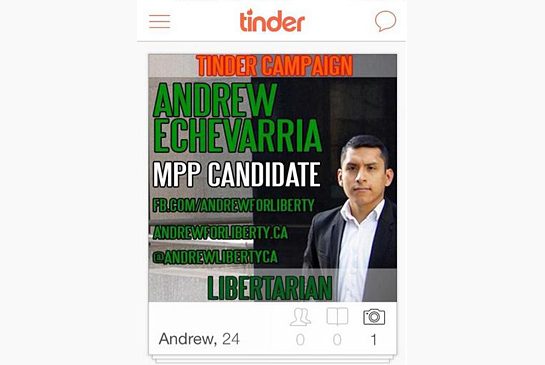
Elect Tim Moen – “I want gay married couples to be able to protect their marijuana plants with guns”
The Libertarian Party of Canada has risen from the dead (again). Here’s the federal candidate for the Alberta riding of Fort McMurray-Athabasca:

Vincent McDermott reports for Fort McMurray Today:
Libertarian party candidate Tim Moen wants gay married couples to have the right to protect their personal marijuana plants with guns.
That’s one of the many slogans Moen, a captain with the Fort McMurray Fire Department and freelance videographer, is posting online as a federal byelection in the region approaches.
“To me, that meme is the message of classical liberalism and the philosophy of liberty,” he says.
“People should be allowed to marry whoever they want, put what they want into their bodies as long as no one is hurt, and protect themselves and their property.”
Moen is the first federal Libertarian candidate to run in the Fort McMurray-Athabasca riding.
The party advocates a platform of no government interference in Canada’s internal social and economic affairs, on the grounds that doing so violates personal liberties and freedoms.
The Libertarian Party of Canada was formed in Toronto in 1973, but has not elected a single member to the House of Commons, nor has it ever gained higher than 0.25% of the popular vote.
[…]
Late last week, the RCMP classified the CZ 858 and the Swiss Arms Classic Green rifle as “prohibited,” meaning gun owners without the proper licensing will now have to surrender the two firearms to local police without compensation.
“Now these people are criminals just because of the property they own,” says Moen.
“Gun control is not about protection, so much as it is about control. We’ve seen what happens in countries that allow these liberties to be eroded and it’s not pretty.”
It also means the party is firmly supportive of LGBTQ rights, open immigration, the legalization of drugs and prostitution — so long as it’s between consenting adults. It also views pollution as a violation of property rights.
“The memes show we care about issues the left likes and issues associated with the right. It doesn’t have to be one or the other,” says Moen. “You don’t have to stay in one group. It’s not about left versus right. It’s about bringing a message of hope.”
Moen’s platform can be viewed at votemoen.ca, or on his Facebook page, Tim Moen for Parliament.
Full disclosure: I was active in both the LPC and the Ontario Libertarian Party through the late 70s and mid-80s.
H/T to Nick Gillespie for the link.
March 5, 2014
QotD: “Truthiness” and the First Amendment
In modern times, “truthiness” — a “truth” asserted “from the gut” or because “it feels right,” without regard to evidence or logic5 — is also a key part of political discourse. It is difficult to imagine life without it, and our political discourse is weakened by Orwellian laws that try to prohibit it.
After all, where would we be without the knowledge that Democrats are pinko-communist flag-burners who want to tax churches and use the money to fund abortions so they can use the fetal stem cells to create pot-smoking lesbian ATF agents who will steal all the guns and invite the UN to take over America? Voters have to decide whether we’d be better off electing Republicans, those hateful, assault-weapon-wielding maniacs who believe that George Washington and Jesus Christ incorporated the nation after a Gettysburg reenactment and that the only thing wrong with the death penalty is that it isn’t administered quickly enough to secular-humanist professors of Chicano studies.
Everybody knows that the economy is better off under [Republican/Democratic]6 presidents — who control it directly with big levers in the Oval Office — and that:
President Obama is a Muslim.
President Obama is a Communist.
President Obama was born in Kenya.
Nearly half of Americans pay no taxes.7
One percent of Americans control 99 percent of the world’s wealth.
Obamacare will create death panels.
Republicans oppose immigration reform because they’re racists.
The Supreme Court is a purely political body that is evangelically [liberal/conservative].8All of the above statements could be considered “truthy,” yet all contribute to our political discourse.
5. Wikipedia.com, Truthiness, http://en.wikipedia.org/wiki/Truthiness (last visited Feb. 28, 2014) (describing the term’s coinage by Stephen Colbert during the pilot of his show in October 2005). See also Dictionary.com, Truthiness, http://dictionary.reference.com/browse/truthiness (last visited Feb. 28, 2014).
6. Circle as appropriate.
7. 47 percent to be exact, though it may be higher by now.
8. Again, pick your truth.Ilya Shapiro and P.J. O’Rourke, BRIEF OF AMICI CURIAE CATO INSTITUTE AND P.J. O’ROURKE IN SUPPORT OF PETITIONERS, Susan B. Anthony List v. Driehaus [PDF], 2014-02-28