
Our key insight is a pessimistic one: this is the sort of situation which, though individuals and markets don’t handle it well, isn’t actually handled well by governments either. The fundamental mistake of statist thinking is to juxtapose the tragically, inevitably flawed response of individuals and markets to large collective-action problems like this one against the hypothetical perfection of idealized government action, without coping with the reality that government action is also tragically and inevitably flawed.
The implicit burden of the article, after all, is indignation that the government has been done too little and the wrong things. What the author fails to grasp (because his thinking is warped by the religion of state-worship) is that this sort of dysfunction is not a sporadic accidental failure that could be corrected by sufficiently virtuous thoughts and deeds; it is an essential failure, entirely predictable from the incentives operating on all the actors (including the actors within government).
His sort of fantasy thinking implicitly throws a burden of proof on anarchists to construct a perfect response to something like the Deepwater Horizon disaster in a stateless system, or else have their critique of statism dismissed as heartless and inadequate. But the correct analysis is to notice that we can only do what we can only do, and compare the rationally expectable effectiveness of flawed government action against the rationally expectable effectiveness of flawed individual and market action.
The second level of error, once you get this far, is to require that the market action achieve a better outcome without including all the continuing, institutional costs of state action in the accounting. So, for example, other parts of the continuing costs of accepting state action to solve this individual toxic-exposure problem in the Deep Horizon aftermath is that Americans will be robbed every April 15th of five in twelve parts of their income (on average), and be randomly killed in no-knock drug raids. And it’s no use protesting that these abuses are separable from the “good” parts of government as long as you’re also insisting that the prospect of market failures is not separable from the good behavior of markets!
Irrational anarchists believe that utopia is somehow achievable in a stateless system; they make the exact reciprocal error from statists, believing that all evil proceeds from government. Rational anarchists like myself know that stateless systems will have tragic failures too, but believe after analysis that they would have fewer and smaller ones.
If this seems doubtful to you, do not forget to include all the great genocides of the 20th century in the cost of statism. It was contemplating those that turned me into an anarchist – because that sort of eruption of fire and blood, too, is not accidental but essential given the logic of state collectivism.
Eric S. Raymond, “Pessimistic anarchism”, Armed and Dangerous, 2010-09-15.
January 14, 2021
QotD: Collective-action problems – perfect state response versus flawed private responses
January 13, 2021
Driving people offline will break essential political feedback loops
Larry Correia on the ongoing purge of Trump supporters from many social media networks:
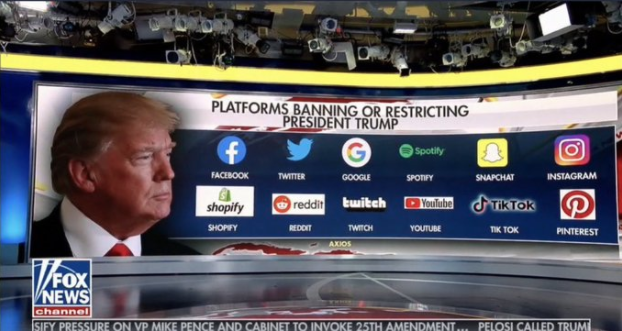
Screencap of a Fox News report on the social media networks that have deplatformed President Donald Trump, January 2021.
For all of history when people have a problem they have been able to talk about it and hash it out. Solutions to complex problems don’t spring fully formed into existence the instant you note the problem. You get ideas from others. Their perspectives help you better articulate the issue and recognize consequences you didn’t expect.
Lawyers know law, engineers know engineering, artists know art, so on. So when there is a big problem that spreads across multiple fields, of course you need to talk it over with people who know those areas, because they know things you don’t. Being smart in one area doesn’t automatically make you an expert in others. We all need help. Big problems require discussion and brainstorming. Even if it isn’t effective, it’s still useful for the clever people who can make solutions to be able to listen to what the regular populace thinks and feels so that they can get the scope and understand how the problem hurts the public.
In the old days these conversations happened at churches, taverns, colleges, that kind of thing. All the famous places where big solutions to big problems were hashed out have a historical marker on them today. For us, those things are now illegal or stifled and we get the internet.
So of course the people who don’t see the problems as problems — or sometimes they are the problem — are trying to stop the rest of us from discussing the problems or they are trying to control where and how the conversations happen. Since they benefit from the problem, they will squash or sabotage people talking about solutions. It is in their best interests to do so, and when you give a bully a stick, they will beat you with it.
The topic of the current problem isn’t the important thing. This is our public square now whether we like it or not. We have foolishly abdicated the public square and now we are paying the price. Of course they can’t just let people they don’t like converse. That’s dangerous to their positions.
So when information they don’t like appears, they hide it. If they can’t hide it, they “fact check” it, and often that’s just a headline screaming false followed by an article full of straw grasping excuses they know most people won’t read. The goal is to shut you up or discredit you.
In the old days, at your pub or church, your drinking buddies or co-religionists probably shared your concerns and faced the same problems. So at least you were working toward a common goal. But now, big tech doesn’t want that. They don’t like groups or forums that don’t share their orthodoxy. They want/need to keep you here, and they need strangers to constantly kick in the doors and blunder in to tell you that you are stupid or crazy, that way we waste time arguing with them. It used to be a village had one idiot. When we talk now we get to deal with a thousand villages worth of idiot.
January 2, 2021
This is the dawning of the Age of the Putz
At least, that’s how David Warren sees it:

“Covid 19 Masks” by baldeaglebluff is licensed under CC BY-SA 2.0


… the spirit of Resolution has been dying in our society, and that is among the principal reasons that our public life has been down-trending. It is what we may call the Age of the Putz, using the term with its full Yiddish vigour, yet in English where we may say it in the presence of women and children. Yes, it means stupid, foolish, worthless, idle and so forth. But as I understand, at the fulcrum, it means “easy to swing around.” It means being led by one’s rope, as it were. A putz (understandably confused with a schmuck, or a nebbish) does what he has been told by the authorities, and oddly like the brave, he does not hesitate. But this is because he can’t endure pain. He can be agreeable, yet without charm. (Reader warning: my Yiddish may be defective.)
This would be acceptable, in the sense that there is nothing we can do about a putz — he has already surrendered — but a line must be drawn somewhere, if only for our own edification. This is where, in current jargon, we cross over from a putz, to a Karen. In my apartment building alone, there must be a dozen who have made this “transition.”
They are the ones who think they will die, if you’ve forgotten your bat-muzzle, or threaten to step within seventy inches of them, in an elevator. They may appear to be making a threat, by the shrieks of complaint they utter, but really it is only fear. It is, to be plain, the opposite of Resolution. The authorities, taking them for putzes, have easily instilled the “public health” terror, with “science” they have made up, and may yank them here or there as they want.
Could I make videos, I would record a snide little number that composed itself in my head, last May (when we were only two months into “fifteen days to flatten the curve”). It was entitled, “You’re Going To Kill People!” The dance component was a variation on the hippie-days twist, in which Walmart shoppers try to stay two feet clear of each other, while looting modest consumer durables.
December 7, 2020
QotD: American politics as “the playoffs”
Libertarians should stop thinking of parties as teams and think of them instead as the playoffs. In NFL football terms, The Democrats are the AFC and the Republicans the NFC. To get into the Superbowl, you have to survive the season and the playoffs in your respective conference. In effect, Libertarians want to form their own league which no one but themselves is interested in watching. And they assure themselves of never making the playoffs much less the Superbowl.
Randy Barnett, “Parties Are Not Sports Teams — Parties are the Playoffs”, The Volokh Conspiracy, 2005-02-24
December 4, 2020
Canada used to have a “none of the above” option in federal elections … let’s bring it back
David Warren describes how the “returned ballot” functioned as a “none of the above” vote in Canadian federal elections:
“2019 Canadian federal election – VOTE” by Indrid__Cold is licensed under CC BY-SA 2.0
Back to the polling station, where the electoral officer is now passing me a ballot, with a hint on how to make an X on it. I am directed to a voting stall.
But I refuse to go there. Instead, I turn earnestly to the officer and say: “I am returning this ballot.”
Chances were, even decades ago, he would be thrown into confusion. So one would explain his job to him. He was supposed to have a book, entitled “Returned Ballots.” Into this he was supposed to transcribe one’s name and address. Getting into the book was one’s only way to avoid the secret ballot. But it was important to get in, to be recorded correctly, rather than as a “spoilt ballot,” as one is counted now if one’s ballot has no X.
After voting, I would check the result, and if not even one returned ballot had been recorded, I could doubt it was legitimate.
Now comes the good part. For returned ballots were supposed to be a separate category in the election tally. It was competing with all the other candidates. If it won a plurality — more returned ballots than the leading candidate — the election was to be formally thrown out, and a by-election called, in which none of the candidates for the thrown out one were allowed to run again. Too, voters could “theoretically” do this over and over, until at least one Party chose a candidate we could stomach.In theory, this was an excellent way for voters to “drain the swamp,” directly, by eliminating the political sleaze in successive groups. In practice — aheu — it was never used. The political sleaze nevertheless spotted the possibility, and had it taken off the books, at both Dominion and Provincial levels. What can I say? They are sleaze.
So the first thing we must do is campaign for the return of the returned ballot, up here; and for its institution in all the other Western nations. Then the second is to impartially, but massively, campaign for its use. It could be the greatest thing since the ancient Athenian ostracon.
November 21, 2020
Brendan O’Neill: My Beef With Millennials
Independent Man
Published 13 Aug 2017Original Video: https://www.youtube.com/watch?v=iV5Qv…
PATREON: https://www.patreon.com/independentman
IM SHOP: https://shop.spreadshirt.com/INDEPEND…
PayPal: https://www.paypal.me/IndependentMan
TWITTER: https://twitter.com/Independt_Man
MINDS https://www.minds.com/IndependentMan
VIDME: https://vid.me/independentman
November 20, 2020
QotD: Tolerance
Tolerance represents a mutual compact to which the state itself is a party. And its minimalism is an important feature. Tolerance does not ask you to approve of gay people, or to like atheists, or to appreciate a jaunty Sikh turban, or to trust a redhead. It insists only that you treat them as humans and fellow citizens — equal to yourself in legal endowments and social entitlements, and most particularly in the right to be left alone.
Tolerance means you do not persecute; you do not abuse; you do not commit or threaten violence. It is a restriction on behaviour, above all, or, more broadly, on conduct: it is not a test of one’s disposition, private opinions or feelings.
Colby Cosh, “‘Can we stop talking about tolerance?’ Lord, I hope not”, National Post, 2018-08-23.
November 17, 2020
Cancel culture comes for Donald Trump’s lawyers
Mark Steyn reported yesterday that the Lincoln Project’s latest doxxing has been successful and that a law firm representing President Trump in one of his Pennsylvania suits has been intimidated into withdrawing from the case:
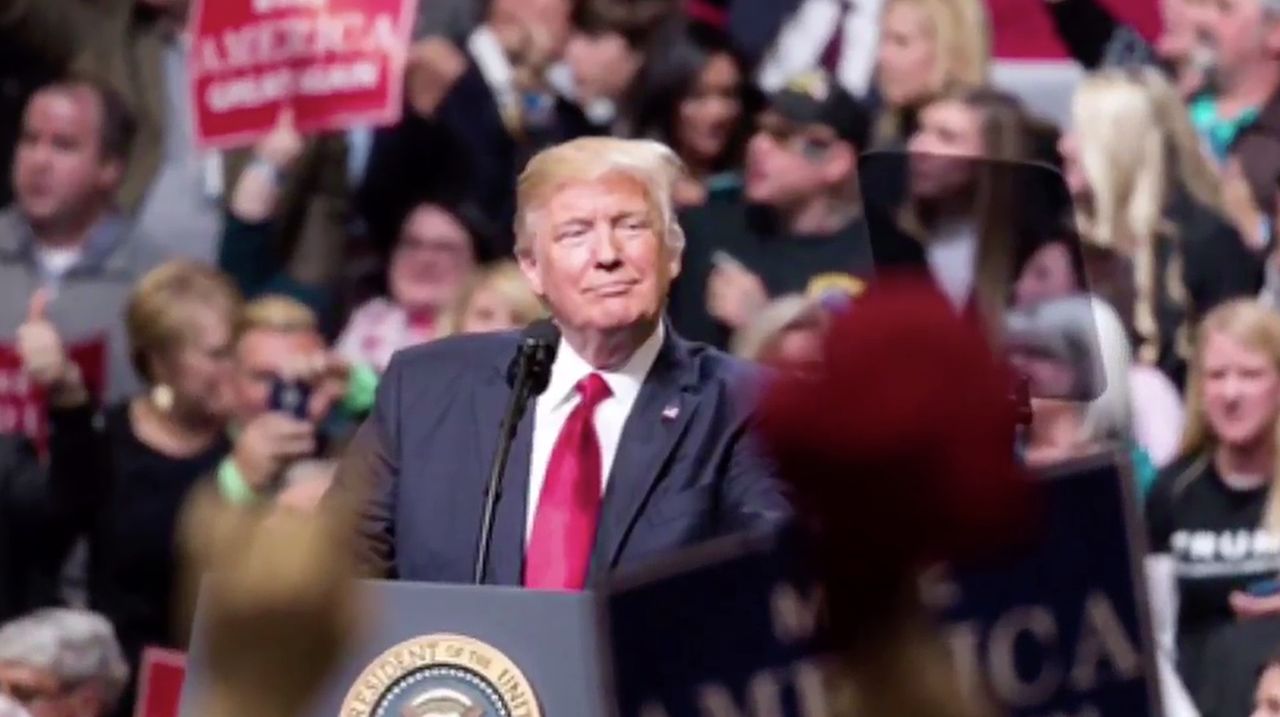
Donald Trump addresses a rally in Nashville, TN in March 2017.
Photo released by the Office of the President of the United States via Wikimedia Commons.
Back in the summer I mentioned on The Mark Steyn Show that “cancel culture” was increasingly literal: It used to mean you got kicked off Twitter or Facebook; then it progressed to losing your job or television show or book contract. By 2020 it had advanced to being denied domain registration on the Internet, credit-card services, bank accounts and other basic necessities of modern life. Now, in a country with more lawyers than the rest of the planet combined, the supposedly “most powerful man on earth” wakes up and finds his counsel just canceled:
Lawyers with Porter Wright Morris & Arthur LLP submitted a filing late Thursday stating they were withdrawing as counsel in a federal suit seeking to block Pennsylvania from certifying its vote. No reason was given. In a statement issued Friday, the firm confirmed the filing but did not say why it was exiting the case.
Powerline‘s John Hinderaker reckons the reason is pretty obvious:
Porter Wright is a mid-sized law firm with offices in eight cities across the country. But apparently it lacked the courage to stand up against the Twitter mob. The “Lincoln Project” doxxed the two Porter Wright lawyers who signed the Pennsylvania complaint, tweeting their pictures, addresses and telephone numbers, and encouraging leftists to harass them. Reportedly there also were employees at the law firm who objected to representing President Trump. Porter Wright’s abandonment of its client is shameful conduct for which I suspect it will receive little but praise.
[UPDATE: A Powerline reader with knowledge of the situation says that Porter Wright has withdrawn from only one of five suits.]
As John points out, in America everybody from 9/11 plotters to celebrity pedophiles, Boston bombers to Oscar-winning serial rapists gets hotshot law firms and nobody bats an eyelid. But not Donald J Trump, who is apparently unfit for legal representation.
If you like the sound of all that “unity” and “healing”, this is what it boils down to — unity in the sense the Soviets meant it: the absence of opposition. And, when they’re done with Trump, they’re serious about that “Truth & Reconciliation” enemies list. To reiterate a point I’ve made for months: on free speech and related issues, things are going to head south very fast. I carelessly assumed they’d wait till the inauguration, but it seems “the Office of the President-Elect” is already on the case.
“We are so well off here in the United States that our poverty line begins 31 times above the global average. Thirty. One. Times.”
Alyssa Ahlgren ponders the fact that we North Americans take our unprecedented-in-human-history prosperity very much for granted:
I’m sitting in a small coffee shop near Nokomis trying to think of what to write about. I scroll through my newsfeed on my phone looking at the latest headlines of Democratic candidates calling for policies to “fix” the so-called injustices of capitalism. I put my phone down and continue to look around.
I see people talking freely, working on their MacBooks, ordering food they get in an instant, seeing cars go by outside, and it dawned on me. We live in the most privileged time in the most prosperous nation and we’ve become completely blind to it. Vehicles, food, technology, freedom to associate with whom we choose.
These things are so ingrained in our American way of life we don’t give them a second thought. We are so well off here in the United States that our poverty line begins 31 times above the global average. Thirty. One. Times. Virtually no one in the United States is considered poor by global standards. Yet, in a time where we can order a product off Amazon with one click and have it at our doorstep the next day, we are unappreciative, unsatisfied, and ungrateful.
Our unappreciation is evident as the popularity of socialist policies among my generation continues to grow. Democratic Congresswoman Alexandria Ocasio-Cortez recently said to Newsweek talking about the millennial generation, “An entire generation, which is now becoming one of the largest electorates in America, came of age and never saw American prosperity.”
Never saw American prosperity. Let that sink in. When I first read that statement, I thought to myself, that was quite literally the most entitled and factually illiterate thing I’ve ever heard in my 26 years on this earth. Now, I’m not attributing Miss Ocasio-Cortez’s words to outright dishonesty. I do think she whole-heartedly believes the words she said to be true. Many young people agree with her, which is entirely misguided. My generation is being indoctrinated by a mainstream narrative to actually believe we have never seen prosperity. I know this first hand, I went to college, let’s just say I didn’t have the popular opinion, but I digress.
Let me lay down some universal truths really quick. The United States of America has lifted more people out of abject poverty, spread more freedom and democracy, and has created more innovation in technology and medicine than any other nation in human history. Not only that but our citizenry continually breaks world records with charitable donations, the rags to riches story is not only possible in America but not uncommon, we have the strongest purchasing power on earth, and we encompass 25 percent of the world’s GDP. The list goes on.
November 7, 2020
QotD: “Hate speech”
It is, of course, fatal to humour, if enforced and persisted in. For one vital quality of humour is inequality, and striking visual, aural, and physical differences. Differences in sex, age, colour, race, religion, physical ability, and strength lie at the source of the majority of jokes since the beginning of human self-consciousness. And all jokes are likely to provoke discomfort if not positive misery among those laughed at. Hence any joke is liable to fall foul of those laws. The future for humourists thus looks bleak, at the time I write this. The ordinary people like jokes, often crude ones, as George Orwell pointed out in his perceptive essay on rude seaside picture postcards. But are ordinary people, as opposed to minor officials, in charge any more? Democracy doesn’t really seem to work, and people are insufficiently dismayed at its impotence.
Paul Johnson, Humourists: From Hogarth to Noël Coward, 2010.
November 1, 2020
QotD: Trumbo
And it was. Needless to say, the movie made villains of the conservatives who opposed the Marxist infiltration: people like John Wayne and Hedda Hopper in particular, Wayne because Wayne, and Hopper because she had a son serving in the U.S. Navy during the Korean War. Of course Wayne was made out to be a bully and Hopper a vindictive bitch — and the Senators and Congressmen who haled the Commies in front of the Senate and House Un-American Committee (HUAC) were depicted as ideological purists who saw Communists behind every bush — even though, in the case of Hollywood, there were Commies behind every bush at the time.
Of course, much was made of the fact that being a Communist wasn’t actually illegal (then, and now), and Trumbo made a great show of this being a First Amendment issue — which it was — and how these Commies all wanted to improve America, but of course there were evil right-wingers like Wayne, Joe McCarthy and HUAC harassing them at every turn.
The execution of the traitors Julius and Ethel Rosenberg got a little puff piece in the movie, which didn’t — couldn’t — actually say they weren’t guilty of
treasonespionage, so it was brushed over with the throwaway that it was the first execution for espionage in peacetime, as though peacetime should give espionage a pass. And if that wasn’t enough, the Rosenberg children were paraded around as sympathy magnets — as they still are — because Communists have no problem using children to serve their own purposes.Kim du Toit, “Blacklists Matter”, Splendid Isolation, 2020-07-28.
October 20, 2020
The watchful algorithms of the Nanny State’s AI tools
David Warren considers the evolution of the Nanny State’s arsenal of technological surveillance (supplemented by the Karenstapo):

While it is not in my interest, currently, for gentle reader to get off the Internet, the idea must have occurred to him. In times like these, why put yourself under watch from Big Brother (or, Big Sibling, as he might prefer)? Why surround yourself with his electronic eyes, the way I am presently surrounded by jackhammers?
Granted, Nanny State was devising ways to track its citizens, and to exercise “crowd control,” long before the Internet was invented. But we had the advantage with them, for they were incompetent, often laughably inept. However, Internet-plus-meejah-plus-activists-plus-Guvmint makes a more capable adversary.
I am not recommending a systematic withdrawal from the world. That is for people with a religious calling, or some grave eccentricity. Rather I am thinking of self-defence, in the spirit of buying a gun. Of course, I am writing from Canada, one of the countries where owning a gun is more-or-less illegal; as is any other form of self-defence. (“When seconds count, the police will be here in minutes.”) Though I have noticed that, upcountry, the “No Hunting” signs tend to be used for target practice.
The “other side,” as I see it, which always worked on numbers, now has algorithms. “Artificial Intelligence” can home right in. The Nanny State never took the individual seriously, except when he was offering a threat. Now it is threatened by anything human. It is, as it were, utilitarian in outlook — “the greatest good for the greatest number” — along with other fatuous concepts, unamenable to reason. By its nature, it is positivist, nominalist, relativist, and “idealistic” in a very abstract way.
Whereas we, so far as we are human, take ourselves quite personally. In a clinch, we often prefer our own survival, and the survival of family and friends, to the requirements of a bureaucratic “policy.” That this is “selfish” should be immediately affirmed.
Because the masses are now deprived of a Christian education, they misconstrue the “selfishness” of Christian teaching, which tells us that we ought selfishly to become saints. Our intention should be to get ourselves to Heaven, along with any we know who can be taken with us. But charity is not “selfish,” in ways they understand. Under modern tenets of “multiculturalism,” even fidelity to the old Christian view is decried as a form of selfishness, calling out for persecution. For this is because it is “cultural,” not “multi” — for all the many languages it speaks.
Our enemy wants us to eschew uniqueness, and become instead “diverse” — by which it means homogenized and narrowly interchangeable. Increasingly, this adversary has the means to enforce its arbitrary will.
October 18, 2020
Larry Correia on the danger in allowing Big Tech to decide what speech is and is not allowed to be heard
The recent now-you-see-it, now-you-don’t over allegations that former Vice President Biden’s son used his father’s influence to gain vast sums of money are — ahem — unproven but persuasive. The frantic efforts of companies like Google, Facebook, and Twitter to keep those allegations out of the public eye get Larry Correia very angry:

If social media had banned Obama’s press secretary, and then stopped Diane Feinstein and Chuck Schumer from sharing articles from the New York Times, and then shut down the Obama campaign page nineteen days before his election against Mitt Romney, everyone would have lost their fucking minds. And rightfully so! Because that kind of blatant manipulation of information is evil.
If I put that into a thriller my editor would tell me it was too far fetched. Nobody would buy into such mustache twirling villainy, even if I was writing cyberpunk dystopia.
But Correia, they are private companies and you are usually against meddling in the affairs of private companies, you big hypocrite! Yeah, usually I am, but this is also something new, the likes of which mankind has never seen before, with these entities being the primary exchange of information for BILLIONS of people, so it’s kind of hard to put this thing which didn’t exist before into historical context. Facebook has no real competitors, and it has something like 2.7 billion regular users. With the flick of a switch it can stop a third of the Earth’s population from seeing whatever it doesn’t want them to see. Humanity has never had that before.
That’s real fucking power right there.
Now, unlike most people on the internet, I am not compelled to pretend to be a lawyer who just got my law degree from the University of Internet. Communications law is not my area, and I’m not going to be a Dunning-Krugerand talking about section 230 or whatever.
However, what I do know is that this is some seriously dangerous bullshit, and if we keep going down this road it is going to lead to some very bad ends. Freedom of speech functionally ceases to exist when both sides speak, but only one side is heard. If social media is a forum, then it needs to be an actual forum. If it is functionally a propaganda arm of the DNC, then so be it, but it can’t keep pretending to be something it’s not, while mindfucking the populace.
They are subpoenaing the Twitter CEO to come testify before congress but I expect that to be another utterly useless clown show where dummies ask dumb questions about something they don’t understand to some clever asshole who is just going to lie.
Like most liberty minded people, I have a reflexive dislike for government regulation of the free market. If the government can screw something up, it will. However I doubt I’ll feel that strongly about the sanctity of the free market as I’m being starved to death in a re-education gulag, after conservatives were stupid enough to let a tiny group of control freak statists have absolute power over the whole country’s speech and information.
What we’ve got right now with a handful of organizations having a monopoly over news and knowledge is stupid, getting stupider, and going to end extremely badly.
I don’t give a shit if you are liberal or conservative, the idea of some entity like Google determining what mankind is allowed to know or not know should terrify the shit out of you. Free speech becomes a meaningless concept if only approved speech is ever seen. And if you are cheering this shit on because right now it is helping your team score points against the other team, you are fool. Because once they have that power it is only a matter of time until one of your beliefs ends up on the naughty list too.
(note, that’s not an issue for Kool Aid drinking progs, because they don’t actually have any beliefs beyond GET POWER. It took them less than 24 hours to change “sexual preference” to a bad thing in the dictionary)
The only good thing about this situation is that even though Facebook and Twitter are trying to monopolize the flow of information, they are still bad at it. This week’s attempt at shutting down the New York Post‘s expose will probably go down as the biggest Streisand Effect in history. Their painfully obvious censorship will make far more people pay attention and lend credence to the report. Because after all, they wouldn’t try this hard to squish it, if there wasn’t some meat to it.
October 15, 2020
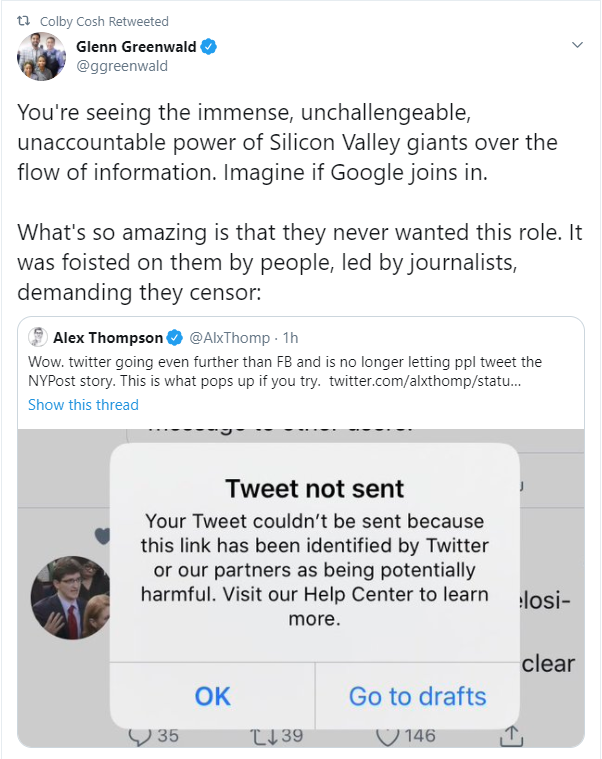
Twitter will now helpfully prevent you from committing thoughtcrime, citizen!
When you appoint yourself the guardian of speech, you quickly become the gatekeeper of all speech:
October 7, 2020
QotD: The gullible generation
For Americans, it meant looking for protection by a political regime so grossly and criminally corrupt that future historians will shake their heads, wondering how an entire people could be such suckers. “The Greatest Generation”, that miserable collectivist mouthpiece Tom Brokaw has called them. Looking back over what my father told me of his life, how his family suffered in the government-caused Great Depression, how he and his comrades risked unspeakable danger in the war, and how he became a prisoner in Germany — all to aggrandize the virtual godhood of Franklin Delano Roosevelt — I call them “The Gullible Generation”.
On the other hand, people loved the Roosevelt Administration so much that they passed a Constitutional amendment to make sure that no sonofabitch could ever be elected to more than two Presidential terms again.
World War II gave government complete, dictatorial control of American society, control of industry, control of communications, control of the economy, control that Roosevelt had desperately lusted after before the war, but failed to achieve. If anyone objected, or insisted on his rights under the Constitution, all the other side had to say was, “Don’t you know there’s a war on?”
The government enjoyed that level of control. Once the war was won, and people looked forward to a period of peace, the government plunged us into the Korean War, Vietnam, and an increasing number of undeclared and stupid conflicts in order to retain its power. “Don’t you know there’s a war on?” never worked quite as well as it had to shut dissenters up, but it’s clear that this scam will go on and on and on until something drastic is done to stop it.
L. Neil Smith, “The Deep State”, Libertarian Enterprise, 2019-04-14.


