Quotulatiousness

January 2, 2015

Debunking the “Broken Windows” theory of crime

Filed under: Law, USA — Tags: , , — Nicholas @ 07:51

In Mother Jones, Kevin Drum looks at the frequent claim on the political right that the “Broken Windows” model of policing was pivotal in reducing urban crime:

The “Broken Windows” theory suggests that tolerance of small acts of disorder creates an environment that leads to rising amounts of serious crime. So if police crack down on small offenses—petty vandalism, public lewdness, etc. — crime reductions will follow. George Kelling was one of the originators of the theory, and NYPD police commissioner Bill Bratton is one of its strongest proponents.

It sounds reasonable, but as Drum points out, it takes credit for improvements that it couldn’t have been driving:

Violent crime 1985-2012So here’s the thing: this is almost certainly wrong. Not even controversial. Just wrong: broken windows policing may well have been helpful in reducing New York’s crime rate, but there’s flatly no evidence that it’s been pivotal. It’s true that crime in New York is down more than it is nationally, but that’s just because crime went up more in big cities vs. small cities during the crime wave of the 60s through the 80s, and it then went down more during the crime decline of the 90s and aughts. Kelling and Bratton can dismiss this as ivory tower nonsense, but they should know better. The statistics are plain enough, after all.

Violent crime big vs small cities 1985-2010Take a look at the two charts on the right. The top one shows crime declines in six of America’s biggest cities. As you can see, New York did well, but it did no better than Chicago or Dallas or Los Angeles, none of which implemented broken windows during the 90s. The bottom chart is a summary of the crime decline in big cities vs. small cities. Again, the trend is clear: crime went up more during the 80s in big cities, but then declined more during the 90s and aughts. The fact that New York beat the national average is a matter of its size, not broken windows.

Now, none of this is evidence that broken windows doesn’t work. The evidence is foggy either way, and we simply don’t know. My own personal view is that it’s probably a net positive, but a fairly modest one.

Works that didn’t enter public domain, thanks to copyright extension

Filed under: Books, Law, Media, Science, USA — Tags: , , , — Nicholas @ 02:00

The Center for the Study of the Public Domain (at Duke Law), lists some of the better-known works that should have become public domain in the United States this year, except for the extension of copyright terms:

Works from 1958 that won't enter public domain

Current US law extends copyright for 70 years after the date of the author’s death, and corporate “works-for-hire” are copyrighted for 95 years after publication. But prior to the 1976 Copyright Act (which became effective in 1978), the maximum copyright term was 56 years — an initial term of 28 years, renewable for another 28 years. Under those laws, works published in 1958 would enter the public domain on January 1, 2015, where they would be “free as the air to common use.” Under current copyright law, we’ll have to wait until 2054. And no published works will enter our public domain until 2019. The laws in other countries are different — thousands of works are entering the public domain in Canada and the EU on January 1.

What books and plays would be entering the public domain if we had the pre-1978 copyright laws? You might recognize some of the titles below.

  • Chinua Achebe, Things Fall Apart
  • Hannah Arendt, The Human Condition
  • Isaac Asimov (writing as Paul French), Lucky Starr and the Rings of Saturn
  • Simone de Beauvoir, Mémoires d’une jeune fille rangée (Memoirs of a Dutiful Daughter)
  • Michael Bond, A Bear Called Paddington, with illustrations by Peggy Fortnum
  • Eugene Burdick and William Lederer, The Ugly American
  • Truman Capote, Breakfast at Tiffany’s
  • Agatha Christie, Ordeal by Innocence
  • John Kenneth Galbraith, The Affluent Society
  • Graham Greene, Our Man in Havana
  • Dr. Martin Luther King, Jr., Stride Toward Freedom: The Montgomery Story
  • Claude Lévi-Strauss, Anthropologie Structurale (Structural Anthropology)
  • Mary Renault, The King Must Die
  • Dr. Seuss, Yertle the Turtle and Other Stories
  • T.H. White, The Once and Future King

What a trove of books — imagine these being freely available to students and educators around the world. You would be free to translate these books into other languages, create Braille or audio versions for visually impaired readers (if you think that publishers wouldn’t object to this, you would be wrong), or adapt them for theater or film. You could read them online or buy cheaper print editions, because others were free to republish them. (Empirical studies have shown that public domain books are less expensive, available in more editions and formats, and more likely to be in print — see here, here, and here.) Imagine a digital Library of Alexandria containing all of the world’s books from 1958 and earlier, where, thanks to technology, you can search, link, annotate, copy and paste. (Google Books has brought us closer to this reality, but for copyrighted books where there is no separate agreement with the copyright holder, it only shows three short snippets, not the whole book.) You could use these books in your own stories — The Once and Future King was free to draw upon Sir Thomas Malory’s Le Morte d’Arthur (a compilation of King Arthur legends) because Malory’s work was in the public domain. One tale inspires another. That is how the public domain feeds creativity. Instead of seeing these literary works enter the public domain in 2015, we will have to wait until 2054.

January 1, 2015

It’s. Just. Wrong. Period.

Filed under: Law, Liberty, Military, USA — Tags: , , — Nicholas @ 02:00

Jacob Sullum on the always-hot-button topic of state torture:

In an interview on Sunday, NBC’s Chuck Todd asked former Vice President Dick Cheney if he was “OK” with the fact that a quarter of the suspected terrorists held in secret CIA prisons during the Bush administration “turned out to be innocent.” Todd noted that one of those mistakenly detained men died of hypothermia after being doused with water and left chained to a concrete wall, naked from the waist down, in a cell as cold as a meat locker.

Cheney replied that the end — to “get the guys who did 9/11” and “avoid another attack against the United States” — justified the means. “I have no problem as long as we achieve our objective,” he said.

Charles Fried, a Harvard law professor who served as solicitor general during the Reagan administration, and his son Gregory, a philosophy professor at Suffolk University, offer a bracing alternative to Cheney’s creepy consequentialism in their 2010 book Because It Is Wrong. They argue that torture is wrong not just when it is inflicted on innocents, and not just when it fails to produce lifesaving information, but always and everywhere.

That claim is bolder than it may seem. As the Frieds note, most commentators “make an exception for grave emergencies,” as in “the so-called ticking-bomb scenario,” where torturing a terrorist is the only way to prevent an imminent explosion that will kill many people. “These arguments try to have it both ways,” they write. “Torture is never justified, but then in some cases it might be justified after all.” The contradiction is reconciled “by supposing that the justifying circumstances will never come up.”

December 30, 2014

Tax-splaining a headline

Filed under: Business, Economics, Law, USA — Tags: , — Nicholas @ 03:00

The headline that grabs attention says that a vast number of US corporations pay absolutely no corporate taxes. Tim Worstall explains that this is quite true:

Timothy Taylor has a nice piece here on the subject:

    More than 90 percent of businesses, representing more than one-third of all business activity, in the United States are structured as flow-through entities — businesses that do not pay the corporate income tax, but rather pass profits through to owners who pay tax under the individual income tax.

    We have two (actually, more than two, but this is the distinction that matters to us here) forms of business ownership. The first is the C Corporation, what we all normally think of as a corporation. The second is an S corporation (in taxation, very like a partnership). And the important thing is that C corporations are the only ones that pay the corporate income tax. S corporations don’t: their owners pay individual income tax on the profits. So, if we saw a move from C to S corporations as the method of organisation then we’d see a reduction in corporate income tax paid. But not, possibly, a reduction in total tax paid on business profits.

And that is what seems to have happened at least in part:

    Back in 1980, nearly 80% of business income went to “C” corporations–so named after the applicable part of the tax code that governs them–which are what most of us think of when we think of a “corporation.” Back then, the remaining 20% was almost all sole proprietorships, which were just taxed as individual income. …..(…)…But C corporations now account for only about 30% of all business income. The share going to sole proprietorships hasn’t changed much. But much more corporate income is going to partnership and S corporations….(…)…Back in the 1960s, the corporate income tax often collected 4-5% of GDP. Since about 1990, it has more commonly collected 1-2% of GDP. Part of the reason is that a smaller share of business income is flowing through the conventional C corporation form.

That really is a large part of the explanation. It’s not that business profits are not being taxed, it’s that they’re being taxed in a different way. And that explains much of the fall in the corporate income tax revenues: and all too few people are over on the other side looking at the increase in individual income tax payments stemming from corporate profits.

So a legal change has drawn a lot of corporations to change how they are structured, so that profits are taxable in the hands of their individual owners, rather than in the imaginary hands of the corporate person. And another US tax quirk explains even more of the headline:

There is another point to be made here, about how we measure the share of corporate profits in the US economy. This has very definitely risen, this is absolutely true. And the tax bill hasn’t, that’s also true. A goodly part of the explanation is the above, about C and S corporations. But there’s this one more thing. Profits in the US economy includes all profits made in the US, by both Americans and foreigners. But it also includes foreign profits made by US corporations. Those tens of billions being made abroad by Google and Apple, Microsoft, they’re all included in the US profit share. And as we also know, those foreign profits aren’t paying the US corporate income tax because, entirely legally, they’re being used overseas to reinvest in those foreign businesses. My stick my finger in the air estimate of the difference those profits make is about 2% of US GDP. Meaning that if we measure US profits as 10% of GDP, then look at tax payments, we’re only seeing the tax payments from 8% of GDP (before we even look at the C and S corporation thing).

December 28, 2014

Edward Luttwak on Napoleon’s modernization of European law

Filed under: Europe, France, History, Law, Liberty — Tags: , — Nicholas @ 12:19

In the London Review of Books, Edward Luttwak starts his review of Britain against Napoleon: The Organisation of Victory, 1793-1815 by Roger Knight by contrasting British and European views of Napoleon’s legacy:

I can recall few heated arguments with my father, but I remember very well our Napoleon quarrel. After two years at a British boarding school, I had learned a fair amount of English and just about enough history to mention Wellington and Waterloo as we were approaching Brussels on a drive from Milan. To my great surprise, my father burst out with a vehement attack on ‘the English’ for having selfishly destroyed Napoleon’s empire. Wherever it had advanced in Europe, modernity had advanced with it, sweeping away myriad expressions of obscurantism and hereditary privilege, emancipating the Jews and all manner of serfs, allowing freedom of, and from, religion, and offering opportunities for advancement for the talented regardless of their origins. I do not recall his actual words, and he would hardly have put it as I have here, but that was certainly his meaning, and I remember his equal-opportunity quotation: ‘Every French soldier carries a field-marshal’s baton in his knapsack.’ I also remember his explanation of the reason he accused the English of being ‘selfish’: Great Britain was already on its way to liberty and did not need Napoleon, but Europe did, and Britain took him away.

In other words, for Jozef Luttwak of Milano, formerly of Arad, Transylvania, as for many others on the Continent (and not only the French), all the wars of Napoleon, all his victories, counted for little in evaluating the man and his deeds. What counted was the progressive moderniser, the law-giver of the Code Napoléon of 1804, actually the Code civil des Français, which was really a civil code for Europeans, since Napoleon’s empire français extended across the Low Countries to Jutland and into northwest Italy, and took in the ex-Papal States and Dalmatia (as Illyria), adding up to a good part of Western Europe. Nor was Napoleon’s Code as ephemeral as his victories. It endures as the core of civil law not only in France but in its former European possessions, and their former possessions too, encompassing ex-French Africa, all of Latin America and the Philippines by way of Spain, and Indonesia by way of the Netherlands, as well as Quebec and Louisiana.

Even that list understates the influence of the code, and therefore of Napoleon the moderniser. Its text conveyed three powerfully innovative principles whose influence transcended by far its actual legal application, and which no restoration could undo: clarity, so that all could know their rights if they could read, without the recondite expertise of jurists steeped in customary law, with its hundreds of exemptions, privileges and eccentricities; secularism, which inter alia replaced parishes with municipalities, thereby introducing civil marriage, part of an entirely new form of individual and civic existence; and the right to individual ownership of property – which untied the immobilised holders of communal property – and employment free from servile obligations.

It mattered greatly that these revolutionary principles were proclaimed by Napoleon, already a conservative and commanding figure – unlike the revolutionaries of 1789, who could not give an aura of authority to their Declaration of the Rights of Man and of the Citizen, which was itself soon challenged by the more egalitarian 1793 version, with both anyhow rejected by the upholders of privilege. In Napoleon’s vassal states (the Confederation of the Rhine, the Kingdoms of Spain, Italy and Naples, and the Grand Duchy of Warsaw), even where the code was not promulgated it was imitated, as was its drastically new style. Just as the florid convolutions and encrustations of rococo had been replaced by the linear elegance of the empire style, the thickets of customary law that Montesquieu had praised as barriers to despotism – as indeed they were, but only for privileged jurists – were replaced by the utterly systematic code, whose descending hierarchy of books, titles, chapters and sections that devolved into 2281 numbered paragraphs was itself infused with the new spirit of modernity. For Europeans of a liberal disposition, the code was a call to modernise not merely the law but society in its entirety – an impulse that would persist for decades.

December 19, 2014

Rape culture

Filed under: Government, Law, USA — Tags: — Nicholas @ 00:02

Michael Brendan Dougherty on the real rape culture in the United States:

… we don’t have to descend to the netherworld of Greek life to find evidence of an insidious rape culture. There are indeed state-supported institutions where gang rape is used as ritual initiation. There are institutional authorities that meet this culture with indifference or outright support. And we file the poor souls of this system under the heading: deserving victims. We joke in ways that suggest that if these rape victims did not want it, they should never have put on a prison uniform.

In this manner, rape is treated as a feature of our justice system when it happens to prisoners, rather than what it is: another grave crime.

[…]

Statistics on rape are notoriously unreliable. In or out of prison, victims often fear reporting on their assailants. And so the above statistics are likely to underestimate the problem. But we do know that once you include the prison population, men are raped more often in the United States than women.

In prison, men may become the victim of repeated gang rapes. Prisoners can be locked into cells with the men who prey on them. Some live under the constant threat of sexual assault for decades. Their efforts to report their rape are ignored or even punished, both by prison personnel and an inmate culture that destroys “snitches.” The threat of rape is so pervasive it causes some inmates to “consent” to sex with certain prisoners or officers as a way of avoiding rape by others.

Acceptance of prison rape is a stinking corruption. No conception of justice can include plunging criminals into an anarchic world of sexual terror. And obviously it thwarts any possibility of a rehabilitative justice that aims to restore criminals to lawful society. Inmates are not improved or better integrated into society through physical and psychological torture.

December 18, 2014

A mandatory registry that might actually do some good

Filed under: Law, USA — Tags: , , , — Nicholas @ 00:03

At Reason, Ed Krayewski suggests that a Police Offenders Registry might be an excellent start to reduce some of the worst interactions between the police and the public they are supposed to serve:

This week, the Department of Justice announced new guidelines against racial profiling. The changes don’t actually change all that much. As regular incidents of police brutality get more and more mainstream media attention, it’s time for a bold move from the White House.

There’s a moral obligation to keep bad cops off the streets. A job with a police department is not a right and shouldn’t be treated like one. Police unions that push for permissive rules that end up protecting bad cops pose a serious public safety threat. Nevertheless, dismantling them where they’ve taken root is a difficult prospect even in the long-term. There are other ways to keep bad cops off the streets. The federal government, and state governments, ought to create and encourage the use of a police offender registry list. Such a list would register individuals who while employed as law enforcement officers were found unfit for duty or faced serious disciplinary issues they may have resigned to avoid. Just as any other component of comprehensive police reform, this won’t eliminate excessive police violence, but it’s a start.

When actually identified, a surprising (or not) number of officers involved in controversial, high-profile use of force incidents have previously disciplinary history. Officer Daniel Pantaleo, the New York City cop who put Eric Garner in a fatal chokehold, had been previously accused, at least twice, of racially-motivated misconduct, including strip searching a man in the middle of the street and allegedly hitting his testicles. The police union in New York City is among the strongest in the country. When a rookie cop shot Akai Gurley in apparent panic last month, he didn’t think twice to reportedly contact his union rep first. A man lay dying in a stairwell for no other reason that he startled a rookie, and the fact that the officer called his union representative before calling for assistance isn’t shocking enough to lead to the officer’s termination. Even if it were, it would still be impossible to terminate the officer immediately. While all this is happening, the state of New York is on the verge of placing even more of the disciplinary regime that applies to cops under the purview of the police unions.

December 17, 2014

Canadian telcos: “there is no need for legally mandated surveillance and interception functionality”

Filed under: Business, Cancon, Law, Liberty — Tags: , , , — Nicholas @ 07:10

Sounds good, right? Canada’s telecom companies telling the government that there’s no reason to pass laws requiring surveillance capabilities … except that the reason they’re saying this is that “they will be building networks that will feature those capabilities by default“:

After years of failed bills, public debate, and considerable controversy, lawful access legislation received royal assent last week. Public Safety Minister Peter MacKay’s Bill C-13 lumped together measures designed to combat cyberbullying with a series of new warrants to enhance police investigative powers, generating criticism from the Privacy Commissioner of Canada, civil liberties groups, and some prominent victims rights advocates. They argued that the government should have created cyberbullying safeguards without sacrificing privacy.

While the bill would have benefited from some amendments, it remains a far cry from earlier versions that featured mandatory personal information disclosure without court oversight and required Internet providers to install extensive surveillance and interception capabilities within their networks.

The mandatory disclosure of subscriber information rules, which figured prominently in earlier lawful access bills, were gradually reduced in scope and ultimately eliminated altogether. Moreover, a recent Supreme Court ruling raised doubt about the constitutionality of the provisions.

[…]

Perhaps the most notable revelation is that Internet providers have tried to convince the government that they will voluntarily build surveillance capabilities into their networks. A 2013 memorandum prepared for the public safety minister reveals that Canadian telecom companies advised the government that the leading telecom equipment manufacturers, including Cisco, Juniper, and Huawei, all offer products with interception capabilities at a small additional cost.

In light of the standardization of the interception capabilities, the memo notes that the Canadian providers argue that “the telecommunications market will soon shift to a point where interception capability will simply become a standard component of available equipment, and that technical changes in the way communications actually travel on communications networks will make it even easier to intercept communications.”

In other words, Canadian telecom providers are telling the government there is no need for legally mandated surveillance and interception functionality since they will be building networks that will feature those capabilities by default.

December 16, 2014

America’s “terribly warped justice system”

Filed under: Law, Liberty, USA — Tags: , , , , — Nicholas @ 00:03

Conrad Black talks (partly from first-hand experience) of how badly served the United States is by its justice system:

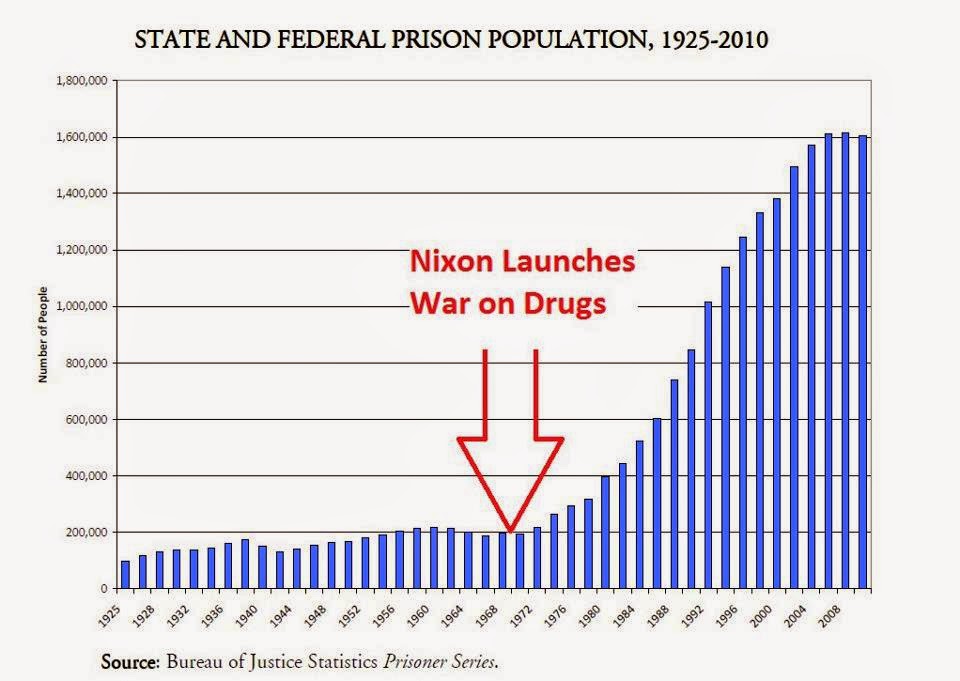
… everyone in the United States, from the president and the wealthiest and most admired citizens down, is, in some measure, a victim of this now terribly warped justice system. No one is safe and everyone pays for it. The legal cartel is riveted on the back of the country like a horse-leech and extracts $1.8 trillion a year from the American economy as the legislators and regulators add 4,000 new measures with weighty sanctions each year, for the delectation of their confrères at the bar. At any time, 1 percent of the entire adult population is incarcerated, at a cost of about $150 billion annually and usually in unconstitutionally inhuman conditions; another 6 or so percent of all adults, male and female, are awaiting conviction (99.5 percent of those tried are convicted, an absurdly implausible number rivaled only by North Korea) or are under supervised release by often pettifogging probation officers at further great cost to the country. There are 48 million convicted felons in the United States, and even if decades-old unstigmatizing offenses such as failing a breathalyzer or being disorderly at a fraternity party are omitted, this means that approximately 15 percent of American adult males are designated felons. This is an absurd and barbarous number achieved by equal-opportunity multi-ethnic injustice, albeit unevenly applied. It presents African Americans a chance to form an invincible coalition in whose victory they would be the principal winners.

Though evidence of police and prosecution abuse pours in through the media every week, the majority of Americans, personally unaffected by the failings of the system, complacently believes that they live in a society of laws envied by the world. Neither supposition is correct. The United States has six to twelve times as many incarcerated people per capita as other prosperous democracies: Australia, Canada, France, Germany, Japan, and the United Kingdom. This appalling state of affairs has developed gradually over the last 40 years, as the percentage of prosecutions resolved by (very often) abusive applications of the plea-bargain system without a trial has risen from about 80 (an unheard of number in other democratic countries) to 97. The percentage of incarcerated people among the population has multiplied by five in that time, so the U.S. today has 5 percent of the world’s people, but 25 percent of its incarcerated people (and 50 percent of its lawyers – counting only those countries in which a serious professional entry course is required to practice that occupation).

The Supreme Court has sat like a shelf of suet puddings while the criminal-justice system has become a conveyor belt to the country’s bloated and corrupt prison system, and lawyers have become an immense industry, hiding its avarice behind a fog of insipid pieties about the rule of law (which, as the phrase was meant by the authors of the Bill of Rights, can scarcely be said to exist in the U.S.). New York federal judge Jed S. Rakoff wrote in the New York Review of Books on November 20 that the traditional American notion of the day in court is “a mirage” because of the corruption of the plea-bargain system, in which inculpatory evidence is extorted from witnesses in exchange for immunity from prosecution, including for perjury. Every week there is some new exposé of horror stories of prosecutorial abuse, yet prosecutors enjoy an absolute immunity, even when it is revealed that they have committed crimes of obstruction of justice, as in the infamous Connick v. Thompson decision of 2011: An innocent man spent 14 years on death row because prosecutors willfully withheld DNA evidence they knew would, and ultimately did, acquit him; the U.S. Supreme Court narrowly overruled the damage award to the wrongfully convicted Mr. Thompson on a spurious technicality.

December 15, 2014

Sony games the copyright laws

Filed under: Business, Law, Media — Tags: , , — Nicholas @ 00:02

At Techdirt, Mike Masnick explains why Sony released only a tiny number of pressed CDs of 1964 musical tracks:

Two years ago we wrote about the very odd release, by Sony, of just 100 copies of a set of previously unreleased Bob Dylan tracks. Why so few? Well, Sony sort of revealed the secret in the name of the title. See if you can spot it:

Bob Dylan - Copyright Extension

Yup. The release had absolutely nothing to do with actually getting the works out to fans, and absolutely everything to do with copyright. You see, back in 2011, despite having absolutely no economic rationale for doing so, the EU retroactively extended copyright on music from 50 years to 70 years. However, there was a tiny catch: there was a “use it or lose it” provision in the law, saying that the music had to have been “released” to qualify for that 20 year extension. Thus, Sony realized with Dylan that it had to “release” (and I use the term loosely) some of its old recordings that had never been officially released, or it would lose the copyright on them.

The other major labels have been doing the same. Last year, there was a series of releases of 1963 music, including more from Dylan, along with some previously unreleased Beatles tunes (at least those were somewhat more widely available). This year, we’re getting a new crop of barely released 1964 songs including (yet again) more from Dylan, along with some from the Beach Boys as well (and some expect more Beatles tunes as well).

December 13, 2014

Tobacco – 480,000. Alcohol – 88,000. Marijuana – > 0

Filed under: Health, Law, Liberty, USA — Tags: , , — Nicholas @ 12:06

It’s ridiculous to claim that smoking marijuana is a healthy habit. It does increase the risk of certain kinds of cancers, although the numbers are not huge, they’re also not zero. Jacob Sullum says “Marijuana Kills! But Not Very Often. Especially When Compared to Alcohol and Tobacco.

In a new Heritage Foundation video, anti-pot activist Kevin Sabet bravely tackles “the myth that marijuana doesn’t kill.” Although cannabis consumers (unlike drinkers) do not die from acute overdoses, he says, “marijuana does kill people” through suicide, chronic obstructive pulmonary disease, car crashes, and other accidents.

I won’t say Sabet is attacking a straw man, since overenthusiastic cannabis fans have been known to say that “marijuana doesn’t kill anyone” (although the top Google result for that phrase is an article by Sabet explaining why that’s not true). But I will say that Sabet manages to obscure the fact that marijuana does not kill people very often, especially compared to the death tolls from legal drugs such as tobacco and alcohol, which is the relevant point in evaluating the scientific basis for pot prohibition. Let’s take a closer look at the four ways that marijuana kills, according to Sabet:

Suicide. Some research does find a correlation between suicide and marijuana use, but that does not mean the relationship is causal. A longitudinal study published by The British Journal of Psychiatry in 2009 reached this conclusion:

    Although there was a strong association between cannabis use and suicide, this was explained by markers of psychological and behavioural problems. These results suggest that cannabis use is unlikely to have a strong effect on risk of completed suicide, either directly or as a consequence of mental health problems secondary to its use.

Furthermore, there is some evidence that letting patients use marijuana for symptom relief reduces the risk of suicide. Still, if reefer has ever driven anyone to kill himself, that would be enough to prove Sabet’s point. You can’t say it has never happened!

Adrian Peterson’s appeal is denied – he won’t be allowed to play this year

Filed under: Football, Law — Tags: , , , — Nicholas @ 10:12

As most dispassionate observers had expected, the arbitrator appointed by the NFL decided that Peterson’s ongoing suspension would continue until at least April 15, 2015. Unlike most dispassionate observers, Vikings fans were rather upset by the ruling:

Arif Hasan discusses the situation here:

After an agonizingly stupid waiting game, the NFL announced that arbitrator Harold Henderson has denied Adrian Peterson’s appeal against the severity of the NFL suspension regarding his incident, which means his suspension is upheld. The suspension is for at least six games will continue into the next season, starting immediately — meaning he will miss at least three weeks to start the 2015 season though right now is technically suspended indefinitely.

In April he will be able to reduce his suspension from indefinite to merely six games (meaning he could be reinstated and play for Week 4 of the 2015 NFL season) end his suspension. Contrary to previous reports, the suspension is for the remainder of the season, not six games. He will need to prove some degree of remorse and complete or make significant progress in parental counseling in order to be reinstated. Peterson will retroactively serve the six-game suspension by paying back the three game checks for the games he was on the Exempt List during his appeal after the ruling, per Ed Werder of ESPN.

Arif also quotes the conclusion of Harold Henderson’s decision with a bit of emphasis added:

The facts in this appeal are uncontested. The player entered a plea which effectively admitted guilt to a criminal charge of child abuse, after inflicting serious injuries to his four-year old son in the course of administering discipline. No direct evidence of the beating was entered in the record here, but numerous court documents, investigative reports, photographs and news reports, all accepted into evidence without objection, make it clear that Mr. Peterson’s conduct was egregious and aggravated as those terms are used in the Policy, and merits substantial discipline. His public comments do not reflect remorse or appreciation for the seriousness of his actions and their impact on his family, community, fans and the NFL, although at the close of the hearing he said he has learned from his mistake, he regrets that it happened and it will never happen again. I reject the argument that placement in the Commissioner Exempt status is discipline. I conclude that the player has not demonstrated that the process and procedures surrounding his discipline were not fair and consistent; he was afforded all the protections and rights to which he is entitled, and I find no basis to vacate or reduce the discipline.

Peterson and the NFLPA may now decide to launch a court action, but there is no way that legal action at this late date will make it possible for Peterson to return to the league before the end of the regular season.

December 12, 2014

Supreme Court swings and misses on cellphone privacy ruling

Filed under: Cancon, Law, Liberty — Tags: , , , , — Nicholas @ 07:00

Michael Geist on the most recent Supreme Court of Canada ruling on the ability of the police to conduct warrantless searches of cellphones taken during an arrest:

The Supreme Court of Canada issued its decision in R. v. Fearon today, a case involving the legality of a warrantless cellphone search by police during an arrest. Given the court’s strong endorsement of privacy in recent cases such as Spencer, Vu, and Telus, this seemed like a slam dunk. Moreover, the U.S. Supreme Court’s June 2014 decision in Riley, which addressed similar issues and ruled that a warrant is needed to search a phone, further suggested that the court would continue its streak of pro-privacy decisions.

To the surprise of many, a divided court upheld the ability of police to search cellphones without a warrant incident to an arrest. The majority established some conditions, but ultimately ruled that it could navigate the privacy balance by establishing some safeguards with the practice. A strongly worded dissent disagreed, noting the privacy implications of access to cellphones and the need for judicial pre-authorization as the best method of addressing the privacy implications.

The majority, written by Justice Cromwell (joined by McLachlin, Moldaver, and Wagner), explicitly recognizes that cellphones are the functional equivalent of computers and that a search may constitute a significant intrusion of privacy. Yet the majority cautions that not every search is a significant intrusion. It ultimately concludes that there is the potential for a cellphone search to be intrusive, it does not believe that that will be the case in every instance.

Given that conclusion, it is prepared to permit cellphone searches that are incident to arrest provided that the law is modified with some additional protections against invasion of privacy. It proceeds to effectively write the law by creating four conditions: a lawful arrest, the search is incidental to the arrest with a valid law enforcement purpose, the search is tailored or limited to the purpose (i.e., limited to recent information), and police take detailed notes on what they have examined and how the phone was searched.

December 11, 2014

David Friedman on the historical uses of torture in legal situations

Filed under: Greece, History, Law — Tags: , , — Nicholas @ 06:50

David Friedman discusses a few of the legal systems under which torture was not only possible, but omnipresent:

The use of torture to extract information is not a new idea. Under both Athenian and Roman law, slave testimony could only be taken under torture. Presumably the theory was that slaves were interrogated in order to get evidence against their owners, the owner had ways of putting pressure on the slave, so torture was needed to get the slave to tell the truth. In Imperial Chinese law, not only the defendant but also witnesses could be tortured. In that system, and I think also in some legal systems of medieval and renaissance Europe, a defendant could only be convicted by his own confession. Torture was one way of getting it.

The argument against torture, that the victim will say whatever he thinks will end it whether true or false, is also old — people in the past were not stupid. Our main source of information on Athenian law consists of orations written by professional orators to be memorized by a party to a law suit in a legal system where there were no lawyers and each party had to represent himself. There is one oration which claims that slave testimony under torture is perfectly reliable, that there has never been a case where it turned out to be false. There is another making the obvious argument on the other side, that such testimony is worthless since the slave will say whatever the torturer wants him to say.

They were both written by the same orator.

People in other legal systems that used torture were also aware of the problem. There is a collection of Chinese cases compiled in the 13th century for the use of magistrates. Many of them are cases where a clever judge realizes that an innocent person has been forced to confess under torture and figures out who is really guilty.

That raises an obvious question — if they saw the problem with torture, why did they continue to employ it? One answer is that extracting information might only have been an excuse, that the real purpose was to punish someone without having first to convict him. That is a possible explanation in some contexts, including the current case of torture by the CIA. But it does not explain contexts where the person being tortured was not the suspect but a potential witness.

A second possible explanation is the belief that a competent interrogator could distinguish a real confession from a fake one. That strikes me as the most likely explanation in the Roman and Athenian cases, where it was the defendant’s slave, not the defendant, who was being interrogated.

A third explanation is that torture might produce information that could be checked. That is the situation in the hypothetical cases sometimes offered in defense of the use of torture — the suspect is being forced to say where the kidnap victim, or the terrorist time bomb, is concealed. More plausibly, to say where the loot is hidden.

“Eyewitnesses” and the human mind

Filed under: Law, Liberty, Science — Tags: , , , — Nicholas @ 00:04

Maggie McNeill discusses some of the problems we encounter when we depend on “eye witness accounts” of events:

If you haven’t yet read my research paper, “Mind-witness Testimony”, you really ought to […] The Reader’s Digest version is:

    … The human mind doesn’t passively record events as a camera does; memory is an active and dynamic process which retains information by fitting it into schemata, mental frameworks which shape our thinking and give meaning to perceptions … The same psychological mechanism which causes us to find pictures in Rorschach’s inkblots also causes us to fit memories into the complex web of schemata by which we interpret the world. And just as we ignore those topological elements of a cloud or inkblot which do not fit the meaning our minds have imposed upon it, so do we forget or distort elements of a memory which fail to conform to the schema in which we have embedded it, or even invent elements which were not in reality present, but which the schema predicts should be…The human mind often completely fabricates memories in order to impose conformity with one’s weltanschauung. One simple example involves police lineups: people will often identify the man whom police imply (subtly or overtly) is their preferred suspect because they believe police to be expert assessors of guilt who would never implicate someone falsely, and this schema of police authority and infallibility actually shapes their memories, sometimes to the point of identifying a person who is later proven to look absolutely nothing like the actual criminal…

In witch hunts of both the classic and modern varieties, hypersuggestible people such as children, the mentally ill, the emotionally needy or the severely traumatized can be induced to “remember” all sorts of fantastic things which are not even physically possible, much less grounded in actual events; when they repeat these “memories” in court (or in front of audiences hungry for “sex trafficking” narratives) they are not lying in the strict sense, but merely playing back a script that was written into their memories by processes such as suggestion, group polarization, stereotypic conformation, guided imagination, abusive interrogation tactics and others discussed in my paper. Though the concept of “recovered memory” has been discredited and most reasonably-well-informed people understand its role in driving the Satanic panic, few have yet connected the dots to recognize “sex trafficking” narratives as produced by the same processes. However, as the public begins to recognize driving the Satanic panic, few have yet connected the dots to recognize “sex trafficking” narratives as produced by the same processes. However, as the public begins to recognize the fallibility of human memory, it’s inevitable that outlandish, evidence-free stories such as those told by Somaly Mam, Chong Kim and Theresa Flores will be treated with greater skepticism.

« Newer PostsOlder Posts »

Powered by WordPress