
The pint in eighteenth-century Paris was equivalent to 0.93 liters, whereas in Seine-en-Montane it was 1.99 liters and in Precy-sous-Thil, an astounding 3.33 liters. The aune, a measure of length used for cloth, varied depending on the material (the unit for silk, for instance, was smaller than that for linen) and across France there were at least seventeen different aunes. […]
Virtually everywhere in early modern Europe were endless micropolitics about how baskets might be adjusted through wear, bulging, tricks of weaving, moisture, the thickness of the rim, and so on. In some areas the local standards for the bushel and other units of measurement were kept in metallic form and placed in the care of a trusted official or else literally carved into the stone of a church or the town hall. Nor did it end there. How the grain was to be poured (from shoulder height, which packed it somewhat, or from waist height?), how damp it could be, whether the container could be shaken down, and finally, if and how it was to be leveled off when full were subjects of long and bitter controversy. […]
Thus far, this account of local measurement practices risks giving the impression that, although local conceptions of distance, area, volume, and so on were different from and more varied than the unitary abstract standards a state might favor, they were nevertheless aiming at objective accuracy. This impression would be false. […]
A good part of the politics of measurement sprang from what a contemporary economist might call the “stickiness” of feudal rents. Noble and clerical claimants often found it difficult to increase feudal dues directly; the levels set for various charges were the result of long struggle, and even a small increase above the customary level was viewed as a threatening breach of tradition. Adjusting the measure, however, represented a roundabout way of achieving the same end.
The local lord might, for example, lend grain to peasants in smaller baskets and insist on repayment in larger baskets. He might surreptitiously or even boldly enlarge the size of the grain sacks accepted for milling (a monopoly of the domain lord) and reduce the size of the sacks used for measuring out flour; he might also collect feudal dues in larger baskets and pay wages in kind in smaller baskets. While the formal custom governing feudal dues and wages would thus remain intact (requiring, for example, the same number of sacks of wheat from the harvest of a given holding), the actual transaction might increasingly favor the lord. The results of such fiddling were far from trivial. Kula estimates that the size of the bushel (boisseau) used to collect the main feudal rent (taille) increased by one-third between 1674 and 1716 as part of what was called the reaction feodale. […]
This sense of victimization [over changing units of measure] was evident in the cahiers of grievances prepared for the meeting of the Estates General just before the Revolution. […] In an unprecedented revolutionary context where an entirely new political system was being created from first principles, it was surely no great matter to legislate uniform weights and measures. As the revolutionary decree read “The centuries old dream of the masses of only one just measure has come true! The Revolution has given the people the meter!”
James C. Scott, Seeing Like A State: How Certain Schemes to Improve the Human Condition Have Failed, 1998.
May 1, 2019
QotD: Standardized measurements, feudalism, and revolution
April 30, 2019
You Will Never Do Anything Remarkable
exurb1a
Published on 28 Apr 2019Illegitimi non carborundum, yo.
So.
The original line was, “If they give you ruled paper, write the other way.” As far as I can tell it’s Juan Ramón Jiménez’s.I am also now painfully aware I’ve written a half as ‘2/1’. Sorry maths.
Please note that this wasn’t intended to be a diatribe against critics or experts. They obviously play an important role. It was more directed at the recreational cynicism one comes across in daily life from time to time, generally pointed at young artists. I have had the privilege to meet plenty of people 1000x more talented than me, who are simultaneously doubting their abilities because of some stupid comment made by an unpleasant teacher or jaded family member.
If you are that artist, I really just wanted to say: You’re in good company; the Greats doubted themselves too. Don’t let the bastards get you down and I hope you make all manner of interesting and fantastic things.
The music is the 3rd movement of Big Baus Brahms’ Violin Concerto in D Major: https://youtu.be/Ev45Knhdlp8
I like that piece lots. I hope you do too.
Again, all the very best of luck in your projects.
Japan’s monarchy
Colby Cosh looks at the astonishingly successful Japanese monarchy over the last few centuries of change:

Emperor Akihito and Empress Michiko at the Tokyo Imperial Palace in Chiyoda Ward, Tōkyō Metropolis on April 24, 2014.
US State Department photo by William Ng, via Wikimedia Commons.
Most everybody knows how the office of the Japanese Emperor became “ceremonial” for the better part of 700 years, and how the archipelago was governed in isolation by what we call the shogunate. The first Westerners who established diplomatic relations with Japan in the 19th century did not think of the Emperor as analogous to Queen Victoria at all. For years they thought of the Mikado as primarily a religious functionary, a sort of pope performing funny, tedious rites in seclusion. (As anyone who has been watching Japanese news in the run-up to Golden Week knows, there is some truth to this.)
Even as reality dawned on those foreign barbarians, their presence in Japan led to social breakdown, civil war, and a sharp, sudden revival of the power of their monarchy — the Meiji Restoration. This is still an awe-inspiring event. Japan was confronted by a little-known and hated outer realm, and was able to adapt with inexplicable confidence. It did not descend into psychic and economic malaise, but almost immediately began to compete with obtrusive Western “powers.” After centuries in abeyance, their constitution somehow allowed them to conjure a enlightened despot of enormous ability, the Meiji Emperor, at the precise moment one was required.
This led in time to the war in the Pacific — and to a second miracle of the same kind. If matters had been left up to American public opinion in 1945, or to the allies of the United States, or even to the American executive branch, the Japanese monarchy would have been abolished and the Emperor given a humiliating trial and death. Such a procedure could have easily been justified then, and can be justified in retrospect now. U.S. foreign policy almost always, in practice, seems to follow the country’s republican instincts.
But while Japan was defeated, it had not been invaded. So Gen. Douglas MacArthur and a few foreign-policy brainiacs reached a magnificent, cynical modus vivendi: they would exploit and reshape the Japanese monarchy rather than smashing it. As a soldier, MacArthur, made Supreme Commander of occupied Japan, would have shot the Emperor with his own sidearm and never lost a minute’s sleep. But he and others somehow managed to overcome racial and political prejudices, and perform an act of American “nation-building” that was not a cruel joke.
The Neurology of Hate – WW2 – WaH SPECIAL EPISODE
World War Two
Published on 27 Apr 2019In this special episode of War Against Humanity, we take a look at the underlying neurological functions that allow us to hate another group of people. Maybe it helps us to understand the ultimate question about WW2; how on earth could all of this happen?
Join us on Patreon: https://www.patreon.com/TimeGhostHistory
Or join The TimeGhost Army directly at: https://timeghost.tvWritten and Hosted by: Spartacus Olsson
Produced and Directed by: Astrid Deinhard
Executive Producers: Bodo Rittenauer, Astrid Deinhard, Indy Neidell, Spartacus Olsson
Creative Producer: Joram Appel
Post Production Director: Wieke Kapteijns
Research by: Spartacus Olsson
Edited by: Spartacus OlssonArchive by Screenocean/Reuters https://www.screenocean.com
A TimeGhost chronological documentary produced by OnLion Entertainment GmbH.
QotD: Successful “democracies” in history have usually been disguised oligarchies
Thus we get the “Revolutions” in America and France, where educated and newly politicised chattering classes try to find a simplistic solution to all the world’s problems. Their solution being to adopt a system which fits their preferred world order, and seems to give them an advantage that will allow them to force people into their way of thinking.
Humans being what they are, it didn’t work of course.
The American Revolution, supposedly about ‘equality for all’ – if you want to fall for idealistic propaganda – was actually a tax rebellion by Northern states (who also wanted to get rid of the English government’s treaties that kept them out of Indian land), and the Southern states (who wanted to block the English anti-slavery legislation from spreading to their nice comfy system). It was never really about equality, and all the exclusions of people from voting on the basis of colour, race, sex, religion, immigration status, etc., should have made it clear to anyone that what was being considered was really an Oligarchy. Similar in fact to the Ancient Greek and Roman slave-based societies, where some special and limited classes shared rights no one else had.
Actually all “successful” democracies in history have always been Oligarchies. The 1,000 year old “Sublime Republic of Venice” – on which large parts of the US constitution were based – for instance, being limited to a certain number of families that had the vote. Similarly the “Republics” of Ancient Greece or Rome, and modern Switzerland or Israel, being based on vote by military service – another way of ensuring the voters might put national interests above selfish ones.
The first few French republics (those squeezed in around the inevitable dictatorships and emperors that are the result of such systems) were also based on a limited franchise. In their case not a race or religion or sex one like the US, but a straight property qualification that saw a small percentage of both sexes as voters.
Unsurprisingly the Oligarchical Republics of the 18th and 19th centuries were some of the most internally violent (US Slavery, Civil War, Indian Wars, the Terror, multiple revolts and “communes”, Lynchings, Jim Crow laws, etc), and externally aggressive (Napoleonic Wars, Spanish–American Wars, “Interventions” in Central America, Occupations of Hawaii, Philippines, etc.) governments in history. Rivaling the Greek and Roman republics for their aggressive expansionism by land and sea, and certainly being no less effective than more traditional military (Russia and Germany) or trade (Britain and Netherlands) expansionist states.
(And here I would note that the one of the mitigating factors in the idea that German Nationalism was a problem in WWI, was that the populist Navy Leagues and Colonial Leagues of the newly enfranchised voting classes did in fact push Nationalism to dangerous extremes. The Kaiser was a dangerous loon, but he was a dangerous loon responding to the fervor of the dregs of the petit bourgeois who had been enfranchised in his nation, not a man with Napoleonic capabilities in his own right.)
Nigel Davies, “The Solution is… European Union/Multiculturalism/Communism… Name your poison!”, rethinking history, 2015-12-26.
April 29, 2019
Queen Nzinga – Rise of a Legend – Extra History – #1
Extra Credits
Published on 27 Apr 2019Nzinga didn’t start out as a queen — but when she saw how incompetently her brother was running affairs in Ndongo (what would become Angola), she took advantage of his decision to send her to negotiate with the Portuguese — much to his grief later. Nzinga established herself against colonial forces and did not budge.
Queen Nzinga of the Ndongo and Matamba Kingdoms, a scion of the Mbundu people, will spend forty years standing between the Portuguese and their ambitions, using everything at her command — her cunning, her ruthless intellect, her military acumen, even the bodies of her people — whatever it takes to succeed.
Thanks again to Cassandra Khaw for guest-writing this mini-series!
Join us on Patreon! http://bit.ly/EHPatreon
System of a Nazi Terror – WW2 – WaH 002 – April 1940
World War Two
Published on 27 Apr 2019In April 1940 in Poland, if you are on the list of Nazi or Soviet non-desirables, there three options: run for your life, be shipped off to a camp, or face the execution squad… if you happen to be Jewish it’s likely to be the fourth option: the Ghetto.
Neurology of Hate Special: https://youtu.be/yeZ3_OtDa7E
Join us on Patreon: https://www.patreon.com/TimeGhostHistory
Or join The TimeGhost Army directly at: https://timeghost.tvFollow WW2 day by day on Instagram @World_war_two_realtime https://www.instagram.com/world_war_t…
Source list: http://bit.ly/WW2sourcesWritten and Hosted by: Spartacus Olsson
Produced and Directed by: Astrid Deinhard
Executive Producers: Bodo Rittenauer, Astrid Deinhard, Indy Neidell, Spartacus Olsson
Creative Producer: Joram Appel
Post Production Director: Wieke Kapteijns
Research by: Spartacus Olsson
Edited by: Wieke KapteijnsArchive by Screenocean/Reuters https://www.screenocean.com
A TimeGhost chronological documentary produced by OnLion Entertainment GmbH.
From the comments:
World War Two
4 hours ago
Now… this is a tough episode. It’s also tough to illustrate with images. Many of the events we speak of were, for obvious reasons not documented at the time. As a result we have had to resort to using some imagery that is from later dates when similar events, or the aftereffects of these events were documented on film and photo. We have labeled these images as best we can when it is relevant. Last but not least… do please remember our rules, especially on an episode like this one. Respect the dead and never forget that the only way we can do them justice is to remember their loss and sacrifice.
April 28, 2019
Norway is Burning – WW2 – 035 – April 27 1940
World War Two
Published on 27 Apr 2019The invasion and subsequent Battle of Norway has only just begun when the British decide to pull back. Poor planning and misfortune after misfortune harms the British campaign, which becomes very apparent this week while the fighting continues. Almost everywhere, except for in the far north, the Allied troops pull back under heavy German pressure.
Join us on Patreon: https://www.patreon.com/TimeGhostHistory
Or join The TimeGhost Army directly at: https://timeghost.tvFollow WW2 day by day on Instagram @World_war_two_realtime https://www.instagram.com/world_war_t…
Join our Discord Server: https://discord.gg/D6D2aYN.
Between 2 Wars: https://www.youtube.com/playlist?list…
Source list: http://bit.ly/WW2sourcesWritten and Hosted by: Indy Neidell
Produced and Directed by: Spartacus Olsson and Astrid Deinhard
Executive Producers: Bodo Rittenauer, Astrid Deinhard, Indy Neidell, Spartacus Olsson
Creative Producer: Joram Appel
Research by: Indy Neidell
Edited by: Iryna Dulka
Map animations: EastoryColorisations by Norman Stewart and Julius Jääskeläinen https://www.facebook.com/JJcolorization/
Eastory’s channel: https://www.youtube.com/channel/UCEly…
Archive by Screenocean/Reuters https://www.screenocean.comSources:
© IWM (HU 74922)
© IWM (HU 104678)
© IWM (A 22641)
© IWM (TR 209)
© IWM (N 97)
© IWM (A 1873)
© IWM (N 102)
© IWM (HU 104688)
© IWM (Q 88619)
© IWM (N 107)
© IWM (Q 92253)
© IWM (HU 91803)National Army Museum (NAM), 1984-10-79-.
A TimeGhost chronological documentary produced by OnLion Entertainment GmbH.
The Battle of Lützen – 1632 – The 30 Years War (in Swedish, with English sub-titles)
Gripen
Published on 3 Dec 2015One of the bloodiest battles of the Thirty Years War. Sweden vs. the Holy Roman Empire. A mass grave has been found, with the victims from the battle. Are they Swedish/Finnish soldiers or German mercenaries?
(This Swedish documentary has English subtitles).
From the comments:
Blah b
2 years ago
This documentary is often painful to watch, the way inexperienced modern people with no sense of empathy project their values onto those times. They weren’t “defenseless men standing still”. Armies had learned the hard way that massed musket fire won battles. If everybody is looking for cover and looking out for themselves, you can never operate such rigid units.So the individual soldier was harshly drilled to indeed stand still even with cannonballs tearing through his unit, or another unit standing 30-80 meters away. Because if individuals acted as individuals, the battle would be lost and the army would be destroyed.
But when that machine operated, it would win battles. The system invented by Maurice of the Netherlands ensured that if you were attacking a group of musketeers, every 20-25 seconds, they could deliver a crushing volley that can kill or injure 10-25% of a another unit, that means they only needed 2-3 salvos to achieve a local victory. Untrained units would literally never touch a musketeer, as his unit would’ve routed the attackers before they got within touching range.
Also there were no standing armies, there was no national identity as such. Mercenaries were totally acceptable. Mercenaries could become very loyal and reliable if paid on time [and] consistently, and would easily crush national armies that usually lacked the routine of professional soldiers. Loyalty and your identity was constructed differently. It would’ve been perfectly normal for me to utterly hate and maybe kill my neighbours if they were of a different religion. Otherwise, a Swedish protestant from far away was an ally with the right ideas. I wouldn’t have been able to understand him and everything would be alien about him, but I’d consider him a friend, and Catholics from the next village where I’d lived all my life would be enemies.
Unless the king comes around and says the Catholics are friends. Because the king is appointed by God who runs the world on a day to day [basis], and you obey without question. If the king says it’s so, that means God himself agrees and says it’s so, and you don’t question God. Loyalty until death is about the least you owed your king in those days.
People who can’t understand how such things worked historically, really should not be making documentaries…
QotD: Innovations in taxation
The door-and-window tax established in France [in the 18th century] is a striking case in point. Its originator must have reasoned that the number of windows and doors in a dwelling was proportional to the dwelling’s size. Thus a tax assessor need not enter the house or measure it, but merely count the doors and windows.
As a simple, workable formula, it was a brilliant stroke, but it was not without consequences. Peasant dwellings were subsequently designed or renovated with the formula in mind so as to have as few openings as possible. While the fiscal losses could be recouped by raising the tax per opening, the long-term effects on the health of the population lasted for more than a century.
James C. Scott, Seeing Like A State: How Certain Schemes to Improve the Human Condition Have Failed, 1998.
April 27, 2019
Israeli Light-Barrel FAL (from DS Arms)
Forgotten Weapons
Published on 23 Mar 2019http://www.patreon.com/ForgottenWeapons
Cool Forgotten Weapons merch! http://shop.bbtv.com/collections/forg…
Israel was one of the very First Nations to adopt the FN FAL rifle – after Canada but before many
actualother NATO nations. Israel made its first purchases of the rifles in 1955, and delayed them almost immediately in the 1956 Suez Crisis. The first rifles were wholly made by FN in Belgium, but over time IMI in Israel would produce almost all parts except receivers (they had a good working relationship with FN, which had licensed production of the Uzi submachine gun from IMI). These first rifles are good examples of many early FN design elements, which are not seen on later major NATO contracts, as the design details evolved over time. Israel would use the FAL through the Yom Kippur War in 1973 before transitioning to the 5.56mm Galil rifles.In addition to the light-barrel infantry rifle, Israel also adopted a heavy barreled version of the FAL as a light machine gun or automatic rifle. These were fitted with stout bipods, but used the same 20-round magazines as the standard rifles.
A very small number of Israel semiauto FAL rifles were imported in the late 1980s, and they are very scarce in the United States today – or they were, until DS Arms acquired a supply of Israeli light-barrel parts kits and began assembling them into complete rifles to sell. They are particularly nice builds as the DSA markings and serial number are on the inside of the magazine well, allowing the external surface to be engraved with a very nice recreation of the original Israeli receiver markings with their distinctive Hebrew text and IDF insignia.
Stay tuned for an upcoming 2-Gun Action Challenge Match on InRangeTV using this rifle!
Contact:
Forgotten Weapons
PO Box 87647
Tucson, AZ 85754
April 26, 2019
“Rose Wilder Lane may be the most controversial woman nobody’s ever heard of”
NPR‘s Etelka Lehoczky interviews cartoonist Peter Bagge about his new book, Credo: The Rose Wilder Lane Story:
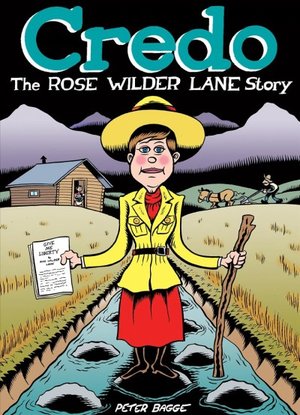
Journalist, novelist and polemicist Rose Wilder Lane may be the most controversial woman nobody’s ever heard of. Today she’s known primarily for her turbulent collaboration with her famous mother, Laura Ingalls Wilder, on the Little House on the Prairie books. But Lane’s story doesn’t end there — far from it. A fire-breathing libertarian, she denounced Social Security as a “Ponzi scheme” and grew her own food to protest World War II rationing. From the 1920s through the 1960s she wrote one of the first libertarian manifestos (1943’s The Discovery of Freedom), hobnobbed with Ayn Rand, penned six novels and amassed a 100-plus-page FBI file. In Credo: The Rose Wilder Lane Story, cartoonist Peter Bagge illustrates Lane’s hurly-burly life in his own inimitable way.
Lane isn’t the first controversial woman Bagge has chosen to write (and draw) about — he published books on Margaret Sanger in 2013 and Zora Neale Hurston in 2017. In an email conversation, he told me why he decided to focus on these particular women.
“I was ready to do a book-length comic-book biography, and while reading about people’s life stories I noticed there were women during the years around the world wars who pretty much did exactly what they wanted,” he says. “It struck a note in me just because there’s been — and it isn’t just with women, it’s with everybody these days — this obsession with safety. You know, ‘I don’t feel safe,’ or, ‘Because of how I identify myself, there are people trying to hold me back.’ These women never, ever stopped for a single second in doing what they wanted to do. In the back of my mind I thought this would be something of a demonstration of how people could be and — I would argue — should be.”
“Bismarck” – Battle of the Atlantic – Sabaton History 012
Sabaton History
Published on 25 Apr 2019Despite restrictions that were put on the German navy by the Treaty of Versailles, the Kriegsmarine rebuilt in the 1930s with one goal: to be bigger and better than ever. Two powerful Bismarck-class battleships formed the pinnacle of the German naval warship production. When the British caught wind that the Bismarck was out in the open in May 1941, they in turn formulated a goal of their own: to take it down for once and for all. The Sabaton song “Bismarck” is about the chase, the battle in the Atlantic and subsequent fate of the Bismarck.
Support Sabaton History on Patreon (and possibly get a special edition of The Great War): https://www.patreon.com/sabatonhistory
Endless hours of strategy, tactical gameplay and pulse pounding combat! Play World of Warships for FREE: https://wo.ws/sabatonYou can find the official music video for “Bismarck” right here: https://www.youtube.com/watch?v=oVWEb…
Check out the trailer for Sabaton’s new album The Great War right here: https://www.youtube.com/watch?v=HCZP1…Hosted by: Indy Neidell
Written by: Markus Linke and Indy Neidell
Directed by: Astrid Deinhard and Wieke Kapteijns
Produced by: Pär Sundström, Astrid Deinhard and Spartacus Olsson
Creative Producer: Joram Appel
Executive Producers: Pär Sundström, Joakim Broden, Tomas Sunmo, Indy Neidell, Astrid Deinhard, and Spartacus Olsson
Maps by: Eastory
Edited by: Iryna Dulka
Sound Editing by: Marek KaminskiEastory YouTube Channel: https://www.youtube.com/channel/UCEly…
Archive by: Reuters/Screenocean https://www.screenocean.com
Music by Sabaton.Sources: © IWM (CS 159), © IWM (A 14840), © IWM (A 178), © IWM (HU 385), © IWM (HU 381), © IWM (HU 384), © IWM (HU 382), © IWM (A 3769), © IWM (A 9798), © IWM (MH 15929), © IWM (A 4386).
An OnLion Entertainment GmbH and Raging Beaver Publishing AB co-Production.
© Raging Beaver Publishing AB, 2019 – all rights reserved.
From the comments:
Sabaton History
1 day ago
I’m sure that many – if not all of you have seen Sabaton’s new single “Bismarck” by now. If not, make sure to check it out after you’re done watching this video – it’s awesome. The link is in the video description. Now, we have already used some of videoclip’s footage in this episode of Sabaton History, because it is incredible and does tremendous job in showing some of the drama of this historical event. Enjoy the episode about one of the most well-known naval battles of World War Two! Cheers and ROCK ON! 🤘🤘🤘
The ill-founded notion that rural peasants had a better life than the city-dwelling poor
Historical illiteracy — encouraged by totally unrealistic historical fiction and highly selective memories — places the lifestyle of farm workers, herders, and other rural people before the industrial era in almost a Disneyfied state of Arcadian paradise. This misunderstanding of reality fed many of the complaints about the terrible living conditions of the poor in industrial towns and cities up to almost living memory — which, to be fair, were terrible, by the standards of the upper and middle classes of the day. Marian L. Tupy provides a bit of evidence for the horrible poverty and miserable living conditions of the majority of Europeans living outside the major towns and cities:
In my last two pieces for CapX, I sketched out the miserable existence of our ancestors in the pre-industrial era. My focus was on life in the city, a task made easier by the fact that urban folk, thanks to higher literacy rates, have left us more detailed accounts of their lives.
This week I want to look at rural life, for that is where most people lived. At least theoretically, country folk could have enjoyed a better standard of living due to their “access to abundant commons – land, water, forests, livestock and robust systems of sharing and reciprocity,” which the anthropologist Jason Hickel praised in a recent article in The Guardian. In fact, the life of a peasant was, in some important aspects, worse than that of a city dweller.
[…]
An account of rural life in 16th century Lombardy found that “the peasants live on wheat … and it seems to us that we can disregard their other expenses because it is the shortage of wheat that induces the labourers to raise their claims; their expenses for clothing and other needs are practically non-existent”. In 15th century England, 80 per cent of private expenditure went on food. Of that amount, 20 per cent was spent on bread alone.
By comparison, by 2013 only 10 per cent of private expenditure in the United States was spent on food, a figure which is itself inflated by the amount Americans spend in restaurants. For health reasons, many Americans today eschew eating bread altogether.
What about food derived from water, forests and livestock? “In pre-industrial England,” Cipolla notes, “people were convinced that vegetables ‘ingender ylle humours and be oftetymes the cause of putrid fevers,’ melancholy and flatulence. As a consequence of these ideas there was little demand for fruit and vegetables and the population lived in a prescorbutic state”. For cultural reasons, most people also avoided fresh cow’s milk, which is an excellent source of protein. Instead, the well-off preferred to pay wet nurses to suckle milk directly from their breasts.
The diet on the continent was somewhat more varied, though peasants’ standard of living was, if anything, lower than that in England. According to a 17th century account of rural living in France: “As for the poore paisant, he fareth very hardly and feedeth most upon bread and fruits, but yet he may comfort himselfe with this, and though his fare be nothing so good as the ploughmans and poore artificers in England, yet it is much better than that of the villano [peasant] in Italy.”
The pursuit of sufficient calories to survive preoccupied the crushing majority of our ancestors, including, of course, women and children. In addition to employment as domestic servants, women produced marketable commodities, such as bread, pasta, woollen garments and socks. Miniatures going back to the 14th century show women employed in agriculture as well. As late as the 18th century, an Austrian physician wrote, “In many villages [of the Austrian Empire] the dung has to be carried on human backs up high mountains and the soil has to be scraped in a crouching position; this is the reason why most of the young people [men and women] are deformed and misshapen.”
April 25, 2019
British Ration Week Episode 8: Conclusions (with Karl)
InRangeTV
Published on 27 Jan 2018At the end of British Ration Week, Karl joins Ian for a hearty slice of Woolton Pie and a discussion of everything learned through the project!
Want to know more about rationing and Lord Woolton? We strong recommend William Sitwell’s Eggs or Anarchy: The remarkable story of the man tasked with the impossible: to feed a nation at war: http://amzn.to/2Dpjxph
InRange is entirely viewer supported:
https://www.patreon.com/InRangeTV


