Quotulatiousness

November 2, 2020

Hammurabi & the First Babylonian Empire

Filed under: History, Law, Middle East — Tags: , , , — Nicholas @ 02:00

History Time
Published 19 Feb 2018

A brief look at Hammurabi, the most famous king of the Old Babylonian Empire (1830 – 1531 BC)

If you liked this video you can help support the channel here:-
http://www.patreon.com/historytimeUK

Are you a budding artist, illustrator, cartographer, or music producer? Send me a message! No matter how professional you are or even if you’re just starting out, I can always use new music and images in my videos. Get in touch! I’d love to hear from you.

I’ve compiled a reading list of my favourite history books via the Amazon influencer program. If you do choose to purchase any of these incredible sources of information then Amazon will send me a tiny fraction of the earnings (as long as you do it through the link) (this means more and better content in the future) I’ll keep adding to and updating the list as time goes on:-
https://www.amazon.com/shop/historytime

Music:-
Derek & Brandon Fiechter – “Byzantium”
Derek & Brandon Fiechter – “Assyrian Fortress”
Derek & Brandon Fiechter – “Hittite Chariots”

Recommended reading:-
Babylon, Paul Kriwaczek
The History of the Ancient World, Susan Bauer

I try to use copyright free images at all times. However if I have used any of your artwork or maps then please don’t hesitate to contact me and the appropriate credit can be given.

—Join the History Time community on social media:-
Instagram:-
https://www.instagram.com/historytime…
Twitter:-
https://twitter.com/HistoryTimeUK

QotD: The Patriarchy

Filed under: History, Media, Politics, Quotations — Tags: , , , — Nicholas @ 01:00

Since anything men utter is tainted by their place in the power hierarchy and their implicit desire to maintain that power – a homeless man at Grand Central station may be surprised, even delighted, to learn that he occupies a “privileged” position in this hierarchy – nothing a man says can be taken at face value because, consciously or unconsciously, it is imbued with patriarchal values and language. Whether they realise it or not, all men are engaged in a struggle to consolidate and extend their power, particularly over women. This is doubtless why, according to this theory, rape is considered a manifestation of male dominance – of the patriarchy – rather than an expression of sexual desire. Power is everything – which tells you something, perhaps, about the status anxiety of this theory’s most fanatical adherents.

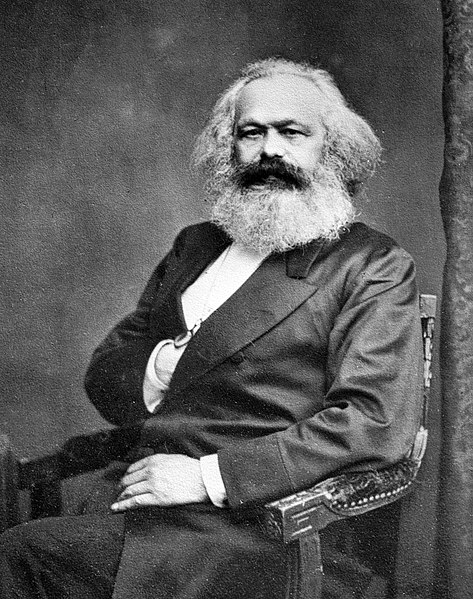
Thus it is okay to hate all men – they are all infected by the canker of patriarchy which, unlike individual thoughts and motivations, is a kind of all-powerful super-organism, a hive mind controlling its male worker bees. Men as individuals are simply tokens of something deeper – structural misogyny embedded in institutional power. If you’re a man who thinks you are not a misogynist, who in fact thinks you like women perfectly well, you are deluding yourself. For such men, their sexism is simply unconscious, just as in classical Marxism the “good” bourgeois was unconscious of the fact that he could not avoid exploiting his workers or employees, even though he might be providing them with a decent wage, good working conditions, and health and pension benefits.

This analysis, given a moment’s thought, doesn’t make a lot of sense. Even if you accept that all the ills of the world are down to patriarchy and the dominance of men, you have to concede the corollary – that all the triumphs of humankind are down to the patriarchy also, from medicine and science to the highest reaches of art and culture.

Women may point out that they have been excluded from these fields until now, and that’s largely true, although biology – the lack of control women have historically had over their own fertility and the greater physical strength of men – might be a far more simple and plausible explanation than the existence of a hypothetical, all-powerful super-organism. However, the very act that men hold the balance of power is proof of the existence of patriarchy, according to this belief system.

Tim Lott, “Why It’s Not OK to Hate Men”, Quillette, 2018-08-14.

November 1, 2020

Polish-Lithuanian War – Caught Between Poland and Soviet Russia I THE GREAT WAR 1920

Filed under: Europe, History, Military, Russia — Tags: , , , , , — Nicholas @ 06:00

The Great War
Published 31 Oct 2020

Sign up for Curiosity Stream and get Nebula bundled in: https://curiositystream.com/thegreatwar

Like the other Baltic states, Lithuania declared independence at the end of World War 1 and was caught in the chaotic and violent situation of 1919 and 1920 when much of Eastern Europe was in turmoil. Territories that today belong to Lithuania were claimed by Poland and Soviet Russia alike — while these two were waging a war in the direct vicinity of Lithuania.

» SUPPORT THE CHANNEL
Patreon: https://www.patreon.com/thegreatwar

» OUR PODCAST
https://realtimehistory.net/podcast – interviews with World War 1 historians and background info for the show.

» BUY OUR SOURCES IN OUR AMAZON STORES
https://realtimehistory.net/amazon *
*Buying via this link supports The Great War (Affiliate-Link)

» SOURCES
Balkelis, Tomas, “From Self-Defense to Revolution: Lithuanian Paramilitary Groups in 1918 and 1919”, in Fleishman, Lazar & Weiner, Amir (eds.) War, Revolution and Governance: The Baltic Countires in the Twentieth Century, (Boston: Academic Studies Press, 2018)

Balkelis, Tomas, “Turning Citizens into Soldiers: Baltic Paramilitary Movements after the Great War” in Gerwarth, Robert & Horne, John (eds.), War in Peace: Paramilitary Violence in Europe after the Great War, (Oxford: Oxford University Press, 2012)

Gerutis, Albertas, “Independent Lithuania” in Gerutis, Albertas (ed.) Lithuania: 700 Years, (Woodhaven: Manyland Books, Inc, 1969)

Lieven, Anatol, The Baltic Revolution: Estonia, Latvia, Lithuania and the Path to Independence, (New Haven: Yale University Press, 2005)

Mačiulis, Dangiras and Staliūnas, Darius, Lithuanian Nationalism and the Vilnius Question, 1883-1940, (Marburg: Verlag Herder-Institut, 2015)

Senn, Alfred Erich, The Great Powers, Lithuania and the Vilna Question 1920-1928, (Leiden: E. J. Brill, 1966)

Snyder, Timothy, The Reconstruction of Nations: Poland, Ukraine, Lithuania, Belarus, 1569–1999, (New Haven: Yale University Press, 2008)

Leonhardt, Joern. Der Ueberfordete Frieden, (CH Beck, 2018).

Borzecki, Jerzy. The Polish-Soviet Peace of 1921 and the Creation of Interwar Europe, (New Haven and London: Yale University Press, 2008)

Lehnstaedt, Stephan. Der Vergessene Sieg. Der Polnisch-Sowjetische Krieg 1919-1921 und die Entstehung des modernen Osteuropa, (CH Beck, 2019)

Davies, Norman. White Eagle Red Star, (Random House, 2003 (1972))

Böhler, Jochen. Civil War in Central Europe, 1918-1921, (Oxford University Press, 2019)

» MORE THE GREAT WAR
Website: https://realtimehistory.net
Instagram: https://instagram.com/the_great_war
Twitter: https://twitter.com/WW1_Series
Reddit: https://reddit.com/r/TheGreatWarChannel

»CREDITS
Presented by: Jesse Alexander
Written by: Jesse Alexander
Director: Toni Steller & Florian Wittig
Director of Photography: Toni Steller
Sound: Toni Steller
Editing: Toni Steller
Motion Design: Philipp Appelt
Mixing, Mastering & Sound Design: http://above-zero.com
Maps: Daniel Kogosov (https://www.patreon.com/Zalezsky)
Research by: Mark Newton
Fact checking: Florian Wittig

Channel Design: Yves Thimian

Contains licensed material by getty images
All rights reserved – Real Time History GmbH 2020

From the comments:

The Great War
1 day ago
As you can see and hear we are back in the Emergency Lockdown Studio Also Known As Jesse’s Living Room (ELSAKAJLR™) and we know the sound isn’t ideal. Starting with the next episode, Jesse will have a better mic that should improve things dramatically. Next step we will also make a few more improvements to Jesse’s overall recording setup. Recording TGW episodes remotely while Jesse is in his ELSAKAJLR™ and we are in Berlin is not easy, but that bloody pandemic will not stop us.

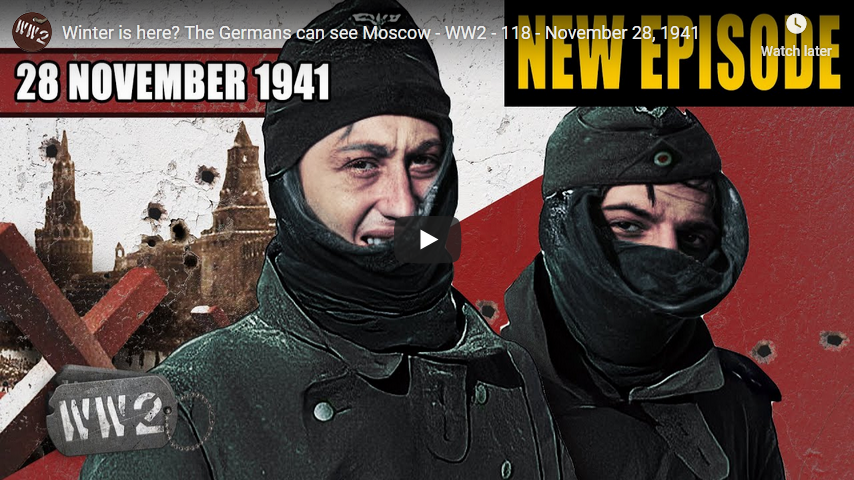
Winter is Coming – WW2 – 114 – October 31, 1941

Filed under: Europe, Germany, History, Military, Russia, WW2 — Tags: , , , , , , — Nicholas @ 04:00

World War Two
Published 31 Oct 2020

Operation Typhoon is halted until the coming winter can freeze enough ground to increase mobility. But the ever colder weather is a disaster waiting to happen for an already over-stretched German supply line.

Join us on Patreon: https://www.patreon.com/TimeGhostHistory
Or join The TimeGhost Army directly at: https://timeghost.tv

Follow WW2 day by day on Instagram @ww2_day_by_day – https://www.instagram.com/ww2_day_by_day
Between 2 Wars: https://www.youtube.com/playlist?list…
Source list: http://bit.ly/WW2sources

Written and Hosted by: Indy Neidell
Director: Astrid Deinhard
Producers: Astrid Deinhard and Spartacus Olsson
Executive Producers: Astrid Deinhard, Indy Neidell, Spartacus Olsson, Bodo Rittenauer
Creative Producer: Maria Kyhle
Post-Production Director: Wieke Kapteijns
Research by: Indy Neidell
Edited by: Miki Cackowski
Sound design: Marek Kamiński
Map animations: Eastory (https://www.youtube.com/c/eastory)

Colorizations by:
Mikolaj Uchman
Dememorabilia – https://www.instagram.com/dememorabilia/
Jaris Almazani (Artistic Man) – https://instagram.com/artistic.man?ig…

Sources:
Bundesrchiv
Narodowe Archiwum Cyfrowe
Yad Vashem 7283/146

Soundtracks from the Epidemic Sound:
Johannes Bornlof – “Death And Glory 2”
Johan Hynynen – “Dark Beginning”
Johannes Bornlof – “The Inspector 4”
Hakan Eriksson – “Epic Adventure Theme 4”
Farell Wooten – “Blunt Object”
Fabien Tell – “Last Point of Safe Return”

Archive by Screenocean/Reuters https://www.screenocean.com.

A TimeGhost chronological documentary produced by OnLion Entertainment GmbH.

Arcelin Mousqueton: An 1850s Breechloader with a Ludicrous Bayonet

Filed under: France, History, Military, Weapons — Tags: , , , , — Nicholas @ 02:00

Forgotten Weapons
Published 26 Jun 2020

http://www.patreon.com/ForgottenWeapons

https://www.floatplane.com/channel/Fo…

Cool Forgotten Weapons merch! http://shop.bbtv.com/collections/forg…

The Arcelin system was a capping breechloader provisionally adopted by the French military in 1854. It was a bolt action system with a folding bolt handle, firing a paper cartridge. It impressed Emperor Louis Napoleon III in initial trials, and he directed it be used to arm his elite Cent Gardes bodyguard. More extensive testing showed that it suffered from insufficient obturation, and would with extended use, eventually become so difficult to close that bolt handles would break. Its adoption was rescinded, and it was replaced by the Treuille de Beaulieu 9mm pinfire carbine in Cent Gardes use within just a few years.

The most distinctive element of the Arcelin in use was its bayonet — a true full-length sword complete with brass handguard that could be clipped to the muzzle. This was chosen for its impressive length, although it would have been cumbersome if used beyond ceremonial guard duties.

Thanks to the Cody Firearms Museum for allowing me access to film this very rare and very cool musketoon and its bayonet! Check them out here: https://centerofthewest.org/explore/f…

Contact:
Forgotten Weapons
6281 N. Oracle #36270
Tucson, AZ 85740

QotD: Trumbo

Over the past weekend I watched Trumbo, the story of the Marxist screenwriter blacklisted by Hollywood during the Red Scare back in the 1950s. To say that I watched it with a jaundiced eye would be a very big understatement, because I suspected (just from the trailer) that the movie would just be one big blowjob for both Dalton Trumbo and his merry little band of Commiesymps who infested Hollywood back then.

And it was. Needless to say, the movie made villains of the conservatives who opposed the Marxist infiltration: people like John Wayne and Hedda Hopper in particular, Wayne because Wayne, and Hopper because she had a son serving in the U.S. Navy during the Korean War. Of course Wayne was made out to be a bully and Hopper a vindictive bitch — and the Senators and Congressmen who haled the Commies in front of the Senate and House Un-American Committee (HUAC) were depicted as ideological purists who saw Communists behind every bush — even though, in the case of Hollywood, there were Commies behind every bush at the time.

Of course, much was made of the fact that being a Communist wasn’t actually illegal (then, and now), and Trumbo made a great show of this being a First Amendment issue — which it was — and how these Commies all wanted to improve America, but of course there were evil right-wingers like Wayne, Joe McCarthy and HUAC harassing them at every turn.

The execution of the traitors Julius and Ethel Rosenberg got a little puff piece in the movie, which didn’t — couldn’t — actually say they weren’t guilty of treason espionage, so it was brushed over with the throwaway that it was the first execution for espionage in peacetime, as though peacetime should give espionage a pass. And if that wasn’t enough, the Rosenberg children were paraded around as sympathy magnets — as they still are — because Communists have no problem using children to serve their own purposes.

Kim du Toit, “Blacklists Matter”, Splendid Isolation, 2020-07-28.

October 31, 2020

Atun-Shei’s Dracula

Filed under: Books, Britain, Europe, History, Media — Tags: , , , , , — Nicholas @ 06:00

Atun-Shei Films
Published 30 Oct 2020

🎃 Get 50% OFF 👉🏻 your first 6 months of Babbel 🕰 limited time only! HERE: http://bit.ly/AtunSheiFilms

An in-depth analysis of Dracula, the original 1897 book by Bram Stoker, possibly the most influential horror novel ever written. Why has the Count enjoyed such longevity in popular culture? What made Dracula so scary for Victorian readers? And what – pray tell – makes vampires so attractive?

Support Atun-Shei Films on Patreon ► https://www.patreon.com/atunsheifilms

Leave a Tip via Paypal ► https://www.paypal.me/atunsheifilms

Buy Merch ► teespring.com/stores/atun-shei-films

#BramStoker #Dracula #Analysis

Reddit ► https://www.reddit.com/r/atunsheifilms
Twitter ► https://twitter.com/atun_shei

~REFERENCES~

[1] “Dracula Movies” (2016). IMDB https://www.imdb.com/list/ls058255047/

[2] Leslie S. Klinger. The New Annotated Dracula (2008). W.W. Norton & Company, Page xvi

[3] Klinger, Page xxi

[4] Dr. Andrzej Diniejko. “Slums and Slumming in Late-Victorian London.” The Victorian Web http://www.victorianweb.org/history/s…

[5] Gill Davies. “London in Dracula; Dracula in London” (2004). Literary London: Interdisciplinary Studies in the Representation of London, Volume 2 Number 1 http://www.literarylondon.org/london-…

[6] Klinger, xxxii-xli

[7] “An 1897 Review of Bram Stoker’s Dracula” (2019). Literary Hub https://bookmarks.reviews/an-1897-rev…

[8] “The Spectator‘s Review of Dracula, 1897″ (2012). The Spectator https://www.spectator.co.uk/article/t…

[9] olly Furneaux. “Victorian Se•ualities” (2014). British Library https://www.bl.uk/romantics-and-victo…

[10] Klinger, Page xvii-xviii

[11] Greg Buzwell. “Daughters of Decadence: The New Woman in the Victorian Fin De Siécle” (2014). British Library https://www.bl.uk/romantics-and-victo…

The Banality of Death – War Against Humanity 021 – October 1941 Pt. 2

Filed under: Europe, France, Germany, History, Military, Russia, WW2 — Tags: , , , , — Nicholas @ 04:00

World War Two
Published 29 Oct 2020

French resistance members liquidate a high-ranking German officer, triggering a series of retaliatory actions by the German occupiers. Meanwhile, actions in the “Holocaust of Bullets” continue in the east as German forces move further into the USSR, taking Odessa.

Join us on Patreon: https://www.patreon.com/TimeGhostHistory
Or join The TimeGhost Army directly at: https://timeghost.tv

Follow WW2 day by day on Instagram @ww2_day_by_day – https://www.instagram.com/ww2_day_by_day
Between 2 Wars: https://www.youtube.com/playlist?list…
Source list: http://bit.ly/WW2sources

Hosted by: Spartacus Olsson
Written by: Joram Appel
Director: Astrid Deinhard
Producers: Astrid Deinhard and Spartacus Olsson
Executive Producers: Astrid Deinhard, Indy Neidell, Spartacus Olsson, Bodo Rittenauer
Creative Producer: Maria Kyhle
Post-Production Director: Wieke Kapteijns
Research by: Joram Appel
Edited by: Miki Cackowski
Sound design: Marek Kamiński
Map animations: Eastory (https://www.youtube.com/c/eastory)

Colorizations by:
Mikołaj Uchman
Julius Jääskeläinen – https://www.facebook.com/JJcolorization/
Norman Stewart – https://oldtimesincolor.blogspot.com/
Jaris Almazani (Artistic Man) – https://instagram.com/artistic.man?ig…
Carlos Ortega Pereira – BlauColorizations, https://www.instagram.com/blaucolorizations
Tzo15 – https://commons.wikimedia.org/wiki/Fi…

Sources:
– Berkhoff, Karel (ed.), Basic Historical Narrative of the Babi Yar Holocaust Memorial Center (2018).
– Cobb, Matthew, The Resistance (2009).
– Desbois, Patrick, The Holocaust by Bullets: A Priest’s Journey to Uncover the Truth Behind the Murder of 1.5 Million Jews (2008).
– Fox, Holquist and Martin, The Holocaust in the East: Local Perpetrators and Soviet Responses (2014).
– Kay, Alex and David Stahel, Mass Violence in Nazi-Occupied Europe (2018).
– Klee, Dressen and Reiss, The Good old Days: The Holocaust as Seen by Its Perpetrators and Bystanders (1991).
– Longerich, Peter, The Unwritten Order: Hitler’s Role in the Final Solution (2001)
– Longerich, Peter, Holocaust: The Nazi Persecution and Murder of the Jews (2010).
– Mitter, Rana, Forgotten Ally: China’s World War II, 1937-1945 (2013).
– Müller, “The Brutalisation of Warfare, Nazi Crimes and the Wehrmacht”, In: Erickson & Dilks, Barbarossa: The Axis and the Allies.
– Parrish, Michael, The Lesser Terror Soviet State Security, 1939-1953.
– Rutherford, Jeff, Combat And Genocide on the Eastern Front: The German Infantry’s War, 1941-1944 (2014).
– Snyder, Timothy, Bloodlands: Europe Between Hitler and Stalin (2010).
– United States Holocaust Memorial Museum, Encyclopaedia of Camps and Ghettos, 1933-1945, volume II, Part A (2012).
– United States Holocaust Memorial Museum, Encyclopaedia of Camps and Ghettos, 1933-1945, volume II, Part B (2012)

Visual sources:
Yad Vashem 75EO4, 933/3/5, 94DO1, 75FO4, 75DO3, 3065/2, 4359/45, 2725/6, 86FO2, 3199/5, 7904/172, 3745/138, 90FO3, 4359/83, 4359/21, 4359/55, 4216/34, 86DO8, 3150/129, 4613/89, 142BO7, 3150/122
Bundesarchiv
Visuotinė lietuvių enciklopedija
Narodowe Archiwum Cyfrowe
Picture of Lavrentiy Beria in court, courtesy of Фотограф – Ист.доки https://commons.wikimedia.org/wiki/Fi…
Picture of Gilbert Brustlein, courtesy of Fbrustlein https://commons.wikimedia.org/wiki/Fi…
Picture of Jewish officials of the Vilnius ghetto, courtesy of United States Holocaust Memorial Museum, William Begell
Picture of Jewish and Lithuanian police guarding the entrence to the Vilnius ghetto, courtesy of United States Holocaust Memorial Museum, William Begell
from the Noun Project: Skull by Muhamad Ulum, students by Piotrek Chuchla, person by Adrien Coquet, Injury by Adraino Emerick, Man by Milinda Courey, Woman by Maxim Kulikov, Child by RocketDiction

Soundtracks from Epidemic Sound:
Reynard Seidel – “Deflection”
Johannes Bornlof – “The Inspector 4”
Johannes Bornlof – “Deviation In Time”
Farell Wooten – “Blunt Object”
Peter Sandberg – “Document This 1”
Gunnar Johnsen – “Not Safe yet”
Jon Bjork – “For the Many”

Archive by Screenocean/Reuters https://www.screenocean.com.

A TimeGhost chronological documentary produced by OnLion Entertainment GmbH.

Modern Halloween costumes show us how wealthy we have become

Filed under: Cancon, Economics, History, Media, USA — Tags: , , , , , , — Nicholas @ 03:00

Richard Lorenc looks back at the “costumes” for Halloween from the 1970s and 1980s to help illustrate how much our general economic picture has improved since those dark days:

While my husband and I were recently struggling to figure out our costumes for this Halloween (and we still don’t have any idea), he pulled up some old commercials on YouTube. The off-the-shelf options that trick or treaters had were, in a word, pitiful.

Basically, costume makers thought it was ok to make a front-only plastic mask (in any color, really) of a character and top it off with a plastic smock featuring an illustration of said character with either its name or the name of the show or movie it comes from. There was no attempt to dress in the character’s actual attire. If you wanted that, you’d either have to know a professional costumer or cobble together something from your closet.

Take a look for yourself at just how costume-poor we used to be:

Obviously, every costume is an opportunity to generate interest in a brand or franchise, and slapping on a logo is an easy way to get a name out there, but these costumes truly heralded a dark time for Halloween. Some may even argue that it demonstrated crass consumerism at its worst, with cynical companies taking the easiest route to grabbing a couple of bucks from desperate parents.

The truth of the tragedy of terrible old Halloween costumes has to do with a simple idea: specialization.

[…]

The next time you compare our screen-accurate store-bought costumes of Darth Vader and Mr. Incredible to those of yesteryear, remember that we enjoy them today not because previous generations didn’t care for accurate costuming, but because growing trade across the globe has generated so much wealth for each of us that we can now demand things we may have only imagined previously.

I only realized as I got ready to schedule this post that it was an article I’d blogged a couple of years back, but the point of the story is still relevant even in our pandemic-wracked economy of 2020.

October 30, 2020

“We Burn” – The Road to Srebrenica – Sabaton History 091 [Official]

Filed under: Europe, History, Media, Military — Tags: , , , , , , , , — Nicholas @ 06:00

Sabaton History
Published 29 Oct 2020

Srebrenica in the summer of 1995. The road to the bloodiest massacre since the end of the Second World War was paved by the violence that followed the breakdown of Yugoslavia. A series of wars and brutal atrocities accompanied the individual struggles for independence as old ethnic and nationalist hatred resurged. The Bosnian Serbs who followed the leadership of politician Radovan Karadžić and General Ratko Mladić sought to separate themselves within Bosnia. However their views soon radicalized and Kradazic began to advocate for a Serbian ethno-state utopia, free of the Muslim Bosniaks. And he was willing to use extreme violence to achieve it.

Support Sabaton History on Patreon: https://www.patreon.com/sabatonhistory

Listen to “We Burn” on the album Attero Dominatus: https://music.sabaton.net/AtteroDomin…

Listen to Sabaton on Spotify: http://smarturl.it/SabatonSpotify
Official Sabaton Merchandise Shop: http://bit.ly/SabatonOfficialShop

Hosted by: Indy Neidell
Written by: Markus Linke and Indy Neidell
Directed by: Astrid Deinhard and Wieke Kapteijns
Produced by: Pär Sundström, Astrid Deinhard and Spartacus Olsson
Creative Producer: Maria Kyhle
Executive Producers: Pär Sundström, Joakim Brodén, Tomas Sunmo, Indy Neidell, Astrid Deinhard, and Spartacus Olsson
Community Manager: Maria Kyhle
Post-Production Director: Wieke Kapteijns
Editor: Karolina Dołęga
Sound Editor: Marek Kaminski
Archive: Reuters/Screenocean – https://www.screenocean.com

Visual Sources:
– Library of Congress
– Portrait of Slobodan Milosevic courtesy of Stevan Kragujevic with the approval of daughter Tanja Kragujevic
– Icons from The Noun Project: Arrow by Dolly Holmes
– Pictures from Siege of Sarajevo, Portrait of Mladić & Karadžić and more courtesy of Mikhail Evstafiev
– Photograph of execution in Brcko in 1992 – Photograph provided courtesy of the ICTY
All music by: Sabaton

An OnLion Entertainment GmbH and Raging Beaver Publishing AB co-Production.

© Raging Beaver Publishing AB, 2019 – all rights reserved.

Halloween Special: H. P. Lovecraft

Overly Sarcastic Productions
Published 31 Oct 2018

HAPPY HALLOWEEN IT’S TIME TO GET SPOOKY WITH HISTORY’S MOST PROBLEMATIC HORROR WRITER LET’S GOOOOO

While there’s something to be said for separating the art from the artist, I think there’s a lot of merit in CONTEXTUALIZING the art WITH the artist. Did Lovecraft write some pretty incredible horror? Sure! Was he also a raging xenophobe? Absolutely! Are his perspectives on life connected with the stories he felt compelled to tell? Duh! If you look at Lovecraft’s writing through the lens of his life, clear patterns emerge that allow us to pin down what exactly he built his horror cosmology out of. It’s an invaluable analytical tool that allows us to take apart his writings by getting inside his head. So before you yell at me for Not Separating The Artist From The Art, know that it was completely intentional and I’m not sorry.

3:20 – THE CALL OF CTHULHU
8:40 – COOL AIR
10:36 – THE COLOR OUT OF SPACE
14:38 – THE DUNWICH HORROR
19:32 – THE SHADOW OVER INNSMOUTH

PATREON: www.patreon.com/user?u=4664797

MERCH LINKS:
Shirts – https://overlysarcasticproducts.threa…
All the other stuff – http://www.cafepress.com/OverlySarcas…

From the comments:

Overly Sarcastic Productions
1 year ago
Hey gang! Can’t help but notice the comment section is a little bit on fire. That’s all good with me, but one recurring complaint I’ve noticed has started to get under my skin – namely that my explanation of non-euclidean geometry was insufficient, or even – dare I say – inaccurate. Now this is a fair complaint, because after a lifetime of experience finding that people’s eyes glaze over when I talk math at them, I concluded that interrupting a half-hour horror video with a long-winded explanation of a mathematical concept wouldn’t go over too well. I put it in layman’s terms and used a simple example to illustrate the point. However, since some of the more mathematically-inclined of you took offense, I now present in full a short (but comprehensive) explanation of what exactly non-euclidean geometry is.

First, we axiomatically establish euclidean geometry. Euclidean geometry has five axioms:
1. We can draw a straight line between any two points.
2. We can infinitely extend a finite straight line.
3. We can draw a circle with any center and radius.
4. All right angles are equal to one another.
5. If two lines intersect with a third line, and the sum of the inner angles of those intersections is less than 180º, then those two lines must intersect if extended far enough.

Axiom #5 is known as the PARALLEL POSTULATE. It has many equivalent statements, including the Triangle Postulate (“the sum of the angles in every triangle is 180º”) and Playfair’s Axiom (“given a line and a point not on that line, there exists ONE line parallel to the given line that intersects the given point”).

Euclidean geometry is, broadly, how geometry works on a flat plane.

However, there are geometries where the parallel postulate DOES NOT hold. These geometries are called “non-euclidean geometries”. There are, in fact, an infinite number of these geometries, and because the only defining characteristic is “the parallel postulate does not hold”, they can be all kinds of crazy shapes. (As you can see, my explanation of “this is just how geometry works on a curved surface” is quite reductive, but at the same time serves to get the general impression across without going into too much detail.)

An example of a non-euclidean geometry is “Elliptic geometry”, geometry on n-dimensional ellipses, which includes “Spherical geometry” as a subset. Spherical geometry is, predictably enough, how geometry works on the two-dimensional surface of a three-dimensional sphere.

In spherical geometry, “points” are defined the same as in euclidean geometry, but “line” is redefined to be “the shortest distance between two points over the surface of the sphere”, since there is no such thing as a “straight line” on a curved surface. All “lines” in spherical geometry are segments of “great circles” (which is defined as the set of points that exist at the intersection between the sphere and a plane passing through the center of that sphere).

The axiom that separates spherical geometry from euclidean geometry and replaces the parallel postulate is “5. There are NO parallel lines”. In spherical geometry, every line is a segment of a great circle, and any two great circles intersect at exactly two points. If two lines intersect when extended, they cannot be parallel, and thus there are no parallel lines in spherical geometry.

Since the Parallel Postulate is equivalent to Playfair’s Axiom, the fact that no parallel lines exist in spherical geometry negates Playfair’s Axiom, which thus negates the Parallel Postulate and defines spherical geometry as a non-euclidean geometry. Also, since the Triangle Postulate is another equivalent property to the Parallel Postulate, it is thus negated in spherical geometry. Hence, my use in-video of an example of a triangle drawn on the surface of a sphere whose inner angles sum greater than 180º.

Hope that cleared things up (and helped explain why I didn’t want to say “see, non-euclidean geometry is just a geometry where Euclid’s Parallel Postulate doesn’t hold – hold on, let me get the chalkboard to explain what THAT is-” in the video)

Peace!

-R ✌️

QotD: Artillery “duels”

Filed under: Britain, Germany, History, Humour, Military, WW1 — Tags: , , — Nicholas @ 01:00

Each afternoon we creep unostentatiously into subterranean burrows, while our respective gunners, from a safe position in the rear, indulge in what they humorously describe as “an artillery duel.” The humour arises from the fact that they fire, not at one another, but at us.

Ian Hay (Major John Hay Beith), The First Hundred Thousand: Being the Unofficial Chronicle of a Unit of “K(1)”, 1916.

October 29, 2020

Cranking This War Up to Eleven – Hideki Tojo – WW2 Biography Special

Filed under: History, Japan, Military, WW2 — Tags: , , , , — Nicholas @ 06:00

World War Two
Published 28 Oct 2020

A man who was both Japan’s War Minister and Prime Minister, who played a large role in escalating the already daunting scale of the war in China to a world war against multiple world powers. We learn about his life from his birth in Tokyo in 1884 to his execution at Sugamo prison in Tokyo in 1948.

Join us on Patreon: https://www.patreon.com/TimeGhostHistory
Or join The TimeGhost Army directly at: https://timeghost.tv

Follow WW2 day by day on Instagram @ww2_day_by_day – https://www.instagram.com/ww2_day_by_day
Between 2 Wars: https://www.youtube.com/playlist?list…
Source list: http://bit.ly/WW2sources

Written and Hosted by Indy Neidell
Director: Astrid Deinhard
Producers: Astrid Deinhard and Spartacus Olsson
Executive Producers: Astrid Deinhard, Indy Neidell, Spartacus Olsson, Bodo Rittenauer
Creative Producer: Joram Appel
Post-Production Director: Wieke Kapteijns
Research by: Indy Neidell
Edited by: Karolina Dołęga & Iryna Dulka
Sound design: Marek Kamiński
Map animations: Eastory (https://www.youtube.com/c/eastory)

Colorizations by:
Carlos Ortega Pereira, BlauColorizations – https://www.instagram.com/blaucolorizations
Jaris Almazani (Artistic Man) – https://instagram.com/artistic.man?ig…
Mikołaj Uchman
Norman Stewart – https://oldtimesincolor.blogspot.com/

Archive by Screenocean/Reuters https://www.screenocean.com.

A TimeGhost chronological documentary produced by OnLion Entertainment GmbH.

The Legendary Scottish Infill Plane

Filed under: Britain, History, Tools, Woodworking — Tags: , , , , — Nicholas @ 05:00

Rex Krueger
Published 28 Oct 2020

Learn about the famous infill planes of Scotland and England. Do they deliver on the hype?

More video and exclusive content: http://www.patreon.com/rexkrueger
(more…)

War, Cinema, and Cheese! | BETWEEN 2 WARS: ZEITGEIST! | E.01 – Harvest 1918

TimeGhost History
Published 28 Oct 2020

War, poverty, and disease continue to pummel the word in the wake of the Great War. But still, humanity carries on, not only surviving but creating a host of futuristic opportunities in the arts, the economy, and … cheese.

Join us on Patreon: https://www.patreon.com/TimeGhostHistory

Hosted by: Indy Neidell
Written by: Indy Neidell, Francis van Berkel, and Spartacus Olsson.
Director: Astrid Deinhard
Producers: Astrid Deinhard and Spartacus Olsson
Executive Producers: Astrid Deinhard, Indy Neidell, Spartacus Olsson, Bodo Rittenauer
Creative Producer: Maria Kyhle
Post-Production Director: Wieke Kapteijns
Research by: Indy Neidell, Francis van Berkel, and Spartacus Olsson.
Archive Research: Daniel Weiss
Edited by: Daniel Weiss
Sound design: Marek Kamiński

Colorizations:
Daniel Weiss – https://www.facebook.com/TheYankeeCol…
(BlauColorizations) – https://www.instagram.com/blaucolorizations
Dememorabilia – https://www.instagram.com/dememorabilia/

Sources:

From the Noun Project:
iron cross By Souvik Maity, IN
poverty By Phạm Thanh Lộc, VN
Skull_51748

Soundtracks from Epidemic Sound:
– “One More for the Road” – Golden Age Radio
– “Dark Shadow” – Etienne Roussel
– “Not Safe Yet” – Gunnar Johnsen
– “Rememberance” – Fabien Tell
– “Last Point of Safe Return” – Fabien Tell
– “Steps in Time” – Golden Age Radio
– “What Now” – Golden Age Radio
– “Sunday Worship” – Radio Night
– “Astray” – Alec Slayne
– “Break Free” – Fabien Tell

Archive by Screenocean/Reuters https://www.screenocean.com.

A TimeGhost chronological documentary produced by OnLion Entertainment GmbH.

From the comments:

TimeGhost History
1 day ago
Welcome back to Between Two Wars! Strap in for what is going to be an exciting ride through the massive cultural, social, economic, and technological shifts that take place after the Great War. We can’t guarantee this will always be a positive tale. These changes entail plenty of fear and suffering, and even ‘fun’ things like the Jazz Age have their darker sides.

But that doesn’t alter the fact that the interwar era is a time of promise where people envision modern futures to replace old pasts. There is everything to play for in this brave new world and a vision of progress all around in politics, culture, food, and more.

« Newer PostsOlder Posts »

Powered by WordPress