
Churchill threw all of his support behind Stalin’s armies despite Stalin’s alliance with Hitler during the first 21 months of the war — the USSR having invaded the same number of countries as Nazi Germany (seven), having supplied the German Wehrmacht as it invaded France and the Low Countries, and having literally fueled the Luftwaffe as it bombed London in 1940.
This support was more than rhetorical. In a gesture of astonishing (and short-sighted) selflessness, Churchill responded to news of Nazi Germany’s invasion of the Soviet Union by sending Stalin 200 brand-new Hawker Hurricane pursuit planes which had been pledged to defend Singapore against Japanese attack. Churchill then “re-gifted” Stalin 200 Tomahawk fighters and 300 Douglas A-20 Havoc bombers from Britain’s own Lend-Lease consignments, and shipped Stalin 2,000 tonnes of processed aluminum for Soviet warplane factories, despite it being desperately needed at home.
Even more striking was Churchill’s decision to ship Stalin nearly 600 tanks, which helped tip the balance in the Battle of Moscow in December 1941. Churchill even agreed to strip Cairo command of hundreds more tanks in 1942, routing them to Stalin’s USSR via Iran to bail out the Red Army at Stalingrad, which left Egypt vulnerable to Rommel’s Afrika Korps.
Churchill doubled down on his pro-Soviet policies even in areas where Britain had her own clients, such as Yugoslavia. Despite hosting the Yugoslav exile government in London, by September 1943, Churchill abandoned that government’s commander on the ground and threw his full support behind Stalin’s man, Josip Broz (“Tito”). Bamboozled by a Soviet smear campaign against Colonel Draža Mihailovic, Churchill cut off Mihailovic’s Chetniks and shipped Tito more than 100 times more war materiel over the next nine months than Mihailovic had received in the previous two years.
Sean McMeekin, “Churchill’s enigma: the real riddle is why he cozied up to Stalin”, Spectator, 2021-03-21.
June 23, 2021
QotD: Churchill’s support for Stalin
June 22, 2021
History Summarized: The Athenian Temple at Sounio
Overly Sarcastic Productions
Published 29 Sep 2017On my summer vacation, I had the distinct pleasure of visiting Cape Sounio, at the southern tip of Attica at sunset, and I have to say it was one of the most historically exciting moments of my life. For all I myself have said about the Athenian empire, seeing the view from this temple made everything click into place and feel tangibly real for the first time ever (even my 10+ trips to the Parthenon over the course of my childhood didn’t do that). So uh … here’s 7 minutes of me gushing about it under the thin guise of persuasive historical argumentation.
PATREON: www.patreon.com/user?u=4664797
MERCH LINKS:
Shirts – https://overlysarcasticproducts.threa…
All the other stuff – http://www.cafepress.com/OverlySarcas…Find us on Twitter @OSPYouTube!

QotD: The “Stringbag”, formally known as the Fairey Swordfish
There are three reasons for this feat. The first is that the British were early adaptors of night operations, and performed successful Swordfish strikes (such as the amazingly successful strike at the Port of Taranto which crippled or sank several major warships – becoming the Japanese model for Pearl Harbor), and successful night attacks at sea once the second innovation came in. This was the development of airborne radar, which was first operational on Swordfish operating on British carriers six months before Pearl Harbor. The British were to hold this unique ability to use radar for carrier aircraft operations for a couple of years before the Americans deployed similar concepts in 1943. They were to hold their unique advantage of night-time strikes also. (Both the Japanese and Americans lost many pilots over the next few years in strikes that failed to get home before dark!) So the Swordfish could soldier on under the cover of night, and continued to be useful as a strike aircraft long after its use in daytime had been demonstrated to be suicidal by the easy slaughter of those attempting to attack the Scharnhorst and Gneisenau during the Channel Dash in 1941.
The third, and unexpected reason, why the Swordfish was still in production at the end of the war, was that its unrivalled flying characteristics made it the only aircraft capable of surviving operations from small escort carriers operating in the Arctic Circle in bad weather. Whereas more modern, higher speed aircraft, like the Hurricane, Wildcat and Avenger could work from escort carriers in calmer seas, none of those would even consider operations under the sort of conditions that a Swordfish could easily manage. So the venerable old bus continued to serve successfully purely in an anti-submarine role until the final days of the war. This was not because there weren’t many better aircraft available, but simply because no other aircraft available could do the job as well. An example of a World War Two aircraft still having a (slightly reduced) role, long after being technically obsolete — see the many inadequate fighters that lived on as very successful night fighters. (Though the fact that “modern” B-52s are scheduled to still be operational 80 or 90 years after their initial deployment shows that new roles are always possible for reliable old aircraft, even when their technology is fifty years out of date.)
Nigel Davies, “Comparing naval aircraft of World War II”, rethinking history, 2010-12-20.
June 21, 2021
“The public are getting a little bit fed up of virtue-signalling police officers when they’d really rather we just locked up burglars”
Gawain Towler on the sudden, unexpected — and undoubtedly unwelcome to self-appointed guardians of the official narrative — appearance of what sounds surprisingly like common sense from a top police officer in Britain:
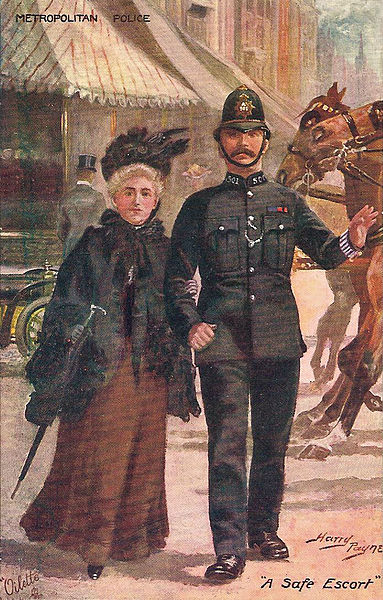
“A Safe Escort” by Harry Payne (1858-1927), first published in August 1911 but possibly painted a few years earlier. From the back of the card: “Among the hundred and one duties of the London Policeman he is here depicted as a kindly protector, halting the traffic as he escorts a Lady across the congested streets. This is essentially a London incident, and has no parallel in any other Police Force in the world.”
Photo of the Tuck’s Oilette by Leonard Bentley via Wikimedia Commons.
Has Robert Peel been reincarnated as the Chief Constable for Manchester?
“But officer, if you are not on your knee, and wearing a rainbow lanyard, how do we know that you are on the side of the oppressed, the intersectional, the poor, downtrodden graduates of minor universities?”
“I’m sorry madam, may I call you madam? I am on the side of the law.”
The promotion of Stephen Watson as the new Chief Constable for Manchester comes as a shaft of light cutting through the murk of muddled thinking. He has said two things that will resonate with millions and will cause consternation amongst thousands:
I would probably kneel before the Queen, God and Mrs Watson, that’s it … The public are getting a little bit fed up of virtue-signalling police officers when they’d really rather we just locked up burglars.
It sounds like the first blast of the trumpet, but not only does it strike an astonishingly different note than the honky tonk tunes played by other constabularies. Stentorian and self confident it also marks a huge departure in that he makes a very public statement that he would kneel before God. A very courageous statement in the current climate in itself. But it is his approach to policing that strikes the eye.
One almost feels that as was once the case, each new officer in the Manchester Metropolitan Area will be issued with Sir Robert Peel’s 1829 Nine Principles of Policing. It is worth our while looking at those principles and deciding whether or not to accept that they should remain at the core of policing, or be junked as impossibly dated.
What is clearly apparent is that Peel’s principles are at heart about consent. Famously it described the police as merely the citizens in uniform, or that “the police are the public and that the public are the police, the police being only members of the public who are paid to give full time attention to duties which are incumbent on every citizen in the interests of community welfare and existence”.
Underlying this basic thought is an understanding that the police rely, entirely on the goodwill of the populace, if they wish to carry out their basic duties. In order to fulfil their functions and duties they are “dependent on public approval of their existence, actions and behaviour and on their ability to secure and maintain public respect”.
Etruscans: Italian Civilization Before Ancient Rome
Kings and Generals
Published 20 Feb 2020Our new animated historical documentary talks about the Etruscans. Their origins, culture, religion, lifestyle and how they influenced the Roman Republic and through it the world.
Support us on Patreon: http://www.patreon.com/KingsandGenerals or Paypal: http://paypal.me/kingsandgenerals
We are grateful to our patrons and sponsors, who made this video possible: https://docs.google.com/document/d/1_…
The video was made by our friend András Szente-Dzsida while the script was researched and written by Leo Stone
This video was narrated by Officially Devin (https://www.youtube.com/user/OfficiallyDevin)
✔ Merch store ► teespring.com/stores/kingsandgenerals
✔ Podcast ► Google Play: http://bit.ly/2QDF7y0 iTunes: https://apple.co/2QTuMNG
✔ Twitter ► https://twitter.com/KingsGenerals
✔ Instagram ► http://www.instagram.com/Kings_GeneralsProduction Music courtesy of Epidemic Sound: http://www.epidemicsound.com
#Documentary #Etruscans #KingsandGenerals
Turner Semiauto SMLE Conversion
Forgotten Weapons
Published 12 Nov 2016Cool Forgotten Weapons Merch! http://shop.bbtv.com/collections/forg…
Russell Turner was a Pennsylvania gunsmith and inventor who developed this semiautomatic conversion of an SMLE bolt action rifle circa 1940. It was intended for trial and potential sale to the Canadian military, as it would allow them to retrofit existing rifles into semiautomatic configuration and still use existing supplies of .303 British ammunition. Rather than try to devise a reliable system to rotate the original Enfield bolt, Turner replaced the bolt entirely, using instead a side-tilting design much like what he used in his M1 Carbine trials rifle for the US military. This was coupled with a long stroke gas piston and a hammer firing trigger mechanism.
Reportedly the rifle was tested by Canadian authorities, and performed quite well, with the adjustable gas system allowing it to function reliably even in temperatures of 25 below zero (where the Garand, tested alongside, experienced problems). However, Turner’s rifle was deemed too complex for military adoption.
That decision against the rifle was probably the right one for Canada, although Turner’s conversion is one of the better semi auto bolt acton conversions I have handled. It was remarkably non-awkward — that may not sound like much to crow about, but it sets a pretty high standard for this type of rifle.

QotD: The young Richard Nixon
The Orthogonians’ base was among Whittier’s athletes. On the surface, jocks seem natural Franklins, the Big Men on Campus. But Nixon always had a gift for looking under social surfaces to see and exploit the subterranean truths that roiled underneath. It was an eminently Nixonian insight: that on every sports team there are only a couple of stars, and that if you want to win the loyalty of the team for yourself, the surest, if least glamorous, strategy is to concentrate on the nonspectacular — silent — majority. The ones who labor quietly, sometimes resentfully, in the quarterback’s shadow: the linemen, the guards, the punter. Nixon himself was exemplarily nonspectacular: the 150-pounder was the team’s tackle dummy, kept on squad by a loving, tough, and fatherly coach who appreciated Nixon’s unceasing grit and team spirit — nursing hurt players, cheering on the listless, even organizing his own team dinners, entertaining the guests on the piano, perhaps favoring them with the Orthogonian theme song. It was his own composition.
Nixon beat a Franklin for student body president. Looking back later, acquaintances marveled at the feat of this awkward, skinny kid the yearbook called “a rather quiet chap about campus,” dour and brooding, who couldn’t even win a girlfriend, who attracted enemies, who seemed, a schoolmate recalled, “the man least likely to succeed in politics.” They hadn’t learned what Nixon was learning. Being hated by the right people was no impediment to political success. The unpolished, after all, were everywhere in the majority.
Rick Perlstein, Nixonland: The Rise of a President and the Fracturing of America, 2008.
June 20, 2021
Tobruk: A second siege? – WW2 – 147 – June 20, 1942
World War Two
Published 19 Jun 2021Two convoys head from opposite ends of the Mediterranean to supply Malta, hoping to run interference for each other, and the Battle of Sevastopol continues as the Axis slowly wear down the Soviet defenders, but the big news is Erwin Rommel’s continued advances in North Africa, defeating the 8th Army again and again. Can the Allies hold Tobruk? Will they even try? Watch and find out.
(more…)
June 19, 2021
“Defence of Moscow” – Autumn 1941- Sabaton History 103
Sabaton History
Published 17 Jun 2021While it is legendary, there is a lot of confusion and a lot of myths about Operation Typhoon, the German drive on Moscow in the fall of 1941, and Operation Barbarossa, the invasion of the Soviet Union that summer. Today I talk about the first 5.5 months of Barbarossa, and then Joakim and I discuss covers and covers of covers.
Support Sabaton History on Patreon: https://www.patreon.com/sabatonhistory
Listen to “Defence Of Moscow”: https://music.sabaton.net/DefenceOfMo…
Watch the Official Music Video of “Defence Of Moscow” here: https://www.youtube.com/watch?v=i7K4v…
Listen to Sabaton on Spotify: http://smarturl.it/SabatonSpotify
Official Sabaton Merchandise Shop: http://bit.ly/SabatonOfficialShopHosted by: Indy Neidell
Written by: Markus Linke and Indy Neidell
Directed by: Astrid Deinhard and Wieke Kapteijns
Produced by: Pär Sundström, Astrid Deinhard and Spartacus Olsson
Creative Producer: Maria Kyhle
Executive Producers: Pär Sundström, Joakim Brodén, Tomas Sunmo, Indy Neidell, Astrid Deinhard, and Spartacus Olsson
Community Manager: Maria Kyhle
Post-Production Director: Wieke Kapteijns
Editor: Karolina Dołęga
Sound Editor: Marek Kaminski
Maps by: Eastory – https://www.youtube.com/c/eastory
Archive: Reuters/Screenocean – https://www.screenocean.comColorizations by:
– Mikołaj Uchmann
– Julius Jääskeläinen – https://www.facebook.com/JJcolorization/Sources:
– National Archives Nara
– Narodowe Archiwum Cyfrowe NARA
– Bundesarchiv
– New York Public Library
– Train tracks icon by Danishicon from the Noun Project
– Picture of singer Loona courtesy of Sandstein https://commons.wikimedia.org/wiki/Ca…
– Imperial War Museums: HU 75543, PST 4712
– Australian War MemorialAll music by: Sabaton
RADIO TAPOK – Битва за Москву (В стиле Sabaton / ИзиРок / – Defence Of Moscow)An OnLion Entertainment GmbH and Raging Beaver Publishing AB co-Production.
© Raging Beaver Publishing AB, 2021 – all rights reserved.

The context for Confederate general Patrick Cleburne’s proposal to arm slaves to fight the Union
On YouTube, Andy of Atun-Shei Films responds to a social media post that presented Cleburne’s proposal without context, which appears to show Cleburne as an anti-slavery advocate:
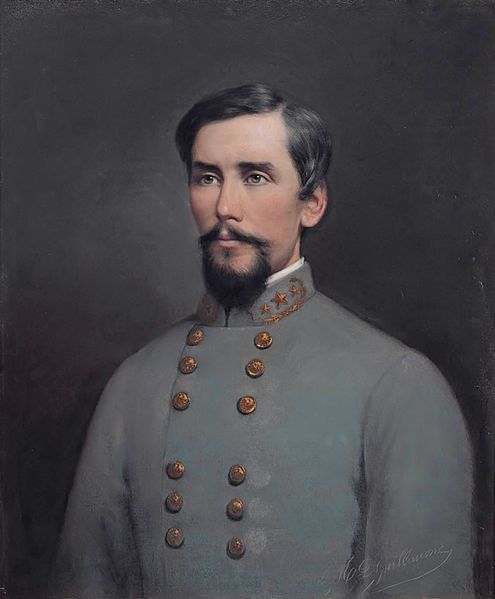
Confederate army Major General Patrick Cleburne.
Painting by M.D. Guillaume (1816-1892) via Wikimedia Commons.
I recently came across a pro-Confederate Facebook post featuring this quote from Confederate major general Patrick Cleburne, written on January 2, 1864:
It is said slavery is all we are fighting for, and if we give it up we give up all. Even if this were true, which we deny, slavery is not all our enemies are fighting for. It is merely the pretense to establish sectional superiority and a more centralized form of government, and to deprive us of our rights and liberties.
Now, I’m not going to share the post itself, as that would inevitably lead to doxxing and bullying. However, this is a teachable moment, a classic example of the beloved Lost Causer past-time of divorcing quotes from their important contexts.
You need to keep a couple things in mind when considering a historical quote. Who is the speaker? Who are they talking to? Do they have an objective in mind? What events surrounding this person, if any, have inspired them to say this particular thing at this particular time?
Quotes by themselves are useless in historical education and can often be misleading. I see y’all making this mistake with the Cornerstone Speech [Wiki] all the time – it’s not the mic drop you think it is. You can’t just shove it in someone’s face and call it a day. If you really want to change minds, you need to present it in its proper context and alongside other evidence. Only then can you craft a complete and compelling argument.
Now as it happens, Alexander Stephens was totally sincere when he called late 18th century notions of racial equality “wrong,” and he spoke for the overwhelming majority of Confederate true believers in the Spring of 1861 when he said that “our new government is founded on exactly the opposite ideas; its foundations are laid, its cornerstone rests, upon the great truth that the [black man] is not equal to the white man; that slavery, subordination to the superior race, is his natural and normal condition.” But without context, how would I know that? When making an argument, the onus of proof is on you.
This particular pro-Confederate post presented the Cleburne quote by itself in meme format without any context whatsoever, so allow me to provide one. At first glance, it seems like Cleburne is espousing anti-authoritarian values. It seems like he is declaring, clearly and definitively, that the Southern states did not secede to preserve slavery, but rather to uphold their regional self-determination.
This quote is from a letter Cleburne wrote to Joseph E. Johnston, his commanding officer in the Army of Tennessee, proposing that the Confederate government emancipate and arm the South’s enslaved men to bolster the thinning ranks of the army. As you may remember from Checkmate Lincolnites, this proposal was met with shock and horror from the Confederate leadership, who quickly rejected it.
But Cleburne saw further than them. He believed – correctly – that unless something drastic was done, the Confederacy was doomed to destruction. As he writes in the proposal, “Instead of standing defiantly on the borders of our territory or harassing those of the enemy, we are hemmed in to-day into less than two-thirds of it, and still the enemy menacingly confronts us at every point with superior forces.”
“If this state continues much longer we must be subjugated,” he continues, arguing that achieving victory would require immense sacrifice, including “the loss of all we now hold most sacred — slaves and all other personal property, lands, homesteads, liberty, justice, safety, pride, manhood.”
June 18, 2021
Innovation was minimal in the Roman Empire, because slave societies think they don’t need new inventions
Mark Koyama writes for the Foundation for Economic Education on the similarities and differences of the economy of the Roman Empire at its second-century peak and the booming European economies of the 17th and early 18th centuries:
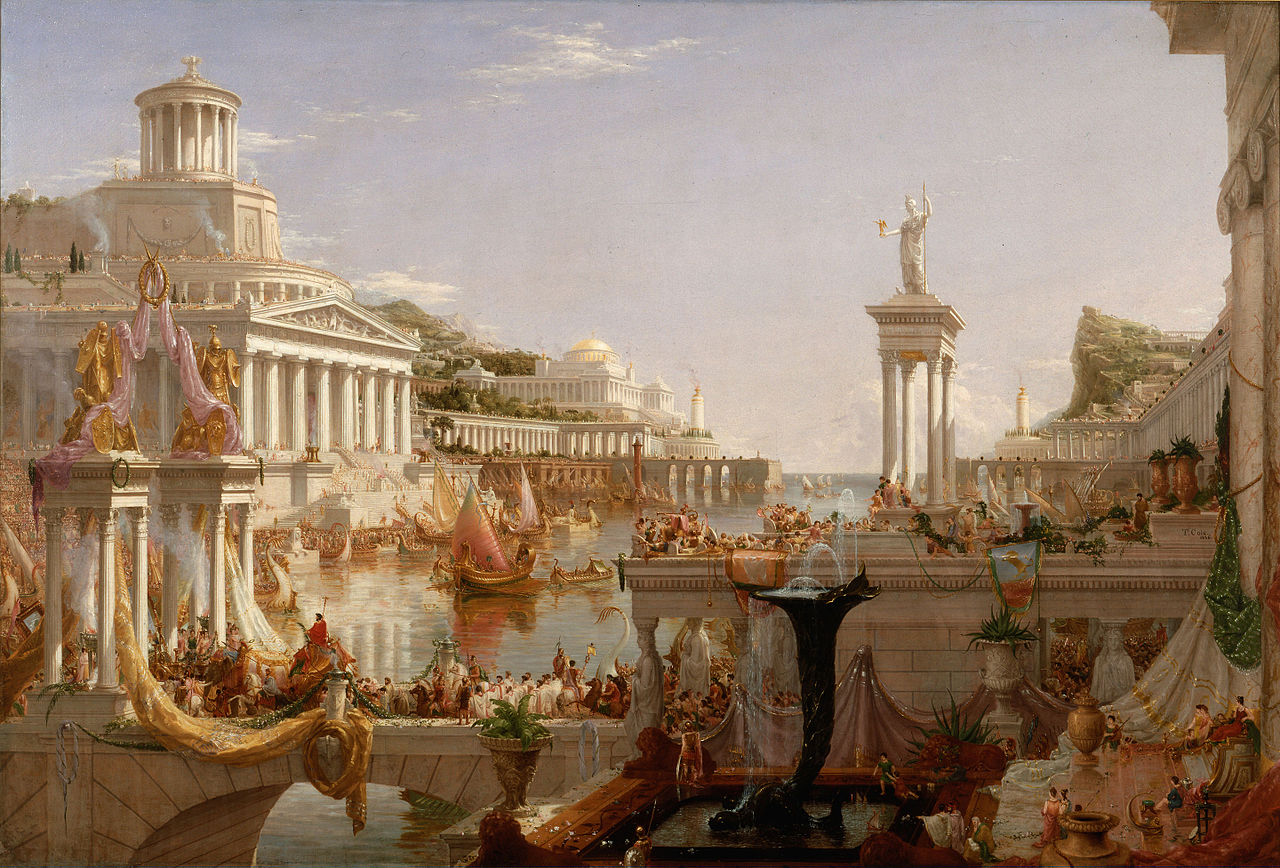
“The Consummation of Empire” from the painting series “The Course of the Empire” by Thomas Cole (1801-1848).
New York HIstorical Society collection via Wikimedia Commons.
The most obvious institutional difference between the ancient world and the modern was slavery. Recently historians have tried to elevate slavery and labor coercion as a crucial causal mechanism in explaining the industrial revolution. These attempts are unconvincing […] but slavery certainly did dominate the ancient economy.
In its attempt to draw together the various strands through which slavery permeated the ancient economy, [Aldo] Schiavone’s chapter “Slaves, Nature, Machines” [in The End of the Past] is a tour de force. At once he captures the ubiquity of slavery in the ancient economy, its unremitting brutality — for instance, private firms that specialized in branding, retrieving, and punishing runaway slaves — and, at the same time, touches the central economic questions raised by ancient slavery: to what extent was slavery crucial to the economic expansion of the period between 200 BCE and 150 AD? And did the prevalence of slavery impede innovation?
It is impossible to do justice to the argument in a single post. Suffice to say that after much discussion, and many fascinating interludes, Schiavone suggests that ultimately the economic stagnation of the ancient world was due to a peculiar equilibrium that centered around slavery.
One can think of this equilibrium as resting on two legs. The first is the observation that the apparent modernity of the ancient economy — its manufacturing, trade, and commerce rested largely on slave labor. The expansion of trade and commerce in the Mediterranean after 200 BC both rested on and drove the expansion of slavery. Here Schiavone notes that the ancient reliance on slaves as human automatons — machines with souls — removed or at least weakened, the incentive to develop machines for productive purposes.
The existence of slavery, however, was not the only reason for the neglect of productive innovation. There was also a specific cultural attitude that formed the second leg of the equilibrium:
None of the great engineers and architects, none of the incomparable builders of bridges, roads, and aqueducts, none of the experts in the employment of the apparatus of war, and none of their customers, either in the public administration or in the large landowning families, understood that the most advantageous arena for the use and improvement of machines — devices that were either already in use or easily created by association, or that could be designed to meet existing needs — would have been farms and workshops
The relevance of slavery colored ancient attitudes towards almost all forms of manual work or craftsmanship. The dominant cultural meme was as follows: since such work was usually done by the unfree, it must be lowly, dirty and demeaning:
technology, cooperative production, the various kinds of manual labor that were different from the solitary exertion of the peasants on his land — could not but end up socially and intellectually abandoned to the lowliest members of the community, in direct contact with the exploitation of the slaves, for whom the necessity and demand increased out of all proportion … the labor of slaves was in symmetry with and concealed behind (so to speak) the freedom of the aristocratic thought, while this in turn was in symmetry with the flight from a mechanical and quantitative vision of nature
Thus this attitude also manifests itself in the disdain the ancients had for practical mechanics:
Similar condescension was shown to small businessmen and to most trade (only truly large-scale trade was free from this taint). The ancient world does not seem to have produced self-reproducing mercantile elites. Plausible this was in part because of the cultural dominance of the landowning aristocracy.
The phenomenon coined by Fernand Braudel, the “Betrayal of the Bourgeois”, was particularly powerful in ancient Rome. Great merchants flourished, but “in order to be truly valued, they eventually had to become rentiers, as Cicero affirmed without hesitation: ‘Nay, it even seems to deserve the highest respect, if those who are engaged in it [trade], satiated, or rather, I should say, satisfied with the fortunes they have made, make their way from port to a country estate, as they have often made it from the sea into port. But of all the occupations by which gain is secured, none is better than agriculture, none more delightful, none more becoming to a freeman'” (Schiavone, 2000, 103).
Such a cultural argument fits perfectly with Deirdre McCloskey’s claim in her recent trilogy that it was the adoption of bourgeois cultural norms and specifically bourgeois rhetoric that distinguished and caused the rise of north-western Europe after 1650.
Heydrich, Architect of the Holocaust, Dies – WAH 036 – June 1942, Pt. 1
World War Two
Published 17 Jun 2021Reinhard Heydrich is fighting for his life, as the hunt of his assassins continues. Meanwhile, news of the Nazi atrocities starts to reach the Allied countries.
(more…)
Boob Armor: 4 Things You Need to Know
Jill Bearup
Published 1 Mar 2021Designing some armour for ladies? Female torso armour specifically? Welcome. Get a year of streaming some of your favourite creators and HQ documentaries for under $15 at http://curiositystream.com/jillbearup
Boob armour, or boob plate, or lady armour. Or fantasy lady armour, come to that: how does it work then? Let’s have a look at Wonder Woman, The Mandalorian, Warhammer 40K and various examples of historical armour, as well as costume considerations, which will make designing a look for your female fighters that is practical and looks awesome a breeze.
TIMESTAMPS!
00:00 So you need some lady armour?
00:37 1. You don’t need boob plate
02:23 Alternate options
03:14 2. Divots are a disadvantage
03:56 Muscle cuirasses
04:35 Boob shelf designs
05:11 Cleavage divots
05:39 Wasp waist armor
06:44 Sticky weapons
08:02 Codpieces
08:40 3. Consider mobility (including experiments)
09:35 Two handed weapons and giant swords
10:29 Underlayers and materials used in experiments
11:03 Low guards and power generation in boob plate
11:46 Not painting a ‘look, a lady!’ target on yourself with your armor
12:17 4. Breathing is important
13:44 Corsets are not like armor, and scifi armor with flex
15:44 Fencing chest protectors are not armor, extra content on Nebula, this video is sponsored by Curiosity Stream
16:49 Lightning round#boobplate #femalearmor #armor
Music by epidemicsound.com
“Meet Me in the Hills” – Howard Harper-Barnes
“To Begin” – Raymond Grouse
“Honorable Salute” – Sage Orsler
“Plains of Illeyneth” – Dragon Tamer
“Sparkle and Swirl” – Raymond Grouse
“Sergeant Wise” – Stationary Sign
“Optimist At Heart” – Jerry Lacey
“Fluz de la Riviere” – Howard Harper-Barnes
“Sailing for Gold” – Howard Harper-Barnes
“Endless Flirtation” – Jerry Lacey

June 17, 2021
Encouraging innovation by … rejigging the honours system
In the latest Age of Invention newsletter, Anton Howes considers how one man’s efforts to encourage and reward innovation in the United Kingdom eventually led to “mere inventors” receiving honours that once were dedicated to military paladins and political giants:
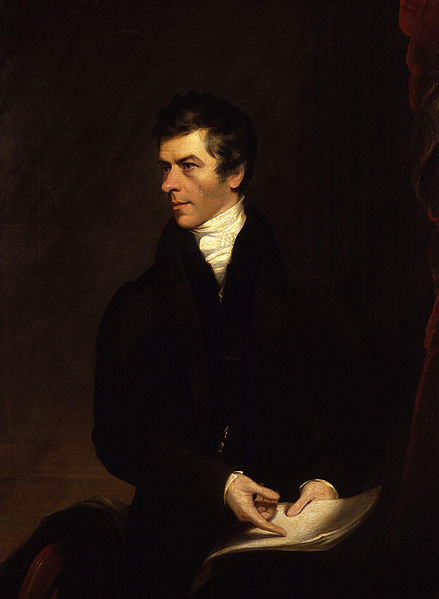
Henry Brougham, 1st Baron Brougham and Vaux, by James Lonsdale (died 1839), given to the National Portrait Gallery, London in 1873.
Image from the National Portrait Gallery via Wikimedia Commons.
One of my all-time favourite innovation evangelists is the nineteenth-century barrister, journalist, and politician Henry Brougham. He was an innovator himself, in the late 1830s designing a form of horse-drawn carriage, and as a teenager even managed to get his experiments on light published in the Royal Society’s prestigious Transactions. But his main achievements were as an organiser. Clever, dashing, and articulate, the son of minor gentry, he was an evangelist extraordinaire. In the 1820s he helped George Birkbeck to found the London Mechanics’ Institute (which survives today as Birkbeck, University of London), was instrumental in the creation of University College London (to provide a university in England where you didn’t have to swear an oath to the Church of England), and founded the Society for the Diffusion of Useful Knowledge (to print reference works and textbooks cheaply and in bulk). They were all organisations intended to widen access to education, spreading science to the masses.
He also presided at the opening of many more worker-run mechanics’ institutions, libraries, and scientific societies. As a Member of Parliament who went out of his way to support workers’ efforts at self-education, even though none of them could vote, Brougham thus became something of a celebrity to working-class inventors. John Condie, born in Gorbals, Glasgow, to poor parents, and apprenticed to a cabinet maker, would become a prolific and successful improver of iron-making, locomotive springs, and photography, as well as an inspiring lecturer on scientific subjects in his own right — his students at the Eaglesham Mechanics’ Institution were reportedly so engrossed that they would attend his evening classes until midnight. Having once exhibited a model steam engine at the opening of the Carlisle Mechanics’ Institution, however, Condie was reportedly “not a little proud” that Brougham — who had presided at the opening — recalled the model over thirty years later. The detail comes from Condie’s obituary notice in the local papers; I like to think that it was a story upon which he frequently dined out.
Brougham’s celebrity, I suspect, made him appreciate the usefulness of status and prestige, and his influence only grew when in 1830 he was made a lord and appointed Lord High Chancellor — a high-ranking ministerial position, which he held for four years. Brougham was soon behind many efforts to increase the visibility of inventive role-models. The nineteenth-century mania for putting up statues — to people like Johannes Gutenberg, Isaac Newton, and James Watt — often had Brougham or his political allies behind them. Brougham even hoped that while the “temples of the pagans had been adorned by statues of warriors, who had dealt desolation … ours shall be graced with the statues of those who have contributed to the triumph of humanity and science”.
His hero-making extended to print, too, when in the 1840s his Society for the Diffusion of Useful Knowledge embarked on publishing a comprehensive biographical dictionary — an early forerunner to the Oxford Dictionary of National Biography, but with the extraordinary aim of covering notable individuals from all over the world. It managed to print seven volumes covering the letter “A” before financial considerations forced the whole society to cease, but in 1845 Brougham published Lives of Men of Letters and Science who Flourished in the Time of George III, in which he showcased a handful of eighteenth-century literati and scientists from whom readers were to draw inspiration.
And Brougham tried to raise the status of inventors who were still living. This was done by co-opting a Hanoverian order of chivalry, the Royal Guelphic Order (by this stage the kings of the United Kingdom of Great Britain and Ireland were also simultaneously the kings of Hanover). The order was generally used to recognise soldiers, but an interesting precedent had been set when the astronomer Frederick William Herschel, the discoverer of Uranus, had been made a knight of the order in 1816. So when Brougham rose to power in the 1830s, he envisaged using it more widely, to recognise inventors, scientists, and medical pioneers, as well as literary scholars like museum curators, archivists, antiquarians, historians, heralds, and linguists. Thanks to Brougham’s machinations, the knighthood of the order was offered to the mathematician James Ivory, the scientist and inventor David Brewster, and the neurologist Charles Bell (after whom Bell’s Palsy is named). It was later also awarded to serial inventors like John Robison, who improved the accuracy of metal screws, experimented with cast iron canal locks and the water resistance of boats, and applied pneumatic presses to cheesemaking.
One problem, however, was that the Royal Guelphic Order was considered second-rate. It was technically a foreign order, and did not actually entitle one to be called “Sir” in the UK. The mathematician and computing pioneer Charles Babbage was apparently insulted to have been fobbed off with the offer of a Guelphic knighthood instead of a British one. Although William Herschel had accidentally been called “Sir” during his lifetime, this was soon realised to be a mistake in protocol. When his son John — a scientific pioneer in his own right — was also made a knight of the order, he was also quietly knighted normally a few days later so that the rest of the family would be none the wiser. And regardless, the whole scheme came to an end with the accession of Queen Victoria in 1837 — as a woman, she did not inherit the throne of Hanover, and so appointments to the Guelphic order simply passed out of British control.
The Real Indiana Jones and his Jurassic Quests | BETWEEN 2 WARS I E.20 Summer 1923
TimeGhost History
Published 16 Jun 2021On their search for the origins of humanity, the expedition led by Roy Chapman Andrews makes some amazing discoveries in the Gobi Desert, including the uncovering of dinosaur eggs and velociraptors. Who knew paleontology could be so cool?
(more…)


