Quotulatiousness

August 29, 2021

MP-28: Hugo Schmeisser Improves the MP18

Filed under: Germany, History, Military, Weapons — Tags: , , , — Nicholas @ 02:00

Forgotten Weapons
Published 22 Aug 2017

The MP28,II was Hugo Schmeisser’s improved take on the original World War One MP18,I design. It used a simple box magazine in place of the Luger drum magazines, and this magazine would form the basis for a long series of military SMG magazines. It was a double-stack, single feed design because Schmeisser thought this would prevent some malfunctions that were possible with double-feed magazines (and because Mauser probably had a patent on the double feed box magazine at the time). This magazine would be used in conversions of MP18 guns, and would also be the model for the MP-38/40 and subsequent British Sten gun magazines.

The MP28 also introduced a semiautomatic selector switch, where the MP18 had been a fully automatic-only design. It is the presence of this selector button over the trigger, along with a tangent sight instead of a simple flip-up notch that can be used to distinguish between an updated MP18 and an MP28.

While the MP28 was not formally adopted by the German military, it was used by police and SS units, as well as being adopted or copied by a wide selection of other nations, including Portugal, Spain, China, Japan, and Ethiopia.

http://www.patreon.com/ForgottenWeapons​

Cool Forgotten Weapons merch! http://shop.bbtv.com/collections/forg…​

If you enjoy Forgotten Weapons, check out its sister channel, InRangeTV! http://www.youtube.com/InRangeTVShow

August 28, 2021

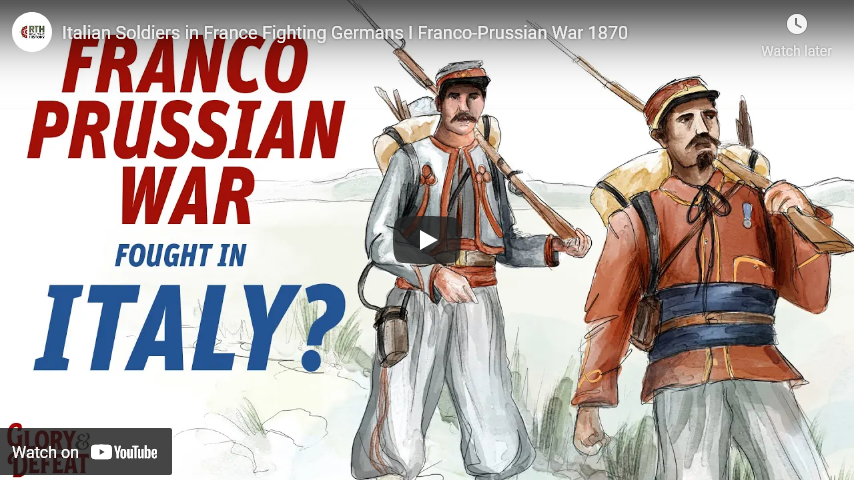
An Entire French Army Trapped in Metz During the Franco-Prussian War

Filed under: France, Germany, History, Military — Tags: , , — Nicholas @ 04:00

realtimehistory
Published 26 Aug 2021

Sign up for Curiosity Stream and get Nebula bundled in and SAVE 26%: https://curiositystream.com/realtimeh…

The French Army of the Rhine under Marshal Bazaine is trapped inside Metz — along with civilians and wounded over 250,000 people will need to be fed from the city’s dwindling supplies. Surrounding the city is a German Army that cannot force the Metz fortifications and opts for starving it into submission instead.

» THANK YOU TO OUR CO-PRODUCERS
John Ozment
James Darcangelo
Jacob Carter Landt
Thomas Brendan

» OUR PODCAST
https://realtimehistory.net/podcast – interviews with historians and background info for the show.

» LITERATURE
Arand, Tobias: 1870/71. Der Deutsch-Französische Krieg erzählt in Einzelschicksalen. Hamburg 2018

Bourguinat, Nicolas/Vogt, Gilles: La guerre franco-allemande de 1870. Une histoire globale. Paris 2020

Gouttman, Alain: La grande défaite de 1870-1871. Paris 2015

Herre, Franz: Eugénie. Kaiserin der Franzosen. Stuttgart, München 2000

Milza, Pierre: L’année terrible. Paris 2009

Schikorsky, Isa (Hrsg.): “Wenn doch dies Elend ein Ende hätte”. Ein Briefwechsel aus dem Deutsch-Französischen Krieg 1870/71. Köln, Weimar, Wien 1999

» SOURCES
Bazaine, François-Achille: Episoden aus dem Kriege von 1870 und der Belagerung von Paris. Berlin 1884

Bazaine, François-Achille: Feldzug des Rhein-Heeres vom 12. August bis 28. Oktober 1870. Leipzig 1872

Großer Generalstab (Hrsg.): Der Deutsch-Französische Krieg, 1870–71. Bd. 1–3. Berlin 1874 ff.

Historischer Verein der Höhen von Spicheren des 67. Kaiserlichen Linienregiments der Infaterie (Hrsg.): Das Kriegstagebuch von Clovis Hardy. Soldat im 63. Linienregiment. Deutsch-Französischer Krieg 1870/71. Vom Lager in Châlons bis nach Ansbach in Bayern. O.O. [Esvres] O.J. [2011]

Sternegg, Johann Khoss von: Schlachtenatlas des XIX. Jahrhunderts. Leipzig 1886

» OUR STORE
Website: https://realtimehistory.net

»CREDITS
Presented by: Jesse Alexander
Written by: Cathérine Pfauth, Prof. Dr. Tobias Arand, Jesse Alexander
Director: Toni Steller & Florian Wittig
Director of Photography: Toni Steller
Sound: Above Zero
Editing: Toni Steller
Motion Design: Philipp Appelt
Mixing, Mastering & Sound Design: http://above-zero.com
Maps: Battlefield Design
Research by: Cathérine Pfauth, Prof. Dr. Tobias Arand
Fact checking: Cathérine Pfauth, Prof. Dr. Tobias Arand

Channel Design: Battlefield Design

Contains licensed material by getty images
All rights reserved – Real Time History GmbH 2021

Russo-Japanese War 1904-1905 – Battle of Tsushima

Filed under: China, History, Japan, Military, Pacific, Russia — Tags: , — Nicholas @ 02:00

Kings and Generals
Published 16 Dec 2018

In our new historical animated documentary, we will cover the Russo-Japanese War of 1904-1905 with a focus on the naval engagements at Tsushima, the Yellow Sea, and Port Arthur. This conflict between Russia and Japan was unique due to the heavy usage of the battleships and its results influenced the First and Second World Wars.

Support us on Patreon: http://www.patreon.com/KingsandGenerals or Paypal: http://paypal.me/kingsandgenerals

Check out our Merch Store: teespring.com/stores/kingsandgenerals

We are grateful to our patrons and youtube members, who made this video possible: https://drive.google.com/open?id=1Tff…

This video was narrated by Officially Devin (https://www.youtube.com/user/OfficiallyDevin)

✔ Merch store ► teespring.com/stores/kingsandgenerals
✔ Podcast ► Google Play: http://bit.ly/2QDF7y0 iTunes: https://apple.co/2QTuMNG
✔ Twitter ► https://twitter.com/KingsGenerals
✔ Instagram ► http://www.instagram.com/Kings_Generals

Sources:
Robert Forczyk – Russian Battleship vs Japanese Battleship
William Koenig – Epic Sea Battles
Левицкий – Русско-японская война 1904—1905
Сорокин – Оборона Порт-Артура. Русско-японская война 1904—1905

Production Music courtesy of Epidemic Sound: http://www.epidemicsound.com

#Documentary #RussoJapaneseWar #KingsAndGenerals

August 27, 2021

On Which Side is Brazil? – WW2 Special

World War Two
Published 26 Aug 2021

Brazilian President, Getúlio Vargas, has led his country as dictator since the 1930s. He has embraced European fascist ideas and fostered close ties with Germany and Italy. Yet, he also maintains a close relationship with the United States. After skilfully playing both sides, he must now choose Axis or Allies.
(more…)

The Raid on the Medway – Grand Theft Warship

Filed under: Britain, Europe, History, Military — Tags: , , , , — Nicholas @ 02:00

Drachinifel
Published 24 Apr 2019

Today we look at the Dutch raid on the Medway in the 2nd Anglo-Dutch War and its after-effects.

Want to support the channel? – https://www.patreon.com/Drachinifel

Want to talk about ships? https://discord.gg/TYu88mt

Music – https://www.youtube.com/watch?v=jRQWZ…

Want to get some books? – www.amazon.co.uk/shop/drachinifel

Drydock Episodes in podcast format – https://soundcloud.com/user-21912004

From the comments:

lordmuntague
2 years ago
“On 14 December 1941 a Dutch minelayer named after Jan van Brakel, which was serving as a convoy escort on the UK eastern coast, accidentally hit the anchor buoy of one of the gate vessels which were protecting the entrance to the Medway during World War II. The commander reported this incident to the port authorities, signalling: “Van Brakel damaged boom defence Medway”. The instant reply was: “What, again?”

From the RNSA Website.

August 26, 2021

A New World Order? – The World Power Conference | B2W: ZEITGEIST! I E.24 Summer 1924

TimeGhost History
Published 25 Aug 2021

The League of Nations is just one manifestation of a broader ideal in the interwar years. Within a palace in the heart of the British Empire, a new conference is underway. It is attended by everyone from H.G. Wells to the Prince of Wales.
(more…)

Winchester WWII 50 AT rifle

Filed under: Cancon, History, Military, USA, Weapons, WW2 — Tags: , , , — Nicholas @ 02:00

Forgotten Weapons
Published 3 Aug 2016

http://www.patreon.com/ForgottenWeapons​

David Marshall Williams was hired by the Winchester company in 1939, and would have a hand in a number of major projects during his 10-year stint with the company, although best known for the M1 Carbine. The Carbine was an offshoot of the Winchester G30 and G30M rifles, which would also evolve into the G30R and Winchester Automatic Rifle. Another offshoot using this same basic mechanism was this undesignated .50 BMG semiautomatic antitank rifle developed by Winchester during World War II.

This rifle, like its developmental precursors, uses a two-lug, Garand type rotating bolt and a Williams gas tappet short stroke action. It has a 10-round detachable box magazine.

Although I have not found a testing report, the gun was apparently tested by the Canadian military and performed quite well. It was never purchased or put into serial production, however, most likely because as an antitank rifle the .50 BMG cartridge was not effective by the end of World War II.

August 25, 2021

Carica! – The Cavalry Charges of World War Two – WW2 Special

Filed under: Europe, Germany, History, Italy, Military, Russia, WW2 — Tags: , , , , — Nicholas @ 04:00

World War Two
Published 24 Aug 2021

The Eastern Front is a battleground of Blitzkrieg and Deep Battle; Panzers vs. T-34s; Nazism and Communism. You’d think that there would be no place for cavalry tactics here. But the Wehrmacht, Red Army, and Regio Esercito do still use centuries-old cavalry tactics in their waging of war.
(more…)

Louisa May Alcott’s childhood experiences in a utopian socialist commune

Filed under: Economics, History, USA — Tags: , , , — Nicholas @ 03:00

At the Foundation for Economic Education, Lawrence W. Reed recounts the author’s family’s time in one of the many utopian settlements of the early United States:

The original farm house of Fruitlands farm community in Harvard, Massachusetts, founded by Bronson Alcott and Charles Lane in 1843. Now a museum to the experiment.
Photo by Midnightdreary via Wikimedia Commons.

Alcott was just 11 when her father moved the family to the experimental village of Fruitlands in Massachusetts. It was not a promising place. Elizabeth Dunn at History.com writes,

    Fruitlands was founded in Harvard, Massachusetts, as a self-sufficient farming community by Charles Lane and Bronson Alcott, two men with no practical experience in either farming or self-sufficiency … Settlers were forbidden to eat meat, consume stimulants, use any form of animal labor, create artificial light, enjoy hot baths or drink anything but water. Lane’s ideas later evolved to include celibacy within marriage, which caused no small amount of friction between him and his most loyal disciple, Bronson Alcott, who had relocated his wife and four daughters [Louisa being one of them] to Fruitlands in a characteristic fit of enthusiasm.

At least 119 utopian, communal or socialist settlements were founded in the early 1800s in America. As most of the country reveled in newly won freedoms and a market economy that allowed the enterprising to create wealth, a few malcontents sought a different life. They spurned private property in favor of sharing material things in common. They preferred a “planned” community over the supposed “chaos” of the market’s spontaneous order. They thought if they just worked out on paper what their preferred society would look like, everything and everybody would just fall into place.

Like many idealists, Alcott’s father and many others believed that it was possible to “plan” everything successfully so that nothing was wasted and there was no economic inequality. Like many others since then, they quickly discovered that human nature does not work that way:

Lofty pledges of equality that fell far short of reality. Women, for instance, were promised they would have to work no harder or longer than men, but the Alcott girls were among the Fruitlands women who were stuck with most of the labor.

Goofy, fringe notions about life. At Fruitlands, these notions included a general abstinence not only from sex but from most of what its architects regarded as “worldly activities” — like most commerce and trade, the raising of livestock, and the planting of vegetables that grow down (like turnips and carrots) instead of up (like lettuce and tomatoes).

A weird disdain for private property. The mere desire to acquire property for oneself (even by serving others as customers) was regarded as repugnant. Lane and Alcott once visited a nearby settlement of Shakers and while admiring the Shakers’ practice of property held “in common”, they condemned them for engaging in commerce by selling their homemade furniture.

Tanks Chats #121​ | The Cascavel | The Tank Museum

Filed under: Americas, History, Military, Weapons — Tags: , , , , — Nicholas @ 02:00

The Tank Museum
Published 2 Apr 2021

The Tank Museum’s Curator David Willey presents a Tank Chat on the EE-9 Cascavel, a Brazilian Armoured Car developed during the 1970s, primarily for reconnaissance. David also touches upon the EE-11 Urutu, which shares many of the Cascavel’s components. Join him to find out more.
(more…)

August 24, 2021

Bloody Victories – The Battles For Metz | GLORY & DEFEAT Week 6

Filed under: France, Germany, History, Military — Tags: , , , — Nicholas @ 04:00

realtimehistory
Published 19 Aug 2021

Support Glory & Defeat by sponsoring an illustration: https://realtimehistory.net/adoptanar…

The French Army of Marshal Bazaine was hoping to reach Verdun or even Paris after the first engagements around Metz. But the French troops were exhausted which allowed the Germans to catch up. With the Battle of Gravelotte and the Battle of Mars-la-Tour, the fate of the French Rhine Army is sealed; they are trapped in Metz.

» THANK YOU TO OUR CO-PRODUCERS
John Ozment
James Darcangelo
Jacob Carter Landt
Thomas Brendan

» OUR PODCAST
https://realtimehistory.net/podcast – interviews with historians and background info for the show.

» LITERATURE
Arand, Tobias: 1870/71. Die Geschichte des Deutsch-Französischen Krieges erzählt in Einzelschicksalen. Hamburg 2018
Bourguinat, Nicolas/Vogt, Gilles: La Guerre franco-allemande de 1870. Une histoire globale. Paris 2020
Buk-Swienty, Tom: Feuer und Blut. Hauptmann Dinesen. Hamburg 2014
Roux, Georges: La Guerre de 1870. Paris 1966

» SOURCES
Braun, Lily (Hrsg.): Kriegsbriefe aus den Jahren 1870/1 von Hans von Kretschman. Berlin 1911
Engels, Friedrich: Der Deutsch-Französische Krieg. Sechzig Artikel aus der “Pall Mall Gazette”. Berlin (Ost) 1957
Fontane, Theodor: Der Krieg gegen Frankreich. Bd. 1. Berlin 1873
Geschichte des Krieges 1870–1871, Union Deutsche Verlagsanstalt, Stuttgart 1895
N. N. (Hrsg.): Bismarcks Briefe an seine Gattin aus dem Kriege 1870/71. Stuttgart, Berlin 1903
Seigneur, Daniel: Carnets d’un infirmier d’une guerre oublié. Bière 2014

» OUR STORE
Website: https://realtimehistory.net

»CREDITS
Presented by: Jesse Alexander
Written by: Cathérine Pfauth, Prof. Dr. Tobias Arand, Jesse Alexander
Director: Toni Steller & Florian Wittig
Director of Photography: Toni Steller
Sound: Above Zero
Editing: Toni Steller
Motion Design: Philipp Appelt
Mixing, Mastering & Sound Design: http://above-zero.com
Maps: Battlefield Design
Research by: Cathérine Pfauth, Prof. Dr. Tobias Arand
Fact checking: Cathérine Pfauth, Prof. Dr. Tobias Arand

Channel Design: Battlefield Design

Contains licensed material by getty images
All rights reserved – Real Time History GmbH 2021

Aztec Chocolate – Blood & Spice

Tasting History with Max Miller
Published 9 Mar 2021

Help Support the Channel with Patreon: https://www.patreon.com/tastinghistory
Tasting History Merchandise: crowdmade.com/collections/tastinghistory

Follow Tasting History here:
Instagram: https://www.instagram.com/tastinghist…
Twitter: https://twitter.com/TastingHistory1
Tiktok: TastingHistory
Reddit: r/TastingHistory
Discord: https://discord.gg/d7nbEpy

Tasting History’s Amazon Wish List: https://amzn.to/3i0mwGt

LINKS TO INGREDIENTS & EQUIPMENT**
Sony Alpha 7C Camera: https://amzn.to/2MQbNTK
Sigma 24-70mm f/2.8 Lens: https://amzn.to/35tjyoW
Molinillo: https://amzn.to/3rpoXGJ
Cacao Beans: https://amzn.to/3v4feIe
Cacao Nibs: https://amzn.to/3sX7JAU
Achiote/Annatto Powder: https://amzn.to/3rpWe4C

LINKS TO SOURCES**
The Secret Life of Chocolate by Marcos Patchett: https://amzn.to/3qoLOB1
For more information visit thesecretlifeofchocolate.com
The True History of Chocolate by Sophie & Michael Coe: https://amzn.to/3sWBl1f
Florentine Codex by Bernardino de Sahagún: https://amzn.to/2OrKiAE
Thomas Gage’s Travels in the New World: https://amzn.to/3sO3YxA

**Some of the links and other products that appear on this video are from companies which Tasting History will earn an affiliate commission or referral bonus. Each purchase made from these links will help to support this channel with no additional cost to you. The content in this video is accurate as of the posting date. Some of the offers mentioned may no longer be available.

Subtitles: Jose Mendoza

PHOTO CREDITS
Metate et Mano: Yelkrokoyade, CC BY-SA 3.0 https://creativecommons.org/licenses/…, via Wikimedia Commons
Olmec Head No 3: By Maribel Ponce Ixba (frida27ponce) – Flickr, CC BY 2.0, https://commons.wikimedia.org/w/index…

#tastinghistory #aztec #chocolate

August 23, 2021

Swastika Raised on Highest Point in Europe – WW2 – 156 – August 21, 1942

World War Two
Published 21 Aug 2021

The Axis advance in the Caucasus takes Mt. Elbrus, and the one on Stalingrad continues, and there are several raids of note this week- a Japanese one on Guadalcanal is destroyed, an Allied one on Dieppe is badly savaged, and an American one at Makin Atoll is successful in the short term, but with bad long term ramifications.
(more…)

Canadian Army Ranks 1939-1945

Filed under: Cancon, History, Military, WW2 — Tags: , — Nicholas @ 02:00

HandGrenadeDivision
Published 6 Sep 2019

A brief video describing the ranks used by the Canadian Army in the Second World War, with an equally brief introduction to the General Staff system.

Further reading and resources regarding the Canadian Army of the Second World War:

Service Publications

https://servicepub.com/

canadiansoldiers.com

http://www.canadiansoldiers.com

Department of National Defence Directorate of History and Heritage

http://www.cmp-cpm.forces.gc.ca/dhh-d…

August 22, 2021

Mounties’ First Revolver: the NWMP Adams MkIII

Filed under: Britain, Cancon, History, Weapons — Tags: , , , , — Nicholas @ 02:00

Forgotten Weapons
Published 3 May 2021

http://www.patreon.com/ForgottenWeapons​

https://www.floatplane.com/channel/Fo…​

Cool Forgotten Weapons merch! http://shop.forgottenweapons.com​

The first handguns issued by the North West Mounted Police (which would later become the modern RCMP) were 330 Adams revolvers, requisitioned by the new police service in March 1874, and shipped over from England. Upon their receipt in July of that year, the Mounties were dismayed to find thoroughly worn out Adams Mk I 5-shot conversions from old percussion revolvers. These were found totally unfit for frontier service, and an appeal was sent back to England for something better.

A replacement shipment arrived in October 1875, and this time they received 326 much better Adams MkIII revolvers (330 were shipped, but 4 were stolen in transit). The MkIII pattern was a purpose-made .450 Adams cartridge revolver, holding six shots with a double action trigger and solid frame. These served very well, and the NWMP ordered more in 1880 — for which they instead received Enfield revolvers, which had replaced the Adams in British military service by that time.

The 326 Adams MkIII revolvers issued by the NWMP were marked by a local gunsmith upon their arrival. The right side of the frames are marked “C M.P.” (presumably Canada Mounted Police) and given a police inventory number just below the barrel (in addition to the serial number above the trigger). These issue numbers were defaced when the guns were sold out of service.

Contact:
Forgotten Weapons
6281 N. Oracle Box 36270
Tucson, AZ 85740

« Newer PostsOlder Posts »

Powered by WordPress