
Good government is a constable — it keeps the peace and protects property. Parasitic government — which is, sad to say, practically the only form known in the modern world — is at its best a middleman that takes a cut of every transaction by positioning itself as a nuisance separating you from your goals. At its worst, it is functionally identical to a goon running a protection racket.
[…]
The desire to be left alone is a powerful one, and an American one. It is not, contrary to the rhetoric proffered by the off-brand Cherokee princess currently representing the masochistic masses of Massachusetts in the Senate, an anti-social sentiment. It is not that we necessarily desire to be left alone full stop — it is that we desire to be left alone by people who intend to forcibly seize our assets for their own use. You need not be a radical to desire to live in your own home, to drive your own car, and to perform your own work without having to beg the permission of a politician — and pay them 40 percent for the privilege.
Principles are dangerous things — whiskey is for drinking, water and principles are for fighting over. The anti-ideological current in conservative thinking appreciates this: If we all seek complete and comprehensive satisfaction of our principles, then there will never be peace. This is why scale matters and why priorities matter. In a world in which the public sector consumes 5 percent of my income and uses it for such legitimate public goods as law enforcement and border security, I do not much care whether the tax system is fair or just on a theoretical level; and while I may resent it as a matter of principle, the cost of my consent is relatively low, and I have other things to think about. But in a world in which the parasites take half, and use it mainly to buy political support from an increasingly ovine and dependent electorate, then I care intensely.
Kevin D. Williamson, “Property and Peace”, National Review, 2014-07-20.
July 16, 2015
QotD: The proper role of government
July 14, 2015
Washington’s streetcars
Warren Meyer isn’t a fan of streetcars in general, but he views the Washington DC streetcar project as being particularly deserving of scorn:
I am increasingly convinced that the appeal of streetcars and light rail has everything to do with class. From any rational perspective, these systems make no sense — they are 10-100x more expensive than buses and lack the flexibility that buses have to adjust to shifting demand patterns over time. A single extra lane of highway adds more capacity than any light rail line.
Streetcar’s single, solitary advantage is that middle and upper class whites who would not be caught dead on a bus seem to be willing to ride streetcars. I don’t know if this is because of some feature of the streetcars (they are shiny and painted pretty) or if it is some sort of self-segregation (the upper classes want to ride on something that is not filled with “riffraff”).
He also points out that even Vox.com can’t make the case for streetcars particularly well:
The arguments are:
- Tourists like them, because you can’t get lost like you can on buses. My response is, “so what.” Unless you are one of a very few unique cities, tourists are a trivial percentage of transit riders anyway. Why build a huge system just to serve out-of-town visitors? I would add that many of these same cities (e.g. Las Vegas) considering streetcars are the same ones banning Uber, which tourists REALLY love.
- Developers like them. Ahh, now we are getting somewhere. So they are corporate welfare? But not so fast, they are not even very good corporate welfare. Because most of the studies they cite are total BS, of the same quality as studies that say sports stadium construction spurs all sorts of business. In fact, most cities have linked huge tax abatement and subsidy programs to their streetcars, such that the development you get with the subsidy and the streetcar is about what you would expect from the subsidies alone. Reminds me of the old joke that mimicked cereal commercials: “As part of a breakfast with juice, toast, and milk, Trix cereal has all the nutrition of juice, toast, and milk.”
- Good for the environment. But even Vox asks, “as compared to what.” Since they are generally an alternative buses, as compared to buses that have little environmental advantage and often are worse (they have a lot more weight to drag around when empty).
- The Obama Administration likes them. LOL, that’s a recommendation? When you read the text, what they actually say is that mayors like the fact that the Obama Administration likes them, for it means the Feds will throw lots of Federal money at these projects to help mayors look good using other peoples’ money.
- Jobs. This is hilarious Keynesianism, trying to make the fact that streetcars are 10-100x more expensive than buses some sort of positive. Because they are more inefficient, they employ more people! One could make the exact same argument for banning mechanical harvesters and going back to scythes. Left unquestioned, as Bastiat would tell us, is how many people that money would have employed if it had not been seized by the government for streetcar use.
- Je ne sais quoi. I kid you not, that is their final argument, that streetcars add that special something to a neighborhood. In my mind, this is Vox’s way of saying the same thing I did the other day — that the streetcar’s appeal is primarily based on class, in that middle and upper class folks don’t want to ride on a bus with the masses. The streetcar feels more upscale than buses. The poor of course, for whom public transit is most vital, don’t want to pay 10 times more for sexiness.
Every argument I have ever been in on streetcars always boils down to something like “well, all the cool kids like them.”
July 4, 2015
Reason.tv – The Secret Scam of Streetcars
Published on 1 Jul 2015
Meet the Thighmaster of urban public policy: Streetcars.
Municipal politicians all across the country have convinced themselves that this costly, clunky hardware can revitalize their flabby downtown economies.
That includes the fearless leaders of America’s capital city. The DC government has spent hundreds of millions of dollars over the last decade trying to erect a streetcar line in the up-and-coming neighborhood of H Street. The project has been an epic disaster, perfectly demonstrating how ill-suited streetcars are to modern urban life.
Watch the full video above, or click below for downloadable versions. And subscribe to Reason TV’s YouTube channel for daily content like this.
June 30, 2015
Elon Musk – high tech messiah or grasping crony capitalist?
Sean Noble says that the subsidies Elon Musk’s high-tech Tesla and Solar City firms are much higher than he implies:
Tesla, SpaceX, and Solar City head Elon Musk lashed out at the Los Angeles Times following an article that totaled up all the government support that his three-headed corporate-welfare monster receives. The number the Times reported was nearly $5 billion in combined support for his companies, including subsidies for those who purchase Musk’s products, such as the high-priced solar panels of Solar City and the supercars of Tesla.
Musk responded by arguing, “If I cared about subsidies, I would have entered the oil and gas industry.” He further asserted that his competitors in the oil-and-gas industry haul in 1,000 times more in subsidies in a single year than his companies have received in total. Such statements reveal that Musk seems to care as little for facts as he purports to care about the taxpayer dollars propping up his various businesses.
Earlier this year, the U.S. Energy Information Administration (EIA) released the most recent data available regarding energy subsidies provided by the federal government. The data, covering the year 2013, broke down total taxpayer subsidies across the different sectors of the energy industry. While fossil fuels did enjoy some government support through various direct expenditures, tax credits, and R&D programs, the data stands in sharp contrast to Musk’s claims.
Data from the EIA report, combined with numbers from an anti-oil advocacy group regarding state-level government support, reveals that total state and federal support for the oil-and-gas industry is no more than $5.5 billion each year. As stated, Musk’s companies combine for $5 billion in subsidies, a number that he has yet to dispute. Clearly, the difference is much smaller than Musk’s outlandish 1,000-to-one claim.
June 29, 2015
Price Ceilings: Shortages and Quality Reduction
Published on 25 Feb 2015
Price ceilings result in five major unintended consequences, and in this video we cover two of them. Using the supply and demand curve, we show how price ceilings lead to a shortage of goods and to low quality goods. Prices are signals that indicate to suppliers how much is being demanded, but when prices are kept artificially low with price ceilings, suppliers have no way of knowing how many goods they should produce and sell, leading to a shortage of goods. Quality also decreases under price controls. Do you ever wonder why the quality of customer service at Starbucks is generally better than at the DMV? The answer lies in incentives and price ceilings. We’ll discuss further in this video.
June 23, 2015
June 18, 2015
Nutrition … what we thought we knew is wrong, again
At Real Clear Science, Ross Pomeroy explains how historical “expert knowledge” and government cheerleading pointed in exactly the opposite direction of today’s experts and government regulators:
For decades, the federal government has been advising Americans on what to eat. Those recommendations have been subject to the shifting sands of dietary science. And have those sands ever been shifting. At first, fat and cholesterol were vilified, while sugar was mostly let off the hook. Now, fat is fine (saturated fat is still evil, though), cholesterol is back, and sugar is the new bogeyman.
Why the sizable shift? The answer may be “bad science.”
Every five years, the Dietary Guidelines Advisory Committee, composed of nutrition and health experts from around the country, convenes to review the latest scientific and medical literature. From their learned dissection, they form the dietary guidelines.
But according to a new editorial published in Mayo Clinic Proceedings, much of the science they review is fundamentally flawed. Unlike experiments in the hard sciences of chemistry, physics, and biology, which rely on direct observational evidence, most diet studies are based on self-reported data. Study subjects are examined for height, weight, and health, then are questioned about what they eat. Their dietary choices are subsequently linked to health outcomes — cancer, mortality, heart disease, etc.
That’s a poor way of doing science, says Edward Archer, a research fellow with the Nutrition Obesity Research Center at the University of Alabama, and lead author of the report.
“The assumption that human memory can provide accurate or precise reproductions of past ingestive behavior is indisputably false,” he and his co-authors write.
Two of the largest studies on nutritional intake in the United States, the CDC’s NHANES and “What We Eat,” are based on asking subjects to recall precisely what and how much they usually eat.
But despite all of the steps that NHANES examiners take to aid recall, such as limiting the recall period to the previous 24 hours and even offering subjects measuring guides to help them report accurate data, the information received is wildly inaccurate. An analysis conducted by Archer in 2013 found that most of the 60,000+ NHANES subjects report eating a lower amount of calories than they would physiologically need to survive, let alone to put on all the weight that Americans have in the past few decades.
QotD: The “optimal” level of corruption
Quick question for you: What’s the optimal amount of corruption in politics?
If you said “zero,” then I’m sorry. You do not win the prize. (It was a year’s supply of Mr. Clean Magic Erasers, just so you know.) The optimal amount of corruption in any system is almost never zero, and that goes double for politics.
We shouldn’t try to get corruption to zero because fighting corruption is costly. Think, for example, of government contracting, which mindlessly awards contracts to the low bidder, as if quality and reliability were irrelevant considerations. This sloppiness inevitably adds time and costs. Or the various requirements we impose on civil service workers to make sure that not one of them enjoys so much as a stray sandwich on the taxpayer dime … and thereby ensure that normal business practices, like sitting down for an inexpensive group meal to discuss something, are almost comically difficult to arrange. All these procedural rules make government less effective and more costly. My father, who was the head of a trade association for contractors on heavy infrastructure projects, estimates that adding federal money to a project adds about five years to its completion date.
There’s even more reason not to strive for zero corruption: Politics is the art of getting widely disparate factions to come to some sort of policy agreement, and “clean graft” greases those wheels. Now, calm down — I’m not advocating that we move to a full-on kleptocracy like Russia. What I’m suggesting is in attempting to root every last vestige of pork and patronage out of the system, we have inadvertently produced the partisan gridlock that we now decry. Anyone who thinks that this is a crazy statement should read Jonathan Rauch’s terrific new e-book, Political Realism: How Hacks, Machines, Big Money, and Back-Room Deals Can Strengthen American Democracy. At a trim 55 pages, it is a fast read, and at $0, it is the bargain of the century.
Megan McArdle, “In Politics, It’s Good to Be a Little Bad”, Bloomberg View, 2015-05-07.
June 17, 2015
When you tax something, you get less of it
At International Liberty, Dan Mitchell points out an example of leftists who genuinely want higher taxes on “the rich” even when the higher rate will return less money to the government:
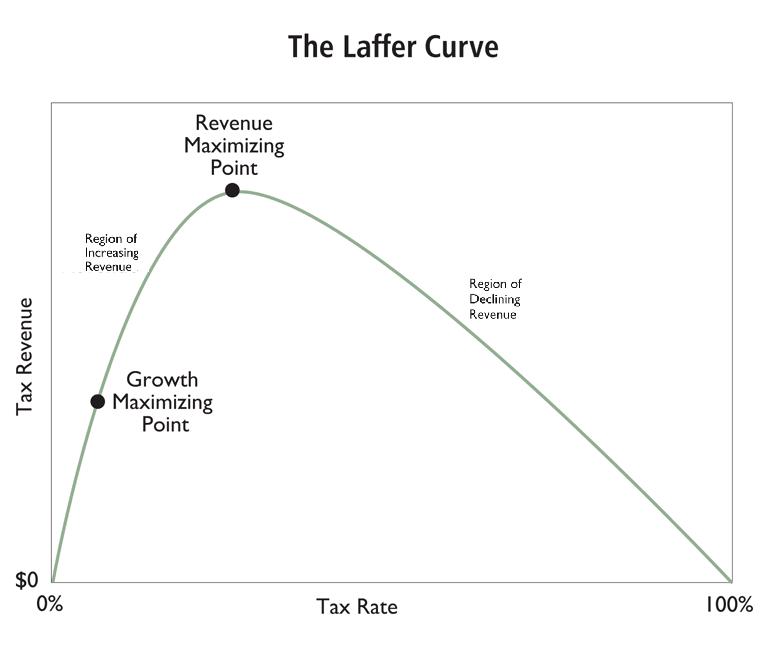
Every so often, I’ll assert that some statists are so consumed by envy and spite that they favor high tax rates on the “rich” even if the net effect (because of diminished economic output) is less revenue for government.
In other words, they deliberately and openly want to be on the right side (which is definitely the wrong side) of the Laffer Curve.
Critics sometimes accuse me of misrepresenting the left’s ideology, to which I respond by pointing to a poll of left-wing voters who strongly favored soak-the-rich tax hikes even if there was no extra tax collected.
But now I have an even better example.
Writing for Vox, Matthew Yglesias openly argues that we should be on the downward-sloping portion of the Laffer Curve. Just in case you think I’m exaggerating, “the case for confiscatory taxation” is part of the title for his article.
Here’s some of what he wrote.
Maybe at least some taxes should be really high. Maybe even really really high. So high as to useless for revenue-raising purposes — but powerful for achieving other ends. We already accept this principle for tobacco taxes. If all we wanted to do was raise revenue, we might want to slightly cut cigarette taxes. …But we don’t do that because we care about public health. We tax tobacco not to make money but to discourage smoking.
The tobacco tax analogy is very appropriate.
June 2, 2015
May 28, 2015
QotD: The key strength of markets
This is a general and pernicious failing of the left in my view. They really, just really, don’t get what it is that markets do and do very well. What markets do do is they produce the information, through the price system, of who is willing to produce what at which price and who desires to consume what at which price. Thus we get an efficient allocation of scarce resources by our use of markets. And Hayek pretty much got his Nobel for proving that there is no other system to hand which can perform this function. The planner simply cannot gain enough information to be able to perform that function, nor process it real time (and no, computing can’t do it either, Allende and his computer to run the Chilean economy was wrong.)
It’s entirely possible to critique markets on the grounds of equity though. For example, too many people are too poor if we just leave it to the market. Perhaps we agree with that idea, perhaps we don’t: but that argues for changing peoples’ incomes through intervention, not for abolishing the market in the provision of goods. Or, as I’ve said before, if Chavez and Maduro want poor Venezuelans to be better off then send them more money. Don’t mess with the market: the result of that messing will inevitably be the sort of breakdown we see here.
As for the people of Venezuela, well, obviously, this isn’t going to work out well. Their rulers have pretty much bankrupted the country through their incompetence: and now they’re taking more economic power unto themselves?
Not going to work, is it? Even competent governments haven’t been able to make nationalised food distribution systems work…
Tim Worstall, “Amazingly, Maduro Is Going To Make The Venezuelan Economy Even Worse. Yes, Worse”, Forbes, 2015-05-03.
May 24, 2015
Charles Stross proposes “The Evil Business Plan of Evil”
Well, “proposes” isn’t quite the right word:
Let me describe first the requirements for the Evil Business Plan of Evil, and then the Plan Itself, in all it’s oppressive horror and glory.
Some aspects of modern life look like necessary evils at first, until you realize that some asshole has managed to (a) make it compulsory, and (b) use it for rent-seeking. The goal of this business is to identify a niche that is already mandatory, and where a supply chain exists (that is: someone provides goods or service, and as many people as possible have to use them), then figure out a way to colonize it as a monopolistic intermediary with rent-raising power and the force of law behind it. Sort of like the Post Office, if the Post Office had gotten into the email business in the 1970s and charged postage on SMTP transactions and had made running a private postal service illegal to protect their monopoly.
Here’s a better example: speed cameras.
We all know that driving at excessive speed drastically increases the severity of injuries, damage, and deaths resulting from traffic accidents. We also know that employing cops to run speed traps the old-fashioned way, with painted lines and a stop-watch, is very labour-intensive. Therefore, at first glance the modern GATSO or automated speed camera looks like a really good idea. Sitting beside British roads they’re mostly painted bright yellow so you can see them coming, and they’re emplaced where there’s a particular speed-related accident problem, to deter idiots from behaviour likely to kill or injure other people.
However, the idea has legs. Speed cameras go mobile, and can be camouflaged inside vans. Some UK police forces use these to deter drivers from speeding past school gates, where the speed limit typically drops to 20mph (because the difference in outcome between hitting a child at 20mph to hitting them at 30mph is drastic and life-changing at best: one probably causes bruises and contusions, the other breaks bones and often kills). And some towns have been accused of using speed cameras as “revenue enhancement devices”, positioning them not to deter bad behaviour but to maximize the revenue from penalty notices by surprising drivers.
This idea maxed out in the US, where the police force of Waldo in South Florida was disbanded after a state investigation into ticketing practices; half the town’s revenue was coming from speed violations. (Of course: Florida.) US 301 and Highway 24 pass through the Waldo city limits; the town applied a very low speed limit to a short stretch of these high-speed roads, and cleaned up.
Here’s the commercial outcome of trying to reduce road deaths due to speeding: speed limits are pretty much mandatory worldwide. Demand for tools to deter speeders is therefore pretty much global. Selling speed cameras is an example of supplying government demand; selling radar detectors or SatNav maps with updated speed trap locations is similarly a consumer-side way of cleaning up.
And here’s a zinger of a second point: within 30 years at most, possibly a lot sooner, this will be a dead business sector. Tumbleweeds and ghost town dead. Self-driving cars will stick to the speed limit because of manufacturer fears over product liability lawsuits, and speed limits may be changed to reflect the reliability of robots over inattentive humans (self-driving cars don’t check their Facebook page while changing lanes). These industry sectors come and go.
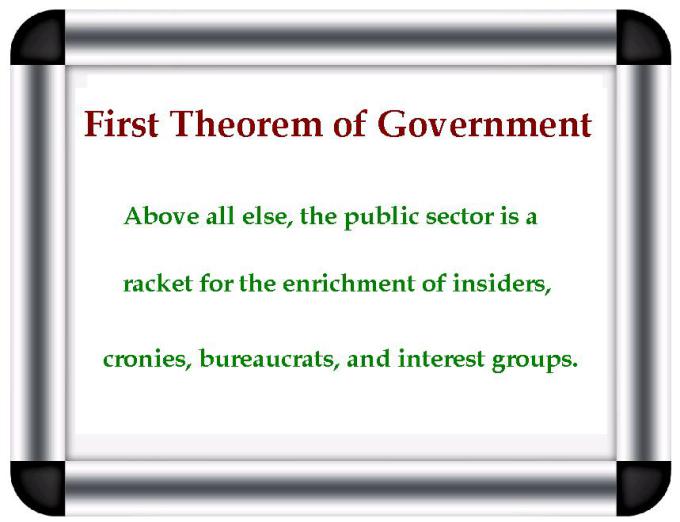
Mitchell’s First Theorem of Government
Dan Mitchell clearly understands what modern western government is really all about:
May 19, 2015
QotD: The iron law of bureaucrats
I should say I’m no free-speech absolutist. I think the notion that we should treat pole dancing like constitutionally protected speech while we try to ban actual political speech is just one of the loopiest manifestations of our popular confusion over the First Amendment. In fact, government support for the arts doesn’t offend me in theory, it’s just how they do it in practice that bothers me.
Specifically, I cannot stand the way New Class bureaucrats think they must be autonomous from the taxpayers who pay their salaries. Imagine if we lived in anything like the “Christianist” theocracy so many lefties live in quaking fear of. Evangelical bureaucrats would likely fund art they liked. The professional Bohemians would shriek — with some justification — that the state was imposing its values on the rest of us. But when those same people are in driving the gravy train, they think there’s nothing wrong — and everything right — with imposing their values.
Of course, this is a problem that extends far beyond outposts like the National Endowment for the Arts (NEA). Public teachers’ unions and ed-school priests hate the idea that parents and other taxpayers should have a real say in how education money is spent. Bureaucrats in general have become a kind of secular aristocracy that resents second-guessing by the people who fund their will-to-power.
When voters say that bureaucrats shouldn’t spend money on X, the bureaucrats shriek “censorship!” But it is only the equivalent of censorship if you work from the assumption that it’s all the government’s money anyhow. As Bill Clinton once said about the federal surplus, “We could give it all back to you and hope you spend it right.” But if we did, alas, not enough of you would spend it on urophagic art.
Jonah Goldberg, “Bureaucrats Use Taxpayer Money to Subsidize Their Own Values — and No One Else’s”, National Review, 2015-05-09.
May 16, 2015
Charles Murray and Jonah Goldberg on civil disobedience in America
Published on 11 May 2015
The American ideal of limited government on life support. Is it time for civil disobedience? Charles Murray says yes. Murray has been writing on government overreach for more than 30 years. His new book, By The People, is a blueprint for taking back American liberty. Jonah Goldberg sits down with Murray to discuss civil unrest in Baltimore, the scope of the government, and why bureaucrats should wear body cameras.
According to AEI scholar, acclaimed social scientist, and bestselling author Charles Murray, American liberty is under assault. The federal government has unilaterally decided that it can and should tell us how to live our lives. If we object, it threatens, “Fight this, and we’ll ruin you.” How can we overcome regulatory tyranny and live free once again? In his new book, By the People: Rebuilding Liberty Without Permission (Crown Forum, May 2015), Murray offers provocative solutions.


