
The government decides to try to increase the middle class by subsidizing things that middle class people have: If middle-class people go to college and own homes, then surely if more people go to college and own homes, we’ll have more middle-class people. But homeownership and college aren’t causes of middle-class status, they’re markers for possessing the kinds of traits — self-discipline, the ability to defer gratification, etc. — that let you enter, and stay, in the middle class. Subsidizing the markers doesn’t produce the traits; if anything, it undermines them.
Glenn Reynolds, Instapundit.com, 2010-09-23.
April 13, 2018
QotD: Reynolds’ Law
Comments Off on QotD: Reynolds’ Law
April 9, 2018
QotD: Democracy and the scope of government
That the increasing discredit into which democratic government has fallen is due to democracy having been burdened with tasks for which it is not suited is a fact of the greatest importance which has not yet received adequate recognition. Yet the fundamental position is simply that the probability of agreement of a substantial portion of the population upon a particular course of action decreases as the scope of State activity expands.
F.A. Hayek, “Freedom and the Economic System”, 1938.
Comments Off on QotD: Democracy and the scope of government
April 8, 2018
Brexit: Why Britain Left the European Union
PragerU
Published on 12 Mar 2018Is the European Union good for Europe? Or would Europeans be better off without it? Nigel Farage, a leader of the United Kingdom’s Brexit movement, shares his view.
Script:
If one big government is bad, imagine how much worse two big governments would be. But that’s what people living in Europe have had to deal with: their own nation’s bloated government and the super-national government of Europe, now known as the European Union. Bureaucracy times two! How’s that for a horror show?
Well, actually, you’ve no idea. It’s worse than you think. Believe me — I know, because for seventeen years, I’ve represented South East England as a member of the European Parliament, the EU’s legislative body. I was also leader of the UK Independence Party, or UKIP, where I lead Britain’s efforts to leave the European Union. To their everlasting credit, that’s just what happened on June the 23rd, 2016: The United Kingdom left the European Union. The world knows it as “Brexit.”
Brexit is a statement of national sovereignty. Don’t misunderstand me: I like nations. I like borders. I like the people that live within those borders making their own laws. But I don’t like it when faceless bureaucrats make laws for nations they don’t even live in.
But that’s what they do in the European Union.
Imagine a Belgian telling a Brit how much he can charge his customers — or the reverse. The EU bureaucrats do this in a myriad of different ways, all day, every day. It is a conspiracy of the elites.
Who are those elites? Well, they’re a bunch of self-important, overpaid, social engineers with useless college degrees who have never done a proper day’s work in their lives and have no connection with ordinary, decent people. I’ll take the good sense of an Italian farmer or a French baker over the arid intellectualism of an EU bureaucrat any day.
And I say these things not as an anti-European; I love Europe! It’s a fantastic, exciting, great continent: different peoples, languages, and cultures. But these peoples, with their languages and cultures, have effectively been hijacked by a giant, ever-expanding bureaucracy: the European Union.
People will say, “but isn’t there a parliament, a European parliament, that represents the people of Europe?” Well, yes, but this body has got no real power; it can’t make its own laws. Rather, the power resides with the European Commission. They’re unelected and they can’t be removed, and that’s how absurd the whole thing is.
The European Parliament meets in Brussels. At least, that’s what I thought when I was elected there. But once a month, do you know what happens? They load the contents of our offices and papers into big, plastic trunks, and they put those trunks on lorries, and they drive them nearly 400 miles down Europe’s motorways to a French city called Strasbourg where, for four days, the contents of our offices, and our papers, are put into a new office, and the parliament then sits there. Twelve times a year this back-and-forth happens, and this from an organization who say they want to reduce their level of carbon footprint! This, from an organization whose accounts have not been given a clean bill of health by the auditors for the last twenty years!
This…a parliament? It’s more like a traveling circus.
For the complete script, visit https://www.prageru.com/videos/brexit-why-britain-left-european-union
Comments Off on Brexit: Why Britain Left the European Union
April 7, 2018
Kevin Milligan on the Catch-22 that is the modern recycling situation
Most of us are aware that we “should” recycle (even though the economics of recycling are, for most items, mixed at best), but as Kevin Milligan points out, there are no universal standards for what can and can’t be recycled among municipalities:
The headline and tone of this story on recycling "Canadians are doing it wrong" shows everything that is wrong with recycling. Confusing, complex, and conflicting rules relying on voluntary compliance leads to a large waste. It's not citizens' fault. https://t.co/VcvSpJIypR
— Kevin Milligan (@kevinmilligan) April 6, 2018
Check out this part. It's Plastic, labelled as recyclable, but somehow the citizen is supposed to know it's not recyclable. At least in Toronto. Cross a municipal border and there will be different rules. pic.twitter.com/QpVUoH8uWk
— Kevin Milligan (@kevinmilligan) April 6, 2018
Ok you finish your takeout coffee. Quick: which bin does soiled waxed paper go in? I have no clue. Depends where you are. UBC seems to have different rules than Vancouver. And that's different from home/condo rules. And their enforcement strategy is to try to shame us.
— Kevin Milligan (@kevinmilligan) April 6, 2018
To me, the solution seems to be centralized standards; clear and uniform for manufacturers and consumers. I've always found the German Grüne Punkt system easy to follow. https://t.co/MzLCRmC6fr pic.twitter.com/1lXlNpmawC
— Kevin Milligan (@kevinmilligan) April 6, 2018
Anyway. I don't do research in this area so I'm just a citizen with no expertise. As a citizen though I would like a system designed like the designers have ever met an actual human. Also, get off my lawn.
— Kevin Milligan (@kevinmilligan) April 6, 2018
This is what generates my rantiness. In Vancouver there are pro-recycling bus ads that explicitly try to shame people for not recycling everything; depict you literally as a monster for not complying. I reject this shaming! https://t.co/VDDdrjNKBC
— Kevin Milligan (@kevinmilligan) April 6, 2018
Comments Off on Kevin Milligan on the Catch-22 that is the modern recycling situation
Car rental agencies look to government to quash upstart “personal vehicle sharing” companies
Steven Greenhut discusses yet another entrenched industry trying to get the government to protect them from disruptive competitors:
Real capitalism is a tough sport where entrepreneurs risk their capital in hopes of winning customers.
The “crony” version of it involves politicians rigging the rules to assure that the “right” people are winners. We see this ugly process on high-profile national issues, such as when Donald Trump promotes tariffs to boost steel makers at the expense of companies that use steel products. But most of this nonsense proceeds quietly in legislative committees, without garnering any headlines or vocal opposition.
One awful but illustrative example popped up recently in the California state Capitol. Assembly Bill 2246, by Assemblywoman Laura Friedman, D-Glendale, apparently is part of a national effort by rental-car companies to snuff out a burgeoning industry that just happens to be threatening its business model. The bill would redefine “personal vehicle sharing” companies as “car rental companies” — and then slam them with reams of new regulations. Similar measures have been proposed in Idaho, New Hampshire, Maryland and Maine.
Rental-car companies are facing the same challenges as other established business models in this internet and app-based age. Capitalism — the real sort — is defined by “creative destruction,” as economist Joseph Schumpeter called it. New companies are free to offer better products and services that appeal to customers. This is creative as new ideas flourish and consumers get a broader choice and lower prices thanks to competition. But it’s also destructive. Complacent old companies suddenly are forced to improve their offerings or shut their doors. The consumer is king.
For example, I recently grabbed a taxicab rather than my usual Uber and noticed the oddest thing. The cabbie had a modern app-based system for taking my credit-card payment. Until recently, paying by credit card was a hassle because cab services didn’t really want to take your card. I’ve also noticed a fleet of nice new cabs around my city. And the cab I took even sent an email with a receipt and a rating system. Sound familiar?
Comments Off on Car rental agencies look to government to quash upstart “personal vehicle sharing” companies
April 5, 2018
QotD: ESR’s “Iron Laws of Political Economics”
Mancur Olson, in his book The Logic Of Collective Action, highlighted the central problem of politics in a democracy. The benefits of political market-rigging can be concentrated to benefit particular special interest groups, while the costs (in higher taxes, slower economic growth, and many other second-order effects) are diffused through the entire population.
The result is a scramble in which individual interest groups perpetually seek to corner more and more rent from the system, while the incremental costs of this behavior rise slowly enough that it is difficult to sustain broad political opposition to the overall system of political privilege and rent-seeking.
When you add to Olson’s model the fact that the professional political class is itself a special interest group which collects concentrated benefits from encouraging rent-seeking behavior in others, it becomes clear why, as Olson pointed out, “good government” is a public good subject to exactly the same underproduction problems as other public goods. Furthermore, as democracies evolve, government activity that might produce “good government” tends to be crowded out by coalitions of rent-seekers and their tribunes.
This general model has consequences. Here are some of them:
There is no form of market failure, however egregious, which is not eventually made worse by the political interventions intended to fix it.
Political demand for income transfers, entitlements and subsidies always rises faster than the economy can generate increased wealth to supply them from.
Although some taxes genuinely begin by being levied for the benefit of the taxed, all taxes end up being levied for the benefit of the political class.
The equilibrium state of a regulatory agency is to have been captured by the entities it is supposed to regulate.
The probability that the actual effects of a political agency or program will bear any relationship to the intentions under which it was designed falls exponentially with the amount of time since it was founded.
The only important class distinction in any advanced democracy is between those who are net producers of tax revenues and those who are net consumers of them.
Corruption is not the exceptional condition of politics, it is the normal one.
Eric S. Raymond, “Some Iron Laws of Political Economics”, Armed and Dangerous, 2009-05-27.
Comments Off on QotD: ESR’s “Iron Laws of Political Economics”
April 3, 2018
Governments are like diapers – they need to be changed regularly and for the same reason
Paraphrasing an old joke in the headline, but as Andrew Coyne points out, it’s close enough to observed federal reality to qualify:
Is it inevitable that every government becomes what it once despised — a matter of the realities of power overtaking the dreams of opposition? Or do their broken promises, ethical lapses and abuses of power remain, in the end, choices, for which they can be held to account? Do governments turn to seed, or were they that way before they took office? Or is the problem not of any particular party at any particular time, but of a larger culture of cynicism and deceit, in which all parties share?
I do not know the answers to these questions. I only see the same pattern repeated in every government over the last several decades. The Mulroney government came to power promising to clean up the sodden mess left by the Trudeau Liberals (“you had an option, sir — you could have said no!”), only to indulge in its own orgy of patronage appointments and dubious ethics.
The Chretien Liberals were elected to clean up the mess left by the Mulroney Conservatives. Instead they ramped up a massive kickback scheme overseen by a parallel government of party officials and Liberal-friendly advertising executives — to say nothing of their shameless pork-barreling, habitual disdain for Parliament or the prime minister’s personal portfolio of shame.
The Harper government ran and won on a promise to break this pattern, even including the passage of a Federal Accountability Act among their “five priorities.” In power, they invented whole new ways to evade accountability and step on Parliament, while going back on nearly every principle they had ever held or promise they had ever made. Unsurprisingly, compromises on principle ended up begetting compromises on ethics, if only because, in the blur, people forgot which was which.
And now the Trudeau Liberals, again, dynastic succession being the surest sign of the democratic health of a polity. But then, Trudeau fils went to unusual lengths to stress how different he was, not only from his father but from pretty much every leader who went before.
Comments Off on Governments are like diapers – they need to be changed regularly and for the same reason
March 30, 2018
QotD: “Progressive” eugenicists
Although their ethics were appalling, “Progressive” eugenicists of the late 19th and early 20th centuries at least got their economic analysis correct: they understood that forcibly raising employers’ cost of employing certain kinds of labor would reduce the quantity of that labor that is employed. This correct economic understanding was at the foundation of these “Progressives’” support for minimum wages; these “Progressives” explicitly wanted to keep people that they regarded as ‘undesirable’ from working.
I say (and believe) that these “Progressives’” ethics were appalling. Yet I’m quite sure that they did not see themselves as monsters. They surely believed themselves to be enlightened, humane, and highly ethical. They believed that they worked for a larger cause – “social reform” – and saw eugenics, minimum wages, and other uses of state force as progressive means of improving humankind through social engineering. One lesson here is that people convinced that they have a mission to improve society by helping forcibly to re-arrange that society so that it conforms to some pre-conceived image are dangerous brutes (if ones that wear suits) whose brutality is hidden from them by their consciously held good intentions and masked from their contemporaries, ironically, by the grand scale (‘society’) upon which they propose to implement their schemes. (If Bill pokes a gun at his neighbor Betty and threatens to shoot Betty if she pays any of her workers less than $7.25 per hour, Bill is rightly recognized as a brute who belongs in prison. Yet if Bill persuades a uniformed and well-armed gang to threaten to shoot, not just Betty, but everyone in the state who employs workers at wages lower than $7.25 per hour, Bill is celebrated as a humane social reformer who belongs in public office. It’s damn bizarre.)
Don Boudreaux, “Quotation of the day…”, Café Hayek, 2016-07-16.
Comments Off on QotD: “Progressive” eugenicists
March 24, 2018
QotD: Joining “The Firm”
Personally I think Meghan Markle would be a catastrophic addition to The Firm if she does not understand why it is a terrible idea for the Royals to get political. Do that and they stop being symbols (essentially endearing living flags whose job is to wave strangely and act as a navigational datum for flypasts) and become legitimate political targets. There is no surer route to a republic and I would regret that (as I do not share Spiked’s democracy fetish) but not necessarily oppose it if the House of Windsor does indeed go full retard.
Perry de Havilland, “Samizdata quote of the day”, Samizdata, 2018-03-01.
Comments Off on QotD: Joining “The Firm”
March 22, 2018
Unaccountable federal agency refuses to answer to the senator who wanted it to be unaccountable in the first place
Perhaps this is a teaching moment for Senator Elizabeth Warren, says A. Barton Hinkle:
If Massachusetts Sen. Elizabeth Warren had taken a page out of Virginia Delegate Nick Freitas’ book, she might not be in the pickle she is today.
Warren is spitting mad at Mick Mulvaney, the Office of Management and Budget director who does double duty heading up an agency whose creation Warren championed: the Consumer Financial Protection Bureau (CFPB). The CFPB’s previous director was an ideological ally of Warren. Since Mulvaney took over, Warren has ripped the agency’s decisions. Warren said Mulvaney is giving “the middle finger” to consumers, and she railed at Mulvaney’s indifferent response to the 10 (!) letters she has sent him demanding answers to more than 100 questions.
The other day she tweeted that she is giving Mulvaney “one last chance.” Yet as The Wall Street Journal points out, she has only herself to blame for her apparent impotence.
Time and again during debate over the CFPB, conservatives and libertarians warned that its powers were too great and that its accountability to the other branches of government was too limited. But that was just the way Warren and other supporters wanted things. Neither Congress nor other political forces could influence an unaccountable regulatory agency. Now Warren finds herself thwarted by the very lack of oversight she championed.
Be careful what you wish for.
[…]
Philosopher John Rawls famously invented a mechanism for doing just that: the “veil of ignorance”: If you are designing the rules for a society, you should assume that you know nothing about your place in that society. If your race, age, physical abilities, mental prowess, and so forth are all a complete mystery, then you are likely to design a political-economic system that is fair to all. Just in case you wind up at the bottom of the social pile.
Having a president who makes policy through signing statements, his “pen and phone,” and other forms of executive action, for example, seems brilliant when the opposing party controls Congress. It seems less so when the opposing party controls the White House.
Should intelligence agencies keep tabs on Islamists who might pose a threat of domestic terrorism? Then don’t be surprised if a different administration turns the focus to right-wing militias.
Comments Off on Unaccountable federal agency refuses to answer to the senator who wanted it to be unaccountable in the first place
March 20, 2018
March 16, 2018
March 14, 2018
Ontario’s tax dollars at work
At Worthwhile Canadian Initiative, Frances Woolley shows the picture that will define Ontario politics for years to come:
In Ontario, public sector employees earn more than private sector employees. Many workers in the private sector earn the minimum wage, or only slightly above minimum wage. The peak of the public sector earnings distribution is much higher, at twenty-something dollars per hour, and there are a good number of public sector workers earning $40 or $50 an hour.
There are many things missing from this picture. Most importantly, it excludes highly-paid self-employed professionals, such as doctors, lawyers, and accountants, as well as entrepreneurs and business owners. It also excludes self-employed people in the trades, such as plumbers, electricians and contractors. The numbers are non-trivial: 13 percent of Ontario workers are self-employed. A good chunk of the upper part of the private sector earnings distribution is missing from the picture. On the other hand, the hourly wage distribution above excludes non-wage benefits that are more common in the public than the private sector, such as employer contributions to health insurance and pension plans.
Furthermore, the picture does not take into account the differences in the nature of work in the public and private sector. Many public sector jobs, such as nursing, social work, and teaching, require relatively high levels of skill and education. There are private sector jobs that require skill and education as well – but, as noted earlier, many of those jobs are carried out by self-employed professionals, so are not in the graph.
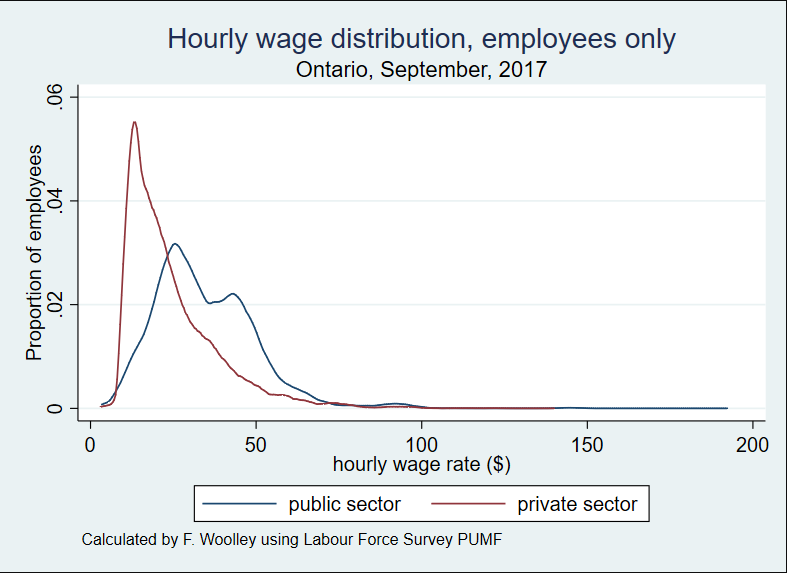
Even noting the exclusions, it’s striking that the old trade-off between public and private sector jobs — that civil servants got lower pay but better benefits and job security — has long since ceased to function. Civil servants, on the whole, now get higher pay than private sector workers, but have retained or even improved the benefits advantage over their private counterparts … and also still retain the job security that private workers can only dream of.
Comments Off on Ontario’s tax dollars at work
March 13, 2018
Trump Is ‘Destroying’ Regulations
ReasonTV
Published on 12 Mar 2018The president’s first year of slowing down regulations shattered previous records. But will politics and legislative inaction stall things from here?
—–
With his tariffs on aluminum and steel, family-separating crackdowns on nonviolent illegal immigrants, and authoritarian musings about executing drug dealers, President Donald Trump can be a libertarian’s nightmare.Except when it comes to regulatory reform.
The Competitive Enterprise Institute (CEI), a Washington, D.C.-based free market think tank that focuses on the administrative state, tallied up the number of regulations in Trump’s first year in office and found, “This is the lowest count since records began being kept in the mid-1970s.” CEI Vice President for Policy Clyde Wayne Crews told Reason that, “I haven’t seen personally anything like the regulatory reductions that have taken place.”
What’s producing these results? In part, the president’s early executive orders mandating that with every new regulation two old ones get killed, and that the net imposed regulatory cost of each agency and department be zero. Trump has also appointed some real reformers to change the way the executive branch does business: Scott Gottlieb at the Food and Drug Administration (FDA), Ajit Pai at the Federal Communications Commission, Betsy DeVos at the Department of Education, and Rick Perry at the Department of Energy.
Chief among the anti-bureaucratic bureaucrats is Neomi Rao, administrator of the obscure-sounding but important Office for Regulatory Affairs (OIRA), which applies cost-benefit analyses to proposed regulation while making sure it still aligns with legislative intent. Rao, who came to the administration after founding the Center for the Study of the Administrative State at George Mason University’s Antonin Scalia Law School, tells Reason that, “We have done more in our first year than any president since we’ve been keeping records, which is back to Reagan.”
President Trump appears genuinely enthusiastic about this push, talking up FDA reforms in both of his State of the Union addresses, and crowing at a December red-tape-cutting ceremony that, “The never-ending growth of red tape in America has come to a sudden screeching and beautiful halt.”
But Crews warns that a midterm will be much harder for Trump to navigate than the comparative honeymoon of 2017. “I think in 2018, he’s going to have a much tougher time meeting the goal,” Crews said. “When you’re acting alone as president and you can’t make law on your own, the barrier that you run into is you run out of low-hanging fruit.”
Produced by Matt Welch and Alexis Garcia. Camera by Todd Krainin, Ian Keyser, Mark McDaniel, and Jim Epstein.
Comments Off on Trump Is ‘Destroying’ Regulations
The economic argument for carbon taxes
Tim Worstall explains what a carbon tax is supposed to do, as opposed to what many environmental activists want it to do:
The essential economic analysis is that carbon emissions are an “externality.” There are costs to third parties of the freely chosen activities of consenting adults. If there aren’t such third party costs then the adults get to consent – as long as your bedroom contains only those freely consenting adults then what goes on there is up to you. But if there are those third party costs – say, the noise from the enjoyments causes lost sleep among the neighbours – then some societal power to force an adjustment seems reasonable enough.
Again, economics analyses here by suggesting that we’ll get too much, or too many, of those third party costs if people aren’t paying for them. If we’ve not got to pay to soundproof the orgy then we’ll have more orgies than if we do. It’s fair that we insist upon such soundproofing perhaps. But sometimes we cannot insist upon such direct actions – then we’ve got to try and change the price system. Which is what the carbon tax does.
There are benefits to using fossil fuels – transport, heat, cooking and so on. Given current technological levels immediate banning would mean billions die – commonly thought to be a Bad Thing. But there are those costs imposed upon others as well in the climate change the emissions cause. The answer is that we look to that greatest good of the greatest number, the utilitarian answer. Where emissions produce more value than the damage they cause – including over time – then we want them to continue. Where they don’t then we want them to stop. That way we get the maximum possible value being created and thus all humans – over time – are as rich as we can be given current technologies.
Calculating what this number is, this tax rate, is also known as determining the social cost of carbon emissions. The Stern Review may or may not have exactly the right number but it’s a good enough starting point, $80 per tonne CO2. Say 50 cents or so per gallon of gas. Slap that tax on and we’ve corrected the price system. People who use gas are now paying the environmental costs of their use. So, anything they use it for must create greater value than the damage being caused. We’re copacetic at this point, we’ve the optimal level of emissions.
Note that this logic still works whatever you think of the rate. 1 cent or $100 a gallon, the logic is still the same, we’re only arguing over what is that social cost of carbon. Stick a tax on of whatever it is and we’re done.
Even if climate change isn’t a problem, or isn’t happening, we do still need some tax revenues somewhere. It’s also better to tax consumption than incomes or capital, better to tax things inelastic in demand with respect to price than those elastic. Fossil fuel consumption taxation is a consumption tax and the demand for fossil fuels is, in the short to medium term at least, inelastic. We’re fine with fuel taxation therefore.
For a quick backgrounder on the concept of externalities, MR University did a video on this a few years back. For reasons to worry that your government might not be quite as revenue-neutral in imposing a Pigouvian tax, Warren Meyer also has doubts.
Comments Off on The economic argument for carbon taxes


