
From time immemorial, the reigning myth of rule has been that the rulers provide a quid pro quo: in exchange for the people’s submission and payment of tribute, the rulers protect the people from the enemies who lurk “out there.” The promise was often unfulfilled, however. The lord of the manor might well flee into his castle, leaving the peasants outside the walls to suffer whatever outrages an invader chose to wreak on them. Or the lord might haul them off to a distant war in which they had no real interest, merely to satisfy the lord’s feudal obligation to the baron or duke just above him in the feudal pecking order.
Most important, however, is the sheer fact that the ordinary people’s most dangerous enemy, the one by far the most likely to plunder and abuse them, was their own impudent lord, the selfsame “nobleman” who forbade them to leave their place of birth or to engage in a variety of tasks and pleasures they might prefer — that is, the man who held and exploited them in a condition of serfdom.
Robert Higgs, “I Reject the Right of the Government to Choose My Friends and Enemies for Me”, The Beacon, 2017-04-03.
March 18, 2019
QotD: The eternal bad bet that was feudalism
March 16, 2019
MMT – Magic Money Theory
Antony Davies and James R. Harrigan explain just why so many progressives are so excited about MMT:
Modern Monetary Theory, or MMT, is all the rage in the halls of Congress lately.
To hear the Progressive left tell it, MMT is not unlike a goose that keeps laying golden eggs. All we have to do is pick up all the free money. This is music to politicians’ ears, but Fed Chairman Jerome Powell is singing a decidedly different tune. Said Powell recently on MMT, “The idea that deficits don’t matter for countries that can borrow in their own currency … is just wrong.”
MMT advocates see this as outdated thinking. We can, they claim, spend as much as we want on whatever we want, unencumbered by trivialities like how much we have. But MMT is a bait-and-switch wrapped in a sleight-of-hand. It focuses on debt and dollars rather than resources and products. Debt and dollars are merely tools we use to transfer ownership of resources and products. It’s the resources and products that matter. Shuffling debt and dollars merely changes the ownership of resources and products. It doesn’t create more.
[…]
So here’s the sleight of hand. MMT advocates say that we won’t experience inflation because the U.S. dollar is a reserve currency — foreigners hold lots of U.S. dollars. First, increasing the money supply, other things constant, does create inflation. But when a reserve currency inflates, the pain gets spread around the world instead of being concentrated within one country. In short, MMT advocates believe our government should print money and let foreigners bear some of the inflation pain. Second, there’s no law that says that the U.S. dollar must be a reserve currency. The British Pound was one, but as its value declined, foreigners stopped holding it. Foreigners will stop holding U.S. dollars too as their value declines.
And here’s the bait-and-switch. MMTers say that if inflation does become a problem, the government can simply raise tax rates to soak up excess dollars. In short, the government would print money with one hand, buying whatever it wants and causing inflation. It would then tax with the other, thereby removing dollars from the economy and counteracting the inflation. In the end, all that’s happened is that the government has replaced goods and services that people want with goods and services politicians want.
After a bout of MMT, we might have the same GDP and zero inflation, but what constitutes that GDP would have changed dramatically. Instead of having more cars and houses, we might have more tanks and border walls.
March 10, 2019
There’s something bigger at stake in the SNC-Lavalin affair than Trudeau’s career
Chris Selley explains why SNC-Lavalin is an example of Canada’s less-than-stellar record of holding corporations to account:

… University of Michigan law professor David Uhlmann argues in a 2016 paper, “criminal prosecution of corporations upholds the rule of law, validates the choices of law-abiding companies, and promotes accountability. … When corporations face no consequences for their criminal behavior, we minimize their lawlessness, and increase cynicism about the outsized influence of corporations.”
No kidding. And in a country like Canada, not to say a province like Quebec, it’s safe to say these lines of accountability and trust get severely tangled. Once a government deems any company “too big to fail,” whether it’s because of political donations or connections, or because its pension plan is heavily invested, or because it has acquired a creepy semi-sacred status among otherwise normal people — or indeed, because of an alleged 9,000 jobs — all these nice theories about the rule of law break down. That’s what we’ve been witnessing.
But there’s an even bigger breakdown going on that’s received far less attention. Employees allegedly behind Lavalin’s Libyan capers were criminally charged as well. Between them, former vice-president Sami Bebawi and former controller Stéphane Roy faced charges including defrauding the Libyan state, money laundering, violating UN sanctions, bribing Saadi Gadhafi — Moammar’s soccer-playing, Montreal-enjoying third son — and trying to extract him from Libya once it all kicked off in 2011.
Those charges were laid in February 2014. Last month, some against Bebawi and all against Roy were dismissed because the Crown didn’t manage to bring them to trial in five blessed years. In a scathing decision, judge Patricia Compagnone characterized the Crown’s behaviour as a perfect illustration of the “culture of complacency” and the “culture of delays” the Supreme Court had assailed in its landmark 2016 Jordan decision, which established empirical standards for the Charter right “to be tried within a reasonable time.”
It is an ever-more-curious mystery that Canada’s comprehensively screwed-up justice system never rises to the level of political crisis. In the first year after the Jordan decision alone, some 200 cases were thrown out on grounds of excessive delays. Some of the accused make the Friends of Moammar look like saints. They include alleged murderers, child molesters and drunk drivers.
The charges against SNC-Lavalin were laid in February 2015. More than four years later, we’re still fighting over whether to pursue them — and not, it must be said, in a way that makes us look like a terribly serious country. How nauseatingly fitting it would be if a court threw the case out before the feds even got a chance to decide what to do with it.
March 9, 2019
QotD: “Scientific” urban planning versus messy, unscientific, evolved town growth
Natural organically-evolved cities tend to be densely-packed mixtures of dark alleys, tiny shops, and overcrowded streets. Modern scientific rationalists came up with a better idea: an evenly-spaced rectangular grid of identical giant Brutalist apartment buildings separated by wide boulevards, with everything separated into carefully-zoned districts. Yet for some reason, whenever these new rational cities were built, people hated them and did everything they could to move out into more organic suburbs. And again, for some reason the urban planners got promoted, became famous, and spread their destructive techniques around the world.
Ye olde organically-evolved peasant villages tended to be complicated confusions of everybody trying to raise fifty different crops at the same time on awkwardly shaped cramped parcels of land. Modern scientific rationalists came up with a better idea: giant collective mechanized farms growing purpose-bred high-yield crops and arranged in (say it with me) evenly-spaced rectangular grids. Yet for some reason, these giant collective farms had lower yields per acre than the old traditional methods, and wherever they arose famine and mass starvation followed. And again, for some reason governments continued to push the more “modern” methods, whether it was socialist collectives in the USSR, big agricultural corporations in the US, or sprawling banana plantations in the Third World.
Traditional lifestyles of many East African natives were nomadic, involving slash-and-burn agriculture in complicated jungle terrain according to a bewildering variety of ad-hoc rules. Modern scientific rationalists in African governments (both colonial and independent) came up with a better idea – resettlment of the natives into villages, where they could have modern amenities like schools, wells, electricity, and evenly-spaced rectangular grids. Yet for some reason, these villages kept failing: their crops died, their economies collapsed, and their native inhabitants disappeared back into the jungle. And again, for some reason the African governments kept trying to bring the natives back and make them stay, even if they had to blur the lines between villages and concentration camps to make it work.
Why did all of these schemes fail? And more importantly, why were they celebrated, rewarded, and continued, even when the fact of their failure became too obvious to ignore? Scott gives a two part answer.
The first part of the story is High Modernism, an aesthetic taste masquerading as a scientific philosophy. The High Modernists claimed to be about figuring out the most efficient and high-tech way of doing things, but most of them knew little relevant math or science and were basically just LARPing being rational by placing things in evenly-spaced rectangular grids.
But the High Modernists were pawns in service of a deeper motive: the centralized state wanted the world to be “legible”, ie arranged in a way that made it easy to monitor and control. An intact forest might be more productive than an evenly-spaced rectangular grid of Norway spruce, but it was harder to legislate rules for, or assess taxes on.
The state promoted the High Modernists’ platitudes about The Greater Good as cover, in order to implement the totalitarian schemes they wanted to implement anyway. The resulting experiments were usually failures by the humanitarian goals of the Modernists, but resounding successes by the command-and-control goals of the state. And so we gradually transitioned from systems that were messy but full of fine-tuned hidden order, to ones that were barely-functional but really easy to tax.
Scott Alexander, “Book Review: Seeing Like a State”, Slate Star Codex, 2017-03-16.
March 5, 2019
If Brexit doesn’t happen, will there be a meaningful reaction?
The British government under Prime Minister Theresa May believes — or appears to believe — that with sufficient delay, muddle, and obfuscation, the voters will mutter and grumble but in the end do nothing. David Betz and MLR Smith believe differently:

What do you get when you have a Conservative party that doesn’t conserve, a Labour party that doesn’t represent the interests of the working class, and a Liberal Democrat Party that is neither liberal nor democratic?
The answer is, a pretty accurate description of the current British political landscape. Here are different kinds of political ice cream for sale, but when licked they all turn out to have roughly the same unpalatable taste: a bland, socially progressive, anti-traditionalist, globalist, corporatist flavour. And, you the people, don’t ask for anything else! We know how to make ice cream. You don’t.
Of course, it is Brexit and the reactions of the political classes to it, that most clearly reveals the startling democratic deficit in the United Kingdom. Brexit is, though, not the cause of political strife. It is merely the symptom that has brought these latent anti-democratic inclinations to the surface. Arguably, they have always been there in one form or another since ancient times.
In November 2016, Nigel Farage told the BBC’s Andrew Marr: ‘Believe you me, if the people in the country think they’re going to be cheated, they’re going to be betrayed, then we will see political anger the likes of which none of us in our lifetimes have ever witnessed in this country’. It was an obvious point and true. Yet the striking thing about such a warning has been the degree to which national politicians and media have tried to ignore it.
How, we might wonder, has it all come to this and, just as vitally, what are the possible long-term consequences?
The government is gambling that reaction will be fierce, but localized and short-lived, and that the establishment can ride out the storm with little or no real problem. They may be seriously underestimating the anger and resentment of a voting public who are being explicitly denied the outcome they chose. But will there be serious outbreaks of violence?
Cumulatively, over the past three decades, then, the empirically demonstrable lesson is that violence and threats work. Crudely, there is simply no arguing with the fact that violence is the deus ex machina for changing the way people think and act. Physical force is a method of political communication, and when it is sustained it invariably succeeds in changing minds and changing policies.
Under the threat of violence, it is often easier for governments to knuckle under for the sake of maintaining a semblance of peace, to wax piously about societal cohesion and resilience, and to climb onwards as though the status quo ante were not crumbling beneath them. The progressive factions of academia, culture, and media cheer them for it. So, if the populace don’t really react in the face of such threats and actual violence, and merely light candles and hug teddy bears, then the bet of the political classes is sustained. They have gambled correctly.
But do enough people feel that violence is their only resort when the government refuses to do what the voters want? Might things go beyond mere loud, angry protests and transition towards rioting? Worse?
Thus, we come to the ultimate gamble of the political class, one that appears strongly to be operative in the minds of many in Parliament, namely, that Britons do not rebel and, therefore, faced with a fait accompli they will lump it even if they do not like it. Unlike the French, Italians, or Germans each of which nation is prone in its own way to violent mass spasms of political passion, the British are a phlegmatic people given to the sensible path. So the cliché goes.
It is true to an extent that revolution is a continental phenomenon that does not travel well across the English Channel — British governments have been better at responding to incipient uprisings, sometimes deflecting them, betimes co-opting their leaders, but mostly muddling through by accommodating their demands within the parameters of the status quo. This is a system that has succeeded precisely because parliamentary democracy, for over 300 years now, is able to internalise the will of the people, even when faced with threats of violent revolt, be it in the demands of Chartists, Irish nationalists or suffragettes.
Should we be so sanguine to believe that the British political system, for so long a beacon of stability, is immune from the turbulence that has afflicted other societies? As Remainers are so keen to remind us, we are not an island whose fortunes and follies are separate from those of our near-neighbours. If people, goods, and ideas flow freely across the borders of Europe why should not the concept of the Yellow Jackets too? White Van Man voted strongly for Brexit, after all. Why should there be an Alternative for Germany movement but not an alternative for Britain, even though the people were asked to choose one and did?
March 3, 2019
We need more data on the SNC-Lavalin affair
Andrew Coyne insists the whole story must come out before we call in the RCMP:
Where do we go from here? It is important not to get ahead of ourselves. Opposition calls for the prime minister to resign over the SNC-Lavalin affair, or for the RCMP to investigate, are premature at this point. However compelling Wednesday’s testimony before the Commons justice committee by the former minister of justice and attorney general, Jody Wilson-Raybould, may have been, all of the facts are not in.
It is still open to the government to provide those missing facts, and still possible to hope they may prove exculpatory. That they have done their level best so far to provide none, alas, strongly suggests the contrary. Even in response to Wilson-Raybould’s detailed, documented account of the many and sustained ways in which he and officials in his government attempted to interfere with a criminal prosecution, to the point not only of threatening her job but, it would seem, of carrying out the threat, the best that Justin Trudeau could offer was that he “disagreed” with it.
The prime minister prevented Wilson-Raybould from speaking for as long as he dared, and is still insisting she may not discuss potentially significant conversations with him and his cabinet after she was shuffled out of Justice. The prime minister’s former principal secretary, Gerry Butts, has agreed to testify before the committee, but no current employee of the prime minister’s office has yet been called, nor have any of the others Wilson-Raybould identified as having pressured her to go easy on SNC-Lavalin, save the clerk of the privy council, Michael Wernick.
Demands for a public inquiry, then, or at least for all of the relevant witnesses to be called before the committee, are closer to the mark. Whatever the prime minister and his people may or may not be guilty of, they cannot be allowed to get away with this blatant stonewalling. So, too, the Conservative and NDP leaders were justified in calling for Parliament to continue to sit next week, rather than take the next two weeks off. Indeed, they would be within their rights to hold up all parliamentary business, including the budget, until they get satisfaction. It is that important.
March 2, 2019
Mark Steyn – Trudeaupia on the Waterfront
Mark Steyn on the “nothing to see here, let’s just move on” SNC-Lavalin affair:
Speaking as someone who gets sued a lot, I account Jody Wilson-Raybould as a killer exemplar of what every litigant dreads the other side coming up with – a credible witness. In a riveting performance, the former Attorney General of Canada laid out calmly and without overheated rhetorical flourish a campaign by the most powerful figures in the government to get their cronies at SNC-Lavalin off the hook of a criminal prosecution for bribing (Libyan) government officials. Ms Wilson-Raybould identified just shy of a dozen Liberal Party bruisers who leaned on her, including the most senior chaps in the Prime Minister’s Office, the Privy Council Office and the Ministry of Finance – and ultimately the PM himself.
But, in a competitive field, perhaps the behavior of Michael Wernick, Clerk of the Privy Council, a career civil servant and the highest-ranking in Canada, is the most outrageous. In a three-man meeting – the Clerk, the Attorney General and the PM – Mr Wernick acted not as an impartial public servant but as a gung-ho party hack demanding political interference in a criminal prosecution in order to help Justin’s pals beat the rap:
The PM again cited potential loss of jobs and SNC moving. Then to my surprise – the Clerk started to make the case for the need to have a DPA – he said “there is a board meeting on Thursday (Sept 20) with stock holders” … “they will likely be moving to London if this happens”… “and there is an election in Quebec soon”…
At that point the PM jumped in stressing that there is an election in Quebec and that “and I am an MP in Quebec – the member for Papineau”.
I was quite taken aback. My response – and I remember this vividly – was to ask the PM a direct question while looking him in the eye – I asked: “Are you politically interfering with my role / my decision as the AG? I would strongly advise against it.” The Prime Minister said “No, No, No – we just need to find a solution.”
When Ms Wilson-Raybould held firm against Justin’s pressure to lean on the Crown’s prosecution of a serious criminal case, he arranged a Cabinet reshuffle to remove her as Attorney General.
This is a protection racket: Underneath the LGBTQWERTY Ramadan socks and the Bollywood bridesmaid outfits for his passage through India, Justin Trudeau turns out to be Lee J Cobb in On the Waterfront. My old friend Paul Wells calls this a “moral catastrophe” for Justin. Not quite: He is who he is. It’s a moral catastrophe for Canada if those who dote on the Dauphin make the rest of us go along with it.
QotD: Big Brother
Actually, it seems that Orwell was mistaken. Oppression does not have to mean dismal living conditions, horrible food, telescreen propaganda and rusty rationed razor blades. Big government can control people far more effectively by giving them a small slice of comfort and domesticity. Allow them a modest home. Encourage them to accumulate trinkets and toys and the occasional status symbol. Allow commercial marketing to develop the propaganda that shapes opinion and mood and sets people on the desired path.
Commercial marketing is far more effective than state propaganda — “Drivers Wanted” has recruited more people than any poster featuring a stern and serious Uncle Sam. Keep them somewhat comfortable, keep them acquisitive rather than inquisitive, keep them entertained rather than informed — and no-one will be seriously tempted to pursue an alternative.
Jonathan Piasecki, private e-mail, 1999-07-07. (Republished with permission)
February 28, 2019
The federal Liberals did get one important thing right … no, not marijuana legalization
Justin Trudeau’s Liberals haven’t had a lot of successes in their term in office, but there is one achievement they can legitimately take some credit for:
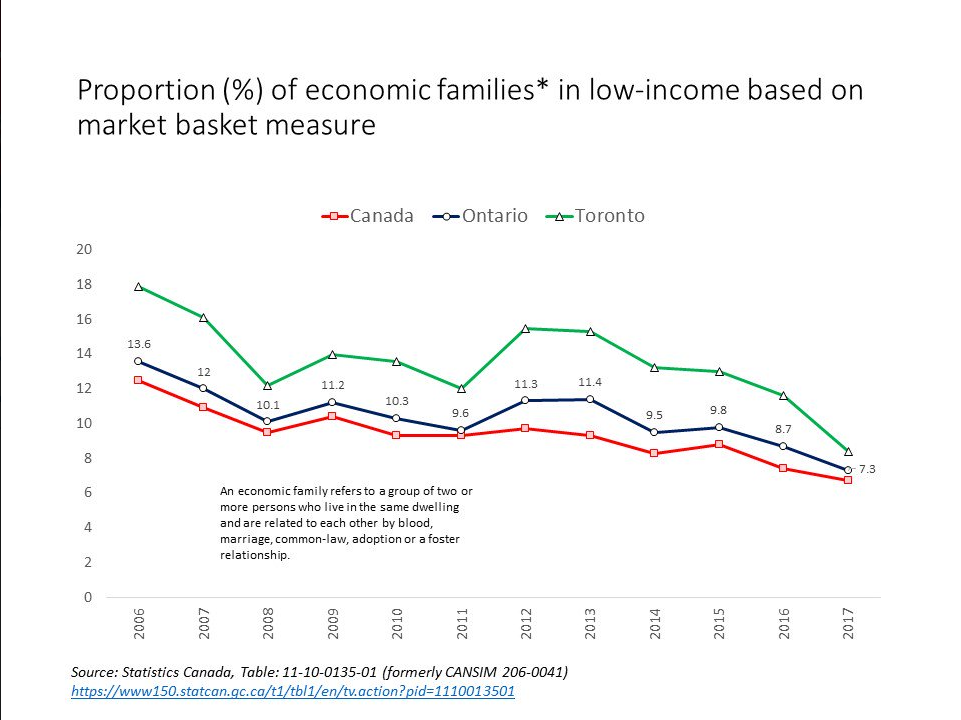
Pssst. Can I let you in on a little secret? Keep it under your hat, but — the poverty rate has fallen again. In fact, it’s at a new all-time low. Statistics Canada reports that the percentage of Canadians falling below the official poverty line in 2017 fell to 9.5 per cent, down from 15.6 per cent in 2006. That still leaves much room for improvement. But this is remarkable progress.
Of course, the official measure of poverty, known as the Market Basket Measure, has only been around for a few years. But an earlier, unofficial measure, known as the Low Income Cut Off, goes back much further. It, too, is at an all-time low, after a steady, two decades-long decline. Indeed, at 7.8 per cent, it’s barely half what it was in 1996.
Andrew Coyne continues:
The sources of this amazing success story are not hard to find — and no, it is not quite as simple a matter as replacing the Conservatives with the Liberals. The trendlines on both low and median incomes, I repeat, go back to the mid-1990s: when the economy, after the long recession, began to grow again.
It turns out — who knew — that poverty tends to fall, and incomes to rise, in periods of economic growth, such as we have enjoyed, almost without interruption, since then. Even the 2009 recession, a relatively mild one in Canada, barely made a dent in either trend.
Still, the Liberals deserve some credit for the continuing decline in poverty since they were elected. If the overall rate has dropped appreciably, it has fallen even more among children — especially welcome, given the lasting effects poverty can have on life chances. At nine per cent, it is down a third from just two years ago.
That’s almost certainly due, at least in part, to the Liberals’ first and most significant policy reform: the rationalization of several existing child benefits and credits into a single income-tested Canada Child Benefit, with increased amounts going to low-income families. It turns out — who knew — that if you give people more money, they are less likely to be in poverty.
February 26, 2019
“The SNC-Lavalin affair is the quintessential Canadian controversy”
Conrad Black on the ongoing SNC-Lavalin scandal:
The SNC-Lavalin affair is the quintessential Canadian controversy. It is alleged by unnamed sources that the former justice minister and attorney general, Jody Wilson-Raybould, was pressured to order her officials to assess fines rather than prosecute executives for financial crimes in the matter of SNC-Lavalin’s methods in seeking certain construction contracts in Libya, not a country where the Better Business Bureau rules commerce with an iron fist. At a later date, Ms. Wilson-Raybould consented to be moved to the position of associate minister of national defence and minister of veterans’ affairs, generally considered a demotion. When rumours circulated in the media about the propriety of allowing the company to pay fines rather than prosecute some of its executives, the prime minister defended the government, denied the rumours, and stated that the minister’s continued presence in the government was proof that the rumours were unfounded. The minister then resigned, but has since attended a full caucus meeting and had a calming effect on the Liberal MPs. She has said nothing publicly because of the delicacy of lawyer/client privilege opposite the prime minister, who has declined to waive the privilege. This is, in fact, bunk. The prime minister was not the client of the minister of justice in the SNC-Lavalin affair, and the prime minister doesn’t have any standing to waive anything on this subject, and his invocation of cabinet secrecy is twaddle, especially after the subject was aired before the entire Liberal caucus.
All government spokespeople deny any official misconduct or impropriety but the principal secretary and chief strategist of the regime, Gerald Butts, resigned, with the novel explanation that although nothing inappropriate had occurred, he thought the air should be cleared, so he walked the plank. This is the point at which this supposed scandal becomes uniquely Canadian. A minister belatedly resigns but informally continues to attend cabinet and expatiate on this issue and the government reinforces its protestations of absolute innocence of wrongdoing by the prime minister accepting the abrupt resignation of the most influential non-elected person in the government (and he also had a great deal more influence than almost all the elected ministers and MP’s).
I invite any reader to cite another country where a minister would consent to be shuffled down, maintain a complete silence while her father, an indigenous leader, has conducted an entertaining non-stop press conference denouncing the “white man’s justice,” although he has clearly gamed the system pretty well for himself, and the head of the prime minister’s office and closest collaborator of the prime minister resigns while proclaiming that nothing improper has been done and that he is only sacrificing himself to satiate the false accusers. This is too innocuous for the Americans and major European countries, too wholesome for Latin America, too complicated for the Swiss and Scandinavians, too discrete for Australia, and small potatoes for the Japanese. This is Canada, the land of Dudley Do-Right, and before him, of Nelson Eddy and Jeanette MacDonald singing Rose-Marie in the Rockies. The story line of this scandal is absurd, but in its way, magnificently Canadian.
February 23, 2019
No matter which “global crisis” they cry up, their answer is always “more government”
Alex Noble on the remarkable consistency of the proffered solution to any and all “global” problems:
Climatechangers are really just watermelons – green on the outside but red on the inside. You’ll notice that none of their ideas about how to prevent climate change involve anything other than bigger government.
For them, climate change is just a pretext – an irrefutable argument (“if you disagree that we need to save the planet you must want people to die!”) that enables them to demand more taxes and more power for them and their friends so they can set the world to rights.
And out here in the real world, they have their army of useful innocents – voters fearful of tackling the real world on their own without help from a cosseting State, all too ready to swallow any argument for bigger government.
Climate change largely consists of menacing them with stories about rising water and melting ice and starving polar bears, so they will allow our civil rights to be ridden over to keep us all safe. They demand it, in fact.
As H.L Mencken said, “The whole aim of practical politics is to keep the populace alarmed (and hence clamorous to be led to safety) by menacing it with an endless series of hobgoblins, all of them imaginary”
February 22, 2019
Germany’s armed forces – from world class to laughing stock
Germany’s military has fallen on very hard times, and there’s so much wrong that it will be very difficult to fix even with all the goodwill in the world:

The German Navy training ship Gorch Fock (launched in 1958) under full sail (less the spanker topsail) in Kiel Fjord near the Laboe Naval Memorial in July 2006.
Photo by Felix Koenig via Wikimedia Commons.
Most Germans’ eyes glaze over at the mention of the Bundeswehr’s perpetual troubles, but an affair surrounding the Gorch Fock, the navy’s three-masted naval training ship, has caught their attention.
Launched in 1958 to school a new generation of West German naval recruits, the imposing 81-meter ship, which takes its name from a popular seafaring German author’s pseudonym, is more than just a training vessel; to many, the Gorch Fock — whose likeness was etched onto some Deutsche Mark bills — is a symbol of Germany’s postwar revival.
The ship’s iconic status is one reason why few objected when the Bundeswehr announced in 2015 that it needed a major overhaul. Until, that is, the price tag exploded from an initial projection of €10 million to €135 million, according to the latest estimate.
Bundeswehr officials claimed the depth of the ship’s troubles only became clear when it was in dry dock, but few are buying such explanations. “When the repairs cost more than a new ship, something is obviously amiss,” Bartels, the Bundeswehr’s parliamentary overseer, said in an interview.
The Gorch Fock “is a symptom of the Bundeswehr’s broader problems,” Bartels said. “Everything takes too long and costs too much money. It’s as if time and money were endless resources, and in the end no one takes responsibility.”
Almost overnight, the ship has gone from pride and joy to running gag. Last week, German weekly Der Spiegel pictured the Gorch Fock on its cover under the headline, “Ship of Fools.”
It’s an apt metaphor for Germany’s body politic as well. Given Germany’s size and economic might, Berlin’s attention to security is surprisingly shallow; citizens and politicians alike often seem oblivious to the challenges the country faces. Though Germany faces growing security threats from both Russia and China, one wouldn’t know it hanging around the German capital.
Much of the media now portrays the U.S. as a security threat on par with Russia. Public attitudes have moved in a similar direction. Security discussions are driven by a handful of like-minded think tank analysts who seem to spend most their time on Twitter, fretting about whether Trump will pull the plug on NATO.
More Germans believe China is a better partner for their country than the U.S., according to a survey published last week by Atlantik Brücke, a Berlin-based transatlantic lobbying group. About 80 percent of those surveyed consider U.S.-German relations to be “negative” or “very negative.”
H/T to Instapundit for the link.
The odd dual role of the Minister of Justice and Attorney General of Canada
Colby Cosh provides an interesting tidbit of Canadian constitutional detail in the SNC-Lavalin affair:
As a minister she can be expected, and will have expected, to sometimes be given advice and orders from the PM. It would not be an unusual feature of her job to have one of the PM’s close advisers visit her with delegated instructions. Maybe sometimes those instructions would be delivered somewhat abruptly. It happens.
But. The minister of justice also bears an associated title: she is also the attorney general of Canada. You may have gotten the idea that this is just a matter of tradition, a romantic holdover from olden times. It is in fact a matter of explicit statute, the Department of Justice Act, as well as an important constitutional concept. The minister of justice is a politician who writes legislation and oversees the operation of law and courts. The attorney general, although always and necessarily the same human as the minister of justice, is a distinct person charged with the royal authority to commence, manage and cancel criminal prosecutions. When someone sues the Crown it is normally the attorney general who answers, and when the Crown sues it is done through her.
What does this mean? It means that if you are the prime minister’s trusted old chum who does his dirty work, it is all right for you to visit a mere minister of justice, operating in that capacity, and to tell her what the boss wants done for crude partisan reasons. But it is quite strictly forbidden to do that to an attorney general.
In matters of hiring or statute-writing, you can go ahead, kick down her door, and tell her “Orillia needs more red-headed Hungarian judges!” or “There really oughta be a law against candy.” When it comes to prosecutions — when madame has her attorney general hat on — it is very different. You, as a sunny-ways enforcer, are not even supposed to provide unsolicited advice or hints from the prime minister. The PM may be the minister of justice’s boss, but he is not in the chain of command between the attorney general and the sovereign at all.
An attorney general is supposed to make prosecution decisions with the good of the country in mind, and she can ask ministers for their opinions about what would be good, just as she could consult any other schmuck. But for a PM or his dogsbody to venture such an opinion spontaneously, whatever the motive, is not cool. If someone tried to give an attorney general such advice, and she told that person to shove off back to Cape Breton in a leaky dory, and she woke up one morning not long after and turned on the radio and heard that she was no longer attorney general, that would certainly be a mighty big deal.
February 21, 2019
“Excessive fines can be used … to retaliate against or chill the speech of political enemies”
The US Supreme Court delivered a unanimous body blow to excessive use of asset forfeiture by state and local police:
Timbs challenged that seizure, arguing that taking his vehicle amounted to an additional fine on top of the sentence he had already received. The Indiana Supreme Court rejected that argument, solely because the U.S. Supreme Court had never explicitly stated that the Eighth Amendment applied to the states.
On Wednesday, the high court did exactly that.
“For good reason, the protection against excessive fines has been a constant shield throughout Anglo-American history,” wrote Justice Ruth Bader Ginsburg in the opinion. “Excessive fines can be used, for example, to retaliate against or chill the speech of political enemies,” she wrote, or can become sources of revenue disconnected from the criminal justice system.
Indeed, some local governments do use fines and fees as a means to raise revenue, and that has created a perverse incentive to target residents. After the 2014 shooting of Michael Brown in Ferguson, Missouri, a federal investigation into the city government found that 20 percent of its general fund came from criminal fines. And Ferguson is not alone in relying heavily on revenue from fines. Making clear that the Eighth Amendment applies to the states will make it far easier to challenge unreasonable fines and fees — including not just asset forfeiture cases, but also situations where local governments hit homeowners with massive civil penalties for offenses such as unapproved paint jobs or Halloween decorations.
Some of those cases are already getting teed up. As C.J. Ciaramella wrote in this month’s issue of Reason, a federal class action civil rights lawsuit challenging the aggressive asset forfeiture program in Wayne County, Michigan, that was filed in December argues that the county’s seizure of a 2015 Kia Soul after the owner was caught with $10 of marijuana should be deemed an excessive fine.
February 18, 2019
Mis-measuring inequality
Tim Worstall explains why any protest in a western country about “inequality” is probably bogus from the get-go:
Their opening line, their justification:
We live in an age of astonishing inequality.
No, we don’t. We live in an age of astonishing and increasing equality. Thus any set of policies, any series of analysis, that flows from this misunderstanding of reality is going to be wrong.
And that’s all we really need to know about it all.
The problem is that their measurements – the ones they’re paying attention to – of inequality just aren’t the useful ones, the ones we’re interested in. They’re usually pre-tax, pre-benefits. They’re always pre-government supplied services. And they never, ever, look at the thing we’re actually interested in, inequality of living standards.
To give an example, the Trades Union Congress did a calculation a few years back looking at top 10% households in the UK and bottom 10%. They took the average of each decile – so, the average of the top 10% households, the average of the bottom. Then they looked at the ratio between them.
The top 10% gain some 12 times the market income of the bottom 10%. Now take account of taxes and benefits. Then add in the effects of the NHS, free education for all children and so on. Government services. We end up with a ratio of 4 to 1. Life as it’s actually lived gives the top 10% four times the final income – income being defined by consumption of course – of the bottom 10%.
That’s not a high level of inequality.


