
Quotulatiousness

October 1, 2010

“No pressure” . . . BOOM!

Filed under: Britain, Environment, Media, Politics — Tags: , , , , — Nicholas @ 12:08

I have to imagine that this little propaganda number was put together by the anti side rather than the pro side:

You don’t agree with this program? No pressure . . . we’ll blow up your kids. James Delingpole thinks it’s great (but not for the cause it supposedly represents):

But with this new monstrosity, truly the great Richard Curtis has excelled himself. It’s so bad, it makes his previous shimmering masterpieces of emetica – Love Actually, The Girl In The Cafe, The Boat That Rocked – look like Battleship Potemkin. It makes the Vicar of Dibley look like a collaboration between Oscar Wilde and Shakespeare. It’s so deliciously, unspeakably, magnificently bleeding awful it makes you wish that the man could be given a ticker tape parade in every major capital city, in gratitude for the devastating damage he has (unwittingly) wrought on the eco-fascist cause.

Update: Apparently, James isn’t the only one who thinks this is sending exactly the wrong message — the campaign is trying to recall the clip:

That, at any rate, is what they keep trying to do — cancelling it whenever it appears on You Tube, pulling it from their campaign website and so on.

Unfortunately their efforts are being frustrated by people on the sceptical side of the climate debate, who keep peskily insisting on reposting the video where everyone can view it. And rightly so. With No Pressure, the environmental movement has revealed the snarling, wicked, homicidal misanthropy beneath its cloak of gentle, bunny-hugging righteousness.

I don’t think any of us will ever be able to look at another Richard Curtis movie in quite the same way ever again. It may even be that we will now never, ever be able to enjoy another episode of the Vicar of Dibley, because all we’ll be able to think about is Dawn French with a Panzerfaust beneath her cassock ready to blast off the heads of any members of her congregation who don’t believe in Man Made Global Warming. What a sad day this is for us all.

Update, the second: Iowahawk thinks this may well be a great subject for a Harvard Business School case study. Using the principles of “new journalism”, he carefully recreates the situation, constructing dialogue to fit the theme:

London, sometime earlier this year: The 10:10 Project, a nonprofit NGO focused on reducing carbon, convenes a high level meeting in their posh modern conference room. After reviewing PowerPoint on the results of their latest government grant proposals and white-liberal-guilt fund raising campaigns, the 10:10 marketing team reports that previous communication efforts have not been proceeding as expected.

“Perhaps what we need is a fresh new campaign,” offers one of the conferees. “Something different, provocative… something edgy. Something that will really get our message across.” This is greeted with great excitement. The finance director pours through spreadsheets and identifies a budget source. An executive screening committee is appointed who develop timelines and begin scheduling meetings with London’s top agencies and independent film production firms.

Several weeks later, after sitting through a half dozen agency presentations that have yet to meet their standards, 10:10’s highly paid executive brain trust arrives at a meeting at the sleek offices of London’s hottest agency Splodey, Youngblood, Gutz & Bones. After introductions, small talk, and pastries, SYG&B’s creative director — winner of 5 British Clio awards — strolls confidently to the television monitor at the front of the room and walks the 10:10 clients through a scene-by-scene video storyboard pitching a new promotional mini-movie that will solve their communication dilemma. The smoothness of the presentation masks the hundreds of late night man-hours and debating the SYG&B creative department spent in crafting it — but it was worth it.

“Brilliant!” exclaims the 10:10 executive committee chair, to the enthusiastic nods of his colleagues. “Add one more exploding child, and I think we have a winner.”

Read the whole thing, as they say.
You think you’re struggling with the burden of old debts?

Filed under: Economics, Europe, Germany, History, WW1 — Tags: — Nicholas @ 09:07

Consider the case of Imperial Germany:

First World War officially ends
The First World War will officially end on Sunday, 92 years after the guns fell silent, when Germany pays off the last chunk of reparations imposed on it by the Allies.

The final payment of £59.5 million, writes off the crippling debt that was the price for one world war and laid the foundations for another.

Germany was forced to pay the reparations at the Treaty of Versailles in 1919 as compensation to the war-ravaged nations of Belgium and France and to pay the Allies some of the costs of waging what was then the bloodiest conflict in history, leaving nearly ten million soldiers dead.

H/T to Jon, my former virtual landlord, for the link.

September 30, 2010

Even rustlers are going vegetarian

Filed under: Europe, France, Law, Wine — Tags: — Nicholas @ 08:01

The scourge of the old west (at least in TV and movie representations) were cattle rustlers. Their modern counterparts are apparently grape rustlers:

Thieves in France have broken into a vineyard and stolen an entire crop of Cabernet Sauvignon grapes, say police.

They struck in Villeneuve-les-Beziers on Sunday night, taking advantage of a full moon and using a harvesting machine to seize 30 tonnes of the crop.

Farmer Roland Cavaille said similar crimes had taken place before in the Languedoc-Roussillon, one of France’s best-known wine growing regions.

He said the theft amounted to a year’s work and about 15,000 euro (£12,900).

“They used a harvesting machine to gather grapes. This means there was no need to have lots of people, two people would have been enough,” Mr Cavaille told Le Parisien newspaper.

“The area was quite isolated, it is a a few kilometres from the village and near a river. So the thieves were able to work safely.”

I’m sure there’s a joke in there about sour grapes, but I’m not clever enough to put it together.

Inter-service rivalry now compromising SAS training

Filed under: Britain, Bureaucracy, Military — Tags: , , , — Nicholas @ 07:50

Of all the various famous units the British have to boast of, surely the Special Air Service (SAS) is the top of the list. That status still doesn’t exempt the SAS from being a pawn in the ongoing battle between the Army and the RAF:

For five years now, the Royal Air Force (RAF), and the British Army have been feuding over the lack of aircraft for parachute training. The latest row involves Britain’s SAS (Special Air Service) commandos, who have been unable to train all their operators in complex parachuting techniques, because the RAF has been unable to provide transports to carry the SAS personnel into the air. This is considered a more serious matter than previous problems with not having enough transports to train members of the Parachute Regiment. The SAS threatens to send their operators to the United States for training, relying on long standing ties with their American counterparts (the U.S. Army Special Forces and SOCOM). This would be embarrassing for the RAF, and that would be the point.

This sort of feud has been going on for a long time. For example, four years ago it was revealed that the British Army had to decide between supplying its troops in Iraq and Afghanistan, and providing aircraft for its paratroopers to complete their training. As a result of this shortage, in 2005, only about 25 percent of paratroop trainees were able to make the required jumps, to become qualified parachutists. Back in 2003, 93 percent were able to successfully make their jumps. In addition to the morale boost, being a qualified paratrooper also gets you an extra $3,000 a year in bonus pay.

The RAF, rather like the US Air Force, has different priorities than the other services, and clearly doesn’t value their inter-operational harmony as highly as controlling the equipment and doctrine to support their own mission (as defined by air force commanders). This isn’t a new thing: it’s been going on since the first world war. It also shows a failure of leadership on the civilian side — the civilian bosses should be much more insistent on getting the overall mission done properly than in allowing these turf wars (cloud wars?) to interfere.

Censorship and blocking ineffective, says AK Zensur

Filed under: Britain, Europe, Germany, Law, Technology — Tags: , , , , — Nicholas @ 07:41

Attempts to block websites showing child pornography don’t appear to be as effective as direct action, according to a press release from the German Working Group against Access Blocking and Censorship (AK Zensur):

Internet blocking is advocated as an allegedly effective measure against the proliferation of child abuse images. Countries such as the United Kingdom, Sweden and Denmark have been using this technology for years. But a practical test by the German Working Group against Access Blocking and Censorship (AK Zensur) in cooperation with European civil rights advocacy groups has shown: Internet blocking does not fight abuse, in practice it only serves to conceal the failures of politics and police. Websites can remain on blocking lists for years even though they have either been deleted or could be deleted easily and quickly.

How is this possible, and what could be done against illegal sites? Answers are given by a new analysis of current blocking lists from Sweden and Denmark by the Working Group against Access Blocking and Censorship. The group developed software to select, categorise and geo-locate 167 blocked Internet domains as a representative sample of websites blocked in Denmark at the time of the investigation. “The result is a smack in the face of law enforcement authorities”, says Alvar Freude of the Working Group. “Of the 167 listed sites, only three contained material that could be regarded as child pornography.” Two of these three sites had been blocked in Denmark since 2008, and these are, or least were, blocked in Sweden, Norway and Finland as well. These sites were therefore known for at least two years in several countries, and apparently law enforcement authorities did nothing to try and get this illegal content removed.

This is even more disturbing because the Working Group managed to take down the remaining sites just by sending a few emails. Two of the sites were hosted in the USA, and even during the weekend (Friday, ca. 10 p.m. EDT) they were removed by the hosters within 30 minutes. On the following Tuesday, the third website was taken down by its registry in India, three hours after notification. The content was stored on a server in the Netherlands. “The removal of this dehumanising content and the pursuit of the perpetrators must have absolute priority. Internet Blocking leads to the exact opposite”, says Alvar Freude, who sent the take-down requests.

H/T to BoingBoing for the link.

September 28, 2010

Most self-indulgent generation now also most suicidal?

Filed under: Britain, Media, USA — Tags: , , , — Nicholas @ 12:06

Baby Boomers. It’s always about the frickin’ Baby Boomers isn’t it? Even if according to demographers I’m supposed to be one of them, while your prototypical Baby Boomer was indulging in free love, drugs, and all the other 60’s behavioural abberrations, I was in primary school. I have never identified with that group, and I’m often struck by how self-regarding members of that demographic can be.

Well, perhaps after a life of unparalleled opportunity, wealth, leisure, and general wallow-in-it-ness, Baby Boomers are starting to retire . . . and also killing themselves in numbers not seen in previous generations:

“As children, the baby boomers were the healthiest cohort that had ever lived, due to the availability of antibiotics and vaccines,” Idler says. “Chronic conditions could be more of a rude awakening for them in midlife than they were for earlier generations.”

Given the contrast between the Boomers’ passage through life and that experienced by their parents, one might suggest that they simply brace up a bit and get on with it. This might, however, be bad news financially for the following generations who are already saddled with the task of paying for the Boomers’ wastrel stewardship of the global finances, prolonged and luxurious retirements, hip replacements and various other costs and expenses.

It may be, as we look back from a more austere future in which the retirement age has been raised to 85 or so and the elderly — far from guzzling pina coladas on cruise ships whilst simultaneously occupying badly-needed residential property — are compulsorily relocated to robot-staffed retirement homes, that we will regard the Boomers as the jammiest generation ever to have lived. Their apparent propensity to top themselves out of drug-addled foolishness, in a tantrum at the “rude awakening” of middle age, or simply like mindless sheep because they have seen others do so, will be all the more puzzling.

Britain in the 70’s

Filed under: Books, Britain, Economics, History — Tags: , , , — Nicholas @ 07:38

A review of Dominic Sandbrook’s State of Emergency: The Way We Were. Britain, 1970–1974 sounds interesting:

As prime ministers, Edward Heath and Gordon Brown had quite a lot in common. Both were monstrously self-centred, permanently grumpy and capable of astonishing rudeness. Both of their relatively short-lived premierships ended in humiliating failure. In a recent poll of academics on Britain’s best and worst prime ministers since the second world war, Heath came ninth out of twelve and Mr Brown tenth. But that is where the similarities end. Whereas Mr Brown was largely the author of his own misfortunes (the banking crash apart), Heath, as Dominic Sandbrook reminds us in his splendidly readable new history of Britain during the four years from 1970, was faced with a set of problems whose intractability and nastiness would have overwhelmed even a far more gifted politician.

Heath both appals Mr Sandbrook and elicits his sympathy. Tory mythology still insists that many of Heath’s difficulties arose from his U-turn when he abandoned the free-market ideas with which he entered office and embraced an already discredited and peculiarly British form of corporatism the moment the going got rough. The truth is that although Heath had tried to present himself as the champion of ruthless neoliberalism, he was always at heart a “one nation” Tory with little appetite for the kind of confrontation his successor as Conservative Party leader, Margaret Thatcher, relished. His burning desire was to modernise Britain and to arrest its economic decline through efficiency, pragmatic problem-solving and, above all, by joining the European Community.

My family left Britain in 1967, which was a good time to go: the economy was still in post-war recovery, but opportunities abroad were still open to British workers. My first visit back was in 1979, which was a terrible shock to my system. I’d left, as a child, before the strikes-every-day era began, and my memories of the place were still golden-hued and happy. Going back to grey, dismal, cold, smelly, strike-bound Britain left me with a case of depression that lasted a long time. It didn’t help that the occasion of the visit was to attend my grandfather’s funeral: it was rather like the land itself had died and the only remaining activity was a form of national decomposition.

Some readers will find the way the author flits about tiresome, but given that he was born only in 1974 his almost pitch-perfect ability to recreate the mood and atmospherics of the time is remarkable. He does not lose sight of the fact that although the 1970s are now seen as a nadir in Britain’s post-war fortunes, for the majority of people it was nonetheless a time of growing affluence, widening horizons and personal liberation. Many of the positive developments that are associated with the supposedly wonderful 1960s did not gain traction until a decade later. Viewed from a distance, Britain in the 1970s looks ghastly — angry, decaying, on the skids. But that is not the whole story.

Mr Sandbrook compares this turbulent period with the four years between 1910 and 1914 described by George Dangerfield in “The Strange Death of Liberal England”. As he says: “Dangerfield’s story was one of political ferment and economic turmoil, of challenges to the moral order and rebellions against traditional gender roles, of Utopian socialism and Irish sectarianism — all rooted, like the challenges of the early 1970s, in profound historical trends that no government could possibly control.” Thankfully, the discontent of the 1970s did not end in world war, but continued, mostly unresolved, until the arrival of Lady Thatcher in 1979. That may pose a problem for Mr Sandbrook’s next book, which will be an account of the second half of the decade. In many ways it was more of the same, but without a central character as oddly compelling and sad as Heath.

I’m even more interested — in a grim sort of way — in the next book. It’ll be interesting to read an account of that time from a different perspective than my brief mid-winter visit provided.

September 27, 2010

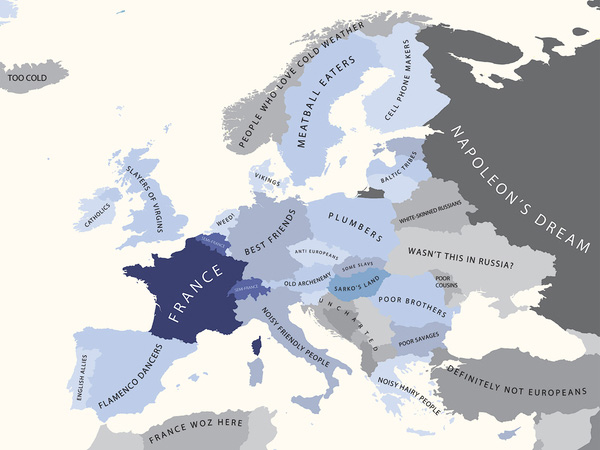
Europe according to . . .

Filed under: Europe, France, Humour — Tags: , — Nicholas @ 14:09

Amusing infographic source including “Europe according to France”:

H/T to Cory Doctorow for the link.

EMALS back on track in time to save British carrier fleet?

Filed under: Britain, Military, Technology — Tags: , , , , , — Nicholas @ 08:54

As discussed earlier, the Royal Navy has been watching the US Navy’s ongoing EMALS project carefully, as it might provide a major cost-saving for the new carriers HMS Queen Elizabeth and HMS Prince of Wales. Recent testing shows the program appears to be back on track:

The US Navy’s plan to fit its next aircraft carrier with electromagnetic mass-driver catapults instead of steam launchers is reportedly on track, with shore trials using test weights a success. The progress of the Electromagnetic Aircraft Launch System (EMALS), the first of its kind, is of interest to the Royal Navy as it could offer a way to massively cut the money spent on the Service’s two new carriers — or, more accurately, to cut the money spent on their aeroplanes.

A statement issued last week by the US Naval Air Systems Command (NAVAIR) says that the EMALS test installation at Lakehurst, New Jersey is going through its planned programme without difficulty.

[. . .]

CVN 78, aka USS Gerald R Ford, is the next US Navy supercarrier, now under construction. It’s very important to the USN that EMALS works, as it is acknowledged that it’s now too late to change the Ford’s design and fit her with steam catapults like all other US (and French) carriers. If for some reason EMALS isn’t a success, the US will have bought the biggest and most expensive helicopter carrier ever.

Though the steam catapult is actually a British invention, Blighty’s present pocket-size carriers don’t have any catapults at all. Thus they can only launch helicopters and short-takeoff Harrier jumpjets.

The problem for Britain’s decision makers is that the current carrier design limits them to the ultra-expensive F-35B, which will be roughly twice the price of the ships themselves to provide sufficient aircraft to make the carriers fully operational. Being able to swap out the deluxe F-35B for cheap-as-dirt F-18E’s may be enough to save both carriers from the ongoing cost-slashing by the ministry.

September 25, 2010

Irony, Polish style

Filed under: Europe, History, WW2 — Tags: , , — Nicholas @ 13:17

By way of Jon Henke’s twitter feed, the most ironic story so far this year:

Two Polish neo-Nazis who were childhood sweethearts and later became skinheads have discovered what for them is a shocking family secret: They’re actually Jewish.

Pawel and Ola, identified only by their first names, are the subject of a CNN documentary about Poles rediscovering their Jewish roots generations after their ancestors hid their religious identities to escape persecution during World War II.

A few years ago, Ola found out from Warsaw’s Jewish Historical Institute that both she and her husband are technically Jews. “It was unbelievable — it turned out that we had Jewish roots. It was a shock,” she said.

September 16, 2010

Army, RN, RAF, and Trident replacement: pick any three

Filed under: Britain, Military, Politics — Tags: , , , , , — Nicholas @ 10:03

The British coalition government has declared that they will retain the nuclear option (that is, buy replacements for their current Trident submarines), but still seem to think that you can take £20bn from the Defence budget (in addition to the 10-20% savings you’re already demanding be made) and still have three viable services. Perhaps it’s a strange form of new math:

The £20bn replacement of the UK’s Trident nuclear deterrent could be put off until after 2015, according to reports.

The BBC said ministers were considering delaying the planned 2014 date in an effort to reduce short-term costs and head off a pre-general election political row.

The Ministry of Defence (MoD) said no decisions had yet been taken on the future of the submarine-based missile system, which is currently the subject of a value-for-money review.

It has been formally excluded from the ongoing strategic defence and security review (SDSR) but the Treasury has made clear the under-pressure MoD budget will have to pay for it. An influential committee of MPs yesterday warned that that decision would have very significant consequences for future defence spending.

Just as the coalition took office, it was mentioned that the previous Labour government had committed to spend £37bn on various new weapon systems, but had not actually provided the funding to make those purchases. Add a Trident replacement bill on top of that and there is no way to successfully pay the bills out of the current military budget.

There are always economies that can be made in military spending: it’s not unreasonable to assume that savings of 10% can be found in any military force. 20% is pushing the envelope too much unless a scaling-back of commitment is also part of the reduction. 20% cuts, no reduction in tasks, and the Trident replacements (even if you reduce the fleet from four to three) can’t be done.

Update: Lewis Page thinks the Trident replacement is essential:

Proper new Trident, with submarine-launched ballistic nukes, is the right call for the UK. Its cost is tiny compared to UK government spending — just half of a single year’s Department for Work and Pensions budget would buy new Trident boats, arm them, crew them and cover their running costs for decades.

Compared to the MoD’s much smaller budget the costs look bigger, but they are still small — and ICBM submarines represent far and away the best value for money in the MoD. For perhaps £20bn to £30bn in acquisition costs you get an unstoppable, unfindable nuclear hammer capable of shattering a nation in an afternoon. When one reflects that we have spent the same money to get the Eurofighter — a wildly expensive and now rather oldfashioned pure air-to-air platform — new Trident looks like a steal.

One major reason that the Eurofighter is such poor value for money, of course, has been repeated delay so as to achieve short-term savings in the past. This is also true of nearly every other procurement project in the MoD: cumulatively, past politicians failing to grasp nettles are now costing us billions every year. It has to stop, and stop now — as a taxpayer, quite frankly I don’t see why I should pay still more billions down the road just to keep Mr Cameron in Downing Street and Mr Clegg in the Cabinet today.

September 15, 2010

The real results of Turkey’s referendum

Filed under: Europe, Government, History, Middle East, Politics — Tags: , , — Nicholas @ 07:50

Austin Bay is still hopeful for a secular Turkish government, but the results of the recent referendum don’t encourage quite as much hope:

Turkey’s leading political organizations both portray the choice between them as “either us or darkness.” This rhetorical demonization is typical of successful democracies. Ataturk deserves credit for establishing a democratic structure that survived his death in 1938 by 72 years.

Turkey’s actual circumstances, however, are much more complex and murky. Start with the referendum’s irony. The constitution had many undemocratic articles and was in fact imposed by the military after a coup in 1980. The European Union ruled that many of these elements did not meet EU membership standards. Thus the ironic situation of an Islamist political party promoting constitutional changes in order to meet Western European democratic standards. Aligning Turkey with Europe was one of Kemal Ataturk’s long-term goals.

Yet the judicial reforms approved this week may be an anti-democratic trap door, for they give the AKP the ability to limit systemic checks and balances on executive power. The AKP can pack the courts. The judiciary has protected the Turkish military. The AKP distrusts the military because it fears a coup, and with good reason. The military sees itself as the protector of the secular state and a bulwark against Muslim fundamentalist usurpation.

September 13, 2010

Call the president a “pr*ck”, get banned from the US for life

Filed under: Britain, Politics, USA — Tags: , , , , , — Nicholas @ 16:09

Fox News picks up an item from The Sun:

A British teenager who sent an e-mail to the White House calling President Obama a “pr*ck” was banned from the U.S. for life, The Sun reported Monday.

The FBI asked local cops to tell college student Luke Angel, 17, that his drunken insult was “unacceptable.”

Angel claims he fired off a single e-mail criticizing the U.S. government after seeing a television program about the 9/11 attacks.

He said, “I don’t remember exactly what I wrote as I was drunk. But I think I called Barack Obama a pr*ck. It was silly — the sort of thing you do when you’re a teenager and have had a few.”

Angel, of Bedford, in central England, said it was “a bit extreme” for the FBI to act.

“The police came and took my picture and told me I was banned from America forever. I don’t really care but my parents aren’t very happy,” he said.

Note that I’ve been very careful not to spell out that “unacceptable” word in the headline. No need to risk that just for reporting the news, right?

Sir Humphrey Appleby on Brussels

Filed under: Britain, Bureaucracy, Europe, Government, Humour, Politics — Tags: , — Nicholas @ 09:41

As long as they’re allowed, http://sirhumphreyappleby2010.blogspot.com/ will be posting some fascinating memos from Sir Humphrey Appleby KCB CVO on various topics of interest. If-and-when the Official Secrets Act is invoked, of course, we will be deprived of this wonderful insight into the real workings of modern parliamentary government.

For example, here is Sir Humphrey on the manifold advantages of Brussels:

Any attempt by this new government to weaken our ties with the European Union must be firmly resisted. Our membership has been a godsend. Since no cabinet minister is really au fait with all the provisions of the treaty of Rome, we can guide them towards our desired decisions by telling them there are obligations under the treaty, and deflect them from unwelcome actions by saying that the treaty prohibits them. In addition we can cite some of the myriad directives, which can be creatively adapted to our purposes by skilful translation from the original French. Since few of them have progressed beyond O level in any modern language, our version is unlikely to be challenged. And of course when we want to get rid of a minister for a few days we can always arrange an emergency meeting in Brussels, Strasburg or Luxembourg to give us a few days breathing space.

Brussels provides a model for modern government. Legislation can be brought forward only by officials, not by elected members. All important posts are filled by appointment, not election. Political ‘leadership’ is rotated every six months, to ensure that no one ever gets a real grip on the job. The proliferation of nations and languages gives officials endless scope for fomenting distrust, confusion and conflict between members. And there is no nonsense about financial constraints: the auditors have refused to approve the EU accounts for the past fourteen years, but they go on spending happily regardless.

Ministers in previous governments have occasionally expressed concern about this in their early months, but we have always found that after a few visits to Brussels and contingent exposure to the legendary Belgian hospitality, their opposition has cooled remarkably, and indeed they express enthusiasm for further visits, which of course we are more than happy to arrange.

September 12, 2010

QotD: Ireland’s post-boom cleanup

Filed under: Economics, Europe, Quotations — Tags: , , — Nicholas @ 00:30

It’s not a good sign when the government has to intervene to prevent a run on a bank that is already owned by the government, but apparently, that’s what it’s doing with Anglo-Irish bank [. . .] One guesses that [. . .] the restructuring will cost a lot, and the “asset-recovery” bank will be worth very little. The Irish economy has a lot of fundamentals going for it — educated population, good corporate tax rates, and considerably fewer regulatory barriers to doing business than you find in Italy or Greece. But as a real economic boom, driven by European integration, brought increasing incomes, the Irish went on a borrowing binge even worse than our own, and inflated their boom into a bubble. One of my favorite stories of the period concerns a friend of mine, an Irish American who was married to an Irishman living in Galway. The level of status-competition that suddenly blossomed among her relatives and in-laws led her to consider opening a boutique that would literally specialize in ugly things which cost unreasonable sums of money.

Cleaning up after that consumer frenzy is going to be long and painful. As it will be for us, though less so.

Megan McArdle, “Ireland Moves to Shore Up State-Owned Bank”, The Atlantic, 2010-09-09

« Newer PostsOlder Posts »

Powered by WordPress


