Quotulatiousness

October 30, 2010

Shakespeare in the original pronunciation

Filed under: Britain, History, Media — Tags: , , — Nicholas @ 10:18

It doesn’t sound much like your traditional Shakespeare production does it?

Like an archeologist reconstructing the fossilized skeleton of an ancient species, a University of Kansas theatre professor has pieced together the bones of a form of English that has never been heard in North America in modern times — the original pronunciation of Shakespeare.

Thanks to the work of Paul Meier, audiences can get a sense of what it might have been like to eavesdrop on opening night of “Hamlet” or “Romeo and Juliet” at the Globe Theater in London or to listen in on a shipboard conversation on the Mayflower as it approaches the shores of the New World.

“What did English sound like back then?” Meier said. “Was it posh or down to earth? Was it anything like today’s British or American English? Would we understand it?”

H/T to A Blog About History for the link.

October 29, 2010

Why some vintage dates matter more than others

Filed under: Australia, Cancon, Environment, France, Randomness, Wine — Tags: , — Nicholas @ 12:36

If you’re not a wine fan, you may wonder why wine snobs pay so much attention to vintage dates. If you drink the occasional bottle of “Raunchy ‘Roo Red” or “Zesty Zebra Shiraz”, the vintage dates matter very little: by the name, you’d guess they’d be from Australia or South Africa, both hot climate wine countries. Vintage dates are much less important for hot climate wines: the variation from year to year is relatively small. As Michael Pinkus points out, however, it matters a great deal for cool climate wine countries:

Many wine drinkers never notice the vintage date on the wine they are drinking — they just blindly go off buying wine. I talk to many people and very few know what year they’re drinking, just the producer. In a wine region like Ontario that’s a odd way to be drinking your wine. We’re a cool climate region after all and if you don’t understand the difference between a good vintage wine a mediocre vintage wine you could be stuck with a lot of 2003s in your cellar for 10 years or more. The key is to know their drink-ability (2003) or conversely, know how long you should be holding onto wines like [these], a few extra years of aging will give these wines time to mature and integrate, drink them too early and you’ll miss out on all the fun.

In a cool climate region (Ontario, Bordeaux, New Zealand) Vintage date means more than in a hot climate region (Australia, Argentina, Chile) — there temps are always beautiful (read: warm and sunny) and vintage variation plays little part in the finished wine; while in a cool climate region harvest is a waiting game and in many years prayer is a grape farmers best friend.

Take 2010 for instance, this year has the likelihood and pedigree to be even better than the much lauded 2007. What makes 2010 better? Glad you asked. While 2007 had lots of heat and little rain (which grapes love), 2010 has been a longer growing season, with lots of heat and rain has come at the “appropriate” times. If you’ll recall our winter was very mild and bud break occured in April, at that time the prayer for farmers was the ‘Psalm of No Frost’. A longer growing season with lots of heat means good grapes — but that does not always apply to all grapes, but that’s really a discussion for another time.

Most determine a good season by how well the red grapes are going to be — in a cool region white grapes grow well year-after-year — but many of the Bordeaux red grapes struggle (Merlot, Cabernet Sauvignon and Cabernet Franc). 2007 was a great year for the usual Bordeaux varietals as well as others reds that don’t often ripen fully under the Ontario skies.

October 22, 2010

The gruesome confessions of a murder that never happened

Filed under: Europe, Germany, Law — Tags: , — Nicholas @ 09:01

Roger Henry sent a link to this Australian story, which is just plain weird:

It was a macabre crime that horrified Germany: a farmer, battered to death and dismembered by his own family, his body apparently fed to his pigs and dogs.

A killing without a corpse, since all traces had been gobbled up in the farmyard.

Yesterday, thought, nine years after Rudi Rupp disappeared, a Bavarian court opened a retrial of his supposed killers after the discovery of his intact body in the River Danube. The case has sent shockwaves through the German judicial system, which since the Second World War has prided itself on its probity and professionalism.

Mr Rupp, a 52-year-old Bavarian pig farmer, allegedly returned home from the pub one autumn night in 2001 and was hit over the head with a large wooden beam by Mathias Eisenhofer, 17, the lover of Mr Rupp’s daughter Manuela, 16. He was beaten almost to death and taken to the cellar where Manuela noticed that her father’s leg was still twitching. Eisenhofer then hit the farmer’s skull with a sharp-edged hammer. Manuela joined in. Another daughter, Andrea, 15, watched, as did the farmer’s wife Hermine.

Why would they make up such a gruesome story? It doesn’t appear to make any sense. The whole thing is so weird that I’d be tempted to check that it wasn’t an early April news story.

October 20, 2010

British defence cuts will impact the troops in Afghanistan

Filed under: Britain, Military, Politics — Tags: , , — Nicholas @ 13:16

Lewis Page comes close to calling Britain’s prime minister a liar over the speech he made the other day:

Mr Cameron and other Coalition politicians have repeatedly assured us that in fact all their decisions are aimed at support of our heroic troops fighting and dying in Afghanistan — but in fact, in one hugely important respect, they are slashing support for our boys and girls.

Last Christmas, regular Reg readers may remember, in a freak outburst of common sense Labour defence ministers announced plans to buy no less than 22 more desperately-needed Chinook helicopters. The powerful Chinook, only helicopter able to really overcome the tough hot-and-high conditions of Afghanistan, is the single greatest desire of our hard-pressed troops in Helmand. Lack of Chinooks is the worst handicap their commanders face. Say what you like about Labour, but in their last months they did the right thing and ordered a good big number of these vital machines. They planned to pay for them, sensibly, by cutting some Tornado bombers among other things.

Good old Mr Cameron, though — the soldier’s friend — has cut this order to 12, almost halving it. He received massive cheers yesterday from ignorant MPs yesterday, saying:

There is no cut whatsoever in the support for our forces in Afghanistan … we have been and will be providing more for our brave forces in Afghanistan [including] crucially, at last, the right level of helicopter capability.

That is perilously close to being an outright lie, we’d suggest. No matter what you think of the rest of his plans, Mr Cameron’s decision to cut the Chinook order (to preserve Tornado bombers, too!) is an unforgivable betrayal of our fighting men and women at war right now — and then he has the gall to try and pretend that he’s actually decided to order some helicopters rather than cutting an existing order!

The daily Orwell

Filed under: Books, Britain, History, WW2 — Tags: , — Nicholas @ 13:09

A few years back, on the old blog, I mentioned that the Orwell Trust was publishing George Orwell’s diary in blog form. It’s now up to October 1940:

19.10.40
The unspeakable depression of lighting the fires every morning with papers of a year ago, and getting glimpses of optimistic headlines as they go up in smoke.

October 19, 2010

UK defence cuts announced

Filed under: Britain, Economics, Military — Tags: , , , , , , , — Nicholas @ 12:57

As I blogged yesterday, quoting a Guardian article, the British government will be cutting their armed forces substantially:

I want to be clear there is no cut whatsoever in the support for our forces in Afghanistan.

The funding for our operations in Afghanistan comes not from the budget of the Ministry of Defence but instead from the Treasury Special Reserve.

So the changes to the Ministry of Defence that result from today’s Review will not affect this funding.

That will help the morale of the troops on the ground in Afghanistan, but the army overall is still being reduced.

Our ground forces will continue to have a vital operational role so we will retain a large well-equipped Army, numbering around 95,500 by 2015 that is 7,000 less than today.

We will continue to be one of very few countries able to deploy a self-sustaining properly equipped Brigade-sized force anywhere around the world and sustain it indefinitely if needs be.

And we will be able to put 30,000 into the field for a major, one off operation.

In terms of the return from Germany half our personnel should be back by 2015 and the remainder by 2020.

And tanks and heavy artillery numbers will be reduced by around 40%.

The garrison in Germany is a relic of the Cold War, and it’s amazing that they’ll still be there until 2020.

We will complete the production of six Type 45 destroyers one of the most effective multi-role destroyers in the world.

But we will also start a new programme to develop less expensive, more flexible, modern frigates.

Total naval manpower will reduce to around 30,000 by 2015.

And by 2020 the total number of frigates and destroyers will reduce from 23 to 19 but the fleet as a whole will be better able to take on today’s tasks from tackling drug trafficking and piracy to counter-terrorism.

Those are the same Type 45’s that haven’t actually had effective main armament, according to The Register.

We have decided to retire the Harrier which has served this country so well for 40 years.

The Harrier is a remarkably flexible aircraft but the military advice is that we should sustain the Tornado fleet as that aircraft is more capable and better able to sustain operations in Afghanistan.

RAF manpower will also reduce to around 33,000 by 2015.

Inevitably this will mean changes in the way in which some RAF bases are used but some are likely to be required by the Army as forces return from Germany.

The retirement of the Harrier is a simultaneous victory for the RAF against their two most dangerous enemies: the army and the Fleet Air Arm. The Harrier was the one aircraft that could provide both naval and ground support, and was therefore considered readily dispensible by the fighter jocks in the Royal Air Force.

We will build both carriers, but hold one in extended readiness.

We will fit the “cats and traps” — the catapults and arrestor gear to the operational carrier.

This will allow our allies to operate from our operational carrier and allow us to buy the carrier version of the Joint Strike Fighter which is more capable, less expensive, has a longer range and carries more weapons.

We will also aim to bring the planes and carriers in at the same time.

That is probably finis for carrier operations in the Royal Navy: but expect both of these ships to show up again in the fleet of India within 5-10 years.

. . . we will retain and renew the ultimate insurance policy — our independent nuclear deterrent, which guards this country round the clock every day of the year.

[. . .]

…extend the life of the Vanguard class so that the first replacement submarine is not required until 2028;
…reduce the number of operational launch tubes on those new submarines from 12 to eight…
…reduce the number of warheads on our submarine at sea from 48 to 40…..
…and reduce our stockpile of operational warheads from less than 160 to fewer than 120.

October 18, 2010

Royal Navy’s Ark Royal to be decommissioned

Filed under: Britain, Military — Tags: , , , — Nicholas @ 17:23

The Royal Navy is losing its carrier HMS Ark Royal effective immediately, according to The Guardian:

The prime minister will underline the scale of the cuts to Britain’s annual £37bn defence budget tomorrow when he announces that Britain will be without a carrier strike capability for a decade. HMS Ark Royal will be decommissioned immediately and its Harrier jump jets will be withdrawn from service.

The Royal Navy will have to wait 10 years until as many as 50 new Joint Striker Aircraft can be launched using the catapult and trap system — “cat and trap” — from the new Prince of Wales aircraft carrier. This system, which will allow French and US planes to fly from Britain’s new aircraft carrier, will cost about an extra £500m.

In reality, this means that the Royal Navy will probably never have a strike carrier capability again. The next government will have lots of reasons to further reduce the RN’s Fleet Air Arm, and the will to reverse these cuts can’t be found on the opposition benches. The Royal Navy will now move toward being a pure coastal defence force.

The cost of only 50 F-35B aircraft will sink the carrier fleet more effectively than torpedoes. They were already going to be ultra-expensive with the original planned order of more than twice as many. Ordering so few guarantees that they’ll be even more expensive per plane. Whether the current government survives a full term in office or is defeated in the house, the next government will have even less political reason to buy these planes.

The Prince of Wales will be the second of the new aircraft carriers to be built at a cost of £5.2bn. The first aircraft carrier — the Queen Elizabeth — will be in service for just three years, between 2016-19, as a helicopter carrier. It will then be mothballed, a process known as “extended readiness”, and possibly sold off.

Cameron told the cabinet today that the decision to abandon a carrier strike capability for 10 years — and to put the Queen Elizabeth aircraft carrier into service for just three years — was one of the most difficult decisions he has made. “The prime minister told the cabinet that this was one of the hardest things he has had to grapple with,” one source said. “But this decision was taken collectively.”

It’s not mentioned in the article, but I assume that the reconfiguration of Queen Elizabeth as a helicopter carrier also means that the RN will be losing the relatively new HMS Ocean as well as the Ark. I guess the “frigate captain” branch of the service won the battle for funding.

Argentina’s opportunity to liberate “les Malvinas” coming up shortly . . .

Update, 19 October: The Prime Minister’s speech to the House of Commons confirms most of what The Guardian reported yesterday. The planned F-35B purchase will be switched to F-35C, one carrier to be completed then mothballed, the other to go into active service, and the Harriers to be retired from service. Trident fleet to be replaced, but five years later than planned, and both tubes per boat and number of boats to be reduced. The Army loses 7,000 troops, and 40% of their tanks and heavy artillery. On the plus side, the British will no longer be maintaining a garrison in Germany after 2015. The RAF will be reduced to 33,000 by 2015.

October 14, 2010

Little Bobby Tables must speak Swedish

Filed under: Europe, Humour, Politics, Technology — Tags: , , , — Nicholas @ 13:19

By way of Bruce Schneier an opportunity to show another xkcd comic:

Exploits of a Mom

So, what’s the Swedish tie-in?

As you may have heard, we’ve had a very close election here in Sweden. Today the Swedish Election Authority published the hand written votes. While scanning through them I happened to notice

R;13;Hallands län;80;Halmstad;01;Halmstads västra valkrets;0904;Söndrum 4;pwn DROP TABLE VALJ;1

The second to last field is the actual text on the ballot. Could it be that Little Bobby Tables is all grown up and has migrated to Sweden? Well, it’s probably just a joke but even so it brings questions since an SQL-injection on election data would be very serious.

British government takes chainsaw to Quango jungle

Filed under: Britain, Bureaucracy, Government, Politics — Tags: , — Nicholas @ 07:30

To my surprise, the British government appears to be quite serious about reducing the number of quasi-autonomous non-governmental organizations (Quangos):

The government has announced that 192 quangos are to be scrapped.

Some will be abolished altogether others will see their functions carried out by government or other bodies, the Cabinet Office says.

A further 118 will be merged. Some are still under consideration but 380 will be retained, according to the list.

Minister Francis Maude said they did not know how many jobs would go. Labour’s Liam Byrne said the cull could end up costing more than it saved.

Quangos — “quasi-autonomous non-governmental organisations” — are arm’s-length bodies funded by Whitehall departments but not run by them.

Sounds like a worthwhile effort. I rather expected the study would “discover” that almost all of the Quangos were performing “essential services” and therefore would be continued. I’m delighted to find that I was being too cynical.

October 10, 2010

Amsterdam failing to protect its gay population from attack

Filed under: Europe, Law, Liberty, Religion — Tags: , , — Nicholas @ 11:10

Ezra Levant looks at the worsening situation in Amsterdam for gay and lesbian residents:

If you think Amsterdam is the gay capital of Europe, you’re half-right, but 10 years out of date. Today it’s the gay-bashing capital of Europe.

Because Amsterdam isn’t just gay. Now it’s Muslim, too. A million Moroccans and Turks have immigrated to the Netherlands, and sharia law rules the streets.

If you doubt it, then you haven’t been paying attention. Actually, that’s not fair. Gay-bashing is front-page news only when it’s committed by a straight, white male.

The media is terribly uncomfortable writing about gay-bashing by minorities. It’s the same reason why Canadian feminists are so eerily quiet about honour killings of Muslim girls.

According to an “offender study” by the University of Amsterdam, there were 201 reports of anti-gay violence in that city in 2007 and researchers believe for every reported case there are as many as 25 unreported ones. Two thirds of the predators are Muslim youths.

The violence couldn’t be more brazen. It’s not in the back alleys in the dark, it’s in the heart of the city, often in broad daylight. It’s a direct dare to the Dutch government to show who rules the streets.

We’ve already seen how wary the Dutch government has been about protecting freedom of speech (when the speech offended Muslim sensibilities). Now we’re starting to see how little protection from violence the police can offer. The Netherlands have had a reputation for tolerance for decades, but it won’t last much longer if the authorities don’t start cracking down on this kind of flagrant criminality.

October 8, 2010

Does SDSR stand for Slashing Damage to Strategic Resources?

Filed under: Britain, Military, Politics — Tags: , , , — Nicholas @ 13:22

Well, no, it stands for Strategic Defence and Security Review, which is what the British government is conducting right now. Lewis Page (who is a former naval officer, BTW) is still hoping that the Admirals can manage to save the core components of the Royal Navy from the budget cutters:

The Telegraph reports on the matter today, quoting unnamed insider sources at the heart of the ongoing Strategic Defence and Security Review (SDSR, the new government’s name for the savage cuts that will be necessary to sort out the UK defence budget crisis).

According to the paper’s informants, the navy has proposed cutting its fleet of “escort” warships (submarine-hunting frigates and air-defence destroyers) from the current 23 down to 12 — a couple more than we here on the Reg naval desk suggested under We Want Two. We didn’t think that the navy could preserve its vital amphibious-landing capability without cutting the tremendously costly — and largely useless — escort fleet a little further. It seems that we were on the money, as reportedly the two-carrier, 12-escort plan calls for “all amphibious craft” to be dispensed with.

If the paper’s sources are correct, some version of the escort-slashing, carrier-saving plan will go ahead. Reportedly the ministers of the National Security Council, meeting yesterday, “stopped short of a formal decision”, but “insiders now believe both ships will be built”.

Getting the two carriers through the first skirmish in the budget battle is a good start, but the ships are cheap compared to the proposed aircraft to equip them. The F-35B supersonic VTOL/STOL aircraft will cost a lot more than the ships they’ll be based on.

Although it makes for a fairly cheap carrier, the F-35Bs would be horrifyingly expensive, particularly if bought in time to equip the ships as they are completed. Not only is the F-35B the world’s first ever supersonic stealth jumpjet, it is currently suffering severe delays in flight testing: for quite some few years, until the production line gets into gear and economies of scale kick in, it will be very pricey to buy. It will also be comparatively expensive to own and operate, as perhaps the most or second-most complicated jet in the world today. Worse still, the need to carry a lift fan, swivelling exhaust nozzle and multiple lids and doors to cover these things when not in use means that the F-35B jumpjet will not be as good a combat plane as the F-35A and F-35C versions (runway and catapult respectively).

If we dare to assume that the hulls will be built, then a quick budget fix would be to omit the F-35B and install catapults on the carriers to allow them to use cheaper tail-hook aircraft (the F-18 or perhaps the F-35C). That’ll chop a few billion off the total cost of the package, and the only fly in the ointment is that the carriers are gas-turbine, not steam or nuclear-powered. That means depending on the not-yet-in-service electromagnetic catapult designed for the USS Gerald Ford, the next big American carrier.

The US Navy is committed to the electromagnetic catapult working, or they’ll have to pay a lot of money to re-engineer the Ford to use older technology and accept a multi-year delay in commissioning the ship. The US Navy could buy the entire Royal Navy out of petty cash, so it’s not a huge risk to depend on them getting the bugs worked out of the new mechanism in time.

The Telegraph thinks that the plan will be to convert HMS Prince of Wales, the second carrier, to an amphibious assault ship. Page thinks this is a bad idea on multiple counts:

The Telegraph‘s sources think that this is on the cards, saying that “ministers have discussed reconfiguring the first new carrier as a helicopter platform that would also carry Royal Marine commandos. The carrier would then ultimately replace the existing helicopter ship, HMS Ocean“.

This is a foolish plan, however. HMS Ocean is new: she doesn’t need replacing. Furthermore, having only one proper carrier is much, much worse than having two, almost as bad as having none: an enemy need only wait until the sole proper carrier is in a planned refit before becoming aggressive, happy in the knowledge that the UK can’t even rattle its sabre effectively in response. (One of the main ways that the USA resolves or responds to tense situations around the world day to day or week to week is to move its carriers about.)

In effect, the amphib downgrade plan sacrifices a hugely important and powerful carrier — gives up the critical one-carrier-always-up capability — and throws away the perfectly good HMS Ocean, which was actually quite cheap to have anyway (she cost less than a typical escort and her crew is no larger). The only upside here is that one or two more frigates or destroyers are preserved, a largely meaningless gain: the more so as there would now be fewer capital ships actually requiring escorts.

The problem with any kind of military spending is that you’re trying to make provision for the unforeseen future contingency. The last time the British government was on the verge of scrapping the aircraft carriers, Argentina kindly kicked up a ruckus that required military action — which would not have been possible without the carriers.

This time around, there’s no likely trouble spot to flare up and force the government to reconsider (unless we can prod Argentina to do us a favour again . . .)


October 7, 2010

Breaking: Historians confess they invented “ancient Greeks”

Filed under: Europe, Greece, History, Humour, Media — Tags: , — Nicholas @ 12:41

As many had suspected for years, the entire history of ancient Greece was fabricated by historians:

A group of leading historians held a press conference Monday at the National Geographic Society to announce they had “entirely fabricated” ancient Greece, a culture long thought to be the intellectual basis of Western civilization.

The group acknowledged that the idea of a sophisticated, flourishing society existing in Greece more than two millennia ago was a complete fiction created by a team of some two dozen historians, anthropologists, and classicists who worked nonstop between 1971 and 1974 to forge “Greek” documents and artifacts.

“Honestly, we never meant for things to go this far,” said Professor Gene Haddlebury, who has offered to resign his position as chair of Hellenic Studies at Georgetown University. “We were young and trying to advance our careers, so we just started making things up: Homer, Aristotle, Socrates, Hippocrates, the lever and fulcrum, rhetoric, ethics, all the different kinds of columns — everything.”

[. . .]

According to Haddlebury, the idea of inventing a wholly fraudulent ancient culture came about when he and other scholars realized they had no idea what had actually happened in Europe during the 800-year period before the Christian era.

I’m glad that they’ve finally come clean on this huge historical fraud. Especially The Iliad, which “was a bitch to write, by the way” but “it seemed to catch on.”

October 6, 2010

British forces facing imminent cuts

Filed under: Britain, Economics, Military — Tags: , , , , , — Nicholas @ 12:15

Lewis Page makes what I think is the correct call for the British government’s National Security Council to keep the Royal Navy’s carrier program and gut the RAF deep bomber fleet and the army’s heavy combat arm:

Thus it is a good bet that the first of the two new carriers for the Royal Navy will go ahead. The second may be downgraded to serve as an amphibious-warfare ship full of troops and helicopters rather than combat aircraft, or it might be cancelled altogether — which means British shipbuilding would be kept alive by bringing forward plans for a new generation of navy frigates.

The RAF and even the Army will be offering up massive cuts of their own — it is expected that the entire Tornado deep-bomber fleet will be retired years early, and the current Cold War style armoured-warfare juggernaut of tanks, mobile artillery and infantry fighting vehicles is set for a major trim back — so there is only one way that the government can preserve a two-carrier navy.

A navy with pretensions to independent action requires aircraft carriers. Plural. A single carrier isn’t enough, and places too much of your naval “capital” in a single hull. Two is the minimum (and three would be even better): you can, with care, always have at least one carrier fully worked-up and ready to deploy.

Even if the RN gets both carriers through the NSC flensing mill, they still face other cuts:

That one way is to finally cut the Royal Navy’s force of frigates and destroyers — collectively known as “escorts”, as their primary role is to protect and defend major warships — down to numbers suitable for actually escorting our biggest ships. For the past many decades, for reasons of history and jobs for the boys, the RN has actually maintained far more escorts than it needs to escort major units such as carriers and amphibious task groups.

Realistically, a combat carrier can actually protect herself using aircraft far more effectively than her escorts can: but it is reasonable to say that sending a carrier out to a major war alone, when just one bomb or missile or torpedo could eliminate Britain’s reach into a given theatre — perhaps cutting off air cover, supplies, even the chance of evacuation for our troops ashore — is a gutsy call.

Reducing the number of frigates and destroyers would make a lot of sense (except if you’ve “spent your whole life in an effort to be a frigate captain”). A bigger-ticket item than the carriers themselves is the required aircraft to equip the ships. Current plans are for the role to be given to the ultra-expensive F-35B. Politics aside, it would make brilliant economic and military sense to replace those techno-wonders with slightly less capable F-18s:

Really we need a maximum total escort fleet of say 10, as compared to the Navy’s current lineup of 23. Savings just in running costs over the next decade would add up to at least £11bn. Then we can save at least another billion-odd in acquisition costs by not buying the last two Type 45s and their dubious missile systems. All this is far and away more than enough to ensure that the second carrier is built, and to give the two ships catapult launch. This in turn would permit the purchase of much cheaper and more powerful aircraft for them, easing the problems caused for the MoD budget by the rising costs and delays facing the F-35B supersonic stealth jumpjet (currently grounded following the discovery of technical snags during flight testing).

And why would I, a former ground-pounder, be so enthusiastic about aircraft carriers? Because the British experience has been that the RN has been there for the army when needed:

It hasn’t been often that British troops have needed fighter cover since World War II, but when they’ve needed it they’ve really, really needed it. Just ask the Welsh Guards, chopped to pieces by Argentine jets at Bluff Cove. When there has actually been any fighter cover for British troops in combat since World War II, it has come from the navy, not the RAF. Every time a British fighter has shot down an enemy aircraft since 1945, it took off from a ship to do so. Even back during WWII, lack of carrier air killed a lot of sailors and soldiers — and the presence of it saved many more.

October 5, 2010

Let me read that again

Filed under: Britain, France, Military — Tags: , — Nicholas @ 13:01

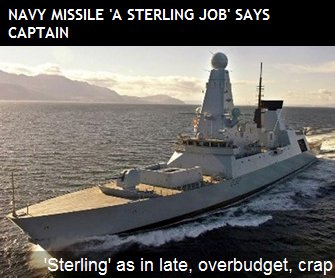
The Royal Navy has had some of their new Type 45 destroyers in service for a while, but they’ve only just gotten around to arming them?

The Royal Navy’s new £1bn+ Type 45 destroyers, which have been in service for several years (the first is already on her second captain), have finally achieved a successful firing of their primary armament.

The Ministry of Defence (MoD) announced yesterday that HMS Dauntless, second of the class, has made the first firing from a Type 45 of the French-made Aster missiles with which the ships are armed. All previous trial shoots were carried out using a test barge at French facilities in the Mediterranean.

Well, at least they’re getting closer to being armed and equipped as they were originally supposed to be:

Each of the six Type 45s will now cost the taxpayer £1.1bn and counting. At the moment the only weapons they can use operationally are their basic 4.5-inch “Kryten” gun turrets and light 30mm autocannon, principally useful for bombarding undefended foreshore targets or shooting up pirate dhows and the like. This is armament barely above the gunboat level.

The big attraction to the (very expensive) PAAMS/Sea Viper missile system is its claimed ability to shoot down the latest generation of Russian supersonic anti-ship missiles . . . oh, and that it wasn’t the cheaper (and proven) American AEGIS system.

As it is, we will pay at least double and get none of these things. Our Type 45s will have no serious ability to strike targets ashore, and we will continue to have no capabilities against ballistic missiles. Most glaringly of all, the Type 45 will have no weapon other than its guns with which to fight enemy ships — Sea Viper has no surface-to-surface mode.

You might feel that preservation of British high-tech jobs in some way justifies such horrific overspending for such lamentable amounts of capability, but in fact the relatively few Brit workers concerned have now mostly been fired anyway.

We can’t poke too much fun at the Royal Navy over the jobs issue: most major purchases for the Canadian Forces are driven more by “spin-offs” and regional employment concerns than either cost or military efficacy.

I did like The Register‘s cheeky graphic:

October 3, 2010

Personal responsibility is key

Filed under: Bureaucracy, Europe, Liberty, USA — Tags: , , , , — Nicholas @ 11:41

A post at The Economist looks at the ongoing debate on liberal/libertarian joint concerns:

My colleague noted the other day the discussion Matthew Yglesias has been having with his readers over whether liberals and libertarians can agree on some regulations they both hate. So, here’s a regulation I hate: you’re not allowed to swim across the lake anymore in Massachusetts state parks. You have to stay inside the dinky little waist-deep swimming areas, with their bobbing lines of white buoys. There you are, under a deep blue New England summer sky, the lake laid out like a mirror in front of you and the rocks on the far shore gleaming under a bristling comb of red pine; you plunge in, strike out across the water, and tweet! A parks official blows his whistle and shouts after you. “Sir! Sir! Get back inside the swimming area!” What is this, summer camp? Henry David Thoreau never had to put up with this. It offends the dignity of man and nature. You want to shout, with Andy Samberg: “I’m an adult!

I would gladly join any movement that promised to do away with this sort of nonsense. For example, Philip K. Howard’s organisation “Common Good” works on precisely this agenda. Common Good’s very bugaboo is useless, wasteful legal interference in schools, health care, recreation, and so on. But what you quickly note with many of these issues is that they’re driven by legal liability concerns. You have a snowblader in Colorado suing a resort because she crashed into someone. You have states declining to put up road-hazard signs because the signs prove they knew the hazard was there, which could render them liable for damages. You have the war on children’s playgrounds. The Massachusetts swimming ban, too, is driven by liability concerns. The park officials in Massachusetts aren’t really trying to minimise the risk that you might drown. They’re trying to minimise the risk that you might sue. The problem here, as Mr Howard says, isn’t simply over-regulation as such. It’s a culture of litigiousness and a refusal to accept personal responsibility. When some of the public behave like children, we all get a nanny state.

As Robert Heinlein put it, “The whole principle is wrong; it’s like demanding that grown men live on skimmed milk because the baby can’t eat steak.”

« Newer PostsOlder Posts »

Powered by WordPress