
Even by the usual standards of historical irony, it remains astonishing that Hitler’s June 1941 invasion of the Soviet Union not only failed to destroy Bolshevism, but instead conferred a new legitimacy on Stalin’s dictatorship, and probably protracted by a generation the existence of his empire. Successful resistance to Hitler was only possible because of the Soviet leader’s industrialisation programme, which had been carried out at appalling human cost.
The Russian people’s 21st-century notion of what they call “the Great Patriotic War” bears little relationship to our own. It ignores Stalin’s 1939-41 pact with Hitler, and the fact that the Luftwaffe planes that bombed London in the Blitz were powered by Russian fuel. President Putin has made unlawful all published mention of the unspeakable cruelties the Soviet regime inflicted on its own citizens — shooting an estimated 300,000 soldiers for alleged desertion or cowardice — in order to prevail. Antony Beevor’s books, and for that matter my own, are nowadays banned because they describe the Red Army’s 1945 campaign of rape and pillage in Germany.
I have argued elsewhere that the ruthlessness of Stalin’s tyranny was essential to contrive the defeat of Hitler’s tyranny; that if the liberation of Europe had proceeded at a pace determined by the US and British armies, we might still stand short of the Elbe.
Max Hastings, “The centenary of the Russian revolution should be mourned, not celebrated”, The Spectator, 2016-12-10.
October 1, 2019
QotD: The Great Patriotic War
September 29, 2019
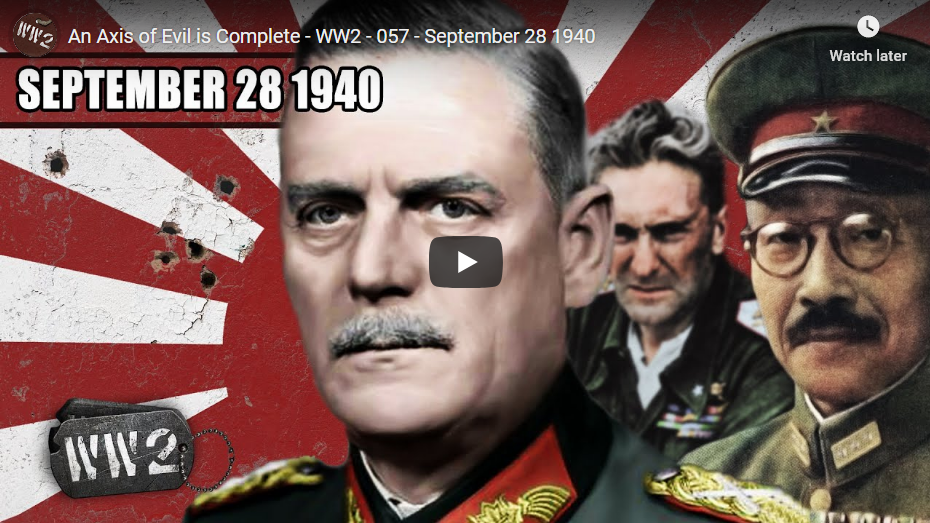
An Axis of Evil is Complete – WW2 – 057 – September 28 1940
World War Two
Published 28 Sep 2019This week, the factions of World War Two begin to crystallise as the Japanese join the Axis powers.
Join us on Patreon: https://www.patreon.com/TimeGhostHistory
Or join The TimeGhost Army directly at: https://timeghost.tvFollow WW2 day by day on Instagram @World_war_two_realtime https://www.instagram.com/world_war_t…
Join our Discord Server: https://discord.gg/D6D2aYN.
Between 2 Wars: https://www.youtube.com/playlist?list…
Source list: http://bit.ly/WW2sourcesWritten and Hosted by: Indy Neidell
Produced and Directed by: Spartacus Olsson and Astrid Deinhard
Executive Producers: Bodo Rittenauer, Astrid Deinhard, Indy Neidell, Spartacus Olsson
Creative Producer: Joram Appel
Post-Production Director: Wieke Kapteijns
Research by: Indy Neidell
Edited by: Iryna Dulka
Map animations: EastoryColorisations by Norman Stewart and Julius Jääskeläinen https://www.facebook.com/JJcolorization/
Eastory’s channel: https://www.youtube.com/channel/UCEly…
Archive by Screenocean/Reuters https://www.screenocean.com.Sources:
– USHMM
1. Accession Number: 1992.252.1 | RG Number: RG-60.0621 | Film ID: 302
2. Photograph Number: 74565
– IMW:
IWM (A 1378)
IWM (A 1376)
IWM (CH 1429)
IWM (C 1819)TimeGhost chronological documentary produced by OnLion Entertainment GmbH.
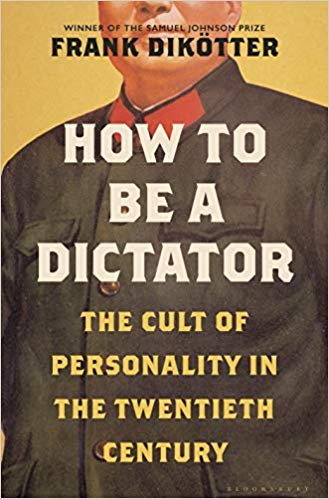
Being a dictator is a stressful vocation
Gustav Jönsson reviews a new book by Professor Frank Dikötter on twentieth-century dictators:
One of the first things to emerge from Professor Frank Dikötter’s eagerly awaited new book How to Be a Dictator is that it is a stressful vocation: there are rivals to assassinate, dissidents to silence, kickbacks to collect, and revolutions to suppress. Quite hard work. Even the most preeminent ones usually meet ignominious ends. Mussolini: summarily shot and strung upside down over a cheering crowd. Hitler: suicide and incineration. Ceausescu: executed outside a toilet block. Or consider the fate of Ethiopia’s Haile Selassie: rumoured to have been murdered on orders of his successor Mengistu Haile Mariam, he was buried underneath the latter’s office desk. Not the most alluring career trajectory, one might say.
Dikötter’s monograph is a study of twentieth century personality cults. He examines eight such cults: those created by Mussolini, Hitler, Stalin, Mao, Kim Il-sung, Duvalier, Ceausescu, and Mengistu. For them, cultism was not mere narcissism, it was what sustained their regimes; foregoing cultism, Dikötter argues, caused swift collapse. Consider Pol Pot and the Khmer Rouge. Cambodians were unsure of Pol Pot’s exact identity for years, even after he had assumed leadership of the country. The Khmer Rouge, meanwhile, was in its initial stages merely called “Angkar” — “The Organisation.” There was no inspiring iconography. There was no ritualised leader worship. There was only dark terror. Dikötter quotes historian Henri Locard: “Failing to induce adulation and submissiveness, the Angkar could only generate hatred.” The Khmer Rouge soon lost its grip on the country. Dikötter makes an obligatory reference: “Even Big Brother, in George Orwell’s 1984, had a face that stared out at people from every street corner.”
Readers of Orwell will remember that INGSOC has no state ideology. There is only what the Party says, which can change from hour to hour. Likewise, Dikötter argues, there was no ideological core to twentieth century dictatorships; there was only the whim of the dictator. Nazism, for example, was not a coherent creed. It contained antisemitism, nationalism, neo-paganism, etc., but its essence was captured in one of its slogans: The Führer is Always Right. That is what the creed amounted to. Indeed, the NSDAP referred to itself simply as “the Hitler movement.” Nazism was synonymous with Hitlerism. Italian Fascism was perhaps even more vacuous. The regime’s slogan was simple: Mussolini is Always Right. Explaining his method of politics, Mussolini said: “We do not believe in dogmatic programmes, in rigid schemes that should contain and defy the changing, uncertain, and complex reality.”
While it is uncontroversial to argue that Nazism and Fascism were without ideology, as Dikötter writes, the “issue is more complicated with communist regimes.” Naturally, Marxism was connected with Stalin, Mao, Ceausescu, Kim, and Mengistu. But Dikötter rightly says that it was Lenin’s revolutionary vanguard, not Marx’s philosophical works, that inspired them. Doctrines can be interpreted in contradictory ways, creating schismatic movements — as shown throughout the history of socialism. In this regard personality cults are far safer because they are substantively empty. Marxist dictators thus subverted Marxism. Engels had said that socialism in one country was impossible, but that is what Stalin’s Soviet Union favoured. Or consider Kim’s North Korea, which in 1972 replaced Marxism with Great Leader Thought. And as Dikötter writes, “Mao read Marx, but turned him on his head by making peasants rather than workers the spearhead of the revolution.” Reading Marx under Marxism, Dikötter says, was highly imprudent: “One was a Stalinist under Stalin, a Maoist under Mao, a Kimist under Kim.” In short, Marxism was whatever the dictator said, and not what Marx had actually written.
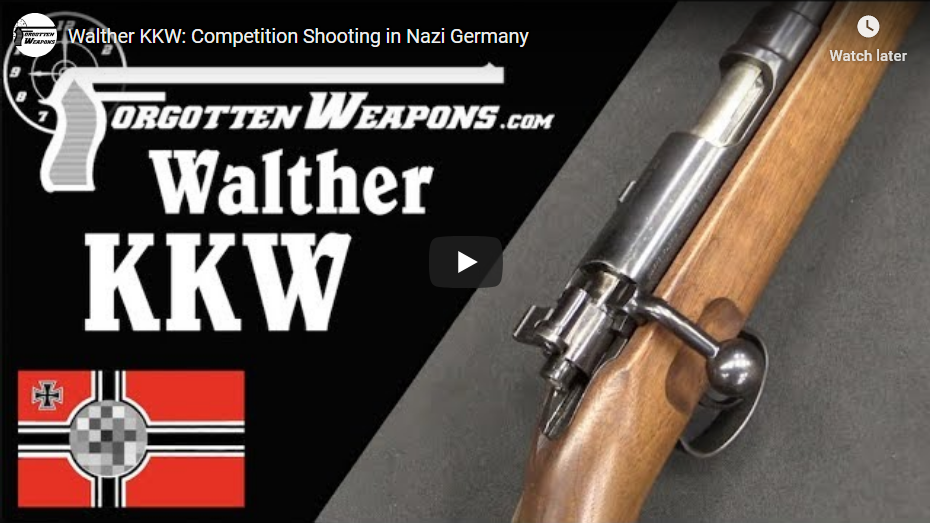
Walther KKW: Competition Shooting in Nazi Germany
Forgotten Weapons
Published on 14 Aug 2019RIA on YouTube: https://www.youtube.com/user/RockIsla…
RIA on Instagram: https://www.instagram.com/rockislanda…The KKW (“Klein Kaliber Wehrsportgewehr“, or small caliber military sporting rifle) was developed by BDW in 1937 as an amalgamation of various .22 rifle elements from other manufacturers as well as BSW itself. It was intended to fill the role of the German national standard target rifle. When the Nazi party took over Germany in the early 30s, the SA consolidated and reorganized the civilian shooting sports in to a format aimed at military training. To this end, they wanted a standardized rifle which would duplicate the handling of the Mauser K98k in .22 long rifle caliber. This was initially the DSM, but in 1935 the SA decided that it wanted a rifle that more closely mirrored the military pattern Mauser. The result was the KKW. For more information on these and other German 1930s/40s training rifles, I recommend the recent book on the subject by Bob Simpson.
http://www.patreon.com/ForgottenWeapons
Cool Forgotten Weapons merch! http://shop.bbtv.com/collections/forg…
Contact:
Forgotten Weapons
PO Box 87647
Tucson, AZ 85754
September 28, 2019
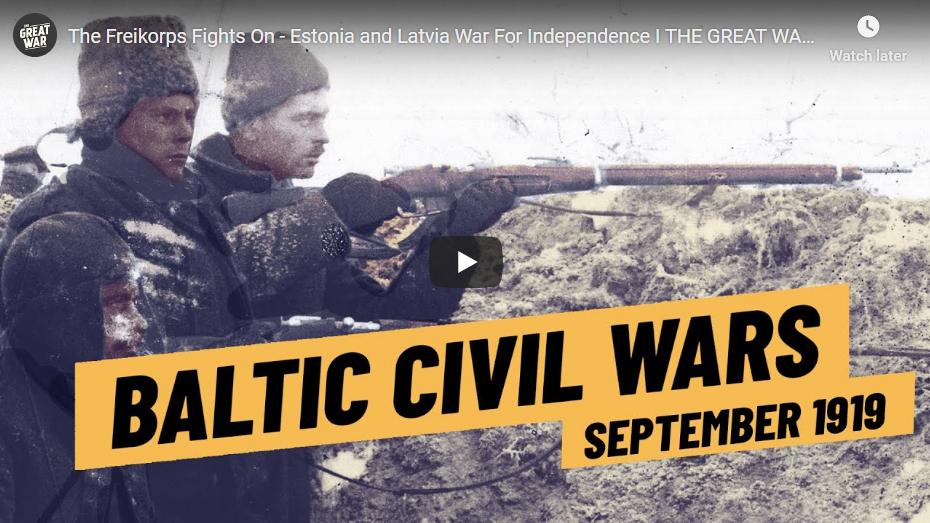
The Freikorps Fights On – Estonia and Latvia War For Independence I THE GREAT WAR 1919
The Great War
Published 27 Sep 2019Support 16 Days in Berlin: https://realtimehistory.net/indiegogo
After the Battle of Cesis it seemed the situation in Latvia and Estonia was about to quieten down. But the German soldiers in the region and the ongoing conflict with Bolshevik Russia meant the 2nd half of 1919 saw even more fighting in the Baltics.
» SUPPORT THE CHANNEL
Patreon: https://www.patreon.com/thegreatwar
Merchandise: https://shop.spreadshirt.de/thegreatwar/»CREDITS
Presented by: Jesse Alexander
Written by: Jesse Alexander
Director: Toni Steller & Florian Wittig
Director of Photography: Toni Steller
Sound: Toni Steller
Editing: Toni Steller
Mixing, Mastering & Sound Design: http://above-zero.com
Maps: Daniel Kogosov (https://www.patreon.com/Zalezsky)
Research by: Jesse Alexander
Fact checking: Florian WittigChannel Design: Alexander Clark
Original Logo: David van StepholdA Mediakraft Networks Original Channel
Contains licensed material by getty images
All rights reserved – Real Time History GmbH 2019
September 25, 2019
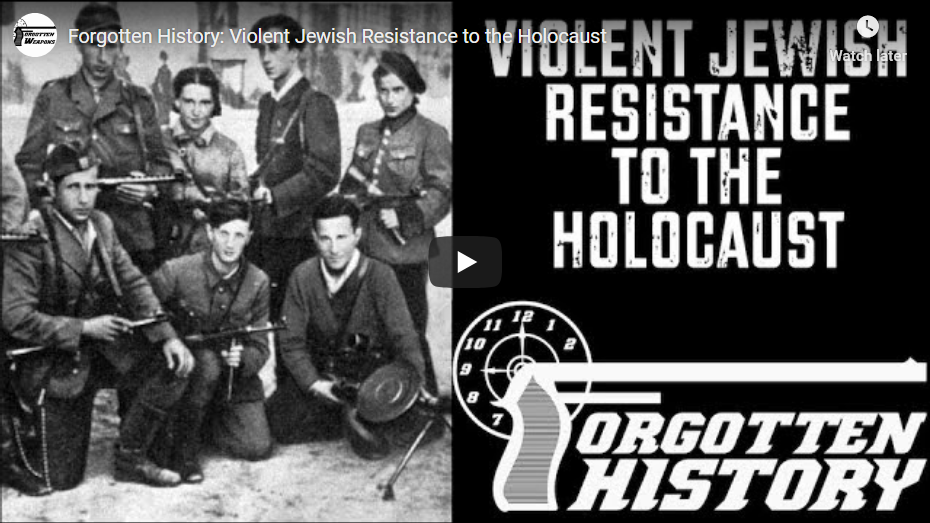
Forgotten History: Violent Jewish Resistance to the Holocaust
Forgotten Weapons
Published 24 Sep 2019http://www.patreon.com/ForgottenWeapons
Cool Forgotten Weapons merch! http://shop.bbtv.com/collections/forg…
I wrote this paper back in 2003 or 2004 for a college class I was taking (HIST 595 – The Holocaust And Genocide). Today, it sounds a bit amateurish — but I suppose that is to be expected of something written by someone barely out of their teens. I think it could be much better written today, and its subject matter deserves much greater depth, but I believe its conclusions are sound. In particular, I would not be so casual in identifying the perpetrators simply as “the Germans”, as this is an unfair simplification of the guilt for the crimes of the Holocaust.
Some people will interpret this paper though narrow political viewpoints today, which is unfortunate. I shouldn’t have to say it, but obviously such interpretations are certainly not reflective of my own beliefs.
Bibliography:
Ainsztein, Reuben. Jewish Resistance in Nazi-Occupied Europe. Paul Elek Ldt, London: 1974.
Arad, Yitzhak. Ghetto in Flames. Holocaust Library, New York: 1982.
Berenbaum, Michael. The World Must Know. New York: Little, Brown, and Co, 1993.
Donat, Alexander. The Death Camp Treblinka. New York: Holocaust Library, 1979.
Gutman, Yisrael. The Jews of Warsaw, 1939-1943. Indiana University Press, Bloomington:1982.
Mark, Ber. Uprising in the Warsaw Ghetto. Schocken Books, New York: 1975.
Novitch, Miriam. Sobibor: Martydom and Revolt. Holocaust Library, New York: 1980.
Rotem, Simha. Memoirs of a Warsaw Ghetto Fighter. New Haven: Yale University Press, 1994.
Zuckerman, Yitzhak. A Surplus of Memory. University of California Press, Berkeley: 1993.
Contact:
Forgotten Weapons
6281 N. Oracle #36270
Tucson, AZ 85704
September 22, 2019
The Brits teach the Germans to bugger off! – WW2 – 056 – September 21 1940
World War Two
Published on 21 Sep 2019The Battle of Britain continues as planes fight over the South-English shorelines and large parts of London are targeted during the Blitz. However, this week the ultimate goal of this air battle is postponed. The invasion of Britain, Operation Sea Lion, is called off. For now at least.
Join us on Patreon: https://www.patreon.com/TimeGhostHistory
Or join The TimeGhost Army directly at: https://timeghost.tvFollow WW2 day by day on Instagram @World_war_two_realtime https://www.instagram.com/world_war_t…
Join our Discord Server: https://discord.gg/D6D2aYN.
Between 2 Wars: https://www.youtube.com/playlist?list…
Source list: http://bit.ly/WW2sourcesWritten and Hosted by: Indy Neidell
Produced and Directed by: Spartacus Olsson and Astrid Deinhard
Executive Producers: Bodo Rittenauer, Astrid Deinhard, Indy Neidell, Spartacus Olsson
Creative Producer: Joram Appel
Post-Production Director: Wieke Kapteijns
Research by: Indy Neidell
Edited by: Iryna Dulka
Map animations: EastoryColorisations by Norman Stewart and Julius Jääskeläinen https://www.facebook.com/JJcolorization/
Eastory’s channel: https://www.youtube.com/channel/UCEly…
Archive by Screenocean/Reuters https://www.screenocean.com.Sources:
– Mussolini colorized by Olga Shirnina, aka Klimbim
– German barge by WerWil on Wikimedia Commons
– IWM: CM3513, MH 6657, ZZZ 2070B, MISC 51237A TimeGhost chronological documentary produced by OnLion Entertainment GmbH.

September 20, 2019
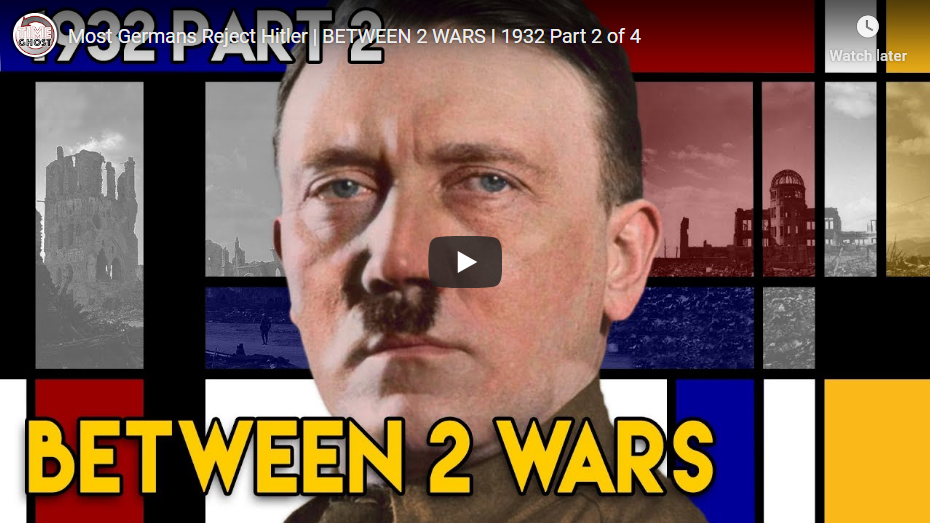
Most Germans Reject Hitler | BETWEEN 2 WARS I 1932 Part 2 of 4
TimeGhost History
Published on 19 Sep 2019After Chancellor Brüning has run Germany’s economy into the ground, the country is once again going to the polls. It’s a wild brawl between reason and madness, populism and stability, and democracy and tyranny focused on who will unite Germany if Germany even can be united again …
Join us on Patreon: https://www.patreon.com/TimeGhostHistory
Subscribe to our World War Two series: https://www.youtube.com/c/worldwartwo…
Hosted by: Indy Neidell
Written by: Spartacus Olsson
Directed by: Spartacus Olsson and Astrid Deinhard
Executive Producers: Bodo Rittenauer, Astrid Deinhard, Indy Neidell, Spartacus Olsson
Creative Producer: Joram Appel
Post-Production Director: Wieke Kapteijns
Research by: Spartacus Olsson
Edited by: Wieke Kapteijns
Sound design: Marek KamińskiSources: Icon german parliament: Gerald Wildmoser. Graphic German Reichstag: Liambaker98. Images: Bundesarchiv.
A TimeGhost chronological documentary produced by OnLion Entertainment GmbH.
From the comments:
TimeGhost History
3 hours ago
This year it will be 85 years ago that Germany elected the Nazis to power, or will it? Well … as most events in history it isn’t quite that simple. There is no majority for anything in Germany at this point. You see, in 1932 Germany is still a diverse, democratic state. But it’s been under attack for many years now by populist, partisan interests tearing it apart into fractious, sometimes destructive opposite forces. In essence, they can be grouped into three camps:1. the mainstream centrist parties on the left and right that want a parliamentary, socially tolerant democracy.
2. the far left that wants to overthrow the parliamentary democracy and start a revolution to create an authoritarian, socially ultra-liberal, rule by the working class
3. the far right that wants to overthrow the parliamentary democracy to create a totalitarian, socially reactionary, rule by a strong man.Now, that is the left to right landscape and as you shall see that is also how the election results play out in alliances. So try your best to get rid of your prejudices and preconceived notions — because for many of you things are not the way that you have been told. And if for no other reason than saving us the trouble of having to police these comments too much — please, please try to remember our rules. They are not there to quash freedom of speech — they are there so that we can keep the comment sections turned on. When we don’t police them it never takes long for videos like this to descend into a hatefest full of death threats and calls for mass murder. You might think that’s cool, but we don’t and we know that most of the world doesn’t so respect that — for the sake of democracy if nothing else.
September 15, 2019
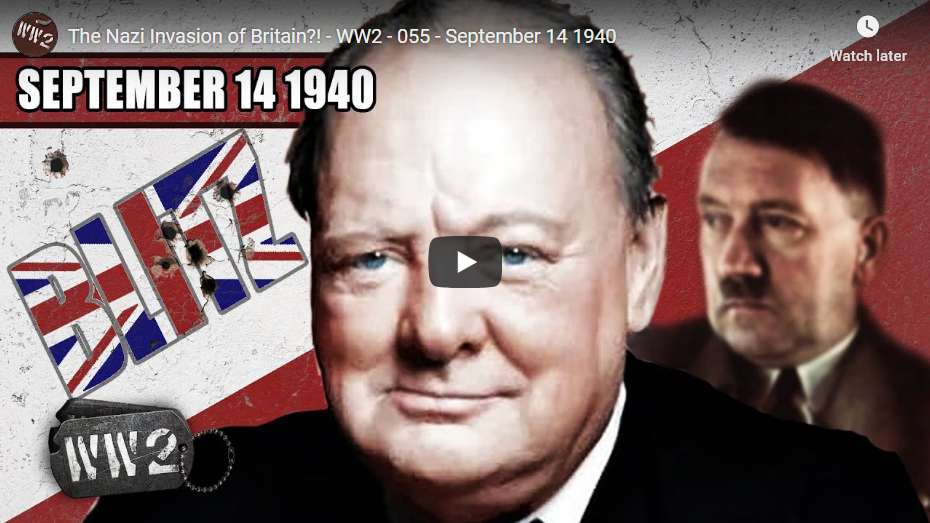
The Nazi Invasion of Britain?! – WW2 – 055 – September 14 1940
World War Two
Published on 14 Sep 2019The Blitz continues as the German army seems close to the execution of Operation Sea Lion: the invasion of Britain.
Join us on Patreon: https://www.patreon.com/TimeGhostHistory
Or join The TimeGhost Army directly at: https://timeghost.tvFollow WW2 day by day on Instagram @World_war_two_realtime https://www.instagram.com/world_war_t…
Join our Discord Server: https://discord.gg/D6D2aYN.
Between 2 Wars: https://www.youtube.com/playlist?list…
Source list: http://bit.ly/WW2sourcesWritten and Hosted by: Indy Neidell
Produced and Directed by: Spartacus Olsson and Astrid Deinhard
Executive Producers: Bodo Rittenauer, Astrid Deinhard, Indy Neidell, Spartacus Olsson
Creative Producer: Joram Appel
Research by: Indy Neidell
Post-Production Director: Wieke Kapteijns
Edited by: Iryna Dulka
Map animations: EastoryColorisations by Norman Stewart and Julius Jääskeläinen https://www.facebook.com/JJcolorization/
Eastory’s channel: https://www.youtube.com/channel/UCEly…
Archive by Screenocean/Reuters https://www.screenocean.com.Sources:
– IWM: E 7304, E 1400, CH 4972, E 12789
– Italian poster – James Vaughan on Flickr
– Narodowe Archiwum CyfroweA TimeGhost chronological documentary produced by OnLion Entertainment GmbH.
From the comments:
World War Two
3 days ago
What if the Germans had invaded Britain this week? We will probably never know, but we get asked to give our views on counterfactual history questions like this all the time. Many did that during our first Q&A session on Instagram last week. We had a great time answering many questions about the war, about TimeGhost and about the production process, and we’ll certainly do similar Instagram Q&A sessions again. If you don’t already, you can follow us by looking up @world_war_two_realtime or https://www.instagram.com/world_war_two_realtime/Cheers,
Joram
September 13, 2019
The new German populists – Alternative für Deutschland (AfD)
Sabine Beppler-Spahl discusses the rise of Alternative für Deutschland:
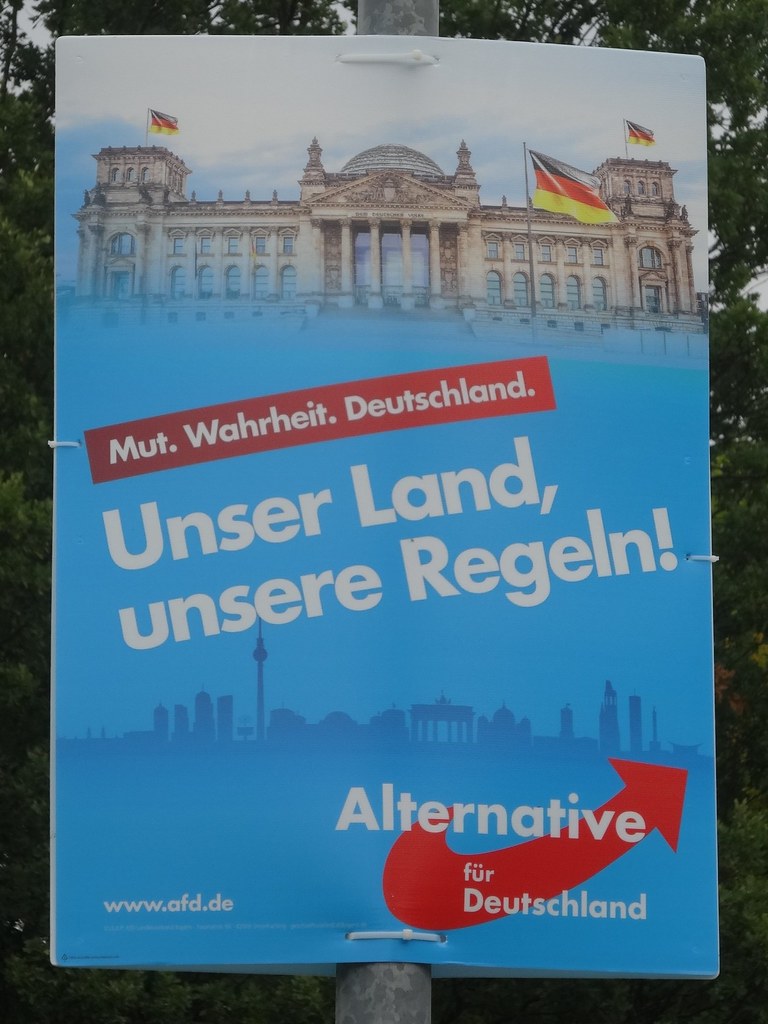
“AfD Election Poster” by harry_nl is licensed under CC BY-NC-SA 2.0


Germany is just two months away from commemorating the 30th anniversary of the fall of the Berlin Wall. But for many commentators, east and west Germany are more divided than ever. The success of the right-wing Alternative für Deutschland (AfD) in the recent state elections in Brandenburg and Saxony has fueled this concern. The AfD came second in both elections. In Brandenburg, it won 23.5 per cent of the vote, just 2.7 per cent below the ruling centre-left SPD. In Saxony, it won 27.5 per cent of the vote, 4.6 per cent behind the incumbent centre-right CDU. “When I, a Wessi [west German], leave Berlin … I see nothing but right-wingers … These are people whose sensitivities I don’t understand… Thirty years after the fall of the wall, there is still no unity”, said a writer for Der Spiegel.
Many in the east are just as keen as their western counterparts to distance themselves from AfD voters. The “most important message” from Saxony’s election result was that the “friendly Saxony” had won, said Michael Kretschmer, the state’s CDU minister president. As if reading from the same script, Brandenburg’s minister president, the SPD’s Dietmar Woidke, emphasised that “the face of Brandenburg would remain friendly”. Of course, “friendly” is a code word for mainstream or pro-establishment. But presenting the elections in these terms may have helped the governing parties to their narrow victories. Some analysts suggest that voters, who would otherwise have opted for the Greens or Die Linke (the Left Party), supported the ruling parties for fear of the AfD coming first.
The debate about the east-west divide is deeply anti-political. It focuses solely on the question of what is wrong with east German voters – and the roughly one million AfD voters in particular – rather than on what has gone wrong with German politics as a whole. As a result, there is a great deal of snobbery in the discussion. For Brigitte Fehrle, former editor of the left-liberal Berliner Zeitung, the AfD‘s success can be explained by a mixture of voters’ “disappointment” and their “unrealistic expectations about what is possible in politics”. Sociologist Cornelia Koppetsch, author of a bestselling book on right-wing populism, describes AfD voters as a “cross-section of globalisation’s losers”. This is despite research finding that people who voted for the AfD in 2017 don’t see themselves as “losers” of globalisation at all, and even rate their personal economic situation as above average. That AfD voters might simply hold different political values or views on climate policy, immigration and the family is rarely considered.
[…]
The established parties have ceded ground to the AfD by refusing to take it seriously. Instead of engaging AfD representatives in as many debates as possible, they have relied on trying to expose the party’s far-right connections. For instance, the AfD leader in Brandenburg has been accused of joining a Neo-Nazi demonstration in Greece in 2007. Though these accusations are not trivial by any means, they have only helped to strengthen the impression among AfD supporters that the established parties prefer to vilify the party morally, rather challenge it politically.
Ultimately, the desire for political change is not limited to east Germany. If the mainstream parties continue to be complacent, all voters will look elsewhere. On this front at least, the east and west might be closer than suspected.
September 8, 2019
Burn London, Burn it’s the Blitz – WW2 – 054 – September 07 1940
World War Two
Published on 7 Sep 2019This week, the battle in the skies of Britain enters a new, even deadlier phase, as the crowded streets of London turn into a war zone. It is the start of the Blitz.
Join us on Patreon: https://www.patreon.com/TimeGhostHistory
Or join The TimeGhost Army directly at: https://timeghost.tvFollow WW2 day by day on Instagram @World_war_two_realtime https://www.instagram.com/world_war_t…
Join our Discord Server: https://discord.gg/D6D2aYN.
Between 2 Wars: https://www.youtube.com/playlist?list…
Source list: http://bit.ly/WW2sourcesWritten and Hosted by: Indy Neidell
Produced and Directed by: Spartacus Olsson and Astrid Deinhard
Executive Producers: Bodo Rittenauer, Astrid Deinhard, Indy Neidell, Spartacus Olsson
Creative Producer: Joram Appel
Research by: Indy Neidell
Edited by: Iryna Dulka
Map animations: EastoryColorisations by Norman Stewart and Julius Jääskeläinen https://www.facebook.com/JJcolorization/
Eastory’s channel: https://www.youtube.com/channel/UCEly…
Archive by Screenocean/Reuters https://www.screenocean.com.Sources:
– IWM: SP 2553, FL 5186, H 23836, HU 93069, CH 19
– Colorization of Hugo Sperrle by Ruffneck88
– Narodowe Archiwum CyfroweA TimeGhost chronological documentary produced by OnLion Entertainment GmbH.
How Did War Become a Game?
Invicta
Published on 28 Jun 2019Get your first audiobook and two Audible originals when you try Audible for 30 days. Visit https://www.audible.com/Invicta or text “Invicta” to 500 500!
In this video we continue to take a look at the history of Kriegsspiel and explore the early days of wargaming that eventually gave rise to modern table top games such as Warhammer and Dungeons & Dragons.
Research: Jon Peterson
Script: Invicta
Narration: Invicta
Artwork: Gabriel Cassata
Editing: InvictaBibliography
Playing at the World by Jon Peterson
Debugging Game History: A Critical Lexicon by Henry Lowood
War Games: A History of War on Paper by Philipp von Hilgers
Pluie de Balles – Complex Wargames In the Classroom by Jorit Wintjes and, Steffen Pielstrom
September 7, 2019
“A Lifetime of War” – Thirty Years War – Sabaton History 031 [Official]
Sabaton History
Published on 5 Sep 2019The Sabaton song “A Lifetime of War” is about the Thirty Years War, which influenced many lives of Northern European soldiers, mercenaries, farmers and city-dwellers.
Support Sabaton History on Patreon: https://www.patreon.com/sabatonhistory
Listen to Carolus Rex (“Lifetime of War” is featured):
CD: http://bit.ly/CarolusRexStore
Spotify: http://bit.ly/CarolusRexSpotify
Apple Music: http://bit.ly/CarolusRexAppleMusic
iTunes: http://bit.ly/CarolusRexiTunes
Amazon: http://bit.ly/CarolusRexAmz
Google Play: http://bit.ly/CarolusRexGooglePlayWatch the official music video for Lifetime of War right here: https://www.youtube.com/watch?v=zvdbD…
Hosted by: Indy Neidell
Written by: Markus Linke and Indy Neidell
Directed by: Astrid Deinhard and Wieke Kapteijns
Produced by: Pär Sundström, Astrid Deinhard and Spartacus Olsson
Creative Producer: Joram Appel
Executive Producers: Pär Sundström, Joakim Broden, Tomas Sunmo, Indy Neidell, Astrid Deinhard, and Spartacus Olsson
Maps by: Eastory
Edited by: Iryna Dulka
Sound Editing by: Iryna Dulka and Marek KaminskiEastory YouTube Channel: https://www.youtube.com/channel/UCEly…
Archive by: Reuters/Screenocean https://www.screenocean.com
Music by Sabaton.Sources:
– Folger Shakespeare Library
– Map of Hanseatic League: H.F. Helmolt, History of the World, Volume VII, Dodd Mead 1902
– Fondo Antiguo de la Biblioteca de la Universidad de SevillaAn OnLion Entertainment GmbH and Raging Beaver Publishing AB co-Production.
© Raging Beaver Publishing AB, 2019 – all rights reserved.
September 6, 2019
Germany Commits Suicide by Cancelling War Reparations | BETWEEN 2 WARS I 1931 Part 3 of 3
TimeGhost History
Published on 5 Sep 2019Contrary to popular belief it is not so much reparations themselves that puts the first stepping stone in place for the Nazi to rise to power. Instead it is the cancellation of war reparations, or more correctly put; the measures that “The Hunger Chancellor” Heinrich Brüning implements to get reparations cancelled that pushes Germany over the financial brink and into the hands of Hitler and Goebbels.
Join us on Patreon: https://www.patreon.com/TimeGhostHistory
Subscribe to our World War Two series: https://www.youtube.com/c/worldwartwo…
Hosted by: Indy Neidell
Written by: Spartacus Olsson and Francis van Berkel
Directed by: Spartacus Olsson and Astrid Deinhard
Executive Producers: Bodo Rittenauer, Astrid Deinhard, Indy Neidell, Spartacus Olsson
Creative Producer: Joram Appel
Post-Production Director: Wieke Kapteijns
Research by: Francis van Berkel and Spartacus Olsson
Edited by: Wieke Kapteijns and Daniel Weiss
Sound design: Iryna Dulka
Colorization by Daniel WeissThumbnail: Goebbels colorized bu Olga Shirnina, aka Klimbim
Archive by Reuters/Screenocean http://www.screenocean.com
A TimeGhost chronological documentary produced by OnLion Entertainment GmbH.
Sources:
Ruth Henig, The Weimar Republic 1919-1933
Theo Balderston, Economics and Politics in the Weimar Republic
Kolbe, The Weimar Republic
Harold James, The Causes of the German Banking Crisis of 1931
Feuchtwanger, From Weimar to HitlerSources images: Bundesarchiv
From the comments:
TimeGhost History
49 minutes ago (edited)OK, so this video is about Naziism to some degree, it’s also a serious look at how Germany started transitioning into Naziism – this is not speculation, it’s not even very controversial, it just happens to not fit with many popular superficial misconceptions. Now, we love it when you guys debate under our videos, even when it’s in disagreement with something we or somebody else said, but before you do so please save us some time and read our rules and consider if your post is against our rules. If you think it might be, consider editing or just not posting it — otherwise you’re just wasting our time and your own — because no matter what, we will moderate this.
If your going to post that the Versailles Treaty was to blame you might want to read this instead: https://community.timeghost.tv/t/why-the-treaty-of-versailles-didnt-cause-naziism-answering-a-guy-on-youtube/1858 — that’s Indy’s extensive answer to that claim.
If you’re going to claim “Naziism was Left Wing” well you can do that, we don’t suppress opinions, not even silly ones, but we suggest that you read this instead: https://timeghost.tv/national-socialism-an-extreme-left-wing-ideology/ that’s Spartacus’s explanation why it is not considered so by historians (and why it’s not really that important).
If you’re going to praise Naziism or celebrate Communism, or propose that any other form of lethal extremism is a great idea — just don’t, we do remove any promotion for lethal anti-democratic ideologies, and will probably revoke your positing privileges.
If you’re going to start peddling conspiracy theories about Jews controlling [insert your crazy idea here] or “it was the Jews” — definitely don’t do that or it will be last thing you post here.
If you’re going to say that stopping German Communism is what caused Naziism — well you can do that … it’s pretty much wrong or at least a gross misrepresentation, and you’ll look like an idiot to anyone who knows their factual German history, but you can do that if publicly proclaiming ignorance is your thing — we would however suggest waiting for our next video on Germany’s elections in 1932 for a more correct take on that instead.
September 4, 2019
Viewing WW2 as “the Air-Sea Super Battlefield”
According to Phillips Payson O’Brien, it’s old-fashioned to view large land battles as being “decisive” in modern warfare:
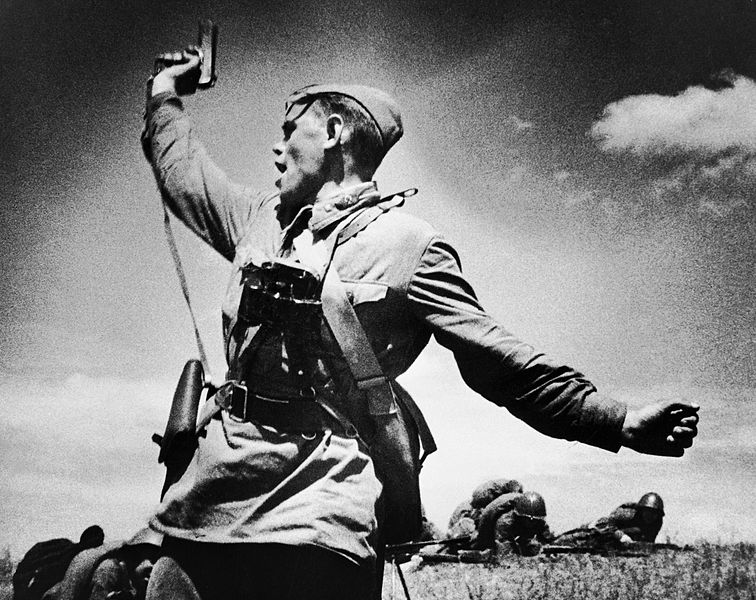
Kombat (Russian: Комбат, lit. “battalion commander”) is a black-and-white photograph by the Soviet photographer Max Alpert. It depicts a Soviet military officer armed with a TT pistol who is raising his unit for an attack during World War II. This work is regarded as one of the most iconic Soviet World War II photographs, yet neither the date nor the subject is known with certainty. According to the most widely accepted version, the photograph depicts junior politruk (political officer) Aleksei Gordeyevich Yeryomenko, minutes before his death on 12 July 1942, in Voroshilovgrad Oblast, Ukraine.
Wikimedia Commons.
Allied victory in WWII is usually viewed through the lens of large land battles, from Stalingrad to Kursk to D-Day. However, battlefield losses of equipment in these “great” land battles were relatively small and easily replaceable. This column demonstrates that the real effort of the major powers was put into the construction of air and sea weapons. The Allies used their air and sea power to destroy the Axis’s in a multi-layered campaign. This was the true battlefield of WWII: a massive air-sea super battlefield that stretched for thousands of miles. Victory in this super-battlefield led to victory in the war.
Every aspect of WWII is discussed in a vast literature. Considering its diversity, explanations of why Germany lost the war are surprisingly predictable. It remains widely argued that the Nazis were beaten mostly by the Soviet Union’s powerful Red Army (Hastings 2005: 508, Kennedy 2013: 183).
From June 1941 to May 1945, German “power” was supposedly engaged and destroyed by the Russians. At some points, more than two-thirds of German infantry were engaged against the Red Army. The famous battles of the Eastern Front, such as Stalingrad and Kursk, supposedly caused the Germans’ crippling losses. The upshot of this lopsided deployment was that most German soldiers died in the East. Fighting against the Americans and British, conversely, is often portrayed as a secondary concern (Roberts 2010: 573).
What’s wrong with a focus on battles?
This battle-centric view, like much history of WWII, is old-fashioned. Historians of strategy have moved away from seeing battles as determinative. Nolan (2017) has argued that attrition losses are more important than battle losses in explaining outcomes.
The battle-centric analysis implies that infantry deployment is the best way to analyse effort. Yet, human-power was rarely the key factor in deciding combat in WWII. Equipment and specialised training mattered more. Possessing and operating the largest stores of modern weapons, not only tanks and artillery but also aircraft and naval vessels, determined the course of battles and the war.
If we reframe the discussion of the war to look not only at what equipment was made but also at how it was destroyed, it emerges that the war was decided far from the land battlefield (O’Brien 2015). The most striking sign of this is how little war production went to the land war and how much went to the combined air-sea war. This was the case for all the powers except the USSR.


