Jabzy
Published 25 Jul 2015Thanks to Xios, Alan Haskayne, Lachlan Lindenmayer, William Crabb, Derpvic, Seth Reeves and all my other Patrons. If you want to help out – https://www.patreon.com/Jabzy?ty=h

Jabzy
Published 25 Jul 2015Thanks to Xios, Alan Haskayne, Lachlan Lindenmayer, William Crabb, Derpvic, Seth Reeves and all my other Patrons. If you want to help out – https://www.patreon.com/Jabzy?ty=h
Sabaton History
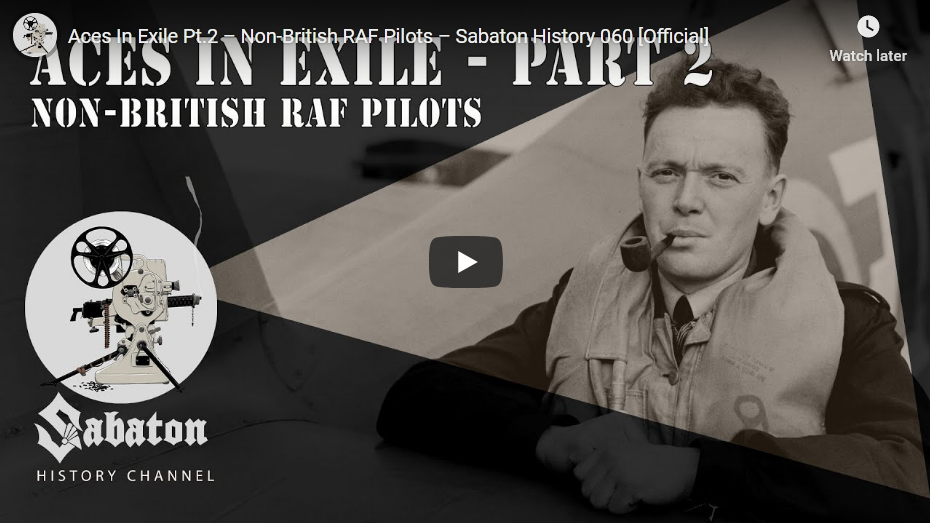
Published 26 Mar 2020“Aces in Exile” return! Interesting times make for interesting men. In this second part we talk about some individual stories of Czechoslovakian, Polish and Canadian pilots that all fought under the banner of the British Royal Air Force during the Second World War. How they escaped German occupation, how they traveled through war torn Europe, and how they eventually found themselves fighting in a different uniform for a different country.
We would like to thank the World of Tanks team for their contribution and help with the video filming. If you’re not yet a World of Tanks player, join the game and get your hands on cool in-game stuff for free via the link: https://redir.wargaming.net/w7fwclmx/…
Support Sabaton History on Patreon: https://www.patreon.com/sabatonhistoryListen to “Aces in Exile” on the album Coat of Arms:
CD: http://bit.ly/CoatOfArmsStore
Spotify: http://bit.ly/CoatOfArmsSpotify
Apple Music: http://bit.ly/CoatOfArmsAppleMusic
iTunes: http://bit.ly/CoatOfArmsiTunes
Amazon: http://bit.ly/CoatOfArmsAmzn
Google Play: http://bit.ly/CoatOfArmsGooglePlayCheck out the trailer for Sabaton’s new album The Great War right here: https://www.youtube.com/watch?v=HCZP1…
Listen to Sabaton on Spotify: http://smarturl.it/SabatonSpotify
Official Sabaton Merchandise Shop: http://bit.ly/SabatonOfficialShopHosted by: Indy Neidell
Written by: Markus Linke and Indy Neidell
Directed by: Astrid Deinhard and Wieke Kapteijns
Produced by: Pär Sundström, Astrid Deinhard and Spartacus Olsson
Creative Producer: Joram Appel
Executive Producers: Pär Sundström, Joakim Broden, Tomas Sunmo, Indy Neidell, Astrid Deinhard, and Spartacus Olsson
Post-Production Director: Wieke Kapteijns
Edited by: Iryna Dulka
Sound Editing by: Marek Kaminski
Maps by: Eastory – https://www.youtube.com/c/eastoryArchive by: Reuters/Screenocean https://www.screenocean.com
Music by Sabaton.Sources:
– Narodowe Archiwum Cyfrowe
– IWM: CH 1566
– Morane-Saulnier icon by Truszko from Wikimedia
– D.520 icon by PpPachy from Wikimedia
– Hurricane icon by Martin Čížek from WikimediaAn OnLion Entertainment GmbH and Raging Beaver Publishing AB co-Production.
© Raging Beaver Publishing AB, 2019 – all rights reserved.
Forgotten Weapons
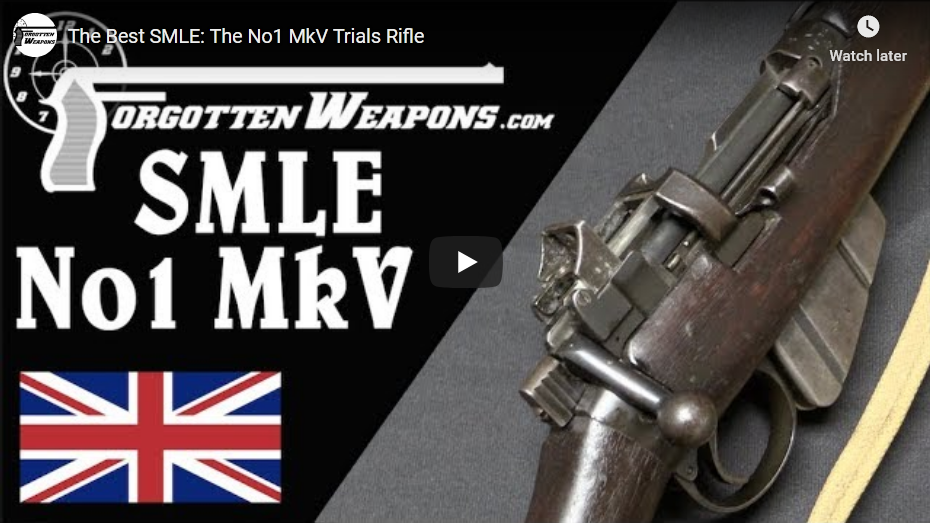
Published 18 Nov 2019After World War One, the British looked at how to apply the lessons of the war to development of a new infantry rifle. Even before the war, a decision had been made to move to an aperture type rear sight — which would have been used on the Pattern 1913 Enfield, had the war no interrupted adoption of that model. So after the war, trials were made on some MkIII SMLE rifles refitted with rear aperture sights. These trials were successful enough to justify production of a substantial number of rifles for troop trials. This would be designated the No1 MkV rifle, and 20,000 of them were made between 1922 and 1924.
The magazine cutoff was retained in the MkV rifles, as were the volley sights in the initial production — along with an aperture rear sight marked out to 1500 yards. Following concerns about the durability of the sight and its adjustment latch, it was redesigned slightly, and the new version only went out to 1400 yards. On this second variation, the volley sights were omitted.
The new rifles was taken to Bisley and input was sought from both military units and civilian marksmen from the British NRA. The feedback that was received was that the sight was too fragile, its adjustments were too coarse, and the barrel was too light. These changes were implemented in the No1 MkVI rifle which would ultimately be adopted as the N4 MkI; the classic World War 2 version oft he Lee Enfield.
http://www.patreon.com/ForgottenWeapons
Cool Forgotten Weapons merch! http://shop.bbtv.com/collections/forg…
Contact:
Forgotten Weapons
6281 N. Oracle #36270
Tucson, AZ 85704
IT’S HISTORY
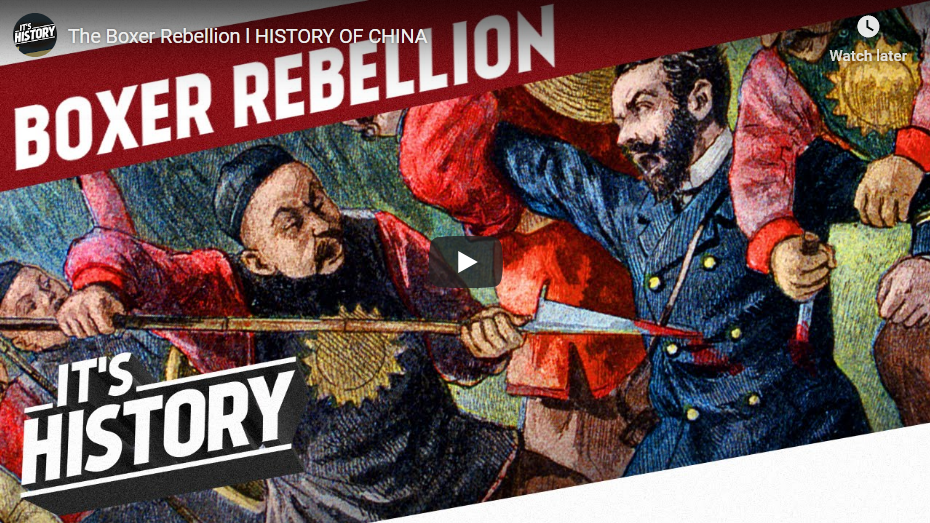
Published 26 Aug 2015The Boxer Rebellion was one of China’s biggest uprisings against the unwanted European, US-American and Japanese imperialism. Distrust and tensions marked all contacts with foreigners. Secret societies were formed to propagate against the enemy. The Yihequan, also known as Boxers, quickly rose to one of the biggest organisations in Northern China. Masters of close combat, they mainly targeted converted Chinese Christians and attacks increased wildly in the 1880s. From 1900 Empress Dowager Cixi was less and less opposed to the Rebellion, as she hoped to fight back foreign influence. Shortly after, even the Chinese Army started helping the rebels and foreigners were fought, killed or driven out. Consequently, an alliance of the imperial powers sent in 50,000 soldiers to end the massacre. Tough reprisals and treaties followed. Learn all about the Boxer Rebellion on IT’S HISTORY.
» JOIN OUR COMMUNITY FOR MORE HISTORY KNOWLEDGE!
Follow us on Twitter: http://twitter.com/thehistoryshow
Your photos on Instagram: https://instagram.com/itshistorychannel» SOURCES
Videos: British Pathé (https://www.youtube.com/user/britishp…)
Pictures: mainly Picture Alliance
Content:
Harrington, Peter: Peking 1900: The Boxer Rebellion, Osprey Campaign
Bodin, Lynn: The Boxer Rebellion, Men-at-Arms
http://www.historyofwar.org/articles/…
http://www.chinafolio.com/chinas-last…» ABOUT US
IT’S HISTORY is a ride through history – Join us discovering the world’s most important eras in IN TIME, BIOGRAPHIES of the GREATEST MINDS and the most important INVENTIONS.» HOW CAN I SUPPORT YOUR CHANNEL?
You can support us by sharing our videos with your friends and spreading the word about our work.» CAN I EMBED YOUR VIDEOS ON MY WEBSITE?
Of course, you can embed our videos on your website. We are happy if you show our channel to your friends, fellow students, classmates, professors, teachers or neighbors. Or just share our videos on Facebook, Twitter, Reddit etc. Subscribe to our channel and like our videos with a thumbs up.» CAN I SHOW YOUR VIDEOS IN CLASS?
Of course! Tell your teachers or professors about our channel and our videos. We’re happy if we can contribute with our videos.» CREDITS
Presented by: Indy Neidell
Script by: Dan Hungerford
Directed by: Daniel Czepelczauer
Director of Photography: Markus Kretzschmar
Music: Markus Kretzschmar
Sound Design: Bojan Novic
Editing: Markus KretzschmarA Mediakraft Networks original channel
Based on a concept by Florian Wittig and Daniel Czepelczauer
Executive Producers: Astrid Deinhard-Olsson, Spartacus Olsson
Head of Production: Michael Wendt
Producer: Daniel Czepelczauer
Social Media Manager: Laura PaganContains material licensed from British Pathé
All rights reserved – © Mediakraft Networks GmbH, 2015
I think it’s important to look beyond personalities and current political issues. Yes, Jeremy Corbyn was a repulsive figure, and that played a significant role in Labor’s defeat; yes, Brexit upended British politics. But if we look at the demographics of who voted Labor, it is not difficult to discern larger and longer-term forces in play.
Who voted Labor? Recent immigrants. University students. Urban professionals. The wealthy and the near wealthy. People who make their living by slinging words and images, not wrenches or hammers. Other than recent immigrants, the Labor voting base is now predominantly elite.
This is the Great Inversion – in Great Britain, Marxist-derived Left politics has become the signature of the overclass even as the working class has abandoned it. Indeed, an increasingly important feature of Left politics in Britain is a visceral and loudly expressed loathing of the working class.
To today’s British leftist, the worst thing you can be is a “gammon”. The word literally means “ham”, but is metaphorically an older white male with a choleric complexion. A working-class white male, vulgar and uneducated – the term is never used to refer to men in upper socio-economic strata. And, of course, all gammons are presumed to be reactionary bigots; that’s the payload of the insult.
Catch any Labor talking head on video in the first days after the election and what you’d see is either tearful, disbelieving shock or a venomous rant about gammons and how racist, sexist, homophobic, and fascist they are. They haven’t recovered yet as I write, eleven days later.
Observe what has occurred: the working class are now reactionaries. New Labor is entirely composed of what an old Leninist would have called “the revolutionary vanguard” and their immigrant clients. Is it any wonder that some Laborites now speak openly of demographic replacement, of swamping the gammons with brown immigrants?
It would be entertaining to talk about the obvious parallels in American politics – British “gammons” map straight to American “deplorables”, of course, and I’m not even close to first in noticing how alike Donald Trump and Boris Johnson are – but I think it is more interesting to take a longer-term view and examine the causes of the Great Inversion in both countries.
Eric S. Raymond, “The Great Inversion”, Armed and Dangerous, 2019-12-23.
Ted Campbell outlines how the Battle of the Atlantic was fought between the Kriegsmarine and the Royal Navy (and the Royal Canadian Navy and, eventually, the United States Navy) in World War 2:
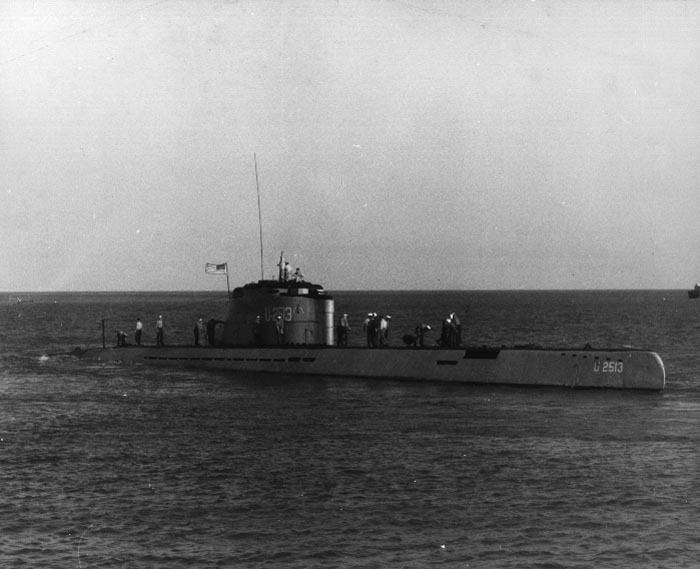
U-2513 in US Navy control off Key West, Florida – 30 October 1946
… there is a rather thick, and quite blurry line between naval strategy and naval tactics. One Army.ca member used the Battle of the Atlantic to distinguish between two doctrines:
- Sea control ~ which was practised by the 2nd World War allies ~ mostly British Admirals Percy Noble and Max Horton in Britain and Canadian Rear Admiral Leonard Murray in St John’s and Halifax; and
- Sea denial ~ which was practised by German Admiral Karl Dönitz.
The difference between the two tactical doctrines was very clear. The strategic aims were equally clear:
- Admiral Dönitz wanted to knock Britain out of the war ~ something that he (and Churchill) understood could be done by starving Britain into submission by preventing food, fuel and ammunition from reaching Britain from North America. (We can be eternally grateful that Adolph Hitler did not share Dönitz’ strategic vision and listened, instead, to lesser men and his own, inept, instincts); and
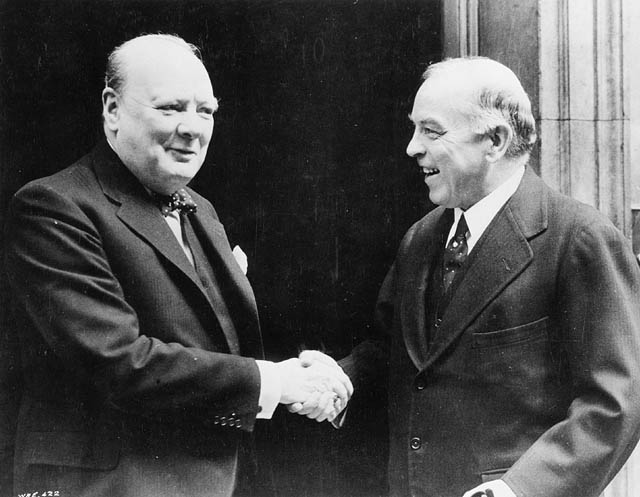
- Prime Minister Churchill, who really did say that “the only thing that ever really frightened me during the war was the U-boat peril“, who wanted to keep Britain fighting, at the very least resisting, until the Americans could, finally, be persuaded to come to the rescue.
Prime Minister Winston Churchill greets Canadian PM William Lyon Mackenzie King, 1941.
Photo from Library and Archives Canada (reference number C-047565) via Wikimedia Commons.Canada’s Prime Minister Mackenzie King did have a grand strategy of his own. It was to do as much as possible while operating with the lowest possible risk of casualties ~ the conscription crisis of 1917 was, always, uppermost in his mind and he was, therefore, terrified of casualties. He mightily approved of the Navy doing a HUGE share in the Battle of the Atlantic ~ especially by building ships in Canadian yards and escorting convoys which he hoped would be a low-risk affair.
Churchill’s grand strategy was based on Britain surviving … there was, I believe, a “worst case” scenario in which the British Isles were occupied and the King and his government went to Canada or even India. But that has always seemed to me to be a sort of fantasy. The United Kingdom, without the British Isles, made no sense.
(While I believe that Rudolph Hess was, as they say, a few fries short of a happy meal, I think that he and several people in Germany believed that it might be possible to negotiate a peace with Britain which many felt was a necessary precursor to a successful campaign against Russia. The Battle of Britain (die Luftschlacht um England, September 1940 to June 1941) was, clearly, not going in Germany’s favour. Late in 1940, the Nazi high command had been forced to send a German Army formation to Libya to prevent a complete rout of the Italians. Malta still held out, meaning that Britain had air cover throughout the Mediterranean. In short, Britain was not going to go down unless it could be starved into submission ~ and in the spring of 1941, the Battle of the Atlantic was going in Germany’s favour. There was, in other words, some reason for Germans to believe that an armistice might be possible ~ freeing up all of Germany’s power to be used against the USSR.)
(But things were changing for the Allies, too. At just about the same time as Hess was flying to Scotland, then Commodore Leonard Murray of the Royal Canadian Navy, who had been in England on other duties, had met with and persuaded Admiral Sir Percy Noble, who liked Murray and had been his commander in earlier years, that a new convoy escort force should be established in Newfoundland and that it should be a largely Canadian force (with British, Dutch, Norwegian and Polish ships under command, too) and that it should be commanded by a Canadian officer. Admiral Noble insisted, to Canada, that Murray, who he liked, personally, and who had written, extensively, on convoy operations in the 1920s and ’30s, must be that commander. The establishment of the Newfoundland Escort Force, which would be more appropriately renamed the Mid Ocean Escort Force in 1942, was a key decision at the much-debated operational level of war which put an expert tactician (Murray) in command of a major force and allowed him (and Noble) to move closer to achieving Churchill’s strategic aim. The Battle of the Atlantic was not won in 1941, but it seemed to Churchill, Noble and Murray that they were a lot less likely to lose it, even without the Americans.)
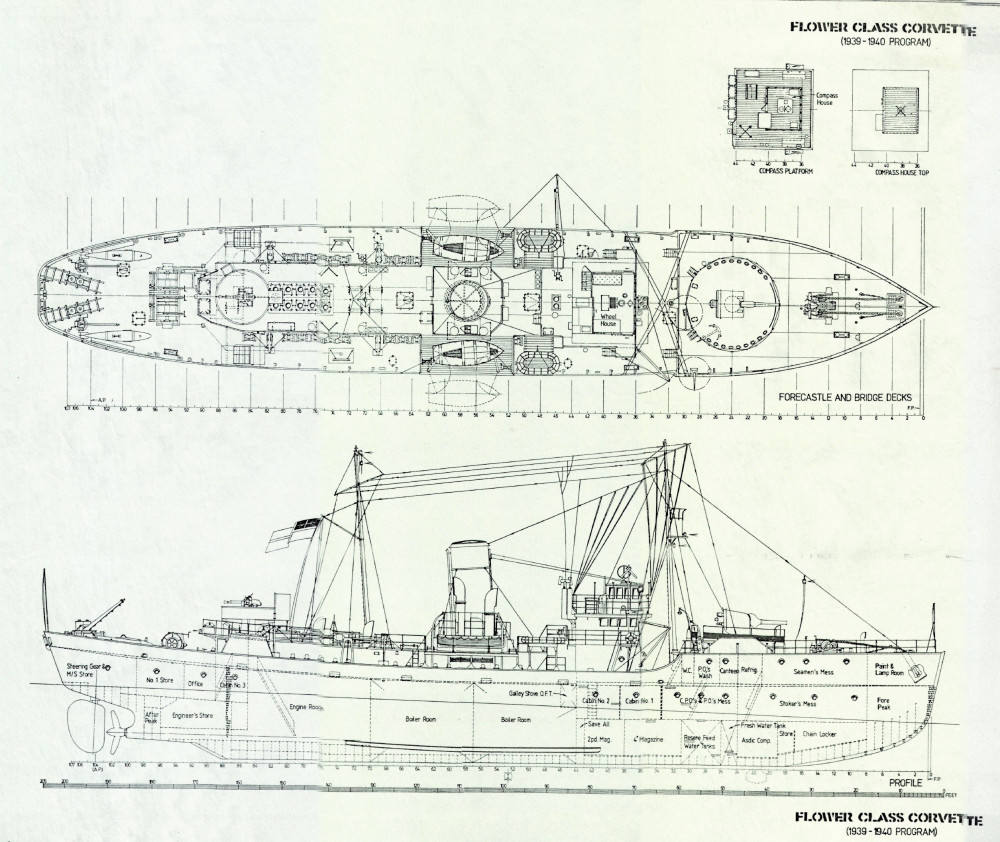
Diagram of the early Flower-class corvettes, via Lt. Mike Dunbar (https://visualfix.wordpress.com/2017/04/12/dreadful-wale-4/)
Anyway, the boundaries of strategy vs. the operational art vs. tactics were as thick and blurry in 1941 as they are today. The decision, taken in 1939, for example, to build little corvettes in the many British and Canadian yards that could not build a real warship was, in retrospect, a key strategic choice, but it was, at the time, totally materialist: just a commonsense, engineer solution to an operational problem ~ lack of ships. Ditto for the eventual decision, which had to be made by Churchill, himself, to reassign some of the big, long-range, Lancaster heavy bombers to Coastal Command. It was, once again, with the benefit of hindsight, a key strategic move, but at the time it would likely have seemed, to Capt(N) Hugues Canuel, the author of that Canadian Naval Review essay, to be materialistic, more concerned with how to use the resources available than with deciding what is needed.
I agree with Capt(N) Canuel that, by and large, Canadians have left strategic and even operational level thinking to first, the British and more recently the American admirals ~ Rear Admiral Murray being known, in the 1930s and early 1940s as a notable exception.
World War Two
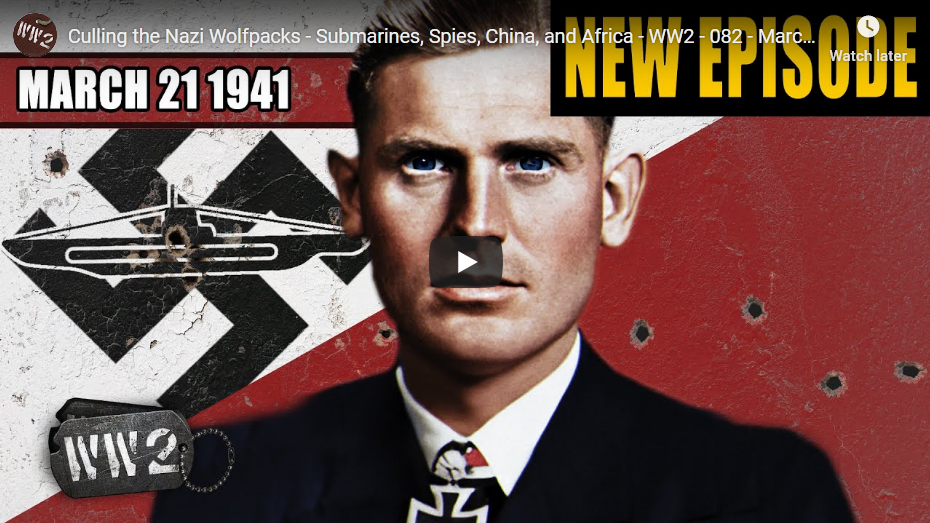
Published 21 Mar 2020While two more Kriegsmarine U-boat aces go down, the moving parts of the war are getting more complex leaving the intelligence services scrambling to separate fact from fiction — they don’t always get it right.
Join us on Patreon: https://www.patreon.com/TimeGhostHistory
Or join The TimeGhost Army directly at: https://timeghost.tvFollow WW2 day by day on Instagram @World_war_two_realtime https://www.instagram.com/world_war_t…
Between 2 Wars: https://www.youtube.com/playlist?list…
Source list: http://bit.ly/WW2sourcesWritten and Hosted by: Indy Neidell
Produced and Directed by: Spartacus Olsson and Astrid Deinhard
Executive Producers: Bodo Rittenauer, Astrid Deinhard, Indy Neidell, Spartacus Olsson
Creative Producer: Joram Appel
Post-Production Director: Wieke Kapteijns
Research by: Indy Neidell
Edited by: Iryna Dulka
Map animations: Eastory (https://www.youtube.com/c/eastory)Colorizations by:
– Olga Shirnina a.k.a. Klimbim – https://klimbim2014.wordpress.com/
– Dememorabilia – https://www.instagram.com/dememorabilia/
– Julius Jääskeläinen – https://www.facebook.com/JJcolorization/Sources:
– BundesarchivArchive by Screenocean/Reuters https://www.screenocean.com.
A TimeGhost chronological documentary produced by OnLion Entertainment GmbH.
From the comments:
World War Two
2 days ago
Indy is at the studio in Bavaria at the moment, shooting new episodes up to May 2020. We don’t know what impact the virus has on our production beyond that, but for now we seem to be fine. That is, thanks to your support! Most of our other (personal) sources of income has fallen away now – we are not able to pay everyone a fair wage just yet. In fact, most of the budget goes into licensing, equipment, editors, researchers and travel. If you can, please consider to support us on www.patreon.com/timeghosthistory or https://timeghost.tv so we can continue to make these series! Thank you all for your support and appreciation! Take care and be safe!
Cheers, Joram
Sabaton History
Published 19 Mar 2020“Aces In Exile” prevail! Did you know that the war in the skies above Britain was not just fought by men from the British Isles alone? It was also fought by men who were forced to flee their home-countries from Nazi occupation and journey through war-torn Europe to continue the resistance. As France fell, pilots from Poland, Czechoslovakia and Canada found themselves once more in the seat of foreign fighter-planes, to fend off the German war-machine in the Battle of Britain.
Support Sabaton History on Patreon: https://www.patreon.com/sabatonhistory
Listen to “Aces in Exile” on the album Coat of Arms here:
CD: http://bit.ly/CoatOfArmsStore
Spotify: http://bit.ly/CoatOfArmsSpotify
Apple Music: http://bit.ly/CoatOfArmsAppleMusic
iTunes: http://bit.ly/CoatOfArmsiTunes
Amazon: http://bit.ly/CoatOfArmsAmzn
Google Play: http://bit.ly/CoatOfArmsGooglePlayCheck out the trailer for Sabaton’s new album The Great War right here: https://www.youtube.com/watch?v=HCZP1…
Listen to Sabaton on Spotify: http://smarturl.it/SabatonSpotify
Official Sabaton Merchandise Shop: http://bit.ly/SabatonOfficialShopHosted by: Indy Neidell
Written by: Markus Linke and Indy Neidell
Directed by: Astrid Deinhard and Wieke Kapteijns
Produced by: Pär Sundström, Astrid Deinhard and Spartacus Olsson
Creative Producer: Joram Appel
Executive Producers: Pär Sundström, Joakim Broden, Tomas Sunmo, Indy Neidell, Astrid Deinhard, and Spartacus Olsson
Post-Production Director: Wieke Kapteijns
Edited by: Iryna Dulka
Sound Editing by: Marek Kaminski
Maps by: Eastory – https://www.youtube.com/c/eastoryArchive by: Reuters/Screenocean https://www.screenocean.com
Music by Sabaton.Sources:
– IWM: CH1733, Q 69697, CH1501, CH 1438, CH 1291, CH 1294, CH 12321, CH 1286, CH 1540, CH 587, CH 1538, CH 1535, CH 1137, CH 2440, HU 106457, D 1731, CH 4790
– Photo of the Battle of Britain Monument by Eluveitie from Wikimedia
– Instytut Pamięci NarodowejAn OnLion Entertainment GmbH and Raging Beaver Publishing AB co-Production.
© Raging Beaver Publishing AB, 2019 – all rights reserved.
World War Two
Published 17 Mar 2020In this first episode of On the Homefront, Anna tells you about division of labour, food production and rationing in the early years of the war.
Join us on Patreon: https://www.patreon.com/TimeGhostHistory
Or join The TimeGhost Army directly at: https://timeghost.tvFollow WW2 day by day on Instagram @World_war_two_realtime https://www.instagram.com/world_war_t…
Between 2 Wars: https://www.youtube.com/playlist?list…
Source list: http://bit.ly/WW2sourcesHosted by: Anna Deinhard
Written by: Spartacus Olsson
Produced and Directed by: Spartacus Olsson and Astrid Deinhard
Executive Producers: Bodo Rittenauer, Astrid Deinhard, Indy Neidell, Spartacus Olsson
Creative Producer: Joram Appel
Post-Production Director: Wieke Kapteijns
Research by: Spartacus Olsson
Edited by: Mikołaj Cackowski
Map animations: Eastory (https://www.youtube.com/c/eastory)Sources:
IWM A 1699, A 7812, A 19891, D 6773, A 11856, A 11857, D 10565, D 9366, D 15530, D 10465, D 20087, D 20079, D 7958, D 2373, D 14667, D 7966
Taking blood pressure (SC 191775), National Museum of Health and Medicine https://www.flickr.com/photos/medical…
Picture of Elsie Widdowson and Robert McCance with their staff, courtesy of British Nutrition Foundation
Pie Chart by Ates Evren Aydinel from the Noun Project
Pie Diagram Half by Trevor Dsouza from the Noun Project
Farm by Symbolon from the Noun Project
Meat by chiccabubble from the Noun Project
Fish by Vectors Market from the Noun Project
butter by Nick Bluth from the Noun Project
potatoes by Vectors Point from the Noun Project
Vegetable by Eucalyp from the Noun Project
Poop by Jordan Díaz Andrés from the Noun Project
shelf by Zach Bogart from the Noun Project
Tea box by Tomas Knopp from the Noun Project
Jam by Vichanon Chaimsuk from the Noun Project
Biscuits by John Burraco from the Noun Project
Cheese by Erin Agnoli from the Noun Project
eggs by Oleksandr Panasovskyi from the Noun Project
butter by Imogen Oh from the Noun Project
can by Anniken & Andreas from the Noun ProjectSoundtracks from the Epidemic Sound:
Gavin Luke – “Seasons of Change”
Johan Hynynen – “Dark Beginning”
Anthony Earls – “The Songs We Sing”
Fabien Tell – “Last Point of Safe Return”
Reynard Seidel – “Deflection”
Farell Wooten – “Blunt Object”
Johannes Bornlof – “The Inspector 4”
Howard Harper-Barnes – “Prescient”
Howard Harper-Barnes – “London”
Philip Ayers – “Under the Dome”Archive by Screenocean/Reuters https://www.screenocean.com.
A TimeGhost chronological documentary produced by OnLion Entertainment GmbH.
From the comments:
World War Two
57 minutes ago (edited)
This is the first episode of On the Homefront. For those of you who haven’t watched our trailer or have seen the Between Two Wars episode on the Home Revolution, let me introduce you to Anna. She will be telling us all about the homefronts and the people on them in these monthly sub-series. Now, we know that this episode might seem to be playing on the Corona related hoarding that is going on, but this was already produced before any of that made the news. In any case, as many of you are sitting in your own homefronts, I hope this episode offers some relief and perspective. If you like it, do make sure to Join the TimeGhost Army to keep us running! You can do so at https://timeghost.tv or patreon.com/timeghosthistory
Cheers, Joram
Forgotten Weapons
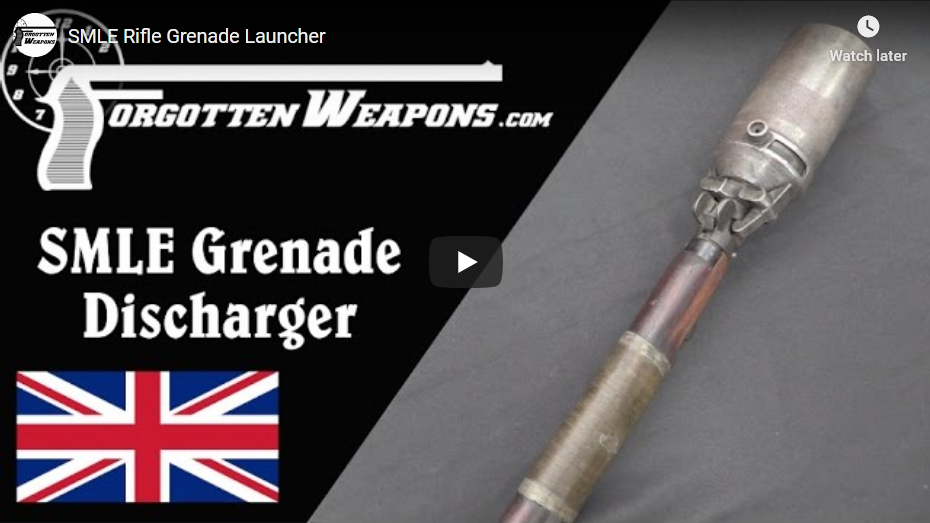
Published 2 Feb 2017While rifle-launched grenades date back hundreds of years, they first came into widespread use during World War One, on all sides of the conflict. The first years of the war saw the use of rod grenades, but their downsides (mediocre accuracy, bulkiness, and a propensity to damage rifle bores) led to the British adopting a 2.5” cup grenade discharger in late 1917. This new launcher used slightly modified Mills bomb hand grenades, and could launch them with significant accuracy from 80 to 200 yards. They would become a staple of WWI combined arms infantry tactics, and be used clear through WW2 until replaced by the 22mm NATO style spigot grenades.
http://www.patreon.com/ForgottenWeapons
Cool Forgotten Weapons merch! http://shop.bbtv.com/collections/forg…
If you enjoy Forgotten Weapons, check out its sister channel, InRangeTV! http://www.youtube.com/InRangeTVShow
Yesterday, David Thompson linked to a post by Natalie Solent about how the police in London failed to do anything about a blatant theft at a Boots pharmacy because it was considered a “civil matter”. The accused thief was prosecuted privately by the parent corporation, which is apparently the first time this has happened in England. As Natalie says, this is the “nice” option when the government fails to enforce the law of the land — or enforces it only sporadically and unevenly.
In the latest edition of the Libertarian Enterprise, Eric Oppen provides an example from the US in the post-Civil War era that shows the other option for private law enforcement:
Many of the victims of the kind of small-time crime committed by vagrants and the “homeless” are, themselves, far from rich. Repeated thefts can drive a small, struggling business under, and loss of, for example, a bicycle can represent a catastrophic blow to a poor person’s finances. This doesn’t address the sense of violation felt by those victimized by crime.
The original San Francisco Committees of Vigilance formed because the “forces of law and order” either were not doing their jobs, or were actively in league with the very criminals they were supposed to be suppressing. Many police were incompetent or lazy, while others were often corrupt on a scale that would shock Boss Hogg.
Do-it-yourself justice was far from uncommon in nineteenth-century America, including in the “civilized” East. In upstate New York, after decades of unpunished crime, the Loomis family gang received an epic comeuppance in 1865. Fifteen years earlier, their outraged neighbors had tried staging a raid on the Loomis farm, but uncertainty about who owned the stolen goods they found prevented any Loomis from being convicted. In 1865, many of their neighbors were returned Civil War combat veterans. They had become inured to violence, and they were tired of the Loomis’ thefts, arsons and intimidation. They killed George “Wash” Loomis, the leader of the gang, nearly lynched one of his brothers, and burned down the family’s home. After that, the Loomis family’s power was broken and their reign of crime was pretty much over.
These things happened because there was no other way to deal with these situations. Law enforcement, in those days, was primitive, especially outside of the major cities. Large corporations often had their own private police simply because of this fact.
The “social contract” is supposed to read something like “renounce personally avenging your wrongs, and society will do it for you.” But what can one do, when society is visibly abrogating the contract? Take it to court?
Vigilantism is not unknown even in Canada.

“Tombstone Courthouse State Historic Park” by August Rode is licensed under CC BY-NC-SA 2.0


The Great War
Published 14 Mar 2020Sign up for Curiosity Stream and Nebula: https://curiositystream.com/thegreatwar
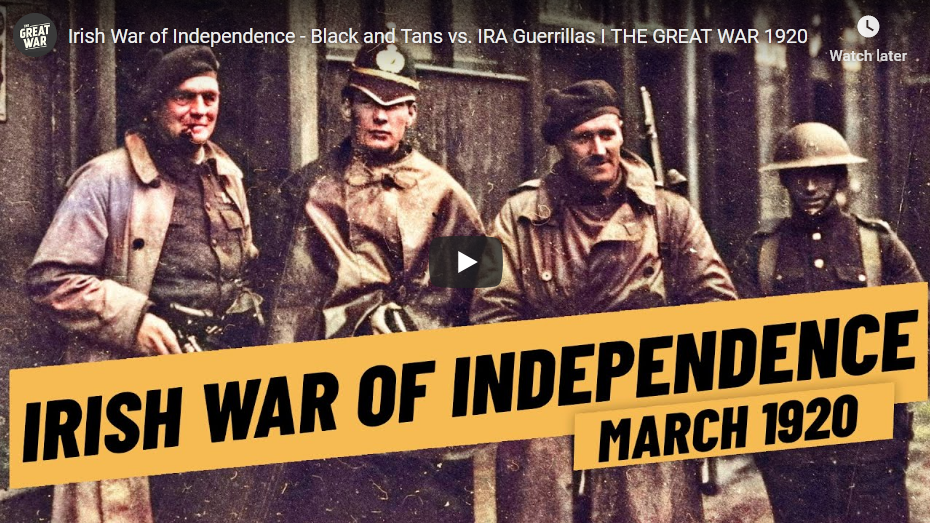
The movement for more Irish self determination had turned into a full out revolutionary movement by 1919. The British Empire was losing control over Ireland and by early 1920 was in a full out guerrilla war against the Irish Republican Army (IRA). To regain control more police forces were recruited with wide ranging authorities – and a lack of actual police training. With their mismatched equipment made from war supplies, they soon got the nickname “Black and Tans”.
» SUPPORT THE CHANNEL
Patreon: https://www.patreon.com/thegreatwar
Merchandise: https://shop.spreadshirt.de/thegreatwar/» SOURCES
Bowen, Tom, “The Irish Underground and the War of Independence 1919-21” Journal of Contemporary History Vol. 8, No. 2 (Apr., 1973), pp. 3-23
Hopkinson, Michael, The Irish War of Independence, (Montreal & Kingston : McGill-Queen’s University Press, 2002)
Leeson, David, The Black and Tans: British Police and Auxiliaries in the Irish War of Independence, 1920-1921, (Oxford : Oxford University Press, 2011)
Lowe, W.J., “Who Were the Black-and-Tans”, History Ireland (Autumn 2004)
Townshend, Charles, The Republic: The Fight for Irish Independence 1918-1923, (London : Penguin Books, 2013)
» SOCIAL MEDIA
Instagram: https://instagram.com/the_great_war
Twitter: https://twitter.com/WW1_Series
Reddit: https://reddit.com/r/TheGreatWarChannel»CREDITS
Presented by: Jesse Alexander
Written by: Mark Newton, Jesse Alexander
Director: Toni Steller & Florian Wittig
Director of Photography: Toni Steller
Sound: Toni Steller
Editing: Jose Gamez, Toni Steller
Mixing, Mastering & Sound Design: http://above-zero.com
Maps: Daniel Kogosov (https://www.patreon.com/Zalezsky)
Research by: Mark Newton
Fact checking: Florian WittigChannel Design: Alexander Clark
Original Logo: David van StepholdA Mediakraft Networks Original Channel
Contains licensed material by getty images
All rights reserved – Real Time History GmbH 2020
In Quillette, Matt Johnson remembers the great anti-identitarian writer and speaker, Christopher Hitchens:
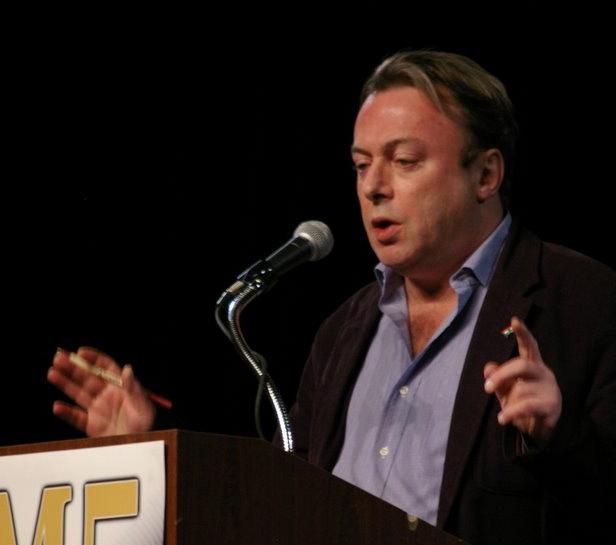
Christopher Hitchens speaking at The Amaz!ng Meeting held at the Riviera Hotel, Las Vegas, Nevada on 20 January 2007.
Photo detail by ensceptico via Wikimedia Commons.
Hitchens thought fearlessly. As Martin Amis put it, he liked “the battle, the argument, the smell of cordite.” This is why he told the publisher of God is Not Great: How Religion Poisons Everything to organize a book tour that ran through the pulpits of the American South instead of remaining confined to the coasts. It’s why he relished every opportunity to lambaste Bill and Hillary Clinton in front of liberal audiences. It’s why he went after Mother Teresa and Princess Diana. He was an inveterate iconoclast — if there was a bloated reputation to puncture or a cherished dogma to deflate, he saw it as a duty and a pleasure to do so.
It’s no surprise that this oppositional inclination, coupled with blistering rhetorical ability, made Hitchens a deadly debater. After his death in December 2011, countless tributes and articles about Hitchens emphasized what a force he was in the studio and on the debate stage — his erudition and wit, his fluency, his seemingly superhuman memory. Hitchens is unforgettable for all these reasons, but people don’t miss him because he could turn a phrase or win an argument on CNN — they miss him because he thought for himself and refused to apologize for it. He didn’t want to write and speak as the representative of a community: “My own opinion is enough for me,” he told the audience at a debate on free speech in 2007, “and I claim the right to have it defended against any consensus, any majority.”
“Unpopular ideas can be silenced, and inconvenient facts kept dark, without the need for any official ban,” Orwell wrote in his original introduction to Animal Farm (which was, ironically, suppressed). He continued: “Anyone who challenges the prevailing orthodoxy finds himself silenced with surprising effectiveness.” While there was far more official censorship in Orwell’s time, we’re living through an era of pervasive self-censorship, and as Packer explains, this type of silencing is “more insidious than the state-imposed kind, because it’s a surer way of killing the impulse to think, which requires an unfettered mind.”
[…]
Hitchens detested tribal and parochial feelings of any kind, which is why he was dismayed when he witnessed the emergence of identity as a catalyst for political mobilization in the late 1960s and early 1970s. In his memoir, Hitch-22, Hitchens attacked radicals who thought it was “enough to be a member of a sex or gender, or epidermal subdivision, or even erotic ‘preference,’ to qualify as a revolutionary.” When Hitchens first heard the expression “the personal is political,” he knew “as one does from the utterance of any sinister bullshit that it was — cliché is arguably forgivable here — very bad news.” As he put it in a 2008 article:
People who think with their epidermis or their genitalia or their clan are the problem to begin with. One does not banish this specter by invoking it. If I would not vote against someone on the grounds of ‘race’ or ‘gender’ alone, then by the exact same token I would not cast a vote in his or her favor for the identical reason.
It’s easy to imagine what Hitchens would have thought about a recent New York Times headline that declared “The Next President Should Not Be a Man” or a prominent writer and activist who announced that she “will not support white male candidates in the Dem primary.” The people who write such things are thinking with their epidermis and genitalia, which is to say they’re not thinking at all. You don’t have to bother defending candidates’ principles and positions when gender and race are the only relevant variables.
Sabaton History
Published 12 Mar 2020So tell me what’s the price of a mile? The Battle of Passchendaele in 1917 is often remembered as a dismal and dreadful campaign. Fighting over endless mud, waterlogged shell-holes and unrecognizable, bombed out ground, the battle became a slog where everybody was just miserable. Hundreds of thousands of men became casualties for the advance of a handful of miles.
The Art of War online: https://sites.ualberta.ca/~enoch/Read… [PDF]
Support Sabaton History on Patreon: https://www.patreon.com/sabatonhistory
Listen to “Price of a Mile” on the album The Art of War:
CD: http://bit.ly/TheArtOfWarStore
Spotify: http://bit.ly/TheArtOfWarSpotify
Apple Music: http://bit.ly/TheArtOfWarAppleMusic
iTunes: http://bit.ly/TheArtOfWariTunes
Amazon: http://bit.ly/TheArtOfWarAmz
Google Play: http://bit.ly/TheArtOfWarGooglePlayCheck out the trailer for Sabaton’s new album The Great War right here: https://www.youtube.com/watch?v=HCZP1…
Listen to Sabaton on Spotify: http://smarturl.it/SabatonSpotify
Official Sabaton Merchandise Shop: http://bit.ly/SabatonOfficialShopHosted by: Indy Neidell
Written by: Markus Linke and Indy Neidell
Directed by: Astrid Deinhard and Wieke Kapteijns
Produced by: Pär Sundström, Astrid Deinhard and Spartacus Olsson
Creative Producer: Joram Appel
Executive Producers: Pär Sundström, Joakim Broden, Tomas Sunmo, Indy Neidell, Astrid Deinhard, and Spartacus Olsson
Post-Production Director: Wieke Kapteijns
Edited by: Karolina Kosmowska
Sound Editing by: Marek Kaminski
Maps by: Eastory – https://www.youtube.com/c/eastoryArchive by: Reuters/Screenocean https://www.screenocean.com
Music by Sabaton.Sources:
– Imperial War Museum: Q 20705;Q 45462;Q 5989;6Q 2890;Q 3117 Q 3008;Q 2712;Q 23779;Q 7806;Q 5937;Q 5726;Q 2902;Q 2713;Q 57299;Q 57247;Q 45390;Q 51569;Q 1426;Q 540;Q 17868;Q 50237;Q 47725;Q 45382;Q 2639;Q 29088;Q 42251;Q 5714;Q 2868;Q 5938;Q_005935;Q 2625;Q 5723;Q 2627;Q 29090;Q 52862;Q 88098;Q 88017;Q 2706;Q 5936;Q 5904;Q 5940;Q 5941;Q 5902;Q 47741;Q 3001;Q 5947;Q 6458;Q 3252;Q 29088;Q 5767;Q 45461;Q 42251;Q 2682;Q 20705;Q 6346;Q 6223;Q 11688;Q 2708.;Q 47719;Q 3103;Q 2679;;Q 2640;Q 2858;Q 2735;Q 2707;Q 2757;Q 5901;Q 3006.;Q 5904;Q 5928;Q 3104;Q5903;Q 29089;Q 5865;Q 11668;Q 3002;Q 2978;Q 3121;Q5706;Q 47741;Q 2755;Q 55558;Q 3012;Q 5874;Q 5888;Q 7806;Q 6327;Q 54408;Q 2866;Q 56567;Q 6047;Q 6049;Q 3252; 3140;Q 2868;Q 61034;Q 42250;Q 3025;Q 7814.;Q 2893;Q 2737;E00777;Q 3029;Q 2763;Q 5773;Q 2756;Q 47741;Q 45369;Q 2707;Q 6327;Q 5902.;Q 3006;Q 5871;Q 5733; CO 1757;CO 2241;CO 1757;CO 2252;CO 2241;CO 1757;CO 2246;CO 2252;CO 1763;CO 2241; E(AUS) 941;(E(AUS) 719);E(AUS) 1233.;(E(AUS) 719),
– Art IWM: ART 1921; ART 1150,
– The Australian War Memorial: E00693; E04678; E01912; E00874; E00807; E00874; E01229; A02653; E00927
– National Army Museum: 1952-01-33-55-391; 1985-04-48-412; 2001-02-256-96;1997-12-75-81; 2010-01-56-40; 1994-12-31-1; 1978-11-157-24-36;
1965-10-209-27; 1972-08-67-1-40; 1917-07-31,
– Canadian War Museum: CWM 19930013-511;CWM 19890222-001;CWM 19930013-464;CWM 19930013-511;CWM 19710261-0093.;
165-BO-1503,
– Library and Archives Canada: 040139An OnLion Entertainment GmbH and Raging Beaver Publishing AB co-Production.
© Raging Beaver Publishing AB, 2019 – all rights reserved.



Powered by WordPress