
On page 147 of Human Action, Ludwig von Mises writes:
The historical role of the theory of the division of labor as elaborated by British political economy from Hume to Ricardo consisted in the complete demolition of all metaphysical doctrines concerning the origin and the operation of social cooperation. It consummated the spiritual, moral and intellectual emancipation of mankind inaugurated by the philosophy of Epicureanism.
This is a rather strong statement. Epicureanism, says Mises, inaugurated the spiritual, moral and intellectual emancipation of mankind. There are several other passages in his books where he mentions this philosophy in a very favourable light, but without ever explaining in details why. And although a lot of attention has been devoted to the influence of Aristotle, Aquinas, the Scholastics, the French liberals and others on Austrian ideas, as far as I know, nobody has ever paid attention to Epicurus.
Now, why would Mises make such a claim in relation to a philosophy that has been so reviled for 2000 years? Stacks of new books devoted to Plato, Aristotle and other philosophers of Antiquity appear every year. But if you go to a university library, you will usually find a shelf or two containing books on Epicureanism, and that’s for all those that were published in the past hundred years.
Epicureanism has been largely forgotten. And when it is mentioned, it is usually the distorted view that has been propagated since Antiquity that is being repeated. Epicureanism is said to be the philosophy of “Eat, drink and be merry because tomorrow you die.” An “Epicure” is a depraved and irresponsible individual only concerned with bodily pleasures. In Austrian terms, we would say he has very high time preference.
I even read in an article posted on LewRockwell.com that the unbridled hedonism of the Epicureans played an important role in the transformation of ancient Rome from a republic to an empire. There is not a shred of historical evidence that they had that kind of influence, and Epicureans were not a licentious lot anyway. On the contrary, their goal was tranquility of mind. For them, it is true, all pleasures were good, including those of the body. But they tried to attain happiness by planning their lives in the long term in the most rational way possible.
Epicurus’ ethics can be summed up by this sentence from his Letter to Menoeceus: “For it is not drinking bouts and continuous partying and enjoying boys and women, or consuming fish and the other dainties of an extravagant table, which produce the pleasant life, but sober calculation which searches out the reasons for every choice and avoidance and drives out the opinions which are the source of the greatest turmoil for men’s souls.”
Martin Masse, “The Epicurean roots of some classical liberal and Misesian concepts“, speaking at the Austrian Scholars Conference, Auburn Alabama, 2005-03-18.
June 24, 2018
QotD: Ludwig von Mises and Epicureanism
June 23, 2018
QotD: The protectionist two-step, Alberta craft-beer variant
Economic protectionism has two classic rationales. Sometimes, as in the case of Alberta’s clumsy attempt at an interprovincial tariff on craft beer, it is undertaken in the name of defending small, emerging “infant industries” that a government wishes to give time to establish themselves in its territory. And sometimes, as in the case of Canadian dairy supply management, it is done to defend “strategic” industries that have existed forever and that allegedly create an irreplaceable quantity of employment and profits.
Give yourself a gold star if you spotted that these canonical pretexts for trade barriers are contradictory. The inherent promise of protection for “infant industries” is that they will grow up and leave the nest. But, oops: by the time they reach adulthood, they may have become too “strategic” to expose to market forces. Heads, the favoured firms win; tails, the consumer loses.
Of course, on the level of fine detail, the arguments for trade barriers are manifold and complicated. (If you get into a quarrel about dairy, and take the free-trade side, you will find them being changed by your interlocutor every 30 seconds.) Alberta’s program for supporting small brewers has an unclear, touchy-feely small-is-beautiful justification. By design, the tariff applies only to businesses that have no intention of attaining industrial scale. It’s right there in the term “craft brewing,” isn’t it? Whatever the esthetic merits of craft beer, this is surely the deliberate encouragement of what the urbane left likes to calls “precarious” jobs that could be flung into disarray by a bad season, a shift in fashions, or a supply problem.
And, also, it’s illegal.
Colby Cosh, “A court refuses to swallow Alberta’s thinly disguised craft-beer tariff”, National Post, 2018-06-22.
June 21, 2018
QotD: Statistics
If the devil is in the details, and if the details can be hidden from view by lumping them all into various aggregate statistics, then among the biggest fans of the uncritical use of aggregate statistics will be the devil.
Don Boudreaux, “Devilish”, Café Hayek, 2016-08-29.
June 19, 2018
Women Working: What’s the Pill Got to Do With It?
Marginal Revolution University
Published on 29 Nov 2016At the turn of the century, it was rare for a woman to get a college degree or join, and stay in, the workforce. One trailblazer was Katherine McCormick. She was the second woman ever to graduate from MIT, a suffragist, advocate for women’s education, and later philanthropist. McCormick was also a staunch supporter of birth control, going so far as to smuggle contraceptives into the United States at a time when they were illegal or highly regulated.
In the 1950s, the birth control pill was extremely controversial. Funding for its development had been pulled. McCormick stepped in and, over time, contributed nearly $23 million (in today’s dollars) of her own money to research efforts. Her financial involvement was instrumental in achieving FDA approval and widespread acceptance of “the pill.”
But what does the the pill have to do with female education or women working? For the very first time, women were in control over if and when they would have children.
Since the mid-1960s, shortly after the pill was approved as a contraceptive in the United States, female education and labor force participation rates have skyrocketed. With the ability to control when they will have children, women are able to better plan for their academic and professional future. We may take it for granted today, but half a century ago, the pill changed the game for working women.
June 17, 2018
Conrad Black – Trump’s not bluffing
In the National Post (but linked from his personal website), Conrad Black warns of the danger of assuming that Trump is just blustering on his trade threats:
Justin Trudeau struck just the right Canadian note of our gentle nature but refusal “to be pushed around,” and he predictably will reap the short-term reward for standing up for the country opposite the ideal American bogeyman, the blustering billionaire president who has been a Garry Trudeau caricature of the Ugly American for 25 years. (It is a very incomplete picture, like most caricatures, but it works for Trump and he often cultivates it.) The boycotts of American goods and holidays will be a bonus to Canada economically and the anti-Trump American media will be along within two weeks to lionize doughty Canada like “Gallant little Belgium” in 1914 and “Plucky Israel” in 1947, and it will strengthen Canada’s always fragile self-regard opposite the United States.
On the other hand, Trump isn’t just a blowhard; all his career he has known how to go for the jugular and his reference to 270-per-cent Canadian tariffs on butter is a valid complaint that threatens to tear the scab off this egregious payoff to the comparatively small number of Quebec dairy farmers who mainly profit from it. The same issue was hammered hard by Martha Hall Findlay when she ran for the federal Liberal leadership in 2013 and by Maxime Bernier when he ran narrowly behind Andrew Scheer for the Conservative federal leadership last year. The issue died down after their unsuccessful campaigns, but if Donald Trump is incited to hammer that theme, he will roil the domestic Canadian political waters and English-French relations in the country generally.
Presumably our trade negotiators will not become so intoxicated by the prime minister’s peppy talk and spontaneous popular boycotts of the U.S. that they forget the correlation of forces. An aroused American administration could do serious damage to Canada’s standard of living, and it could be a tempting tactic to expedite more important negotiations with Mexico and the principal Asian and European powers. The United States is now enjoying three times as great a rate of economic growth as Canada (4.8 to 1.5 per cent), has lower tax rates, 11 times as great an economy, and more unfilled jobs than unemployed people.
Behind the peeling façades of Norman Rockwell and Walt Disney, the United States is a monster, and not always an amiable monster. If Canadians are blinded by their visceral dislike of Donald Trump, as the antithesis of Canadian criteria for likeable public figures, they will be exposed to the ruthless pursuit of the national interest that in his own career propelled him from technical insolvency to immense wealth and celebrity and then, against all odds, to control of a great political party and to the headship of the most powerful country in the world. If these talks blow up, the U.S. doesn’t have to settle for WTO rules; it can impose outright protectionist measures. Justin Trudeau has been agile, and the country has responded admirably. But Canadian policy-makers must understand that they are playing for almost mortal stakes with potentially dangerous protagonists who have no sense of fair play and no interest in what Canada thinks of them.
June 15, 2018
Looking at US farm subsidy claims
On Twitter, Chris Auld, an economics professor at the University of Victoria explains why Canadian journalists should stop using the $22 billion figure for US farm subsidies to justify Canada’s unjustifiable supply management regime:
It's been widely reported that the U.S. subsidizes dairy farms $22B per year, or 71% of revenues. Which seems… large. That figure comes from a report paid for by the Dairy Farmers of Canada by a small consulting firm. (https://t.co/2v4xkOZRBU). 1/5 pic.twitter.com/chMnPeRMZx
— Chris Auld (@Chris_Auld) June 12, 2018
If we follow their source to pg 111 of the cited USDA document, we find what they're counting as the $225B of "agricultural subsidies" includes absolutely everything in the USDA's budget! More than half goes to SNAP ("food stamps") and other anti-poverty programs. 2/5 pic.twitter.com/tPhR3Qtb6d
— Chris Auld (@Chris_Auld) June 12, 2018
And much of the remainder, including programs like food safety, the forest service, and research, are not agricultural subsidies, either. See pages 210-211 here: https://t.co/BBmjD41AWZ 3/5
— Chris Auld (@Chris_Auld) June 12, 2018
Some of what's left is subsidies, but the report just takes 10.54% of the total as allocated to dairy since that's the percentage of dairy in U.S. agriculture. What most people would think of as actual "dairy subsidies," direct or indirect payments to dairy farmers, 4/5
— Chris Auld (@Chris_Auld) June 12, 2018
are a trivial fraction of the staggering sums claimed in this report. And if we calculated Canadian "dairy subsidies" in the same silly manner, we'd wind up with similarly vast sums. This figure is rubbish and journalists in particular should stop repeating it. 5/5 pic.twitter.com/Hg0M3vpOuB
— Chris Auld (@Chris_Auld) June 12, 2018
June 14, 2018
The economic idiocy of Canada’s supply management system
Andrew Coyne, who finally seems to have weaned himself off the PR voting jag, explains the Canadian government’s idiotic yet deeply entrenched supply management bureaucracy:
How did supply management, of all things, come to be at the centre of everything?
The policy, under which farmers in a number of sectors — milk, cheese, eggs, poultry — are organized into government-approved price-fixing rings, enforced by a complex system of quotas and protected by prohibitive tariffs on imports of the same goods, has been in place since the early 1970s. It affects fewer than 15,000 farmers nationwide, who between them account for less than one per cent of Canada’s GDP.
Yet it has somehow become the central issue not only of our domestic politics, but of international trade talks. It was the pretext for Donald Trump’s decision to impose tariffs on imports of aluminum and steel, and is his most-cited grievance with Canadian trade policy. As such, it has become the rallying cry of preening political patriots, each of the parties seeking to outdo the others in defence of a policy whose avowed purpose, let us remember, is to make basic food items more expensive for Canadians.
It has also become a source of deep division within the Conservative Party. It was already, of course, thanks to last year’s leadership race, in which Maxime Bernier made its elimination the central plank in his campaign, as Andrew Scheer made its retention the key to his. Indeed, Scheer’s narrow victory was directly attributable to the votes of thousands of Quebec dairy farmers, who took out party memberships for the sole purpose of ensuring Bernier’s defeat. It is even possible the Scheer campaign encouraged them in this endeavour.
[…]
There is no serious case for supply management — a policy that is is as unjust, inasmuch as it imposes the heaviest burden on the poorest families, as it is inefficient; that locks out new farmers and deters existing farmers from seeking new markets; and that makes us look utter hypocrites in free-trade talks, not only with the U.S., but the rest of the world — and no serious person whose livelihood does not depend upon it would make it.
And yet every member of every party is obliged to swear a public oath of undying fealty to it. That all do, but for one, is a sign of the institutional rot in our politics. For they do so not in spite of its awfulness but because of it — because the willingness to say two plus two equals five has become the ultimate test of loyalty.
On other issues, that might be because of genuine agreement. But a willingness to sign onto a truly hideous policy like supply management — that’s certain proof an MP is a “team player.”
June 13, 2018
Imagine … a tariff-free world
Danny Chabino on what he calls “Trump’s G7 Surprise”:
In what I consider a brilliant move on the part of Trump and his team, instead of initially discussing what tariffs he would increase if x,y and z didn’t happen or if whichever nation wouldn’t reduce tariffs on whatever industry, he simply raised the simple question of why don’t we just not have tariffs at all? It’s brilliant in the sense that it not only shut down all the anticipated arguments, but also placed the world’s leaders in a position of having to awkwardly defend the very idea of tariffs (and subsidies), and they knew they couldn’t really do that. It highlighted the true intentions of the world’s leaders as representatives of the authoritarian nature of almost every existing government in the world today.
Now, please don’t misunderstand this article as me beaming with a Trump glow. In fact, Trump knew full well no one would take him up on such an offer. I do believe if they had he would have followed through, but his next moves will be ones that I believe are the wrong ones. He will seek to raise tariffs, which has always done more harm to the nation raising the tariffs than it has done good that nation. Trump will do just as he has threatened and hurt his own country;’s economy with new tariffs.
What I do enjoy, though, is that all of the world’s major leaders had to essentially admit that they don’t want their people and their economies to be better off. At least not on their own. They want their people and economies to be dependent upon their leadership and their governments. While everyone at the summit knew that the greatest of outcomes would be for all the world’s most powerful nations to exercise free trade, and that this would benefit the entire world in great proportions, that really wasn’t their aim. Their aim was to gain greater power. What an incredible admission!
When given a golden opportunity to end tariffs and increase freedom and prosperity for most citizens of the world, the world’s leaders instead chose to cling hard to their own designs. The world’s leaders know full well that tariffs hurt their own citizens, but they don’t care. Tariffs have never served the function of creating market efficiency, and they have never helped protect a nation’s economy. Instead, they have always been a means for governments to exercise control over huge parts of their own economies, and where there is control, there is power. Politicians and world leaders seek power. It’s like their drug of choice, and they can never get enough of it.
June 12, 2018
G7 minus one
Justin Raimondo on the well-shared image of Angela Merkel and her associates apparently trying to browbeat Donald Trump at the G-7 meeting (this version from Raimondo’s article):
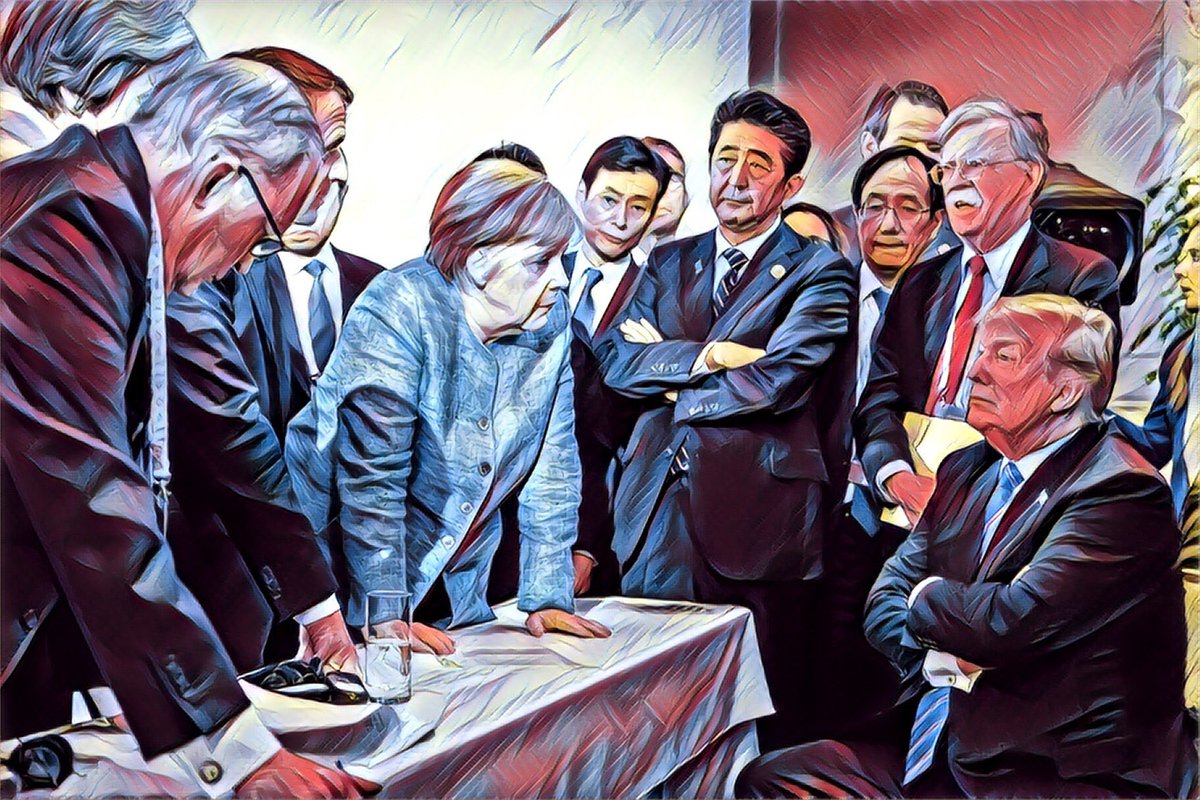
All the Very Serious People are tweeting and retweeting this “iconic” photo of Trump surrounded by the Euro-weenies, with Angela Merkel seeming to lecture the President while the rest of our faithless “allies” look on. It’s “America Alone” – the visual representation of the internationalist worldview: Trump’s policy of “America First” is “isolating” us, and, according to clueless leftists like Michael Moore, Merkel is now the “leader” of the “free world.”
This last is good news indeed, for if Merkel is the new leader of the “free world” then the stationing of 35,000 US troops in Germany – at a cost of billions annually – is no longer required and we can bring them home. This also means Germany, rather than the US, will be sending troops all over the world to fight “terrorism” – a move that is sure to cause consternation in certain regions with a history of German intervention, but hey, somebody has to do it!
The political class is screaming bloody murder over Trump’s performance at the G-7 meeting in Canada, where he reportedly spent most of the time detailing how much the US was paying for the defense of our vaunted “allies,” not to mention the high tariffs imposed on American goods. He then proposed a “free trade zone” in which member countries would drop all tariffs, subsidies, and other barriers to trade: the “allies” didn’t like that much, either. Nor did the alleged advocates of free trade here in the US give him any credit for ostensibly coming around to their point of view. Which reminds me of something Murray Rothbard said about this issue: “If authentic free trade ever looms on the policy horizon, there’ll be one sure way to tell. The government/media/big-business complex will oppose it tooth and nail.”
Of course the Euro-weenies don’t want real free trade: after all, they practically invented protectionism. What they want is a free ride, at Uncle Sam’s expense, and the reason they hate Trump is because they know the freebies are over. However, what really got the Usual Suspects frothing at the mouth was Trump’s insistence that Russia be readmitted to the G-8:
“I think it would be good for the world, I think it would be good for Russia, I think it would be good for the United States, I think it would be good for all of the countries in the G-7. I think having Russia back in would be a positive thing. We’re looking to have peace in the world. We’re not looking to play games.”
The “experts” went crazy when he said this: our “allies” are being insulted, they wailed, while our “enemies” are being “appeased.” It’s sedition! Russia! Russia! Russia!
Eric Boehm says that the White House’s justification for imposing tariffs on national security grounds may have been undermined through Trump’s tweets hitting back after what he clearly felt was Justin Trudeau’s hissy fit (although Trudeau didn’t exactly break new ground or say anything radically different in his comments):
The Trump administration has spent months trying to construct a rather flimsy argument that steel and aluminum imports from Canada and other close American allies constitute a national security threat. More than a handy way to drum up public support for trade barriers, the “national security” claim is a crucial bit of the legal rationale for letting the president impose tariffs on those goods without congressional approval.
Then, as he was departing this past weekend’s G7 summit, Trump took to Twitter to air some grievences with Canadian Prime Minister Justin Trudeau. In doing so, the president may have significantly kneecapped that legal argument.
PM Justin Trudeau of Canada acted so meek and mild during our @G7 meetings only to give a news conference after I left saying that, “US Tariffs were kind of insulting” and he “will not be pushed around.” Very dishonest & weak. Our Tariffs are in response to his of 270% on dairy!
— Donald J. Trump (@realDonaldTrump) June 9, 2018
The last sentence of Trump’s tweet is the one that really matters.
The White House slapped a 25 percent tariff on imported steel and a 10 percent tariff on imported aluminum by invoking Section 232 of the Trade Expansion Act of 1962, which gives the president legal authority to impose tariffs without congressional approval when it’s for the sake of national security. That line of argument, outlined by Commerce Secretary Wilbur Ross in a February report, says that America needs aluminum and steel to make weapons of war, and that protecting the domestic steel and aluminum industries is the only way to ensure the country will be able to defend itself if attacked.
That is pretty weak, as I (and others) have written before. But as long as Trump makes that claim — no matter how strained the logic might be — the law seems to be on his side. Invoke “national security” and the president can do what he wants with trade.
Except now Trump seems to have admitted that it’s not about national security at all. His tweet plainly states that “our Tariffs [sic] are in response to his of 270% on dairy!”
Chris Selley points out that up until this eruption, Canadian politicians were still carrying on as if nothing was really at stake (especially Conservative leader Andrew Scheer, who re-swore his allegiance to ultra-protectionist supply management at all costs, and damn actual free trade):
So utterly obsessed are Canadian politicians by the small differences between them that federal Conservative leader Andrew Scheer recently demanded Prime Minister Justin Trudeau explain what he meant when he suggested Canada might be “flexible” on the issue of supply management in the dairy industry, in the face of new demands from Washington. It’s preposterous: you can’t fit a processed cheese slice between the three major party’s total devotion to the dairy cartel.
Trudeau needs to explain what he meant when he said he was open to "flexibility" on that file when negotiating with the US, and what concessions he offered to them from Canada's dairy industry. https://t.co/GeCA4irhAY (2/2)
— Andrew Scheer (@AndrewScheer) June 8, 2018
Because, as we all know, what unites Canadians from coast-to-coast is our universally shared determination to pay significantly higher prices for dairy products, to ensure that Quebec farmers are not overly bothered by pesky competition from uppity foreigners who don’t even speak Joual…
June 11, 2018
Jay Currie says it’s time to light the Bat Signal for … Brian Mulroney?
I find it hard to believe that things have gotten to the point that anyone, let alone Jay Currie, is looking to former PM Brian Mulroney to pull Justin’s chestnuts out of the Trumpian fire:
In Canada, more specifically Ontario, the destruction of the auto industry would be a full scale, all hands on deck, disaster. Realistically, the auto sector is Ontario’s largest private sector employer and the largest manufacturing sector. Being priced out of the US market would kill tens of thousands of well-paid jobs.
Trump has taken the measure of Trudeau and his tiny, annoying, Minister of External Affairs, Chrystia Freeland and concluded they are featherweights. Which means that Canada is potentially screwed because Trump has no faith in our leadership. You don’t call people dishonest publicly if you plan to do business with them.
It is unlikely that Trudeau will be aware of just how badly he has failed for a few days. The Canadian media are heavily invested in a narrative which has Justin standing up to the big, bad, Trump. Trudeau’s tone-deaf advisors are, no doubt, revelling in the fact they got lots of “gender” language into the communique.
It will take a few days for the more sober side of the media to realize what peril Trudeau has put us in. And a few more for the geniuses in the PMO to figure out that Trump is not playing the same game as they are.
When they do figure it out the question will arise, “What the fuck do we do now?”
As I am quite sure Butz and his posse read this blog I have a simple suggestion.
Normally, I would have suggested they get in touch with Simon Reisman who negotiated both the Auto-Pact and NAFTA. Alas, Reisman is dead.
Second best by a long shot? Brian Mulroney. A man I have next to no time for but who a) managed to get Canadians onboard for NAFTA, b) was a quite successful Canadian Prime Minister, c) is wired into both Trump World and broad swaths of corporate America.
If Trudeau could get Mulroney to do it Mulroney would be going into the US with a serious, well thought out, everything on the table, pitch. Likely starting with first principles – no tariffs, no subsidies, no non-tariff barriers. Be prepared to dump dairy and end transhipment of Chinese steel. And pitch it to the Trump people as the template for the deals which could be made with the EU, Japan, India and so on. (China is a whole other thing.)
The key point here is that Canada has to move, and move quickly, away from the finger-wagging politics of gender inclusion and climate change to a hard-nosed business approach to getting the best deal we can with an America which is now willing to put its own interests first.
June 10, 2018
Why the Canadian media (and the Laurentian Elite) misjudge Trump
Ted Campbell provides a thumbnail sketch of Donald Trump and suggests why the Canadian establishment finds him so hard to understand (and to work with):
In the view of Professors Bradbury and Leuprecht Canada and all of the US’ competitors are falling into Trump’s trap and the WTO ~ and global fair trade ~ will be the chief victim because, from President Trump’s perspective it is better that we all sink into poverty as long as the US remains top dog.
OK, what do we actually know about Donald Trump? What drives his policy choices?
I’m going to engage in a bit of ‘pop psychology’ and very personal speculation to try to clarify my own thoughts about President Trump as he prepares to meet, in just a few hours, with the G7 in Canada.
Is he stupid? No, not really … perhaps not “well read” as, say, most presidents from George Washington and Thomas Jefferson through to George H.W. Bush and Barack Obama were, but he’s not a stupid man. Is he intellectually lazy? I believe so … I think that explains why he is reported to dislike sitting through briefings and so on; he seems to want to follow his own instincts and cut through all the details, especially those which might not support his instinctive preferred course of action.
Is he a racist? The available evidence says “No,” he’s not. Is he Islamophobic? Not likely, I think. Is he a white supremacist? Not that, either, in my view, but it may be closer to his ‘basic instincts.’ He is, I suspect, something a kin to the Nativists who sprung up in mid 19th century America. He is, I believe, suspicious of everyone who is not a born and bred American. It not a racist or religious thing, it is simple nationalism of a rather narrow and nasty sort.
I think he is also, or wishes to be, an isolationist; I suspect he actively detests the World Trade Organization, the United Nations, the World Court, the International Monetary Fund, the Organization of American States, NATO and, possibly, even bilateral even NORAD because he sees each as an attempt by foreigners to entangle America and tie its hands. He is said to be less opposed to bilateral deals in which the US is, inevitably, the major partner but dislikes multi-lateral deals wherein American can be outnumbered and outvoted by others. he seems not to care who the “others” are … foreigners are foreigners, none are friends.
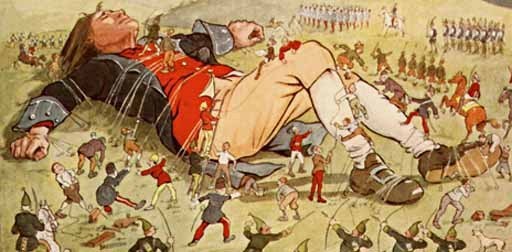
He is, as I have said before, an instinctive man; he makes up his mind quickly ~ although he may change it, by a full 180°, in hours or days ~ based on the evidence he wants to hear and believe, and I suspect that his instinctive reaction to the world is the America is like a modern day, national Gulliver, marooned in a hostile, greedy world and tied down by agreements and treaties and institutions created by little people …
… and then forced to abide by the little peoples’ rules.
[…]
His view of “winning,” it seems to me, owes more to Conan the Barbarian than to Adam Smith or Andrew Carnegie. Thus, I think Time has it about right … he wants to be an absolute monarch.
In fact, I think he shares Prime Minister Justin Trudeau’s “admiration” for China’s “basic dictatorship, which “allows them to turn their economy around on a dime.” Since I don’t think he, Trump, or Trudeau for that matter, knows much about economics I can only conclude that he admires Xi Jinping’s ability to exercise dictatorial power and throw his perceived enemies in jail on a whim.
That, I suspect, is President Trump’s “basic instinct:” he wants to be the absolute monarch of whatever enterprise with which he happens to be involved ~ property development, repeated bankruptcy proceedings, reality TV shows and now the US presidency. I’m guessing that we might have Donald Trump in the White House until 2020 … his view of America in the world, as Gulliver, is shared by many millions of his fellow citizens and the US Democrats seem, at best, incoherent in policy terms.
June 7, 2018
Trade war with Canada justified because the White House was torched in the War of 1812
Maybe it was intended as a joke, but what else was Trump supposed to say when Trudeau actually asked what actual security threat Canada poses to the United States?
During a phone call with Canadian Prime Minister Justin Trudeau last weekend, President Donald Trump reportedly justified his decision to impose tariffs on Canadian steel and aluminum by invoking … the burning of the White House by British troops during the War of 1812.
At least, that’s what CNN is reporting this afternoon. Here’s how they put it, citing information from “sources familiar with the call: “Trudeau pressed Trump on how he could justify the tariffs as a ‘national security’ issue. In response, Trump quipped to Trudeau, ‘Didn’t you guys burn down the White House?'”
That is, presumably, a reference to the War of 1812, during which British troops invaded Washington, D.C., and set fire to the White House. Despite the war’s name, the burning of the White House actually occurred in 1814. And it wasn’t carried out by Canadians because, well, Canada did not become an independent nation until 1867 — or 53 years after the White House burned.
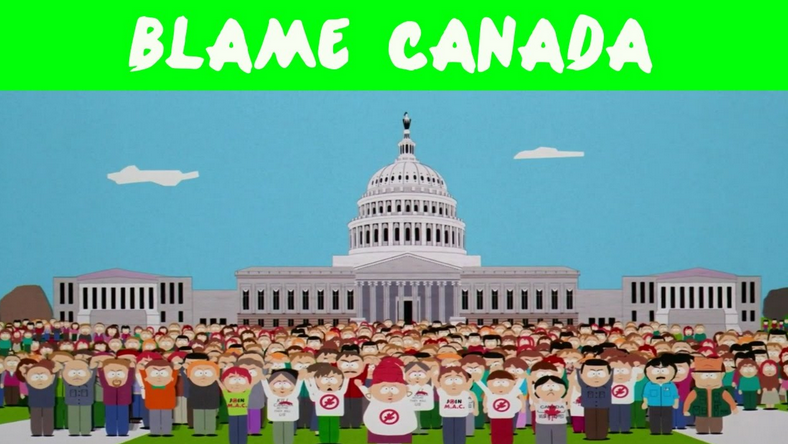
But, sure, whatever. The War of 1812 makes Canada a national security threat in the year 2018, despite our having been allies for the last century, sharing the world’s longest unpatrolled border, and exchanging more than $620 billion in goods last year. The rationales for war with Canada in Canadian Bacon and South Park: Bigger, Longer & Uncut are more grounded in reality.
QotD: Profit and loss
It is necessary for people, most especially politicians and those who campaign for them, to understand that economics is not an optional aspect of our universe. We really do have scarce resources and we really do want to optimise our allocation of those resources. One implication of this is that activities which make losses should not happen. And if an activity starts to make losses then we want that activity to stop happening. This is because a loss is the universe’s method of telling us the alternative uses of those scarce resources would be a better use of those scarce resources.
That is, if we use some thing (whatever, labour, capital, land, buildings, electricity, just whatever) and pay market price for it and then make a profit from selling what we create from using it then we have added value. Profit is the value of the output over and above the value of those inputs in their alternative uses. Losses, equally obviously, mean that we are subtracting value from those inputs. Or, as we can also put this, losses make us all poorer in aggregate, profits make us all richer in aggregate.
For, as it shouldn’t be necessary to point out, that gross domestic product, GDP, that everyone likes to talk about is just the aggregate value added in the economy. Something which profits increase and losses reduce.
Tim Worstall, “Things That Make Losses Are Things That Stop Happening – Aetna Edition”, Forbes.com, 2016-08-17.
June 5, 2018
Taxing Work
Marginal Revolution University
Published on 22 Nov 2016For most people in developed countries, retirement comes down to a choice: weighing the costs and benefits of continuing to work vs. leisure. An important factor influencing an individual’s decision is their government’s tax and retirement policies.
Most developed countries offer a government-run retirement system with benefits that kick-in at a certain age. That age varies from country to country, usually starting when a worker reaches their early sixties.
Of course, not everyone wants to retire simply because they can receive benefits. People that really love their work may choose not to retire. In some countries, though, that decision can be heavily penalized through lost retirement benefits.
Taxes on earnings plus penalties, like losing retirement benefits, gives us an implicit tax rate. Countries with higher implicit tax rates for older workers see a much lower labor force participation rate for people considered retirement age.
As you might imagine, these government policies on retirement can be extremely costly. Many European governments that penalize non-retirement have been working to reform these policies and reduce implicit tax rates for elderly workers.
In the Netherlands, which had one of the highest implicit tax rates in the 1990s, an older worker could have actually had to pay to work. Since the Netherlands reformed their policies surrounding retirement, they’ve seen an increase in the labor force participation rate for older workers.
In the next video, we’ll cover another big influence on female labor force participation: The Pill.


