
Published on 23 Sep 2015
Imagine you take your car in to the shop for routine service and the mechanic says you need a number of repairs. Do you really need them? The mechanic certainly knows more about car repair than you do, but it’s hard to tell whether he’s correct or even telling the truth. You certainly don’t want to pay for repairs you don’t need. Sometimes, when one party has an information advantage, they may have an incentive to exploit the other party. This type of exploitation is called moral hazard, and can happen in many situations — a taxi driver who takes the “long route” to get a higher fare from a tourist, for example. In this video, we cover moral hazard and what is known as the principal-agent problem.
November 16, 2016
Moral Hazard
Comments Off on Moral Hazard
November 14, 2016
Trudeau’s corner
Ted Campbell rounds up much of the recent media wisdom on the state of relations between Canada and the US in the wake of Il Donalduce‘s victory in the presidential election, and summarizes what Justin Trudeau may be forced to do:
It would appear that there is an emerging consensus in the mainstream Canadian media, from left, centre and right, that the election of Donal Trump means that Justin Trudeau, and, indeed, Canada, is backed into an unhappy, uncomfortable, even dangerous corner; dangerous, that is, to our national interests.
[…]
In short, in so far as Prime Minister Trudeau’s agenda is concerned, most media commentators seem to agree that it, and by extension Canada, in so far as Canada shares the prime minister’s vision, is:
What
shouldmust Prime Minister Trudeau do?
First: secure the CAN~USA free trade agreement. Everything on his agenda depends upon revenue and revenue depends upon Canadians having jobs and many, many of those Canadian jobs depend upon access to the gigantic US market. If he wants to do anything except bow out, three years from now, as a miserable failure of a prime minister, then he must secure our free trade deal with the USA. And it’s a deal, which means that in order for us to get what we want and need the Americans have to get what they want and need, too.
Second, and likely consequential to the first priority: increase defence spending ~ double it if that’s what it takes, buy the F-35, strengthen the Canadian contribution to NORAD and NATO, and then make UN peacekeeping support US and Western strategic objectives.
Third: cancel the carbon tax; it will only make Canadians companies less competitive.
Fourth: force pipelines through to tidewater on both coasts. Keystone XL is OK for getting Alberta’s oil to Texas, but we really need to get it, readily, to the whole world. That means pipelines to Canadian ports … no matter what the greenies and first nations might say or do.
Fifth: negotiate free(er) trade deals with others. Start by ratifying the TPP, no matter what. Negotiate deals with the UK, with China, with India and with the Philippines, all as matters of urgency.
Finally, Prime Minister, please do not get into this position …

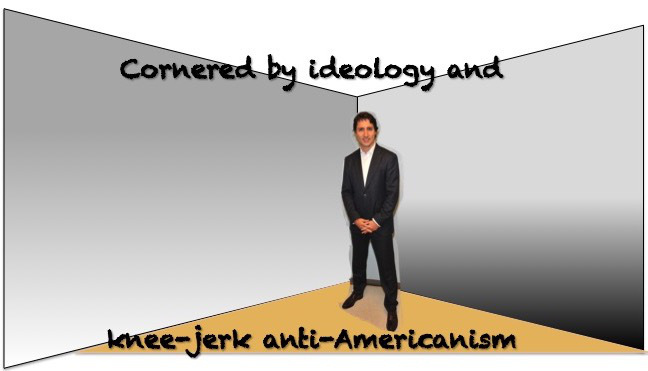
If Trudeau did all or most of this, he might well be able to appease Trump and retain Canada’s advantageous relationship with the US otherwise intact. The problem is that, as Campbell notes, it will offend and outrage so many parts of the Liberal coalition that it would take such a “Nixon goes to China” level of political audaciousness combined with a Jean Chrétien degree of fiscal austerity that I doubt Trudeau could even get his caucus unified enough to pass the legislation, never mind withstand the inevitable protests in Liberal ridings across the country (and in the domestic media).
Cornered indeed.
Comments Off on Trudeau’s corner
QotD: The relationship between unions and occupational licensing
… this is also known as “licensure”. And the rate in the 50s, at that peak of union power, was around 5% of workers needed such a licence to go to work. And union membership was, at that peak, 35% and is now around 10% or a little above, and licensure has gone from 5% to 30%.
For my point to work we have to consider unionisation and licensure as being the same thing. And they’re obviously not exactly the same thing. But they are sorta, kinda, the same thing. For all the claims that the requirement for a licence is in order to protect consumers (a theory for which the technical economic term is “codswallop”) it’s really a way to protect the wages of the ingroup against competition. As, of course, is being in a union a method of protecting those economic interests of the ingroup.
Actually, licensure is most akin to the medieval and early modern guilds system, out of which the union movement itself grew. So it’s really not surprising at all that they share certain attributes. That aim and desire of protecting the incomes of members of the group against the economic interests of everyone else.
So, my argument is that we’ve not in fact had a fall in the power of organised labour over these recent decades. We’ve just seen a change in the form of it, from unionisation to licensure. The point being that this is absolutely and definitely true in part and may or may not be true entirely. I tend towards the entirely end of that spectrum and I’d be absolutely fascinated to see if there’s been any academic comparisons made of the strengths of the two systems in protecting workers’ wages and conditions. I’d even be willing to believe that licensure works better than unionisation, given that the first is a conspiracy against the consumer, something easier to carry off than the unions’ conspiracy against the employer.
Tim Worstall, “More Union Power Won’t Raise Wages Or Reduce Inequality”, Forbes, 2015-03-07.
Comments Off on QotD: The relationship between unions and occupational licensing
November 5, 2016
QotD: Gentrification
Virtually no one has a good word for gentrification. It is lamented in tones from angry to mournful, by political commentators across the spectrum, possibly including me. Yet many of those same people are … renting or buying homes in “up and coming” neighborhood, which they prize for their proximity to other young(ish), progressive, creative-class people much like themselves. Which is to say that they are gentrifiers. In a neat inversion of the old activist slogan, they are “being the change they don’t want to see in the world”.
Their location puts them in the paradoxical situation of wishing gentrification wouldn’t happen, while avidly rooting for all the stuff that gentrification brings, from farmer’s markets to dog parks. If they are homeowners, too, they are not unhappy about the local price appreciation (their financial plan may indeed require it), however much they may regret its effects in the abstract. As a practical matter, this is something like declaring that you hate the Yankees, but have $5,000 on them to win the World Series. Your loyalties are bound to be divided.
Megan McArdle, “My Love-Hate Relationship With Gentrification”, Bloomberg View, 2015-03-26.
Comments Off on QotD: Gentrification
November 1, 2016
November is financial literacy month … please stop pestering us with well-meaning financial advice
Frances Woolley says the various government attempts to cajole us into being more economically minded are mostly a waste of time and effort:
November is financial literacy month. Canadians are being advised: Start with a budget. It is about as effective as declaring National Fat Shaming month, and advising Canadians: Start with a diet. Saving money, like losing weight, requires fundamental lifestyle changes. But it is hard for anyone to change the way that they live.
Take, for example, one of the standard pieces of financial advice: Give up that morning latte, and other frivolous habits, and soon you’ll have saved enough for a down payment on a new home. As someone who works at a university, I have some sympathy for those who rail against millennials with their lattes. Here am I, bringing my coffee from home in a Thermos, and I see students who are less affluent than me sipping fancy drinks from Starbucks. What would it take for them to do what I do?
To begin with, it would take time: an extra 10 or 15 minutes in the morning. Second, it would take capital: a kitchen with a coffee machine and space to store stuff. Third, it would take know-how: coffee brewing skills. Finally, it would take self-discipline: to go to bed early, and get up in time to make coffee at home.
Financial literacy education tries to remove that last obstacle, self-discipline, by lecturing people about the virtues of managing money and debt wisely. But, for the most part, it does not work. As Carleton University economist Saul Schwartz, puts it: “Financial education might have some positive effects on financial outcomes, but they are modest at best.” People are simply not very good at exercising self-restraint. When consumers have tap-enabled credit cards that make purchases painless, it is hard to resist the temptation to spend.
Comments Off on November is financial literacy month … please stop pestering us with well-meaning financial advice
October 31, 2016
The History of Paper Money – II: Not Just Noodles – Extra History
Published on Oct 8, 2016
How does paper money get introduced? Who has to lose their head to do so? And what does Marco Polo have to do with anything???
Comments Off on The History of Paper Money – II: Not Just Noodles – Extra History
October 24, 2016
QotD: Eliminating the middleman
You hear them daily: advertising pitchmen exclaiming on radio and TV that this jewelry store or that furniture retailer “saves you money by bypassing the middleman!”
Seems sensible, doesn’t it? Wholesalers and other middlemen don’t work for free; they must be paid. So if a retailer “bypasses” or “eliminates” the middleman, that retailer has “savings” that it can “pass on to you.”
But if middlemen only raise retailers’ costs, why does anyone ever use such parasites to begin with?
Simply to ask this question about middlemen is to cast doubt on the widespread myth that the dominant effect of middlemen is to raise the retail costs of goods.
It’s true that middlemen must be paid for their services. These services are valuable, however, because they reduce the final prices that consumers pay at retail.
Middlemen who fail to reduce the final price go bankrupt; these middlemen are “bypassed.” But middlemen in general reduce the costs that consumers pay at retail.
To see the value of middlemen, it’s helpful to realize that retailers themselves are middlemen. The furniture store that brags of “eliminating the middleman” by “buying direct from the factory” doesn’t itself manufacture sofas, beds and dining-room tables. That retailer specializes in acquiring inventories of furniture and assembling these inventories in locations that are convenient for you to visit (such as the strip mall down the street).
If it were generally true that middlemen raise consumers’ costs, you’d be foolish ever to buy furniture from a retailer — including the one who “eliminates the middleman.” You would be better off going directly to the factory to shop for furniture.
But you almost never do so. You buy furniture from retailers. The reason you don’t “eliminate the middleman” — the retailer — when you buy furniture is that the middleman saves you money.
To “eliminate the middleman” here would require you to rent a large truck and drive it (depending on where you live) hundreds of miles to the nearest furniture factory. The factory owner might be willing to sell to you a nightstand or chair for less money than you’d pay at retail. But this price discount likely isn’t worthwhile. Not only do you spend time and money driving to and from the factory; once at the factory, you can’t easily compare that factory’s offerings with the offerings of competing furniture producers. To make such comparisons, you’d have to get back in your truck and drive to other furniture factories.
By the time you do all this driving around, the price reduction that you get by “eliminating the middleman” won’t be worthwhile. You’ll bankrupt yourself by trying to save money!
Don Boudreaux, “Ode to the middleman”, Pittsburgh Tribune-Review, 2012-02-22.
Comments Off on QotD: Eliminating the middleman
October 19, 2016
Economics Made the World Great – and Can Make It Even Better
Published on Sep 23, 2016
A lot of doom and gloom types say we’re living in dark times. But they’re wrong.
While there are real problems, the world has never been healthier, wealthier, and happier than it is today. Over a billion people have been lifted from dire poverty in just the past few decades.
What has contributed to this improvement of our well-being? The answer can be found in the evolution of economic and policy ideas.
But we can still do better. How will we solve today’s challenges and what breakthroughs will spark change tomorrow?
Comments Off on Economics Made the World Great – and Can Make It Even Better
October 18, 2016
QotD: “Smart Growth” regulations hurt the poor
In the 1970s, municipalities enacted new rules that were designed to protect farmland and to preserve green space surrounding rapidly growing cities by forbidding private development in those areas. By the late 1990s, this practice evolved into a land-use strategy called “smart growth.” (Here’s a video I did about smart growth.) While some of these initiatives may have preserved green space that can be seen, what is harder to see is the resulting supply restriction and higher cost of housing.
Again, the lower the supply of housing, other things equal, the higher real-estate prices will be. Those who now can’t afford to buy will often rent smaller apartments in less-desirable areas, which typically have less influence on the political process. Locally elected officials tend to be more responsive to the interests of current residents who own property, vote, and pay taxes, and less responsive to renters, who are more likely to be transients and nonvoters. That, in turn, makes it easier to implement policies that use regulation to discriminate against people living on low incomes.
Sandy Ikeda, “Shut Out: How Land-Use Regulations Hurt the Poor”, The Freeman, 2015-02-05.
Comments Off on QotD: “Smart Growth” regulations hurt the poor
October 17, 2016
Hillary Clinton tells us to expect a major US recession shortly after January 20, 2017
Fortunately, as Tim Worstall explains, politicians can rarely be believed — especially when it comes to economics:
Hillary Clinton Vows To Slam The Economy Into Recession Immediately Upon Election
This probably isn’t quite what Hillary Clinton intended to say but it is what she did say at a fundraiser on Friday night. That immediately upon election she would slam the US economy into a recession. For what she has said is that she’s not going to add a penny to the national debt. Which, in an economy running a $500 billion and change budget deficit means tax rises and or spending cuts of $500 billion and change immediately she takes the oath. And that’s a large enough and fierce enough change, before she does anything else, to bring back a recession.
[…]
Now, what she meant is something more like this. That she has some spending plans, which she does. And she is also proposing some tax rises. And that her tax rises will balance her spending plans and thus the mixture of plans will not increase the national debt. Which is possibly even true although I don’t believe a word of it myself. For her taxation plans are based upon static analyses when we really must use dynamic ones to measure tax changes. This is normally thought of as something that the right prefers. For if we measure the effects of tax cuts using the dynamic method then there will be some (please note, some, not enough for the cuts to pay for themselves) Laffer Effects meaning that the revenue loss is smaller than that under a static analysis. But this is also true about tax rises. Behaviour really does change when incentives change. Thus tax rises gain less revenue in real life than what a straight line or static analysis predicts.
That is, as I say, probably what she means. But that’s not actually what she said. She said she’ll not add a penny to the national debt. Which means that immediately on taking office she’s got to either raise taxes by $500 billion and change or reduce spending by that amount. Because the budget deficit is that $500 Big Ones and change at present and the deficit is the amount being added to the national debt each year. The problem with this being that that’s also some 3.5% or so of GDP and an immediate fiscal tightening of that amount would put the US economy back into recession.
Comments Off on Hillary Clinton tells us to expect a major US recession shortly after January 20, 2017
The History of Paper Money – I: Origins of Exchange – Extra History
Published on 1 Oct 2016
Giant stones sunk under the sea? Cows? Cowrie Shells? What do they all have in common? They were all money. Find out how we got from exchanging these things to doing 8 hours of work for a stack of paper that takes 2 seconds to print on The History of Paper Money.
Comments Off on The History of Paper Money – I: Origins of Exchange – Extra History
October 5, 2016
QotD: Why professional athletes and actors get paid much more than firefighters and teachers
I agree that most people are troubled that the likes of Tom Brady and Jennifer Lawrence earn far higher pay than does any firefighter or school teacher. But this reality reflects not people’s correct understanding of a failing economy but people’s incorrect understanding of a successful economy. It reflects also a failure of economists to better teach basic economics to the general public. So let me ask: would you prefer to live in a world in which the number of people who can skillfully fight fires and teach children is large but the number of people who can skillfully play sports and act is very tiny, or in a world in which the number of people who can skillfully fight fires and teach children is very tiny but the number of people who can skillfully play sports and act is large?
I’m sure that you’d much prefer to live in a world in which skills at fighting fires and teaching children are more abundant than are skills at playing sports and acting. Precisely because saving lives and teaching children are indeed far more important on the whole than is entertainment, we are extraordinarily fortunate that the numbers of our fellow human beings who possess the skills and willingness to save lives and to teach children are much greater than are the numbers who can skillfully play sports and act.
The lower pay of fire fighters and school teachers simply reflects the happy reality that we’re blessed with a much larger supply of superb first-responders and educators than we are of superb jocks and thespians. Were it the other way around, then while we’d be better entertained with more top-flight sporting events and movies, all but the richest amongst us would suffer significantly greater risks of being unable to educate our children and of dying in house fires and from other mishaps.
Don Boudreaux, “Thinking At the Margin: It’s Revolutionary”, Café Hayek, 2016-09-01.
Comments Off on QotD: Why professional athletes and actors get paid much more than firefighters and teachers
October 1, 2016
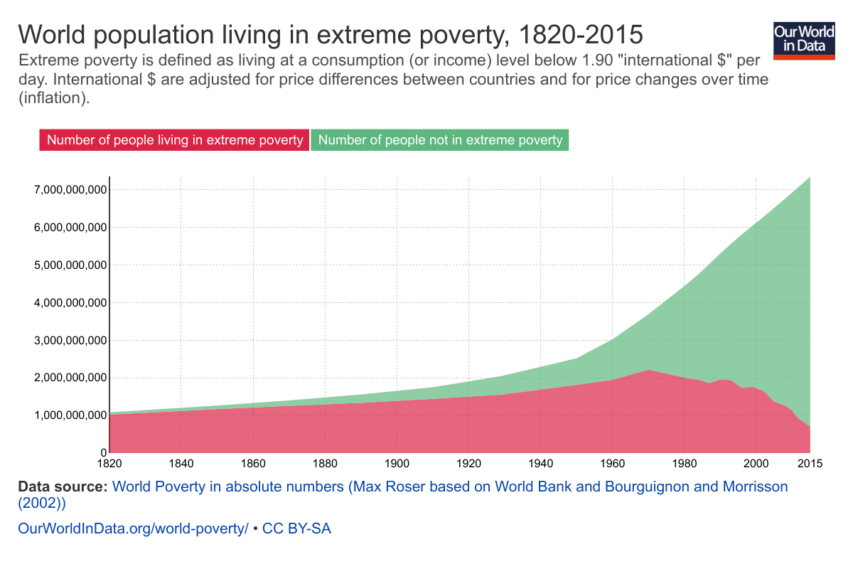
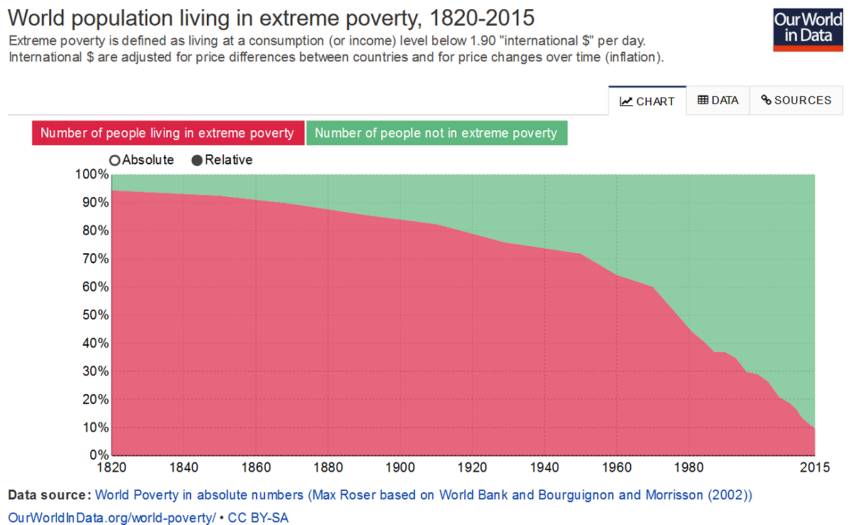
Here’s some fantastic news you’re not seeing in the headlines
The same world poverty data, presented as absolute or relative levels of poverty:
H/T to Rob Fisher at Samizdata for the link.
Comments Off on Here’s some fantastic news you’re not seeing in the headlines
QotD: Thinking at the margin
Thinking at the margin is much more crucial than it seems to non-economists when it is first explained to them. Only by thinking at the margin can we correctly understand, for example, why the wages of life-saving first-responders are lower than are the wages of NFL players and of Hollywood starlets and why this fact is a good thing for society. Only by thinking at the margin can we understand the error of those who assert that firms that have lots of money stashed away in reserve, or that are currently earning higher-than-normal profits, will respond to a hike in minimum wages simply by raising the pay of all of their affected workers. And only by thinking at the margin can we come close to fully understanding why there is no objectively correct minimum standard of drug safety, workplace safety, food safety, or of any other kind of safety.
Don Boudreaux, “Quotation of the Day…”, Café Hayek, 2016-08-30.
Comments Off on QotD: Thinking at the margin
September 20, 2016
QotD: Municipal parking regulations hurt the poor
Another land-use regulation that makes space more expensive is municipal requirements that establish a minimum number of parking spaces per housing unit.
According Donald Shoup’s analysis, parking requirements add significantly to the cost of housing, particularly in areas with high land values. For example, in Los Angeles, parking requirements can add $104,000 to the cost of each apartment. Parking requirements limit consumers’ choices and increase the cost of housing even for those who prefer not to pay for parking.
Developers typically build only the minimum amount of parking required by law, which indicates that those requirements are binding. That is, in a less-regulated environment, developers would devote less land to parking and more land to living space. A greater supply of living space will, other things equal, lower the cost of housing.
Sandy Ikeda, “Shut Out: How Land-Use Regulations Hurt the Poor”, The Freeman, 2015-02-05.
Comments Off on QotD: Municipal parking regulations hurt the poor


